
Here is some advice for you if you decide to read Crooked House by Agatha Christie: If you think that you know who the guilty party is, but you’re uncomfortable with who you think the guilty party is, go with that feeling and your choice.
That won’t make sense until you read the book, so here is a little background on this one, which does not feature one of Christie’s famous detectives.
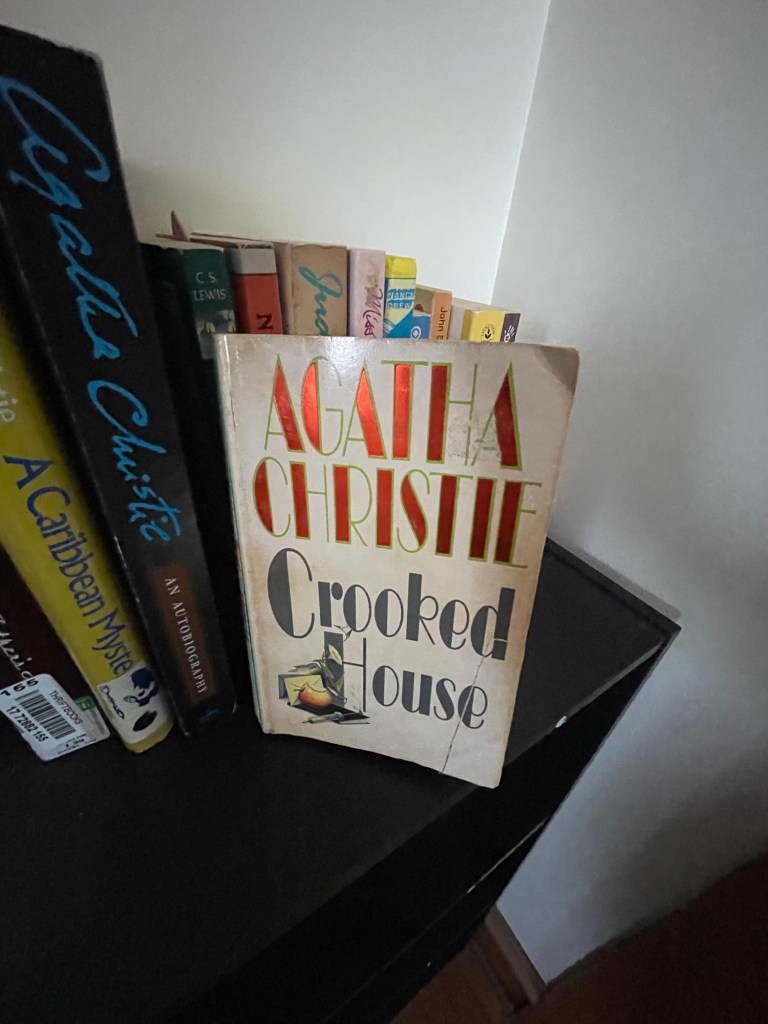
This book is a standalone novel that starts with the main character Charles Hayward planning to marry Sophia Leonides who he met in Egypt toward the end of the war. They hang out while in Eqypt and correspond some afterward, but drift apart until he returns to England two years later. It’s after his return that he reads in the paper that Sophia’s grandfather has died. He knows it is her grandfather because she once told him all about her family.
“’We live in a crooked little house . . .’”
“I must have looked startled, for she seemed amused, and explained by elaborating the quotation. ‘And they all lived together in a little crooked house,’ That’s us. Not really such a little house either. But definitely crooked — running to gables and halftimbering!”
In this case the crooked little house quote is a play on the nursery rhyme “There Was a Crooked Little Man,” but I am not familiar with that nursery rhyme.
Due to the blitz, Sophia’s extended family was all living in the house with the patriarch, Aristide Leonides, a short Greek man who commanded a lot of presence. Her family includes her younger brother and sister, her parents, her uncle and an aunt by marriage, her grandfather, a great aunt, and a step-grandmother.”
Charles reaches out to her by telegram, and she asks to meet that night at a local restaurant. The connection they had two years ago is still strong, and he still wants to marry her, but she says she can’t marry him now, and maybe never. She believes her grandfather has been murdered, and she doesn’t want to ruin Charles’ reputation as a member of the Diplomatic Service because she feels certain the murder was committed by someone in her family.
The main suspect is her step-grandmother, Brenda, with the tutor for Sophia’s siblings a close second because the family believes the two were having an affair.
In the first part of the book, we get to know the entire family, and it isn’t very pretty. Many of them are selfish and bitter people looking out for themselves, and the ones who don’t seem that way may be putting on an act. Maybe even Sophia is putting on an act. Figuring out who committed the crime will baffle Charles and Scotland Yard, and when you get to the ending — oof. It’s definitely a plot twist, one I saw coming, but still had to find out how and why.
I would definitely recommend this one if you’ve never read Agatha before or even if you have. I think it’s one of her best, and I read today that she called it one of her favorites to write. It is definitely a book that will stick with you over the years, making you think (and shudder a bit) long after you’ve put it down.
Some quotes from it I enjoyed:
“Curious thing, rooms. Tell you quite a lot about the people who live in them.”
***
“I think people more often kill those they love than those they hate. Possibly because only the people you love can really make life unendurable to you.”
***
“I’ve never met a murderer who wasn’t vain… It’s their vanity that leads to their undoing, nine times out of ten. They may be frightened of being caught, but they can’t help strutting and boasting and usually they’re sure they’ve been far too clever to be caught.”
***
“Murder, you see, is an amateur crime… One feels, very often, as though these nice ordinary chaps, had been overtaken, as it were, by murder, almost accidentally. They’ve been in a tight place, or they’ve wanted something very badly, money or a woman – and they’ve killed to get it. The brake that operates with most of us doesn’t operate with them… They continue to be aware that murder is wrong, but they do not feel it. I don’t think, in my experience, that any murderer has really felt remorse… Murderers are set apart, they are ‘different’ – murder is wrong – but not for them – for them it is necessary – the victim has ‘asked for it,’ it was ‘the only way.”
Discover more from Boondock Ramblings
Subscribe to get the latest posts sent to your email.
