Let’s focus on living instead of dying

People are depressed. I mean it, people. People all around me are depressed.

I can’t turn around without someone standing there or writing somewhere that they are in mourning. The people who are having family members dying, or announcing cancer or abuse is all around me these days. I don’t get why it seems to be happening more and more but it’s probably because I’m getting older. Maybe I was in a fog as a kid and don’t remember all the death and tragedy as much?

I don’t know.

Or maybe people simply tend to share more sadness than happiness and that’s why we are all in the gutter of attitudes some days. We need to share sadness and sadness will happen, it can’t be helped, so don’t get me wrong here.

My brother has been going on for a couple of weeks about he and his wife’s plan for deleting their social media. It’s a good thing but you would think it’s a religious experience for them with all the philosophical statements my brother makes. Or maybe he’s just dramatic (thank God I never am. Ha. Ha.)

My brother has been answering some who ask about his reason for kicking the big “fbook” to the curb, by saying he wants to “make the best of his remaining years.”

He turns 50 in June and in his world 50 is the new 80. But it seems to be where we all are these days (including me) – this impending sense of doom and negativity. We remind ourselves so often that “life is short” and “you never know WHEN YOU WILL DIE!!” in warnings that are supposed to be encouraging that we have forgotten to remind each other to simply live.

I get it. We only get one trip around the sun.

We all die.

Life is short.

That message has been drilled into my head a lot over the years and just in case I didn’t get it I lost three relatives in nine months and a handful of community members passed away as well.

Death is coming.

It’s around the bend.

The grim reaper stands at our door.

But not yet.

Being realistic about death is fine.

Being honest about it is important.

Grieving is important and talking about our grief is very important (so this is not meant as a scolding to those who are grieving), but for all that is good and holy stop reminding everyone they are on the path to death, finding ways to weave it into conversations.

About two years ago death loomed over me like a dark cloud. Test results and severe hypochondria coupled with a mental breakdown had made me decide I had blood cancer and there was no hope. Every day I thought of death and how it was coming and eventually I stopped living. My dog of 14-years died, my aunt’s health was not good, and my husband’s uncle passed away.

One day I was out in our yard trying to make a garden, though I didn’t know why because I was sure I wouldn’t be around the enjoy it. Suddenly I heard a voice within me say “Stop focusing on death and start focusing on living.”

The voice of God? I don’t know but I know I hadn’t been thinking any positive thoughts on my own for about three months at that point.

We can’t really live if all we do is think about how we are dying.

We need to remind people they are on the path of life and life is good much of the time. Maybe telling ourselves we are simply walking toward a new life in the after life is a better idea.

Soon spring will be here and flowers will bloom and birds will chirp and the sky will blue again.

Why don’t we all look toward that new life instead of the grave?

“That’s not my crown! It’s Jesus’ crown!”

I had ordered a crown of thorns last year as a prop for a stock photography session for Lightstock and it has sat on the top shelf of our bookshelf for a year, occasionally being moved for dusting or straightening of books.

A couple times since the purchase I have heard my husband say “ow!” And when we ask what happened he’ll say “I just pricked my finger on Jesus’ crown!”

A month or so ago my son pretended to put it on his sister. The mock crown is made of real thorns. They hurt.

“Knock it off!” She yelled. “That’s not my crown! It’s Jesus’ crown!”

I knew there was a sermon, so to speak, in there somewhere but my brain is mush most days and this was one of those days so I just filed it away to think about another time.

DSC_3596

I took the crown down again a couple of days ago to photograph for stock photography again this year. The sunlight was pouring through our kitchen window perfectly and it was the first time I’d been inspired to shoot something in almost two months.

I laid the crown on my new Bible and in the center I placed a communion cup filled with grape juice and then two pieces of broken bread (incidentally, I accidentally purchased 1,000 sealed plastic communion cups. I have 999 left. Let me know if your church needs some.).

“That’s not my crown! It’s Jesus’ crown!”

Ouch.

If we as Christians truly believe Jesus lived and died and now lives again, then we must believe the full story and that is that the crown of thorns, of pain, of humiliation, was placed on his head and not ours.

And if he took our pain then he also took our sins, past, present and future. And if he took our sins onto himself then he also took our doubts, our loneliness, our health worries, our physical and emotional shortcomings, our failures and all of our questions.

He wore the crown.

He took the nails.

He carried the cross.

He entered hell so we didn’t have to.

The question is, do we really believe that?

And if we really believe that then why don’t we live like we do?

DSC_3618DSC_3683

Wasting too much time talking about Facebook and what’s on Facebook and what we saw on Facebook and oh my gosh blah, blah, blah Facebook

I can’t be the only one who is completely sick of talking about Facebook, thinking about what I read on Facebook, or wishing there was an IQ test before people are allowed to post on Facebook.

So yeah, here I am writing about Facebook again, but maybe that’s because I’m logging off Facebook for Lent. No, I don’t usually celebrate “Lent” in the strict sense of the word, but this year I am trying to focus more on relaxing, my relationship with God and simply detoxing my brain. And to do that I have deactivated my Facebook account for an entire – gulp – 40 days. (I do, however, have a business page that is being maintained by a “ghost account” simply for blog posts. I won’t really be checking it because not too many people see the page,  however, and I have no “friends” on the ghost account.)

Incidentally, the phrase “detoxing my brain” makes me think of sliding a toilet brush in and out of my ears and after reading the cesspool that is the current state of national news, I think that might be a good analogy. I’ve really been trying to avoid the news as I begin to detox, I really have, but almost every day I find myself peeking through my fingers, hoping something positive has happened, only to see it’s only gotten worse every, single day. It’s completely insane how crazy the national media is and I no longer know what is true or who to believe so I decided not to believe any of them. Part of my detox, therefore, will also be trying not to look at any news sites, which I have actually blocked on my phone.

Note I say “national media. My husband is a member of the small town news media, and I used to be, and that is a whole other “kettle of fish”, so to speak. Smalltown news is pretty tame and less prone to sensationalism, though some people are convinced that the behavior of the national media is trickling down to the local newspapers. They look for conspiracies even in the coverage of the school board meetings, as if any of the small town reporters have enough time or gumption to concoct stories slanted one way or another. Most small town reporters want to get in and get out of their meetings and go home on their meager salaries and eat some beans out of a can while binge-watching Netflix, since they can’t afford cable on their salary.

But I have digressed – as I so often do.

My brother and his wife have decided to completely delete their Facebook accounts after Lent, if not before. Adapting to a world without Facebook will be a challenge, but it’s needed, my brother, who will turn 50 in a few more months, says. Turning 50 has apparently caused him to reexamine his life and I’d rather he give up Facebook than dump his wife for a younger woman and buy a Harley during this phase. I’ll miss tagging him in all those memes about being the favorite child, but texting him to say so will do just as well.

I am torn between wanting to completely delete my account and keeping it to stay in contact with some friends and family, but honestly, most of those friends and family don’t actually speak to me, even on Facebook. Most likely I’ll decide to say good-bye to Facebook by the end of Lent. I highly doubt I will be missing much when I do and I might even have more time for other activities like I did when I took a break from the social media giant in December. The best thing about shutting my account down? Never writing another bloody blog post about Facebook and hopefully never talking about it again either.

Planning to take a Facebook break yourself? Here is a link to some tips I learned during my last Facebook break.

Four is the new terrible twos

“I’M NOT DOING ANY MORE SCHOOL WORK UNTIL MY BROTHER SITS NEXT TO ME AT THE TABLE!!”

Her little voice pierced my eardrums and grated on my nerves like fingernails on a chalkboard.

Papers, pencils, and crayons scattered across the floor with a swift move of her fierce little hand. Next, she took aim at the battery for my camera and the charger it was connected to sent that to the floor with a bang.

DSC_3479For the last week, I had been laying my hand against her forehead to see if she was coming down with something, anything, looking for any reason for her Horrid Henry-like behavior. Since no fever was detected next on the list was to call the local Catholic Church to see if they still perform exorcisms in between press conferences to defend their innocence in abuse cases.

She was sitting with her head down on the table, her little feet dangling off the bench, kicking them back and forth as she revved up for her tantrum.

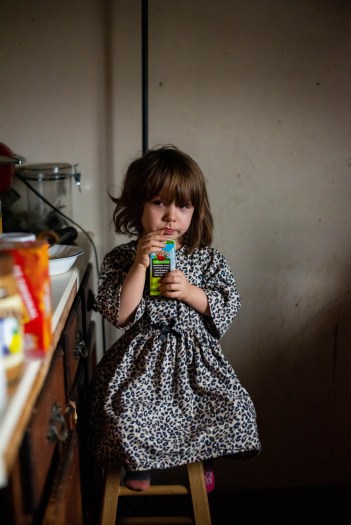
She was wearing the same outfit she’d had on for three days – a long sleeved dress and long pants with a brown leopard pattern. On Saturday she’d fallen asleep before I could negotiate a peaceful ending to the outfit change. On Sunday I knew we’d never make it to church if we stopped to let her pick the ten outfits she normally does before she gets dressed.  I promised myself I’d begin a peaceful settlement when we returned. Negotiations failed and I somehow let it go an extra day. So there she sat, her clothes probably caked to her now, while she started her new tactic of whining instead of verbalizing.

“Your brother is in the bathroom, I can’t make him sit next to you,” I told her, throwing up my hands in exasperation.

“I won’t do work ever, ever again if he doesn’t sit with me!”

I ignored her and went to the kitchen to start cleaning the pan for lunch.

Her brother came down and I asked him to sit with her but now she had worked herself up to a wail, the same wail she’d been sounding for almost a week now – anytime she didn’t get what she wanted, when she wanted, even though half the time she never said what she wanted, but simply cried and whined and kicked her feet.

I burned my hand in the hot water trying to clean out the cast iron pan to make lunch. It made me even grumpier.

“I DON’T KNOW WHAT YOU WANT!” my screams were now matching her own and for good measure, I tossed a fork, which bounced off the counter and shattered the McDonald’s collection Garfield class I’d bought for my husband to replace the one he’d had as a child.

Now I was mad at her and myself. It was a standoff of uncontrolled emotions and suddenly I realized I had dropped my emotional maturity to the level of a 4-year old. A 4-year old who was still trying to figure out how to navigate her emotions, while I was 41 and supposed to already have it all figured out. I shouldn’t have a fuse as short as a preschooler and I knew it.

DSC_3490

“Let me hold you,” I told her finally, no longer caring what her original breakdown had been about. She climbed into my lap and leaned into me her little body warm and heavy against me. Tears were still rolling down her cheeks as I rubbed her back and absentmindedly patted her bottom as  I rocked her.

It grew quiet and she sniffed.

“Mama?”

“Yes, sweetie?”

“Are you patting my butt?”

“Hmm….um..yeah, I guess I was. I thought it was your lower back.”

She pulled away and looked sideways at me.

“Okay. That was disturbing.”

She climbed off my lap with her finger in her nose and shook her head.

She’s been skipping naps of late so when she passed out against my chest early in the afternoon, an hour or so after this. I texted my husband and said, with much relief, though a bit of regret, “she’s asleep and I have to pee.”

I held that pee in until my bladder almost burst because I had a plan to enjoy the last chapter of my book in blissful silence.  That hour free of preschool manipulation was certainly welcome.

And then my preteen began to extol the virtues of his latest video game discovery and the silence was broken, but, hey, that’s life.


Can you give me a sign, Lord?

Reading the Bible as a reference for a story I’m working on, (Plus I should be reading it more anyhow) I noticed there are a couple of different times it is noted, at least in the NIV version, that Jesus “sighed deeply.” I’m not sure if this translation from Hebrew and Greek is correct or not, but it cracks me up. I can actually see Jesus rolling his eyes in his particular part from Mark.

“The Pharisees came and began to question Jesus. To test him, they asked him for a sign from heaven. 12 He sighed deeply and said, “Why does this generation ask for a sign? Truly I tell you, no sign will be given to it.” 13 Then he left them, got back into the boat and crossed to the other side.” (Mark 8:11)

In my head, this is how it went down: “Seriously? A sign? Why do you people always want a sign?”

Mocking tone: “‘Give me a sign and then I’ll do it.’ It’s like you just want to procrastinate in doing what you know my Father is asking you do to. Just believe it or don’t. Don’t wait for fire from heaven. If it is God’s will you’ll begin to see your path clear, if it isn’t, the path will be closed. I really don’t have time for this. I have others who listen and don’t ask me for signs. Disciples, let’s blow this village.”

And then he pivoted on his feet and walked away.

So anyhow, I have these decisions to make in my life and I need a sign. You think God will give me one?


When we rode in the back of the station wagon with no seatbelts and spun ourselves off the merry-go-round

“Mom wants to know if you wanna go to my birthday party.”

The inside of Jake’s father’s store was full of candy, soda, and junk food. Jake was standing behind the counter with a handful of candy, wearing a white t-shirt and his jeans sliding down off his butt. He smelled like boy sweat and his face was smeared with dirt.

He shrugged.

“Yeah. Okay.”

He snatched a pack of Big League Chew Bubble Gum off the shelf and started shoveling gummy worms into a plastic bag.

“Dad. Can I go?”

His dad grunted, never looking up from the register.

“Cool. See ya’ later.”

We ran out the front door of the store and climbed through the back hatch of the station wagon. Jake had a wad of gum the size of a softball stuffed in his cheek before we even pulled away from the curb.

There weren’t any seatbelts in the back and we bounced around like empty soda cans as the car turned each corner, mouths full of gummy worms.

My other friends were shoved in the rest of the seats. Jake was the only boy.

It was my 10th birthday.

Mom was taking us to Pudgies Pizza for an impromptu party.

Our faces were smeared with pizza sauce when we piled onto the playground and climbed on merry-go-rounds without safety bars and swings made of hard seats. We swung high and metal brackets squeaked and the set shook like it might fall down around us. When our bellies were up in our throats we let go and landed on feet, on knees, on rears. We laughed and got back up again.

The metal slide tore at our skin on the way down and our legs were pink from the friction.

We spun ourselves wild on the merry-go-round until we almost threw up and the world blurred into a million colors. Jake flew off and fell on his back into a mud puddle. He stood up and grinned, his cheek full of bubble gum.

The backside of his pants were a muddy mess. Mom laid a blanket in the back of the station wagon for him to sit on.

Back at the store he jumped out, yanked his jeans up around his waist, held them in place with one hand.

“See ya’ later,” he said. He shoved a gummy worm his mouth. His hands were still covered in mud. His hair was matted to his forehead with sweat.

He ran up the stairs. The door slammed closed hard behind him.

I climbed back into the cargo area of the station wagon and pulled the tailgate closed.

This was life in the ’80s.


The remarkable life of Charles Reynolds: pastor, missionary, troublemaker, stubborn Irishman, thorn in the side, devoted friend

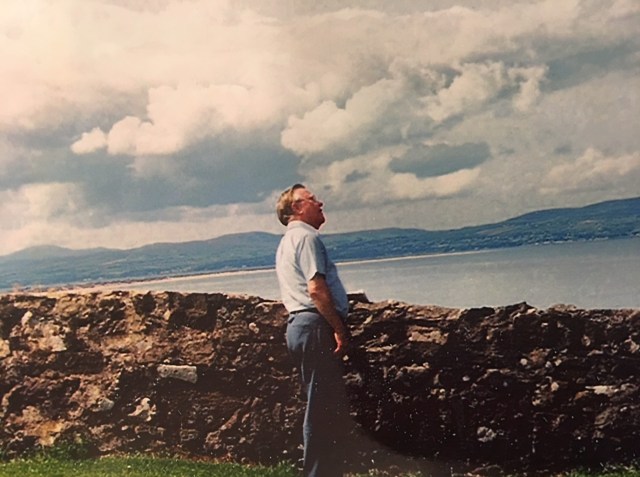
I pulled into the driveway of a little house that looked as if it had been lifted out of Northern Ireland and dropped, unscathed, into the hills of Pennsylvania. The ceilings were low, the windows were small and cute and the stone fireplace had been built by hand.

On one side of the house was a cow pasture and on the other a tiny, century-old cemetery with a sign on the metal gate that read “Enter At Your Own Risk.”

I blew my nose as I parked and began to rehearse what I would say to the elderly Irishman inside, determined to not let him talk me into staying for tea. I did not want tea. I wanted to go home, lay down and fall asleep after a long day of work at the local weekly newspaper and catching a cold that had only gotten worse as the day went on.

I would simply tell Rev. Charles Reynolds, the aforementioned Irishman, that I was too ill to come in, but would stop again another day when I was feeling better.

The door swung open and a man with blond-white hair, glasses slipping down his nose, stood there in a button up dress shirt and a pair of dress pants, his traditional garb for as long as I had known him; as if he had just returned from church.

“Hello, Rev. Reynolds, I’m sorry I can’t stay long, but I seem to have a cold and I don’t want to get you and Maud sick,” I steeled my resolve to not be swayed by his Celtic charm.

“Come, come. Have a cup of tea,” his Irish brogue was thick. “Maude, put the kettle on. We’ll have some tea and Lisa will feel better.”

“But I -”

“Come. Come.”

He was already walking away from me, gesturing for me to close the door.

Maude, his gray-haired wife, had dutifully shuffled into the kitchen, off to the left of the front door, and placed the kettle on the stove.

“Yes, Paddy.” She nodded curtly at her husband, like a soldier to a superior.

Her tone hovered somewhere between affection and sarcasm.

I sat at the kitchen table and waited for the whistle of the kettle as cookies, crackers, plates, tea cups, a bowl of sugar cubes and cream was placed on the table before me. water was poured into a teapot filled with loose tea and steam rose as it was poured into my cup and bits of the leaves settled at the bottom.

Rev. Reynolds leaned over the table and added a cube of sugar to my cup. Two, round white horse pills pills showed up next.

“There now. That will be just what you need. Tea and vitamin c.”

Rev. Reynolds’ had a doctorate but sometimes he seemed to forget it was in theology.

The dainty tea cup covered in blue patterns was warm in my hand and clinked against the plate when I set it down. Being served tea this way was a far cry from tea at my house, served in a mug with a tea bag after pulling it from the microwave.

“So, have you talked to Ian lately?”

I marveled at how Rev. Reynolds had the worst timing and the least tact of almost anyone I knew, other than my former editor.

I had no interest in talking about my former editor. My departure from the daily newspaper I had once worked at hadn’t been pleasant.

But if it hadn’t been for that job, my first in newspapers, I wouldn’t have met Rev. Reynolds.

********

“Hey, Lisa – this is Rev. Reynolds.”

Ian was the editor of the local daily I had started working at while still in college. He had a slight nasal tone when he spoke, like he had a permanent stuffed nose.

“He’s from Northern Ireland and would be a great source for a story about all the drama going on over there. We can localize an AP story. Interview him and give me 15 inches for the front page tomorrow.”

Localizing, or “adding local color” to a national or international story, was a favorite pass time of Ian, or as Rev. Reynolds would often call him “eeeeeahn”. The concept of localizing involved using an interview or information from a local resident and adding it to a story we had pulled off the Associated Press wire. Ian wanted me to add Rev. Reynolds’ comments to a story about the possible peace deal being negotiated between the Irish Republican Army and the United Kingdom.

“Oh, you’re Irish! Do you speak Gaelic?”

The elderly man with a slightly bulbous nose and holding a stack of papers, looked indignant.

“Noooo!” he cried in a drawn-out Irish accent. “That is the language of the rebels!”

I had no idea who “the rebels” were. Had we just switched to talking Star Wars? I didn’t know, but for the basis of needing to write a story for the next day’s paper, I needed to know.

Even after we talked I was a bewildered by it all. to this day I remain bewildered. It wasn’t until later I started to connect that rebels appeared to be synonymous with “Catholics.” In the world of Rev. Reynolds. As a Protestant, Rev. Reynolds had been raised in a family who supported Northern Ireland remaining within the United Kingdom. Most of those who supported the province remaining within Great Britain were protestant and those who wanted to break off and be part of the Republic of Ireland were Catholics. That’s about all I can explain because even after he explained it to me, wrote a book about it and told me to read it, and I looked it up online, I still can’t wrap my head around why there is an Ireland and a Northern Ireland.

In some sort of ironic twist straight out of a Hollywood script, Rev. Reynolds ended up in the hospital at one point after our friendship grew and his roommate was a local priest, who was well known to my husband and I. Not only did a friendship develop between the two but through him Rev. Reynolds developed a friendship with an Indian priest who was serving as an assistant priest at our local Catholic Church. I remember Rev. Reynolds inviting my family, including my parents, and the local priests to dinner at a local restaurant where he spoke about his life coming full circle – from a distrust of Catholics at a young age to an affection for members of the church he had come to call friends.

From that day at the paper, I became the contact for Rev. Reynolds for his various projects. And he always had a project underway. A fundraiser for an Indian village damaged by a tsunami; a new book he was writing and wanted publicity on; a need to bring awareness to the need for more women in the medical field in India. They were all worthy causes but sometimes it was hard to keep up with his ever-growing list of charitable pursuits.

********

IMG_2022“Tea has healing properties,” Rev. Reynolds slipped another cube of sugar into my tea.

The tea came from a 50-year old stash in the shed across the dirt road that they’d brought back from India during their time as missionaries. Rev. Reynolds pulled back a tarp one time to show me the small, square white and green boxes stacked high, each full of traditional, loose leaf Indian tea. They’d had it shipped to them from India and knowing Rev. Reynolds he’d found a way to get it there at little to no cost to him. Rev. Reynolds had a way of convincing people they wanted to help him.

I began to realize my headache and body chills were fading. Maybe Rev. Reynolds was right about the healing properties of tea after all.

It was often hard for me to imagine this man, sitting across from me at the table, now in his mid-70s, as a young man living in Northern Ireland. During World War II he joined the Royal Air Force and was stationed in India, where he fell in love with the Indian people, but also with a young woman from a little farming village in Pennsylvania who was in the country as a missionary. After the war he and Maud became missionaries to the country for 20 years. Maud had been an only child who had grown up on a farm and had been taught how to do anything a man could do – including fixing cars and hiking through some of the most remote areas of the world.

Over the years they met many famous people, including Mother Theresa, the Dalai Lama and several American and British political leaders. Rev. Reynolds also once lead the leader of Northern Ireland around the United States in a public relations campaign in support for Great Britain continuing it’s rule over Northern Ireland. In 1995 he was also appointed as an OBE (Order of the British Empire) by Queen Elizabeth II.

But to me he was simply the man who called me to help him send an email, figure out why his computer wasn’t working, write a news story, or eat a traditional Irish meal of boiled ham, potatoes, carrots, turnips and cabbage with him and his wife, or sometimes some new person he had taken under his wing. In truth, we were almost family, since Maud was related to my grandfather’s family, but we were also family because we somehow adopted each other.

*****

The day before our wedding my strong-willed great aunt and the maybe slightly more strong-willed Rev. Reynolds battled over where the main flower arrangement would be placed for the ceremony.

“The arrangement will go on the altar because it deserves to be the center of the ceremony,” Aunt Peggy said in her thick Southern accent.

She had designed all the flower arrangements, full of gorgeous purple lilies. She transported them to Pennsylvania from Cary, North Carolina, stopping several times along the way to spritz them with water and make sure they stayed cool. Once she arrived at the century old house I had grown up in, she rushed them into the cool stone basement.

On rehearsal day she  placed a large, expansive arrangement on the altar between the unity candles and stepped back to inspect her handiwork.

We all stepped back.

We all admired its beauty.

All except Rev. Reynolds.

Rev. Reynolds picked it up and moved it to a stand that was sitting off to one side of the altar.

“It can not be on the altar. The altar is for the candles and the holy book.”

“It will be fine in the center of the table.”

“Noooo….you can no’ place it there.”

The more agitated they became, the thicker their respective accents became.

The exchange went on for several moments longer with the flowers being moved back and forth as each person explained their position.

It was like a scene from a sitcom.

The rest of us wished we had a bowl of popcorn for the show.

I thought my aunt’s eyebrow, which arched when she was indignant, was going to fly right off her face. Her lips, pursed tight to keep herself from saying something “unpleasant”, were now a thin red line.

Rev. Reynold’s ears and nose were glowing red.

Eventually, a compromise was reached and the arrangement was placed to one side of the altar, still in an appropriately visible location, but not in a place that would detract from “the holiness of the altar.”

Rev. Reynolds could be bull-headed, sometimes even rude, but those moments were overshadowed by a deep desire to serve, to be the hands and feet of God. No matter where he was, from the green hills of Northern Ireland to the remote forests of India, to the tiny Pennsylvania farming community, he never shied away from sharing the gospel. In the last book he wrote, “He Leadeth Me,” he wrote about meeting with the Dalai Lama with a contingent of missionaries and leaders from the United Methodist Church. They hoped to help the exiled Tibetan leader and his people, who had been pushed from their country.

The Dalai Lama turned abruptly to Rev. Reynolds during one conversation and asked, in English, “Why do you help my people? We are not of your faith or your culture, yet you help us.”

Rev. Reynolds said he wasn’t sure how to respond at first, surprised by the question, but believes the Holy Spirit directed his words when eventually relayed Luke 10:33.

“I repeated the simple story of the Good Samaritan and the teaching of our Lord Jesus that we are to love our neighbor, even though that person was not of our faith, our race or our culture. Anyone in need of help and who could not help himself was to be touched by the grace and love of our Lord. This discussion continued on into our knowledge and kinship with God.”

I have many regrets in my life and one of them is driving by the hospital that day, ignoring Mom’s warning that it might be my last chance to say my goodbyes. I was in denial that death could ever come for someone so full of life. A few days later I stood in the back of the church the day of the funeral and held my crying baby, mourning loss and celebrating new life simultaneously.

There are many times since I have felt the void of the insistent Irishman who often drove me to my wits end, blessed me with his kindness, and demonstrated to me what it means to truly live in the footsteps of Christ.

*******

“I believe God made us all as individuals, each with their own life’s work, calling and talents. We should therefore find a place of service in this gigantic jigsaw puzzle that we see as the world, and as having found it, we should serve to the best of our ability. Shakespeare understood this when he had Polonius say ‘This above all to thine own self be true.; However, we know that Polonius was not true to that affirmation, so Shakespeare added a contra when he wrote, ‘All the world’s a stage, and all the men and women merely players.’ True, many people wear masks and act a role, but nobility of spirit requires identifiable personal characteristics.”

~ Rev. Charles Reynolds
IMG_2017

Photography Tuesday: The dirty, no good, rotten truth about selling stock photography

Stock photography isn’t what it used to be. Gone are the cheesy cutouts and posed images. Those who purchase stock photography now want authentic, real-life images for their advertising – at least to make it look like they are authentic, real-life companies, selling authentic, real-life products.

I delved into the world of stock photography a couple of years ago, even purchasing a fancy Nikon d750 to help reduce the grain in my images so there would be more chance they would be accepted by the stock agencies. I knew from research I wouldn’t make a ton of money submitting my images to agencies that then sell them to advertisers, bloggers, or other content managers, but I hoped to make a little extra to add to our household needs.

Building up a portfolio for stock photography can take a very long time. I knew this, but this past year I’ve been more than a little discouraged with the industry and have learned stock may be a way to earn a small side income, but not necessarily a career. Unless you already have the cash to travel the world or are single with no children, stock photography is an extremely difficult “job” to make money at.

Still, I plug away at it, submitting photos here and there because it’s not like they’re going to make any money sitting on my hard drive or even hanging on my walls. And even if the money isn’t a lot, it’s something and every little bit counts in this day and age. Last year I was featured on Alamy.com as a featured artist and hoped that would boost my sales. It didn’t, but the honor was a nice one to have, at least.

If you are a photographer who is considering stock photography, some advice I would give is to not expect to make a great deal of money, even if you are accepted by a “high end” stock agency like I was. At least not at first. When I first signed up with one high-end agency, I was promised a starting price of $150 for each image sold, if not higher, but once I was accepted and began submitting images, that amount suddenly decreased until one of my last sales with them was 83 cents for one image. On the other end of the spectrum I also sold one for $120, so, in other words, I’ve discovered the amount you could make with stock varies greatly.

With many agencies you need at least 500 images to start making sales and usually having more than 1,000 is even better. Most agencies allow you to submit whatever images you want but then they must pass “quality control” to be added to your final portfolio. The standards of some agencies are higher than others. For example, Alamy allows almost anything to be submitted as long as it isn’t graphic, nudes, out of focus, or severely grainy. Their collection is aimed at anyone and everyone, much like Shutterstock, which I believe is based in the US. For an agency like Cavan Images, your images will be accepted only if they fit their particular style, which is more artsy-fartsy, as I call it. They say their agency is for more high end clients but, again, this is the agency that once sold one of my photos for 83 cents and another for 67 cents so …. don’t always take an agency at their word.

To pass quality control for most agencies the images don’t have to be artistically amazing, but they should be bright and without grain or blur. Each stock agency has their own rules about what the photos need to pass quality control and you can usually find that listed on the site before you submit.

As for what sells in stock photography: the answer is almost anything, yet sometimes nothing. With some agencies, you can upload whatever you want because you never know what will sell. I’ve seen portfolios with photos of newspapers and trash cans and hands holding cellphones and for some reason those photos sell, mainly because some client, somewhere, needed the shot for some purpose. Some of the photos that have sold for me are not my favorites or technically perfect. Still, they brought me more income than they would have sitting in a hard drive, so I won’t complain. Right now the thrust of stock photography is “authentic imagery”, which can mean different things for different clients but normally means everyday people doing every day things.

The bottom line is that stock photography is not, for most people, a way to get rich fast, but if you keep plugging away and submitting images, you can at least earn a bit of a side income.

You can see some of my stock photography work at the links below:

Alamy

Cavan

Lightstock

Here is one of my top sellers on Lightstock, a Christian stock agency:

000000_DSC_4669-Edit

It’s been downloaded 64 times so far and you might think that means I made a lot of money from it’s sale, but sadly the total is about $240 in five years. Lightstock is not one of the agencies that compensates photographers at a  high rate, but I support them for their message, more than their revenue capabilities.

To see more of my photography you can visit my photography site here or see my work on my Instagram account.