Welcome to the A Good Book & A Cup of Tea (A Monthly Bookish Link Party)!! This link-up is for book and reading posts or anything related to books and reading (even movies based on books!).
1. For Bloggers, you can link unlimited posts related to books and reading. They can be older posts or newer posts. These can be posts about what you’re reading, book reviews, books you’ve added to your shelf, reading habits, what you’ve been reading, about trips to the bookstore, etc. You get the drift.
2. Link to a specific blog post (URL of a specific post, not just your website). Feel free to link up any older posts that may need some love and attention, too.
3. Please visit at least two other bloggers on this list and comment on their posts. Have fun! Interact! Get some book recommendations.
4. Readers can click the blue button below to visit blog posts.
5. If you add a link you are giving me permission to share and link back to your post(s).
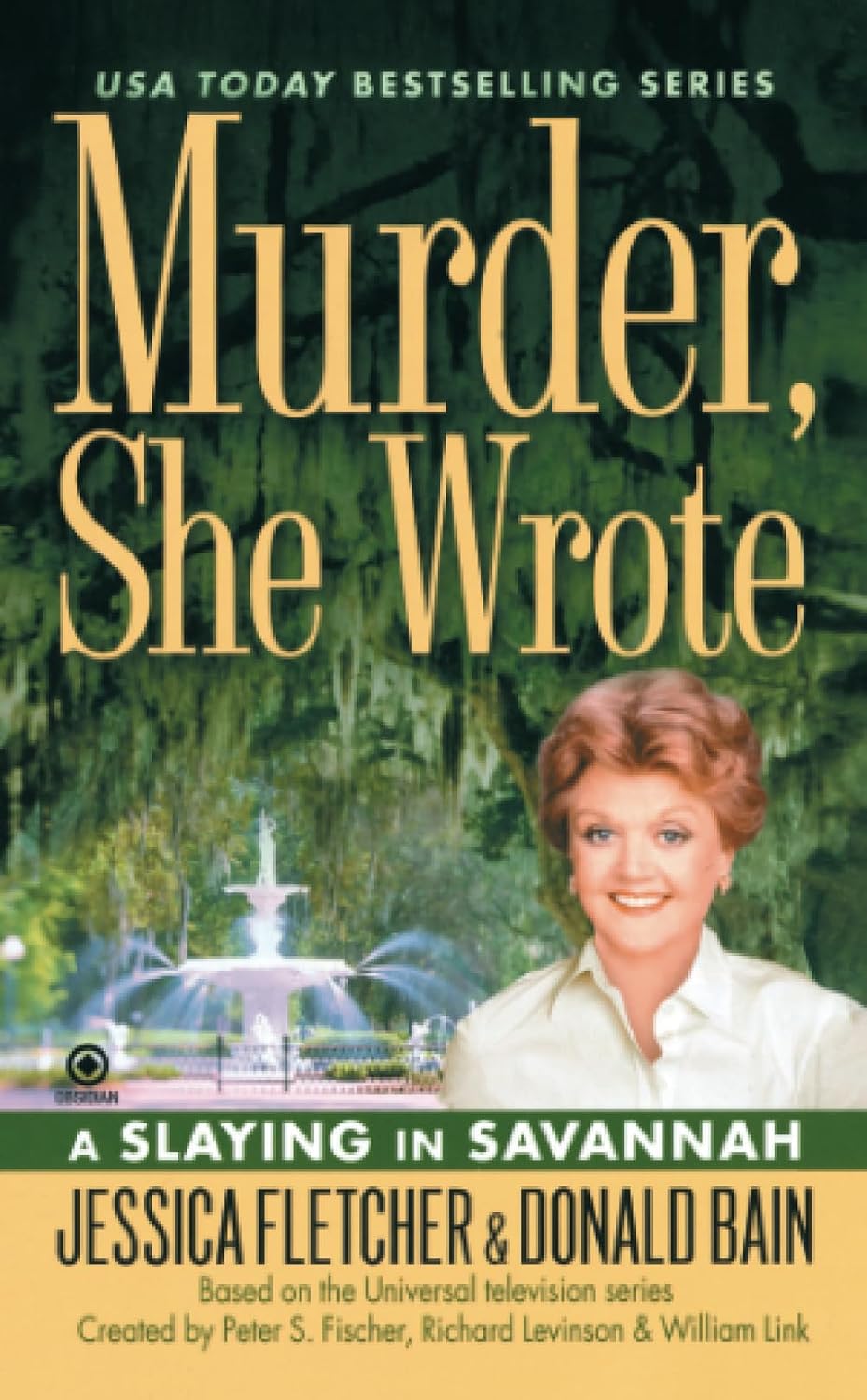
Here we are for yet another Murder, She Wrote installment written by Donald Bain.
This one was just as fun and engaging as previous ones I have read. Award winning? Nope but I don’t mind. It was still well-written and a good distraction from real life.
This is number 30th in the series. I have read about five of the books in the series, never in order and haven’t had an issue jumping right into the story. Each one is like a Murder, She Wrote episode.
In this one we are down south where Jessica has been asked to solve a 40-year old crime. What’s interesting isn’t that she’s been asked to solve such an old crime – it’s that she is asked to do so by a dead woman.
Tillie Mortelaine stipulated in her will that if Jessica wants $1 million for a literacy program the two women started, she will solve the murder of Tillie’s former finance Wanamaker Jones within a month.
Jessica takes the challenge on, despite the anger of family members of Tillie who believe the entire inheritance should come to them.
To make matters even more complicated, there was a ghost hunting couple and a manipulating conman living in Tillie’s mansion at the time of her very strange death. The woman was 91 but she fell down a large flight of stairs and Jessica isn’t sure that it was an accident. She soon wonders if she will have two murders to solve.
If you’re looking for a quick, intriguing read I would definitely recommend this one or any of the other Murder, She Wrote books I have read so far.
You can find links to reviews of some of them by searching in the side bar to the right.
_____
You can find my book reviews, movie reviews, and ramblings about the books I write on Instagram.
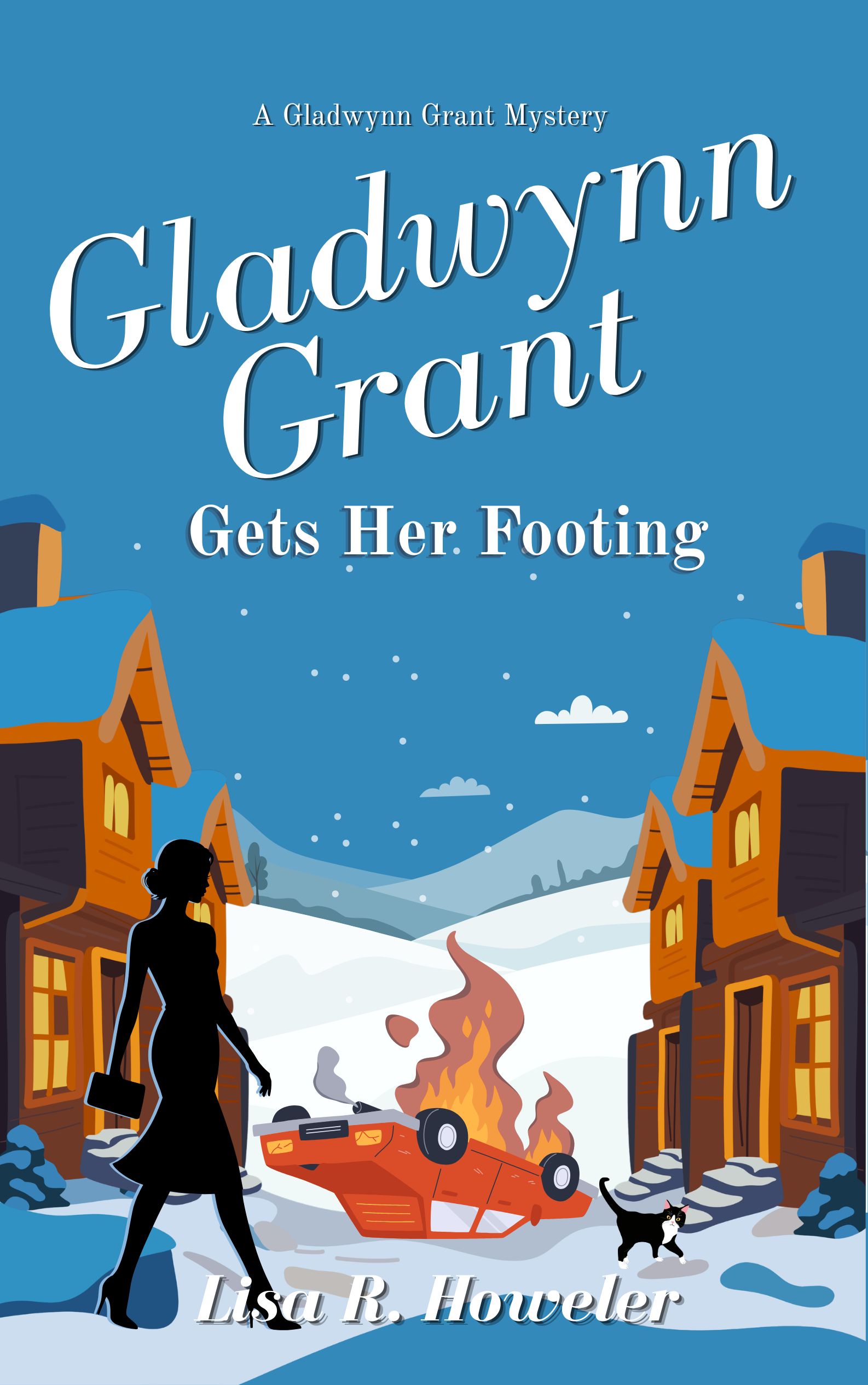
Hello! Welcome to my blog. I am a blogger, homeschool mom, and I write cozy mysteries.
You can find my Gladwynn Grant Mystery series HERE.
If you’re a regular around here, you’ll know that for the last couple of years I have been picking classic films starring one particular actor/actress to focus on for a season.
For example, I’ve had a Summer of Paul, Summer of Marilyn, Winter of Cagney, Spring of Cary, Spring of Bette, and Autumn of ….oh. I’ve never actually done an Autumn of…anyone. So this year I decided on an Autumn of Lemmon, which means I will be watching and writing about Jack Lemmon movies.
Actually, it turns out I’ve already watched more of Jack’s movies than I realized so this one should be easier than some of these features where I was rushing to watch movies and share about them in the same week.
I thought I would kick off this two-three month feature with an introduction post about the life and career of actor Jack Lemmon.
I’ll also let you know what movies I plan to watch at the end of the post so if you don’t want to read all about Jack, you can skip to the end.
Jack Lemmon was born in a way that would have fit in a movie —his mother gave birth to him in an elevator in Boston in 1925.
He was an only child who had some of his first acting experiences in prep schools. He learned to play piano at a young age, which would help sustain him in more ways than financially over the years
Some actors change their names when they go into the profession, but Jack kept his.
According to Britannica.com, Jack attended Harvard University and was the president of the Hasty Pudding Club, which was known for annual satiric revues.
He took a break from college to serve in the Navy during World War II and then graduated from Harvard in 1947. Broadway was calling so when he left he went to NYC and picked up some theaters jobs. In between he played piano accompaniment to silent films at the Old Knick Music Hall. He later said that watching Chaplin, Keaton, and Harold Lloyd taught him more about comic technique that acting school ever could have.
“I used to play at the Old Knick Music Hall on Second Avenue in New York, way back in the ’40s when I first started,” Lemmon said. “Some weeks, we didn’t get paid, because there wouldn’t be enough people in there to give us anything. Sometimes you’d get maybe five bucks. We’d split whatever was left on Saturday night. But you got a piece of chicken and French fries every night. You got a meal.”
Lemmon leaned into music in his later years when acting became stressful, his son Chris Lemmon remembered in an interview with NPR.
Jack Lemmon plays the piano at New York’s Old Knick Music Hall in 1947, his first job in the entertainment industry.
“Hollywood is an enormously invasive thing, especially when you reach a level of stardom that my father did,” Chris Lemmon said. “Hollywood owns you, basically — puts you in a headlock. And is a very jealous mistress when you reach that kind of stardom, especially back then. It’s a little less now. So [music] was his escape.”
He always downplayed his musical talents, though, saying it was merely another creative outlet.
Chris was Jack’s son from his first marriage, by the way. He was married to Chris’s mother, Cynthia Sone, from 1950 to 1956. He married Felicia Farr in 1966 and they remained married until his death in 2001.
In addition to working in theater and music, before going into movies, Jack also worked on radio and more than 140 live television shows.
Like other movie actors, he started in Broadway but his debut performance was not a success. Luckily, it still led him to a contract with Columbia Pictures in 1954.
His first two films — It Should Happen To You and Phffft! — came out that same year and both set him up opposite Judy Holliday, who was already well known for her Oscar performance in Born Yesterday. The tagline they used for It Should Happen to You:
“Introducing Jack Lemmon — a guy you’re gonna like.”
And many people did in that movie and many more over the years.
It didn’t take Jack long to be recognized for all his hard work. He won an Oscar in 1955 for Mr. Rogers for Best Supporting Actor, which surprises me a little because I’m not sure if that was a strong role for him. He was much better in Some Like It Hot (1959) (to me) and The Apartment (1960) which he received Oscar nominations for (both of them) but didn’t win.
He was nominated again for Days of Wine and Roses (1962). He won an Oscar for Best Actor in Save the Tiger in 1970.
All together Lemmon had 8 Oscar nominations.
The first Jack Lemmon film I ever saw, other than Grumpy Men when I was younger and actually just remembered as I was writing this, was— Some Like It Hot with Marilyn Monroe and Tony Curtis.
I watched it a couple of years ago and wrote about it here.
Lemmon was known to play socially awkward, self-depreciating, slightly clueless characters who often came to a wider understanding of their world by the end of the movie.
It wasn’t the only role he played, but it was the most popular for him. Most film fans agree that he could play serious characters as well as he could comedic roles.
He had a long-term acting partnership with Walter Matthau, with their most well-known partnership in The Odd Couple from 1968, which was based on the play by Neil Simon.
According to Britannica.com, “The film established the pattern for most of their appearances together, with a fussy neurotic (Lemmon) butting heads with a carefree scalawag (Matthau).”
Other Lemmon-Matthau films included The Front Page (1974), Buddy Buddy (1981), Grumpy Old Men (1993), Grumpier Old Men (1995), and The Odd Couple II (1998).
Matthau said that he was once injured on a set of one of their movies.
“Lemmon was white as a ghost. He ran down, and he took off his jacket, and he rolled his jacket up, and he put it under my head. And he said, “Are you comfortable?”… And I said, “I make a nice living.”
No wonder those two hit it off. Jack had his own knack at witty comments, but also thoughtful ones.
“I really can’t be funny unless it’s part of the character. It really bugs me when someone thinks of me as a comic. If I read ‘comedian Jack Lemmon,’ I gag. That means I’m not an actor – which I am.
It’s better to work with a Billy Wilder once or with a John Ford once than to work with four other directors who do not have that touch of genius.
Nobody deserves this much money – certainly not an actor.
“If I’d been bright, I’d have realized that I was horribly uncomfortable, amazingly frustrated, and like any sensible person, I’d have quit. But it never occurred to me that I wouldn’t be successful eventually.
And one of his most witty comments came when he died and had inscribed on his tombstone, “Jack Lemmon In:”
Now for the list of movies I’ll be watching and writing about:
Welcome to the A Good Book & A Cup of Tea (A Monthly Bookish Link Party)!! This link-up is for book and reading posts or anything related to books and reading (even movies based on books!).
You can link up with any of us!
Some guidelines.
1. For Bloggers, you can link unlimited posts related to books and reading. They can be older posts or newer posts. These can be posts about what you’re reading, book reviews, books you’ve added to your shelf, reading habits, what you’ve been reading, about trips to the bookstore, etc. You get the drift.
2. Link to a specific blog post (URL of a specific post, not just your website). Feel free to link up any older posts that may need some love and attention, too.
3. Please visit at least two other bloggers on this list and comment on their posts. Have fun! Interact! Get some book recommendations.
4. Readers can click the blue button below to visit blog posts.
5. If you add a link you are giving me permission to share and link back to your post(s).
I’m not sure why I got it in my head that I wanted to read John Steinbeck’s nonfiction book Travels with Charley in Search of America this summer since I have only read two only other small works of his and that was many years ago. I guess I thought it would help me get to know the man whose books I wanted to read in the future.
It is true I have not read Steinbeck’s “big works” — East of Eden or Grapes of Wrath but I did read Of Mice and Men and The Pearl in high school…or college. I can’t remember which now. High school was Of Mice and Men and The Pearl was college.
I think.
I don’t know!
I’m old.
Leave me alone!
Anyhow, because I didn’t read a lot of him, in my head I always thought of him as the guy I had to read in high school who had all those run-on sentences. In reality, I realized recently, it was William Faulkner who had all the run-on sentences and I don’t remember minding them when I had to read excerpts of his work.
I did get to know about Steinbeck during this book and learn what an amazing writer he is.
When I finished this book, I was actually a bit sad because I missed curling up in bed at night and reading a chapter or two before I went to sleep, which is something I did for about a month; reading and adding annotation tabs on quotes I wanted to read one again later or share with others.
Steinbeck had a special camper made for him and his dog Charley for a 1960 road trip that he wrote about in the book released in 1962. He named the camper Rocinante after Don Quixote’s horse and traveled from Long Island, N.Y., along the outer border of the United States from Maine to the Pacific Northwest, down to Salina Valley in California (where he grew up), across Texas, through the deep South and back to New York.
There were stops in Chicago, California, and Texas, where he met up with his wife (his final and third) and/or family/friends. He didn’t go into a ton of details about those visits, other than the one in Texas where his use of the word “orgy” had me looking up the various definitions of the word. It was not the definition I thought it was. It just meant a several-day party with friends and booze.
In my opinion, the last few chapters of the book were among the most impactful with him learning first hand about Americans and what makes them tick when he drove to New Orleans and decided to watch the circus that surrounded US marshals walking young black girls into white schools.
Before that much of the book was more like a history and geography lesson with some interesting tidbits thrown in about Steinbeck and the relationship to his dog Charley.
Don’t get me wrong, all of the early stories were good as well. Steinbeck had very serious and deep observations about people, places and other events throughout his journey, but he became the most descriptive when he wrote about the nausea that overcame him while watching racist, demonic women scream at small black children, as the children were walked into schools that the states made them go to during desegregation.
He wanted to see a group of women called “the cheerleaders.” These white women would gather with other whites from town and scream obscenities at the little black children being ushered into the schools the state was requiring them to attend to end the racism of segregation. Most in the town, the state of Lousiana, and the country, seemed to see these women as some kind of heroes.
Steinbeck saw them as something much more evil.
“No newspaper had printed the words these women shouted. It was indicated that they were indelicate, some even said obscene. On television, the soundtrack was made to blur or had crowd noises cut to cover. But now I heard the words, bestial and filthy and degenerate. And along and unprotected life I’ve have seen and heard the vomiting of demonic humans before why then these screams fill me with a shocked and sick sorrow?
The words written down are dirty, carefully and selected filthy. But there was something far worse here than dirt, a kind of frightening witches’ Sabbath. Here was no spontaneous cry of anger, of insane rage. Perhaps that is what made me sick with weary nausea. Here was no principle good or bad, no direction.
These blowzy women, with their little hats and their clippings, hungered for attention. They wanted to be admired. They simpered in happy, almost innocent triumph when they were applauded. Theirs was the demented cruelty of egocentric children, and somehow this made their insensate beastliness much more heart-breaking. These were not mothers, not even women. They were crazy actors playing to a crazy audience.”
Steinbeck said he had a hard time understanding racism because when he grew up he lived in a town where the most talented, prominent, and kindest people was an African-American family that the entire town, white and black, looked up to.
Before this part of the book, Steinbeck wrote a lot about how unfriendly the country had become and that struck me because I thought this disconnect Americans had started developing with their fellow man had started much later, like the late 1990s and early 2000s.
There were so many well written passages and quotable sentences in this book, many focusing on the desire of Steinbeck, and he believed, most members of mankind, especially Americans, to love the idea of traveling, progressing, going somewhere new.
“When I was very young and the urge to be someplace else was on me, I was assured by mature people that maturity would cure this itch. When years described me as mature, the remedy prescribed was middle age. In middle age I was assured greater age would calm my fever and now that I am fifty-eight perhaps senility will do the job. Nothing has worked. Four hoarse blasts of a ship’s whistle still raise the hair on my neck and set my feet to tapping. The sound of a jet, an engine warming up, even the clopping of shod hooves on pavement brings on the ancient shudder, the dry mouth and vacant eye, the hot palms and the churn of stomach high up under the rib cage. In other words, I don’t improve; in further words, once a bum always a bum. I fear the disease is incurable. I set this matter down not to instruct others but to inform myself.”
I’m glad I read this book before I read Steinbeck’s deeper or more acclaimed works. I was able to learn more about what Steinbeck felt was important in life – what virtues and morals he grew up with (even if he didn’t always practice them) and how they shaped his thinking about how the world should be even when it wasn’t.
“We value virtue but do not discuss it. The honest bookkeeper, the faithful wife, the earnest scholar get little of our attention compared to the embezzler, the tramp, the cheat.”
Let me know if you have read this book or other Steinbeck works and I’ll leave you with a few more quotes from the book that I enjoyed or that made me think because they made me so uncomfortable.
“ I think today if we forbade our illiterate children to touch the wonderful things of our literature, perhaps they might steal them and find secret joy.”
***
“I have said that Texas is a state of mind, but I think it is more than that. It is a mystique closely approximating a religion. And this is true to the extent that people either passionately love Texas or passionately hate it and, as in other religions, few people dare to inspect it for fear of losing their bearings in mystery or paradox. But I think there will be little quarrel with my feeling that Texas is one thing. For all its enormous range of space, climate, and physical appearance, and for all the internal squabbles, contentions, and strivings, Texas has a tight cohesiveness perhaps stronger than any other section of America. Rich, poor, Panhandle, Gulf, city, country, Texas is the obsession, the proper study and the passionate possession of all Texans.”
***
“Everything we use comes in boxes, cartons, bins, the so-called packaging we love so much. The mountains of things we throw away are much greater than the things we use. In this, if in no other way, we can see the wild and reckless exuberance of our production, and waste seems to be the index. Driving along I thought how in France or Italy every item of these thrown-out things would have been saved and used for something. This is not said in criticism of one system or the other but I do wonder whether there will come a time when we can no longer afford our wastefulness—chemical wastes in the rivers, metal wastes everywhere, and atomic wastes buried deep in the earth or sunk in sea. When an Indian village became too deep in its own filth, the inhabitants moved. And we have no place to which to move.”
Welcome to the A Good Book & A Cup of Tea (A Monthly Bookish Link Party)!! This link-up is for book and reading posts or anything related to books and reading (even movies based on books!).
1. For Bloggers, you can link unlimited posts related to books and reading. They can be older posts or newer posts. These can be posts about what you’re reading, book reviews, books you’ve added to your shelf, reading habits, what you’ve been reading, about trips to the bookstore, etc. You get the drift.
2. Link to a specific blog post (URL of a specific post, not just your website). Feel free to link up any older posts that may need some love and attention, too.
3. Please visit at least two other bloggers on this list and comment on their posts. Have fun! Interact! Get some book recommendations.
4. Readers can click the blue button below to visit blog posts.
5. If you add a link you are giving me permission to share and link back to your post(s).
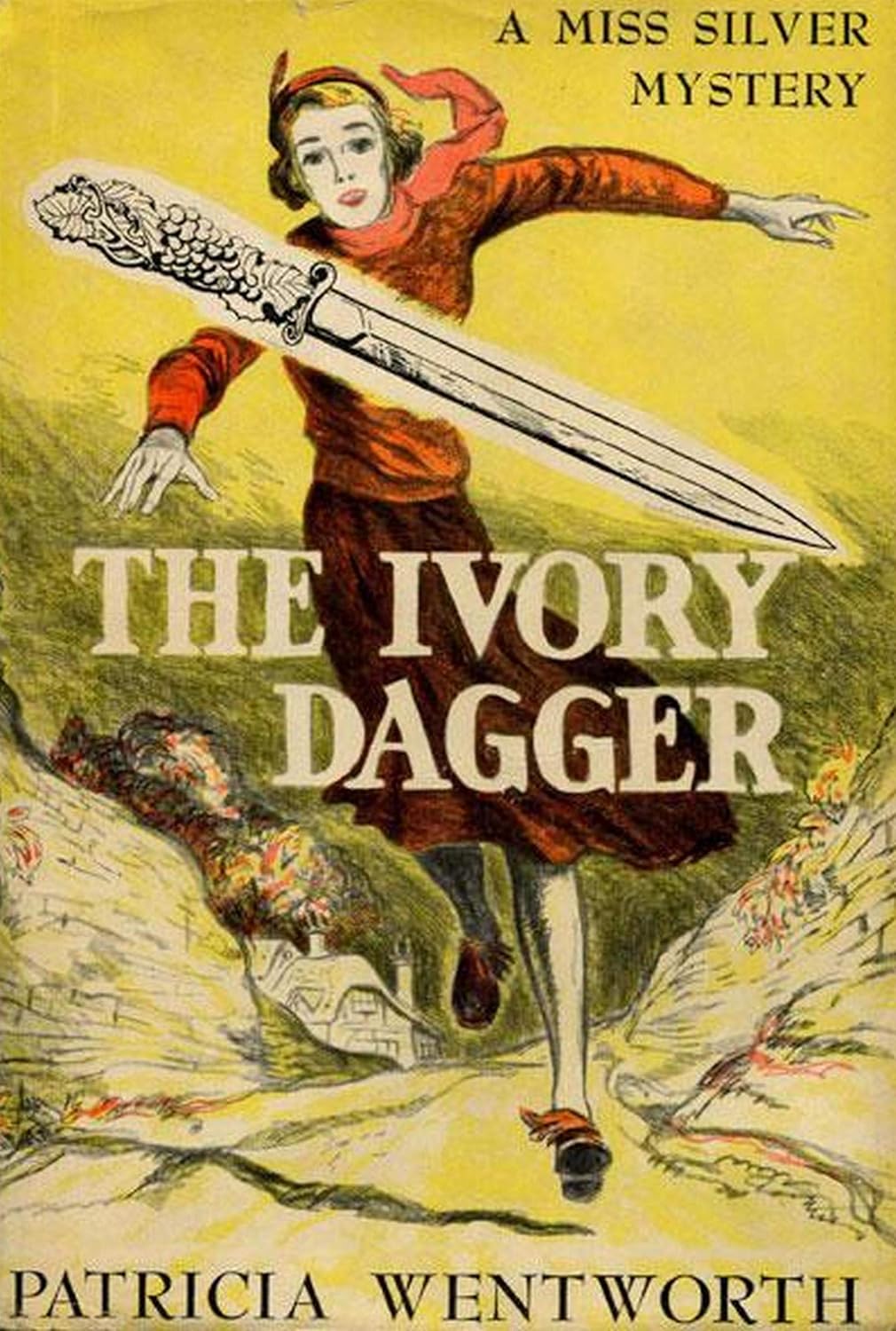
The Ivory Dagger was my first Patricia Wentworth book so it was also my first Miss Silver Mystery as well.
This was number 18 in the series and it didn’t matter that I had not read the previous 17 books. I was able to catch on with the characters and their backgrounds very quickly. Wentworth was a British Mystery writer who published books between the 1920s and the 1960s. The Ivory Dagger was written in 1953.
I liked Maud Silver, the elderly woman called in to help solve the crime, immediately. I also liked Detective Inspector Frank Abbott immediately.
It was made clear, without too much supposition on past cases, that these two had worked together before and had a very teasing and affectionate relationship because of that.
I absolutely loved their interactions.
Let’s go back and grab a description of the book from online, though:
Bill Waring, collecting his wits in hospital after a train crash, receives only one letter from Lila Dryden, his fiancée. When he discovers Lady Dryden, Lila’s guardian, has pressured her into an engagement with Herbert Whitall, he is furious. Herbert Whitall is aggressive, with a cold-hearted possessiveness that expands past the bounds of his ivory collection he can’t bear to lose. His employees hate him, Lila is terrified of him and it appears he has a hold on Lady Dryden. When a dagger in Whitall’s collection becomes the instrument of his own death there are many suspects. Maud Silver must see that justice is done, not merely to punish the guilty, but to protect the innocent.
One thing left out of this particular description, but is in others, is that Lila becomes the prime suspect because she is found standing over his body, holding an ivory dagger that belonged to him.
She has a history of sleep walking, though, and this seems to be another one of those incidents. Could she have killed Herbert in her sleep? Even she is worried about that.
I won’t lie – I wasn’t a big fan of Lila through parts of this book. She was pretty weak and cruel to Bill and others at times, but, then, she was also very young and inexperienced at life.
It’s Lady Dryden who calls in Miss Silver because she has heard about the previous cases Miss Silver has solved.
Miss Silver doesn’t know when she comes to the mansion, that Frank Abbott has been assigned the case but she is pleasantly surprised. Frank is pleasantly surprised with her appearance as well.
“Frank Abbott took the hand and reciprocated the smile. Adrian Gray having mentioned that there was a Miss Silver staying in the house, he was by no means unprepared for the appearance of the lady who he had been known in moments of expansion to address as Revered Preceptress. They were, all jesting apart, on a footing of deep attachment, and, upon Frank’s side, of a most unfeigned respect.”
Miss Silver knows that the focus is on Lila but there is a list of people who didn’t like Whitall, so she must look at them all. She doesn’t think Lila is guilty. Neither does Frank so they will need to join their efforts to find out who really is guilty.
Miss Silver reminds me of Agatha Christie’s Miss Marple and has similar hobbies and mannerisms. Miss Silver also has similar great comebacks or lines as Miss Marple.
They both appear to be innocent old ladies just sitting and knitting away while they are actually listening in to solve the crime. In this one, Miss Silver is knitting a vest for a great niece or relative, I can’t remember which. Wentworth likes to remind us she’s just simply knitting along with such lines as, “The crocket hook went in and out, making a delicate shell pattern about the neck of little Josephine’s vest.”
One difference between Miss Silver and Miss Marple is that Miss Silver is an actual private investigator and Miss Marple is simply a spinster living in a small town who becomes involved in solving crimes.
If you’re curious which one came first, it was Miss Marple by a year. Her first story was published as a short story in 1927. The first Miss Silver book came out in 1928.
What I like about Wentworth’s writing is that she is light on description of characters, scenery, and other aspects of the story, but still heavier than Christie. She provides more literary imagery to draw from to create an image in the readers mind of the main characters and the surroundings than Christie does. This doesn’t mean that one is better than the other. Christie was a brilliant stripped back storyteller and Wentworth is also a wonderful storyteller who simply adds a bit more personality and description to her characters.
Wentworth’s writing reminded me more of Margery Allingham, another Golden Age mystery writer, than Agatha’s. Both Wentworth and Allingham were great at creating engaging and well-written sentences or paragraphs that left you wanting to read it again, highlight it, or write it down.
“They sat facing one another. Feature and expression were hidden by the darkness, yet each knew the other so well that his darkness was only a black screen upon which memory could throw its pictures. Bill holding doggedly to what he had said and saying it all over again, as if battering repetition was an argument in itself. Ray on the defensive – quick thrust and parry to met his bludgeon blows, eyes wide and the colour in her cheeks like flame.”
Though this wasn’t the first book in the series, it was a good introduction for me and I am looking forward to reading more.
If you write book reviews or book-related blog posts, don’t forget that Erin, Cat, and I host the A Good Book and A Cup of Tea Monthly Bookish Blog Party. You can learn more about it here.
On Thursdays, I am part of the Weekend Traffic Jam Reboot blog link party. You can find the latest one in the sidebar to the right under recent posts.
Notice: This post may contain affiiate links. If you purchase the product from these links I will receive a small compensation at no extra charge to you.
Hello! Welcome to my blog. I am a blogger, homeschool mom, and I write cozy mysteries.
You can find my Gladwynn Grant Mystery series HERE.
If you would like to be the first to get news about my books or just have access to special posts for supporters, you can do so here for $2.99 a month https://lisahoweler.com/support-my-writing/
Did you know that there are actually four verses to The Star Spangled Banner, also known as the United States’ National Anthem?
Many of you probably do know that already, but it wasn’t until about five or six years ago that I learned Francis Scott Key actually wrote four verses, but we only sing the first. I mean, it would take a lot longer to get to the game if we had to sing four verses, right?
Many Americans know the history of the song, but for those who don’t, or for any who aren’t Americans, who want to know its history — here is the short version.
The Star Spangled Banner was written in 1814 during the war of 1812 (which in the end was not won by either side).
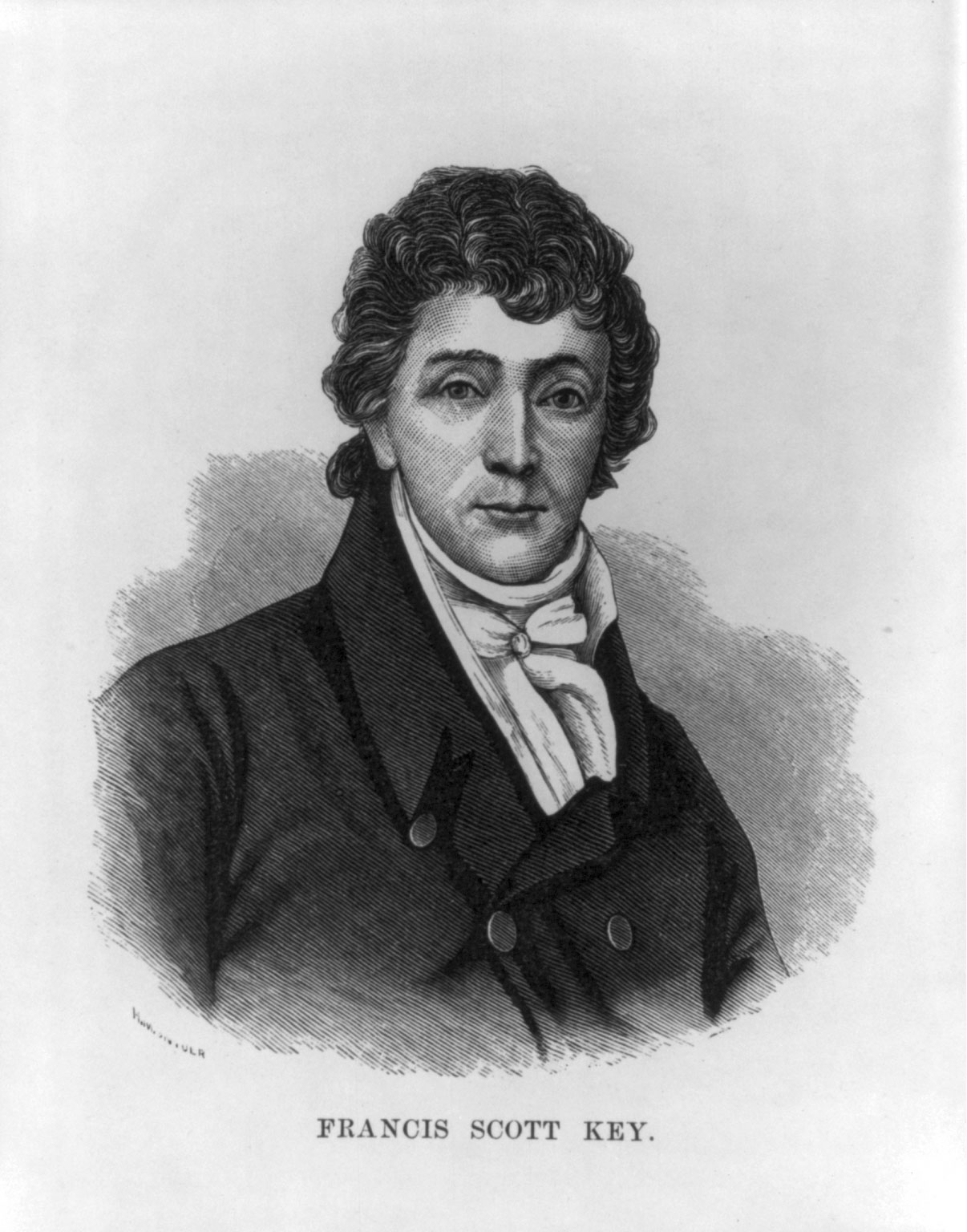
Francis Scott Key was an American lawyer and amateur poet. He was among many who were not happy with the U.S. attacking Great Britain. They felt that declaring war on the British war machine was a poor decision. Great Britain was the biggest trading partner of the U.S. at that time.
Source: The Kennedy Center
It wasn’t until 1814 when British forces raided Washington, D.C. and burned down the White House, the buildings that housed Congress, and several other government buildings, that Scott Key and others got behind the U.S. and started to get fired up about the war.
According to The Kennedy Center website: “On September 13, 1814, Key and a U.S. official rowed over to a British warship at the mouth of the Patapsco River outside of Baltimore, Maryland. Their mission was to seek the release of some American prisoners.
The meeting with the British officers went well, and they even dined together. But when it came time for Key and his companions to paddle home, their hosts said hold your rowboats. The Americans had seen too much. British ships were moving into position to blast the daylights out of Fort McHenry, about eight miles away. Once they captured the fort, British troops would then raid the city, like they had in Washington. The British could not let Key and the others report on what they had seen.”
Key and his friends were kept as prisoners and were made to watch the British forces send more than 1,500 canons at Fort McHenry.
When morning came, Key was sure he would look through the smoke and see the British flag, but instead the American flag was still there, waving proudly.
Photo by Lisa R. Howeler
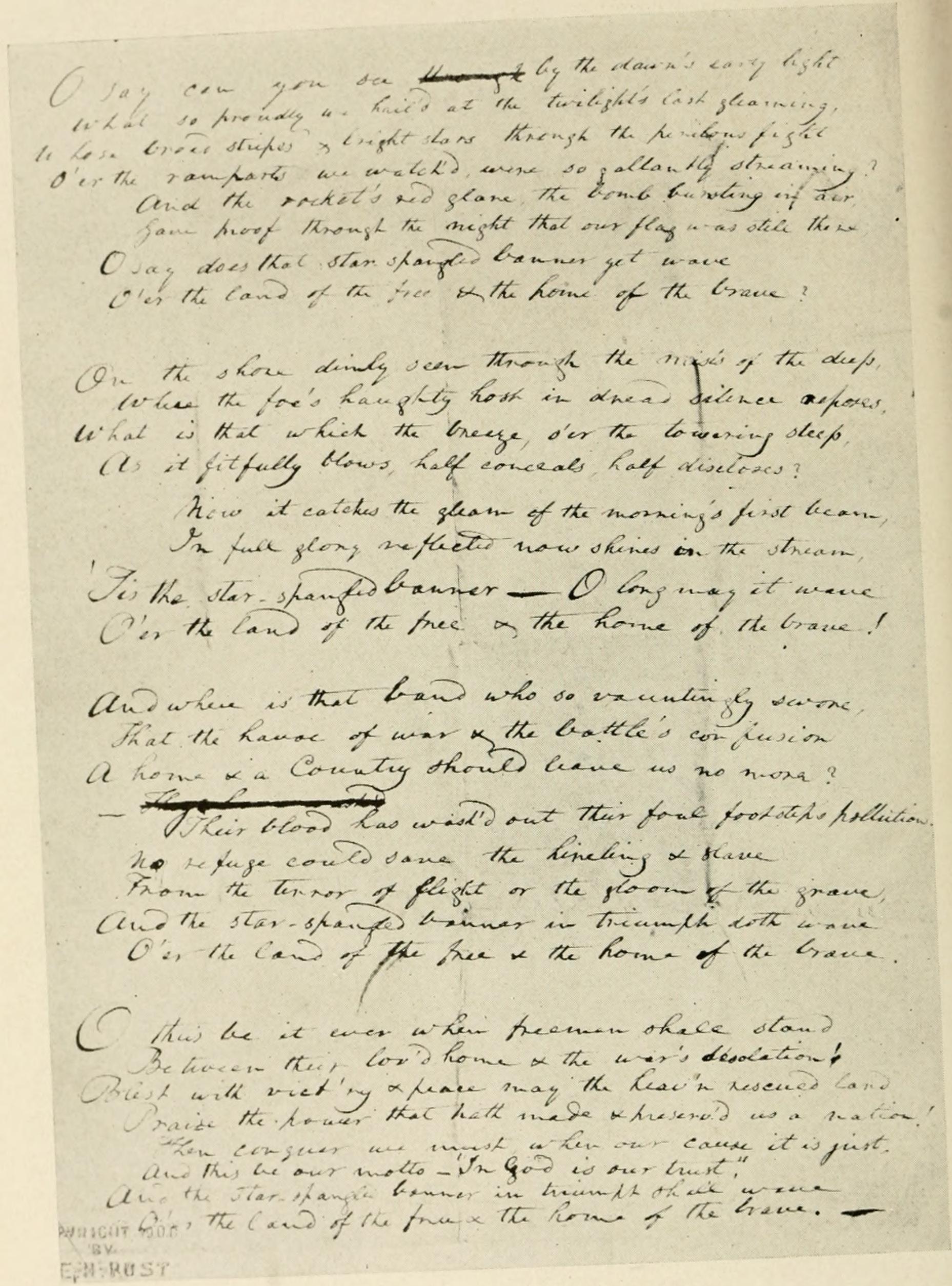
Once released, he pulled out an envelope, or found one, and began to write a poem.
Source: The Kennedy Center
That poem was sent to the Baltimore Patriot and The American newspaper with a note to sing it to a certain tune.
What was that tune?
Ironically, the lyrics were set to the tune of a British drinking song, “To Anacreon in Heaven,” written by British composer John Stafford Smith, when it was first sung and the tune stuck.
It was Key’s brother-in-law, Joseph H. Nicholson, who recognized the lyrics would work with song. Hmmm…I wonder why he knew that. *wink*
Only a week after the battle the poem was printed under Key’s title, “Defence of Fort McHenry” in several newspapers all over the country. A music printer named Thomas Carr, of the Carr Music Store in Baltimore, put the music and lyrics together and rechristened it The Star-Spangled Banner.
The song did not become the national anthem until 1931 when Congressed passed the bill to make it the national anthem.
Since then there have been plenty of complaints about it — mainly that it is too hard for the average person to sing. Another complaint is that celebrates war and should only be sung at military ceremonies.
Some suggested replacements have been America the Beautiful, God Bless America, and This Land is Your Land.
Why do we play the first verse at sporting events? Thank, or blame, Major League Baseball, which started performing It before games during World War II.
And, finally, in case you are wondering, here are all four verses, as Key wrote them:
O say, can you see, by the dawn’s early light, What so proudly we hailed at the twilight’s last gleaming? Whose broad stripes and bright stars through the perilous fight, O’er the ramparts we watched, were so gallantly streaming? And the rockets’ red glare, the bombs bursting in air, Gave proof through the night that our flag was still there; O say does that star-spangled banner yet wave, O’er the land of the free and the home of the brave?
On the shore dimly seen through the mists of the deep, Where the foe’s haughty host in dread silence reposes, What is that which the breeze, o’er the towering steep, As it fitfully blows, half conceals, half discloses? Now it catches the gleam of the morning’s first beam, In full glory reflected now shines on the stream: ‘Tis the star-spangled banner, O long may it wave O’er the land of the free and the home of the brave.
And where is that band who so vauntingly swore That the havoc of war and the battle’s confusion, A home and a country should leave us no more? Their blood has washed out their foul footsteps’ pollution. No refuge could save the hireling and slave, From the terror of flight, or the gloom of the grave: And the star-spangled banner in triumph doth wave, O’er the land of the free and the home of the brave.
O thus be it ever, when freemen shall stand, Between their loved home and the war’s desolation, Blessed with vict’ry and peace, may the heav’n rescued land, Praise the power that hath made and preserved us a nation! Then conquer we must, when our cause it is just, And this be our motto: “In God is our trust.” And the star-spangled banner in triumph shall wave, O’er the land of the free and the home of the brave!
In 1861, poet Oliver Wendell Holmes Sr. penned an unofficial fifth verse during the beginning of the American Civil War, looking hopefully at the emancipation of slaves.
When our land is illumed with Liberty’s smile, If a foe from within strikes a blow at her glory, Down, down with the traitor who dares to defile The flag of her stars and the page of her story! By the millions unchained when our birthright was gained, We will keep her bright blazon forever unstained! And the star-spangled banner in triumph shall wave While the land of the free is the home of the brave!
If you have time, you might enjoy this video — I can not find who is narrating it but it sounds like Paul Harvey. As noted on the video, there some historical inaccuracies but people like the message behind it:
You might also want to listen to one of the most amazing versions by singer Sandi Patty, which includes a special second verse composed by Claire Clonninger for the Statue of Liberty Centennial Celebration in 1986. A note: when you think she can’t get her voice any higher – she does. Brace yourself.
Here is another iconic performance by Whitney Houston:
And another by Natalie Grant (notable here is she did it acapella):
One last, unique, one by Chris Stapleton:
There is your American History lesson for today.
And happy 250th America!
Sources:
The Star-Spangled Banner: The story behind the song
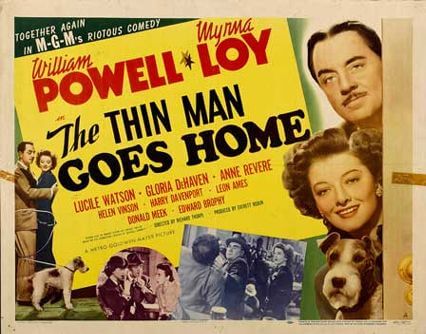
In this installment, Nick Charles returns home to where he grew up and where his father thinks he’s a failure and roaring drink. He is a not a failure, but he has, many times throughout this series, been a roaring drunk.
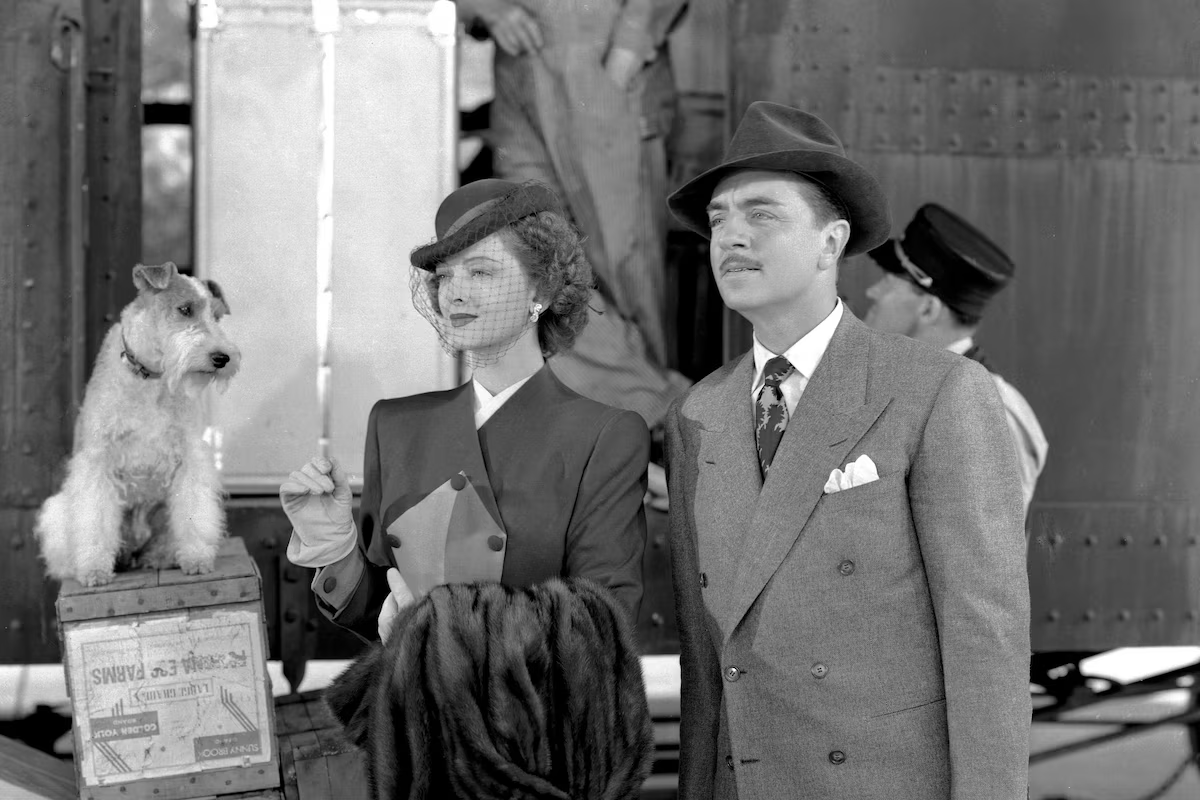
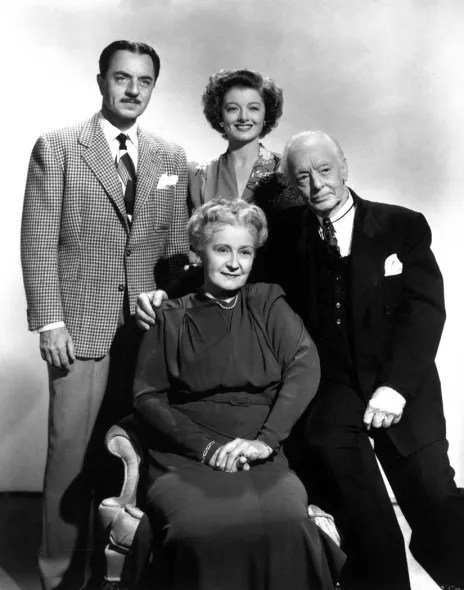
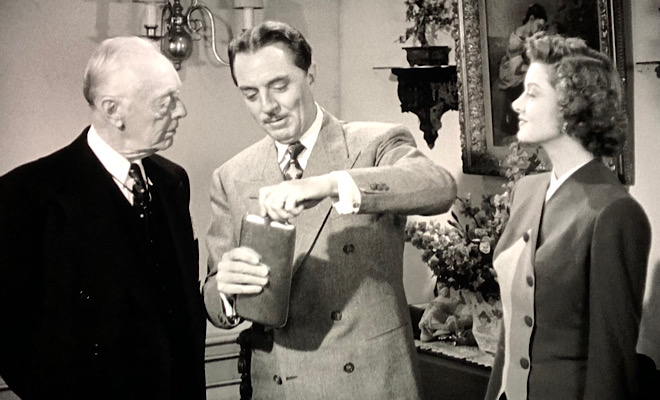
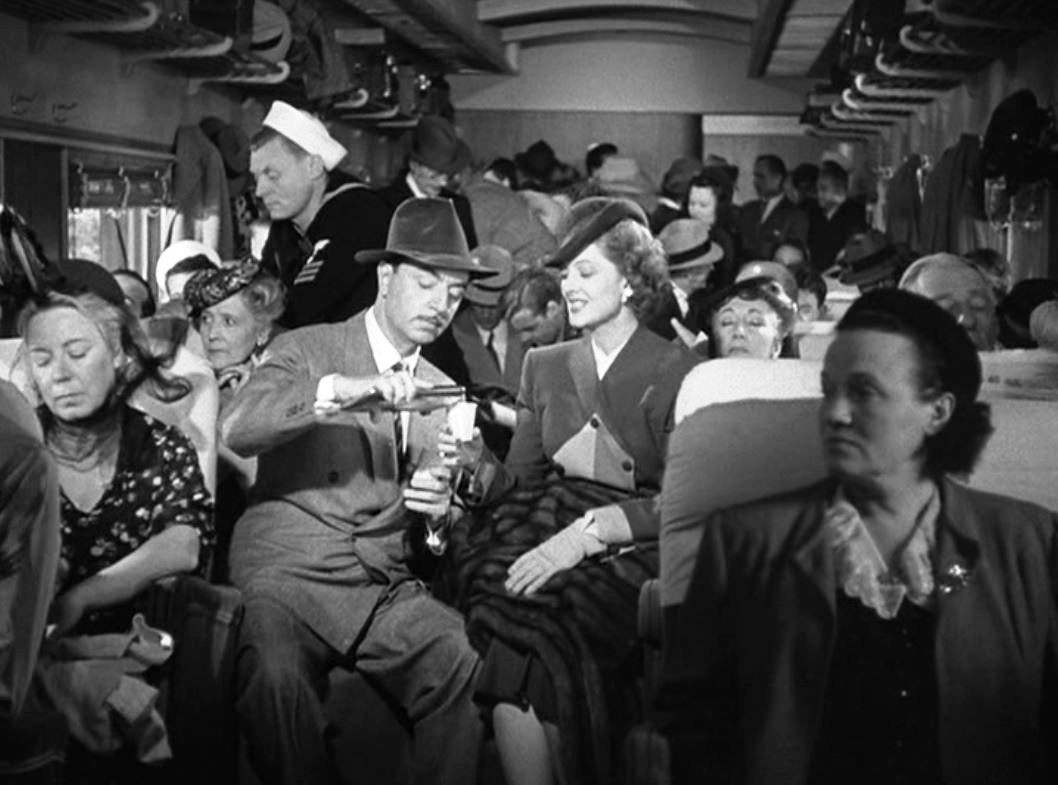
His father, played by Harry Davenport (I love him in anything I see him in) has not been impressed by his son’s detective endeavors. He wanted his son to become a doctor. Nick is attempting to change at least his drinking ways, which is why on the train to see his parents he is drinking apple cider instead of whiskey, or whatever it is he usually has in his flask.
While home, Nick, of course, gets mixed up in a mystery, which puts his job on full display for his disapproving father.
Lucile Watson joined Davenport, portraying Nick’s mother.
TCM describes the Thin Man movies as being about a “sophisticated married couple with a knack for solving murders,” and I guess that works but they are so much more. There is witty banter between Nick and his heiress wife Nora, quirky characters, a cute and funny dog, slapstick comedy, and quick little quips that sometimes make you gasp from the audacity of the writers to slip that in there.
This was a fun movie, even though they wrote Nick Jr. out of it by saying he had to stay home to attend kindergarten.
I read a quote from Myrna Loy that the movies after the second weren’t very good, but I actually liked this movie more than the third. Adding Nick’s parents in was a good decision and added a new dynamic and new life to the franchise, in my opinion.
The jokes about Nick’s alcoholism were rich in this one, especially when he arrives home and tries to fix an old desk for his mother while his father is out. Part of the desk falls, hitting him on the head, and knocking him down on his face on the floor. Of course at that moment, his father and believes he’s been on yet another drunken binge.
There are always jokes in these movies about Nick drinking too much but this time around his family is appalled by the drinking, instead of encouraging it, which Nora tends to do.
We start the film on the train with Nick, Nora, and Asta on their way to New England to see Nick’s parents and celebrate his birthday.
The reunion is full of funny moments and the funny continues as people in town start to hear that Nick is home and circulate rumors that he’s there to solve a case.
Edgar Draque even tells his wife Helena that they must leave town immediately after she goes and acquires painting by local artist Peter Berton. It won’t be until much later that we find out why that painting is important and not until Nora buys the painting for Nick’s birthday before Helena can get there. Nora thinks the painting, which features a windmill outside of town, will remind Nick of good times he had at the windmill as a child.
The artist of the painting arrives at the Charles’s home that night, starts to confess something, but is shot in the back before he can finish his sentence.
Things roll on into total chaos from there and I found that chaos a lot of fun. It was a complex case with a solution that was actually very ahead of it’s time, in my humble opinion.
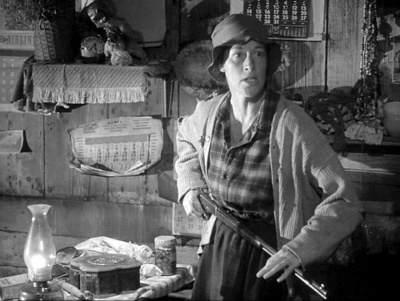
The woman who played Crazy Mary (Anne Revere) was amazing, by the way. There is a scene where she talks about something very emotional that happened to her and she blew me way. It was one of the few serious moments of the film and it had tears welling up in my eyes. She was the mother in National Velvet and was in a ton of other movies, in case you have never heard of her. She was an amazing actress.
This was the first of the series not to be directed by W.S. Van Dyke, since he died in 1943. Instead, Richard Thorpe directed it and was familiar with William and Myrna after directing them in Double Wedding in 1937.
I watched Double Wedding this past weekend and didn’t enjoy it as much as their other films, but that’s probably because I am so used to seeing them as Nick and Nora.
Myrna had been away from the screen for three years when the suggestion to make the film came up. She had been busy with the home-front war effort and a marriage to car-rental heir John Hertz in New York. Thin Man fans wanted another film and were horrified when studio executives let it slip they might replace Myrna with Irene Dunne.
“The fans wanted Myrna, and they didn’t want anyone else,” Powell later recalled. “And I wanted Myrna, too. Besides the favorable reception our pictures always received, I must say it was certainly a pleasure to work with her.”
The cast and crew was pleased to see her too, William said.
“I’ve never seen a girl so popular with so many people,” he said. “Everybody from wardrobe was over the set, everybody from makeup, everybody from property, everybody from miles around, it looked like.”
While the characters were based on Dashiell Hammet’s characters, the screenplay was written by Robert Riskin, Dwight Taylor, from story by Riskin and Harry Kurnitz.
The couple’s dog, Asta (real name Skippy), was back for the movie and provided his usual comedic relief.
Up next I will be watching the final movie in the series, The Song of the Thin Man.