
I’m watching Bette Davis movies this spring, but have chosen some of the less popular ones for something different.
This next movie, A Working Man, came on after It’s Love I’m After and intrigued me in the first several minutes so I decided to stick with it. I ended up enjoying it more than I thought I would. It was a cute movie and a very early one for Bette. So early, she still had platinum blonde hair and was 25-years old.
I have a temporarily lost remote to thank for finding this one.
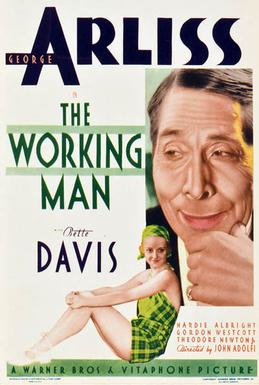
This pre-Hayes Code 1933 movie is about John Reeves (George Arliss), the president of the Reeves Shoe Company, who is determined to beat his competitor, Hartland Shoes.
He’s so determined to beat the competition that he ignores a request by a friend to go fishing in Maine.
His nephew Benjamin Burnett is ready for Reeves to retire so he can take over the business already.
When Tom Hartland, CEO of the Hartland Shoe Company, dies, John Reeves is saddened, even though he was his main competitor.
Benjamin begins to hint that John is senile and to teach him a lesson, John heads off for that fishing in Maine, leaving him to run the business for a while and see what it is like.
Ironically, though, a yacht stops running near John’s fishing pier and two young people swim up to ask for booze while they wait. John, who has always been a hard worker, is disgusted by their laziness. One of those young people is Bette Davis as Jenny Hartland.
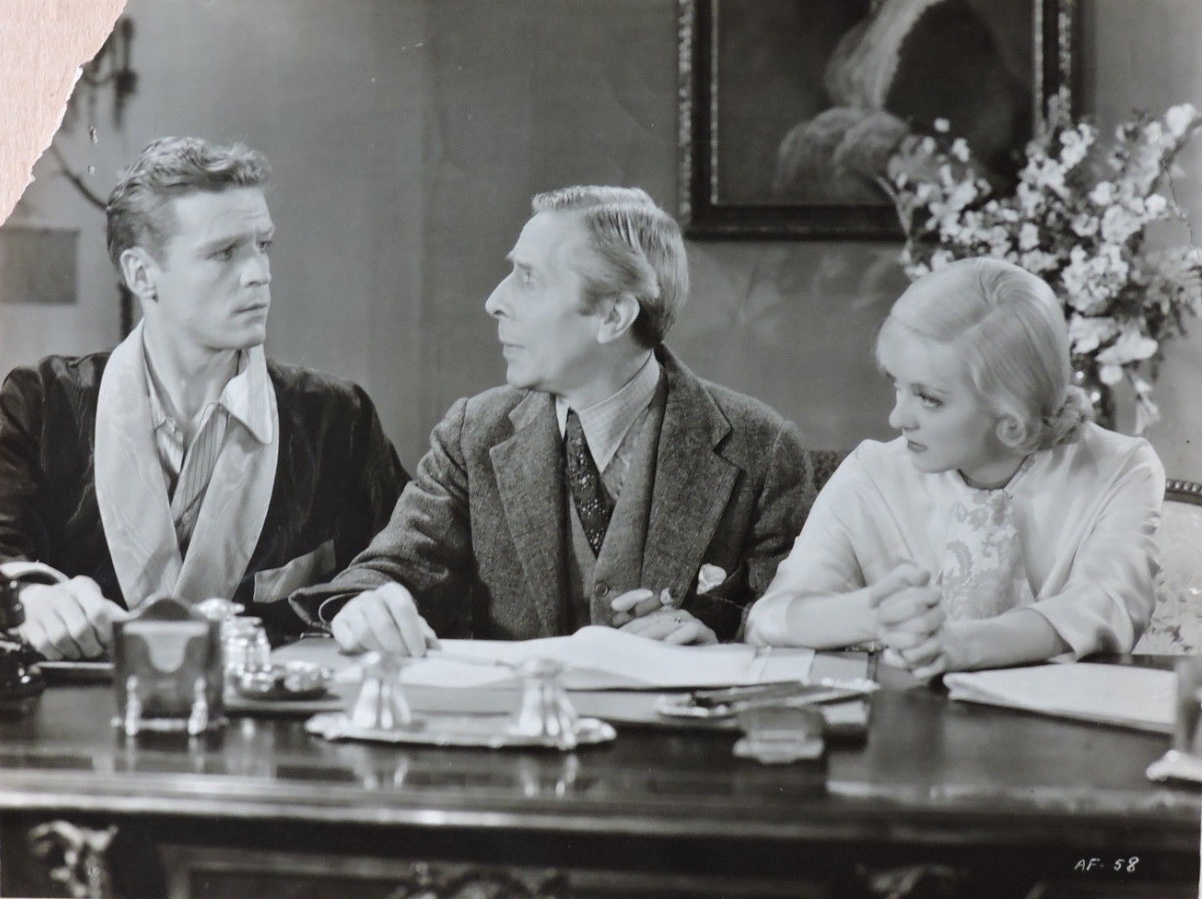
The other is her brother Tommy Hartland played by Theodore Newton.
As they begin to chat, John learns they are the spoiled children of the recently deceased Tom Hartland. John decides to call himself John Walton and befriends them so he can spy on their company but as the spying begins, John starts to like the two kids and decides he wants to help them better themselves. He also discovers that the shoe making plant for their late father’s business is being mismanaged.
This launches him into a journey to save the business he’s been trying to destroy for years while also trying to keep his own business going and his identity hidden.
Bette is so young in this one, as I mentioned above.

The screenplay for the movie was based on a story The Adopted Father by Edgar Franklin and written by Charles Kenyon and Maude T. Howell.
Arliss was a well-known silent movie star before going into talking films and reprised his role in this movie from his 1924 silent movie Twenty Dollars a Week, which was based on the same story. Hollywood does like to rehash an old story because the 1936 20th Century Fox film Everybody’s Old Man was based on the same source.
The movie was Arliss and Bette’s second time appearing together in a movie. They were in The Man Who Played God the year before.
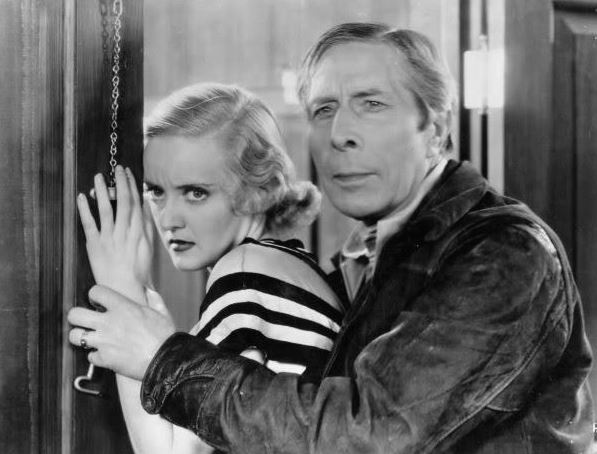
But their relationship goes deeper than just being in a previous movie together, according to TCM.com.
“[The Working Man] was the second and last film Davis made with Arliss, whom she always considered one of her mentors and the person who was responsible for saving her nascent film career,” an article on the site states. “She first met Arliss in the late 1920s, when he was a guest lecturer at the drama school she attended in New York. He counseled her not to adopt the exaggerated “cultured” English diction that many actors were then using. Instead, he suggested that she speak standard American English, but make an effort to get rid of her New England accent. Davis followed his advice. In late 1930, Davis was signed to a contract by Universal and went to Hollywood, but she was cast in pallid secondary roles and made little impression. Nine months later, Universal dropped her. According to Davis, she and her mother were packing up to return to New York, when she received a phone call summoning her to a meeting with Arliss, then one of Warners’ top stars. After meeting with Arliss, she was cast in The Man Who Played God, and signed to a Warner Bros. contract.”
We talk about the oversaturation of the entertainment market these days, but back then, movies were made fast and furious. Bette made, or at least released, seven movies in 1933.
The Working Man was her 15th movie, and she only started working in movies two years before. The New York Times gave Bette a good review saying, “Bette Davis, whose diction is music to the ears, does good work in the role of Jenny.” Bette had good memories of working with Arliss.
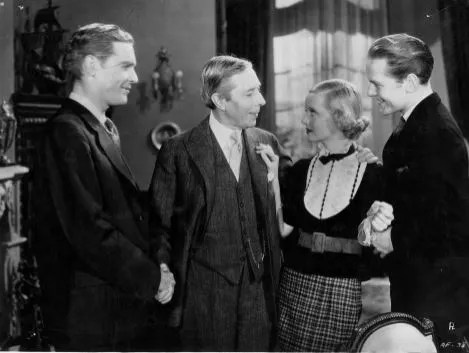
“Whatever was happening on his set, at four p.m. sharp, everything stopped for a half hour while we had tea,” she said. “I think he had it in his contract. Mr. Arliss helped pour, and everyone, to the lowliest grip, participated. I especially enjoyed knowing instinctively that Mr. Jack L. Warner was sitting in his office having a fit during this expensive homage to a civilized way of life.”
Even after Arliss went back to England in 1935, Bette continued to look at him as her mentor.
Margarita Landazuri wrote in her article on TCM that when Bette was in a contract dispute with Warner, Arliss told her to give in and not to try to sue Jack Warner again. She’d already lost her first attempt.
“Bette, you must go home and do anything they ask for one year,” he told her. “You must accept the fact that you have lost. It’s difficult to handle defeat, but you can take it.” Realizing that her career would be over if she continued to fight, Davis followed his advice. She swallowed her pride and returned to Warner Bros., where she soon became the studio’s top female star. “He certainly was my first professional father,” Davis said of Arliss, and the sentiment was reciprocated. In her home, she kept a framed photograph of Arliss. The inscription read, “with adopted fatherly affection.”

Up next in my Spring of Bette Davis, I’ll be writing about Another Man’s Poison.
My watch list for this feature:
It’s Love I’m After (April 15)
The Working Man (April 21)
Another Man’s Poison (April 23)
Dark Victory (April 30)
Jezebel (May 1)
Dangerous (May 7)
The Letter (May 12)
Of Human Bondage (May 21)
Now, Voyager (May 28)
Sources and resources:
https://www.tcm.com/articles/409105/the-working-man-1933-the-working-man
Discover more from Boondock Ramblings
Subscribe to get the latest posts sent to your email.

Pingback: Spring of Bette Davis: Now, Voyager – Boondock Ramblings
Pingback: Classic movie impressions: Spring of Bette Of Human Bondage (1934) – Boondock Ramblings
Pingback: Spring of Bette: The Letter (1940) – Boondock Ramblings
Pingback: Spring of Bette Davis: Dangerous (1935) (with spoilers) – Boondock Ramblings
Pingback: Spring of Bette (Davis): Jezebel (1938). Otherwise known as the movie that made me say, “Well, that escalated fast.” – Boondock Ramblings
Pingback: Spring of Bette (Davis): Jezebel (1938). Otherwise known as the movie that made me say, “Well, that escalated fast.” – Boondock Ramblings
Pingback: Classic Movie Impressions. Spring of Bette: Dark Victory or the movie I couldn’t finish because it hit too close to home – Boondock Ramblings
Pingback: Spring of Bette (Davis): Another Man’s Poison – Boondock Ramblings
Pingback: Sunday Bookends: Slow reading this week – Boondock Ramblings
I’ve never heard of this movie, but it sounds good. I liked reading about Davis and Arliss, though, more than the review of the movie. I knew Bette was a bit of a handful so I’m glad she received that advice about giving in. It would have been awful to not have had all her good movies (and some of her bad ones). Seven movies in one year? Wow! And, I never noticed she didn’t have that ghastly accent so many of the women had back then. Of course, now I will notice it all the time!
https://marshainthemiddle.com/
LikeLiked by 1 person