
I’m surprised more people don’t talk or write about Agatha Christie’s non-fiction books, especially Come, Tell Me How You Live, which reveals so much of her witty sense of humor.
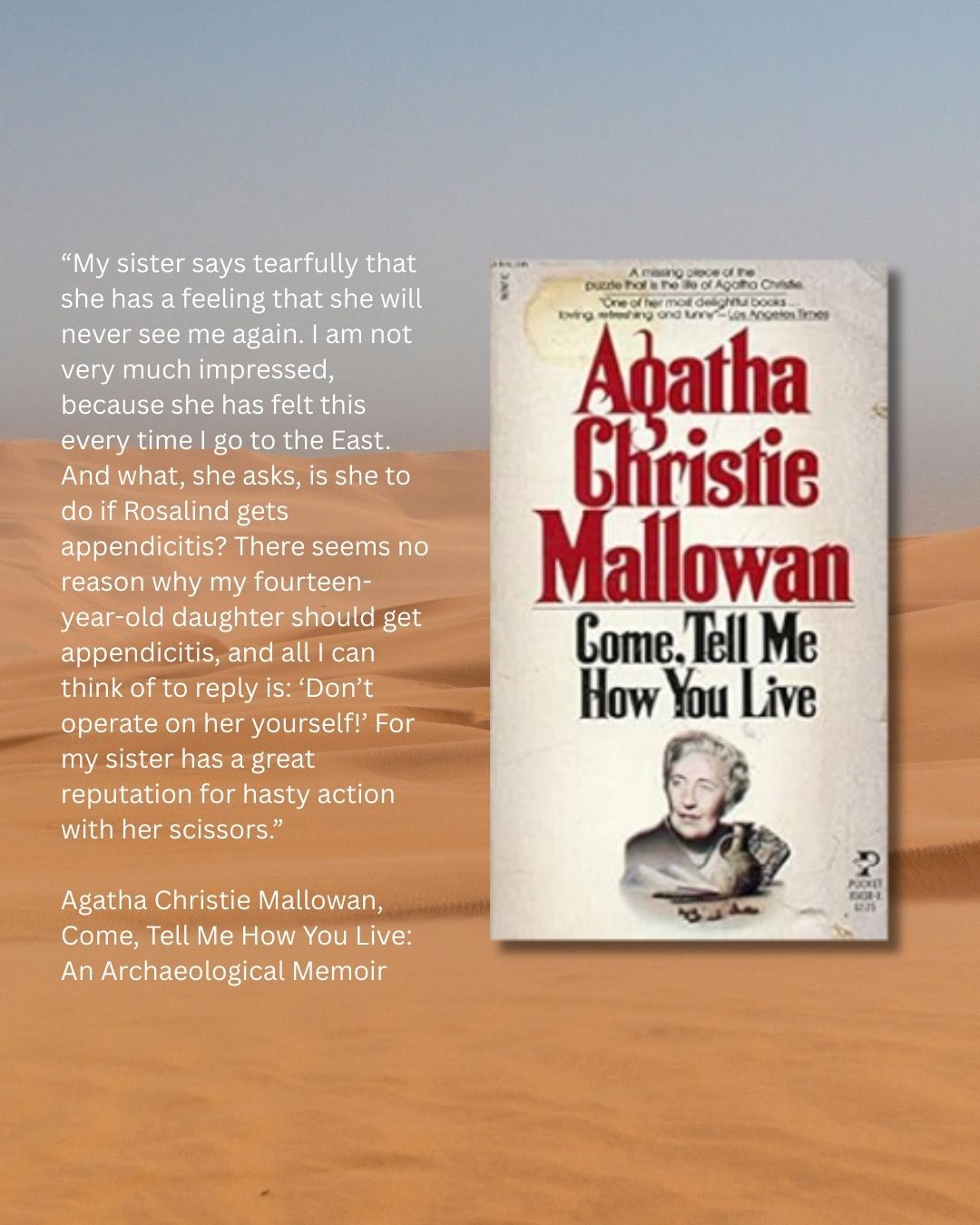
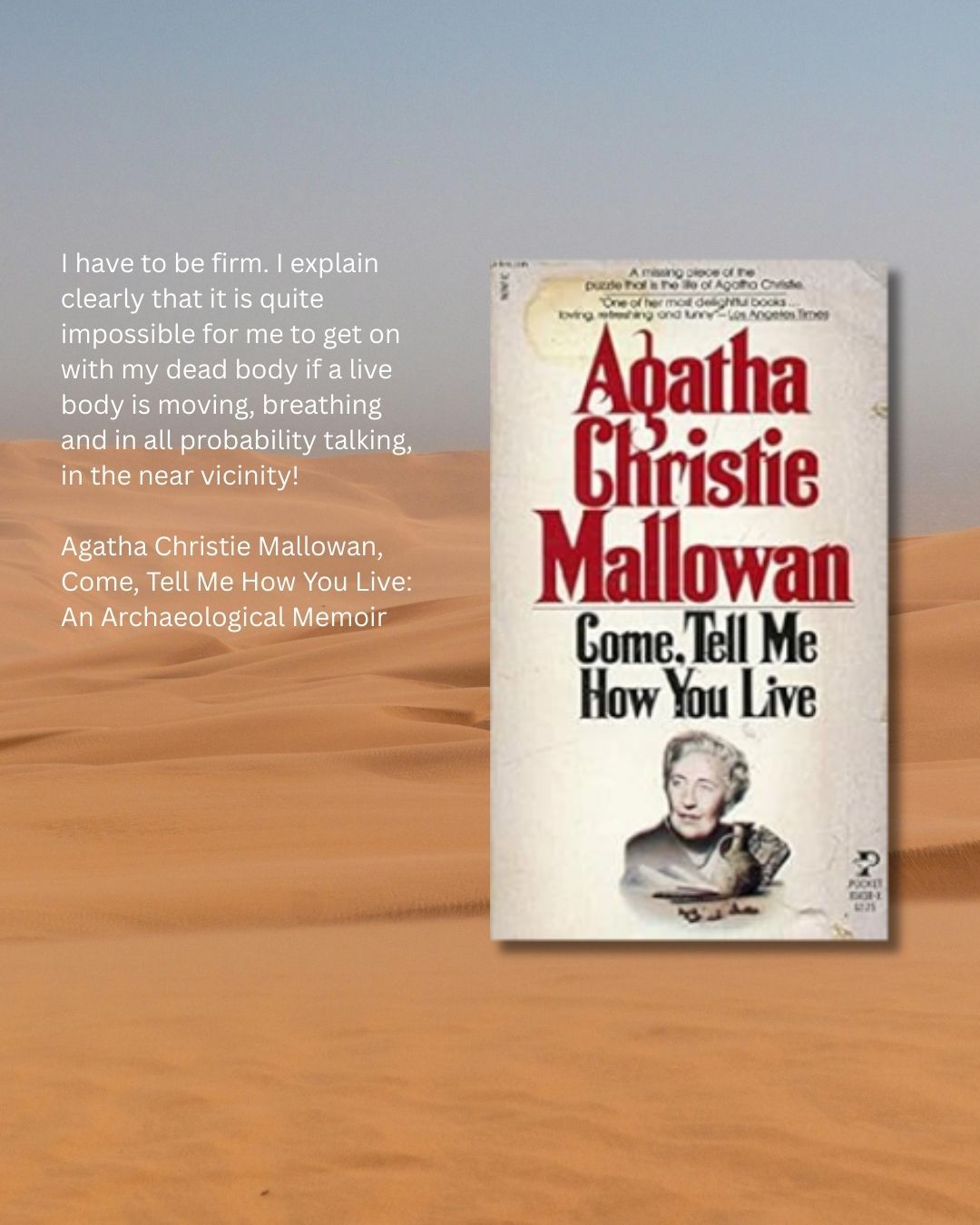
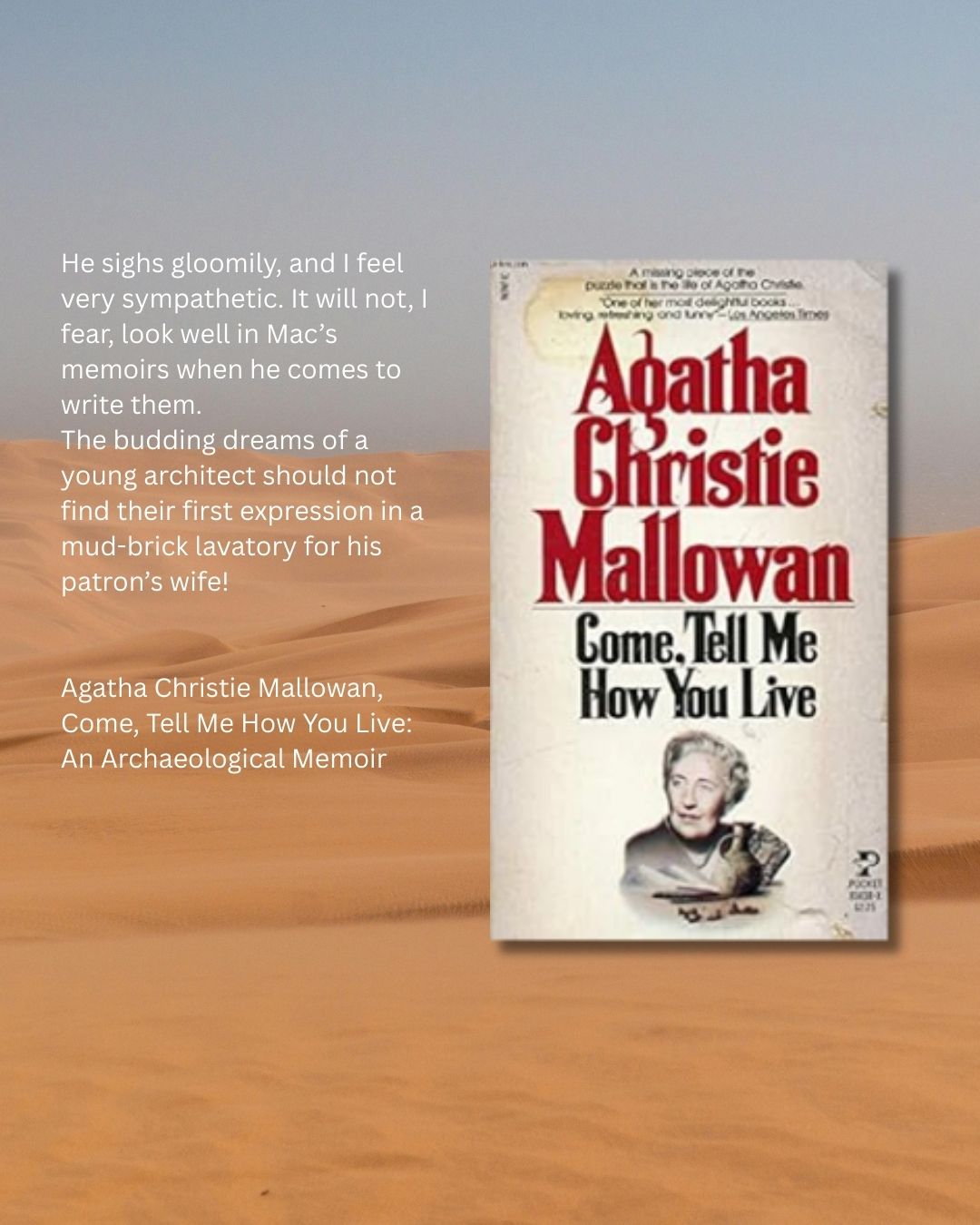
Of course, she only wrote three non-fiction books — this one, her autobiography, and The Grand Tour, a collection of her letters and photographs from her 1922 tour to promote the British empire.
Christie writes this book under her full name of Agatha Christie Mallowen, with Mallowen being the name of her second husband and she’s wrong in her introduction.
I don’t read non-fiction often so I wasn’t sure I would enjoy this one but when the opening pages describe Agatha looking for outfits she can wear on her husband’s archaeological dig in Syria and the clerk lets her know they might not be able to accommodate her larger size, which Agatha handles hilariously, I knew I had to keep going.
As Agatha says in the intro of this book, “This is not a profound book. It will give you no interesting sidelights on archaeology, there will be no beautiful descriptions of scenery, no treating of economic problems, no racial reflections, no history. It is, in fact, small beer — a very little book, full of everyday doings and happenings.”
This book does actually include some beautiful descriptions and a few interesting sidelights on archaeology.
Agatha started writing this book before World War 2 and finished it afterward, sending it out into the world to be published.
As I mentioned already, the book begins with Agatha looking for traveling clothes. Her humor immediately kicks in.
“Shopping for a hot climate in autumn or winter presents certain difficulties. One’s last year’s summer clothes, which one has optimistically hoped will “do”, do not “do” now the time has come. For one thing, they appear to be (like the depressing annotations in furniture removers’ lists) “Bruised, Scratched, and Marked.” (And also Shrunk, Faded, and Peculiar!). For another — alas, alas that one has to say it! — they are too tight everywhere.
So, to the shops and the stores and:
“Of course, Modom, we are not being asked for that kind of thing now! We have some very charming little suits here — O.S. in the darker colors.”
I’m guessing O.S. means oversized because Agatha then writes: “Oh, loathsome O.S. How humiliating to be O.S.! How even more humiliating to be recognized at once as O.S.!”
If I have done my math right, Agatha would have been around 45 at the time this trip was taken.
She and her husband, Max, traveled to Syria and Iraq. Max was an archaeologist and Agatha actually met him on an archaeologist dig in 1930, years after divorcing her cheating first husband, Colonel Archibald Christie.
What’s so fun about this book is how Agatha writes about different she and Max approach situations in life, with her being a bit more high strung and him being laid back and acting like everything will turn out all right. Agatha was about 15 years older that Max, I might add, which I did not realize while I was reading the book. I read that while I was researching for the review. No wonder he seemed so aloof and laid back. He was still young and a bit naïve in some ways.
In addition to sharing details of her marriage, Agatha also writes about the quirky men who travel with her and her husband.
I would not be surprised if some of the people they worked with or met along their travels popped up in Agatha’s mysteries.
Mac, her husband’s architect assistant, gets the bulk of the secondary character playback throughout the book and it is hilarious. His full name was Robin Maccartney.
Mac is extremely serious, a perfectionist, and also lacks any sense of humor.
Agatha and Max traveled off and on between 1935 and 1936, with stays in Syria long enough that they had a house remodeled for them to stay in. Mac, an architect by trade, has been designing blueprints for Agatha’s bathroom.
“I ask Mac that evening at dinner what is fist architectural job as been.
“This is my first bit of practical work,” he replies. “—your lavatory!”
He sighs gloomily, and I feel very sympathetic. It will not, I fear, look well in Mac’s memoirs when he comes to write them.
The budding dreams of a young architect should not find their first expression in a mud-brick lavatory for his patron’s wife!”
Agatha shares some of her most savage lines in the book when she is writing about Mac, who almost seems uptight and perfect to be human at times.
It isn’t until he can’t light a gas lamp that he has a meltdown which Agatha says reveals his humanity.
“I steal a glance at him when another five minutes have gone by. He is getting warm. He is also looking not nearly so superior. Scientific principal or no scientific principal the petrol lamp is holding out on him. He lies on the floor and wrestles with the thing. Presently he begins to swear… A feeling that is almost affection sweeps ove me. After all, our Mac is human. He is defeated by a petrol lamp!”
Agatha writes that from that point on, Mac is one of them, someone who can easily get frustrated and swear about it.
Agatha did take her typewriter and some manuscripts with her and writes about working on a book while there. One of their friends, Louis Osman, an architect and member of the archaeological team, who was affectionately nicknamed “Bumps” by the group, and who Agatha simply calls “B” in her book, came into her office one day to chat, but she wants him to leave because she’s in the middle of writing a murder scene.
“He goes into the drawing office and talks to Mac, but, meeting with no response, he comes sadly into the office, where I am busy on the typewriter getting down to the gory details of a murder.
‘Oh,’ says B. “you’re busy?”
I say, ‘Yes,’ shortly.
“Writing?” asks B.
‘Yes’ (more shortly).
‘I thought, perhaps,’ says B wistfully. ‘I might bring the labels and the objects in here. I shouldn’t be disturbing you should I?’
I have to be firm. I explain clearly that it is quite impossible for me to get on with my dead body if a live body is moving, breathing and in all probability talking, in the near vicinity!
Poor B goes sadly away, condemned to work in loneliness and silence. I feel convinced that, if B ever writes a book, he will do so most easily with a wireless and a gramophone turned on close at hand and a few conversations going on in the same room!”
Agatha also tells about the women of the middle east and how they want to get to know her and learn more about her. I was surprised to learn in this section that Agatha had had a series of miscarriages over the years, which may be one reason she and Archie only had one daughter.
There are some parts of the book I found a tiny bit slow but so much of it was so fascinating that I didn’t mind a little bit of slowness
I really enjoyed Agatha’s recollections and her thoughts about the faith of the people compared to the faith of the people in England.
I also found it interesting to read her views on public education, which would probably surprise people today.
After sharing about watching some of the village children play and experiencing every day life she wrote:
“I think to myself how happy they look, and what a pleasant life it is like the fairy stories of old, wandering about over the hills herding cattle, sometimes sitting and singing. At this time of day, the so-called fortunate children in European lands are setting out for the crowded classroom, going in and out of the soft air, sitting on benches or at desks, toiling over letters of the alphabet, listening to a teacher, writing with cramped fingers. I wonder to myself whether, one day a hundred years or so ahead, we shall say in shocked accents: ‘In those days they actually made poor little children go to school, sitting inside buildings at desks for hours a day! Isn’t it terrible to think off! Little children!’”
Have you ever read this one or any of Agatha’s non-fiction books?
Discover more from Boondock Ramblings
Subscribe to get the latest posts sent to your email.

I have never read any of her nonfiction books but I love a good memoir/autobiography.
LikeLike
Pingback: Sunday Bookends: Severe cold weather, a new-to-me author, and a needed cry | Boondock Ramblings
This sounds really good, Lisa! I admit to finding her mysteries rather dry, but this sounds like there’s a lot of humour (notice the spelling…did that on purpose) in it. I will look for it once I’ve finished the three or four I have on hold!
https://marshainthemiddle.com/
LikeLike
Oh this sounds delightful! I shall have to see if I can find it – since I’m wanting to read more NF this year + I want to indulge in more Christie as well :)
LikeLike
I DNFed Christie’s autobiography years ago. I tried several times, but you know I have a problem with her way of writing sometimes. I think I might have to try with this one again because it’s more interesting to me.
LikeLike