
This winter I am watching movies starring Douglas Fairbanks Jr.

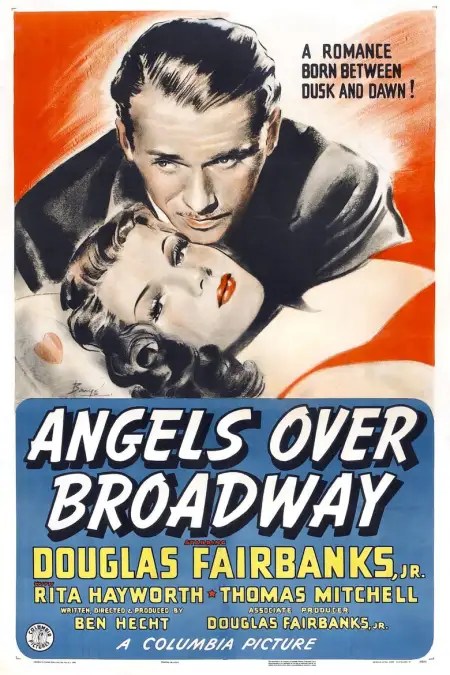
I had to switch movies for this week’s Winter of Fairbanks Jr. because I couldn’t find Chase a Crooked Shadow. Instead I chose Angels Over Broadway, which I found on YouTube.
It was a simple movie with a very sweet ending. It definitely had some plot holes and some vague back stories and some not great reviews online but I found it endearing.
Douglas (remember we are on a first-name basis now) plays a down-on-his-luck con man named Bill O’Brien who thinks he has found his way to fortune when he sees a man named Charles Engle (John Qualen) blowing cash left and right at a night club.
The issue is that Engle really isn’t loaded at all. He stole $3,000 from his business partner to make his wife happy and then his wife took the money to leave with another man.
Engle’s been confronted by his business partner and is ready to kill himself. Now he is spending one last night on the town before he ends it all.
Rita Hayworth is a lounge singer named Nina Barona who spots Engle and wonders if he might be a producer or director who can help her become famous.

O’Brien sees her and wonders if she might be someone that he can pull into one of his schemes. Also, you can tell he likes the look of her, if you know what I mean. *wink* *wink*
So, yes, we have a group of scammers ready to scam each other. O’Brien sees in Engle a quick buck because he’s going to talk him into going to an illegal poker game and throwing away some of his money and then getting a cut of whatever is taken from him. O’Brien’s main source of income is leading rich men to notorious gangster Dutch Enright (Ralph Theodore). Dutch then cheats them out of a fortune and gives Bill a cut of the profits for luring them in.
Thomas Mitchell portrays playwright Gene Gibbons (Thomas Mitchell….also known as Uncle Billy in It’s A Wonderful Life) whose last play fell on its face.
He’s intoxicated and handed the wrong coat when he goes to collect his. Its Engle’s coat and in the pocket is the suicide letter Engle has written for his partner and estranged wife to find after his death.
Gibbons reads the letter and asks who it belongs to. He doesn’t like the idea of someone killing themselves and tracks Engle down to try to talk him out of it.
Gibbons reveals himself to Engle to be a womanizer, adulterer, and a failure at success. He tells Engle he doesn’t want him to miss out on all the beautiful things in life so he decides to help Engle get the $3,000 back. His plan to do that fails so in walks O’Brien, who learns Engle doesn’t actually have any money. Nina thinks this is hilarious and blurts out the scheme O’Brien tried to pull her into.

O’Brien is a bit ticked at her move to blather about the plan but Gibbons believes they can still pull the plan off by pretending Engle is rich.
Scam a gangster? Eek. O’Brien doesn’t like the idea but if Engle can win more than $3,000 in the game then O’Brien can take whatever is left.
The bulk of the movie is watching three people try to play each other or others to benefit themselves and then later having to decide if this is the person they really want to be.

Douglas is a bit of a jerk and a softy in this one. He does, however, rescue Nina from a predatory man when she tries to use the man to get to an opportunity to make her famous. He also shows he’s not all about himself later in the movie.
I wasn’t sure what to make of his thick New York City accent in this one. All I know is that I kept talking like him for the rest of the night, including asking my kids, “Eh, you ready for dinner or what? You need me to wait to get dinner on the plates or do ya’ wants me to bring it to you while it’s still warm?”
My children didn’t find any of this amusing, by the way.
Hayworth got the role after Jean Arthur turned it down and it was her first “A” list film. As we all know, she flew to fame after this by becoming a heartthrob of the 1940s and a pin-up girl during World War II.
Before this movie she was in 35 different movies starting in 1926, but in most of those movies she portrayed secondary characters.
Angels Over Broadway was directed by Ben Hecht and co-produced by Douglas, who convinced Harry Cohn, head of Columbia Pictures, to finance the rest.
“Cohn couldn’t figure out what the picture was about but neither could we,” Fairbanks was later quoted as saying about the film.
Samantha Richards from Musings of A Classic Film Addict writes on her blog, “The plot and theme are clear to audiences today, as the screenplay, which earned iconic screenwriter Ben Hecht an Academy Award nomination for Best Original Screenplay for 1940, has since been regarded as far ahead of its time by critics. I find it difficult to understand why this film isn’t universally recognized that way that I see it: as a strong and riveting drama that blends the realism of New York City life, with a touch of fantasy and the idealism that maybe good guys can sometimes win in the end. To answer my own question, Rita Hayworth is miles apart from the calculated femme fatale image that she would later be known for, with a mousey voice and a doe-eyed look that would make even diehard fans of hers puzzled.”

Richardson continues, “Each performance in Angels Over Broadway (1940) is spot on and impeccably cast, made up of wildly underappreciated actors like Douglas Fairbanks, Jr. and Thomas Mitchell, both of whom rank highly in my book. Jean Arthur could never have portrayed a role like Nina Barona, but I also doubt that even Rita herself could have pulled this part off after being transformed by the Hollywood machine after this film’s release.”
I feel Douglas was very good in this, but in some ways Mitchell stole the show as the intoxicated, and later repentant and sober, Gibbons. He seems to play drunk fellows well. I hope that wasn’t because he knew a lot about it in real life.

It did hit me as I was watching the movie that Douglas always has a small mustache, no matter what movie he is in — other than one of his first movies, The Power of the Press.
There isn’t a ton of information about this movie online, so you won’t have to read through paragraphs of history, behind the scenes stories, or trivia today.
I do have a couple tidbits of trivia I read on Imdb, including:
“The tagline on the original movie poster – “A HECTIC ROMANCE TO BLOW THE FUSES OUT ALONG MAZDA LANE” – refers to the Broadway theater district in New York City as “Mazda Lane.” Mazda was a brand of light bulbs common in the first half of the 20th century, with a name referencing an ancient Persian god of light and good. Broadway was and is known for its brightly lit marquees, and had many nicknames in its heyday.”
And:
“The working title for this film was Before I Die.”
So, there is one line from Douglas in this movie that made me swoon a bit. I’ve gone to the trouble of clipping it for you to share here and it was a bit of an ordeal to do so I hope you appreciate it. *wink* Let me know if you figure out what the line is.
I would guess that many of you have not seen this movie but if you have, what did you think?
I found this for free one on YouTube, by the way.
Up next for me in my Winter of Fairbanks Jr. marathon is Sinbad The Sailor (1947) and I did make sure this one is streaming somewhere.
After that I am watching The Rise of Catherine the Great and writing about it February 27. It is also streaming.
My last pick, The Sun Never Sets, 1939, is available for free on PBS and I also found it here: https://archive.org/details/sun.-never.-sets.-1939
You can find my impressions of previous movies in the series, as well as other classic movies here: https://lisahoweler.com/movie-reviews-impressions/
Discover more from Boondock Ramblings
Subscribe to get the latest posts sent to your email.

Pingback: Sunday Bookends: More cold weather and switching back and forth between books – Boondock Ramblings
Ok. Hear me out – but he reminds me a bit of Steve Buscemi a bit here. Lololol.
LikeLiked by 1 person
Don’t ever say that. lol
LikeLike
I had read the “Musings” post as well, but I can’t get myself to agree with “strong and riveting”. I think I could have if the plan had been better and more realistic, though, because I like the general idea of flawed people unexpectedly turning into “angels” helping a desperate man.
LikeLike
When I read Cat’s review, I was confused by the plot line, and I’m still confused. But, the bit you included now has me thinking I need to watch it. And, yes, I know exactly what line has you swooning!
https://marshainthemiddle.com/
LikeLike