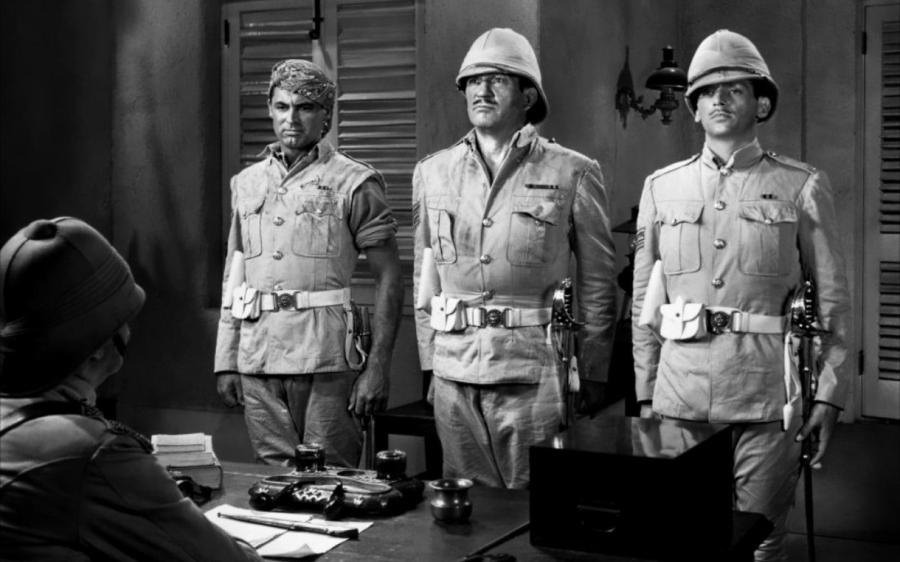
Up this week for the Winter of Douglas Fairbanks Jr. is Gunga Din (1939), said to be one of his most famous movies.

I am going to let you know right up front that I rarely hate classic movies that I watch, but I pretty much hated this movie. This movie was a train wreck for me from beginning to end. Possibly a bit of a racist train wreck at that. It had a severe identity crisis — it wasn’t sure if it was a comedy or a drama.
For me this movie was Gunga Do..n’t.
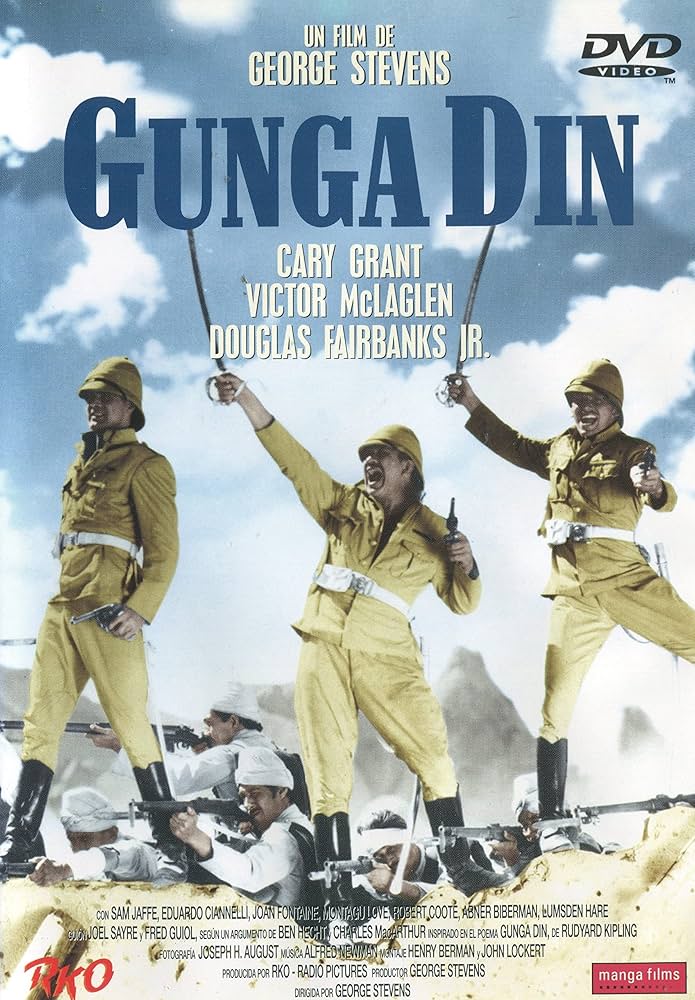
When I first started it I thought, “Two of my favorite actors. Cary Grant and Douglas Fairbanks, Jr! Be still my heart!!!”
As I continued it, I thought things like:
“Are these guys supposed to be British?”
“What accent is that? Is he trying to do an accent? Why is he trying to do an accent?”
“Why didn’t they let the Irish actor just have an Irish accent? His British accent is horrible.”
“Douglas looks bored out of his mind and like he wishes he could get out of his contract.”
“Is that a white man painted brown to look Indian? And that one too? And that one? And…
First a snippet of the synopsis of the movie from TCM.com:
In an encampment of Her Majesty’s Lancers in Colonial India, the commanding officer (Montagu Love) is distressed by the cutoff of communications from an outpost ten miles distant. He wants three of his most dependable sergeants to embark on an investigative mission; however, the trio must first be pulled away from a bar brawl to receive their orders. The comrades in arms include the calculating Cutter (Cary Grant), ever dreaming of finding a cache of riches; the grizzled veteran MacChesney (Victor McLaglen); and the gentlemanly Ballantine (Douglas Fairbanks, Jr.), whose sole focus is his imminent discharge and marriage to his fiancée (Joan Fontaine), much to the chagrin of his comrades.
Among the troops taken on the mission is the humble bhisti Gunga Din (Sam Jaffe), for whom life would hold no greater honor than to serve as regular Army. They arrive at the outpost to find the streets empty; the soldiers’ rousting of the homes turns up one small cluster of ostensible survivors.
Cutter’s drunken fixation with a legendary golden temple leads to a one-sided slugfest with MacChesney, a stint in the brig, and an audacious escape courtesy of Din and MacChesney’s beloved pet elephant. In their flight, Cutter and Din discover the mythical temple which, as they unfortunately learn too late, is also the gathering place of a criminal sect devoted to the Hindustani goddess of destruction Kali. Cutter offers himself to the cult to buy Din time to escape, and the quest for his rescue drives Gunga Din to its rousing conclusion.”
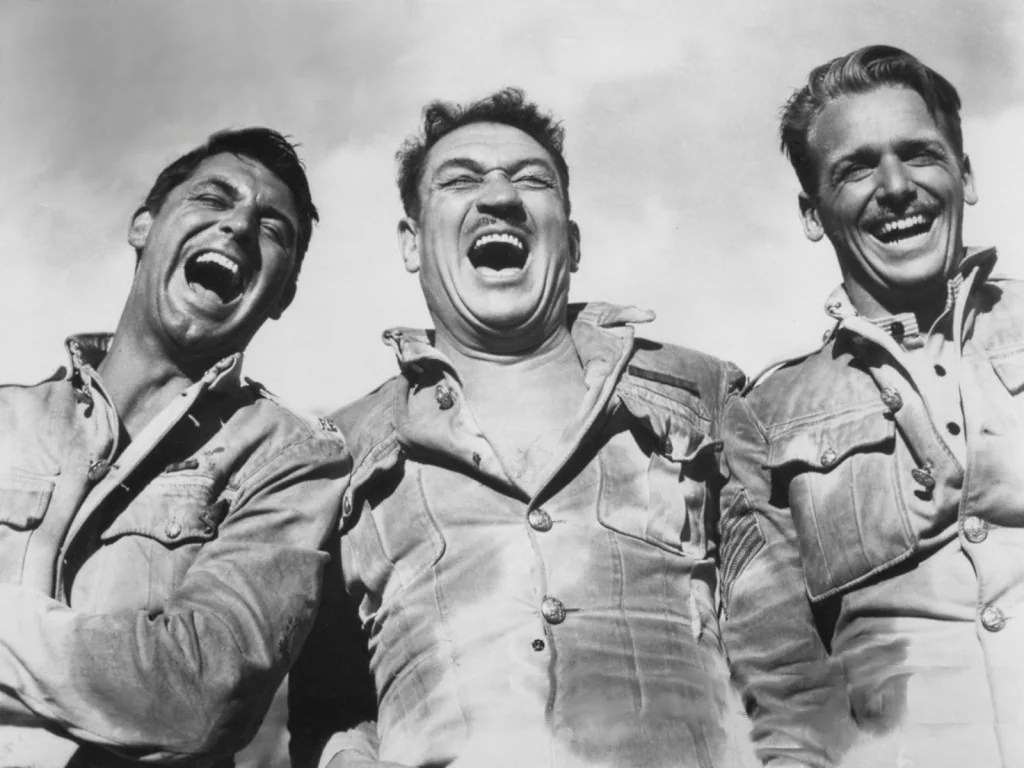
I don’t know what to say about this movie. I really don’t. It was a mix between a comedy and drama with a lot of racist undertones against the Indian people who Great Britain took over for no reason other than greed and power.
Then at the end they acted like these three idiots were heroes, when half of the people who died wouldn’t have if Cary’s character hadn’t been looking for gold.
To me it was a great big statement on imperialism and while the movie was trying o portray British patriotism I found it fairy sickening to watch them gun down Indians whose land it was in the first place.

And the music playing throughout this movie tried to make it seem like it was a goofy romp, even while the footage before our eyes tried to play it off as a serious epic. I was so thoroughly confused.
Also, Douglas Fairbanks Jr. looked so bored in much of this movie. It was like he was trying to figure out what was going on with the rest of us.

The movie was overbudget and took longer to film than promised, according to an article on TCM.com.
“Filming began in June of 1938 and was set to last for 64 days. Due to the working methods of director Stevens and to a studio anxious to produce its most prestigious picture to date, Gunga Din would ultimately go over budget, miss its release date of Christmas, 1938, and the shooting schedule would stretch well beyond the allotted 64 days to a total of 104 days.”
The movie was shot in the deserts of Lone Pine, California, and temperatures of up to 115 degrees took a toll on the cast and crew.
A number of scenes that involved journalist and poet Rudyard Kipling — who wrote the poem and short stories that the movie was based on — were cut at the request of his widow who knew that at that time audiences would have been shocked and laughed at the idea of a journalist being embedded with the army. This is something modern audiences wouldn’t even blink an eye at today.
I found it interesting that author William Faulkner worked on the original screenplay for $750 a week. I guess I always thought of him as more highbrow than writing screenplays for movies. In the end it wasn’t his screenplay that was used, but instead one by Charles MacArthur and Ben Hecht.
The expenses paid out for the movie was one reason the movie ended up costing the most of any movie that the RKO Studio had made so far at $1.9 million. Of course it wasn’t the most expensive movie released that year. That went to Gone With The Wind produced by David Selznick’s Selznick International Pictures and Metro-Goldwyn-Mayer with $3.8 million.
Gunga Din only brought in $2.8 million but was re-released in 1941 and again in the 50s and gained back even more of it’s production costs over the years.

While I thought Douglas looked bored in this movie, he looked back on it with fondness, even though a biography on Cary reports that the veteran actor stole a scene from Douglas so Cary would look better.
From TCM.com: “In his biography Cary Grant: A Touch of Elegance, Warren G. Harris relates a story from the set in which “…Grant deliberately cheated Douglas Fairbanks, Jr., out of one of the most memorable moments in the picture. In a rooftop scene, Fairbanks had to wrestle with a native, pick him up and hurl him into the street below. Grant coveted the bit himself, so he told his co-star, ‘Doug, you really shouldn’t do this. It looks like you’ve killed the guy. It wouldn’t help your image. And you know your father would never have done such a thing on the screen.'” The ruse worked, and when Stevens asked for a volunteer for the shot, Grant jumped at the chance.”
This didn’t stop Douglas from still admiring Cary though because he later told another biographer writing about Cary: “ . . . .the most generous player I’ve ever worked with. He wasn’t just taking his salary. He was concerned that the picture be a good picture. He thought that what was good for the picture was good for him, and he was right. He was very shrewd that way. He was a master technician, which many people don’t realize, meticulous and conscious of every move. It might have looked impetuous or impulsive, but it wasn’t. It was all carefully planned. Cary was a very sharp and intelligent actor who worked out everything ahead. I called him Sarge or Sergeant Cutter, and he called me Ballantine right to the end of his life.”
There are other reviews online bothered by the racist undertones of the movie and just the confusing antics of the three main characters.
“I can see how the film would be epic at the time,” writes the author of Opus.ing.com. “But in this day and age, where epics are tossed off every six months or so, it’s hard to look past the film’s dated-ness and timely flaws. Not an unenjoyable film, but if you’re looking for a “classic” epic, you may wish to look elsewhere — and if you’re looking for an honest, unromantic view of British imperialism, you’ll definitely want to look elsewhere.”
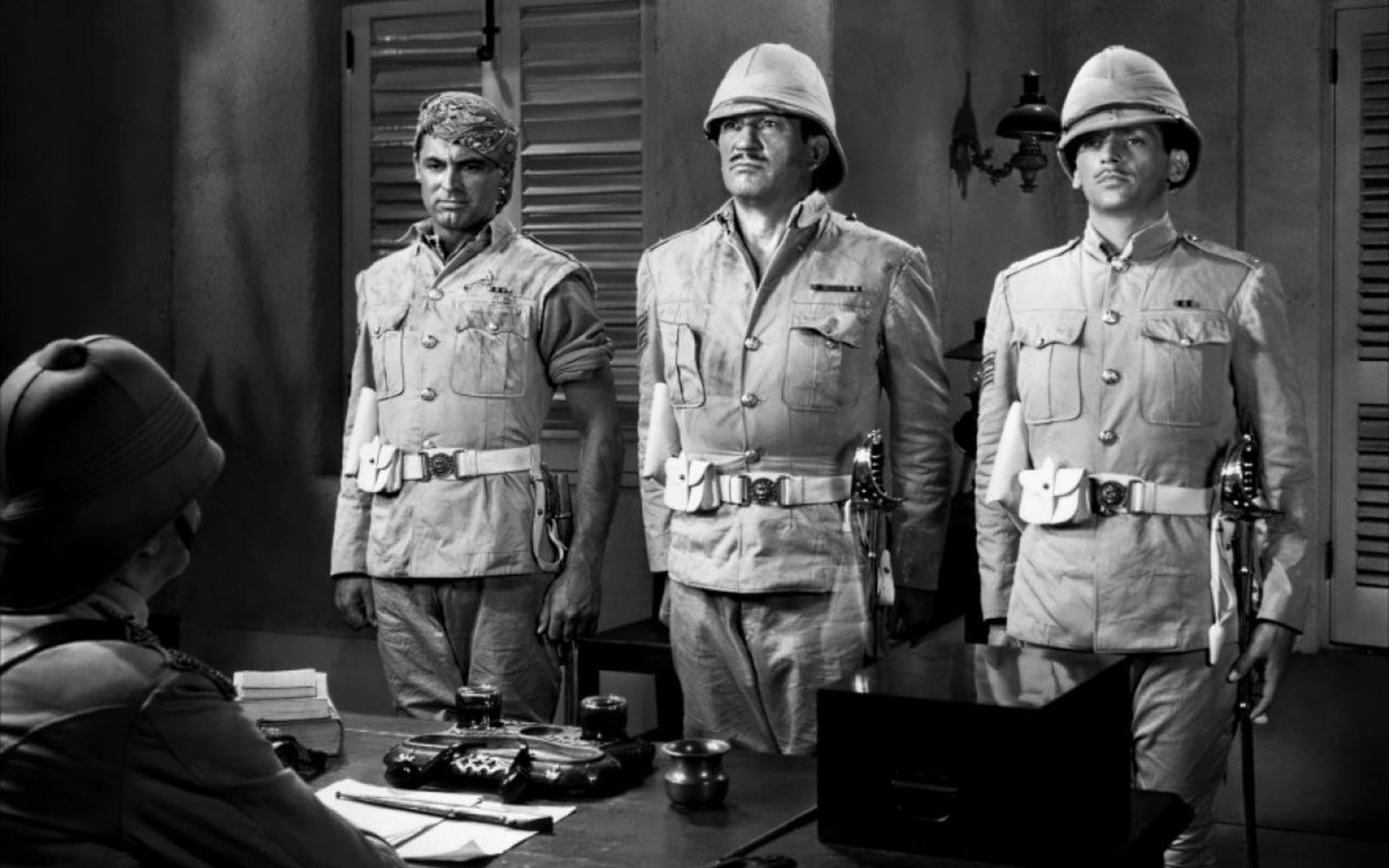
This author also noticed Cary’s accent issues: “Far too much time is spent on the hijinks of the three officers, played by Victor McLaglen, Douglas Fairbanks Jr., and Cary Grant (whose accent seems to change with every scene), such that the titular character, an Indian bugler who wants more than anything to prove himself a soldier, easily becomes overshadowed.”
When I describe Cary’s accent issue, think Kevin Costner in Robin Hood: Prince of Thieves.
Yeah.
That bad.
TCM admits that there have always been issues with the movie regarding it’s political correctness (for lack of a better term). The film was even banned in India.
“But as a pure adventurous lark,” writes TCM’s Jay Steinberg. “Gunga Din holds up as well now as then, and retains its place amongst the top films of 1939, Hollywood’s greatest year.”
If he thinks so….I will just agree to disagree.
Have you ever seen this one? What did you think of it?
Up next for my Winter of Fairbanks Jr. is: The Young At Heart
The rest of the movies I will be watching include:
Having Wonderful Time (February 6)
Chase a Crooked Shadow (February 13)
Sinbad The Sailor (February 20)
The Rise of Catherine the Great (February 27)
The Sun Never Sets (March 6)
You can also find my impressions of previous movies in the series, as well as other classic movies here: https://lisahoweler.com/movie-reviews-impressions/
I loved this history-filled post about the movie by Cat’s Wire.
Discover more from Boondock Ramblings
Subscribe to get the latest posts sent to your email.

“Not unenjoyable”, that’s quite well put.
I think if I want to watch a classic adventure movie, this will not be the one I’m going to grab. I’ll keep it as part of my Grant collection, but there it will be the one getting dusty again. Cat https://catswire.blogspot.com/
LikeLiked by 1 person
Yes, I don’t think I’ll watch this one again anytime soon.
LikeLike
Pingback: Sunday Bookends: Cold weather (still), planned reads for February, and a lot of Edwardian Farm – Boondock Ramblings
I read Cat’s review of the movie. She seemed to feel a lot like you. I think it’s so hard to look at movies (and music) through the lens of today. Do you watch them because they’re a portrayal of the times, or do you avoid them because they’re so accurate and show how bad the times were? As I told Cat, my son and I have this conversation every once in a while about Michael Jackson. Do you not listen to or watch his music because of the allegations against him? Or, since he’s dead and can’t profit from the music anymore, is it ok? Where do you draw the line? I honestly am not sure. MJ had a lot of wonderful music…but, if he was guilty of the thing…do you quit listening to it? I just don’t know. Given both of your reviews, I don’t think I’m going to even waste my time looking for this movie. And, why was it called Gunga Din if the main characters were the three other guys?
https://marshainthemiddle.com/
LikeLiked by 1 person
It is hard to know where to draw the line, but I think my issue in this movie is it simply didn’t know what it was – a comedy or drama. It was like whiplash..beyond all the ridiculous praising of British Imperialism. But it is hard to separate the art from the artist sometimes in those situations like Michael Jackson or Neil Gaiman (just recently) or others accused of horrible things. I don’t know how to answer it other than there must have been something good in those people…somewhere deep down and small…that they could create such good art while doing such awful things.
LikeLike