Welcome to the Weekend Traffic Jam Reboot where we offer a place for bloggers to link up and get a fresh set of eyes on their posts. We also feature one blog a week, letting our readers know about the blog and providing a link so readers can learn more about them.
Look for the post to go live about 9:30 PM EST on Thursdays.
We’ve had a slow week here, which I don’t think is a bad thing. Some more sun than normal a couple of days but as I am writing this it is very gloomy, dark, and rainy out. Tomorrow we are back into some colder temps and Sunday looks to be horrible with a high only of 26 but I am hopeful that our very, very cold temperatures are behind us as we move toward Spring.
I read a lot this week, trying to finish two books from my winter TBR because, for me, Spring starts March 1, even if it isn’t officially spring.
Let’s move on to introducing our hosts this week:
Marsha from Marsha in the Middle started blogging in 2021 as an exercise in increasing her neuroplasticity. Oh, who are we kidding? Marsha started blogging because she loves clothes, and she loves to talk or, in this case, write!
Melynda from Scratch Made Food! & DIY Homemade Household – The name says it all, we homestead in East Texas, with three generations sharing this land. I cook and bake from scratch, between gardening and running after the chickens, and knitting!
Lisa from Boondock Ramblingsshares about the fiction she writes and reads, her faith, homeschooling, photography and more.
Sue from Women Living Well After 50 started blogging in 2015 and writes about living an active and healthy lifestyle, fashion, book reviews and her podcast and enjoying life as a woman over 50. She invites you to join her living life in full bloom.
We would love to have additional Co-Hosts to share in the creativity and fun! If you think this would be a good fit for you and you like having fun (come on, who doesn’t!) while still being creative, drop one of us an email and someone will get back with you!
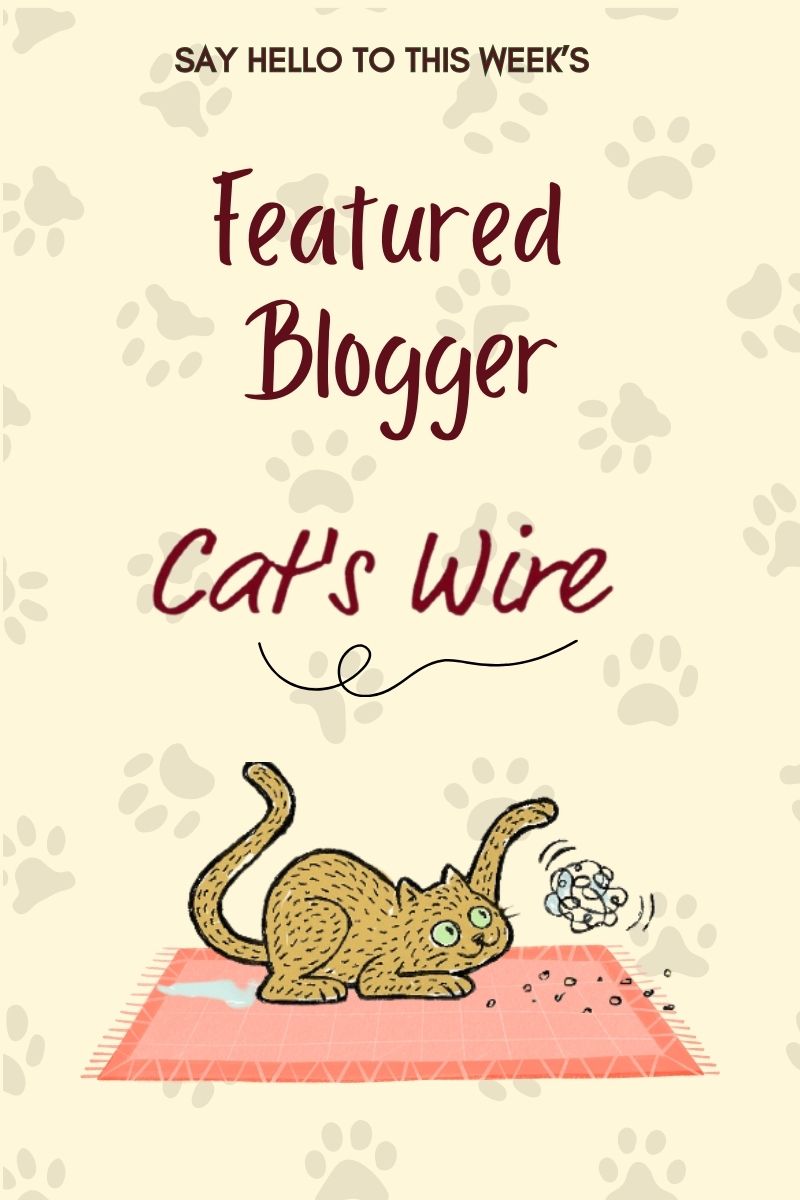
WTJR will be highlighting a different blogger each week this year! We invite you to stop by their blog, take a look around and say hello! This week we are spotlighting Cat’s Wire!
I love Cat’s posts about her cats, old movies, her beading, books, and so much more. She and I sometimes watch the same movies and chat about them through our blog posts and blogs. We’ve also chatted through the Crafternoon zoom calls that Erin from Still Life, With Cracker Crumbs and I have.
Here is a little about her from her about section: Bookworm, movie fan, crazy cat lady, armed with wire, cabs, and beads!
I hope you will take the time to check out her blog.
And now on to my highlights from our links for this week:
Thank you so much for joining us for our link-up! Please remember that this is a link-up where you can share posts from the previous week or posts from weeks, months, or years ago. All we ask is that they be “family-friendly”.
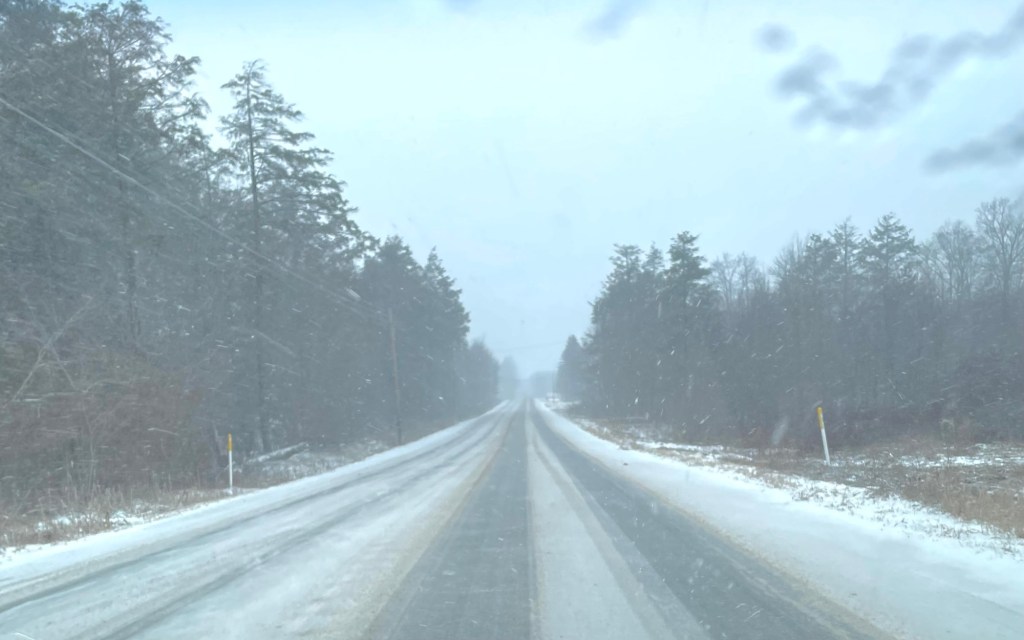
This week we were surprised by snow and unfortunately it wasn’t a pleasant surprise since I was driving in it at the time. I thought it was merely going to be flurries, but oh no…it started sticking. Driving with snow on the road? No. that’s not something I do. Like ever anymore.
But there I was driving to my parents to return their car to them, thinking the entire seven minute drive that it really wasn’t as slippery as it probably was. You ever ask yourself, “Why are people out in this?” when the weather is bad?
I am normally one of those people who ask that, not one who is driving in it but I just kept thinking the snow would stop and the road would clear up.
I made it to my parents with white knuckles. The plan was for my husband to pick me up on his way home from work but Dad decided he’d better drive me home so my husband didn’t get our car, which doesn’t have great tires, stuck on my parents’ dirt road.
Honestly, I think Dad was excited to be needed and get out in that snow. He loves driving in the snow. That’s crazy to me. On the way back to my house he said, “If there isn’t six inches on the road it doesn’t bother me.”
We made it back to my house fine and Dad made it back to his house as well. Another inch or so fell that night and The Boy didn’t have to go to school the next morning.
While I don’t usually drive in snow at all, there was two other times I had to do it — both while working for newspapers.
The first time I was working at the local daily newspaper and when I left work the roads were covered. I was nervous but started inching my way the 15 miles to home. There was one hill I was very worried about and I did well going up it but was nervous going down. There was a line of cars behind me but only one of them seemed annoyed by me going slow. Everyone else was also going slow since there was maybe three inches of white slush covering the roads. Well, almost everyone. One driver of a pickup truck decided he needed to get by us so he passed a couple of cars.
I might have muttered something like, “You idiot,” as he went by.
Several feet in front of me he fishtailed but was able to gain control again.
“See!” I shouted at my windshield. “There’s a reason we’re all going slow!”
He ended up having to drive slowly all the way to the area called The Valley where we lived.
The other time I was stuck in snow was, again, coming home from a newspaper job. This time I was working in New York State, about 50-minutes from our apartment at the time.
I kept asking to go home but the editor wanted me to finish a couple of things. He finally allowed me and by then the main highway was covered in snow and ice. There are two lanes going east and two going west on this highway and I was going east to get home. I was not going very fast and no one was passing me because it was that snow with a layer of ice on top.
At one point I hit some of that ice and my car started to spin until I was all the way around facing the oncoming cars. Thank God I didn’t go into panic mode, causing my brain to freeze up. Instead, I ripped the car into reverse and backed it into the median and waited for the other cars to pass me before trying again.
A 50-minute drive took probably 90-minutes that day, but I was so glad to be home.
All this being said, I am really looking forward to some temps in the 40s this upcoming week where we live. Even a couple days of sun would be so nice.
Other than my driving adventure, we didn’t do too much else this week. I did take Little Miss to Kid’s Club at a local church on Wednesday and it was nice to get out of the house a little bit.
I’m not sure if I shared this photograph of a bald eagle eating a rabbit that The Husband took a couple of weeks ago on here or not. I’m going with not.
He took this shot with his iPhone. The eagle was close to the edge of the road, and I am so excited that Little Miss was able to get a look at it because she often misses the wildlife we see.
How was your week last week?
Do anything fun or interesting? What teas are you drinking this day if you are a tea drinker? Let me know in the comments.
Welcome to the Weekend Traffic Jam Reboot where we offer a place for bloggers to link up and get a fresh set of eyes on their posts. We also feature one blog a week, letting our readers know about the blog and providing a link so readers can learn more about them.
Look for the post to go live about 9:30 PM EST on Thursdays.
I think weather forecasters have just given up on trying to figure out our weather in Pennsylvania. Today we were told we’d have some sun but instead we got half an inch of snow and me driving to my parents with white knuckles. I had borrowed their car and was taking it back with plans for my husband to pick me up after work. My dad ended up driving me back because the tires are better on his car and he didn’t want my husband to get stuck on their dirt road. So, we headed back with Dad driving because I honestly think he loves driving in snow. I, however, hate it and don’t want to drive at all the rest of this winter – especially if these unexpected snow events are going to happen.
Anyhow….on to introducing your hosts for Weekend Traffic Jam Reboot!
Marsha from Marsha in the Middle started blogging in 2021 as an exercise in increasing her neuroplasticity. Oh, who are we kidding? Marsha started blogging because she loves clothes, and she loves to talk or, in this case, write!
Melynda from Scratch Made Food! & DIY Homemade Household – The name says it all, we homestead in East Texas, with three generations sharing this land. I cook and bake from scratch, between gardening and running after the chickens, and knitting!
Lisa from Boondock Ramblingsshares about the fiction she writes and reads, her faith, homeschooling, photography and more.
Sue from Women Living Well After 50 started blogging in 2015 and writes about living an active and healthy lifestyle, fashion, book reviews and her podcast and enjoying life as a woman over 50. She invites you to join her living life in full bloom.
We would love to have additional Co-Hosts to share in the creativity and fun! If you think this would be a good fit for you and you like having fun (come on, who doesn’t!) while still being creative, drop one of us an email and someone will get back with you!
WTJR will be highlighting a different blogger each week this year! We invite you to stop by their blog, take a look around and say hello! This week we are spotlighting Style Yourself Confident.
Pamela says about her blog, “Hi – I’m Pamela thank you so much for visiting my corner of the Internet.
This website is about LOOKING GOOD and FEELING GOOD about yourself, whatever your age shape or size!
Although most women will tell you that looking good and feeling good generally go hand in hand, each of us has a different agenda for what makes that happen.
Many years ago, I trained as an Image Consultant but I’ve always been reluctant to use the title because it’s so pretentious. We’re overdosed with patronizing makeover shows on TV which have nothing whatsoever to do with real life!
The world as a whole often regards the older woman as invisible but it’s easy to take back control of the way you look and feel with a little fun, flexibility and plain old fashioned common sense.
Let me help you discover a little about the COLORS and SHAPES that nature designed for you because it’s never too late to discover STYLE CONFIDENCE!”
Thank you for being part of the Weekend Traffic Jam Reboot, Pamela!
Thank you so much for joining us for our link-up! Please remember that this is a link-up where you can share posts from the previous week or posts from weeks, months, or years ago. All we ask is that they be “family-friendly”.
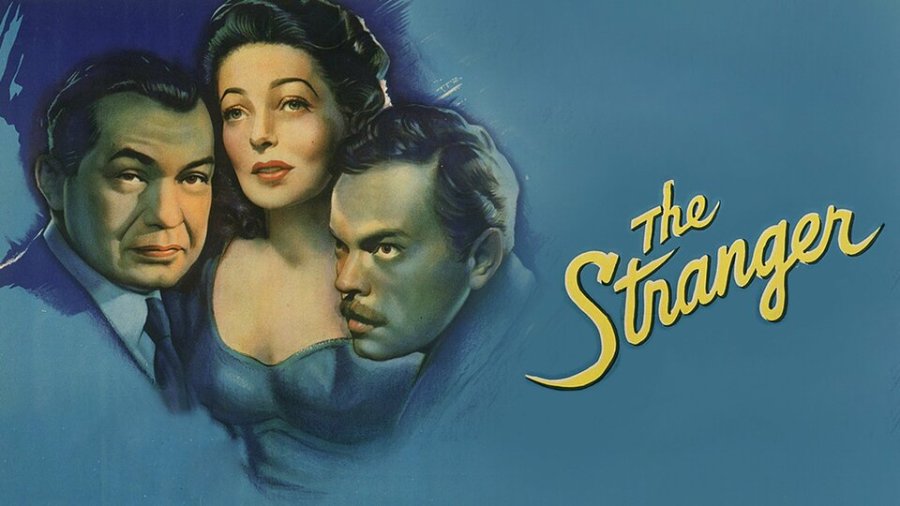
A few weeks ago, my husband suggested we watch an Orson Welles movie. Since I’ve liked other movies by and starring Orson, I agreed to it.
The Stranger was released in 1946 and tells the story of a war crimes investigator who tracks a high-ranking Nazi fugitive to a small Connecticut town.
Welles both directed and co-wrote the film but was uncredited for the writing, which was most likely part of the many concessions he made for the opportunity to direct it. This is a movie that some call his most conventional. It’s also one he wasn’t as fond of because so many changes were made to the final cut without his consultation.
The movie stars Welles, Edward G. Robinson, and Loretta Young.
The creepy undertone throughout the entire movie left me always waiting for the other shoe to drop.
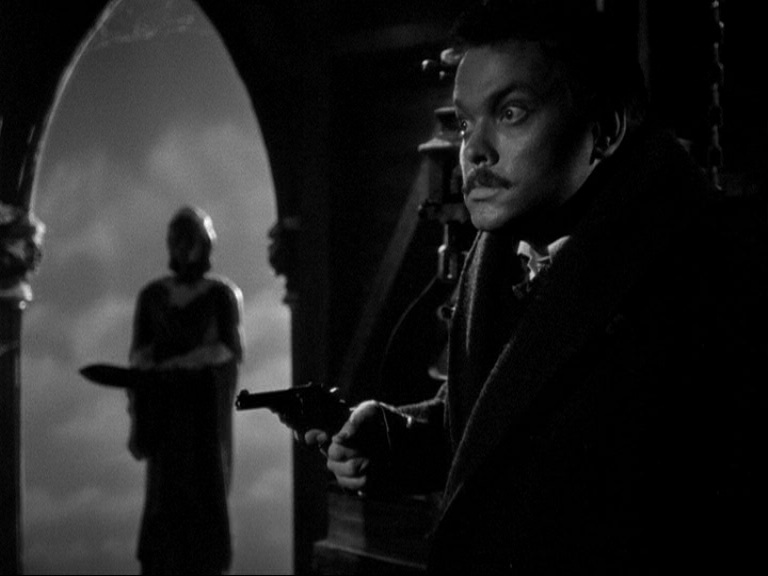
Nazi fugitive, Franz Kindler (Welles), has done his best to assimilate into American society. He’s even about to marry the daughter of a justice of the U.S. Supreme Court.
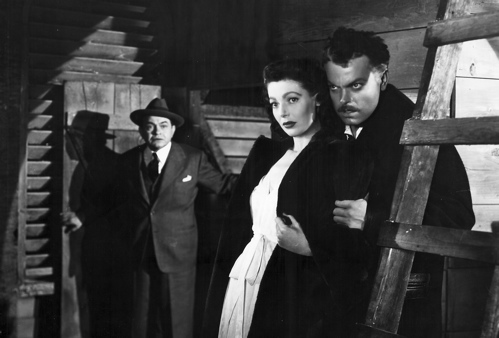
Edward G. Robinson, playing war crimes investigator Mr. Wilson, follows one of the recently released followers of Kindler to the town, hoping he’ll lead him to Kindler. The man suddenly disappears though, and Wilson is certain he’s been murdered by Kindler, but still doesn’t know who Kindler actually is. Only that he is somewhere in the town.
We the viewer, know all along what happened to the man and who made it It happens about 15 minutes into the movie, but Robinson has to spend much of the movie trying to figure it out and once he does figure it out, he spends the rest of the movie trying to make Kindler admit who he really is. The only thing Robinson’s character really knows when he comes to the town is that Kindler had an almost unhealth obsession with old clocks.
It’s a fantastic, stressful game of cat and mouse that had me literally biting my nails part of the time.
The music of the movie is very interesting – mixing in a creepy violin-based humming, with happier melodies to try to show the contrast between an innocent, happy world being infiltrated by pure evil.
It always amazes me how quickly movies were made back then. Filming for this movie took place from September to November of 1945 and was released July 2, 1946.
Originally the film was going to be directed by John Husten, but he entered the military and Welles begged producer Sam Spiegel (also called S.P. Eagle at the time) to let him direct the film. Spiegel agreed as long as Welles agreed to several concessions and to be let go as director if he stepped out of those perimeters. Welles would still have to continue on as the lead actor, even if he was let go as director, however.
Welles agreed. He needed the job if he wanted to continue in Hollywood. Five years earlier Welles had been essentially backlisted with the release of Citizen Kane, which won 9 Academy Awards, including Best Director, Best Movie, and Best Actor for Welles. This should have made Welles a sought-after director and actor. Citizen Kane was based on the life of one of the most powerful men in the world at the time — William Randolph Hearst, a newspaper publisher and owner — though and Hearst wasn’t happy. In fact, he was furious. He made life very difficult for Welles and anyone else associated with the making of the movie, which is now considered the greatest movie all time thanks to its innovative filmmaking techniques, complex story, and influential impact on cinema history.
“In September 1945 Welles and his wife Rita Hayworth signed a guarantee that Welles would owe International Pictures any of his earnings, from any source, above $50,000 a year if he did not meet his contractual obligations,” an article on Wikipedia states. “He also agreed to defer to the studio in any creative dispute.”
This became a challenge when Editor Ernest J. Nims was given the power to cut any material he considered extraneous from the script before shooting began.
“He was the great supercutter,” Welles said, “who believed that nothing should be in a movie that did not advance the story. And since most of the good stuff in my movies doesn’t advance the story at all, you can imagine what a nemesis he was to me.”
Reading about all the cuts that were made from the script, and the final product helps me to understand why this movie feels so choppy at times. It feels like elements that would have helped to explain some of the plot better are missing.
What is really missing is building up Welles’ character and helping the viewer get to know who he is. As I read online, I found out that there were scenes removed from the beginning of the movie that would have given us more character development for Welles’ character.
I feel like Nims really overdid things and should probably be ashamed of chopping up Welles’ work.
I also thought that it was interesting that Welles wanted a female actress to portray the investigator.
“I thought it would be much more interesting to have a spinster lady on the heels of this Nazi,” Welles said.
Welles would later say in interviews that nothing of The Stranger was his in the end. Biographer Frank Brady disagrees, “Welles has said, since the making of The Stranger—which he completed one day before schedule and under budget—that nothing in the film was his, this despite the fact that the unmistakable Wellesian moods, shadows, acute angles, and depth-of-focus shots are pervasive. Within the film is a second film, another Wellesian touch, consisting of snatches of documentary footage showing Nazi atrocities.”
One unique aspect of The Stranger is that it was the first commercial film to use documentary footage from the Nazi concentration camps.
Welles viewed Nazi Concentration Camps (1945), a film used as evidence in the Nuremberg Trials in early May 1945 as a correspondent and discussion moderator at the United Nations Conference on International Organization
One thing I didn’t remember until reading about it this week was that in the 1940s, many in the world simply couldn’t accept that the concentration camps were real.
Welles wrote about the footage in a column for the New York Post:
“No, you must not miss the newsreels. They make a point this week no man can miss: The war has strewn the world with corpses, none of them very nice to look at. The thought of death is never pretty but the newsreels testify to the fact of quite another sort of death, quite another level of decay. This is a putrefaction of the soul, a perfect spiritual garbage. For some years now we have been calling it Fascism. The stench is unendurable.”
Though the studio did not think The Stranger would be a success, it actually was and right out of the gate too. It cost $1 million to make and earned $2.25 million in U.S. rentals in its first six months. Fifteen months later had grossed $3.2 million.
I very much enjoyed the film, but I do wish that Kindler’s German accent would have come back as soon as his cover was blown. Having him keep the American accent he’s been using to keep his cover, even when under pressure, seemed unrealistic to me.
Despite that small issue, Welles is so deliciously evil in this. His excuses for his crimes against humanity were presented with a lecherous smile that sent shivers down my spine. The tension throughout the film is extreme. I never knew when Kindler would finally snap and reveal himself or worse — kill someone to keep his identity secret.
I found this one on YouTube for free, but it is also streaming in better quality on several streaming sites, including Amazon Prime.
Have you ever watched this one? What did you think?
It’s time for our Sunday morning chat. On Sundays, I ramble about what’s been going on, whatthe rest of the familyand I have been reading and watching, andwhat I’ve been writing. Some weeks I share what I am listening to.
The weather is so cold in our area that we are doing our best to conserve heating oil by dressing in layers, wrapping ourselves in blankets, and using microwavable rice packs to warm our feet and laps. This might sound dystopian to some, but I have actually been having fun with it and enjoying my little blanket nests and my warm rice packs. Check back after our planned arctic cold snap this week and see if I still see this all as an adventure. Of course, my attitude will also plan on whether or not I need to go out in the cold on any of the days that the weather is supposed to be so cold.
I talked a little about what else has been going on in our world in my Saturday Afternoon Chat yesterday.
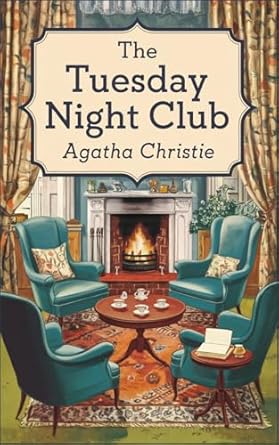
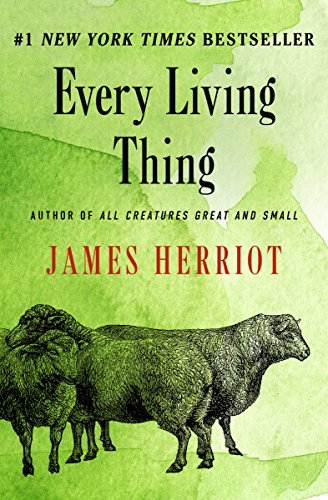
I’ve been switching between The Tuesday Night Club (Miss Marple) by Agatha Christie and Every Living Thing by James Herriot.
I read Miss Marple during the day, usually, and James Herriot right before bed.
I am enjoying them both, but Herriot’s a bit better. Both are a collection of short stories with some connections, such as characters. I am not a huge fan of Christie’s writing style at times and this format, which involves people sitting around and telling each other stories, is a bit dry to me. The stories are good but it does get repetitive for every story to feature someone telling a story they supposedly don’t have an ending to, Miss Marple to solve the case, and then the person telling the story to go, “Actually, I do know what really happened. Let me tell you.”
It’s all a bit tedious but there are some humorous moments and quotes from Miss Marple so I am pushing through.
I also just started Nancy Drew: The Sign of the Twisted Candles by Carolyn Keene.
I am itching for a good novel after these two, which I will finish this week, so I am planning to start A Fatal Footnote by Margaret Loudon, which is a cozy mystery.
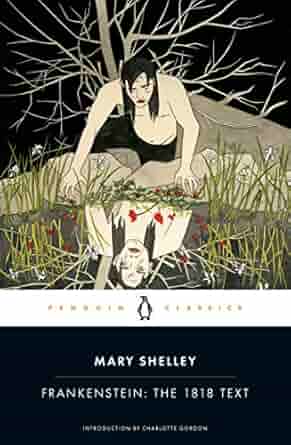
I am listening to Frankenstein while doing my dishes.
Little Miss and I are also reading Sign of the Beaver by Elizabeth George Speare.
She is reading (here and there) Harry Potter: Prisoner of Azkaban.
The Husband is reading Starter Villain by John Scalzi.
This past week The Husband and I watched the first part of Going Postal on Peacock. I watched a lot of Victorian Farm and more All Creatures Great And Small (even going back to the beginning for fun).
Now it’s your turn. What have you been doing, watching, reading, listening to or writing? Let me know in the comments or leave a blog post link if you also write a weekly update like this.
Some commenters have been telling me there are issues with commenting on WordPress. If you can’t comment, but want to, please feel free to hit the contact link at the top of the page.
You can also support my writing and chat about books, mysteries, old movies, vintage books, mystery shows, etc. for $3 a month at my Patreon here: https://patreon.com/LisaHoweler.
If you like my content you can subscribe to my posts for free here too.
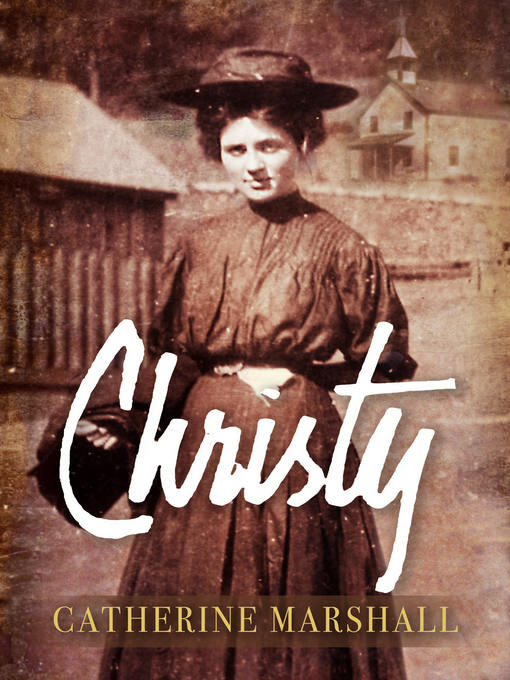
Christy by Catherine Marshall is a very dense book. It is full of life lessons weaved between poetic prose and hard realities of life in the Smoky Mountains in the late 19th and early 20th centuries. Following the story of fictional 19-year-old Christy Huddleston, the book is fiction but based, very loosely, on the real-life experience of Marshall’s mother, Leonora Whitaker Wood.
The CBS series, Christy, starring Kellie Martin, and a couple of made-for-TV movies were based on the book. I watched the show in the 1990s but had never read the book. I didn’t even know the TV-movies existed until I was doing research for this post.
In both the show and the book, Christy travels to a small mission in the mountains of Tennessee from her home in Ashville, North Carolina to teach in a school full of mountain children who have very little material items but a lot of heart and heartache.
The small area where these children and their families are from is called Cutter Gap. The fictional area isn’t really a town since it is only a collection of cabins scattered across the mountains and through the woods, but there is a fiction town called El Pano, located near it. The families in Cutter Gap are poor, uneducated, and fighting for their lives against disease and judgment.
Christy arrives at the mission after listening to the mission founder speak about it and begins her work with Miss Alice Henderson, a Quaker woman, and Pastor David Grantland, a minister who has been assigned to the school.
Once she arrives she meets other colorful members of the community — Dr. Neil McNeil, resident Ruby Mae, and resident Fairlight Spencer (who becomes her best friend), as well as other colorful (shall we say) characters. She also begins to learn more about the history of the area, the hardships they have faced since the 1700s, and the way some of the men feel they have to take a criminal route in life to scrape out a living.
There is a lot of beauty mixed in with some very ugly tales within the 500 pages of Christy. I marked up a lot of the book to remember parts of it later. Even though I found parts of the faith message of the book contradictory and a little confusing at times, there were many parts that were extremely thought-provoking and moving to me.
Most of what I underlined in the book were quotes by Miss Alice, who was my favorite character in the book besides Fairlight Spencer. In the beginning of the book, I found it hard to connect Christy who was very hard-headed and brash at times. She came to the mission with head knowledge of God but not heart knowledge of him.
I couldn’t stand David Grantland through most of the book and wasn’t sure what to make of Neil McNeil.
I wanted to shake Christy a couple of times throughout the book and tell her not to rush into dangerous situations. Toward the end of the book, though, when she truly struggled with the faith that she had only really found since working at the mission, I related to her immensely. So much of what happened to the people she’d come to love in Cutter Gap seemed so cruel to me. Even though the book was fiction, I found myself questioning the goodness of God, thinking about some similar cruel situations of those I’ve known over the years. It’s something I had to sit and wrestle with mental and spiritually in the moments, hours, and days after finishing the book. In many ways I am still struggling with these questions about God and the goodness I sometimes don’t see.
Some of the sections I underlined in the book included:
“Evil is real – and powerful. It has to be fought, not explained away, not fled. And God is against evil all the way. So each of us has to decide where WE stand, how we’re going to live OUR lives. We can try to persuade ourselves that evil doesn’t exist; live for ourselves and wink at evil. We can say that it isn’t so bad after all, maybe even try to call it fun by clothing it in silks and velvets. We can compromise with it, keep quiet about it and say it’s none of our business. Or we can work on God’s side, listen for His orders on strategy against the evil, no matter how horrible it is, and know that He can transform it.”
“What do you do when strength is called for and you have no strength? You evoke a power beyond your own and use stamina you did not know you had. You open your eyes in the morning grateful that you can see the sunlight of yet another day. You draw yourself to the edge of the bed and then put one foot in front of the other and keep going. You weep with those who gently close the eyes of the dead, and somehow, from the salt of your tears, comes endurance for them and for you. You pour out that resurgence to minister to the living.”
“I’d long since learned that no difference in viewpoint should ever be allowed to cause the least break in love. Indeed, it cannot, if it’s real love. …But relationships can be kept intact without compromising one’s own beliefs. And if we do not keep them intact, but give up and allow the chasm, we’re breaking the second greatest commandment.”
“The secret of her calm seemed to be that she was not trying to prove anything. She was—that was all. And her stance toward life seemed to say: God is—and that is enough.”
This was one of the few books I’ve read that I became completely immersed in when I read it. Everything around me disappeared – the language and descriptions were so vivid. I could see the mountains, picture the cabins and the people, and sometimes even smell, sadly, the smells.
It took me a little over a month to read through the book because it was so dense. I felt like I really got to know the characters that way and this was both a good and a bad thing.
It was a bad thing because, toward the end, some of the events hit me so hard and left me on my couch on a cold Sunday afternoon with a warm fire in our woodstove burning and me crying until my sides hurt.
I like to be immersed in books but at that moment I thought that maybe I wouldn’t like to be so immersed if it was going to be this painful to continue to read on.
I won’t give away too much but there was a death in the book that I could not make sense of in the least. Much of the book seemed to want the reader to see that there was hope still available, even in the midst of darkness, anger, and sadness, but when we had almost reached the end it was like that message was yanked out from under us with such a ferociousness that it made my head spin.
When I was reading the book, I was thinking, “Wow. There are so many deep messages about our relationship with God in this book” but then I was like, “But there were some really theological muddy waters in this book and I’m not sure how I feel about that.”
There was a lot of talk about superstitions and instead of dispelling them by saying God is in control, there were times the characters tried to explain it away by science or simply telling the mountain people that their beliefs were faulty. There is little to no mention of Jesus in this book. Yet this book is marketed as a great Christian book. That confuses me a little. Still, the story, overall, was very compelling, interesting, and realistic (maybe a bit too realistic).
I saw a review of this after I read it that tagged the book as being “heartfelt” and “family-friendly.”
The book was NOT family-friendly. There are discussions of rape, abuse, murder, molestation, and many other disturbing and triggering topics. There are not, however, extremely graphic descriptions of these subjects.
There are times this book seems to push that there is truth in superstition, even though, I’m sure that’s not what the author, a well-known Christian author, meant to do.
In the end, Christy was a painfully beautiful book that wrung me out emotionally. It challenged my thinking, built me up, tore me down again, and left me with a glimmer of hope that Christy and the people of Cutter Gap found some joy and happiness beyond the time frame addressed within the book’s pages.
I would be remiss if I did not mention that the ending of this book is very open-ended and, to me, somewhat abrupt. It does not answer all of the reader’s questions. Or it didn’t answer some of my questions at least. It left me with a bit of mystery and with a strong desire for a sequel.
According to more than one article online, notes for a sequel to the book were discovered in Catherine Marshall’s things after her death by her family. Those notes have never been revealed, however. Part of me would love to know what happened to Christy after the events at the end of the book (which were wrapped up a bit too quickly for me), but part of me agrees with the blogger of Taking Up Room who wrote, “Christy ending on a question mark has never failed to get my brain thinking, even after dozens of times of reading the book. In a way, it means the story never really ends. Adding more might just spoil whatever ending fans have come to in their own minds, and that’s no fun. I say keep the mystery.”
Many commenters have been telling me there are issues with commenting on WordPress. If you can’t comment, but want to, please feel free to hit the contact link at the top of the page.
If you like my content you can subscribe to my posts for free or support my writing right here on WordPress for $3 a month. Later in 2025 I will be offering exclusive posts for paid subscribers.
It’s time for our Sunday morning chat. On Sundays, I ramble about what’s been going on, whatthe rest of the familyand I have been reading and watching, andwhat I’ve been writing. Some weeks I share what I am listening to.
The other day I became overwhelmed with worry that I have failed my son, the high school senior. Like maybe I didn’t teach him enough or well enough during our six years of homeschooling. The last two years have been tough. He’s had senioritis both of those years. He’s so ready to be done with high school. Getting him to do his schoolwork has been torture.
I went to him a couple of nights ago while he was preparing his dinner plate and felt very overcome with emotions. I apologized to him and told him I hoped I had taught him what he needed for the future. I told him that I did my best but sometimes it was hard when he didn’t seem interested in learning so I would try to back off and let him explore the subjects he was really interested in. Maybe that was the wrong thing to do, I told him. Maybe I should have been more strict or —
I looked at him and my kid has this dumb grin on his face.
I’m practically crying and he’s grinning at me? What’s this about?
He’s not really looking at me either. So —
He laughs this really stupid laugh , looks up at me, and his smile fades. “What?” he asks. “What’s going on? Why do you look like you’re going to cry?”
That’s when I remember that my son’s long hair covers his ears and in his ears are probably . . . Yes. Earbuds.
He’s been listening to a podcast the entire time and didn’t hear even one part of my lamenting speech.
“Were you saying something serious?” he asks. “What happened?”
I fill him in briefly and he laughs another stupid laugh and sas, “I was totally not listening at all.”
Apparently he isn’t really concerned that I might have screwed up as a parent so I suppose I shouldn’t be either.
I told him not to worry about it and walked back into the living room shaking my head. Sheehs. Kids. *wink*
Did I write last week that I decided not to finish The Definitive Oral Biography of Anthony Bourdain? I could go back and look, I suppose, or I could just run the risk of repeating it. I’ll run the risk.
So, yes, I DNF’d that book on Anthony Bourdain. I was terribly bored and a few chapters in I realized that reading broken up tidbits of people’s memories of Anthony wasn’t very interesting. There really wasn’t a story to the book. It was more like random memories and thoughts and interviews just tossed together in written form. If it had been filmed and I had been watching it, I might have been a little more interested, but this simply did not hold my attention.
I did enjoy reading Kitchen Confidential by Anthony himself — even though I didn’t enjoy aspects of it (how many times did he need to share the crude nicknames he had for his co-workers or how many times he shot up or snorted something before going to work on the line at well-known restaurants?). I did not enjoy reading how others met him or what interactions they had with him as much.
Anyhow, moving on to my current reads. I am reading The Tuesday Night Club, a series of short stories with Miss Marple, by Agatha Christie.
I also decided I needed something sweet and light one night this past week and got caught up in Every Living Thing by James Herriot, so I am also reading that. I absolutely love the sweet and interesting stories in his books but this one, where he is now older with children, is especially endearing.
I am listening to Frankenstein but I keep getting distracted so I may switch to actually reading it. I do enjoy Dan Stevens narration.
Little Miss is getting close to the end of Harry Potter: The Prisoner of Azkaban.
The Boy is listening to Frankenstein. Okay, he isn’t, but he will be soon because even though I am “making” him do it for school he does actually want to read it.
This week I watched The Exile with Douglas Fairbanks Jr., The Victorian Farm, All Creatures Great and Small, and a couple episodes of The Dick VanDyke Show.
Up next in my Winter of Fairbanks Jr. movie marathon was supposed to be Chase a Crooked Shadow but I can’t find it streaming anywhere. I did find it on DVD and do plan to order it because it looks good from the trailer I found. Anyhow, I am switching to Angels Over Broadway, which I found on YouTube, for this week.
I really swear I checked some of these before I put them on the list and I swear that they were streaming but now they are not. I will update any of the movies I can’t find streaming in my Winter of Fairbanks Jr. post this week.
So far it looks like the rest are on Amazon, Hulu, or other streaming services.
I am listening to Frankenstein, narrated by Dan Stevens, but I have a hard time focusing on it so we will see how that goes. I may have to switch back to the book again.
Now it’s your turn. What have you been doing, watching, reading, listening to or writing? Let me know in the comments or leave a blog post link if you also write a weekly update like this.
Welcome to the Weekend Traffic Jam Reboot where we offer a place for bloggers to link up and get a fresh set of eyes on their posts. We also feature one blog a week, letting our readers know about the blog and providing a link so readers can learn more about them.
Look for the post to go live about 9:30 PM EST on Thursdays.
I hope that you will look through the links and click on some and find a new blogger or two to follow. First, I’ll introduce you to our hosts:
Marsha from Marsha in the Middle started blogging in 2021 as an exercise in increasing her neuroplasticity. Oh, who are we kidding? Marsha started blogging because she loves clothes, and she loves to talk or, in this case, write!
Melynda from Scratch Made Food! & DIY Homemade Household – The name says it all, we homestead in East Texas, with three generations sharing this land. I cook and bake from scratch, between gardening and running after the chickens, and knitting!
Lisa from Boondock Ramblingsshares about the fiction she writes and reads, her faith, homeschooling, photography and more.
Sue from Women Living Well After 50 started blogging in 2015 and writes about living an active and healthy lifestyle, fashion, book reviews and her podcast and enjoying life as a woman over 50. She invites you to join her living life in full bloom.
We would love to have additional Co-Hosts to share in the creativity and fun! If you think this would be a good fit for you and you like having fun (come on, who doesn’t!) while still being creative, drop one of us an email and someone will get back with you!
WTJR will be highlighting a different blogger each week this year! We invite you to stop by their blog, take a look around and say hello! This week we are spotlighting Mummabstylish!!
A little about the Mummabstylish blog:
I’m Jacqui a 59 year old fashion and lifestyle blogger. I’ve been married to my soul mate David who I met over 40 years ago at college! I’m a mum of five children, three girls and two boys have 7 grand-kids who keep me very busy.
I started Mummabstylish back in 2016. I reached a time in my life where I felt I’d lost my way in life. The kids didn’t ‘need’ me anymore and although I help my husband at work don’t have a role anymore.
It’s important to me that I keep myself available for David and the family, but I still needed to find my place in the world!
So I started blogging. I looked into what fashions & styles I should be wearing at my age, but soon realised it’s quite the opposite, there are no set rules as to what you should wear at any stage of your life and basically learnt you should wear what you feel good in and like.
Thank you for linking up to Weekend Traffic Jam Reboot, Jacqui!
Thank you so much for joining us for our link-up! Please remember that this is a link-up where you can share posts from the previous week or posts from weeks, months, or years ago. All we ask is that they be “family-friendly”.
The Body in the Library (A Miss Marple Mystery) by Agatha Christie
Description:
It’s seven in the morning. The Bantrys wake to find the body of a young woman in their library. She is wearing an evening dress and heavy makeup, which is now smeared across her cheeks. But who is she? How did she get there? And what is the connection with another dead girl, whose charred remains are later discovered in an abandoned quarry?
The respectable Bantrys invite Miss Marple into their home to investigate. Amid rumors of scandal, she baits a clever trap to catch a ruthless killer.
My impressions:
The Body In the Library is a very interesting and complex mystery that kept me turning the pages.
Part of the Miss Marple series by Agatha Christie, the book tells the story of a high society family who wakes up to find the dead body of a young woman they don’t know in their library.
The wife, Mrs. Dolly Bantry, is quite thrilled with the discovery and contacts her friend Jane Marple to help investigate, even though Col. Melchett and Inspector Slack, as well as Superintendent Harper are on the case.
“What I feel is that if one has got to have a murder actually happening in one’s house, one might as well enjoy it, if you know what I mean,” Dolly tells Miss Marple.
Despite Mrs. Bantry’s fascination with it all, this is a serious crime and how serious it is becomes more apparent as the days go on. How it is going to affect her husband is becoming more clear as well. The town gossip starts up immediately. A dead body in the library of Col. Arthur Bantry? Well, well. Maybe the old man was a bit of a pervert having an affair and things went wrong, eh?
Miss Marple doesn’t think so, but she keeps her ideas mostly to herself. In the mean time Melchett, Slack, and Harper are busy questioning potential suspects and their points of view carry us through most of the story. Harper, does, however, suggest that Miss Marple be consulted.
He tells Melchett at one point, “Downstairs in the lounge, by the third pillar from the left, there sits an old lady with a sweet, placid, spinsterish face and a mind that has plumbed the depths of human iniquity and taken it all as in the day’s work….where crime is concerned, she’s the goods.”
The inspector laughs this off but as the book goes on we realize that Miss Marple enjoys being underestimated and has been formulating her idea of who is guilty all along. She even steps in for a little sly sleuthing herself, pretending to simply be a concerned neighbor. She has experience in these things because of all the “goings on” in the little village she lives in, she says, and likes to use references to those situations to draw conclusions about the current mystery.
I enjoyed the twists and turns of this one, things I didn’t see coming. I had the mystery possibly solved before the end, but that didn’t take away from the enjoyment of hearing Miss Marple explain how she’d decided who the guilty party was.
Like in Murder in the Vicarage, my first Miss Marple read last year, I wanted there to be more Miss Marple in this book because she is so fun. At the same time I like how she is always a more subtle character who the investigating officers always have to consult, whether they want to or not.