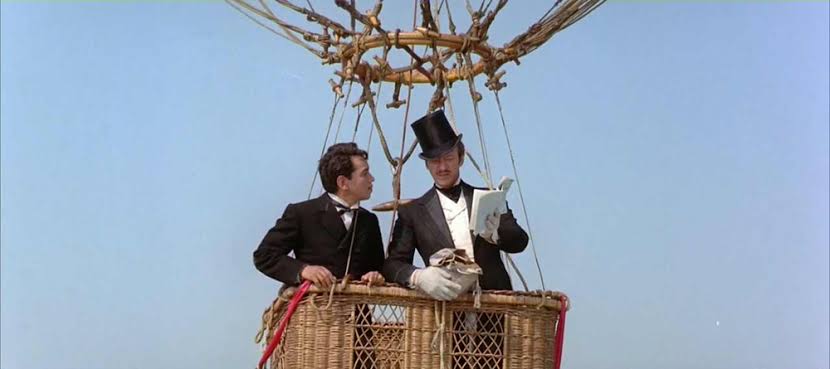
I finally watched Around the World in 80 Days from 1956 with David Niven, two years after reading Jules Verne’s novel, which I thoroughly enjoyed.
The movie, which won the Academy Award for Best Picture in 1956, was a ton of fun and I am going to watch it again just to catch all the moments I might have missed.
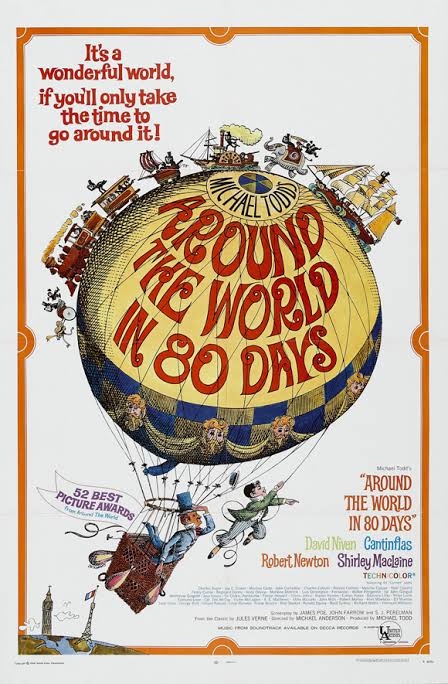
The book and the movie follow the story of Phileas Fogg, an English gentleman, who no one in his gentleman’s club can exactly figure out. During a discussion Phileas brags that he could go around the world in 80 days. A wager is made and he and his French valet (newly hired) Passepartout (Pass-par-too) head out, starting their journey in a large, hot air balloon.
As you can imagine, all kind of situations arise on the journey and along the way they pick up a couple other travelers, one an Indian princess they rescue from being killed and another man who turns out to be a police officer who thinks that Phileas is actually the man who robbed the bank of England shortly before leaving on his trip.
(I may be the only one who thinks of Phineas and Ferb, the kids’ cartoon, when I read or hear the name Phileas but that is because I had a little one when the show first came out.)
In addition to Niven as Phileas Fogg, we also have Cantinflas as Passepartout, Shirley MacLaine as Aouda and Robert Newton as Inspector Fix.
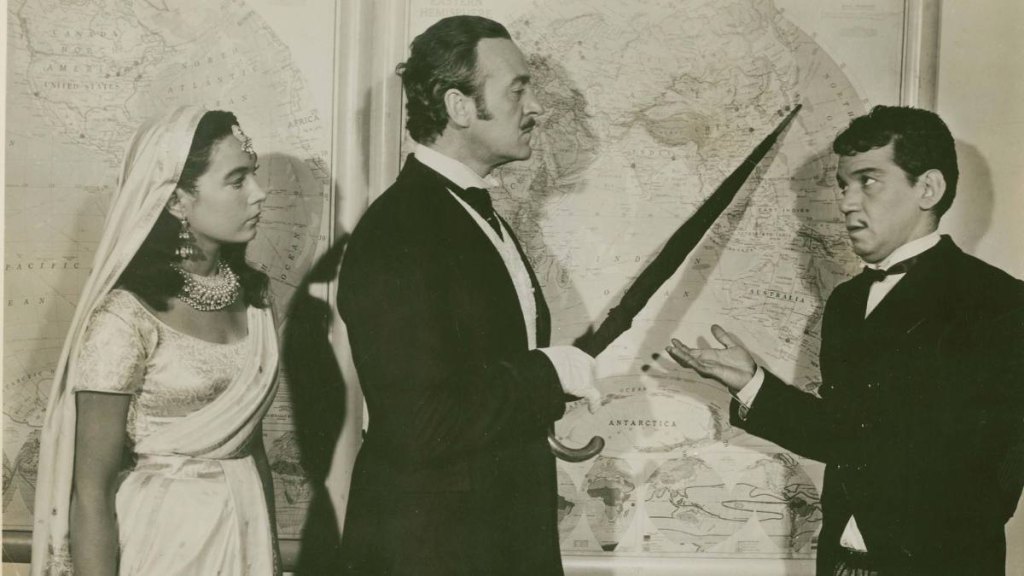
I’m going to be upfront and say that I had no idea Shirley McClaine was Aouda, the Indian princess. I didn’t recognize her at all and didn’t realize it until I was working on this blog post and saw her name listed in the cast.
I found it interesting that the movie created the idea of “cameo roles” as a way to invite established stars to participate in a production. The cameos in this movie included the most I’ve ever head of at 40 cameos with some of the most notable being Frank Sinatra, Marlene Dietrich, Buster Keaton, Noel Coward, Charles Boyer, Caser Romero, Ronald Colman, Red Skelton, and Peter Lorre.
Of course there are some aspects of the movie that have not aged well but many of the racial stereotypes I expected luckily didn’t surface with the focus mainly being on our main characters and the adventures they find themselves in.
Clocking in at 2 hours and 55 minutes, this was one of the longer classic movies I have watched and I actually took several breaks from watching it to run errands, cook dinner, go to bed, and do several other things that needed doing. In other words it took me a couple of days to finish it. I actually do that a lot with movies, no matter the length, because it feels like I am constantly interrupted while watching them.
One couldn’t be expected to shove all that happens in Verne’s book into a 90-minute to 2-hour movie, though, right? The characters travel across several countries, including the US, while being chased by a man who thinks Phileas is a robber, and, for Passepartout, often getting lost or separated from the group.
Michael Todd produced the movie and when it was released, he urged promoters not to refer to Around the World in 80 Days as a movie. To him it was an epic, a spectacle, an experience to immerse oneself in.
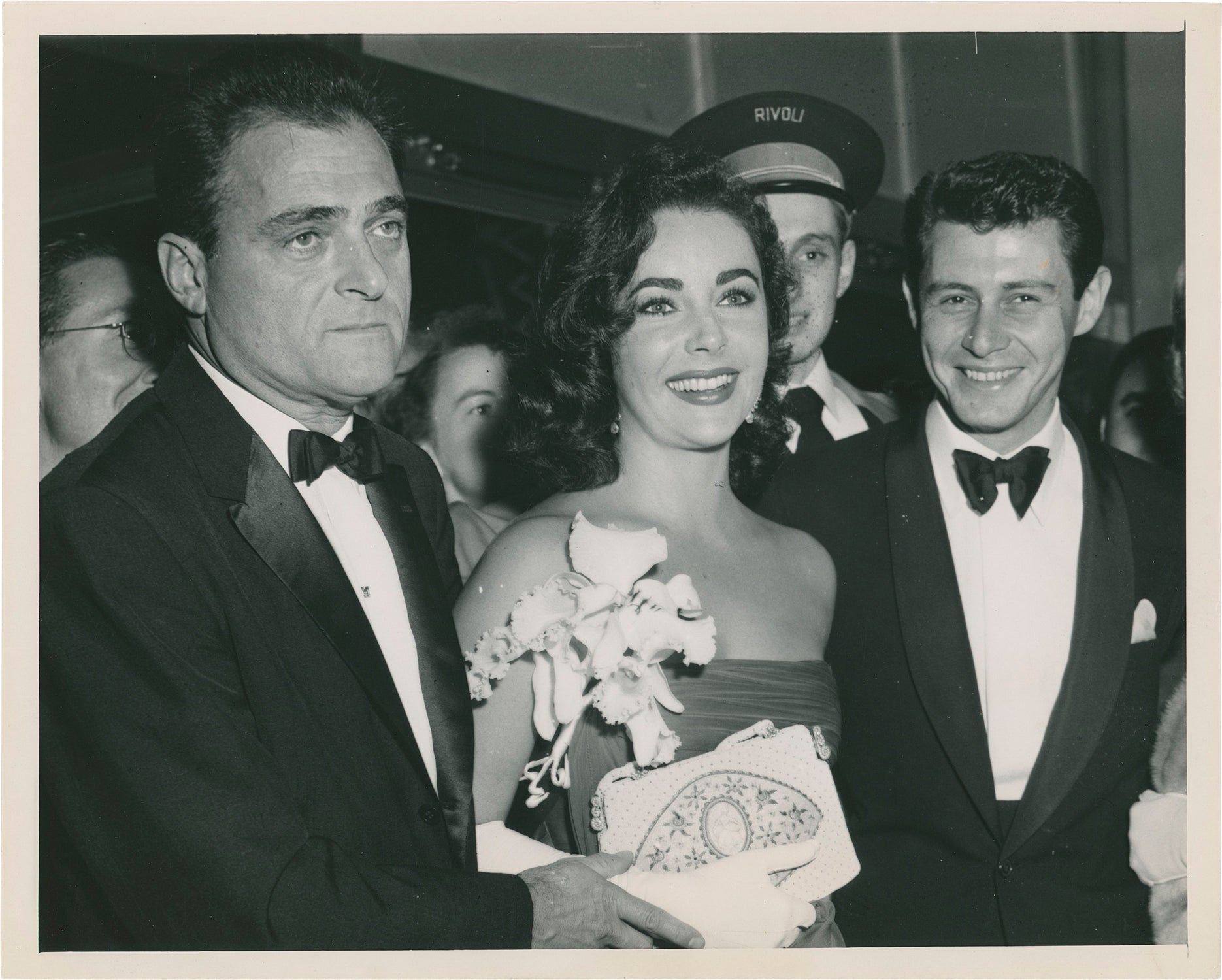
“Do not refer to Around the World in 80 Days as a movie,” Todd wrote when the movie was distributed. “It’s not a movie. Movies are something you can see in your neighborhood theatre and eat popcorn while you’re watching them….Show Around the World in 80 Days almost exactly as you would present a Broadway show in your theatre.”
Critics and movie-goers agreed with the assessment, though some felt the movie would never end because it was so long.
Todd was a master at convincing stars to get involved, according to Jeff Stafford , writing for TCM.com.
“One of his talents was attracting marquee-name talent through his sheer extravagant nature,” Stafford wrote. “When he learned that the Jules Verne novel had been a childhood favorite of David Niven, he casually offered him the role of Phileas Fogg, to which Niven excitedly said, “I’d do it for nothing.” Todd’s famous remark was “You’ve got a deal.” He enticed other actors with gifts: Ronald Colman received a new yellow Cadillac for half a day’s work. Noel Coward was allowed to write his own dialogue for his cameo scene and received a Bonnard painting as a Christmas present. John Gielgud was seduced into appearing in a small role out of sheer curiosity. Todd recalled that “Gielgud asked me, ‘Why do you want me to play a sacked butler? I am a Shakespearean actor.’ I said, ‘Because I know you could do it so well and I know it’s right for you.’ He said, ‘Let me read it.’ I gave him the pages and he read it. Then he said, ‘My dear Mr. Todd, you really want me to play this? Why?…Who is playing the other part?’ I said, ‘Noel Coward.’ He said, ‘I’ve got to see that.’ I said, ‘One way for you to see it – be on the set tomorrow.’ And he was on the set.”
Todd went all out in other ways for this film too. He not only traveled the world to secure actors but props or locations for scenes.
From Stafford’s article: “He went to Chinchon, Spain, and hired the entire population of 6,500 residents to appear in a bullfight sequence. He visited his friend, the King of Thailand, who loaned him his 165-foot-long royal barge, complete with 70 glitteringly clad oarsmen, for a scene that lasted maybe 12 seconds. In China, Todd acquired a Chinese dragon used in holiday processions, which was 250 years old, thirty-feet-long, and required 24 men to operate it. In Pakistan, the producer persuaded the Nawab of Pritim Pasha to loan him his private elephant herd.”
And the train in the movie?
It was a Durango museum piece and used to run from San Francisco to Colorado in 1871 and Todd convinced the museum to loan it after a million dollar bond was secured.
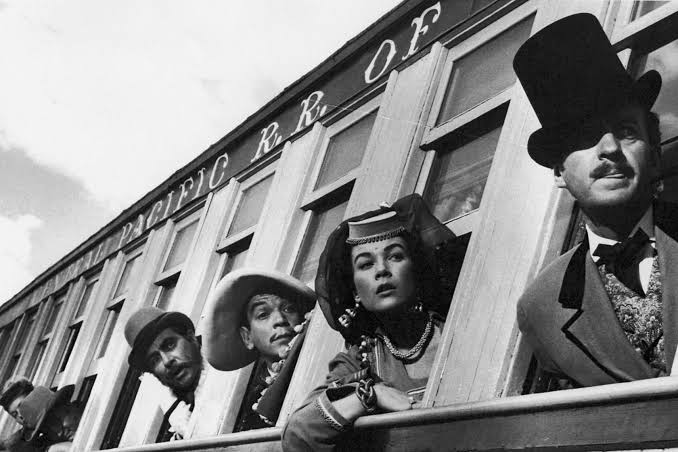
The movie set some definite records, including:
- the most people (68,894) ever photographed in separate worldwide locations; the greatest distance ever travelled to make a film (four million air passenger miles);
- the most camera set-ups ever used (200 more than Gone With the Wind, 1939);
- the most sets ever used (140 actual locations plus interiors on soundstages in London, Hong Kong, and Tokyo as well as six Hollywood studios);
- the most costumes ever used (74,685);
- and the most assistant directors (33).
The movie was directed by Michael Anderson.
Younger viewers may not recognize some of the cameos, I certainly didn’t, but it’s still fun to read about them later and learn who they were. I, honestly, only recognized Frank Sinatra until I read about who was in it after I watched it.
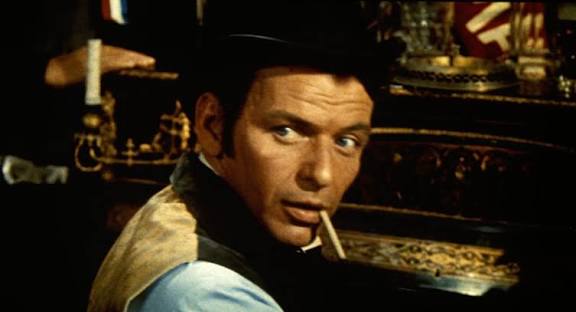
There were generations of people who came to know David Niven through this movie, not realizing his long career before it ever came out.
Gentleman’s Journal wrote that Niven represented the perfect English gentlemen in the minds of generations.
In his first movie he said “Good-bye, my dear,” to a lady getting on a train.
“In just a few words, Niven had distilled onto celluloid the perfect English gentleman – suave and cheerful, sleek and charming,” The website states. “His success skyrocketed overnight, and it echoes still today. Even now, when we think of the quintessential Englishman, it is Niven’s smiling face, pencil moustache, and effortless attire that flashes into view.”
Well, if not Niven, then Phileas Fogg.
A few tidbits of trivia I learned about the movie while researching:
- Orson Welles was a little upset he did not get a cameo in the film. He was upset because before Michael Todd produced this film, he produced a stage version by Welles. The play flopped but Todd turned the project into a film anyway and it enjoyed great success. Welles felt he gave the idea to Todd in the first place. (Source Classic Movie Hub).
- Shirley MacLaine wrote that filming a scene with thousands of extras ground to a complete halt because the propman forgot to put the bottle of champagne in the balloon with David Niven and Cantinflas.
- Michael Todd never had anyone else other than David Niven in mind for the role of Phileas Fogg.
- Michael Todd’s original estimate for the film’s budget was $3 million. The film ended up costing nearly double that, largely thanks to Todd’s demands for verisimilitude and location shooting.
- Alexander Korda had previously taken an unsuccessful stab at the material. His advice to Michael Todd was “Back away from it, Mike. I’ve been trying to lick it for years. Total loss.”
Have you seen this one?
Sources or additional information :
https://www.classicmoviehub.com/facts-and-trivia/film/around-the-world-in-eighty-days-1956/page/1/
https://www.tcm.com/articles/62567/around-the-world-in-80-days
https://www.imdb.com/title/tt0048960/trivia
If you write book reviews or book-related blog posts, don’t forget that Erin, Cat, And I host the A Good Book and A Cup of Tea Monthly Bookish Blog Party. You can learn more about it here.
On Thursdays, I am part of the Weekend Traffic Jam Reboot blog link party. You can find the latest one in the sidebar to the right under recent posts.
Notice: This post may contain affiiate links. If you purchase the product from these links I will receive a small compensation at no extra charge to you.
Hello! Welcome to my blog. I am a blogger, homeschool mom, and I write cozy mysteries.


You can find my Gladwynn Grant Mystery series HERE.
You can also find me on Instagram and YouTube and Facebook.
If you would like to be the first to get news about my books or just have access to special posts for supporters, you can do so here for $2.99 a month https://lisahoweler.com/support-my-writing/
Discover more from Boondock Ramblings
Subscribe to get the latest posts sent to your email.

Pingback: Sunday Bookends: Happy 250th US! And buying DVDs old show! – Boondock Ramblings
I think I can remember my parents going to see this movie. After your review, I definitely want to see it!
https://marshainthemiddle.com
LikeLike
It is a fun one. I think you and Mike might like it!
LikeLike
We read Around the World in 80 Days and then watched the Disney movie from the ’80’s. I had no idea there had been a classic version.
LikeLiked by 1 person
I didn’t know anything about the 1980s version but I read there as a 2000s one that was horrible. I would imagine the remakes were much shorter.
LikeLike
I haven’t watched that movie since I was a kid, but I do remember liking it. :-)
LikeLike
Sounds like it is time for a rewatch!
LikeLiked by 1 person
I love David Niven as Phileas Fogg, he’s perfect, but I have to admit that I’m one of those thinking how looong it was. Some scenes were amazing to look at, but as nothing much happened, they felt more like taken from a travel documentary to me which then took me out of the narrative. I definitely have to take breaks with a film like that.
LikeLike
It isn’t one I would watch over and over for sure. Those scenes did drag, but I still enjoyed it overall.
LikeLike