You don’t have to guess who is going to die in this Agatha Christie book since the title is The Murder of Roger Ackroyd.
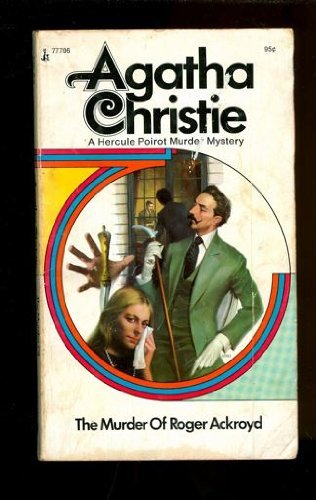
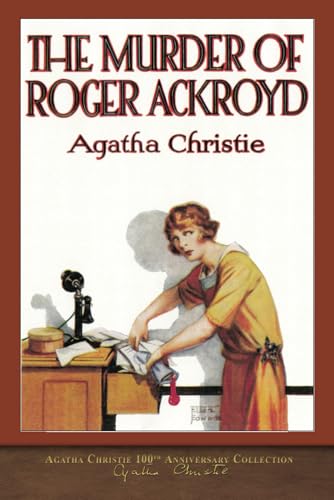
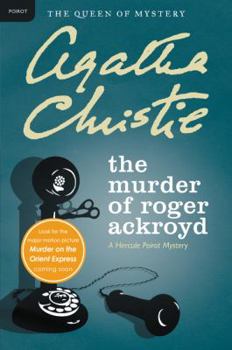
But who killed Roger Ackroyd is going to get complicated and you’ll need to strap yourself in for the rollercoaster ride.
The book was originally presented as a serialization entitled Who Killed Ackroyd? From July to September of 1925 in the London Evening News.
The book is about a doctor, James Sheppard, who lives in the small English village of King’s Abbot with his spinster sister Caroline and gets wrapped up in the mystery of the murder of well-known village resident Roger Ackroyd, which occurs within 24-hours after another village resident commits suicide.
From Goodreads: “Considered to be one of Agatha Christie’s greatest and also, most controversial mysteries. ‘The Murder Of Roger Ackroyd’ breaks the rules of traditional mystery.”
I didn’t realize this was a Hercule Poirot book before I started it. This is actually the third Poirot book, which I found interesting since in it he is talking about retirement. Dr. Sheppard narrates this book in first person, creating a unique and entertaining way to introduce Poirot.
This is my seventh Agatha Christie read this year as I work through the books on my own and through the 2026 Christie Reading Challenge.
Before I was done with this one, someone online (I can’t remember if it was a comment on my post or someone else’s post, spilled the beans that the ending was shocking. They said there was a surprising twist so that had me trying to figure out the twist through most of the book, which means I figured out the killer but still had to be sure I was right and still wanted to know how Agatha lead the reader there.
I was right but I still enjoyed the book immensely. Agatha really was ahead of her time with her plot twists and stories overall. Never before, or maybe I should say, rarely before, had mystery writers taken readers down such psychological roads with endings that left the reader not just thinking about the mystery’s solution, but also about the nature of humans and why they do what they do.
I’m not going to say she was the first to do this (hello, Conan Doyle, Allingham, Sayers, etc.), of course, but she did pull off the twists in interesting ways. I would say that the ending of Crooked House was one of the darkest and uncomfortable twists in any era, let alone the Golden Age of Mystery era.
As in any Poirot book, there were hilarious or interesting quotes.
Among them was one that came from Poirot after he accidentally hits Dr. Sheppard with a marrow (squash):
“I demand of you a thousand pardons, monsieur. I am without defence. For some months now I cultivate the marrows. This morning suddenly I enrage myself with these marrows. I send them to promenade themselves — alas! Not only mentally but physically. I seize the biggest. I hurl him over the wall. Monsieur, I am ashamed, I prostrate myself.”
Dr. Sheppard doesn’t know who Poirot, who has moved in next to him and his sister, is at first. He thinks he might be a hairdresser.
“Clearly a retired hairdresser,” he thinks at one point. “Who knows the secrets of human nature better than a hairdresser?”
Dr. Sheppard calls him “Porrott” and is bewildered by the clues the man is giving him. Poirot also has no idea Dr. Sheppard doesn’t know he’s a famous detective.
“Mr. Ackroyd knew me in London, when I was at work there,” Poirot tells him after the marrow hitting incident. “I have asked him to say nothing of my profession down here.’
Sheppard continues by saying, “I see,” and is amused at Poirot’s “patent snobbery.”
“But the little man went on with an almost grandiloquent smirk,” Christie writes.
“One refers to remain incognito. I am not anxious for notoriety. I have not even troubled to correct the local version of my name.”
“Indeed,” I said, not knowing quiet what to say.
Another funny quote that I took as a bit of a self-deprecating jab at herself by Christie, since she once wrote romances too: “What made you notice Ralph Paton? His good looks?”
“No, not that alone — though he is unusually good-looking for an Englishman — what your lady novelists would call a Greek God. No, there was something about that young man that I did not understand.”
Up next in my Agatha Christie reading journey is a different book for Agatha — The Rose and the Yew Tree — a tragedy written by Agatha under the name Mary Westcott.
Have you read The Murder of Roger Ackroyd? What did you think?
Discover more from Boondock Ramblings
Subscribe to get the latest posts sent to your email.

Pingback: What I read in June – Boondock Ramblings
Pingback: Sunday Bookends: Happy 250th US! And buying DVDs old show! – Boondock Ramblings
I remember being genuinely shocked at the ending of The Murder of Roger Ackroyd. Like you, I always get a bit uncomfortable when Christie is labelled as cosy murder mystery. There isn’t an undue amount of gore, but she doesn’t shy away from the fact that murder is nasty. And the film Crooked House is dark enough that having watched it once, I don’t want to see it again.
LikeLike
Well, this one does sound interesting. I read so many of them back in the days of the dinosaurs. Did I understand them? Nope, but I could say I’d read them. Maybe it’s time to revisit Agatha!
https://marshainthemiddle.com/
LikeLike
I haven’t read any Agatha Christie books in years, but I bet my husband has read this one.
LikeLiked by 1 person
It’s a good one. I’m sure he has!
LikeLike