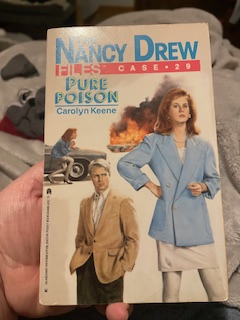
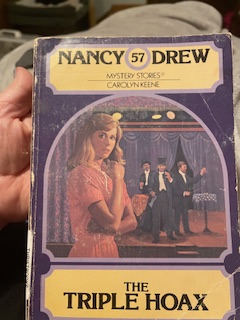
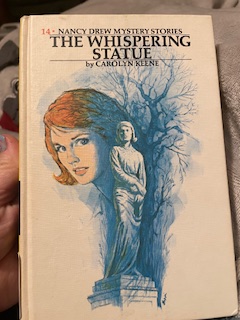
This November I am holding my own Nancy Drew November event and plan to read six Nancy Drew books. I probably will really only get to three, but I’m being ambitious and saying six.
The books I picked out for the event are:
Pure Poison
The Triple Hoax
The Whispering Statue
The Mystery of the Fire Dragon
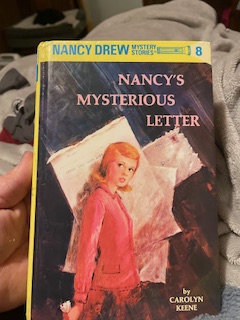
Nancy’s Mysterious Letter
The Clue in the Jewel Box
I am going to start with The Mystery of the Fire Dragon.
I will also be watching the Nancy Drew-centered episodes from the second season of The Hardy Boys/Nancy Drew Mysteries show from the 1970s.
Have you read any of these books?
If you want to join in with me in reading the books or watching the show feel free!
If you write book reviews or book-related blog posts, don’t forget that Erin and I host the A Good Book and A Cup of Tea Monthly Bookish Blog Party. You can learn more about it here.
Hello! Welcome to my blog. I am a blogger, homeschool mom, and I write cozy mysteries.
You can find my Gladwynn Grant Mystery series HERE.
I didn’t read much Nancy Drew when I was a kid so it has been fun to read through the books as an adult. Right now, I am on the original books, which were published in the 1930s, with revisions made later.
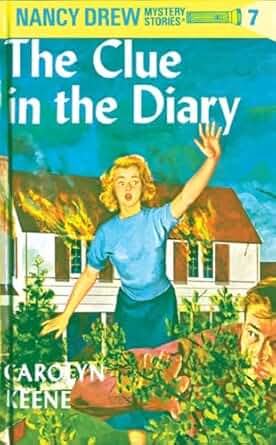
I have read some of the books in order but have also been jumping around. I already knew that Nancy’s boyfriend was Ned Nickerson but he wasn’t in the first six books. He was in later books I had read, though. When I recently read The Clue In The Diary I found out that it was the book where he first appeared.
His appearance was one of the reasons the book is now one of my favorites, but also because the mystery held up well even all these years later.
Ned’s introduction in the book is so cute. It is clear from the start that he is taken with Nancy and hopes to become more than friends. She, of course, is also very smitten, but does her best to pretend she isn’t. What interests her right away is how he becomes interested in the same mystery she is interested in.
That mystery involves a fire at a house that she and her friends, Bess Marvin and George Fayne stumbled upon while driving home from a carnival. At that carnival they met a little girl and her mother and felt both of them looked malnourished and poor. They are talking and worrying about the little girl when they see the fire at a large mansion on the hill.
They pull over to see if they can help. Nancy runs toward the house and tells Bess and George to find a nearby house where they can call the local fire department.
Nancy yells to see if anyone is in the house but there is no answer. She hopes that no one is inside and when she runs toward the back of the house, she sees the shadowed figure of a man in the bushes, but he disappears before she can speak to him. She also finds a journal lying in the driveway and she thinks it might be a clue. The journal is written in Swedish though so she can’t read it.
The fire department arrives and begins putting out the fire and Nancy strikes up a conversation with a neighbor who says the house has been shut up all summer and she doesn’t think anyone is inside. She isn’t too thrilled with the neighbors either. Their names are Raybolt and they aren’t very nice, the neighbor says.
When Nancy goes back to her car she finds a young man climbing into it and moving it. She thinks he’s stealing it, but it turns out he’s actually just moving it out of danger.
“The young man pulled as close to the edge of the drive as possible. He was about nineteen, Nancy decided, surveying him critically. His hair was dark and slightly curly, his eyes whimsical and friendly. He wore a college fraternity pin.”
Nancy is suspicious of him but later he begins directing traffic to help people get around the fire and her mind is changed. During the rush to get away from the fire, another car rearended her and she pulls off the road to inspect it. The young man pulls off too.
That’s when he introduces himself as Ned Nickerson. As the book goes on there will be more chance meetings and some that aren’t by chance as Ned makes it a point to visit Nancy and help her with finding out what happened at the fire.
One reason Nancy wants to find out what happened at the fire is because of the suspicious man who was outside and because Mrs. Raybolt later says her husband was inside and is dead. Nancy isn’t so sure if this is true or not.
Nancy also learns that the husband of the woman with the little girl was the man sneaking around behind the burning house. Could he have set the fire and caused the death of Mr. Raybolt? If so, why?
As I said above, I enjoyed this one. I wasn’t as pulled in by the cover for some reason so I, for some silly reason, had it in my head I wouldn’t like it. I did, though. I’d put it right up there with The Clue of the Whistling Bagpipes, which was my favorite book of the original Nancy Drew’s before I read this one.
I loved the romance part of it. It was subtle and sweet.
Here are some of the cute romance parts:
“After Ned had hung up, Nancy fairly danced back into the bedroom. He sent one slipper flying toward the bed, and the other into the far corner of the room. The young sleuth attempted to convince herself that her jubilant spirits were the result of Ned’s discovery. The ring might be a clue to the identity of the person who had set the Raybolt house on fire. Bess and George, she knew, would have interpreted her reaction very differently!”
“The suggestion was not displeasing to Ned, for he had mentioned the show merely as an excuse to spend the evening with Nancy.”
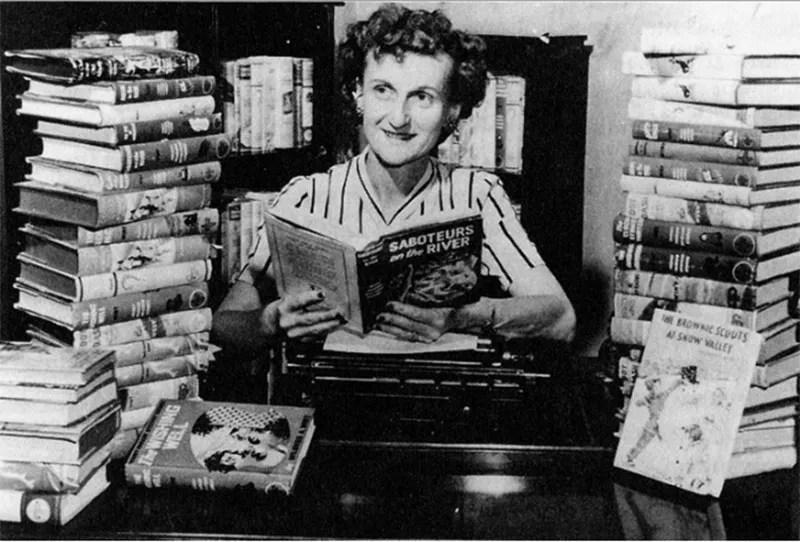
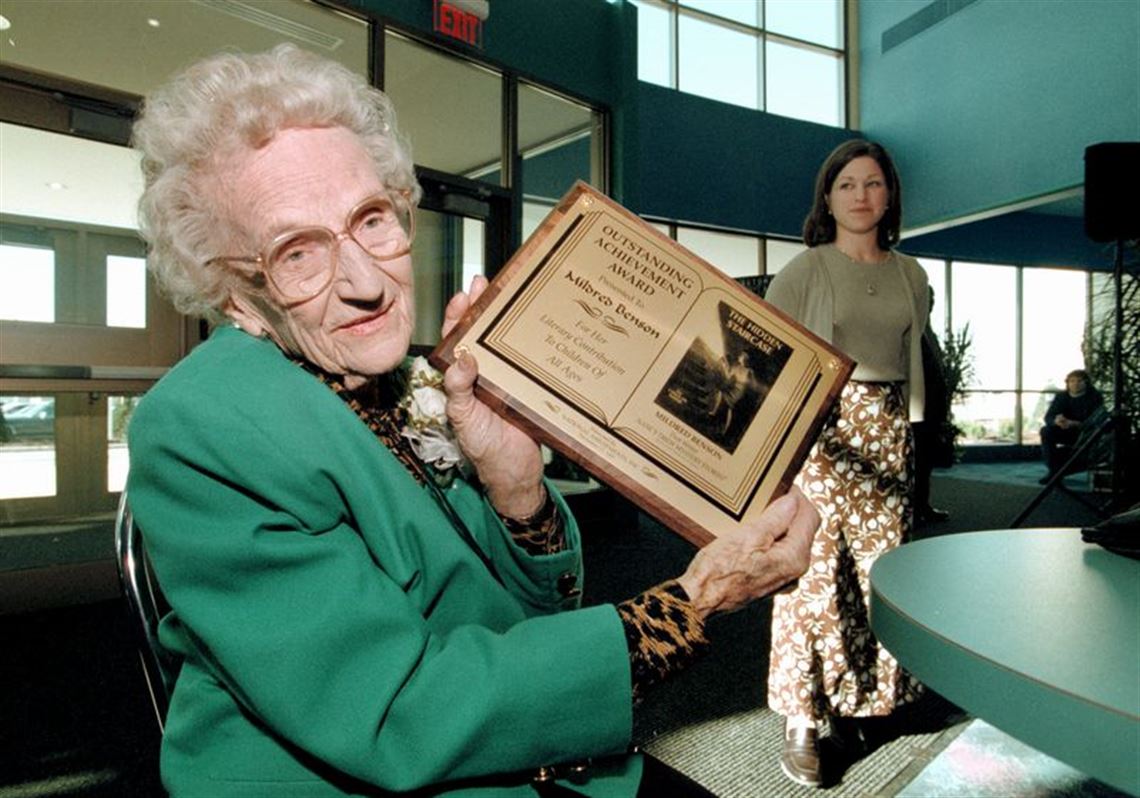
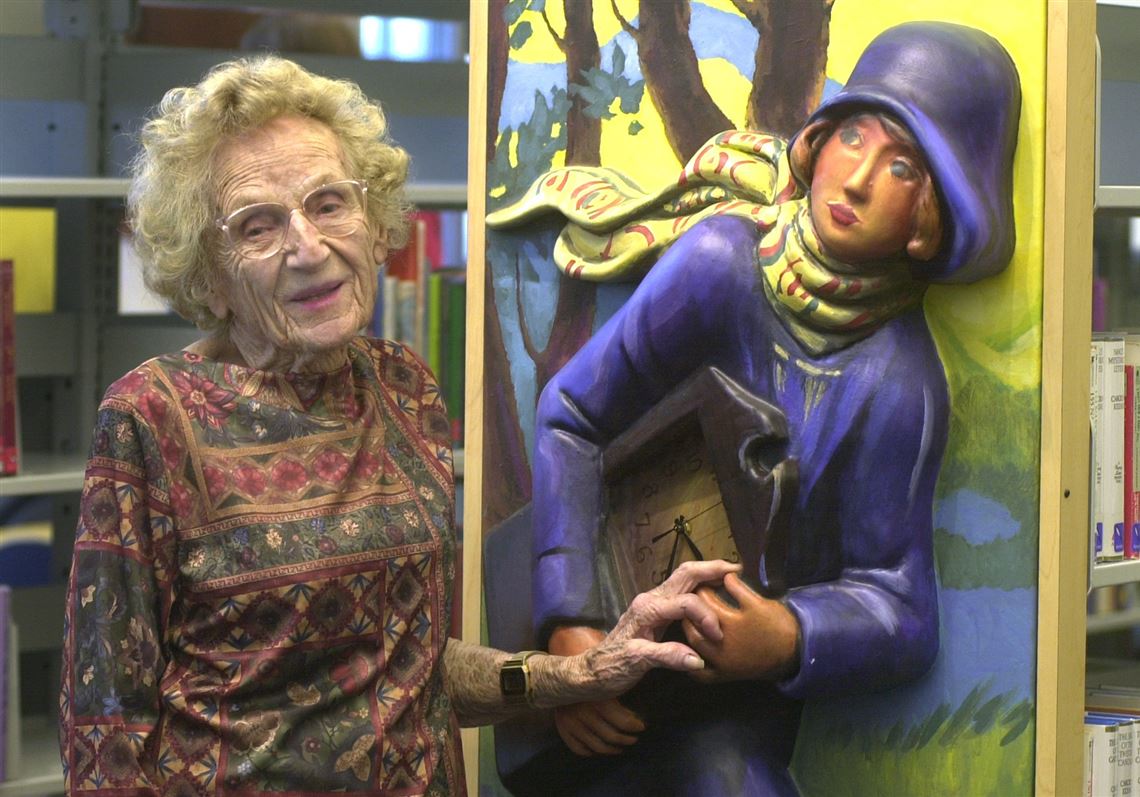
Mildred, or as many called her, Millie, wasn’t an amateur detective, but she was the co-creator of one of the most famous teen amateur sleuths in the United States — Nancy Drew.
For 50 years very few people knew that Millie helped create Nancy Drew.
Until 1980, many readers of Nancy Drew didn’t know that Carolyn Keene, the woman listed as the author of the Nancy Drew books, wasn’t actually a real person. She was a pseudonym for some 28 authors, men and women, who create and wrote the stories for the series.
It was a lawsuit between Grosset & Dunlap, the original publisher of the Nancy Drew books and the Stratemeyer Syndicate, the owner/creators of the stories, that brought Millie into the spotlight.
Really, though, Millie had been somewhat in the spotlight before that. She’d written some 130 books in children’s series under her own name from the 30s to the 50s and was an accomplished journalist and world traveler.
What she hadn’t really talked about a lot was her involvement with the Nancy Drew Mystery series.
She’d signed agreements saying she wouldn’t talk about how she’d written 23 of the first 30 Nancy Drew books. She’d written the books with the direction and input of Edward Stratemeyer, founder of the Stratemeyer Syndicate and the brains behind many juvenile series, including multi-million selling series like Nancy Drew, The Hardy Boys, The Bobbsey Twins, Tom Swift, and Rover Boys.
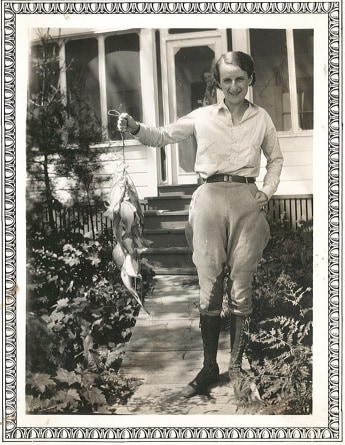
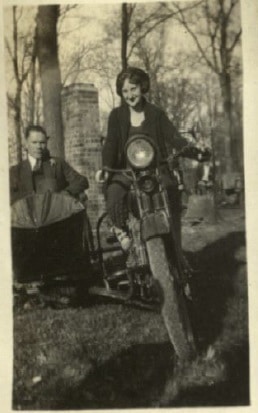
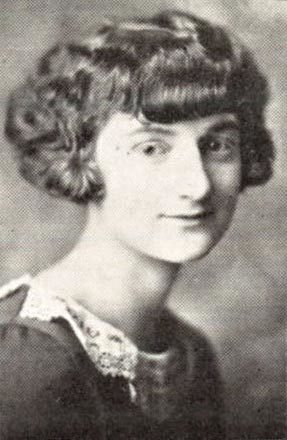
Millie was born Mildred Augustine in 1905 in Iowa, the daughter of a well-known doctor. She wasn’t treated like other girls at the time who were expected to learn how to sew and keep the house.
Instead, Millie was given freedom to explore her own interests and passions. One of those passions was sports. She felt women should have the same opportunities as men to participate and compete in sports she said in an interview with WTGE Public Media in the mid-1990s
“Girls were discouraged from all sorts of athletics,” Millie said. “And I fought that tooth and nail right from the start because I felt that girls should be able to do the same things that boys did.”
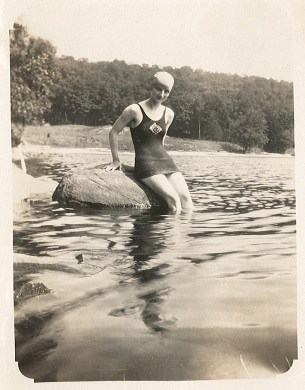
While Millie enjoyed sports, such as swimming and diving, she also loved to write, something her mother encouraged her to continue.
Her father, however, said if she wanted to make money, she should do something else and she admits that he was probably right.
She began selling her stories to church papers, but they only paid a few dollars.
She finally sold a story for a whole $2.50.
“That made me a writer,” Millie said in the interview, while laughing. “So, from then on, I was hooked.”
She attended the University of Iowa after school, majoring in journalism and working on the school newspaper. She also worked with George Gallup, the creator of the Gallup Poll.
After graduating, she landed a job at a newspaper, but at the age of 22, she wanted to see what else she could do and traveled to New York City to look for work.
It was there she wrote to Edward Stratemeyer looking for work. Stratemeyer was releasing a book series for juveniles. They were assembly-line type books where he wrote a paragraph detailing what he wanted in the book, including character names and plots. He would send the information he wanted out to writers he knew, and those writers would write the books under the pen name that Stratemeyer controlled and retained the rights to. The writers signed away their rights to credit for the books to Stratemeyer.
While Stratemeyer didn’t have anything for Millie at the time she contacted him, he reached out to her later and asked if she would write a book for the floundering Ruth Fielding series. She did and from there she began to write books for other series for the company. In the midst of all this she also married Asa Wirt in 1928 while attending graduate school.
Millie was reliable, dependable, and a good writer. When Stratemeyer thought about his Hardy Boys series and how young boys liked the boy detectives and then began to wonder if girls would like a girl detective, he turned to Millie.
Stratemeyer had the basic idea of Nancy Drew, but many literary historians and Nancy Drew fans say it is Millie who flushed her out and made her who she became. Millie created a version of Nancy that Stratemeyer’s daughter, Harriet Stratemeyer Adams, later toned down and changed.
Millie’s version of Nancy was a lot like Millie. She was athletic, adventurous, bold and brash, and never backed down from a challenge. Harriet’s version made her a bit more “perfect” — a rule follower who was polite but still adventurous and who little girls could look up to.
Nancy was what so many girls in the 1930s weren’t allowed to be.
Young girls could live vicariously through her.
Stratemeyer passed away 12 days after the first Nancy Drew book was released. His daughters took over the business after they couldn’t sell it in the difficult economy. Eventually Harriet began taking more control of the Nancy Drew series. Other ghostwriters were working on the series in addition to Millie, who wrote 23 of the first 30 books in the series. In the 1950s Harriet began to rewrite Millie’s original books, changing Nancy’s character, updating some of the material, and, in many ways, stripping away the personality of Nancy that Millie had created.
Millie was working on her own books at that time and had dealt with the illness and death of her first husband and then being a single mother. It was disappointing to see the changes being made but she had other irons in the fire.
In the early 1950s, she was working for the Toledo Times, remarried to the editor of the paper, and being a mother to Margaret Wirt.
She was also writing a character she felt was even more Nancy Drew than Nancy Drew — Penny Parker in the Penny Parker Mysteries.
Penny didn’t see as much success as Nancy, but she didn’t have the mammoth marketing effort that Nancy had, says Millie.
In 1959 Millie was widowed again and afterward she began to live a life a bit more like Nancy Drew — international travel, adventures, independence, learning more about archaeology and even taking flying lessons and eventually earning several flying lessons.
It wasn’t until 1980 when Harriet decided to move the printing of Stratemeyer books from Grosset & Dunlap to Simon and Schuster that more of the public learned about Millie’s role in creating Nancy.
She told WTGE that she could have pushed for her to get credit for the books she’d written. She could have gotten a lawyer and demanded more of the royalties.
She simply didn’t have the desire to put up a fight, though, she said.
“I wrote because I liked to write and I wanted to produce books that girls would enjoy,” Millie said. “And so I didn’t care too much but it got to be … my friends knew I wrote the books and that was sufficient for me. Eventually though it got to be that Mrs. Adams put out publicity to the fact that she was the author and people were reading that.”
One person who was reading all those stories was Millie’s daughter, who asked her own mother if she’d been lying all those years about writing the Nancy Drew books.
Millie hadn’t shared her role in the books with many but when her own daughter started to doubt her, she began to be more open about sharing her role in the creation of the character.
“I thought if my own daughter doubts my integrity, then it’s time I let the truth be known so when people asked me, I stuck my neck out and I told them the truth, which was that I wrote the books.”
Millie was subpoenaed by Grosset & Dunlap during the 1980 when the publisher sued the Stratemeyer Syndicate to keep them from publishing Nancy Drew with anyone else.
They wanted to prove that Harriet Adams didn’t have the right to say who could and could not publish past Nancy Drew books because she had not actually written them. As part of the case, the records that showed Millie had helped developed the series were also subpoenaed.
The truth was finally out there. Millie was the original Carolyn Keene.
Harriet, however, continued to claim she’d written the books right up until her death in 1982 and because the court records were sealed for years, it wasn’t until 1993 when the University of Iowa held a Nancy Drew conference, that Millie really became known as Carolyn Keene.
The conference at the university attracted the attention of literary scholars, collectors, and fans who wanted to know more about the original author and Millie was the main speaker.
Millie, incidentally, was the first woman to earn a master’s degree in journalism from the University of Iowa in 1927.
More fame than Millie imagined hit her after the conference. In some ways, life continued as normal despite the extra attention. She continued to write news and feature stories and her column for the Toledo newspaper. Nancy fans began to contact her, though, asking about her role and for autographs. She was also inducted into the Ohio and then the Iowa Women’s Hall of Fame and her typewriter was enshrined at the Smithsonian.
Millie worked first at the Toledo Times, now defunct, and then at the Toledo Blade right up until the day she died, literally. She was writing her column for the paper, at the age of 96, in the Blade office, when she became ill and was taken to the hospital, where she later passed away.
In the article about her death, the Blade wrote about how her writing impacted young girls and women.
“Her books, Nancy Drew buffs have said, allowed teenage girls and young women to imagine that all things might be possible at a time when females struggled mightily for any sense of equality.”
“Millie’s innovation was to write a teenage character who insisted upon being taken seriously and who by asserting her dignity and autonomy made her the equal of any adult. That allowed little girls to dream what they could be like if they had that much power,” said Ilana Nash, a Nancy Drew authority and doctoral student at Bowling Green State University.
The article continues: “Going to work was a way of life for me and I had no other,” she wrote in a December column upon her pending retirement.
In the column, she explained that her legendary work ethic related to being hired by The Times in her third try during World War II.
“I was told after [the war] ended there would be layoffs, and I would be the first one to go. I took the warning seriously and for years I worked with a shadow over my head, never knowing when the last week would come,” she wrote.
Millie’s column was called, “On the Go With Millie Benson.”
Millie was described in the article about her death as fiercely independent and “always willing to go after a story she was assigned or had set her sights on.”
She almost never took a day off. In fact, the day after she was diagnosed with lung cancer in June, 1997, she was back at her desk working on her next column saying her desk was where she needed to be.
Millie once said in an interview that she never looked back on the books she’d written, “Because the minute I do I’m going into the past, and I never dwell on the past. I think about what I’m doing today and what I’m going to do tomorrow.”
I have had the opportunity to read a couple of books written by Millie, before Harriet got to them, and I have to say I did enjoy them. I didn’t know at the time that other books had been revised, and I had an original copy of Millie’s work, but when I found out, I could see the difference between Millie’s writing and other ghost writers/Harriet.
I am going to be purchasing a couple of books from Millie’s Penny Parker series to see what that series was like as well.
As president of the Nancy Drew Fan Club, Jennifer Fisher is considered a Nancy Drew and Mildred Benson expert. She operates the website nancydrewsleuth.com and donated her Nancy Drew collection several years ago to the Toledo library and now curates items to be added to the collection.
She is currently looking for information on Millie, from letters to manuscripts, to any memorabilia of hers that someone might have.
On her site Jennifer details the life of Millie and talks about the impact her books (130 of them all together, including the Nancy Drew books) made for young women.
Jennifer wrote about Millie in a special section on the site, including detailing the trial where Millie spoke about the conflict that eventually arose between her and Harriet Adams.
“On the stand when shown letters between herself and Harriet regarding criticisms and difficulties, she recalled that this was “a beginning conflict in what is Nancy. My Nancy would not be Mrs. Adams’ Nancy. Mrs. Adams was an entirely different person; she was more cultured and more refined. I was probably a rough and tumble newspaper person who had to earn a living, and I was out in the world. That was my type of Nancy.”
And it is that type of Nancy, and that type of woman, who so many women over the years have been drawn to despite the changes. Even with the changes later made to the books, the heart of Nancy, created by Millie, always remained.