
This was my first Margery Allingham book, and I was very impressed with her writing style and storytelling.
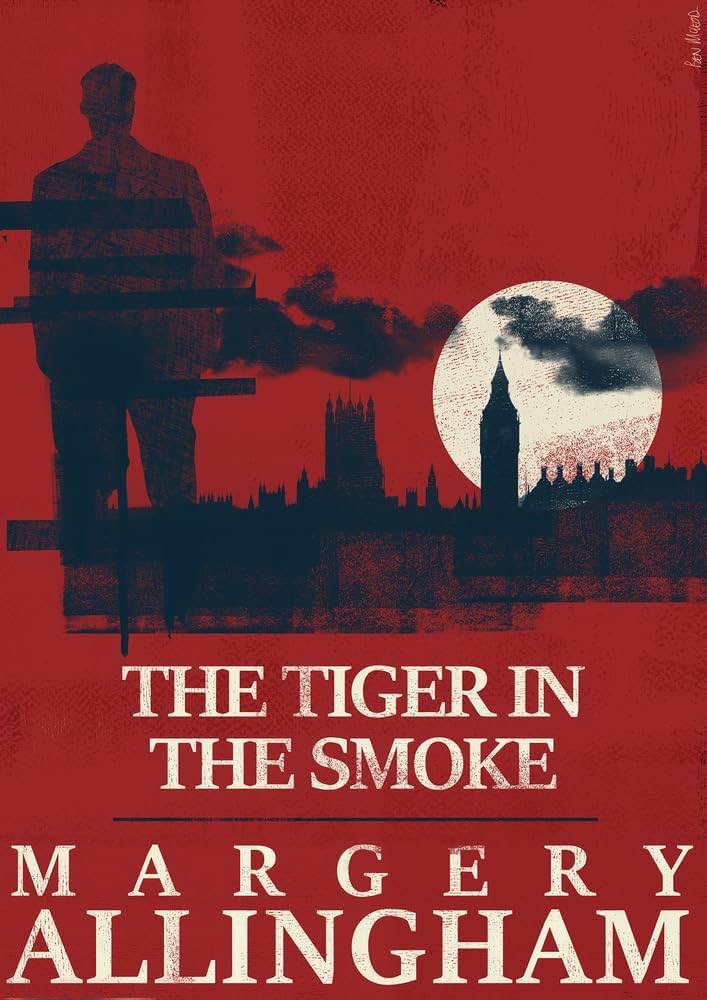
This book is called by Golden Age mystery enthusiasts one of her best. It is the fourteenth book in the Albert Campion series, but Campion isn’t really in this book as much as I expected him to be.
First, a little bit of a description that I pulled off Goodreads:
A fog is creeping through the weary streets of London—so too are whispers that the Tiger is back in town, undetected by the law, untroubled by morals. And the rumors are true: Jack Havoc, charismatic outlaw, knife-wielding killer, and ingenious jail-breaker, is on the loose once again.
As Havoc stalks the smog-cloaked alleyways of the city, it falls to Albert Campion to hunt down the fugitive and put a stop to his rampage—before it’s too late . . .
This one is more of a psychological thriller than a detective mystery with Allingham walking us through the story through action but also a lot of mental contemplations of four different characters, Campion being one but on a smaller scale.
Our characters are Havoc, Geoffrey Leavett, Canon Avril, Inspector Charlie Luke, Campion, and Meg Elgenbrodde.
Points of views are offered for most of them but not consistently, which sounds confusing, but it really isn’t.
If you have read detective or Golden Age mysteries from the 1930s to the 1960s, then you know there is a lot of what we writers call “head hopping.” The author hops in and out of various characters heads, telling us what each one is thinking in the same scene. These days we writers are told to never head hop. Stick to one character’s point of view per scene. If you want to show the thoughts of another character, then wait until a scene break of a new chapter.
Back in the old days, there were less rules, so authors just wrote whatever they wanted to and however they wanted to and readers just went with it. Sure, it could get confusing,s but if the story was strong enough no one cared.
I found myself nervous through a lot of this book as characters seemed to put themselves in the most precarious situations.
We start the book with Meg and George in a car together, talking about Meg preparing to go to a meeting with a man who insists he is her husband who died during World War II, which ended several years before. The man has been sending her letters. Meg and George are supposed to be married soon, so of course this development is unsettling to them both.
Meg takes her cousin, Campion, a private detective, and London Police Inspector Charlie Luke to meet with the man.
I won’t tell you if the man is really her husband or not, because I don’t want to give anything away, but I will say that there is a mystery involving her husband and a treasure and it is tied to Havoc, an evil man who has killed many, just escaped jail, and will kill again to get what he wants.
I loved opening this book up on my Kindle when I had time to read it and had a hard time putting it down. I hope to get a paperback copy at some point so I can reread it.
There are some really well-written lines and paragraphs in it.
Here are a few I enjoyed:
“He was watching her, trying to appraise her reaction. The face she turned to him was both disappointed and relieved. Hope died in it, but also hope appeared. She was saddened and yet made happy.”
The rumbling ceased abruptly and a clipped schoolmasterish voice remarked acidly: “Very tood of you to bother about my immortal soul, Chief Inspector. I’m afraid I’d ceased to concern myself about yours.”
“Then he dropped lightly to the ground and a smile split a wide thin-lipped cat’s mouth in which the teeth were regular and beautiful.
‘Dad’s back,’ he said, and his voice was smooth and careful. Only the shadow flitting like a frown across his forehead and his pallor, which was paper-like, betrayed his weariness. His spirit danced behind his shallow eyes, mocking everything.”
His beauty, and he possessed a great deal, lay in his hands and face and in the narrow neatness of his feet. His hands were like a conjurer’s, large, masculine, and shapely, the fingers longer than the palms, and the bones very apparent under the thin skin.”
He was a man who must have been a pretty boy, yet his face could never have been pleasant to look at. Its ruin lay in something quite peculiar, not in an expression only but something integral to the very structure. The man looked like a design for tragedy. Grief and torture and the furies were all there naked, and the eye was repelled even while it was violently attracted. He looked exactly what he was. Unsafe.”
When he came to the part which was most important of all to him that night, he paused and said it twice. ‘Lead us not into temptation but deliver us from evil.’
That was it. That was what he meant. Lead us not into temptation, for of that we have already enough within us and must resist it as best we can in our own way. But deliver us, take us away, hide us from Evil. From that contamination of death, cover us up.”
I am looking forward to reading more of this series.
Have you read any of Allingham’s books?
Also, I just found out there was a movie based on this book made in the UK in 1956. You know that I am going to have to find it and watch it!
