Jenny Knipfer has a way of melodically weaving a story through well-written prose that takes you into the past, a world she easily strolls through in her latest historical novella Violet’s Vow.
The story of Violet takes the reader on an emotional journey as Violet navigates loss, anger, and love after the unexpected death of her husband, Roger. Violet knows how her husband died but throughout the book, she feels she must find out why her husband died. Was it truly an accident, or was there something more sinister at play? No matter the reason behind his death, his loss has left Violet insecure and unsure of her future, which she thought would involve running the flower shop she and Roger owned together, into their old age.
When Violet begins to receive love notes I was pulled into the mystery of who has feelings for her and why they aren’t telling her in person. As I continued the journey with Violet, I also began to wonder which man in her life I wanted to have written the letters, since each one seemed to have something suspect about their past. As in her other books, Jenny uses poetic language to create a story worth following to the end. There is heartbreak yet hope within the pages of each book she writes, and Violet’s Vow is no different.
My husband and I started to buy more Kindle books a few years ago because our bookshelves were literally starting to sag under the weight of all of our books. Moving them when we left our old house to move into this new one wasn’t very fun either.
So, we have decided that it isn’t that we won’t ever buy physical books again, but that we will only buy physical copies of books that we will want to read again. If we do pick up books at library sales that we don’t really like we can always donate them to another library sale.
I am fine with reading most books on my Kindle (ebook reader for those not familiar with it, though I’d be surprised if there was someone not familiar with it), but there are a few authors I like to read while holding a physical copy of their book.
I don’t know how to explain the difference between reading on the Kindle and reading an actual hard copy of a book. It isn’t that I think the Kindle is inferior, but I don’t feel like I really own the books, even if I have “bought” them off of Amazon. The issue I have is that unless I physically download every book I have purchased off of Amazon, I don’t really own that book. It’s still on Amazon’s servers, which could go down at any point, or which they could choose to remove books from. I’ve even heard of them removing books people have purchased because Amazon deemed the book inappropriate.
That is why I purchased a physical copy of the book Irreversible Damage by Abigail Shier. People were reporting that their digital copies were being removed from their digital clouds if they purchased it through Amazon. I don’t agree with that type of censorship and wanted to read Abigail’s message without the issue of transgenderism rising in young women, so I purchased a hard copy of the book and put it on my shelf. Who knows if or when I might need it at some point.
Side note: as far as I know, Amazon stopped removing books they disagreed with when people started to notice and threw a stink. I’m not a huge fan of Amazon for this and many other reasons, but they are the largest bookseller in the U.S. so it’s hard to completely ignore them.
Moving on from the critique of Amazon, I’ll get back to the original intent of this blog post which is that there are certain books I want physical copies of, even if I read them on a digital device.
For example, I have set out to collect all 14 of the books in The Mitford Series by Jan Karon. When I originally started those books, I read physical copies so reading a physical copy of her books holds a sentimental value to me. I did read her new releases on the Kindle but then realized I also wanted physical copies, again to be sure I don’t lose them in the future. Those are books I will read more than once.
That’s really why there are some books I want physical copies of — I know I will want to read them again and I might not always have a Kindle to read them on.
I feel like the books which need to be read in a hard copy form (paperback or hardcover) feature more polished or classic writing, which dictates that it be read like we used to read books. The writing in these books is not a waste of paper, in other words.
Books like Anne of Green Gables and all of L.M. Montgomery’s books and all of the Little House on the Prairie books should be read in paperback, for example. I also have a paperback collection of The Chronicles of Narnia by C.S. Lewis.
Another author whose books I need a physical copy of is Robin W. Pearson. I have read a couple of her books on Kindle, but afterward, I make sure I buy a physical copy to place on the shelf.
I have found I am doing the same with the Miss Julia series by Ann B. Ross and after a quick glance at the Pop Larkin Chronicles by H.E. Bates (written in 1958), I think I’ll probably purchase the paperbacks of these books as well.
Of course, the ultimate book I prefer to hold a physical copy of is the Bible. I find it easier to flip through the pages to the part I want to read than to skim through it on a device screen.
How about you? Are there certain authors or books you want to read in a hard copy form versus on an e-reader? Let me know in the comments.
Author: Lucinda J. Miller (Last name now Kinsinger)
Genre: Memoir
Release date: July 25, 2017
Plain? Yes. Simple? Well…
If you live in a conservative Mennonite community, edges are sewn shut and questions have answers. So if you’ve got a saucy tongue and a roving curiosity about the world, you’ve got a story to tell.
As a schoolteacher in a small Mennonite school in rural Wisconsin, Lucinda J. Miller wears long dresses and a prayer covering. But she uses a cell phone and posts status updates on Facebook. So why would a young woman with access to all these technologies remain in a sheltered community like the Plain Mennonites? How can someone with an eye for beauty and a sometimes sardonic wit stay within a tradition that values discipline and submission and uniformity?
Anything But Simple is the stirring memoir of a young woman’s rich church tradition, lively family life, and longing for a meaningful future within her Mennonite faith.
As I began to read Anything But Simple I saw so many similarities between the author Lucinda J. Miller and me that I found myself glued to the pages. Our life similarities include her ideas about writing, her experiences with her family, her view of her father, and her many questions and doubts about her faith, though she never left her faith and neither have I. I found those similarities despite the fact I did not grow up as a Mennonite and Lucinda did.
When I was reading this book, I saw another review for it where the reader said they were bothered the book didn’t offer any explanations of what the difference between the Amish and Mennonites was. I was baffled by this review because the book’s subtitle is “My life as a Mennonite.” I bring this up not to criticize the reviewer, who may have sure misunderstood the goal of the book, but to bridge into the issues Miller herself dealt with while writing the book.
When she was writing this book, she had a friend suggest she write about how Mennonites are “different from everyone else.” Miller doesn’t feel different from everyone else, other than how her faith shapes how she looks at life. In many ways, her family is the same as every other family, so her goal in this book is not to show how Mennonites are different from others but how they are the same.
This book does a very good job of showing how similar humans are no matter what faith they are a part of. The human condition isn’t something limited by the faith we were brought up in. Miller tells us her personal story in an entertaining way that delicately balances triumph and heartache. There are times I can’t help but feel heartbreak for the internal struggles she faced during her teen and early adult years, probably because they so closely mirrored mine. These struggles — the feeling she didn’t fit in and how she often felt shy and withdrawn — though tough, was what helped shape her foundation for a fulfilling adulthood. Seeing her spread her wings and step into a future as a writer, one she wasn’t sure she could have with the background she was brought up in, was very satisfying, again because I could relate so viscerally to what writing represents to her.
“Writers did not have to be pretty,” she writes. “They were very often odd-looking, according to their pictures. And the odder the writer, the better the writing. Reclusiveness, for a writer, was expected. Unhappiness was just a bonus that gave you something to write about and opened up the wells of passion within your being. If you were miserable, ugly, hated, alone, still you were okay. Because you still had the Dream. No one could take it from you.”
Some memoirs turn into a negative look back at their childhood, but Miller’s book doesn’t do that, or at least not often. For the most part, she looks back at her life as a Mennonite as a positive experience, not as something to be spurned or mocked. She writes about her journey through life, and how being a Mennonite affected that journey, but also about Mennonites in general and how they look at life and relate to others.
Miller’s prose is poetic, making what could have been a mundane retelling of a life feel more like a majestic journey into the mind of an intellectualist who has finally allowed herself to be an intellectual and not feel guilty about it.
About the Author
Lucinda J Miller Kinsinger has always viewed herself as a shy little Mennonite girl, but refuses to let that stop her from pursuing what she loves—whether that’s writing with honesty and vulnerability or traveling to a remote village in China. In 2019, she married Ivan, the love of her life, and moved from the flat, tree-lined fields of her childhood home in Wisconsin to the rolling hills of Garrett County, Maryland. The couple has a baby daughter, Annalise. Since the publication of Anything but Simple, Lucinda has published a second memoir, Turtle Heart: Unlikely Friends with a Life-Changing Bond. She is a columnist for Anabaptist World and blogs at lucindajkinsinger.com.
More from Lucinda
Me, and The People Who Shaped Me
My dad used to say that every person in your life is placed there by God for a reason. Even the ones you don’t like are there to teach you something.
Learn.
If you don’t, God may send someone else to teach you the same lesson you couldn’t learn the first time around.
Anything But Simple is my story, the story of a shy little Mennonite girl growing up to be a writer and asking questions along the way. It is also the story of the many people who enriched my life.
My dad, with his black hair and handsome face and stories from his past.
My mom, with her smooth sweaters and her sure and solid love.
My bishop with his mouth that turned down like a turtle’s.
My creative writing professor who loved words in a way I had never seen in anyone but myself.
Charlene.
Mara.
Deqo.
Jake.
From these people and alongside these people I arose, breathing, questioning, earnest.
Our journey, like the journey of all the squiggly and intricate humans that wander the face of the earth, is anything but simple.
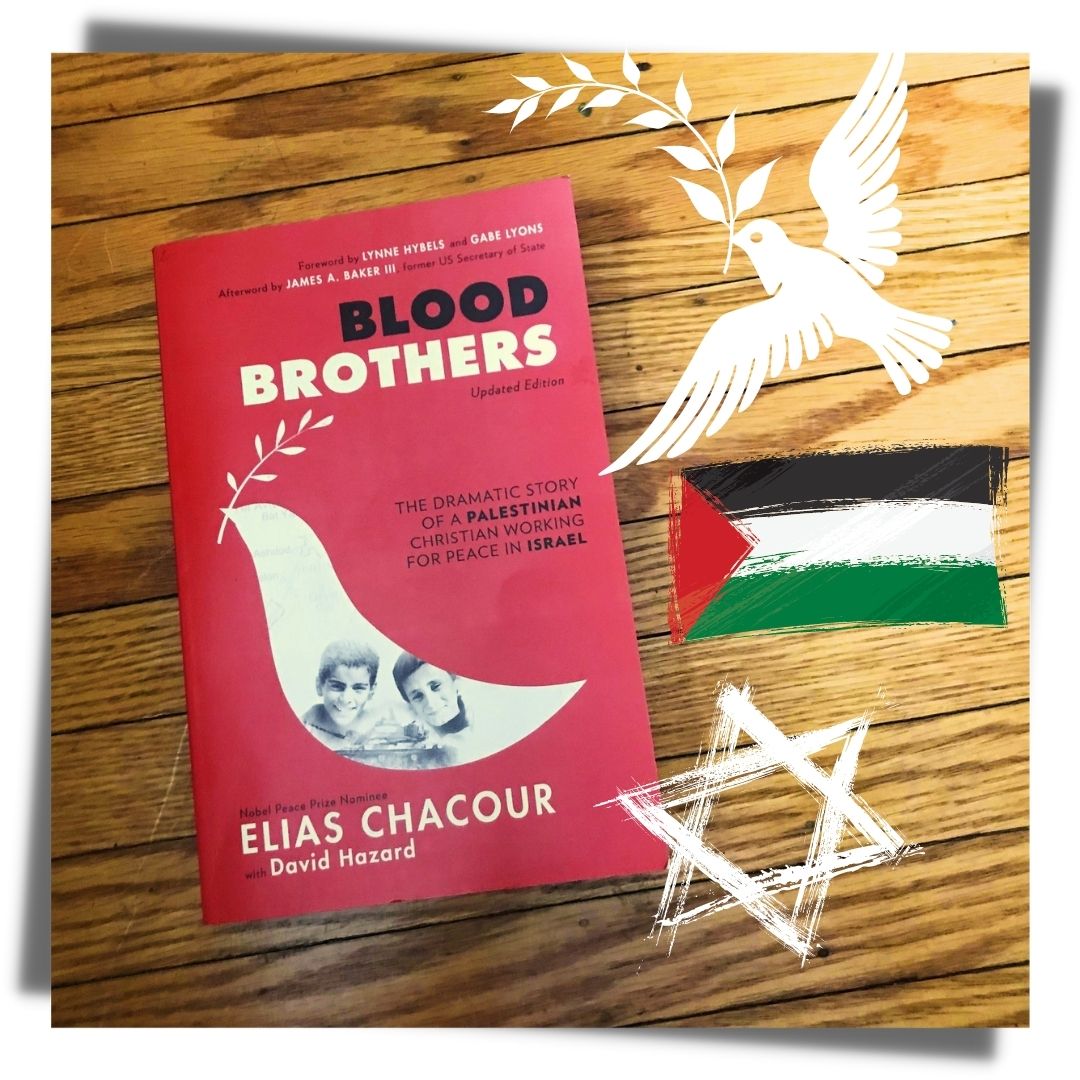
As a child, Elias Chacour lived in a small Palestinian village in Galilee. When tens of thousands of Palestinians were killed and nearly one million forced into refugee camps in 1948, Elias began a long struggle with how to respond. In Blood Brothers, he blends his riveting life story with historical research to reveal a little-known side of the Arab-Israeli conflict, touching on questions such as:
•What behind-the-scenes politics touched off the turmoil in the Middle East? •What does Bible prophecy really have to say? •Can bitter enemies ever be reconciled?
Now updated with commentary on the current state of the Israeli-Palestinian conflict, as well as a new foreword by Lynne Hybels and Gabe Lyons, this book offers hope and insight that can help each of us learn to live at peace in a world of tension and terror.
My Thoughts
I would love to say that Blood Brothers by Elias Chacour is merely a book full of history, a story of experiences of the past, not of the present, or even the future. I would love to say this book is now irrelevant, that the problems that face the nation of Israel and the Palestinian people are no longer there.
Sadly, Chacour’s book about growing up as a Palestinian Christian when Israel became established as a nation in 1948 holds familiar themes for our world today. Chacour’s book, first written in 1984 holds many of the same lessons and truths we need to be aware of today when talking about the tension and bloodshed between the Israeli and Palestinian people.
Chacour’s story is an eye-opening look at the conflict in Israel but also at those working for peace there. Chacour, now in his 80s, is still working for that same peace, the peace that was lost long before modern history, but especially in the late 40s when the United Nations declared Israel its own nation. Chacour may not have seen peace on a wide scale but at the personal level, he has seen healing and understanding unfold between Jews, Muslims, and Christians in a way he never thought possible as a child who witnessed unimaginable, heartbreaking violence toward his people and others.
As the back of the book says, Blood Brothers is a story about people, not politics and that’s exactly how I found it.
Chacour grew up in a small Paestinian village in Galilee. In 1948, tens of thousands of Palestinians were killed and nearly one million were forced into refugee camps. Chacour’s only family was chased from their village and their men were arrested, some of them later able to return, some of them killed. Being called a terrorist was a routine occurrence for Chacour from the time he was a small child and probably even know. He dealt with these these taunts and oppressive comments even as he studied to become a pastor with the Melkite Church. He is now the Archbishop of that church.
Chacour’s personal experience created a struggle within him between the love of the Christ he knew and how humans treat other.
Blood Brothers has become an international best seller, not only because it details Chacour’s experiences, but because it offers hope that healing will come on a personal level, if never on a political level, for the people of Israel and Palestine.
It is a book we all should read before we form or express opinions on the Palestinian-Israeli conflict and I hope more will do so.
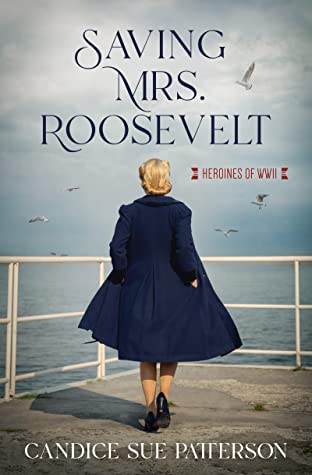
Shirley Davenport is as much a patriot as her four brothers. She, too, wants to aid her country in the war efforts, but opportunities for women are limited. When her best friend Joan informs her that the Coast Guard has opened a new branch for single women, they both enlist in the SPARs, ready to help protect the home front.
Training is rigorous, and Shirley is disappointed that she and Joan are sent to separate training camps. At the end of basic training, Captain Webber commends her efforts and commissions her home to Maine under the ruse of a dishonorable discharge to help uncover a plot against the First Lady.
Shirley soon discovers nothing is as it seems. Who can she trust? Why do the people she loves want to harm the First Lady? With the help of Captain Webber, it’s a race against time to save Mrs. Roosevelt and remain alive.Click here to buy your copy (Celebrate Lit Affiliate Link)
My Review
Saving Mrs. Roosevelt is a great book to get yourself lost in. The story carries you along easily, so easily don’t notice it’s 1 in the morning and you should have been asleep hours ago. It had me biting my nails until the very end.
The characters are intriguing, captivating and people I, for one, would be honored to get to know.
Patterson does a great job of dropping breadcrumbs of information related to the mystery of the book, keeping readers guessing throughout as to who might be involved in a plot to harm Mrs. Roosevelt. Just when you think you’ve figured it out, she sends you down another path full of questions that you know you need the answers to
There is romantic tension in the book, but it isn’t overdone or makes you want to roll your eyes and gag at all. It is subtle and sweet.
If you like historical fiction, light and sweet romance, and intrigue, then this is the book for you.
I received a copy of this book from the publisher through Celebrate Lit. I was not required to write a positive review. All thoughts and opinions expressed are my own.
About the Author
Candice Sue Patterson studied at the Institute of Children’s Literature and is an active member of American Christian Fiction Writers. She lives in Indiana with her husband and three sons in a restored farmhouse overtaken by books. When she’s not tending to her chickens, splitting wood, or decorating cakes, she’s working on a new story. Candice writes Modern Vintage Romance—where the past and present collide with faith. Her debut novel How to Charm a Beekeeper’s Heart was a 2012 ACFW First Impressions finalist and made INSPYs Longlist for 2016.
More from Candice …
The idea for Saving Mrs. Roosevelt literally came overnight. I had just finished writing a contemporary romance set in Maine, centered around a harbor town where lobstering is prevalent. My agent called me and told me about the Heroines of WWII series and asked if I’d be interested in writing a WWII novel. If so, I needed to come up with a story and proposal fast because spots were limited and filling quickly. My mind was so consumed with research of the lobster industry that I felt I couldn’t clear my brain fast enough to come up with another story on such short notice. That’s when I started wondering how I could take the knowledge I already had and make it work for a WWII novel. I googled Maine during WWII, came across an article that mentioned the SPARs, and the idea for Saving Mrs. Roosevelt was born.
I don’t want to give too much away, but the Nancy Drew deep inside me figured out a unique way to merge lobstering with espionage.
Though the plot is purely fiction, there are some characters and events that are historically accurate that were fun to include as well. I love Maine, but I’m Hoosier born and raised, and in my SPAR research, I discovered that Dorothy C. Stratton–the woman the Coast Guard asked to direct the SPARs–was the Dean of Women at Purdue University in Indiana. She was a woman of true character, grace, and strength. I knew right away she needed a cameo in my story.
Within twenty-four hours of receiving my agent’s call, I had plotted the entire story and sent a proposal. Weeks went by, and as fall ushered in its beautiful colors, my husband surprised me with a trip to Monhegan Island, Maine. We walked the trails, ate amazing seafood, and took in the gorgeous view. While on the island, my agent called again, this time to let me know that Barbour had contracted Saving Mrs. Roosevelt. What a special moment it was to be standing on the very shoreline where the book is set when I received the good news.
Since the book is set in Maine where the heroine works on a lobster boat with her father, I wanted to share my favorite recipe for Maine blueberry pie.
Maine Blueberry Pie
Ingredients:
2 Pie crusts
1 quart of fresh Maine blueberries
1 ½ tbsp lemon juice
Freshly grated nutmeg
¼ c light brown sugar
¼ c white sugar
¼ c flour
2 tbsp tapioca for thickening (if the berries are juicy)
Directions:
Preheat oven to 425 degrees. Place the berries into a large bowl, add lemon juice, and toss. Add the remaining ingredients and toss until the berries are well coated with the flour and sugars mixture. Line the pie plate with one crust. Put the berries into the pie plate and top with a solid or lattice-top crust. Bake for 35-40 minutes until the berries are bubbly and the crust is golden brown.
Giveaway
To celebrate her tour, Candace is giving away the grand prize package of a $25 Amazon gift card and a copy of the book!!
Be sure to comment on the blog stops for nine extra entries into the giveaway! Click the link below to enter.Click here to enter the giveaway
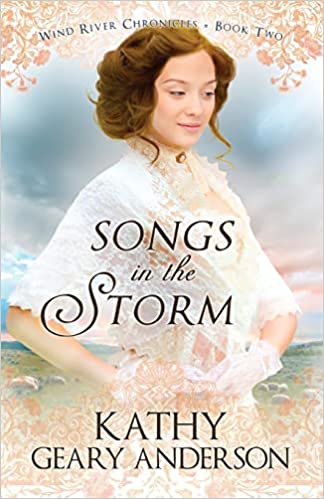
Songs in the Storm is a moving story about a newly married couple struggling with a difficult diagnosis for the husband. The story walks the reader through the ups and downs, triumphs, and trials in an emotional way.
The characters of this book are so well written that I immediately fell in love with them and wanted to be sure their lives turned out okay. Yes, there was some heartbreak for both of the main characters, but they walked through the heartbreak together. This isn’t a book where the book shows the main characters meeting and falling in love. They are already in love when the book begins but their happiness is threatened when a medical tragedy strikes.
The reader is pulled into Anderson’s story through the vivid characters but also through vivid details which capture the atmosphere of the time period.
I’m not someone who reads a ton of historical fiction, but I have read some, and the books in this genre which capture my interest the most are those which immerse me in the time period they are set in. Anderson did this in such a flawless way and none of the information about the time frame or the characters seemed forced or awkward.
Be prepared to feel a range of emotions in this book but don’t let that deter you because underlying beneath it all is a comforting, sweet buzz of hope that only God can bring even in the moments we think he has left us.
I was provided with a complimentary copy of this book in exchange for an honest review. All opinions are my own.
Description: This is not your typical Christian Fiction story…
The entirety of living civilization stands on the very brink of death. Undead hordes have rampaged across the world. Determined to do his part, Leon Rhise left his wealthy father’s estate and chose to defend the last living kingdom by joining the military. It had seemed to be a good idea at the time.
After his career in the airship navy came to an abrupt end Leon arrived home, hoping for a warm reception. Instead, he was abruptly tossed out. Disowned, unemployed, and friendless. All hope seems lost. Then Leon discovers a mysterious relic, which opens up the possibility of him becoming a Judge: a hero of legend. One that has not been seen for centuries.
As Leon travels the road less taken his destiny converges with newfound companions, each one surrounded by mystery. Advised by strange beings in dreams and visions, Leon learns that the undead onslaught the world has suffered is part of a much larger problem. A solution can be found by learning about the forgotten being known as Adonai. But the world is ending, and time is running out.
Delve into a world that brings a unique twist and interpretation to faith-based high fantasy. With emotional highs and lows, certain peril, dysfunction, and humor; tough questions are asked, and answers will come to light.
My Review
Let me get this out of the way first: I don’t read fantasy, Christian or not. I just don’t do it. But I’d met the author of this book in an online writing group, and he seemed nice so I thought I should read it to support him. I dragged my feet on it. I did. I cannot lie. I was like a little child. I folded my arms across my chest, slouched down on the couch and pulled my hood down over my face.
I pushed my lower lip out. “I don’t like fantasy books. All those ridiculous names and magic and sword battles with fantastical creatures.”
I huffed out a breath and grabbed my Kindle. “Fine. I’ll try it, but only because Max is a nice guy.”
Now, after reading The Rhise of Light, I can’t say that I will keep reading fantasy, but I can say I will read more fantasy written by Max Sternberg.
The Rhise of Light is not only full of well-written prose and dialogue and good, smart fun. It is also deeply theological, thought-provoking, and spiritually moving.
I fell in love with the main characters, Leon, Miala, Duame, and Kelleren but then there were even more characters to fall in love with as the book went on.
Creative well-developed characters and his descriptions make you feel like you are right there and all the characters are alive and real – whether they are human, elf, dwarf, dog, or an undead zombie.
Sternberg paints a vivid image of the world Leon and his friends live in, so vivid that sometimes it is a bit scary, considering that when people die they immediately become undead zombies who want to kill everyone else, no matter how nice they were in life or how they died. The only way to kill them for good is to dispatch them a second time and often in a grisly way.
Sternberg doesn’t pull any punches in fight scenes, but he also isn’t overly graphic. He weaves humor in the midst of heavy and serious and touching in the midst of heartbreaking.
Perhaps you’re not a fan of fantasy either. Don’t overlook this one because of your preconceived notions. You might just be as surprised and as enchanted as I was with Sternberg’s debut novel.
With a disposition as bright as her name, Sunny shakes it off the worst day of her life and makes a new start. She’s got the brains that it takes, but she’s more than a little scared. It’s not just her reputation on the line.
Would this cockeyed adventure be the thing her siblings need too?
Pat only wants peace in the family and never dreamed doing a favor for his sister could drop him into so much hot water. Torn between what he’s always wanted and what is staring him in the face, someone is bound to get hurt.
Odds are it will be him.
But then, only the cardinal knows for sure.
Return to 1970 Indiana with Sunny, the first book in The Weather Girls series—get into the miniskirts, bell-bottoms, and Christian family values.
You’ll love Sunny for the music, the fashions, and the hilarious antics, because who can resist a romantic trip down memory lane?
If you are looking for a light read with minimal conflict, then Sunny (The Weather Girls Book One) is the book for you. The story takes place in 1970 with Sunny Day as the main character. Yes, that’s right, her name is Sunny Day, much to her embarrassment. Her sisters are named Stormy and Windy Day and when Sunny ends up starting a new endeavor it isn’t long before she has help from family and a new handsome friend, Pat Whitcomb, of the very well-known Whitcomb family.
I fell in love with the characters, which were well developed, and felt like people I might know myself. Sunny and her sisters supported each other through each trial, showing a close-knit family, but not one without flaws and heartache. There isn’t a large focus on the heartache, though, making this book mostly light-hearted and touching. Humor and romance are sprinkled throughout. I’m a sucker for a book with a meddling grandmother and this one definitely has one and Gramma is one of the brightest spots of the book, besides Sunny herself.
The only aspect of the book which left me a little confused was that there was very little to no mention of a relationship with Jesus throughout the book until it was thrust upon the reader suddenly and in a somewhat awkward way with what I felt was an abrupt “salvation scene.” I don’t disagree with the scene’s content in any way, I just felt it could be written in a little bit more of an organic way. I do not, however, feel that this took away from the book overall and I am looking forward to snatching up a copy of the next book, Stormy, which focuses on the story of Sunny’s sister and is already available on Amazon and in Kindle Unlimited (at the time this review was written anyhow).
I was given a complimentary copy of this book to review in exchange for an honest review. I give it a 4 out of 5.
About the Author
Jennifer Lynn Cary likes to say you can take the girl out of Indiana, but you can’t take the Hoosier out of the girl. Now transplanted to the Arizona desert, this direct descendant of Davy Crockett and her husband of forty years enjoy time with family where she shares tales of her small town heritage and family legacies with their grandchildren. She is the author of The Crockett Chronicles series and The Relentless series as well as the stand-alone novella Tales of the Hob Nob Annex Café and her recent split-time novel The Traveling Prayer Shawl.
More from Jennifer Lynn
I was born in the 50’s, grew up in the 60’s and 70’s, and married in 1980. I relate to K.T. Oslin’s song “80’s Ladies” a little too well. 😉
Though we moved from Kokomo, Indiana in 1972, it always will be my hometown.
A few years ago my sister headed up a plan to have an annual Cousin’s Reunion in Kokomo. Two cousins came from Ohio and my sister and I came from the west to converge on our family who still call Kokomo home. Each trip back reminded me of how much I loved growing up there.
One day Bobby Hebb’s “Sunny” came on the Oldies station and caught my attention. Then I remembered the songs “Stormy” and “Windy” and wondered what it might be like for girls with that sort of name—especially if their surname was Day. Would their dispositions match their names? Why would their parents give them those names? The questions kept coming and I fell in love with the whole storyline.
The best part was putting the house I grew up in into the book(s). Yep, as you read the story, Hazel Day’s house is set up mostly like the one where I grew up only I added a den and an extra bedroom upstairs.
Ferguson House is based on the Seiberling Mansion—I love that place and tour it every chance I can when I get back to Kokomo. It’s amazing.
I also included favorite landmarks. Scotty’s Drive-In saw a lot of me in my early teen years. Great for grabbing a coke and not that far from either school or home.
The funny thing about memories is that they can blur and morph over time. Thankfully someone from my hometown has put together a Facebook page where I can ask questions and get more than enough answers.
Many locales I remember no longer exist, so writing about them helps them live on.
I hope you will check out Sunny and 1970 Kokomo and come back for the rest of The Weather Girls trilogy.
Welcome to the Blog + Review Tour for Blood From a Stone by David James Warren, hosted by JustRead Publicity Tours!
ABOUT THE BOOK
The continuing adventures of Rembrandt Stone from the creative minds of James L. Rubart, Susan May Warren, and newcomer David Curtis Warren, writing collectively as David James Warren.
Title: Blood From a Stone
Series: The True Lies of Rembrandt Stone #5
Author: David James Warren
Publisher: TriStone Media
Release Date: October 5, 2021
Genre: Time Travel Detective Series
He fled the future with blood on his hands. Now, he’ll do anything to stop a killer.
Tragedy has yet again taken from Detective Rembrandt Stone everything he loves. Now, he has one last chance to get things right and stop a killer he’s been hunting across four timelines. Instead, he gets tangled in a petty crime that just might cost him his one chance at justice.
With two murders to stop, and thirty-eight lives still in the balance, Rembrandt must play his hand against time just right if he wants to win his future. Play it wrong and his life will stay shattered beyond repair.
What sacrifices will he have to make to come home to his wife and daughter?
The stakes have never been higher in the heart-wrenching, edge-of-your-seat fifth story of the True Lies of Rembrandt Stone.
I have loved every book in the Rembrandt Stone series so far and the fifth book, Blood From A Stone, was no exception. There were aspects of this book I didn’t enjoy as much as others, but that was only because certain situations weren’t working out the way I wanted them to. I wanted the parts of the main character’s life that were broken in other books to be fixed. Fixed I tell you!
I was hooked on this series from page one of the first book, Cast the First Stone. I fell fast in love with Rembrandt and his wife Eve and their daughter Ashley and all the supporting characters around them. My fast attachment is probably why I have read these books with a “fist in my gut” as Rem would say. I’m on edge, anxious to know if it will all turn out okay, if the family will be happy again, which isn’t a spoiler if you know these books are time travel thrillers. In time travel there is always a chance things will go wrong, but that they can be corrected again. They can be corrected again, right? Right?! Of course, they can, as long as the author (or in this case authors) want it to. Oh, I truly hope these authors want it to.
Most who review this book, and others in the series, are going to tell you they love the fast-paced action, the way Rem breaks the fourth wall, the characters, the backstories that are woven through the series and I love all those aspects as well. What I also love, though, is how marriage is portrayed in these books. It’s not boring, mundane, or something to get out of. It is passionate, special, something to fight for. The bond between Rem and Eve spans timeline after timeline but each time Rem knows that Eve belongs with him, that without her his life isn’t worth living, no matter how many cases he solves, how many wrongs he makes right.
You rarely find a series of books that can balance suspense, mystery, action, and romance. Thankfully, the Rembrandt Stone series is one of those rare, to-be-treasured finds.
ABOUT THE AUTHOR
James L. Rubart is 28 years old, but lives trapped inside an older man’s body. He’s the best-selling, Christy Hall of Fame author of ten novels and loves to send readers on mind-bending journeys they’ll remember months after they finish one of his stories. He’s dad to the two most outstanding sons on the planet and lives with his amazing wife on a small lake in eastern Washington. More at http://jameslrubart.com/
Susan May Warren is the USA Today bestselling, Christy and RITA award–winning author of more than eighty novels whose compelling plots and unforgettable characters have won acclaim with readers and reviewers alike. The mother of four grown children, and married to her real-life hero for over 30 years, she loves traveling and telling stories about life, adventure, and faith.
For exciting updates on her new releases, previous books, and more, visit her website at www.susanmaywarren.com.
David Curtis Warren is making his literary debut in these novels, and he’s never been more excited. He looks forward to creating more riveting stories with Susie and Jim, as well as on his own. He’s grateful for his co-writers, family, and faith, buoying him during the pandemic of 2020, and this writing and publishing process.
(1) winner will receive a print copy of Blood from a Stone and a $15 Amazon gift card!
Full tour schedule linked below. Giveaway began at midnight October 5, 2021 and will last through 11:59 PM EST on October 12, 2021. Winner will be notified within 2 weeks of close of the giveaway and given 48 hours to respond or risk forfeiture of prize. US only. Void where prohibited by law or logistics.