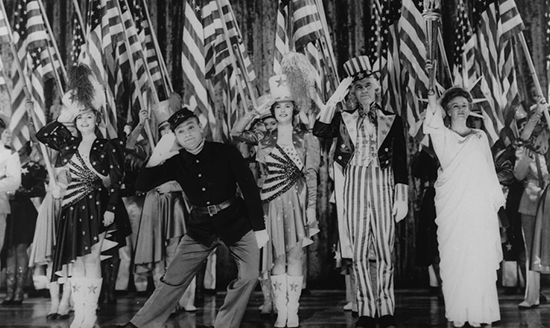
For winter this year, I am watching James Cagney movies.
First up is Yankee Doodle Dandy (1942) which Cagney won an Oscar for.

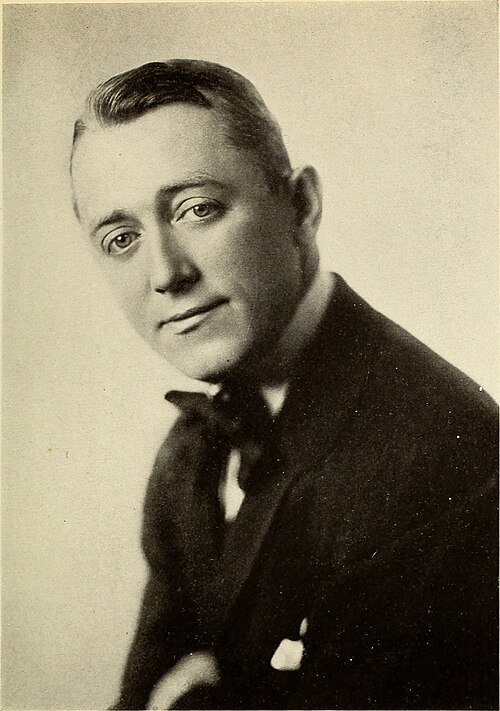
This is a biopic about the entertainer George Cohan. Actually, though, he was more than just an entertainer. Under that umbrella, he was a playwright, lyricist, actor, singer, dancer, and theatrical producer.
Don’t think you know who Cohan is?
Well, if you’ve ever heard the songs “You’re A Grand Old Flag”, “Over There”, “Yankee Doodle Dandy Boy,” or “Give My Regards to Broadway,” then you have heard some of George’s work.
Yankee Doodle Dandy is his story, but . . . with some poetic license from what I’ve been reading. Cohan comes out looking a bit better than he might have been in real life, considering his first wife divorced him for adultery and that mysteriously didn’t make the movie. The movie did portray him as a bit of an arrogant kid who pushed his way to stardom, so he wasn’t portrayed as totally perfect, however. Plus, Cohan had the final say on the movie so maybe that’s why he looked a bit better in the movie. *wink*
Cohan was born July 3, 1878 according to baptismal records but according to him and his parents, he was born on the Fourth of July. This “fact” would be used throughout his career as he asserted his bold patriotism for the United States of America.
“I’m a Yankee Doodle Dandy
A Yankee Doodle, do or die
A real live nephew of my Uncle Sam
Born on the Fourth of July
I’ve got a Yankee Doodle sweetheart
She’s my Yankee Doodle joy”
- From the musical Little Johnny Jones
Cohan’s was an Irish immigrant named Jeremiah (Keohane) Cohan. His mother was Helen “Nellie” Costigan Cohan, and his sister was Josephine “Josie” Cohan Niblo (1876–1916). Together the four of them would form a Vaudeville act called The Four Cohans.
George began singing and playing the violin at the age of 8 and toured with his family from 1890 to 1901.
During these years, he made famous a speech at the end of their show that you might have heard over the years, or even said yourself as a joke: “My mother thanks you, my father thanks you, my sister thanks you, and I thank you.”
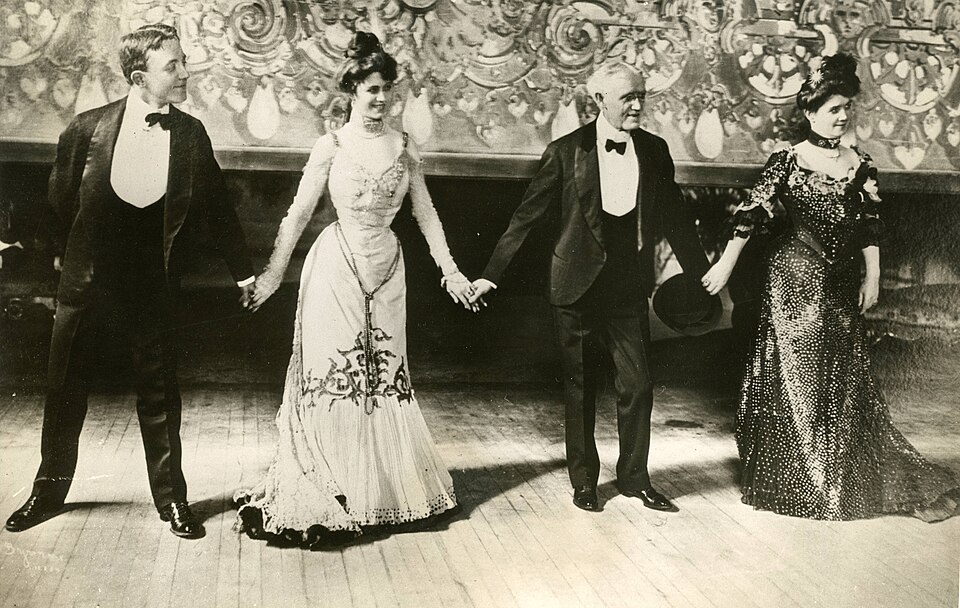
He and his sister made their Broadway debuts in 1893 in a sketch called The Lively Bootblack.
I won’t give you his entire biography here, so if you want to know even more about his life, the movie will fill you in or there is a ton of information about him online.
Many people think of James Cagney with a New York accident asking questions like, “You talking to me?” because of the many mobster-themed movies he appeared in in the 1930s. (I don’t think he actually ever said that line, though. Much like he never actually said, ‘You dirty rat! The quote was actually longer and included the words “You yellow-bellied dirty rat” in the movie Taxi, 1931.)
“There is a story that James Cagney stood on his toes while acting, believing he would project more energy that way,” Roger Ebert wrote. That sounds like a press release, but whatever he did, Cagney came across as one of the most dynamic performers in movie history–a short man with ordinary looks whose coiled tension made him the focus of every scene.”
Yankee Doodle Dandee showed there was lot more to Cagney than many moviegoers realized.
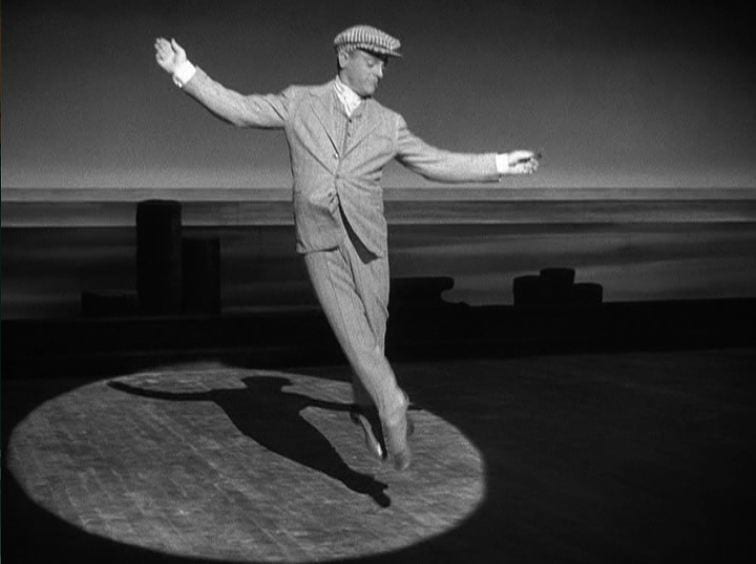
For one, Cagney could dance, which he had showcased in other movies but really was able to showcase in this movie.
Cagney could also be funny and charming — which moviegoers had seen in other movies but really saw in Yankee Doodle Dandy.
Cagney almost didn’t get the role that he would later call his favorite, according to an article on TCM.com.
Originally Cohan and MGM had combined to make a film that would cover when Cohan had toured with his family. It would have starred Mickey Rooney. The deal collapsed because the studio head, Louis B. Mayer, refused to let Cohan have the final cut on the film.
Samuel Goldwyn then expressed an interest in making a movie with Cohan and planned on giving the role of Cohan to Fred Astaire.
Astaire turned it down, and Warner Bros. picked up the rights and cast Cagney, who at the time was being suspected of being a communist sympathizer due to being president of the Screen Actors’ Guild a — gasp! — union!
“He wanted to show his patriotism on screen,” the TCM article reads. “And the George M. Cohan story was the perfect vehicle to do that.”
Cagney broke into infamy with this movie. I am sure many of you have seen one of his most famous scenes — when he tap dances down a long flight of stairs while leaving the white house after talking to President Franklin Roosevelt. This scene, like many others in his career, was improvised by Cagney, who called it his favorite moment in the movie.

“I didn’t think of it till five minutes before I went on,” Cagney later recalled. “And I didn’t check with the director or anything; I just did it.”
Yankee Doodle Dandy was directed by Michael Curtiz (most well-known for directing Casablanca).
According to TCM and other sources online, Curtiz letting Cagney have free rein in the role is what made it such a success and made him so enamored with Cagney as an actor.
“The ordinarily hard-boiled Curtiz was so moved by the scene in which Cohan bids farewell to his dying father (Walter Huston) that he reportedly ruined a take with his loud sobs,” reads the article on TCM.com. “According to Cagney biographer Michael Freedland, tears streamed down Curtiz’s face as he stumbled away to find a handkerchief and exclaimed to Cagney, “Gott, Jeemy, that was marvelous!’”
I can speak from the experience of seeing the movie that that scene was heartbreakingly marvelous. I wasn’t super emotionally invested in the movie as I watched it, but during that scene, I teared up and failed to hold back a small sob. Maybe it’s because my parents are older, so I could relate to that scene more than I might have been able to if I had watched this when I was younger.
Critic Brenden Gill said of Cagney’s role in the film: “George M. Cohan was by all accounts something of a scoundrel. He was an impossible human being, but he was a tremendous actor, comedian, showman, and he wrote great popular songs. He exists in our memories now not as George M. Cohan but as James Cagney in the movie.”
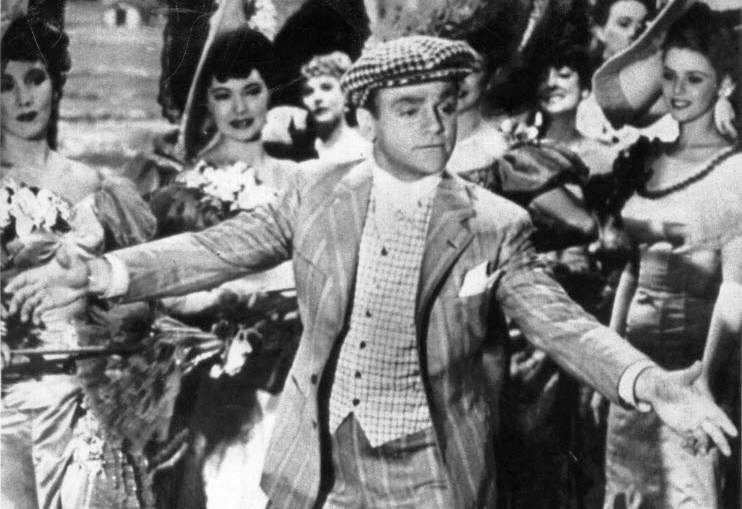
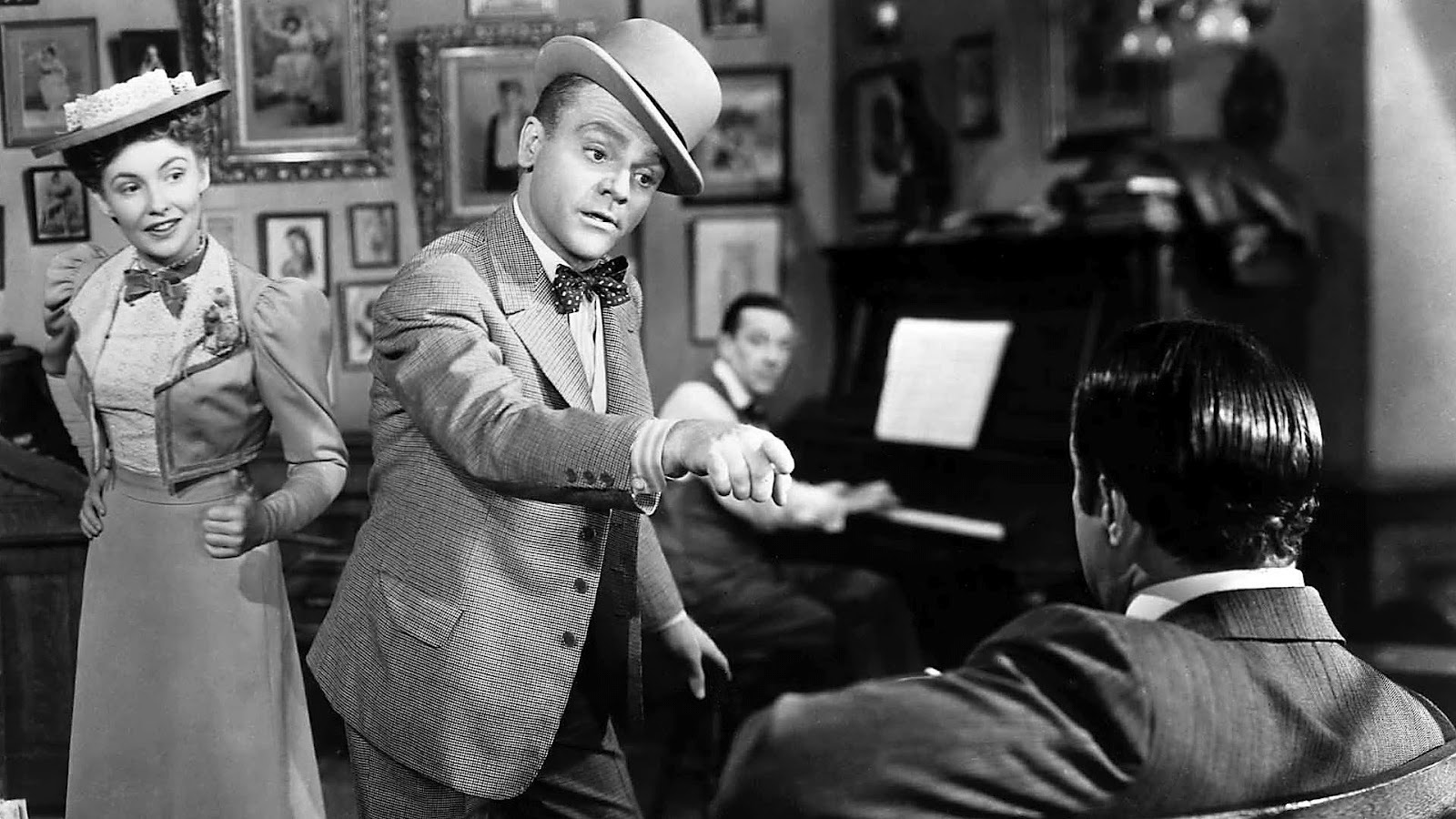
“Cagney managed to capture this persona that Cohan created,” another critic I heard (but couldn’t find the name of) said. “It was brash. It was pushy. It was aggressive. It was funny. Very American. Very New York. And Cohan created this character as his own persona on stage, but it really became the emblem of Broadway itself.”
Cagney, according to TCM.com writer Jeremy Arnold, wanted to portray Cohan correctly, not only because Cohan — 63 at the time the movie was made —had final approval over the film, but for accuracy.
“To perfect Cohan’s distinctive, strutting style of dance,” Arnold writes. “Cagney rehearsed with choreographer John Boyle, who had worked with Cohan extensively in the 1920s. Cagney also channeled Cohan’s singing voice, which was more like rhythmic speaking, and brought his own charismatic talent to the romantic, comedic, and dramatic scenes.”
There were liberties taken with Cohan’s life, as I mentioned above. For instance, his two wives were combined into a single character. Also, the chronology and order of his parents’ death was also switched around (probably to make that death bed scene even more emotional). Additionally, in one scene when he suffers a flop with a non-musical drama called Popularity, a newspaper seller announces the torpedoing of the Lusitania. The play flopped in 1906, but the Lusitania sunk in 1915, according to TCM.
Despite these changes, most critics agree that the movie captured Cohan’s life and music perfectly.
“Yankee Doodle Dandy, with its many flag-waving musical numbers, proved just the ticket for World War II-era audiences and became the top-grossing movie of its year, as well as Warner Bros.’ top-grossing movie to that time,” Jeremy Arnold wrote for TCM.com.
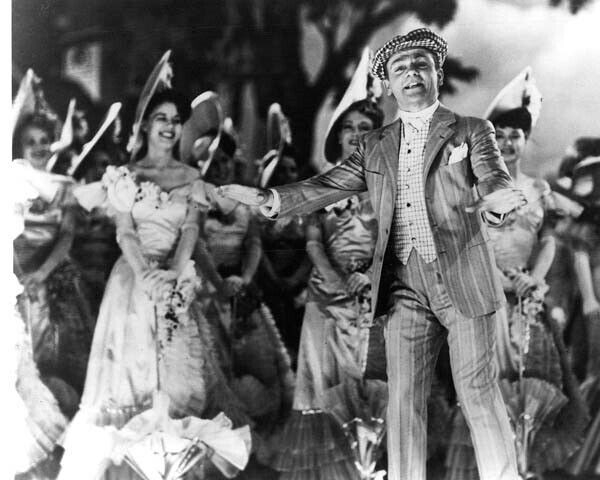
In addition to Cagney, the movie also starred Joan Leslie, Walter Huston, Richard Worf, Irene Manning, Rosemary Decamp, Jeanne Cagney (Cagney’s sister who played his sister Josie in the movie), and Eddie Foy Jr as Eddie Foy Sr.
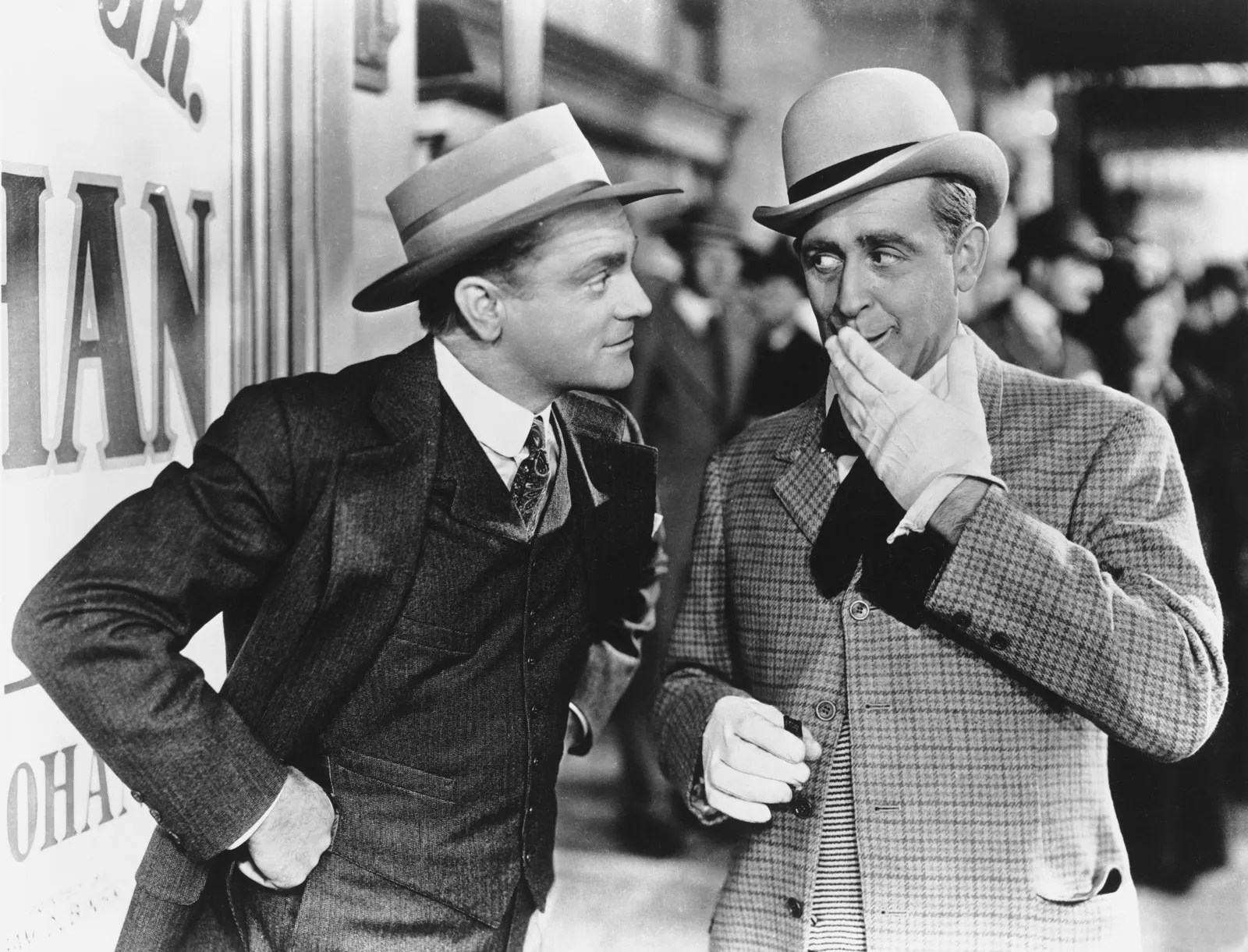
So, a pause here. Eddie Foy Sr. was another entertainer of a similar style and also performed vaudeville with his family, The Seven Foys.
There is a movie called The Seven Little Foys (1955) starring Bob Hope as Eddie Foy Sr. and in it there is a cameo by Cagney, who portrays George M. Cohan, reprising his role from Yankee Doodle Dandy.
The two dancers face off in a very fun tap-dancing routine on a boardroom table. You can catch that here:
As for what movie watchers or critics now think of Yankee Doodle Dandy, you can find a variety of opinions online — some calling it satire to make fun of capitalism and nationalism while others say it is a disgusting display of support for capitalism and nationalism.
Some love the over-the-top patriotism and some absolutely hate it.
I guess you’ll have to make up your own mind what it promotes or represents and what it doesn’t, but what many can’t deny is the talent Cagney displays in the movie.
I definitely enjoyed seeing Cagney’s talent, but at first glance didn’t enjoy his dancing style. It was floppy and lanky instead of smooth and debonair like Gene Kelley or Fred Astaire, who I am more used to, but after seeing footage of Cohan, I now get that Cagney was imitating Cohan’s dancing style.
After hearing and seeing recordings of Cohan this week, I realized how perfectly Cagney nailed Cohan in the movie. No wonder he won the Oscar for best actor that year. It was also his only Oscar, incidentally.
Cagney pulled the role off even though “he (couldn’t) really dance or sing,” observed critic Edwin Jahiel, “but he acts so vigorously that it creates an illusion, and for dance-steps he substitutes a patented brand of robust, jerky walks, runs and other motions.”

Ebert wrote in his review of the film : “Unlike Astaire, whose entire body was involved in every movement, Cagney was a dancer who seemed to call on body parts in rotation. When he struts across the stage in the “Yankee Doodle Dandy” number, his legs are rubber but his spine is steel, and his torso is slanted forward so steeply we’re reminded of Groucho Marx.”
I’ll have to check out Cagney’s dancing in other movies to really get an idea of his actual style.
Cohan saw the picture shortly before he died in November 1942, by the way, and reportedly said afterward, “My God, what an act to follow.” The next morning, he sent Cagney a congratulatory telegram. And then he died. Ha! Kidding. I have no idea when he actually died but I do know he was only 64 so it was shortly after the movie was released.
I was amazed by the amazing sets for the incredible musical scenes in this movie. The scenes — which included moving sets and fireworks, and a floor like a conveyor belt that made the actors seem like they were continuously marching toward the audience — were way ahead of moviemaking at that time
Maybe that is why the movie cost so much to make, which was $1.5 million and well above the standard for the time.
Luckily, it grossed $6 million.
You can catch some of that movie/Broadway magic here:
As for Cagney’s acting in the movie, I thought it was great and engaging. Even parts that could have been a bit cheesy were enhanced by Cagney’s performance.
I loved the dancing and singing sequences throughout the movie. Those snippets were perfect introductions to the style of musicals and Broadway at the time, though that style became the style of Broadway in the future as well, thanks to Cohan.
Have you seen this one?
You can learn a bit more about Cohan in this clip:
If you want to see Cohan himself perform “Over There,” you can see that here:
And for a sneak peek of the movie, here is the trailer from when it was released:
If you want to find clips and thoughts about vintage movies and TV, you can visit me on Instagram on my Nostalgically Thinking Account (https://www.instagram.com/nostalgically_thinking/)
If you would like to follow along with my Winter of Cagney and watch some of the movies yourself, here is my schedule for the winter:
Yankee Doodle Dandy
The Man of A Thousand Faces
Taxi
The Strawberry Blonde
Mister Roberts
Angels With Dirty Faces
Public Enemy
Love Me or Leave Me
White Heat
Bonus: The Seven Little Foys
Additional Resources:
https://www.tcm.com/articles/afi-top-100/24022/yankee-doodle-dandy-1942
https://www.rogerebert.com/reviews/great-movie-yankee-doodle-dandy-1942
https://en.wikipedia.org/wiki/Yankee_Doodle_Dandy
https://en.wikipedia.org/wiki/The_Seven_Little_Foys
If you want to find clips and thoughts about vintage movies and TV, you can visit me on Instagram on my Nostalgically Thinking Account (https://www.instagram.com/nostalgically_thinking/) or on my YouTube account Nostalgically and Bookishly Thinking here: https://www.youtube.com/@nostaglicandbookish
Discover more from Boondock Ramblings
Subscribe to get the latest posts sent to your email.

Pingback: Winter of Cagney: The Bride Came C.O.D. | Boondock Ramblings
Pingback: Winter of Cagney: White Heat (with some spoilers) | Boondock Ramblings
Pingback: Winter of Cagney: Love Me Or Leave Me | Boondock Ramblings
Pingback: Winter of Cagney: The Public Enemy (1931) | Boondock Ramblings
Pingback: Winter of Cagney: Mister Roberts | Boondock Ramblings
Pingback: Winter of Cagney: Strawberry Blonde | Boondock Ramblings
Pingback: Winter of Cagney: Taxi (1931) | Boondock Ramblings
Pingback: Favorite movies I watched in 2025 | Boondock Ramblings
I, too, loved watching James Cagney movies when I was young and Yankee Doodle Dandy was one of my favorites! I remember coming home from church on Sunday mornings and then, after lunch, my mom and I would watch old movies during the afternoon – Blondie and James Cagney were two of our favorites!
LikeLike
Pingback: Sunday Bookends: Disappointing books, Cagney movies, and clueless mom | Boondock Ramblings
Pingback: Sunday BookendsTemplate | Boondock Ramblings
I am going to have to rewatch this one. I remember just loving it when I was a kid. Thanks for all the background information, too. I love learning more about actors and movies!
https://marshainthemiddle.com/
LikeLike
I watched a lot of Cagney movies when I was a young girl. He was one of my favorite actors. Thanks for bringing back memories!
LikeLike