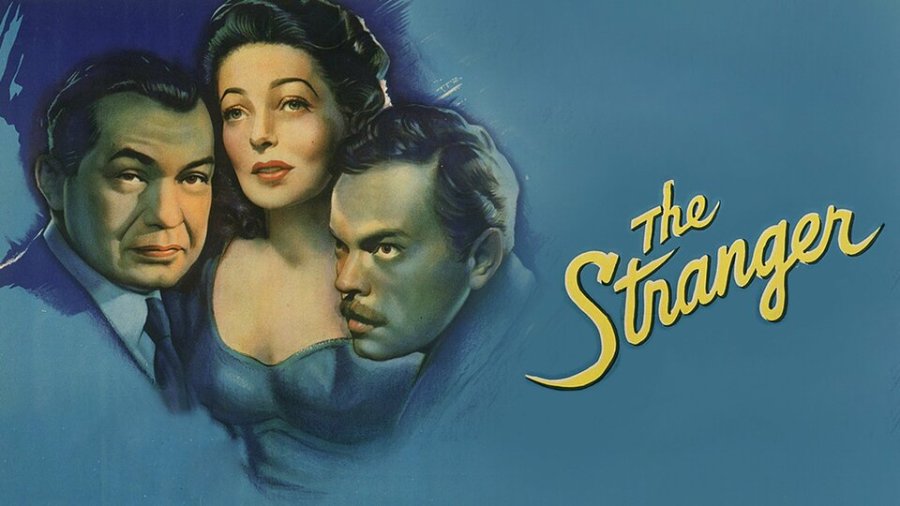
A few weeks ago, my husband suggested we watch an Orson Welles movie. Since I’ve liked other movies by and starring Orson, I agreed to it.

The Stranger was released in 1946 and tells the story of a war crimes investigator who tracks a high-ranking Nazi fugitive to a small Connecticut town.
Welles both directed and co-wrote the film but was uncredited for the writing, which was most likely part of the many concessions he made for the opportunity to direct it. This is a movie that some call his most conventional. It’s also one he wasn’t as fond of because so many changes were made to the final cut without his consultation.
The movie stars Welles, Edward G. Robinson, and Loretta Young.
The creepy undertone throughout the entire movie left me always waiting for the other shoe to drop.
Nazi fugitive, Franz Kindler (Welles), has done his best to assimilate into American society. He’s even about to marry the daughter of a justice of the U.S. Supreme Court.

Edward G. Robinson, playing war crimes investigator Mr. Wilson, follows one of the recently released followers of Kindler to the town, hoping he’ll lead him to Kindler. The man suddenly disappears though, and Wilson is certain he’s been murdered by Kindler, but still doesn’t know who Kindler actually is. Only that he is somewhere in the town.
We the viewer, know all along what happened to the man and who made it It happens about 15 minutes into the movie, but Robinson has to spend much of the movie trying to figure it out and once he does figure it out, he spends the rest of the movie trying to make Kindler admit who he really is. The only thing Robinson’s character really knows when he comes to the town is that Kindler had an almost unhealth obsession with old clocks.
It’s a fantastic, stressful game of cat and mouse that had me literally biting my nails part of the time.
The music of the movie is very interesting – mixing in a creepy violin-based humming, with happier melodies to try to show the contrast between an innocent, happy world being infiltrated by pure evil.

It always amazes me how quickly movies were made back then. Filming for this movie took place from September to November of 1945 and was released July 2, 1946.
Originally the film was going to be directed by John Husten, but he entered the military and Welles begged producer Sam Spiegel (also called S.P. Eagle at the time) to let him direct the film. Spiegel agreed as long as Welles agreed to several concessions and to be let go as director if he stepped out of those perimeters. Welles would still have to continue on as the lead actor, even if he was let go as director, however.
Welles agreed. He needed the job if he wanted to continue in Hollywood. Five years earlier Welles had been essentially backlisted with the release of Citizen Kane, which won 9 Academy Awards, including Best Director, Best Movie, and Best Actor for Welles. This should have made Welles a sought-after director and actor. Citizen Kane was based on the life of one of the most powerful men in the world at the time — William Randolph Hearst, a newspaper publisher and owner — though and Hearst wasn’t happy. In fact, he was furious. He made life very difficult for Welles and anyone else associated with the making of the movie, which is now considered the greatest movie all time thanks to its innovative filmmaking techniques, complex story, and influential impact on cinema history.

“In September 1945 Welles and his wife Rita Hayworth signed a guarantee that Welles would owe International Pictures any of his earnings, from any source, above $50,000 a year if he did not meet his contractual obligations,” an article on Wikipedia states. “He also agreed to defer to the studio in any creative dispute.”
This became a challenge when Editor Ernest J. Nims was given the power to cut any material he considered extraneous from the script before shooting began.
“He was the great supercutter,” Welles said, “who believed that nothing should be in a movie that did not advance the story. And since most of the good stuff in my movies doesn’t advance the story at all, you can imagine what a nemesis he was to me.”

Reading about all the cuts that were made from the script, and the final product helps me to understand why this movie feels so choppy at times. It feels like elements that would have helped to explain some of the plot better are missing.
What is really missing is building up Welles’ character and helping the viewer get to know who he is. As I read online, I found out that there were scenes removed from the beginning of the movie that would have given us more character development for Welles’ character.
I feel like Nims really overdid things and should probably be ashamed of chopping up Welles’ work.
I also thought that it was interesting that Welles wanted a female actress to portray the investigator.
“I thought it would be much more interesting to have a spinster lady on the heels of this Nazi,” Welles said.
Welles would later say in interviews that nothing of The Stranger was his in the end. Biographer Frank Brady disagrees, “Welles has said, since the making of The Stranger—which he completed one day before schedule and under budget—that nothing in the film was his, this despite the fact that the unmistakable Wellesian moods, shadows, acute angles, and depth-of-focus shots are pervasive. Within the film is a second film, another Wellesian touch, consisting of snatches of documentary footage showing Nazi atrocities.”
One unique aspect of The Stranger is that it was the first commercial film to use documentary footage from the Nazi concentration camps.
Welles viewed Nazi Concentration Camps (1945), a film used as evidence in the Nuremberg Trials in early May 1945 as a correspondent and discussion moderator at the United Nations Conference on International Organization
One thing I didn’t remember until reading about it this week was that in the 1940s, many in the world simply couldn’t accept that the concentration camps were real.
Welles wrote about the footage in a column for the New York Post:
“No, you must not miss the newsreels. They make a point this week no man can miss: The war has strewn the world with corpses, none of them very nice to look at. The thought of death is never pretty but the newsreels testify to the fact of quite another sort of death, quite another level of decay. This is a putrefaction of the soul, a perfect spiritual garbage. For some years now we have been calling it Fascism. The stench is unendurable.”
Though the studio did not think The Stranger would be a success, it actually was and right out of the gate too. It cost $1 million to make and earned $2.25 million in U.S. rentals in its first six months. Fifteen months later had grossed $3.2 million.


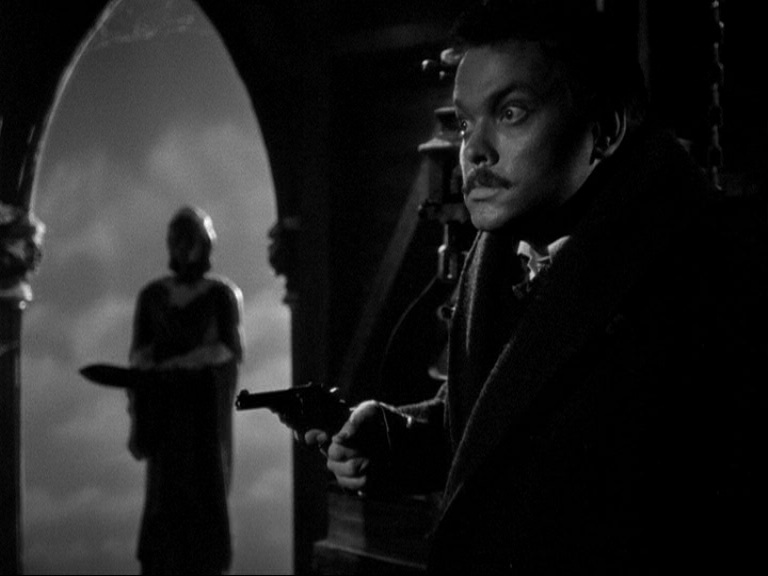
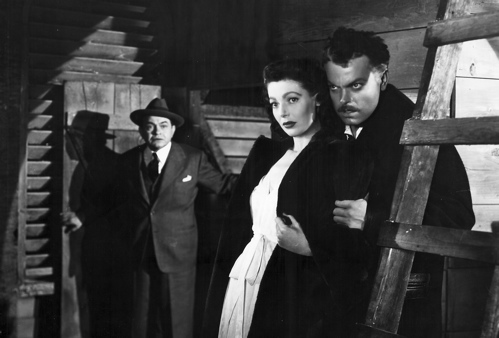
I very much enjoyed the film, but I do wish that Kindler’s German accent would have come back as soon as his cover was blown. Having him keep the American accent he’s been using to keep his cover, even when under pressure, seemed unrealistic to me.
Despite that small issue, Welles is so deliciously evil in this. His excuses for his crimes against humanity were presented with a lecherous smile that sent shivers down my spine. The tension throughout the film is extreme. I never knew when Kindler would finally snap and reveal himself or worse — kill someone to keep his identity secret.
I found this one on YouTube for free, but it is also streaming in better quality on several streaming sites, including Amazon Prime.
Have you ever watched this one? What did you think?
Discover more from Boondock Ramblings
Subscribe to get the latest posts sent to your email.

Pingback: Favorite movies I watched in 2025 | Boondock Ramblings
Pingback: Sunday Bookends: The Get Rid of Hiccups Trick, what I thought of the Miss Marple Short Stories, and a Paris movie marathon being planned – Boondock Ramblings
Lisa, I enjoyed your review of “The Stranger.” While I am most familiar with Welles’ “Citizen Kane,” this film offers quote a story. Edward G. Robinson adds another character role to join the many he gifted us. Your inclusion of the short clip fits right into some of your notes. I need to give this film a deeper look.
LikeLiked by 1 person
I hope you enjoy it if you decide to give it a chance.
LikeLiked by 1 person
Pingback: Sunday Bookends: The Get Rid of Hiccups Trick, what I thought of the Miss Marple Short Stories, and a Paris movie marathon being planned – Boondock Ramblings
I’ve been trying to make up my mind whether or not I want to see this for years and years now. And I still haven’t, but I think you’re tipping me more toward seeing it than away. I like some of Welles’s work so much, and then other things, not really. Sigh. I will just have to watch it one day.
LikeLike
I have heard of it, but never watched it. I will have to be in the right mood for it, so for now it’s going on my “Watch Later” list.
Thanks for the review!
I have seen Citizen Kane, The Third Men, The Magnificent Ambersons.
I also remember seeing the movie about Welles’ radio play when I was a kid, but never listened to the play itself. I should really do that, too!
https://catswire.blogspot.com/
LikeLike
Just saw my own comment in the WP reader.
The Third Man. Not Men. Ugh. I did maths this evening and my brain hasn’t recovered yet 😉
LikeLike
You know, I’ve never watched Citizen Kane. I think the only thing I’ve ever watched was War of the Worlds (the original), and it scared me so much. This movie sounds really good so I’m going to look for it on YouTube. Thanks for the review, Lisa.
https://marshainthemiddle.com
LikeLike