This weekend I watched The Bishop’s Wife (1947), which I have watched before but couldn’t remember the end of, so I watched it again.
The movie stars Cary Grant as an angel named Dudley who comes to earth to help Bishop Henry Brougham, (David Niven). Henry is so wrapped up in securing funding for a cathedral he begins to neglect his wife and daughter.
Dudley arrives at the Bishop’s house after the Bishop prays for God to help him with funding for the cathedral. Dudley tells him right up front that he’s an angel and he’s there to help him but introduces himself to others as Henry’s new assistant. He pretty much forces himself into Henry’s life and ends up charming the pants off all the women he meets and creating miracles for men, women, and children alike. At least one man, Henry’s retired professor friend (Monty Woolley), is very suspicious of him.
Henry isn’t really sure if he believes that Dudley is an angel, especially when the guy starts taking Henry’s wife, Julia, (Loretta Young) out on the town, having dinner with her, taking her skating, and buying her hats.
Still, Henry isn’t about to get distracted from his goal of building the cathedral and he ignores Dudley’s efforts to open his eyes to how much Julia needs him, plowing forward with fundraising instead.

I think Cary is supposed to be charming in this movie but instead I find him a bit devious. Maybe the goal of the movie is to leave the viewer trying to figure out if he is sweet or evil.
The site, The Viewer’s Commentary, had a similar feeling about Cary’s role and explains it better than I can.
“But, while I’m not certain “perfect” is necessarily the right word for Dudley as a character, I’m still not entirely convinced that the movie wasn’t actually trying to play him up as being in his right to step in on Henry’s marriage, either. This is based on the film’s affectionate depiction of his chemistry with Julia, the amount of sympathy the film has for her, and the apparent distaste it has for the stiff Henry beyond his admirable loyalty and good intentions.”
“That ice skating thing I mentioned before wasn’t some kind of non sequitur,” the post continues. “There’s a painfully long scene in which Dudley and Julia and their cab driver have a whimsical impromptu ice skating session where he romances her in front of everyone by secretly granting her expert skill while Henry toils away elsewhere, callously inattentive to Julia’s wifely needs. It would be one thing if it was intended to teach Henry a lesson about what could potentially happen, but it actually kinda left me with a gross feeling, given how wonderful it’s all supposed to be while knowing about Dudley’s infatuation – not to mention his manipulation of the situation and nonchalant demeanor when confronted about it.”
This is the scene in question:
At one point even Henry begins to wonder if Dudley is from heaven or hell and if he truly is trying to steal his wife from him.
It’s what I was wondering too and by the end of the movie . . . well if you’ve never seen it you will have to watch it and let me know what you think.
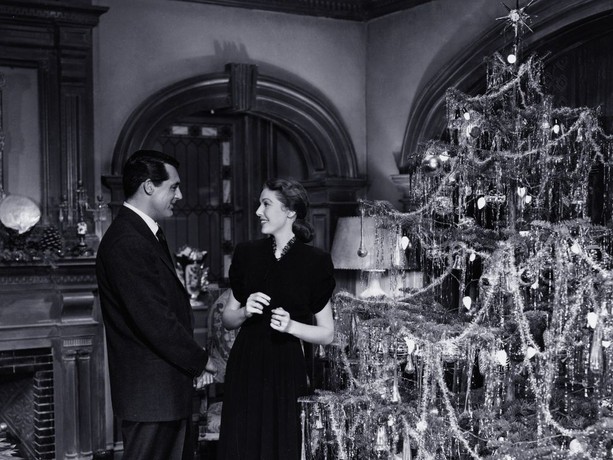
The movie is based on a book by Robert Nathan whose other fantasy romance, Portrait of Jennie, would later overtake The Bishop’s Wife on a literary level and later became a 1948 David Selznick movie.
According to an article on TCM.com, producer Samuel Goldwyn decided to take on this movie right after winning an Oscar for The Best Year of Our Lives in 1946.
Cary was originally set to play the Bishop, but as he read the script he began to suggest edits and finally decided he didn’t have the right part. He should be playing Dudley.
Later on, though, after the final casting decisions were made, Grant wanted to switch back.
Then there was the fact that Goldwyn didn’t like the set.
Niven wrote in his future autobiography, “The day before shooting was to start, Goldwyn decided that the interiors of the Bishop’s house were not ecclesiastical enough and ordered several sets to be torn down, redesigned and rebuilt. For three weeks, while this was going on, production was halted, then, two days after the cameras finally had a chance to turn, Goldwyn decided that Seiter’s hand was a little too heavy on the tiller: he was removed, paid his full salary and after a week, Goldwyn hired Henry Koster to start again from scratch – with another two weeks of rehearsal. All this must have cost Goldwyn several hundred thousand dollars….”
Niven was already struggling through the production because his wife tragically died during filming. Her fatal head injury occurred during a party game of “sardines” at Tyrone Power’s house. Her name was Primmie and she fell down a flight of cellar stairs after thinking she was running into a closet.
Problems further continued to plague the film when Cary and Loretta Young couldn’t get along part of the time.
Despite all of the hardships, the movie was well-received and remains a favorite Christmas film of many classic movie buffs today.
It was nominated for five Oscars but did not win any.
I’m not sure I found this movie as heartwarming as some of the Christmas movies I’ve watched, probably because I found it so difficult to read Cary in this one and was quite suspicious of him. I did, however, still enjoy the movie overall.
A few pieces of trivia about the movie for you:
I recognized the young actor who played the young George Bailey from It’s A Wonderful Life — Bobby Anderson —— in a snowball throwing scene in this film. I looked up his name and found out that Karolyn Grimes, who played Zuzu in It’s a Wonderful Life also played The Bishop and his wife’s daughter, Debby.
According to IMBd (I did not double check these to clarify they are true):
“At about 1:20, Henry and Julia are ready to make some Parish calls. Henry says to Julia, “We go first to the Trubshawes.” This is an example of David Niven’s attempt to mention the name of his friend (Michael Trubshawe) in every movie he made.”
“Over Cary Grant’s protests, a skating double wearing a mask with Grant’s features was used in the long shots of the complex skating routine. A skating double was also used for Loretta Young on all long shots.”
Market research showed that moviegoers avoided the film because they thought it was religious. So, Samuel Goldwyn decided to re-title it Cary and the Bishop’s Wife for some US markets, while adding a black text box with the question “Have you heard about CARY AND THE BISHOP’S WIFE?” on posters in markets where the film kept the original title. By adding Cary Grant’s first name to the title the film’s business increased by as much as 25 per cent.
“In Britain the film was selected for that year’s Royal Command Film Performance screening. Princess Margaret and her sister, the future Queen Elizabeth, both attended the screening of “The Bishop’s Wife” on November 25, 1947, at the Odeon Theatre in Leicester Square. According to David Niven, “The audience loved every second of it, and the Queen and Princess Margaret told me afterwards and at great length how much they had enjoyed it.”
Have you ever seen The Bishop’s Wife? What did you think of it?

*This post is part of the Comfy, Cozy Christmas Link Up for 2024. If you have a Christmas/holiday post you would like to share you can find the link HERE or at the top of the page here on my blog.
Discover more from Boondock Ramblings
Subscribe to get the latest posts sent to your email.

I have always loved this movie and it’s a Christmas must for me.
To me, Dudley isn’t devious, but he’s also not completely innocent. I think he’s an angel on the brink of being all too human and it’s up to Julia to master the challenge and send him away and Henry seeing what is important.
When he’s standing there in front of the church at the end, he always seems very lonely to me, but I guess that’s an angel’s destiny.
Having read the book, I would say Dudley is much nicer than the book’s Michael. Actually, I didn’t care about any of the characters in the book.
I agree on the ice skating scene being a bit long, but it’s okay. What I have always struggled with is the harp scene as I’m not a fan of harp solos!
Cat
https://catswire.blogspot.com/
LikeLiked by 1 person
I didn’t know it was based on a book. That’s interesting. And yes, that harp solo was a bit weird…maybe because I’m pretty sure he really wasn’t playing. I still enjoyed the movie and always love Cary.
LikeLike
This is my favorite holiday movie of all time. It’s not Christmas unless I watch this. The acting and sets are superb and I adore the heartwarming, yet humorous aspects of this film. The ending always makes me cry. If one doesn’t understand the message of this film, they’ve never truly been in love, and never understood the true meaning of Christmas, not just in the religious sense, but also within our good will and humanity towards others.
LikeLike
I have heard of this movie, but I’ve never watched it. I’m going to have to look for it because it does sound interesting…especially after reading about everything that went wrong in making it. How awful for David Niven! I can’t imagine having to carry on after such a tragic death.
https://marshainthemiddle.com/
LikeLike
Pingback: Sunday Chat: Merry Christmas, Christmas movies, and looks like we will have a white Christmas afterall – Boondock Ramblings