
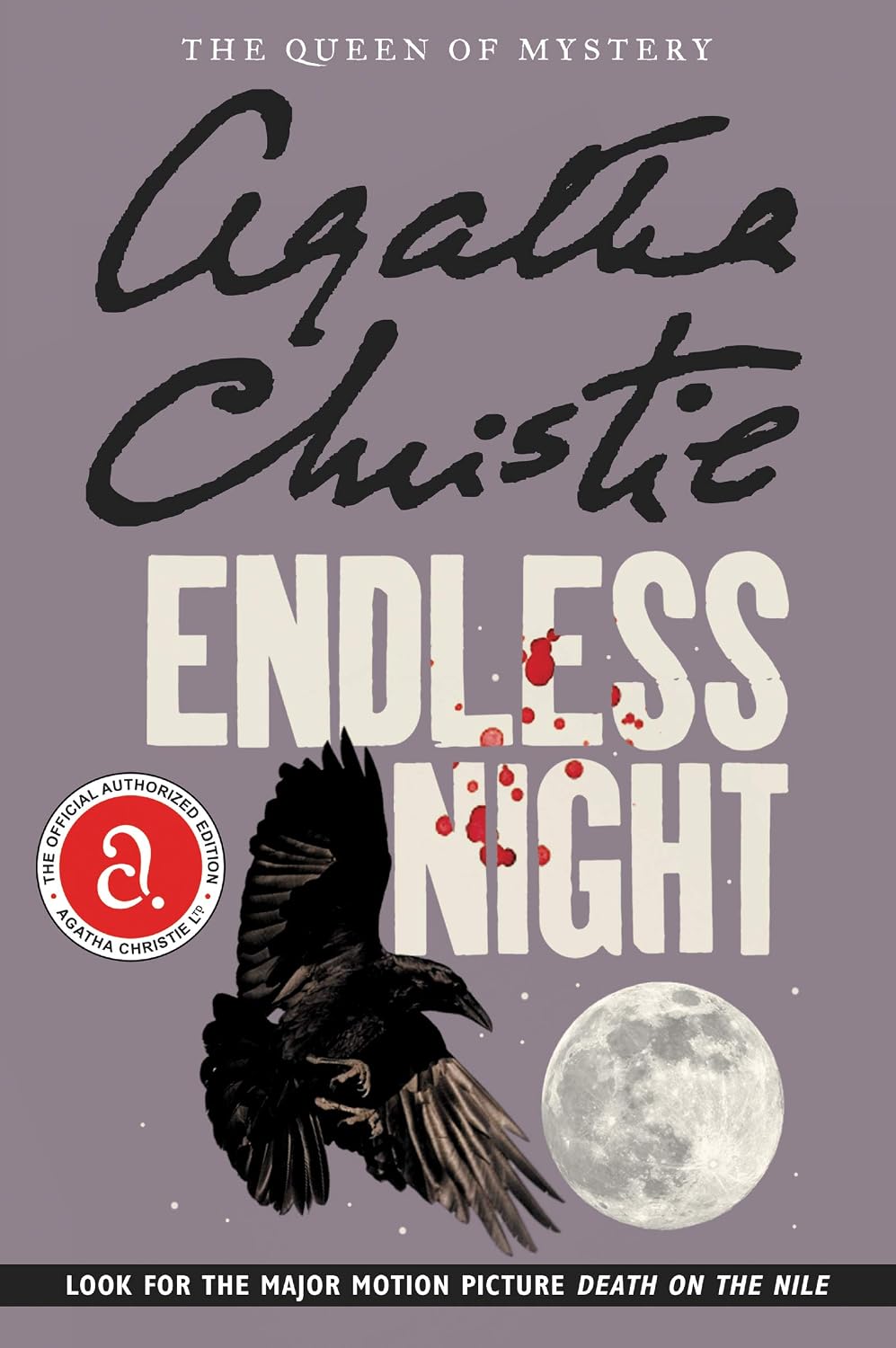
The book suggestion for this months’ read for the 2026 Agatha Christie Reading Challenge was Endless Night, a book that Agatha called one of her favorites. It is not a strict “who-done-it” with one of her detectives. Instead, it is a standalone novel that I would call a psychological mystery.
This book was written in about six weeks in 1968 when Agatha was in her 70s.
I’m going to be honest that I was a bit bored in the first part of this book but I just had this feeling that the ending was going to make it all worth it and I was definitely right.
There are some of Agatha’s books where I know that pushing through the more mundane parts of the book will pay off. I felt that way at times in The Secret of Chimneys and By The Pricking of My Thumbs but the endings saved both of those books for me.
This was another one of Agatha’s books where I guessed who was guilty but I didn’t know why they did it or how. I should have figured part of this one sooner than I did but the result would have been the same because the shock for me was more of how Agatha wrote about the villain’s descent into madness than the fact the person was guilty.
Then there was the ending, the final line, where Agatha blurred reality for the guilty party but also for us as the readers. “In the end was my beginning.”
That line made me think about so many of the parts of the book, replaying in my mind where I missed vital clues or thought something might be a clue, but wasn’t yet sure.
This one was a bit of a mind twist of trying to figure out who was bad, who was good, who was a friend, who was an enemy and who was a lover or who was a killer.
It took a long time for someone to die in this book — more than halfway through — which to me made the book both boring, at first, and then later, suspenseful. I was constantly wondering who was going to die and when, sometimes wishing she’d hurry up already, but feeling that someone definitely would. The person who did die wasn’t who I expected.
There was superstitious moments throughout the book where I was left wondering if supernatural things were really happening or if someone wanted it to look that way.
It’s hard to talk about the book in depth without spoiling the ending, something I never do in my reviews without a warning, so for now I’ll leave you with a quick description from online and then some quotes from the book.
Online description:
Gipsy’s Acre was a truly beautiful upland site with views out to sea – and in Michael Rogers it stirred a child-like fantasy. There, amongst the dark fir trees, he planned to build a house, find a girl and live happily ever after. Yet, as he left the village, a shadow of menace hung over the land. For this was the place where accidents happened. Perhaps Michael should have heeded the locals’ warnings: ‘There’s no luck for them as meddles with Gipsy’s Acre.’ Michael Rogers is a man who is about to learn the true meaning of the old saying ‘In my end is my beginning.’
The title Endless Night was taken from William Blake’s Auguries of Innocence and describes Christie’s favourite theme in the novel: a “twisted” character, who always chooses evil over good.
Christie finished Endless Night in six weeks, as opposed to the three-four months that most of her other novels took. Despite being in her seventies while writing it, she told an interviewer that being Michael, the twenty-something narrator, “wasn’t difficult. After all, you hear people like him talking all the time.”
The book is dedicated to Christie’s relative “Nora Prichard from whom I first heard the legend of Gipsy’s Acre.” Gipsy’s Acre was a field on the Welsh moors.
Quotes that caught my eye:
“Some are born to sweet delight, Some are born to endless night.”
*
“Born poor doesn’t mean you’ve got to stay poor. Money’s queer. It goes where it’s wanted.”
*
“The house only isn’t enough, you see. It has to have
the setting. That’s just as important. It’s like a ruby or an emerald. A beautiful stone is only a beautiful stone. It doesn’t lead you anywhere further. It doesn’t mean anything, it has no form or significance until it has its setting. And the setting has to have a beautiful jewel to be worthy of it. I take the setting, you see, out of the landscape, where it exists only in its own right. It has no meaning until there is my house sitting proudly like a jewel within its grasp.”
*
“Arrangements. I remember his using the word arrangements. What a hateful word it is and all the things it stands for. The things in life that have grand words – Love – sex – life – death – hate – those aren’t the things that govern existence at all. It’s lots of other pettifogging, degrading things. Things you have to endure, things you never think about until they happen to you.
*
In my end is my beginning … That’s a quotation I’ve often heard people say. It sounds all right—but what does it really mean?”
Have you read this one?

