
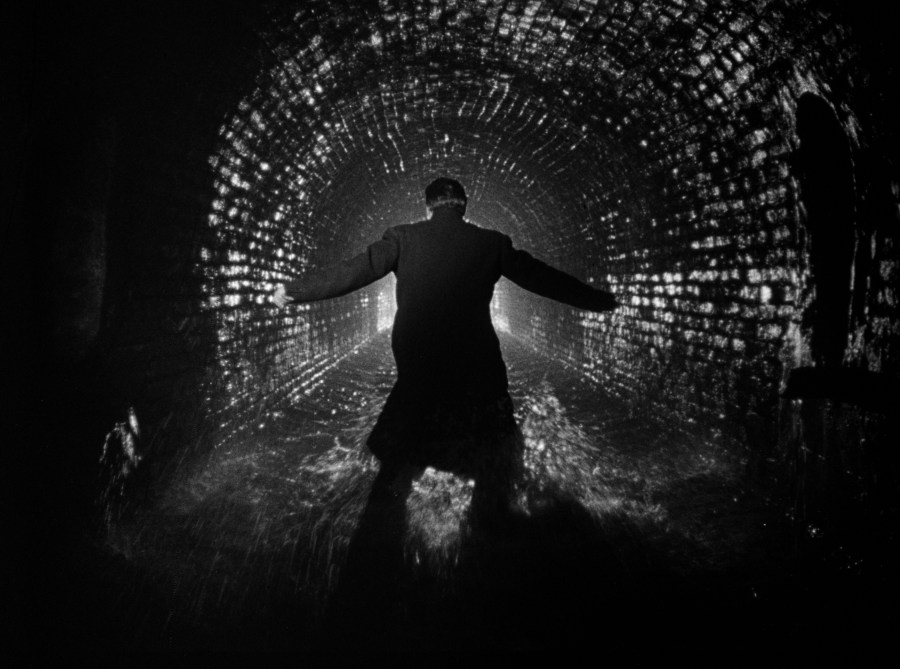
The cinematography in The Third Man (1949 ) is outstanding. The play of light with shadows, figures stepping in and out of light and dark both visually and metaphorically, makes this a movie you can’t look away from. If you do, you might miss a subtle exchange of looks, a quick smirk, someone moving in the shadows. You have to be on high alert while also relaxing into the story. You’re on the edge of your seat but also have plenty of moments to sit back and admire the superb acting of Orson Welles and Joseph Cotton.
The movie is set in post-World War II Vienna, Austria at a time when four political powers America, Russia, England, and France were overseeing a corrupt post-war environment.
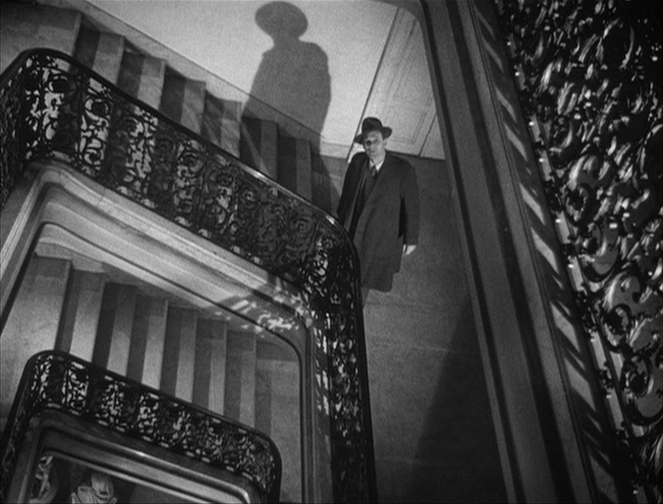
Cotton plays Holly Martins, a writer of pulp Westerns, who arrives without any money as the guest of his childhood friend Harry Lime (Welles). The problem is, when Martins arrives, he finds out Lime has been killed, hit by a car.
Martins wants to know how his friend died and why, and learns there was a “third man” who was present during the accident. This leads him down a path that gets him mixed up with Lime’s girlfriend and British intelligence and knocks him right into the middle of complicated moral and ethical issues.
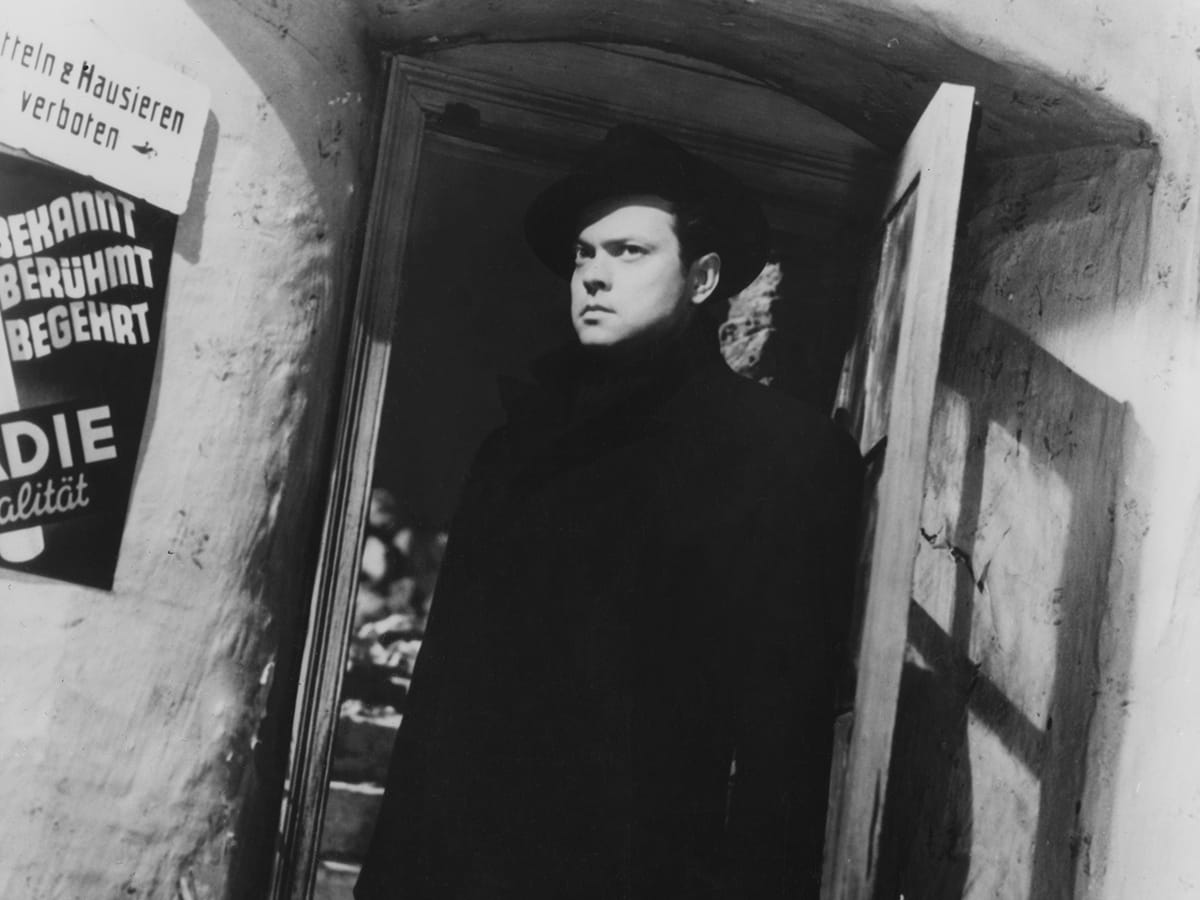
The movie, a British noir film, was directed by Carol Reed and produced by Reed, David Selznick, and Alexander Korda.
It was written by Graham Greene for the screen, and later a novella was released.
According to information online, Korda was someone who repeatedly told Welles he would fund his projects, but at the last minute, would pull out.
“My whole time with Alex was things like that,” Welles once said. “I kept doing projects for him which I did not abandon, but which he did.”
When it came to casting for the film, everyone knew Welles fit the part (with Greene essentially describing Welles when he described Lime) so Korda asked him. Welles agreed but then, as revenge for Korda’s past behavior, proceeded to tour Europe to film scenes for Othello (1952).
Korda wanted the contract signed and Welles locked in, so he sent his brother, Vincent, after Welles. Over the next week, Vincent had to chase Welles to Rome, Florence, Venice, Naples, and Capri because Wels would make sure they picked up and move to a new location each time Vincent was almost to them.
“I knew I was going to do it,” Welles later said, “but I was going to make it just as unpleasant as possible.”
I loved this part of the story shared by TCM.com:
“On the way back to London via a privately chartered plane, Welles played one final, brilliant prank on Alexander Korda. Vincent asked him to hold a basket of fruit that he had gathered for his brother during the pursuit. This was post-war Europe, so fresh fruit was an exceedingly rare item. “It was going to be offered as a great present,” Welles said. “He’d gone and picked each piece of fruit. It was too good to be true! I knew Alex wouldn’t touch any of it if it had been bitten into.” So, when Vincent was asleep, Welles carefully took a bite out of each piece.”
Yes, Welles was literally chased down for this role, and it paid off because the character he played became known as one of the most iconic villains in cinema history.
I can’t say enough about the brilliant imagery in this film. Maybe it is my photography background/experience and my absolutely obsession with black and white photography that had me gawking in amazement and visually enamored with so many of this movie’s scenes.
Here is a still from a scene in the cemetery.
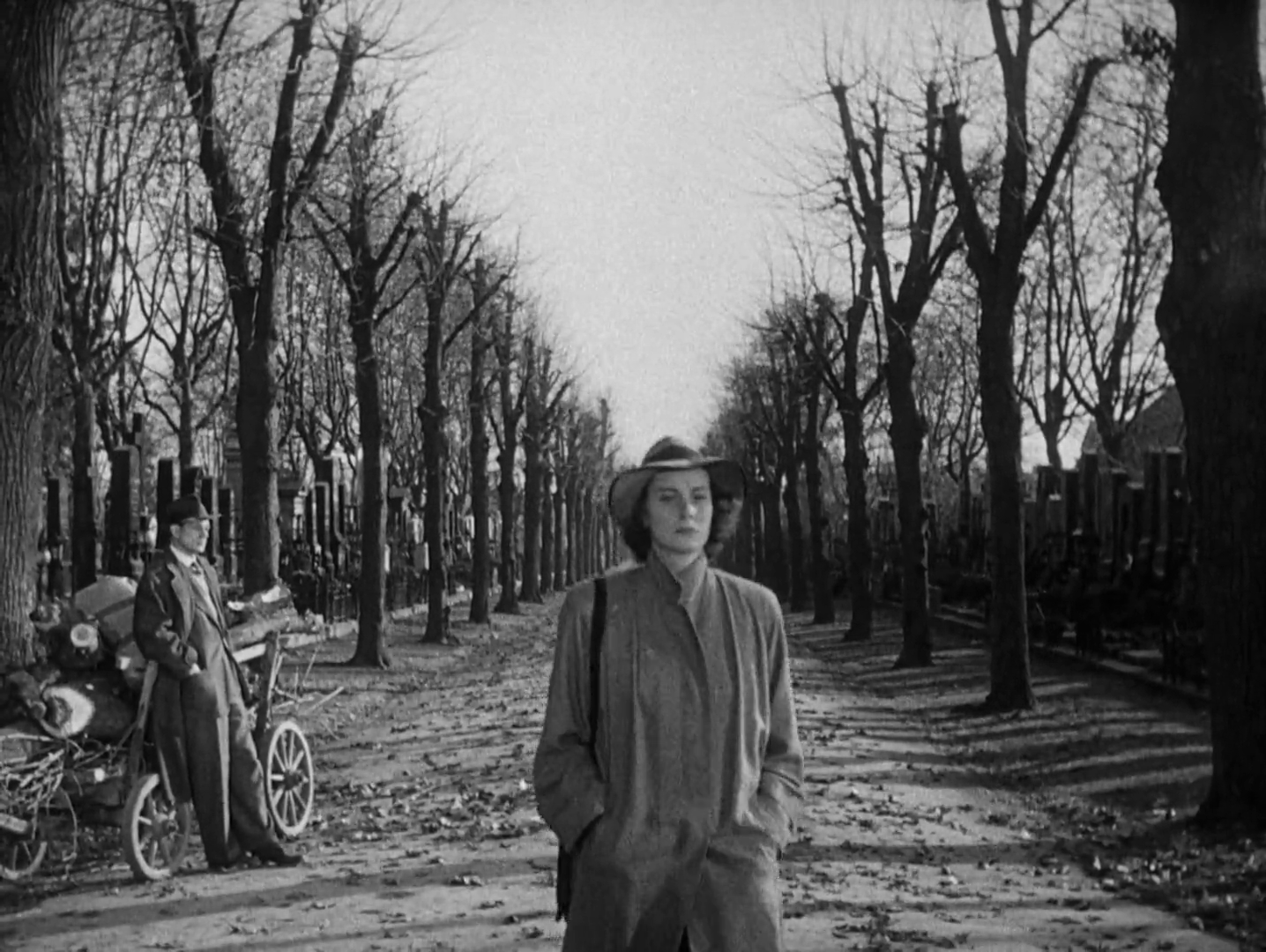
Anna is standing in the middle of the shot, the focal point of the photo, and on either side of her are rows of naked trees, forcing the viewer’s eyes to follow the trees down to Anna and only then wander slowly to Holly, watching her walk away. There is a barren feeling to the scene — the nakedness of the trees, the pale white of the sky showing it’s an overcast day, Anna with her head down, clearly in thought as she’s walking away, Holly watching her with a hint of sadness in his gaze.
Then there is this still from one of the most famous scenes in the movie.
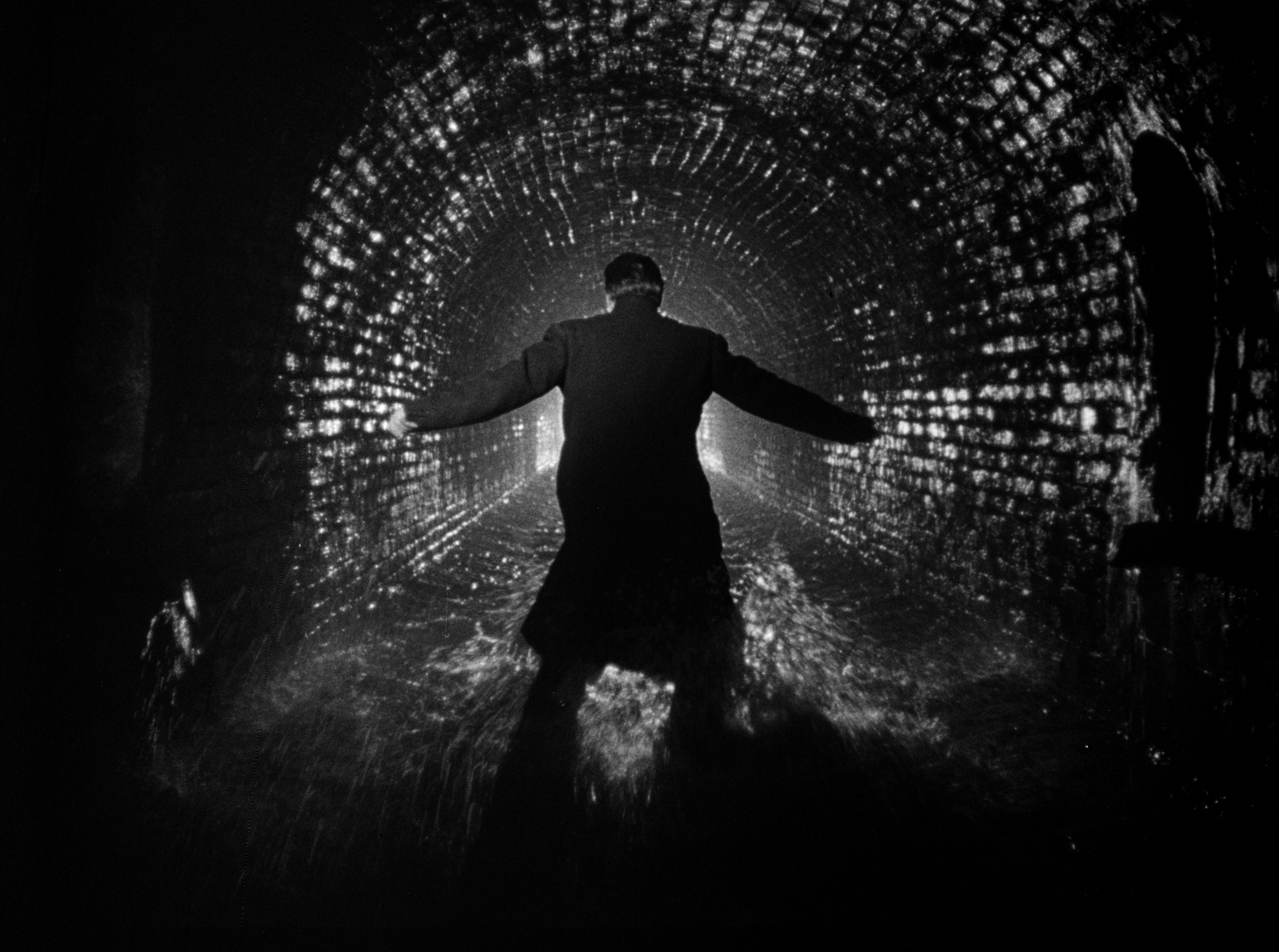
There’s a chase through the sewers going on, Welles’ character is on the run and what is so incredible about this entire scene is how the tunnel forms a tunnel for our eyes, once again bringing our focus right to the man running in the middle of the scene, toward the light, toward freedom that he may or may not ever reach.
It was hard for me to take my eyes off this film, not only because of the story but because of the visual smorgasboard.
There are quite a few reviews of the movie online, with many of them agreeing that The Third Man is one of, if not the, greatest noir film ever made.
Tom Spoors from Loud and Clear Reviews writes: “Almost every frame of The Third Man is a visual marvel, employing all kinds of cinematic techniques. There’s plenty of dutch angles, sure, but what I found even more interesting is the way that Reed uses shadows. He puts his main character in a situation and a location that is brand new to him, and builds this world to be one constantly cloaked in mystery. Reed places silhouettes around every corner, plasters every wall with them, creating a city that almost doesn’t feel real. It’s an atmosphere that I don’t think has ever been captured again to this extent, and perhaps the biggest reason why the moviehas gone on to be one of the most critically acclaimed noirs of all time. Simply put, no other film in its genre looks or feels quite like it.”
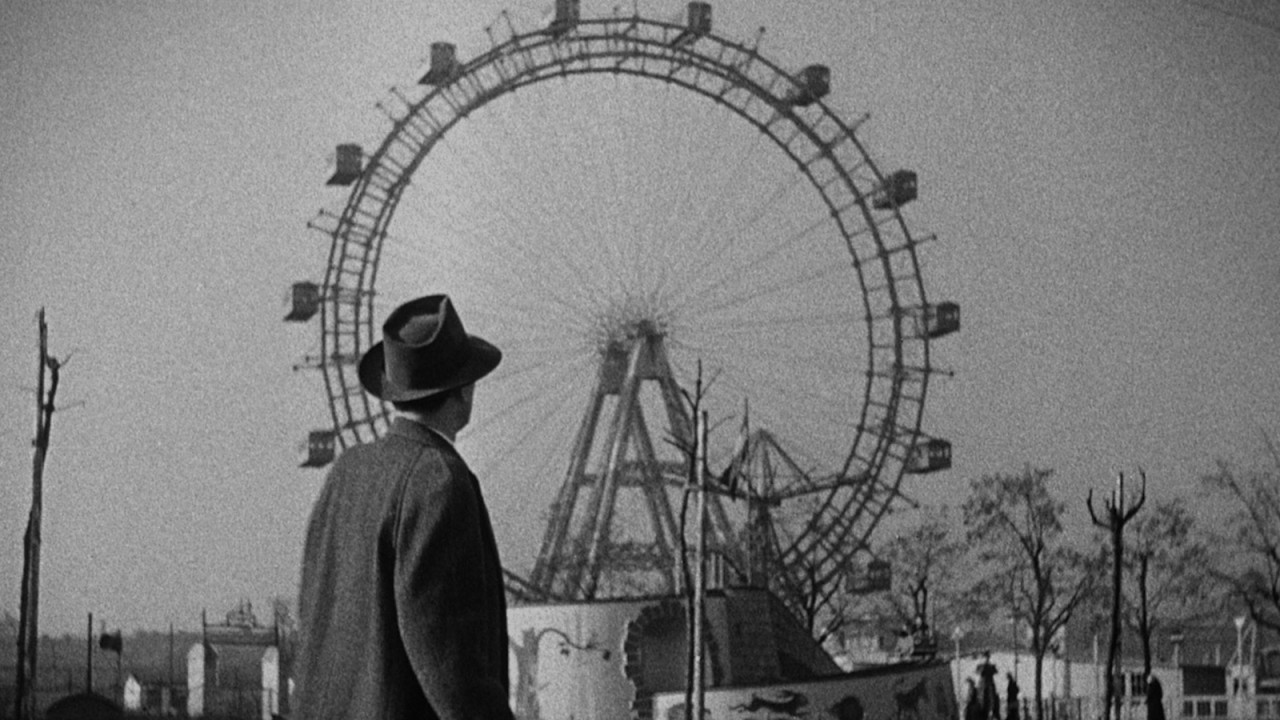
Philip French of The Guardian wrote about the movie: “From the moment the first audiences saw the opening image of Anton Karas’s zither filling the screen with the nerve-jangling Harry Lime Theme (before, indeed, they had heard the word “zither”), they knew that with the second collaboration between director Carol Reed and author Graham Greene they were in for something special. At its end they recognised (British spelling) they’d seen a near-perfect work, what we now call a noir classic.”
It’s become a tradition for me to share and then disagree with the late film critic Roger Ebert’s reviews on here but this time I can’t.
“Of all the movies I have seen, this one most completely embodies the romance of going to the movies. I saw it first on a rainy day in a tiny, smoke-filled cinema on the Left Bank in Paris. It told a story of existential loss and betrayal. It was weary and knowing, and its glorious style was an act of defiance against the corrupt world it pictured. Seeing it, I realized how many Hollywood movies were like the pulp Westerns that Holly Martins wrote: naive formulas supplying happy endings for passive consumption.”
If you haven’t seen the movie, you really need to and find out if this scene below is a flashback or … what’s really going on….
Sources:
https://www.tcm.com/articles/82839/the-third-man
https://loudandclearreviews.com/the-third-man-review/https://www.rogerebert.com/reviews/great-movie-the-third-man-1949
If you want to find clips and thoughts about vintage movies and TV, you can visit me on Instagram on my Nostalgically Thinking Account (https://www.instagram.com/nostalgically_thinking/) or on my YouTube account Nostalgically and Bookishly Thinking here: https://www.youtube.com/@nostaglicandbookish
If you enjoy the kind of content on my blog and all that goes into it, you can support my writing for $2.99 a month or a single donation. Learn more here: https://lisahoweler.com/support-my-writing/
