
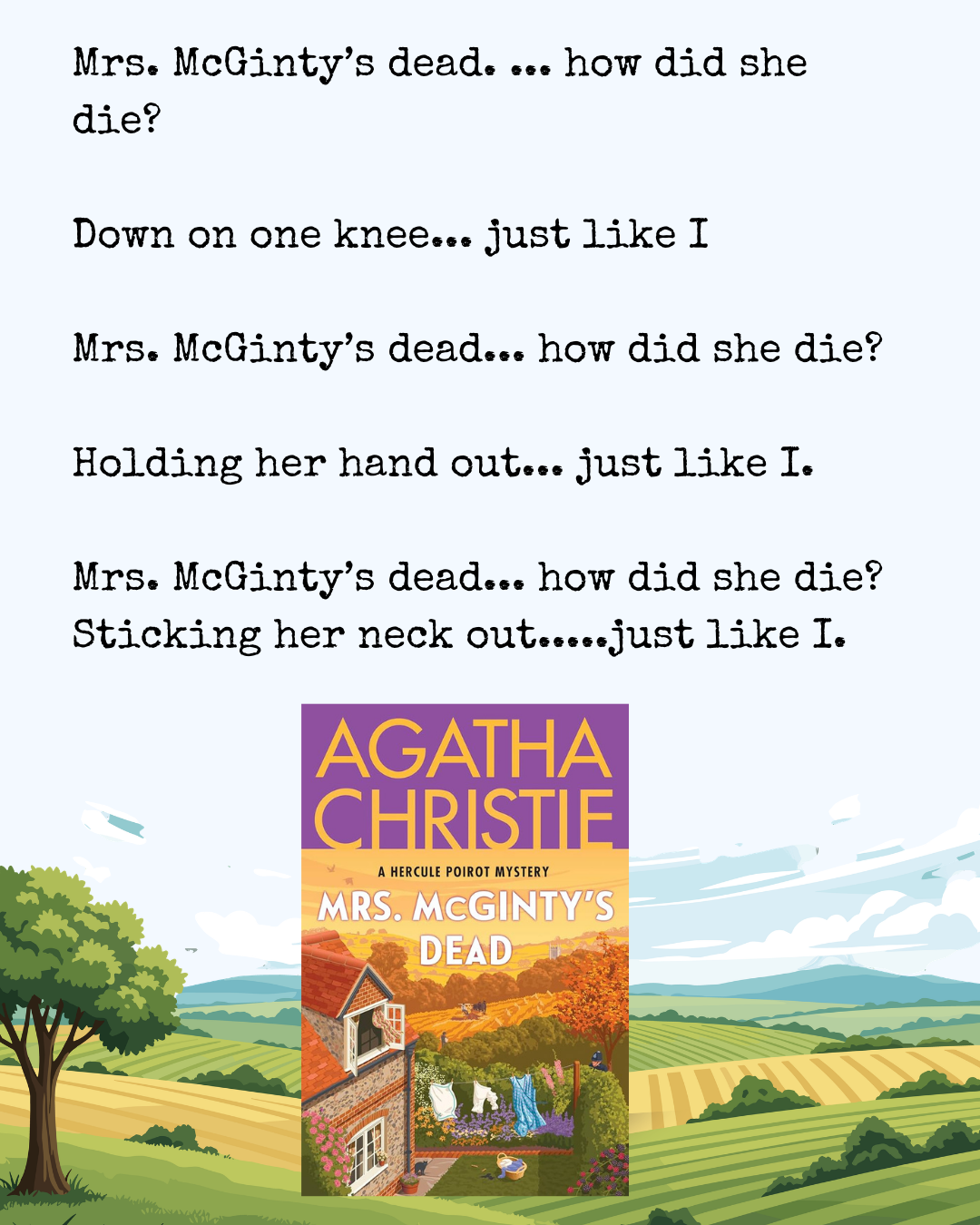
Mrs. McGinty’s Dead by Agatha Christie is a Hercule Poirot mystery, which I enjoyed, despite the fact it did not feature Captain Hastings. This was the first book I have read without him.
I love Hastings and was concerned not having him would make me dislike the book but luckily Superintendent Spence and the mystery writer Mrs. Adriane Oliver ended up getting involved in the mystery as well and they were fun additions. Mrs. Oliver was the most fun.
This was a mystery with two other mysteries mixed in.
The book also features a spoiler in it about Poirot’s future as I think maybe Agatha liked to channel herself a bit through Mrs. Oliver, but more about that later. I’ll give you a warning before I get to that part too.
The story involves Poirot investigating the murder of Mrs. McGinty, a landlady and house cleaner whose tenant, James Bentley, was convicted of her murder and is about to be hung when the superintendent calls Poirot because he’s having doubts that Bentley is guilty.
Poirot isn’t sure how to investigate a murder that happened months ago but agrees to try. He begins to unravel a mystery within a mystery as he finds out that three days before she was murdered, Mrs. McGinty read a clipping from a notorious gossip paper that featured the story of four women connected to decades-old crimes.
She even wrote a letter to the paper to say she had found a similar photo that would prove one of her neighbors was one of the women in the article. Even though her terrible spelling caused the paper to reject the letter, it was found after her murder.
Poirot is intrigued by her letter and her assertions that one of the former criminals or victims lives in the town.
Together he and Spence try to figure out who in the area might be a former 12-year-old girl who killed someone with a meat cleaver, a mistress whose married employer/boyfriend killed his wife, a wife whose husband was killed by a man who loved her, or the wife of a criminal offered the chance to leave the country and start over.
Where does this book foreshadow the future of Poirot?
If you don’t want to know about the last Poirot book, don’t read any further.
According to various sources, Agatha Christie wrote about the death of Hercule Poirot long before the final book in the series. She actually wrote about him dying somewhere between 1941 and 1943 and locked it in a safe for 30 years. She wrote it so early because she was concerned she might not survive World War II and wanted to be able to end her characters life on her own terms and not at the hands of a different writer.
In this book, Ariadne talks about her own character, how she can’t stand him, and it is suggested to her how she can dispose of him in a future book, after she dies.
“How do I know?” said Mrs. Oliver crossly. “How do I know why I ever thought of the revolting man? I must have been mad! Why a Finn when I know nothing about Finland? Why a vegetarian? Why all the idiotic mannerisms he’s got? These things just happen. You try something — and people seem to like it — and then you go on — and before you know where you are, you’ve got someone like that maddening Sven Hjerson tied to you for life. And people even write and say how fond you must be of him. Fond of him? If I met that bony, gangling, vegetable-eating Finn in real life, I’d do a better murder than any I’ve ever invented.”
Robin Upward gazed at her with reverence.
“You know, Ariadne, that might be rather a marvelous idea. A real Sven Hjerson — and you murder him. You might make a Swan Song book of it — to be published after your death.”
Sound familiar? It’s well-known that Agatha grew sick of Poirot (though I couldn’t find the actual source of this statement anywhere online – do any of my blog readers know where it came from?) calling him something along the lines of “a detestable little man” so Ariadne’s description of her character seems to fit. And then the hint at how he might be killed off…again very familiar to Agatha’s plan.
Many of Ariadne’s quotes remind me of what Agatha probably thought about writing ficition, or even just writers in general.
I am sure I will read more of Ariadne in future books, and it will be interesting to see even more similarities between her and Agatha.
Agatha gave Poirot a wry sense of humor and that was on full display in this book as in others. I always love when he tells someone who he is an expects them to be shocked or excited, but instead they are often confused or have no clue who he is.
““His name, he noted with chagrin, made no particular impression on her. The younger generation, he could not but feel, were singularly lacking in knowledge of notable celebrities”
― Agatha Christie, Mrs. McGinty’s Dead
Overall, I enjoyed the book, as I said, but there were quite a few characters and it did get challenging to keep them all straight.
As with Christie’s other books, this is a pretty quick read that will lead you down a few paths until Poirot, and we, reach the right one.
Discover more from Boondock Ramblings
Subscribe to get the latest posts sent to your email.

Pingback: Sunday Bookends: Three seasons in one week | Boondock Ramblings