Summer of Angela: The Long Hot Summer

This summer I am watching Angela Lansbury movies for the Summer of Angela.

This week I dropped the movie with Angela and Warren Beatty that seemed super dark and replaced it with The Long Hot Summer, which I actually watched in 2022 during my first ever movie marathon called The Summer of Paul (Newman that is). For the life of me, though, I could not find that I wrote a blog post about the movie, so I am starting from scratch here.

The Long Hot Summer is not an Angela Lansbury focused movie, but she is in it and fills the screen with her personality when she is on it. The main stars are, of course, Paul Newman and Joanne Woodward, but Angela provides some comic relief as Orson Welles’ mistress, Minnie Littlejohn.

First, a bit of background/description of the movie with the Google description:

Handsome vagabond Ben Quick (Paul Newman) returns to the Mississippi town his late father called home, but rumors of his dad’s pyromaniac tendencies follow him as soon as he sets foot there. The proud young man’s determination eventually wins over civic leader Will Varner (Orson Welles), who decides Ben might be just the man for his daughter, Clara (Joanne Woodward) — much to the displeasure of Will’s gutless son (Anthony Franciosa) and Clara’s society boyfriend (Richard Anderson).

The movie’s main focus is the sexual tension between Paul and Joan’s characters, which worked out fine since the two were having an affair before this and were on the cusp of being able to announce that since Paul Newman’s divorce was essentially final. Yes, I have always been a fan of Paul, but, no, I don’t like that part of his and Joanne’s story, and I have a feeling there were times they didn’t like it either.

Paul was always good at playing loners, sad men who don’t know who they are or what they want in life except the woman they set their sights on.

It’s the same in this movie, where Paul seems to want prestige but really just wants Clara to like him as much as he likes her. Clara is uptight, though. She does everything proper and never lets her guard down, especially around Ben Quick. She seems to have a feeling if she does let her guard down all of those feelings she’s been trying to protect all  her life will spill out.

It’s no surprise since her daddy (Welles), is also pretty uptight and fights for control over everything in his life. That’s why he won’t marry Minnie, who desperately wants to be married.

The movie opens with Ben Quick being told to get out of a county because he is charged with burning a man’s barn because he got mad at the man. There was no proof, though, so instead of jailing him, the town tosses him out.

He rides a couple of steamers down the river to his family’s old town and when he’s hitch-hiking he’s picked up by sour Clara and her bubbly friend.

We find out how sour she is when he asks, “So you girls just take your fun wherever you can find it?” And Clara responds with, “Don’t jump to conclusions, young man, we’re giving you a ride and that’s all we’re giving you.”

The sparring between Clara and Ben kick off right from there and continue on in the movie.

The first sign we see is a welcome sign to Fishermen’s Bend, home to – well, everything owned by someone named Varner.

Ben tells the girls that it sounds like Varner is the man to see about work in that town and the bubbly girl says that he can see Mr. Varner every night at their house. He asks if they are connected to Varner and the girl giggles that they are indeed and then drive off and leave him there at the town hall.

Back at the Varner house, Eula, Clara’s sister-in-law, is gushing to her husband Jody about all the clothes she bought, and Clara is on the terrace sipping lemonade with her friend Agnes when Ben shows up again.

The ladies were talking about how they are single and lonely before Ben showed up. Agnes mentions how he might be an option and Clara quips that they haven’t gotten so desperate as to be turning to strangers.

Ben asks Jody about working one of the tenant farms to make some money off of. Jody agrees before running back upstairs to make out with Eula. The servant comments when he sees muddy footprints on the rug after Ben leaves, “Mister, you sure do leave your calling card.”

That’s a bit of foreshadowing and an understatement.

As the movie goes on Ben will work his way into the family in more ways than one, upsetting the apple cart, so to speak.

Clara walks the carpet back to Ben’s tenant house with a little black boy (yep, another servant down here in the South) and tells him you dirty it, you clean it.

What follows is some great dialogue, which continues throughout the movie.

“A lot of fuss to be making about a rug lady, if it’s the rug that’s bothering you.”

Clara tips her chin up. “What else would it be?”

Ben spits out a watermelon seed. “Well now you correct me if I’m wrong but I have a feeling I rile ya’. I mean me being so mean and dirty and all.”

“Mr. Quick, you being personal with me, I’ll be personal with you. I spent my whole life around men who push and shove and shout and think they can make anything happen just by being aggressive and I’m not anxious of ‘nother one around the place.”

Ben smirks. “Miss Clara, you slam a door in a man’s face before he even knocks on it.”

All Clara says is for him to have the rug at the house by 6.

It shows how bigger than life Varner is when he comes back into town in an ambulance or police car (not sure which ) with the sirens blaring. The people in town who watch him drive through talk about how he was in the hospital and had something cut out of him.

Then it’s time for Angela, the point of this here Summer marathon. She comes running out of the Littlejohn Boarding House and Hotel as soon as he pulls up, wearing a tight and tiny white dress, and throws her arms around him. Her Southern accent is so jarring being familiar with her original accent and the American one she ended up developing as the years went on.

He laughs and declares she seems to be getting fatter and blonder on him.

Oh yeah…Didn’t I mention what a charmer he is?

He tells her he will be back…later. *wink* *wink*

He greets his family at home, with a clear critical eye on his son who seems desperate to please his father. That will come to play in a big way in the movie.

Orson Welles’ color is so horrible in this film, and I don’t know if that is because he is supposed to look sick or if it was bad makeup or if Orson Wells was that color back then. Then again, a couple of the other men had that weird color to their skin too. Maybe it was just bad makeup or the film itself.

Despite his color, Minnie wants to marry Daddy Varner, and she lets him know that. He avoids her as much as possible, preferring to keep control of his world.

What Angela said about the movie:

Angela’s plays a playful flirt in this film, not a dark femme fatale like A Life At Stake and she credited the director, Martin Ritt, for bringing that playfulness out in her.

“Martin Ritt had a wonderful enthusiasm and earthy sexy quality himself,” she said. “He loved the idea of the dirtiness of the carryings on, and he certainly brought every bit of kind of naughty sexuality out of me in that role.”

As for Orson Welles, Angela agreed with others who said he was used to getting his own way because he normally had control of his own projects. This project wasn’t his though.

“He was always nudging and pushing for things and wanted to change lines,” said Angela. “But had to be carefully handled so that he didn’t always get his way because his way wasn’t necessarily the best way for everybody else in the scene.”

Welles would irritate his co-stars by overlapping his own lines with their dialogue, ad-libbing, and mumbling to the point where his lines were barely comprehensible, she added.

Despite him being annoying, Angela also said of him: “There was something you couldn’t resist about Orson.”

In a 2001 interview, quoted on TCM.com, Angela said of Paul and Joan: “They seemed to have such a total understanding of each other that they were able to work in scenes where they were at each other’s throats or falling under each other’s spell.”

My thoughts on the movie:

I like the Southern feel of this movie, the acting, the complex relationships. I love watching Ben try to break through Clara’s hard exterior. No matter how hard she tries to resists him or how many times she pushes him away he keeps trying.

I love how the women are very strong in the movie but not so strong that they are outright disrespectful, even though they probably should be in some cases.

Paul’s smirk works well in just about every movie he’s in but it really works in this one. It’s hard to read what his real motives are sometimes, but deep down I feel like he does want something better than what he’s had. I feel like he does want a family and to be successful on his own merit.

This movie has a Tennessee Williams feel to it even though it is based on one main story and other stories by William Faulkner. It did not have a Tennesse Williams’ ending, at least.

On a more shallow level, I don’t know what they were thinking with Joanne’s big eyebrows and those way too short bangs. Despite how much I didn’t like the look they went for, I really enjoyed watching her character develop and blossom and reveal herself to be different than who we think she is for the first half of the movie.

Watching the jealousy unfold in Jody as he desperately tried to be what his father wanted him to be was difficult to see. The poor guy has no idea how to be a man of his own and is always trying to be what he thinks his daddy wants him to be.

Orson really wasn’t good in this movie. He really wasn’t. I don’t know what happened to him or why he performed so awful but from what I read online it was flat out jealousy over his younger counterparts who were associated with the Actor’s Studio. I also read he was only 10 years older than Paul in this film – 42 years old – but he looks terrible! He wore a prosthetic nose which I can not figure out the point of.

As for Angela, she pulled off her part well and it was fun to watch her with a thick Louisiana accent. Every time I see her in one of her early movies, I really do find myself forgetting she was Jessica Fletcher. She would have been so much better in this one if she hadn’t had to act across from Orson who was way over acting.

Trivia and Facts:

  • Orson Welles always wore a fake nose when he worked, so when he would sweat on this film, his fake nose would slip. Make-up people had to keep applying material to keep the fake nose from falling. (source TCM.com)
  • The director was Marty Ritt and Paul filmed five other films with him including HombreParis BluesThe OutrageHemingway’s Adventures of a Young Man, and Hud. (source, excerpt from Paul Newman biography on Lit Hub)
  • In his biography Paul Newman wrote of Orson: “Orson couldn’t understand screen generosity, where one actor allows another player in his scene to deservedly get the best camera shots. Screen generosity was not part of Orson’s vocabulary. After a number of retakes on a scene he did with me, Orson asked Marty if he could have a private word with him. They stepped away together, and seemed to be discussing something rather serious. When they came back, we did another take, and afterwards, I asked Marty what was going on.

“Orson thought you were submarining him,” he said; it was an actor’s way of saying someone was stealing his screen time.” (source, excerpt from Paul Newman biography on Lit Hub)

  • The director, ‘Martin Ritt’ , was forever known after this movie as the man who tamed Orson Welles. During filming Ritt drove Wells into the middle of a swamp, kicked him out of the car and forced him to find his own way back in the hot Louisiana heat. (various/several sources)
  • Joan and Paul were married in January 1958 and the movie released in March. (TCM.com)
  • When the movie was complete, the director and others watched it and noticed they could barely here Orson at times. The director felt sure Orson had purposely mumbled his lines to make the sound more difficult because he was unhappy with not having control.
  • From TCM.com: “The success of The Long, Hot Summer helped Martin Ritt reestablish himself as a major director following his 5-year blacklisting from Hollywood. It also showcased the talents of young up-and-comers Joanne Woodward and Paul Newman, who won Best Actor that year at the Cannes Film Festival for his portrayal of Ben Quick. It marked both the beginning of long and distinguished careers for the talented couple as well as the beginning of one of Hollywood’s longest and happiest marriages.”
  • The Long, Hot Summer was based on the works of southern writer William Faulkner, most notably his 1940 novel The Hamlet. (source: TCM.com)
  • The movie was turned into a television series in 1965. It starred Roy Thinnes as Ben Quick, Nancy Malone as Clara, and Edmond O’Brien as Will Varner. O’Brien eventually left the show and was replaced with Dan O’Herlihy. Legendary director Robert Altman directed the pilot. (source: TCM.com)
  • Copied directly from TCM.com’s article because I thought it was interesting and I didn’t want to summarize it: Although William Faulkner was best known as a novelist and short story writer, he did work as a screenwriter in Hollywood for 20th-Century-Fox during the thirties and forties. A good deal of his work went uncredited and he was never successful in adapting any of his own work for the screen (although he did do a screen treatment for “Barn Burning” but it was never produced). He did, however, receive credit for the screenplay adaptations of Ernest Hemingway’s To Have and Have Not (1944), Raymond Chandler’s The Big Sleep (1946) and a few other scripts such as Submarine Patrol (1938) for director John Ford and The Road to Glory (1936) for director Howard Hawks.

    Other William Faulkner film adaptations include The Story of Temple Drake (1933, based on his novel Sanctuary), Intruder in the Dust (1949), The Tarnished Angels (1958, based on his novel Pylon), The Sound and the Fury (1959), Sanctuary (1961), The Reivers (1969), Tomorrow (1972, based on his story), and an uncredited Russian adaptation of Sanctuary entitled Cargo 200 (2007, aka Gruz 200).

Have you ever seen this one?

My last Angela movie will be Something for Everyone. I don’t know anything about it so I’m going into it blind.

If you want to read about some of the other movies I watched, you can find them here:

Bedknobs and Broomsticks

The Manchurian Candidate

National Velvet

The Pirates of Penzance

Gaslight

The Pirates of Penzance

Gaslight

Please Murder Me

Death on The Nile

The Court Jester

The Picture of Dorian Gray

A Life At Stake


Sources:

Paul Newman on the Lusty Time He Had Filming The Long Hot Summer with Joanne Woodward

https://lithub.com/paul-newman-on-the-lusty-time-he-had-filming-the-long-hot-summer-with-joanne-woodward/

Behind the Camera, The Long Hot Summer: https://www.tcm.com/tcmdb/title/308663/the-long-hot-summer#articles-reviews

The Long Hot Summer and The Newmans: https://vanguardofhollywood.com/the-long-hot-summer/


Lisa R. Howeler is a blogger, homeschool mom, and writes cozy mysteries.
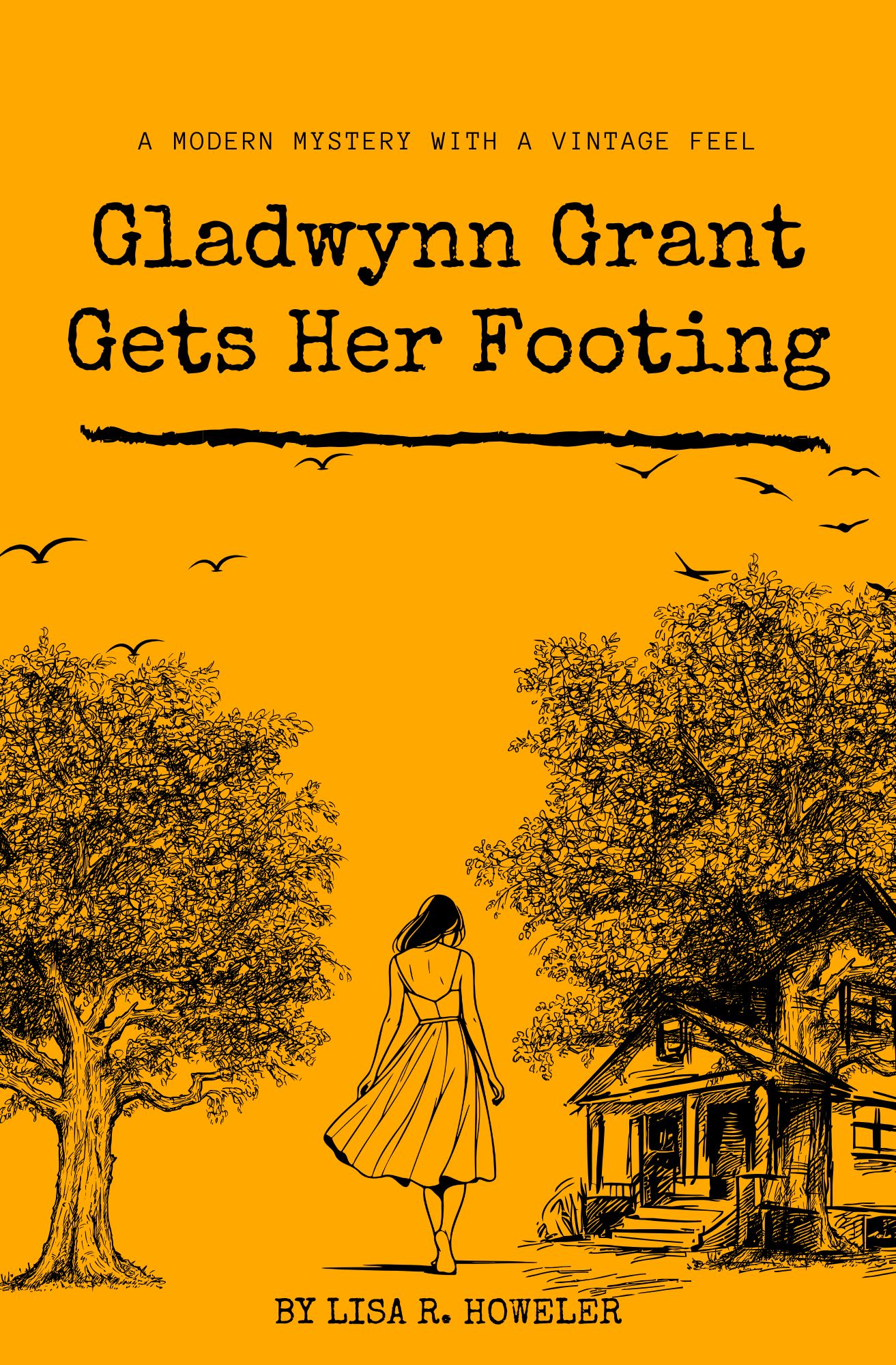
You can find her Gladwynn Grant Mystery series HERE.
You can also find her on Instagram and YouTube.

Classic Movie Impressions: That Touch of Mink

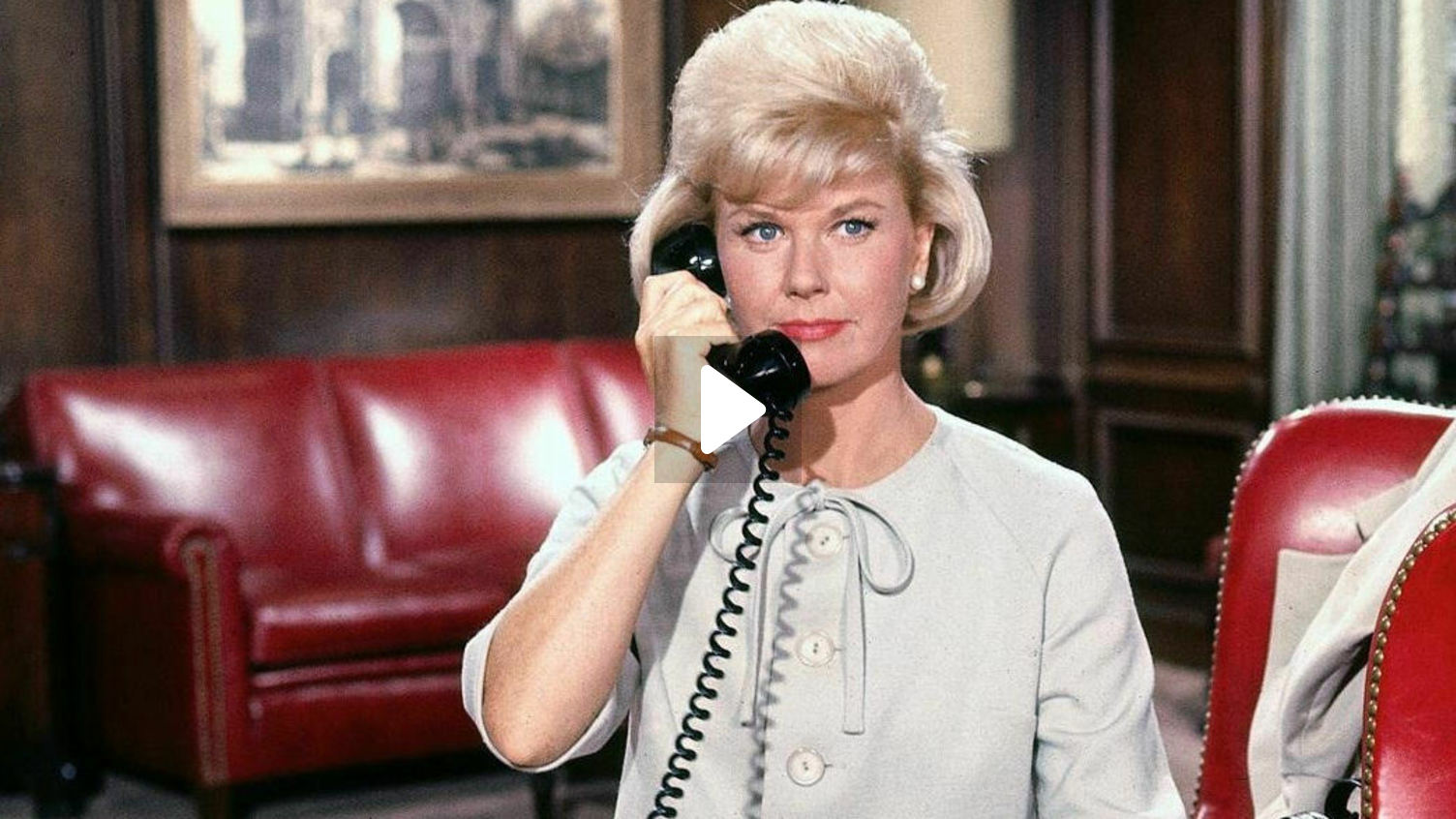
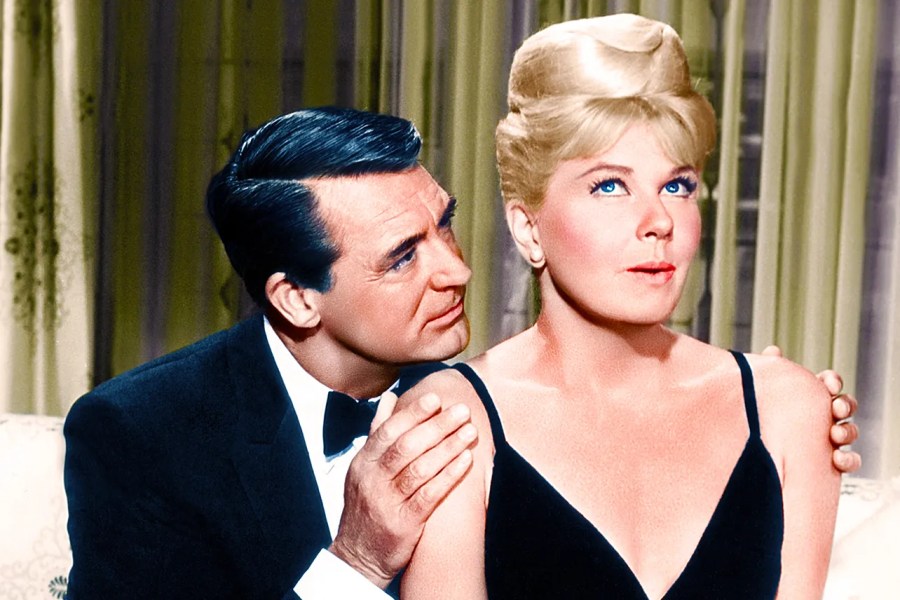
I needed something to distract me from every day life last week so I watched That Touch of Mink with Doris Day and Cary Grant. I am very certain I’ve watched either all or part of this movie before but it has been years so I didn’t remember much about it.

This is quite a modern movie for 1962.

Cary Grant is a no nonsense, yet still kind and understanding, businessman and Doris Day is a young woman from a small town living in a big city and trying to find a job.

This movie was meant to be a comedy, so I tried not to be too uptight about how Cary Grant was essentially trying to get into Doris Day’s pants without actually committing to a relationship for the entire movie.

I have to say that I didn’t really like Cary for most of this movie and my husband said it is probably because of the fact Cary really didn’t want to make the movie, according to articles he has read about it. While I didn’t find articles online specifically saying he didn’t like the film, I did find information that Doris Day wrote in her autobiography that Cary was polite and professional on set but that there was really no “give and take” between them.

First a little summary:

This movie takes place in 1962 starts with Doris Day walking down the street and getting splashed by a car that Cary’s character (Philip Shayne) is riding in. He feels bad but he can’t stop because he is on his way to a very important meeting. We find out later that Doris’s character (Cathy Timberlake) is looking for a job and Philip is a shrewd but also generous businessman with a friend, Roger, (played by Gig Young) who is a bit of a leach. Philip does actually feel awful about splashing Cathy and tells Roger he’d love to find the woman and apologize.

Luckily they are looking out the office window not long afterward and see Cathy walking into a diner across the street.

He orders Roger to take her some money to apologize. Roger is hoping the woman will want to tell Phillip off. He’s sick of Phillip getting all the women despite his flippant attitude. Cathy does want to tell Phillip off so Roger takes her to Phillip immediately.

Unfortunately for Roger, Cathy falls for Phillip immediately. Phillip sees this as a chance to sweep another woman off her feet by taking her on trips around the world.

He starts to do just that and Cathy wants him to like her so she goes along with him — flying to Baltimore for a speech he’s giving, then to Philadelphia for a quick dinner. One night he even takes  her to a New York Yankees game, into the dugout where we meet the real Roger Maris, Mickey Mantle, and Yogi Berra.

Soon though, Phillip wants her to go on vacation with him to Bermuda and she’s not sure if she means he wants her to stay in the same room with him or if they will have separate rooms. He definitely wants her to stay in the room with him, which causes her to breakout in a full body rash and skuttles his plans.

She’s a good girl from Sandusky, Ohio after all. Girls from Sandusky don’t go running off with men on vacation and sleep with them unless they have a ring on their finger and have said “I do” to marriage vows.

Cathy returns home disappointed in herself because she didn’t sleep with Phillip but also fairly annoyed at him for thinking she would after they’ve known each other for only a short time.

She wants to break out of her boring girl mold, though, and decides to try again — telling Phillip she’ll go with him again to Bermuda and she will give him what he wants. She doesn’t say exactly that but the viewer gets her drift.

Sadly, things don’t work out this time either but you will have to watch the movie to find out why.

The movie is a series of miscommunications, silly tropes, and goofy interactions. One of those miscommunications is between Roger and his therapist. Roger is sharing the story about Cathy and Phillip but the therapist walks out of the room and only hears part of the story, leading him to believe that Roger is becoming involved with another man, which I thought was a very progressive (for lack of a better word) joke for the early 1960s. That joke carries on throughout the movie with Roger continually trying to update the therapist on Phillip and Cathy but the therapist instead believing that Phillip has been trying to woo Roger instead.

I found it interesting that this movie was one of the last ones where Cary was a leading man.

It was his 69th movie and he was in his 50s. An article on TCM.com states that he must have known his time for playing leading men was waning.

“He made one more picture in which he was the dashing leading man, Charade (1963), opposite Audrey Hepburn,” the article reads. “After that, he appeared as a grizzled old beachcomber in Father Goose (1964), then as a British gentleman who plays Cupid for the young romantic leads in Walk Don’t Run (1966), his last film before retiring from the screen.

The article goes on: “Doris Day’s string of box office hits continued though with somewhat diminishing returns over the next six years in ten more films. After With Six You Get Eggroll (1968), the actress retired from the big screen. Her hit TV sitcom, The Doris Day Show, ran from 1968 to 1973, changing formats and storylines almost very season.”

As for my feelings on the film, I liked it overall but didn’t like the message that women should just go sleep with men they are not married to. The end of the movie would have feminists of today growling in anger but it was most likely what made most every day movie goers happy at the time.

I couldn’t figure out while I watched it if Cary was bored during the movie or if it was how he was playing Phillip Shayne. Maybe he wanted Phillip to have no real personality beyond seeming bored and like he expected women to fall in bed with him. The man didn’t even seem excited by the prospect of sex. He just seemed to expect that it would happen, and he would move on to the next woman.

Years ago, I was reading about Cary and his use of LSD as an attempt to help him with his depression and other mental issues. Many psychiatrists at the time prescribed LSD as part of psychological therapy. It wasn’t yet a recreational drug.

Both Gig Young and Cary used the therapy and as I researched for this film I read that Gig sadly killed his 31-year-old wife and then himself in 1978 when  he was 64. I wonder how much the drug affected his brain at the time and left him worse off than he had been. He was also an alcoholic, though, so that most likely played an even larger role than the LSD. Either way it is sad.

 I also sometimes wonder if the drug was why Cary seemed so blasé and uninterested in his movies during this particular time period.

I don’t think this is a movie I would watch again but it was a fun escape.

I should also  mention the other star of the movie: The Automat.

The Automat was an automatic-type diner where restaurant goers could go in and choose what they wanted by pushing a button on what looked like post office boxes and then could open a door and the food would be slid to them through the tiny hole. I had never seen anything like it before this movie. Cathy’s friend Connie worked at one and delivered the food. That’s where Cathy would go to talk to her. It seemed like a very busy job since Connie and only one or two other co-workers would have to slide the food into the little box for the people to retrieve.

Have you ever seen this movie? What did you think of it?

Classic Movie Impressions: The Prisoner of Zenda

The Prisoner of Zenda (1937) is a cinematic spectacle. Grand halls, sweeping ballrooms, wildly decorated courtyards, and captivating costumes.

I absolutely loved it and am so glad I stumbled on to Douglas Fairbanks Jr. and decided to do a marathon of his movies to learn more about him so that I could discover this movie.

Douglas Fairbanks Jr.  is not the leading man in this one but he steals the show in every scene he is in. He is deliciously evil.

The leading man, Ronald Colman, is absolutely amazing as well, especially since he is playing two parts in this one. He is so amazing I feel another marathon coming on but of his movies.

An article on TCM.com agrees with me about this version (Okay, I agree with the article).

“ . . . of all the dramatized versions of Anthony Hope’s 1894 tale of adventure, love and honor, the 1937 black-and-white movie version, produced by David O. Selznick for his Selznick International Pictures stands as the definitive adaptation.”

It is easy to see why this movie is called by critics one of the best “Swashbuckler” movies of all time. I say that since this is one of the original Swashbuckler movies without it we wouldn’t have Pirates of the Caribbean, The Princess Bride, and other more modern adventure movies.

 And without the 1894 novel — The Prisoner of Zenda: Being the History of Three Months in the Life of an English Gentleman by Anthony Hope — we wouldn’t have had the movie at all.  Anthony Hope Hawkins was a part-time lawyer who wrote the book in one month from what I read.  

The novel sold more than 30,000 copies in Britain and the U.S. and helped to establish the adventure genre that would later be explored even more by authors such as Sir Arthur Conan Doyle and H. Rider Haggard. The book, according to an article to TCM, has never gone out of print and has continued to sell thousands of copies each year.

The movie is the most referenced Swashbuckler film, TCM further states, which is probably why it was remade at least seven (!!) more times over the years, including one only about 15 years after the 1937 version, which was not the first. There were actually two silent movies of the book made before this version.

The 1952 version was shot frame for frame, according to articles I read online. I think I might watch the one released in 1952 later on and then compare the two, but I highly doubt that the 1952 movie or any of the others (including two made-for-TV movies and three television shows) will top the 1937 one, especially when it comes to Douglas’s performance. Yes, Doug and I are on a first-name basis now. I feel that we are getting to know each other enough now that we can dispatch with the formalities.

When I first saw Douglas in The Rage of Paris, I immediately thought how much he reminded me of Cary Elwes in The Princess Bride – his smile, his delivery, his expressions.

In this movie that similarity came even more into focus and especially during an amazingly well-choreographed and filmed fencing scene between him and Colman.

The two enjoyed a sparring of words while sparring with their swords, reminding me of the scene between Elwes and Mandy Patinkin on the Cliffs of Insanity in The Princess Bride. Perhaps Golding was influenced by the movie? I don’t know but if I research any more for this post, I’ll never publish it.

Let’s finally get to the plot of the movie. Finally…I know!

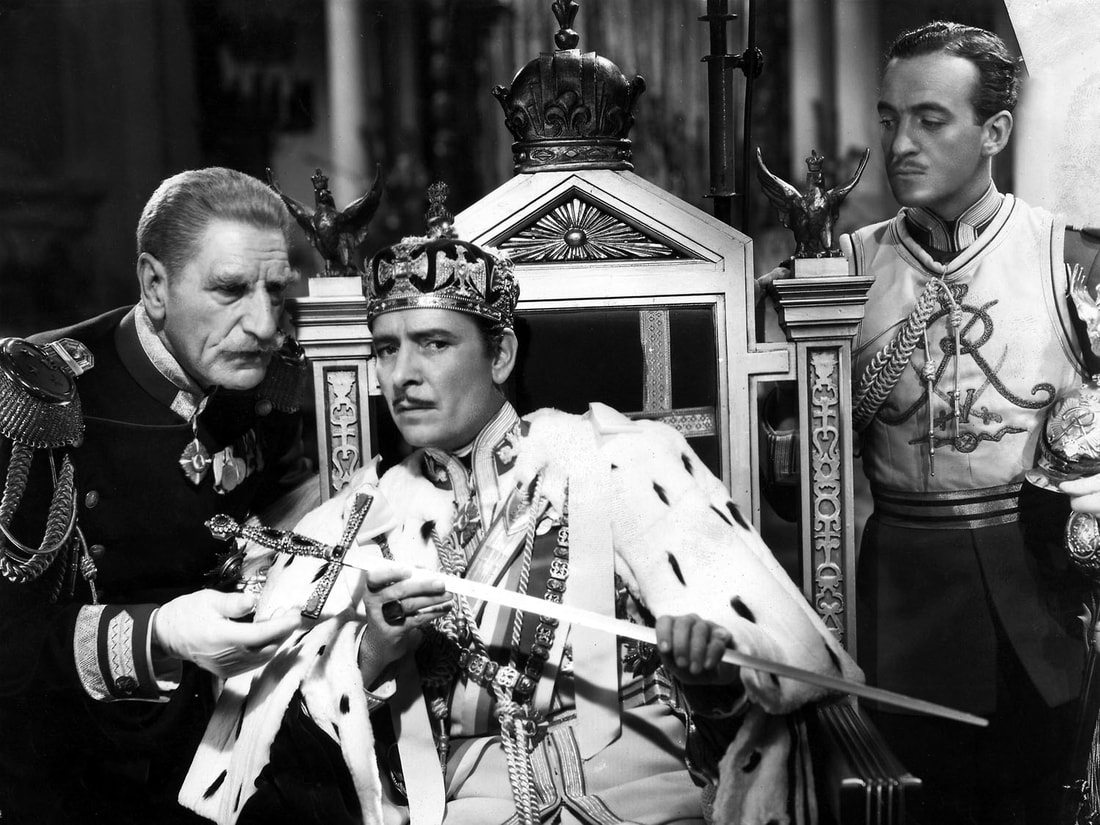
We have an Englishman named Rudolf Rassendyll (Colman) who has gone to a small country located somewhere between Vienna and Bucharest (not named in the film, but in the book it was called Ruritania). He has gone there for a fishing expedition at the same time the king of the country is being coronated. Zenda is a small area in this unnamed country where there is good fishing and boar hunting and where the king, Rudolph V (also portrayed by Colman), has a hunting preserve and cabin. RudolfV and his advisors Col. Zapt (C. Aubrey Smith) and Captain Fritz von Tarlenheim (David Niven, who I recognized immediately from other movies I’ve seen him in) run into Rassendyll in the woods and realize how much the two look alike.

I’m a little confused by the scene where Rassendyll tells the king they look alike because of their ancestors  — the king’s great-great-great grandfather and Rassendyll’s great-great-great grandmother — most likely had an illicit affair. In the beginning of the film, he acts like he’s coming to the country to hunt and knows nothing about the king or how much he looks like him but five minutes later in the film he’s telling the king he knows he looks like him and why. This is probably something that is explained better in the book.

All I can say is thankfully they both have the same British accent even though the King is from a kingdom in Eastern Europe, or they wouldn’t be able to understand each other.  Har. Har.

Minor complaint. Let us move on.

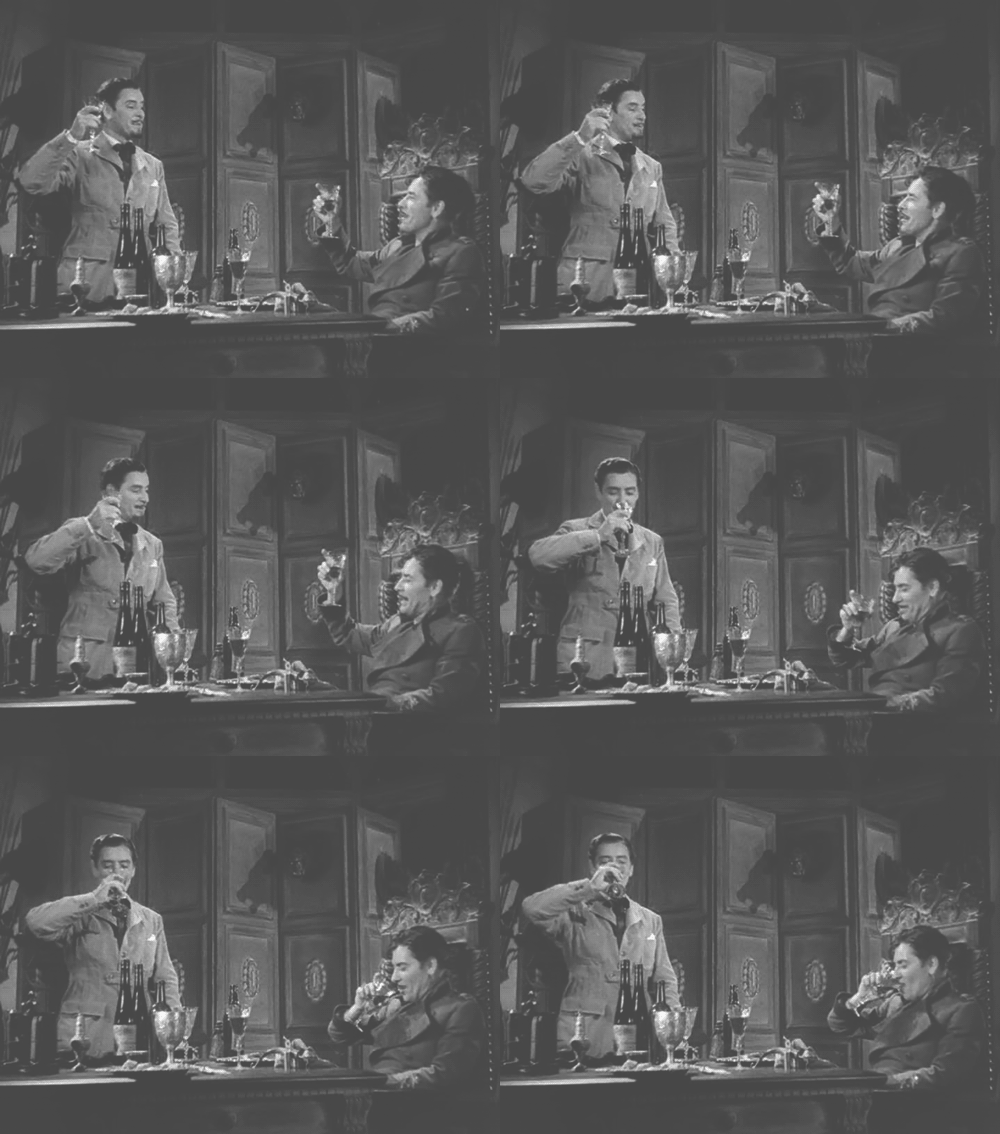
This news from Rassendyll about their probable relationship cracks the king up and he invites Rassendyll back to his hunting cabin where they get completely roaring drunk and Rudolftalks about his coronation scheduled for the next day and his half-brother Duke Michael, who hates him. He also speaks of his cousin Princess Flavia (Madeleine Carroll) who he will wed shortly after the coronation. After everyone else is unconscious from drinking too much, Rudolfdecides to drink a bottle of wine gifted to him by Michael.

 Uh-oh. Bad idea.

When Rassendyll wakes up the King is unconscious on the floor, drugged. The king’s advisor says the king isn’t dead, but he won’t be in any shape to be coronated that which means that Michael could be crowned instead. A plan is hatched to have Rassendyll pose as the king only for the coronation and then to be smuggled out of the country and sent back home.

Of course, we have foreshadowing here that tells us that all will not go as planned and, indeed, it does not.

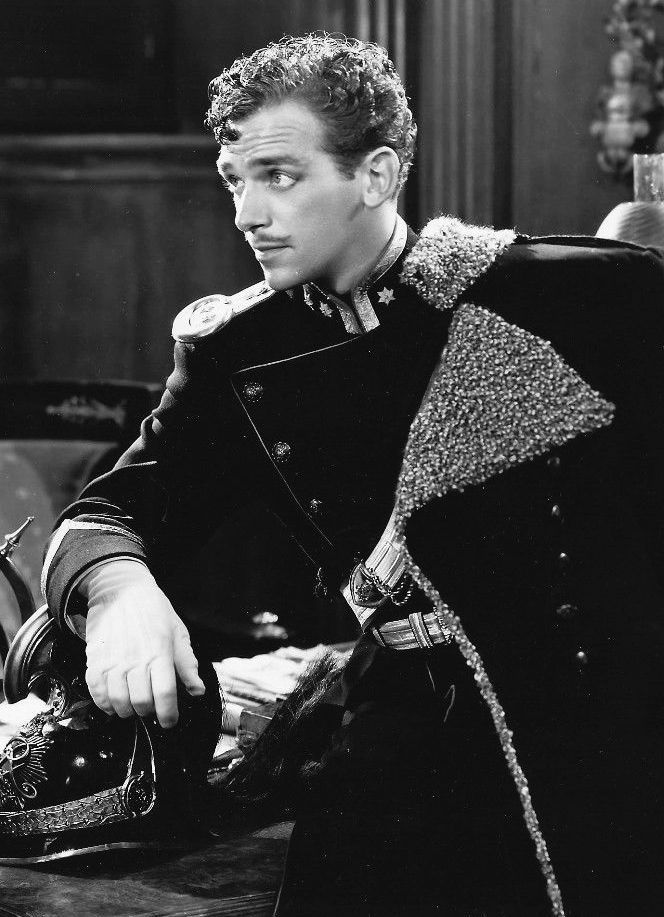
Douglas portrays Robert of Hentzau, the henchman (for lack of a better word) of Duke Michael, the king’s brother who wants to take over the throne.

He shows up for the first time with a crooked, mischievous smile, like in many of his movies, and lets us know immediately he is the comic relief and a completely swarmy cad. A very attractive cad, though, I must say.

Let’s put it this way —Hentzau is all frat boy, and I could not stop watching him when he was on screen.

There was a lot about this movie I could not stop watching — the acting, the scenery, and the exquisitely detailed and breathtaking costumes designed by Ernest Dryden.

The Prisoner of Zenda was originally going to be released by MGM, but was bought by Selznick for his own studio, right around the same time he was working on Gone With The Wind (1939).

If MGM had produced it, they were going to use it as a vessel for more money makers from power team William Powel and Myrna Loy of the Thin Man movies. A musical was also a possibility. That all went out the window when Selznick bought it.

“Zenda was already a proven commodity in print, on the stage and in previous film versions,” writes Roger Fristoe for TCM.com. “And the recent abdication of England’s Edward VIII led Selznick to think that a story of kings and coronations would be timely.”

John Cromwell, a former actor who had previously only directed romantic dramas, was chosen to direct, which some questioned.

Selznick explained the decision had to do with Cromwell’s experience with European audiences.

“In doing a picture like The Prisoner of Zenda, which is aimed at least fifty percent toward a foreign market,” he wrote in a memo. “It becomes important to get a director who at least has the judgment and taste to respect the sensibilities of audiences which are sensitive, particularly in England, about the behavior of royalty.”

Cromwell had a lot of complaints about the cast, though, including Niven and Douglas, who he called lazy and overindulged. He even dismissed Niven at one point because he didn’t find his humor humorous. Ha. But Selznick overruled him and brought Niven back, saying he was bringing life to an otherwise dull role.

 James Wong Howe was the cinematographer for the movie and his work was amazing, in my humble opinion. The various angles, the lighting, all of it.

Look at this fencing scene..the shadows on the walls..

The cinematography, great acting, and astounding costume and set design made this movie overwhelmingly enchanting.

There are a couple of scenes where Colman is filmed talking to himself and I was really interested to know how that was done before the days of digital special effects. Luckily the TCM article explained that for me.

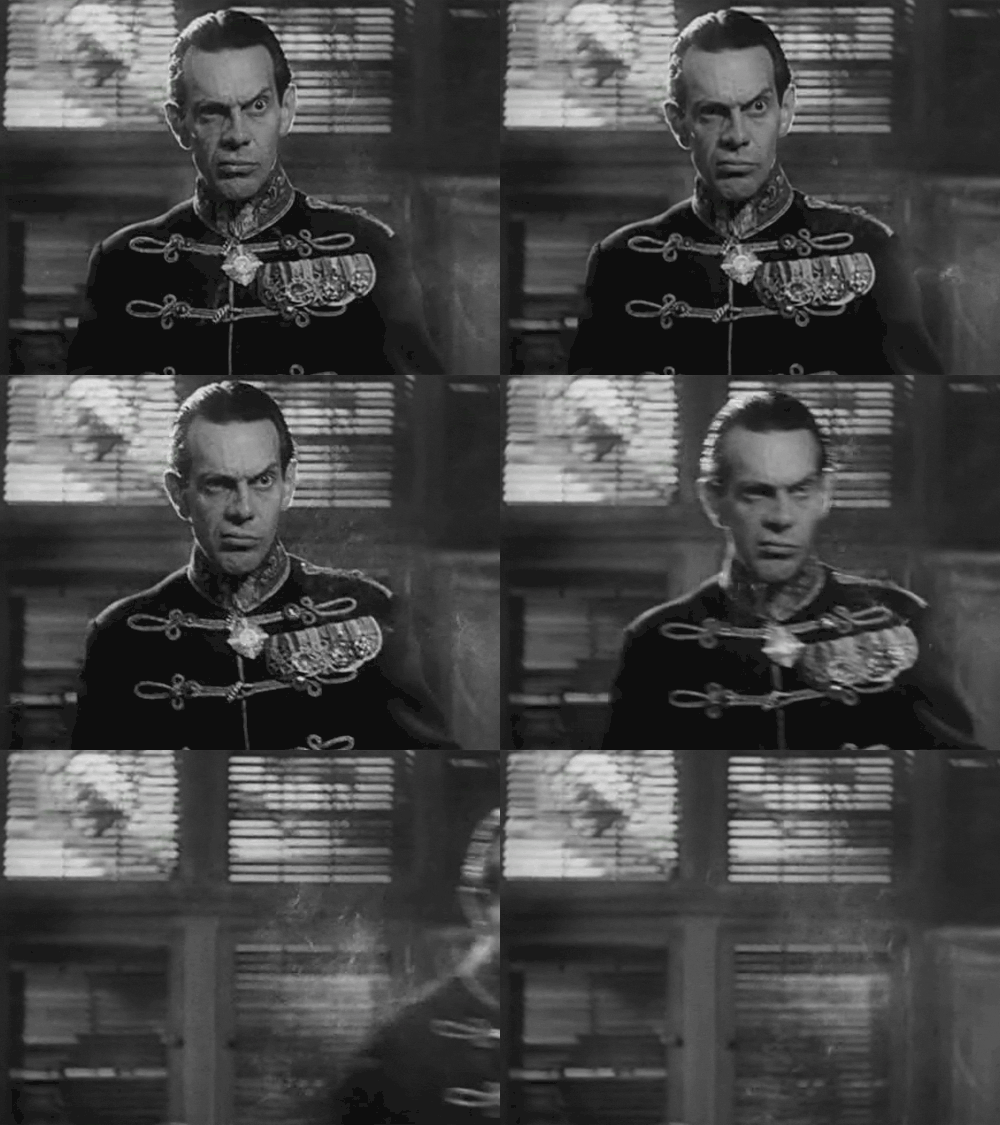
“The special effects created by Howe included a subtle and convincing scene where Colman appears to shake hands with himself. A 3 X 4′ optical glass was placed in front of the camera, and Colman exchanged the handshake with a double, whose head and shoulders were subsequently matted out with masking tape on the glass. The scene was re-photographed with Colman in a different costume and everything matted out except his head and shoulders. When the images were combined, the effect was complete and quite realistic.”

Because I loved Douglas as Hentzau so much, I thought I’d close this post by sharing some quotes that show how delightfully jerky he is in the movie:

“I don’t like women who lie to me. They don’t usually do it, as a matter of fact. I usually do them to them.”

“Someone once called fidelity a fading woman’s greatest defense and a charming woman’s greatest hypocrisy. And you’re very charming. And Michael’s very busy and likely to be more so.”

[during his sword fight with Rupert, Rudolf Rassendyll “retreats” towards the drawbridge’s controls]: “You’d be a sensation in a circus. I can’t understand it. Where did you learn such roller skating?”

To Rassendyll: “Why don’t you let me kill you quietly?”

Rassendyll: Oh, a little noise adds a touch of cheer. You notice I’m getting closer to the drawbridge rope?

Henztau: You’re so fond of rope, it’s a pity to finish you off with steel. What did they teach you on the playing fields of Eton? Puss in the corner?

Rassendyll: Oh, chiefly not throwing knives at other people’s backs. (A reference to a previous scene).

Have you ever seen this version or any version of The Prisoner of Zenda?

What was your impression of it?

Up next in my series will be Gunga Din, one of his more famous movies, from what I’ve read.

The rest of the movies I will be watching include:

The Young At Heart (January 30)

Having Wonderful Time (February 6)

Chase a Crooked Shadow (February 13)

Sinbad The Sailor (February 20)

The Rise of Catherine the Great (February 27)

The Sun Never Sets (March 6)

You can also find my impressions of previous movies in the series, as well as other classic movies here: https://lisahoweler.com/movie-reviews-impressions/

Comfy, Cozy Cinema: Blithe Spirit (1945)


Erin from Still Life, With Cracker Crumbs and I are watching Comfy, Cozy movies this September and October and this week we watched the 1945 version of Blithe Spirit.


This is a movie my husband and I had started a few months ago and didn’t finish up because we got interrupted and distracted by life, so when Erin suggested it for our Comfy, Cozy Cinema, I was all for it.

After watching it, I can share that this was not one of my favorite movies overall but there were parts I enjoyed and performances I found very well done. I also found the dialogue brilliant.

Before I go into my impressions, here is a little online summary of the movie, which is based on a play by Noel Coward:

“Skeptical novelist Charles Condomine (Rex Harrison) invites self-proclaimed medium Madame Arcati (Margaret Rutherford) to his home for a séance, hoping to gather material for a new book. When the hapless psychic accidentally summons the spirit of Condomine’s late wife, Elvira (Kay Hammond), his home and life are quickly turned into a shambles as his wife’s ghost torments both himself and his new bride, Ruth (Constance Cummings). David Lean directed this adaptation of Noel Coward’s hit play.”

I am going to get this out of the way now – I could have completely done without Rex Harrison in this movie. I hated his character. In fact, none of the characters were likable to me, but, as Erin pointed out to me after I watched it, that’s really the point of the play/movie – hence the title.

After double-checking the definition of “blithe” it made even more sense.

Blithe: showing a casual and cheerful indifference considered to be callous or improper.

That is exactly how every character in this movie acted.

While watching this movie, I also started to wonder if Rex Harrison is only capable of playing, arrogant, tone-deaf, rude, and bullheaded characters.

After watching him in Dr. Doolittle and My Fair Lady and now this – I can’t help thinking his range of an actor didn’t go much beyond these typecasts. I’m teasing a bit here because I have not seen every Rex Harrison movie. If you know of one where he isn’t a total jerk, let me know in the comments.

During the whole film, I wanted to throat-punch Rex’s character. Repeatedly.

I mean, it could be a hormone issue (I am at that age) or Rex Harrison might really have just been that annoying of a human being in this movie.

I know he’s playing parts in his movies, but he did it so well that I imagine there must be some of himself in there. I’ll have to research that at some point.

What I did like about this movie was Margaret Rutherford and it is fitting that this is the movie where she became known nation-wide in the UK after already having established herself on the stage and on television.

I first heard her name when I was researching actresses who had played Miss Marple in the past. Her first film debut was in 1936 but it was this performance – as Madam Arcati – that is considered her breakout performance. There are two reasons she might have done so well as the character – she had already portrayed Madam Arcati in the stage version of Blithe Spirit and Coward actually wrote the part with her in mind.

According to Wikipedia, theatre critic Kenneth Tynan once said of her performances on stage: “The unique thing about Margaret Rutherford is that she can act with her chin alone.”

She received rave reviews of her performance on the stage and the movies – from both critics and audiences.

After watching this movie I can see why – she played the part of being a batty old lady very well and if you delve into her sad history and upbringing, you would see why. That’s another tale for another blog post, but I’ll leave the link to her Wikipedia page here:

https://en.wikipedia.org/wiki/Margaret_Rutherford

Be warned there is some sadness about her life in that article, but also some joy and a great deal of success for her.

Even if this wasn’t a favorite movie of mine, I did not hate it. There were many humorous and witty moments in this movie and overall the acting was very good. I think in the end it simply wasn’t what I had expected – mainly because I had never seen the play.

One of the funny quotes from the movie was one that was removed from the U.S. versions by censors when it first released.

During an argument with Ruth, Charles tells her, “If you’re trying to compile an inventory of my sex life, I feel it only fair to warn you that you’ve omitted several episodes. I shall consult my diary and give you a complete list after lunch.” 

As I read what other viewers thought about the movie online I saw that most enjoyed the movie immensely but a few wrote that they found that the movie felt flat because they were comparing it to the stage version. In the stage version there was more of a chance for the actors to bounce of the audience and for the audience to respond with laughter, one reviewer said. In the movie version some felt the jokes and humor just fell flat.

I spent much of the movie not finding the humor very funny because I was so horrified how Harrison didn’t seem upset by any of the events that happened. Again, though, I needed to go back to that definition of blithe when I decided to rewatch some scenes before writing this post. After that I found some of the humor a little funnier and recognized it as being more tongue-in-cheek in some places.

Some viewers might sense the lack of humor in some places because the director, David Lean, apparently did not do a good job translating the play to film, at least according to Coward, who had worked with Lean on one of his previous plays being transferred to film, and enjoyed that experience.

Coward, in fact, informed Lean, after he saw a rough cut of the film, that Lean  had “screwed up” (but used a much more colorful term) the best thing he’d ever written.

Harrison later commented on Dean: ““When you’re on a comedy like Blithe Spirit, it is awfully hard working for a director who has no sense of humor.”

According to Wikipedia Harrison wrote in his memoirs:

“Blithe Spirit was not a play I liked, and I certainly didn’t think much of the film we made of it. David Lean directed it, but the shooting was unimaginative and flat, a filmed stage play. He didn’t direct me too well, either – he hasn’t a great sense of humour…..Lean did something to me on that film which I shall never forget, and which was unforgivable in any circumstances. I was trying to make one of those difficult Noel Coward scenes work… when David said: “I don’t think that’s very funny.” And he turned round to the cameraman, Ronnie Neame, and said: “Did you think that was funny, Ronnie?” Ronnie said: “Oh, no, I didn’t think it was funny.” So what do you do next, if it isn’t funny?””

The play, by the way, was written in six days at a seaside resort, where Coward had gone to escape the Blitz, according to Criterion.com.

Geoffry O’Brien writes in the article on Criterion: “..Blithe Spirit brought superficiality to another level of ambition: what audacity to write a comedy about death in the midst of bombing that would claim tens of thousands of civilian lives, a comedy in which the memory of a lost love became material for a punch line and mortality served as simply a piquant sauce for the same sexual dilemmas that were the staple of Coward’s brand of drawing room comedy. Blithe Spirit may be defined as a very British sort of resistance literature, encouraging resistance to encroaching catastrophe by blithely ignoring it.”

If you would like to read more about O’Brien’s thoughts (even he touched on how much better it is to see the play either before you see the movie or instead), you can find his very interesting (and full of big words) article here:

https://www.criterion.com/current/posts/2221-blithe-spirit-present-magic

I have to agree with O’Brien that the ending of the film is much more satisfying than the ending of the play, but I won’t share what I mean about that here in case you haven’t seen it yet.

I watched this one on Amazon Prime, where it was free with a subscription. It is also free right now on YouTube.

Read Erin’s impressions of the movie here: https://crackercrumblife.com/2024/10/10/comfy-cozy-cinema-blithe-spirit-1945/

Up next in our Comfy, Cozy Cinema is Alfred Hitchcock’s Rear Window. I’ve seen this one before but it’s been a few years so I am looking forward to watching it again and am glad that Erin suggested it.

Feel free to link up your own impressions of the movies at our link-ups. The links close at the end of the week but feel free to leave your blog post on future link-ups, even if it is for another movie.

Here is the rest of the schedule:

Also, don’t forget our Comfy, Cozy Care Package giveaway is still open until Oct. 15. We are giving away some things to make your autumn even cozier. The gifts include my book (Gladwynn Grant Gets Her Footing), Erin’s poetry compilation book, stickers, a journal, an autumn-themed mug, pumpkin-shaped chocolates, a book light, a blanket, and boxes of tea. We also hope to throw a few extras in to the winners!


You can enter anytime between today and October 15th, and the winner will be announced on our blogs on Thursday, October 17th. Please enter via Rafflecopter and it is only open to those 18 or older living in the US.” You can enter here: https://www.rafflecopter.com/rafl/display/3614a4fa2/?

You are invited to the Inlinkz link party!

<a

‘Cassie’ is up for pre-order

She’s here! Cassie’s cover is done and she’s ready to be pre-ordered. Okay, that sounded weird, but Cassie’s book is up for pre-order.

Cassie is book eight in the series and takes place in the 1990s.

If you’re curious what her story will be about, here is a quick description:

Cassie Drake starred in a popular sitcom over a decade ago, but she hasn’t been able to find a job since the show ended five years ago.

Now it’s 1995 and fired by her talent agency, Cassie decides to accept her sister’s offer for an extended visit in their hometown. Back in Coopers Grove, she’s just Cassie Mason, sister to Bridget Martin, the local volunteer extraordinaire with the handsome husband and three wonderful children.

When an accident at the site for the Martin family’s new café and farm store leaves Bridget frantic for help with the community center open house she’s planning, Cassie feels forced to step up—even though it involves something she’s clueless about.

Cooking.


Even with Mrs. Canfield’s Cookery Book, Cassie fails at every attempt. Fortunately, her sister’s handsome neighbor, Alec Alderson, steps in.

As a former chef, he’s more than capable of giving her some tips. Will his charming smile during cooking lessons be too distracting though?


Watching others use their talents leaves Cassie wondering if God, whom she’s barely spoken to in the last few years, is telling her she was made for more than the career that became her identity.

Pre-order here: https://www.amazon.com/dp/B0D1VW9TVK

Keep a look out for more sneak peeks from Cassie in the upcoming months but for now we have a few other books to be released first!

Up next in the series will be Joann, Cynthia, and Renee!

You can keep updated on the books and their release dates, as well as be treated to fun and historical posts in our Facebook group HERE