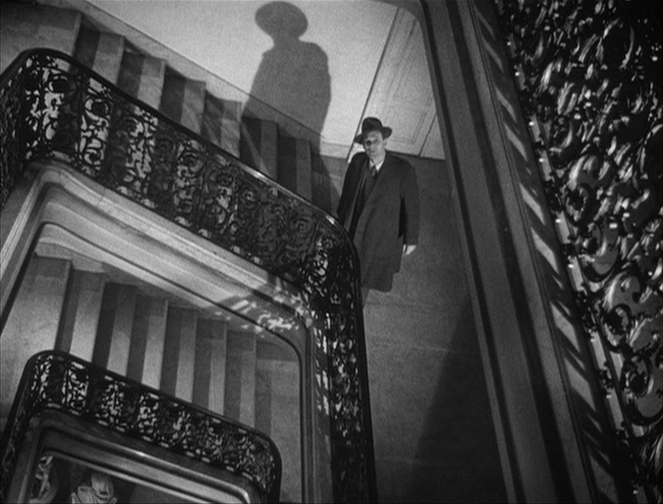
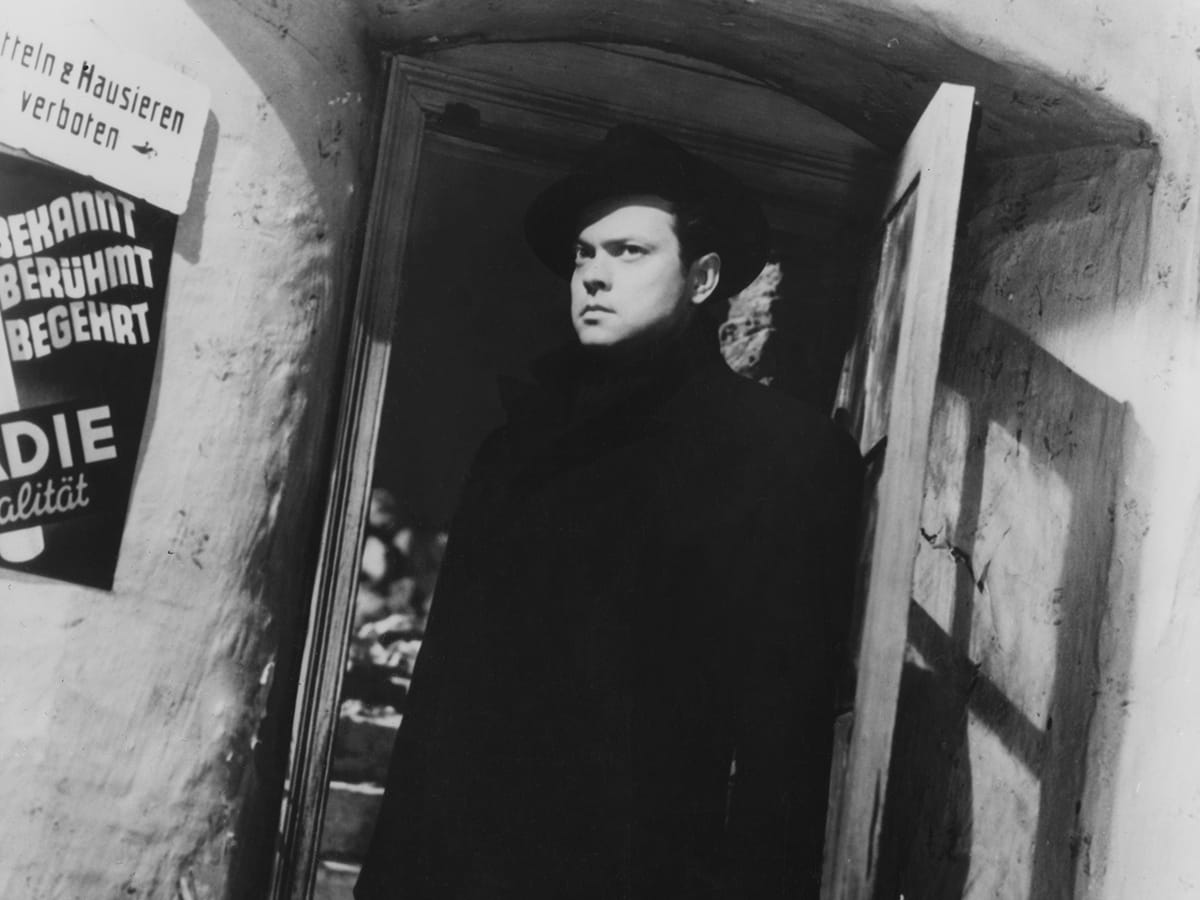
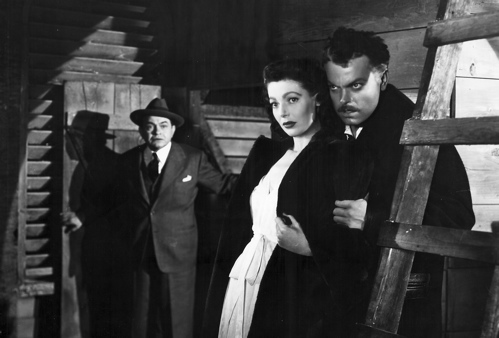
The cinematography in The Third Man (1949 ) is outstanding. The play of light with shadows, figures stepping in and out of light and dark both visually and metaphorically, makes this a movie you can’t look away from. If you do, you might miss a subtle exchange of looks, a quick smirk, someone moving in the shadows. You have to be on high alert while also relaxing into the story. You’re on the edge of your seat but also have plenty of moments to sit back and admire the superb acting of Orson Welles and Joseph Cotton.
The movie is set in post-World War II Vienna, Austria at a time when four political powers America, Russia, England, and France were overseeing a corrupt post-war environment.
Cotton plays Holly Martins, a writer of pulp Westerns, who arrives without any money as the guest of his childhood friend Harry Lime (Welles). The problem is, when Martins arrives, he finds out Lime has been killed, hit by a car.
Martins wants to know how his friend died and why, and learns there was a “third man” who was present during the accident. This leads him down a path that gets him mixed up with Lime’s girlfriend and British intelligence and knocks him right into the middle of complicated moral and ethical issues.
The movie, a British noir film, was directed by Carol Reed and produced by Reed, David Selznick, and Alexander Korda.
It was written by Graham Greene for the screen, and later a novella was released.
According to information online, Korda was someone who repeatedly told Welles he would fund his projects, but at the last minute, would pull out.
“My whole time with Alex was things like that,” Welles once said. “I kept doing projects for him which I did not abandon, but which he did.”
When it came to casting for the film, everyone knew Welles fit the part (with Greene essentially describing Welles when he described Lime) so Korda asked him. Welles agreed but then, as revenge for Korda’s past behavior, proceeded to tour Europe to film scenes for Othello (1952).
Korda wanted the contract signed and Welles locked in, so he sent his brother, Vincent, after Welles. Over the next week, Vincent had to chase Welles to Rome, Florence, Venice, Naples, and Capri because Wels would make sure they picked up and move to a new location each time Vincent was almost to them.
“I knew I was going to do it,” Welles later said, “but I was going to make it just as unpleasant as possible.” I loved this part of the story shared by TCM.com:
“On the way back to London via a privately chartered plane, Welles played one final, brilliant prank on Alexander Korda. Vincent asked him to hold a basket of fruit that he had gathered for his brother during the pursuit. This was post-war Europe, so fresh fruit was an exceedingly rare item. “It was going to be offered as a great present,” Welles said. “He’d gone and picked each piece of fruit. It was too good to be true! I knew Alex wouldn’t touch any of it if it had been bitten into.” So, when Vincent was asleep, Welles carefully took a bite out of each piece.”
Yes, Welles was literally chased down for this role, and it paid off because the character he played became known as one of the most iconic villains in cinema history.
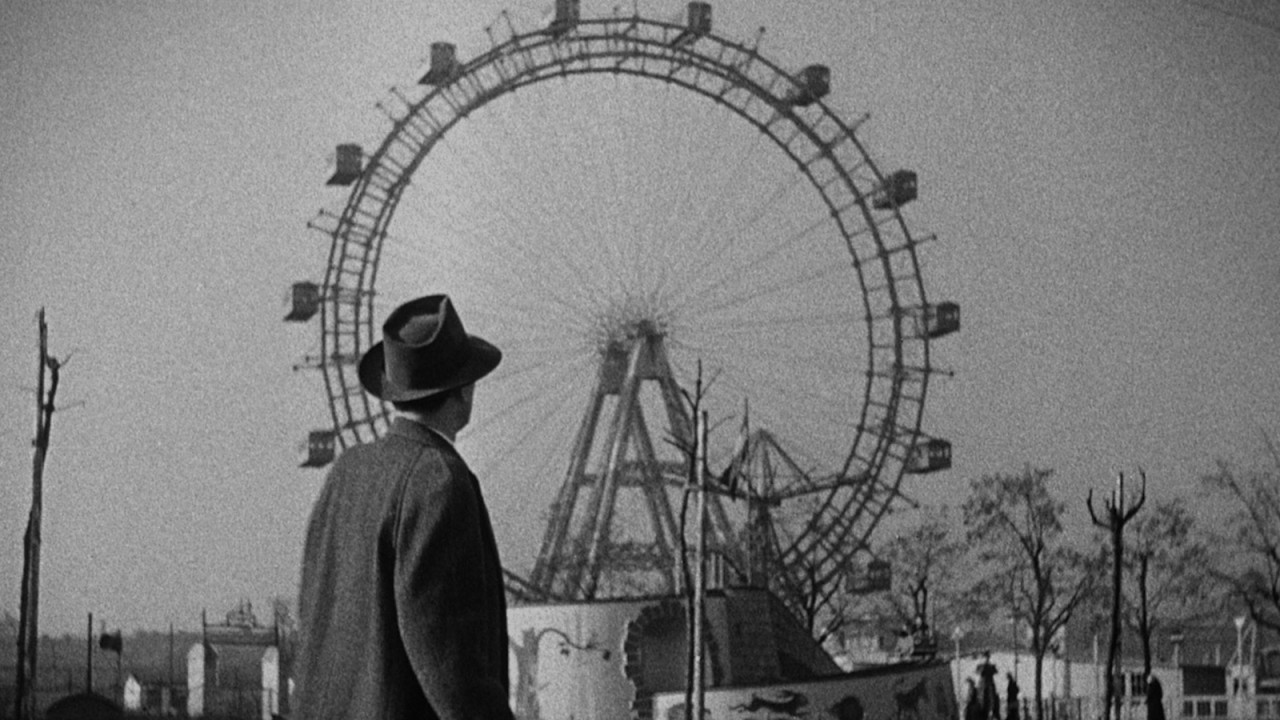
I can’t say enough about the brilliant imagery in this film. Maybe it is my photography background/experience and my absolutely obsession with black and white photography that had me gawking in amazement and visually enamored with so many of this movie’s scenes.
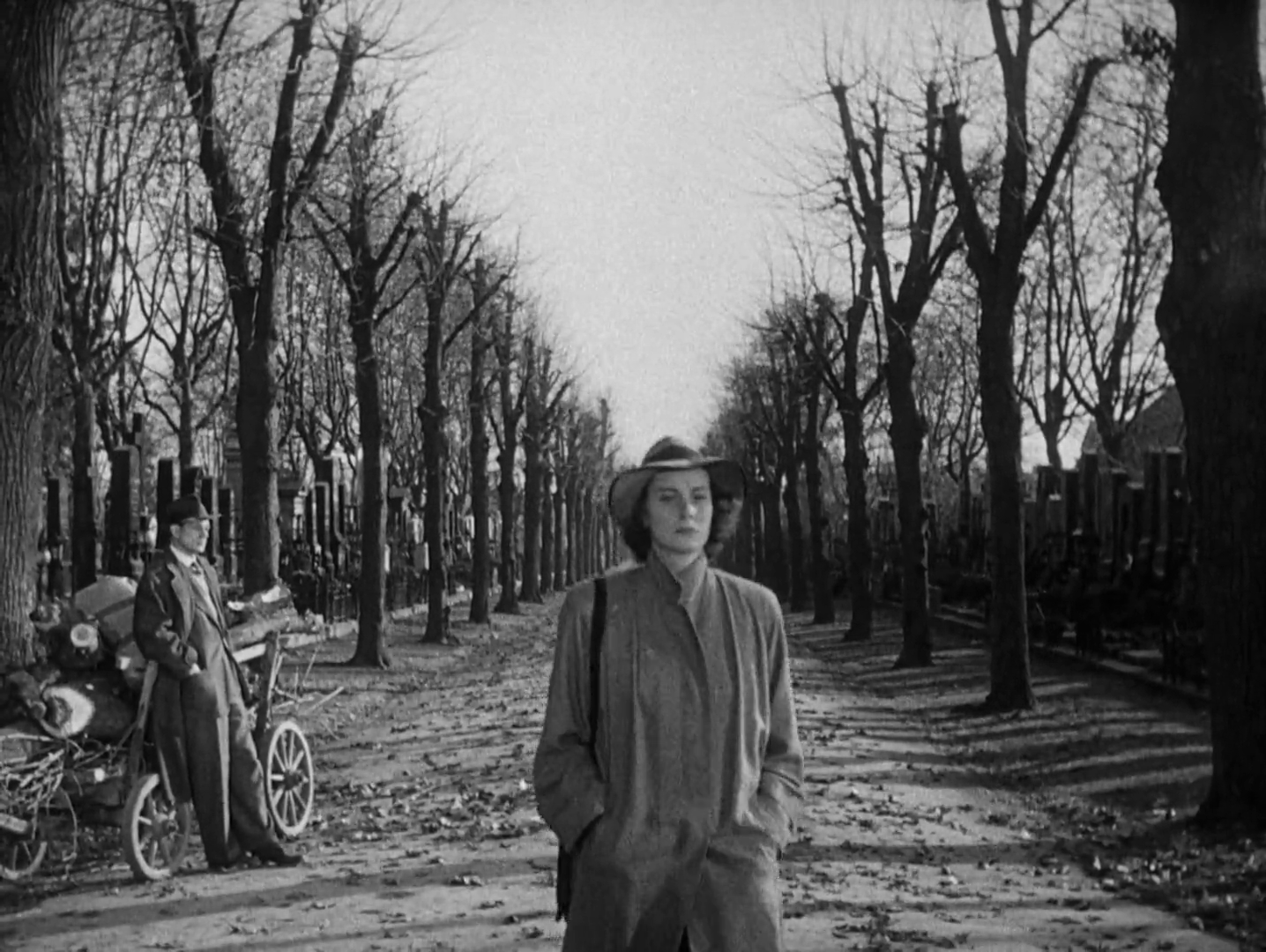
Here is a still from a scene in the cemetery.
Anna is standing in the middle of the shot, the focal point of the photo, and on either side of her are rows of naked trees, forcing the viewer’s eyes to follow the trees down to Anna and only then wander slowly to Holly, watching her walk away. There is a barren feeling to the scene — the nakedness of the trees, the pale white of the sky showing it’s an overcast day, Anna with her head down, clearly in thought as she’s walking away, Holly watching her with a hint of sadness in his gaze.
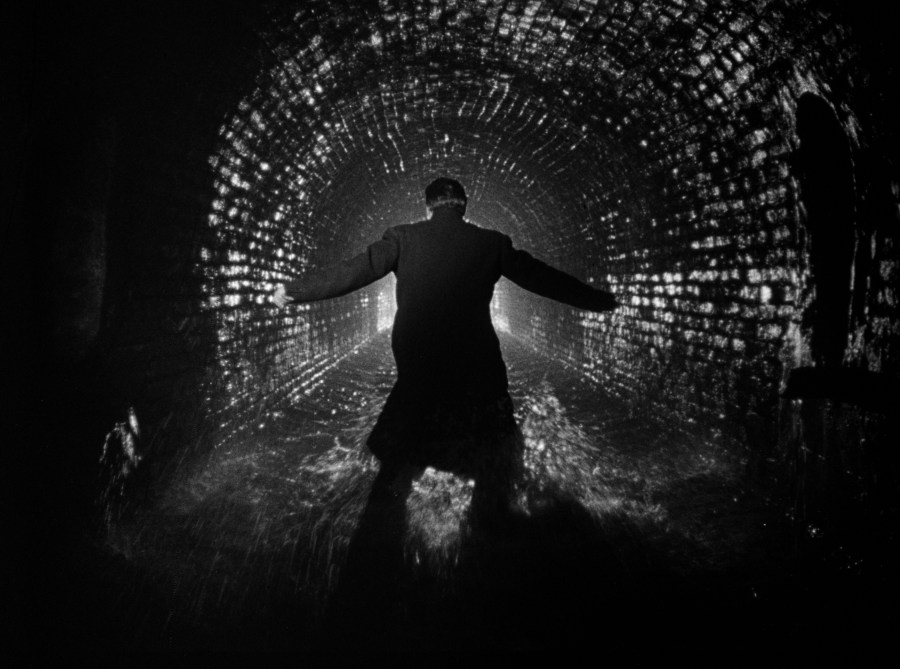
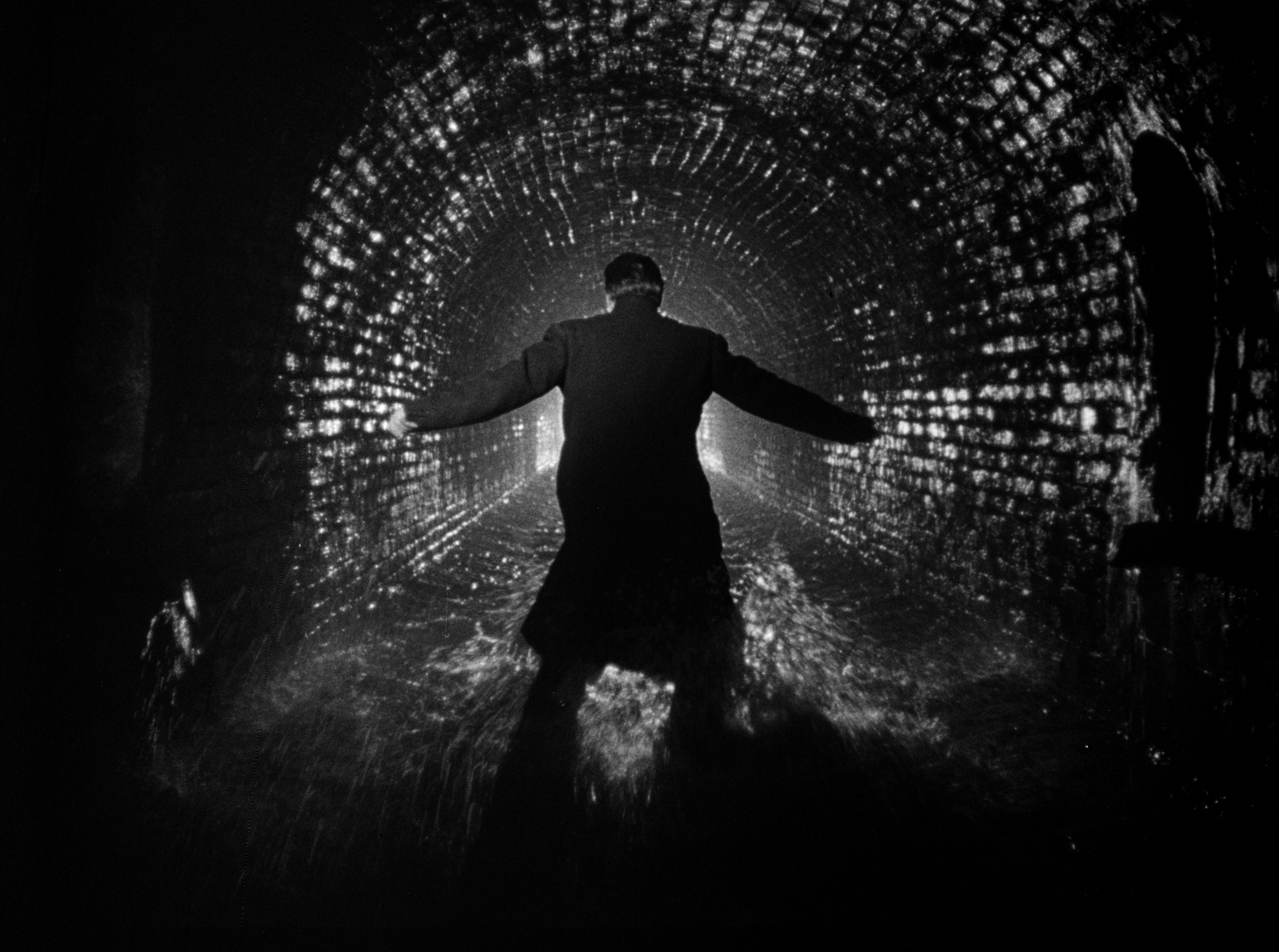
Then there is this still from one of the most famous scenes in the movie.
Orson Welles in Carol Reed’s THE THIRD MAN (1949). Courtesy: Rialto Pictures / Studiocanal
There’s a chase through the sewers going on, Welles’ character is on the run and what is so incredible about this entire scene is how the tunnel forms a tunnel for our eyes, once again bringing our focus right to the man running in the middle of the scene, toward the light, toward freedom that he may or may not ever reach.
It was hard for me to take my eyes off this film, not only because of the story but because of the visual smorgasboard.
There are quite a few reviews of the movie online, with many of them agreeing that The Third Man is one of, if not the, greatest noir film ever made.
Tom Spoors from Loud and Clear Reviews writes: “Almost every frame of The Third Man is a visual marvel, employing all kinds of cinematic techniques. There’s plenty of dutch angles, sure, but what I found even more interesting is the way that Reed uses shadows. He puts his main character in a situation and a location that is brand new to him, and builds this world to be one constantly cloaked in mystery. Reed places silhouettes around every corner, plasters every wall with them, creating a city that almost doesn’t feel real. It’s an atmosphere that I don’t think has ever been captured again to this extent, and perhaps the biggest reason why the moviehas gone on to be one of the most critically acclaimed noirs of all time. Simply put, no other film in its genre looks or feels quite like it.”
Philip French of The Guardian wrote about the movie: “From the moment the first audiences saw the opening image of Anton Karas’s zither filling the screen with the nerve-jangling Harry Lime Theme (before, indeed, they had heard the word “zither”), they knew that with the second collaboration between director Carol Reed and author Graham Greene they were in for something special. At its end they recognised (British spelling) they’d seen a near-perfect work, what we now call a noir classic.”
It’s become a tradition for me to share and then disagree with the late film critic Roger Ebert’s reviews on here but this time I can’t.
“Of all the movies I have seen, this one most completely embodies the romance of going to the movies. I saw it first on a rainy day in a tiny, smoke-filled cinema on the Left Bank in Paris. It told a story of existential loss and betrayal. It was weary and knowing, and its glorious style was an act of defiance against the corrupt world it pictured. Seeing it, I realized how many Hollywood movies were like the pulp Westerns that Holly Martins wrote: naive formulas supplying happy endings for passive consumption.”
If you haven’t seen the movie, you really need to and find out if this scene below is a flashback or … what’s really going on….
If you enjoy the kind of content on my blog and all that goes into it, you can support my writing for $2.99 a month or a single donation. Learn more here: https://lisahoweler.com/support-my-writing/
This summer I am watching Angela Lansbury movies for the Summer of Angela.
This week I dropped the movie with Angela and Warren Beatty that seemed super dark and replaced it with The Long Hot Summer, which I actually watched in 2022 during my first ever movie marathon called The Summer of Paul (Newman that is). For the life of me, though, I could not find that I wrote a blog post about the movie, so I am starting from scratch here.
The Long Hot Summer is not an Angela Lansbury focused movie, but she is in it and fills the screen with her personality when she is on it. The main stars are, of course, Paul Newman and Joanne Woodward, but Angela provides some comic relief as Orson Welles’ mistress, Minnie Littlejohn.
First, a bit of background/description of the movie with the Google description:
Handsome vagabond Ben Quick (Paul Newman) returns to the Mississippi town his late father called home, but rumors of his dad’s pyromaniac tendencies follow him as soon as he sets foot there. The proud young man’s determination eventually wins over civic leader Will Varner (Orson Welles), who decides Ben might be just the man for his daughter, Clara (Joanne Woodward) — much to the displeasure of Will’s gutless son (Anthony Franciosa) and Clara’s society boyfriend (Richard Anderson).
The movie’s main focus is the sexual tension between Paul and Joan’s characters, which worked out fine since the two were having an affair before this and were on the cusp of being able to announce that since Paul Newman’s divorce was essentially final. Yes, I have always been a fan of Paul, but, no, I don’t like that part of his and Joanne’s story, and I have a feeling there were times they didn’t like it either.
Paul was always good at playing loners, sad men who don’t know who they are or what they want in life except the woman they set their sights on.
It’s the same in this movie, where Paul seems to want prestige but really just wants Clara to like him as much as he likes her. Clara is uptight, though. She does everything proper and never lets her guard down, especially around Ben Quick. She seems to have a feeling if she does let her guard down all of those feelings she’s been trying to protect all her life will spill out.
It’s no surprise since her daddy (Welles), is also pretty uptight and fights for control over everything in his life. That’s why he won’t marry Minnie, who desperately wants to be married.
The movie opens with Ben Quick being told to get out of a county because he is charged with burning a man’s barn because he got mad at the man. There was no proof, though, so instead of jailing him, the town tosses him out.
He rides a couple of steamers down the river to his family’s old town and when he’s hitch-hiking he’s picked up by sour Clara and her bubbly friend.
We find out how sour she is when he asks, “So you girls just take your fun wherever you can find it?” And Clara responds with, “Don’t jump to conclusions, young man, we’re giving you a ride and that’s all we’re giving you.”
The sparring between Clara and Ben kick off right from there and continue on in the movie.
The first sign we see is a welcome sign to Fishermen’s Bend, home to – well, everything owned by someone named Varner.
Ben tells the girls that it sounds like Varner is the man to see about work in that town and the bubbly girl says that he can see Mr. Varner every night at their house. He asks if they are connected to Varner and the girl giggles that they are indeed and then drive off and leave him there at the town hall.
Back at the Varner house, Eula, Clara’s sister-in-law, is gushing to her husband Jody about all the clothes she bought, and Clara is on the terrace sipping lemonade with her friend Agnes when Ben shows up again.
The ladies were talking about how they are single and lonely before Ben showed up. Agnes mentions how he might be an option and Clara quips that they haven’t gotten so desperate as to be turning to strangers.
Ben asks Jody about working one of the tenant farms to make some money off of. Jody agrees before running back upstairs to make out with Eula. The servant comments when he sees muddy footprints on the rug after Ben leaves, “Mister, you sure do leave your calling card.”
That’s a bit of foreshadowing and an understatement.
As the movie goes on Ben will work his way into the family in more ways than one, upsetting the apple cart, so to speak.
Clara walks the carpet back to Ben’s tenant house with a little black boy (yep, another servant down here in the South) and tells him you dirty it, you clean it.
What follows is some great dialogue, which continues throughout the movie.
“A lot of fuss to be making about a rug lady, if it’s the rug that’s bothering you.”
Clara tips her chin up. “What else would it be?”
Ben spits out a watermelon seed. “Well now you correct me if I’m wrong but I have a feeling I rile ya’. I mean me being so mean and dirty and all.”
“Mr. Quick, you being personal with me, I’ll be personal with you. I spent my whole life around men who push and shove and shout and think they can make anything happen just by being aggressive and I’m not anxious of ‘nother one around the place.”
Ben smirks. “Miss Clara, you slam a door in a man’s face before he even knocks on it.”
All Clara says is for him to have the rug at the house by 6.
It shows how bigger than life Varner is when he comes back into town in an ambulance or police car (not sure which ) with the sirens blaring. The people in town who watch him drive through talk about how he was in the hospital and had something cut out of him.
Then it’s time for Angela, the point of this here Summer marathon. She comes running out of the Littlejohn Boarding House and Hotel as soon as he pulls up, wearing a tight and tiny white dress, and throws her arms around him. Her Southern accent is so jarring being familiar with her original accent and the American one she ended up developing as the years went on.
He laughs and declares she seems to be getting fatter and blonder on him.
Oh yeah…Didn’t I mention what a charmer he is?
He tells her he will be back…later. *wink* *wink*
He greets his family at home, with a clear critical eye on his son who seems desperate to please his father. That will come to play in a big way in the movie.
Orson Welles’ color is so horrible in this film, and I don’t know if that is because he is supposed to look sick or if it was bad makeup or if Orson Wells was that color back then. Then again, a couple of the other men had that weird color to their skin too. Maybe it was just bad makeup or the film itself.
Despite his color, Minnie wants to marry Daddy Varner, and she lets him know that. He avoids her as much as possible, preferring to keep control of his world.
What Angela said about the movie:
Angela’s plays a playful flirt in this film, not a dark femme fatale like A Life At Stake and she credited the director, Martin Ritt, for bringing that playfulness out in her.
“Martin Ritt had a wonderful enthusiasm and earthy sexy quality himself,” she said. “He loved the idea of the dirtiness of the carryings on, and he certainly brought every bit of kind of naughty sexuality out of me in that role.”
As for Orson Welles, Angela agreed with others who said he was used to getting his own way because he normally had control of his own projects. This project wasn’t his though.
“He was always nudging and pushing for things and wanted to change lines,” said Angela. “But had to be carefully handled so that he didn’t always get his way because his way wasn’t necessarily the best way for everybody else in the scene.”
Welles would irritate his co-stars by overlapping his own lines with their dialogue, ad-libbing, and mumbling to the point where his lines were barely comprehensible, she added.
Despite him being annoying, Angela also said of him: “There was something you couldn’t resist about Orson.”
In a 2001 interview, quoted on TCM.com, Angela said of Paul and Joan: “They seemed to have such a total understanding of each other that they were able to work in scenes where they were at each other’s throats or falling under each other’s spell.”
My thoughts on the movie:
I like the Southern feel of this movie, the acting, the complex relationships. I love watching Ben try to break through Clara’s hard exterior. No matter how hard she tries to resists him or how many times she pushes him away he keeps trying.
I love how the women are very strong in the movie but not so strong that they are outright disrespectful, even though they probably should be in some cases.
Paul’s smirk works well in just about every movie he’s in but it really works in this one. It’s hard to read what his real motives are sometimes, but deep down I feel like he does want something better than what he’s had. I feel like he does want a family and to be successful on his own merit.
This movie has a Tennessee Williams feel to it even though it is based on one main story and other stories by William Faulkner. It did not have a Tennesse Williams’ ending, at least.
On a more shallow level, I don’t know what they were thinking with Joanne’s big eyebrows and those way too short bangs. Despite how much I didn’t like the look they went for, I really enjoyed watching her character develop and blossom and reveal herself to be different than who we think she is for the first half of the movie.
Watching the jealousy unfold in Jody as he desperately tried to be what his father wanted him to be was difficult to see. The poor guy has no idea how to be a man of his own and is always trying to be what he thinks his daddy wants him to be.
Orson really wasn’t good in this movie. He really wasn’t. I don’t know what happened to him or why he performed so awful but from what I read online it was flat out jealousy over his younger counterparts who were associated with the Actor’s Studio. I also read he was only 10 years older than Paul in this film – 42 years old – but he looks terrible! He wore a prosthetic nose which I can not figure out the point of.
As for Angela, she pulled off her part well and it was fun to watch her with a thick Louisiana accent. Every time I see her in one of her early movies, I really do find myself forgetting she was Jessica Fletcher. She would have been so much better in this one if she hadn’t had to act across from Orson who was way over acting.
Trivia and Facts:
Orson Welles always wore a fake nose when he worked, so when he would sweat on this film, his fake nose would slip. Make-up people had to keep applying material to keep the fake nose from falling. (source TCM.com)
The director was Marty Ritt and Paul filmed five other films with him including Hombre, Paris Blues, The Outrage, Hemingway’s Adventures of a Young Man, and Hud. (source, excerpt from Paul Newman biography on Lit Hub)
In his biography Paul Newman wrote of Orson: “Orson couldn’t understand screen generosity, where one actor allows another player in his scene to deservedly get the best camera shots. Screen generosity was not part of Orson’s vocabulary. After a number of retakes on a scene he did with me, Orson asked Marty if he could have a private word with him. They stepped away together, and seemed to be discussing something rather serious. When they came back, we did another take, and afterwards, I asked Marty what was going on.
“Orson thought you were submarining him,” he said; it was an actor’s way of saying someone was stealing his screen time.” (source, excerpt from Paul Newman biography on Lit Hub)
The director, ‘Martin Ritt’ , was forever known after this movie as the man who tamed Orson Welles. During filming Ritt drove Wells into the middle of a swamp, kicked him out of the car and forced him to find his own way back in the hot Louisiana heat. (various/several sources)
Joan and Paul were married in January 1958 and the movie released in March. (TCM.com)
When the movie was complete, the director and others watched it and noticed they could barely here Orson at times. The director felt sure Orson had purposely mumbled his lines to make the sound more difficult because he was unhappy with not having control.
From TCM.com: “The success of The Long, Hot Summer helped Martin Ritt reestablish himself as a major director following his 5-year blacklisting from Hollywood. It also showcased the talents of young up-and-comers Joanne Woodward and Paul Newman, who won Best Actor that year at the Cannes Film Festival for his portrayal of Ben Quick. It marked both the beginning of long and distinguished careers for the talented couple as well as the beginning of one of Hollywood’s longest and happiest marriages.”
The Long, Hot Summer was based on the works of southern writer William Faulkner, most notably his 1940 novel The Hamlet. (source: TCM.com)
The movie was turned into a television series in 1965. It starred Roy Thinnes as Ben Quick, Nancy Malone as Clara, and Edmond O’Brien as Will Varner. O’Brien eventually left the show and was replaced with Dan O’Herlihy. Legendary director Robert Altman directed the pilot. (source: TCM.com)
Copied directly from TCM.com’s article because I thought it was interesting and I didn’t want to summarize it: Although William Faulkner was best known as a novelist and short story writer, he did work as a screenwriter in Hollywood for 20th-Century-Fox during the thirties and forties. A good deal of his work went uncredited and he was never successful in adapting any of his own work for the screen (although he did do a screen treatment for “Barn Burning” but it was never produced). He did, however, receive credit for the screenplay adaptations of Ernest Hemingway’s To Have and Have Not (1944), Raymond Chandler’s The Big Sleep (1946) and a few other scripts such as Submarine Patrol (1938) for director John Ford and The Road to Glory (1936) for director Howard Hawks.
Other William Faulkner film adaptations include The Story of Temple Drake (1933, based on his novel Sanctuary), Intruder in the Dust (1949), The Tarnished Angels (1958, based on his novel Pylon), The Sound and the Fury (1959), Sanctuary (1961), The Reivers (1969), Tomorrow (1972, based on his story), and an uncredited Russian adaptation of Sanctuary entitled Cargo 200 (2007, aka Gruz 200).
Have you ever seen this one?
My last Angela movie will be Something for Everyone. I don’t know anything about it so I’m going into it blind.
If you want to read about some of the other movies I watched, you can find them here:
A few weeks ago, my husband suggested we watch an Orson Welles movie. Since I’ve liked other movies by and starring Orson, I agreed to it.
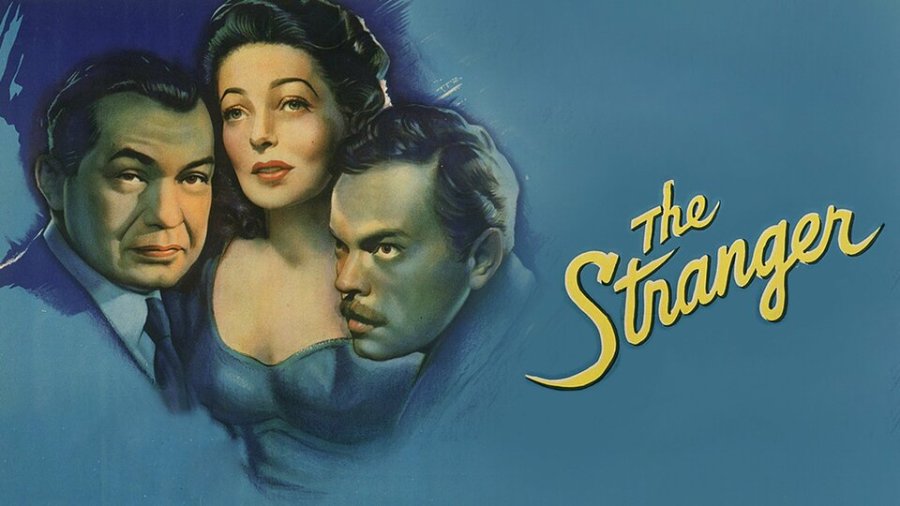
The Stranger was released in 1946 and tells the story of a war crimes investigator who tracks a high-ranking Nazi fugitive to a small Connecticut town.
Welles both directed and co-wrote the film but was uncredited for the writing, which was most likely part of the many concessions he made for the opportunity to direct it. This is a movie that some call his most conventional. It’s also one he wasn’t as fond of because so many changes were made to the final cut without his consultation.
The movie stars Welles, Edward G. Robinson, and Loretta Young.
The creepy undertone throughout the entire movie left me always waiting for the other shoe to drop.
Nazi fugitive, Franz Kindler (Welles), has done his best to assimilate into American society. He’s even about to marry the daughter of a justice of the U.S. Supreme Court.
Edward G. Robinson, playing war crimes investigator Mr. Wilson, follows one of the recently released followers of Kindler to the town, hoping he’ll lead him to Kindler. The man suddenly disappears though, and Wilson is certain he’s been murdered by Kindler, but still doesn’t know who Kindler actually is. Only that he is somewhere in the town.
We the viewer, know all along what happened to the man and who made it It happens about 15 minutes into the movie, but Robinson has to spend much of the movie trying to figure it out and once he does figure it out, he spends the rest of the movie trying to make Kindler admit who he really is. The only thing Robinson’s character really knows when he comes to the town is that Kindler had an almost unhealth obsession with old clocks.
It’s a fantastic, stressful game of cat and mouse that had me literally biting my nails part of the time.
The music of the movie is very interesting – mixing in a creepy violin-based humming, with happier melodies to try to show the contrast between an innocent, happy world being infiltrated by pure evil.
It always amazes me how quickly movies were made back then. Filming for this movie took place from September to November of 1945 and was released July 2, 1946.
Originally the film was going to be directed by John Husten, but he entered the military and Welles begged producer Sam Spiegel (also called S.P. Eagle at the time) to let him direct the film. Spiegel agreed as long as Welles agreed to several concessions and to be let go as director if he stepped out of those perimeters. Welles would still have to continue on as the lead actor, even if he was let go as director, however.
Welles agreed. He needed the job if he wanted to continue in Hollywood. Five years earlier Welles had been essentially backlisted with the release of Citizen Kane, which won 9 Academy Awards, including Best Director, Best Movie, and Best Actor for Welles. This should have made Welles a sought-after director and actor. Citizen Kane was based on the life of one of the most powerful men in the world at the time — William Randolph Hearst, a newspaper publisher and owner — though and Hearst wasn’t happy. In fact, he was furious. He made life very difficult for Welles and anyone else associated with the making of the movie, which is now considered the greatest movie all time thanks to its innovative filmmaking techniques, complex story, and influential impact on cinema history.
“In September 1945 Welles and his wife Rita Hayworth signed a guarantee that Welles would owe International Pictures any of his earnings, from any source, above $50,000 a year if he did not meet his contractual obligations,” an article on Wikipedia states. “He also agreed to defer to the studio in any creative dispute.”
This became a challenge when Editor Ernest J. Nims was given the power to cut any material he considered extraneous from the script before shooting began.
“He was the great supercutter,” Welles said, “who believed that nothing should be in a movie that did not advance the story. And since most of the good stuff in my movies doesn’t advance the story at all, you can imagine what a nemesis he was to me.”
Reading about all the cuts that were made from the script, and the final product helps me to understand why this movie feels so choppy at times. It feels like elements that would have helped to explain some of the plot better are missing.
What is really missing is building up Welles’ character and helping the viewer get to know who he is. As I read online, I found out that there were scenes removed from the beginning of the movie that would have given us more character development for Welles’ character.
I feel like Nims really overdid things and should probably be ashamed of chopping up Welles’ work.
I also thought that it was interesting that Welles wanted a female actress to portray the investigator.
“I thought it would be much more interesting to have a spinster lady on the heels of this Nazi,” Welles said.
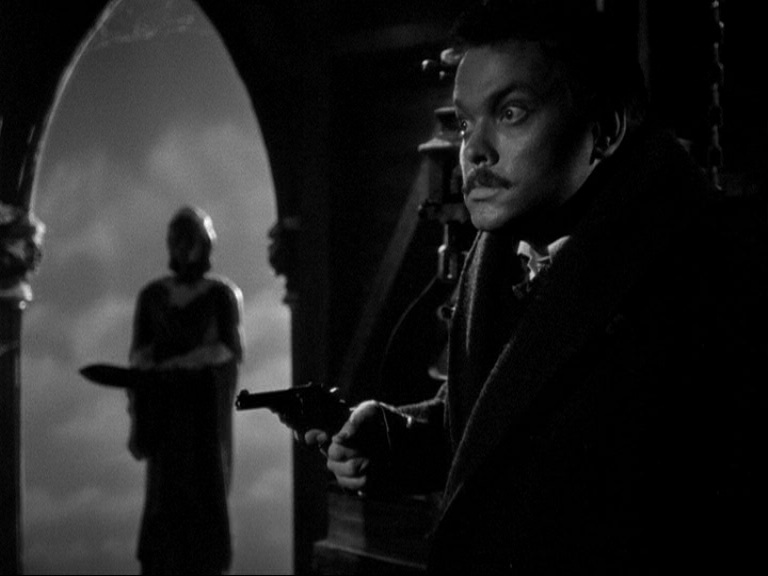
Welles would later say in interviews that nothing of The Stranger was his in the end. Biographer Frank Brady disagrees, “Welles has said, since the making of The Stranger—which he completed one day before schedule and under budget—that nothing in the film was his, this despite the fact that the unmistakable Wellesian moods, shadows, acute angles, and depth-of-focus shots are pervasive. Within the film is a second film, another Wellesian touch, consisting of snatches of documentary footage showing Nazi atrocities.”
One unique aspect of The Stranger is that it was the first commercial film to use documentary footage from the Nazi concentration camps.
Welles viewed Nazi Concentration Camps (1945), a film used as evidence in the Nuremberg Trials in early May 1945 as a correspondent and discussion moderator at the United Nations Conference on International Organization
One thing I didn’t remember until reading about it this week was that in the 1940s, many in the world simply couldn’t accept that the concentration camps were real.
Welles wrote about the footage in a column for the New York Post:
“No, you must not miss the newsreels. They make a point this week no man can miss: The war has strewn the world with corpses, none of them very nice to look at. The thought of death is never pretty but the newsreels testify to the fact of quite another sort of death, quite another level of decay. This is a putrefaction of the soul, a perfect spiritual garbage. For some years now we have been calling it Fascism. The stench is unendurable.”
Though the studio did not think The Stranger would be a success, it actually was and right out of the gate too. It cost $1 million to make and earned $2.25 million in U.S. rentals in its first six months. Fifteen months later had grossed $3.2 million.
I very much enjoyed the film, but I do wish that Kindler’s German accent would have come back as soon as his cover was blown. Having him keep the American accent he’s been using to keep his cover, even when under pressure, seemed unrealistic to me.
Despite that small issue, Welles is so deliciously evil in this. His excuses for his crimes against humanity were presented with a lecherous smile that sent shivers down my spine. The tension throughout the film is extreme. I never knew when Kindler would finally snap and reveal himself or worse — kill someone to keep his identity secret.
I found this one on YouTube for free, but it is also streaming in better quality on several streaming sites, including Amazon Prime.
Have you ever watched this one? What did you think?