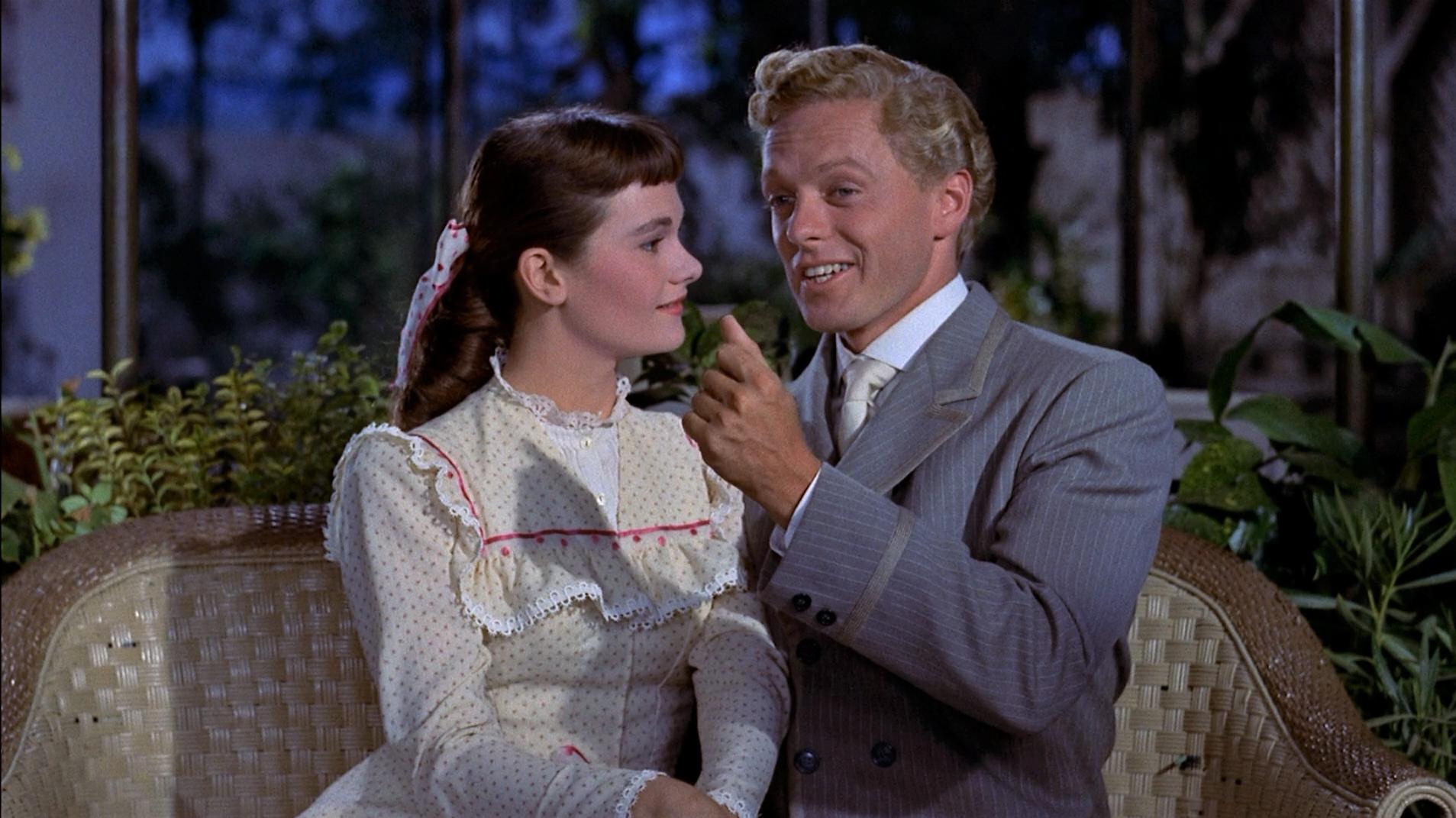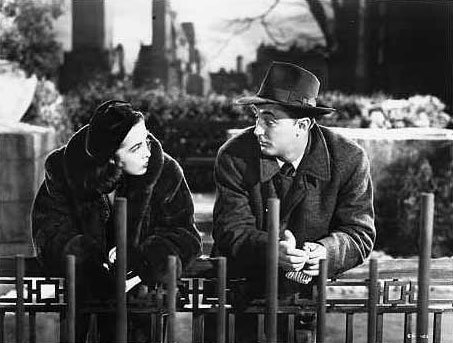
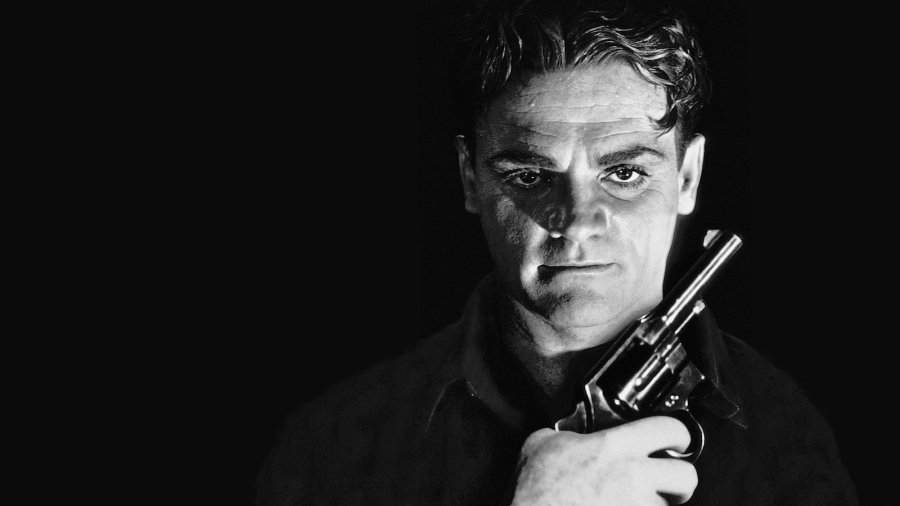
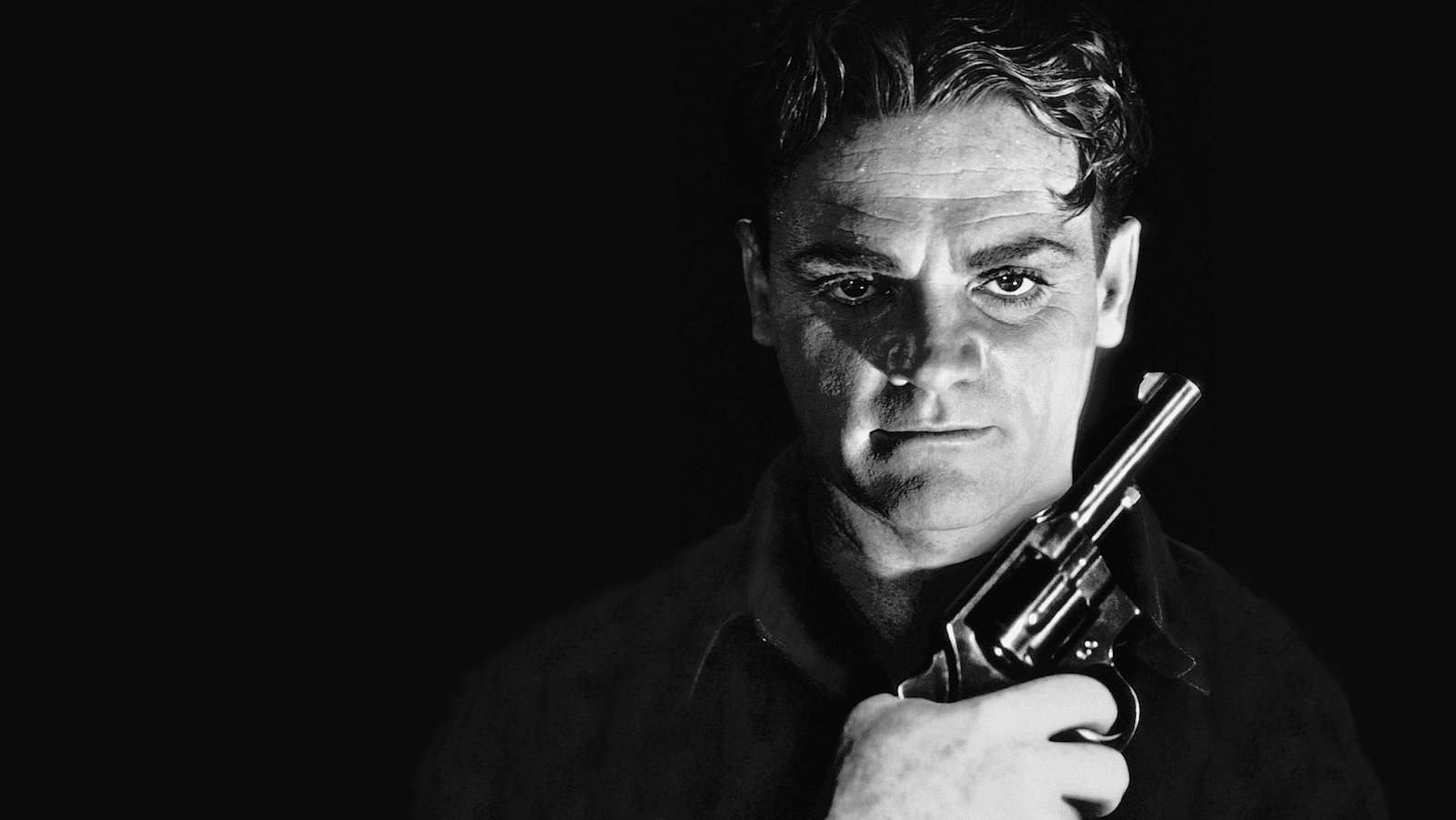
James Cagney: One of the most versatile actors of the Golden Age

When people think of the actor James Cagney, many might think of his roles as gangsters, bad guys, and double-crossers. He was much more than that, though, in his acting roles and in his life.

This month I am watching James Cagney movies as part of my Winter of Cagney movie event.
To kick it off, I thought it might be good to share a little about the actor’s life.

Cagney was born to an Irish bartender father (James Francis Cagney) in the rough lower east side of New York City. His father, who Cagney says was an alcoholic, was also an accomplished boxer and at the age of 14 Cagney followed his footsteps and became one of Yorkville’s best fighters. James’ mother was Carolyn Elizabeth Cagney (my mom’s name is ironically Carolyn Elizabeth..but not Cagney).

“My childhood was surrounded by trouble, illness, and my dad’s alcoholism,” Cagney wrote in his autobiography, Cagney on Cagney. “But as I said, we just didn’t have the time to be impressed by all those misfortunes. I have an idea that the Irish possess a built-in don’t-give-a-damn that helps them through all the stress.”
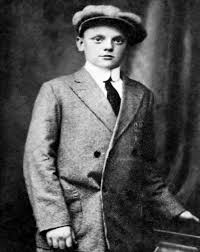
While in high school, Cagney worked wrapping packages at Wanamaker’s Department Store, for $16 a week. His introduction into entertainment came when a fellow employee at Wanamaker’s told him a vaudeville troupe paid its players $35 a week. When Cagney auditioned, he told them he could sing and dance. He couldn’t do either, but he still had a successful audition. It was while working in Vaudeville that he met Frances Willard. They married in 1922 and remained married until his death 64 years later. She lived until 1994.

Cagney’s big break on the stage came in 1929 when he acted opposite Joan Blondell in Penny Arcade.

His big screen debut came in 1930 with Sinner’s Holiday, and he made four more films that year. Public Enemy (1931) and Taxi (1931) are two movies where the world was introduced to him as a gangster.

Growing up, I heard a lot of impressions of Cagney and those always claimed he said, “You dirty rat….” Or “All right, you guys.”

For the record, according to the Encyclopedia Britannica website, Cagney never actually said the words “You dirty rat,” or “All right, you guys” in any of his movies. Wow. Talk about a disappointing revelation there. Ha!

He did, however, say, “Come out here and take it, you dirty yellow-bellied rat or I’ll give it to you through the door,” in the 1931 movieTaxi.
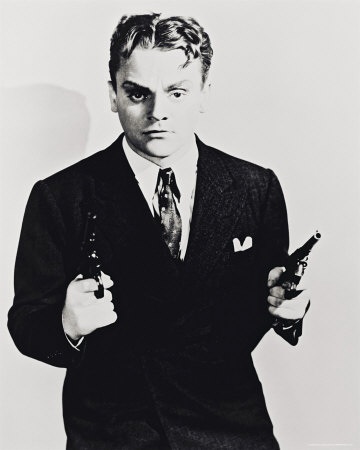
According to The Kennedy Center website (he was honored there in 1980), “The unforgettable ‘fruit facial’ scene, in which he rams a grapefruit into Mae Clarke’s nose is exemplary of Cagney’s spontaneity, for the script called for him to slap Clarke with an omelet.”

Eventually, though, Cagney would tire of “packing guns and beating up women,” as he said in his autobiography, and after a string of movies where he played a gangster type figure, he did try some different roles, including the one he won an Oscar for — playing George M. Cohan in Yankee Doodle Dandy.

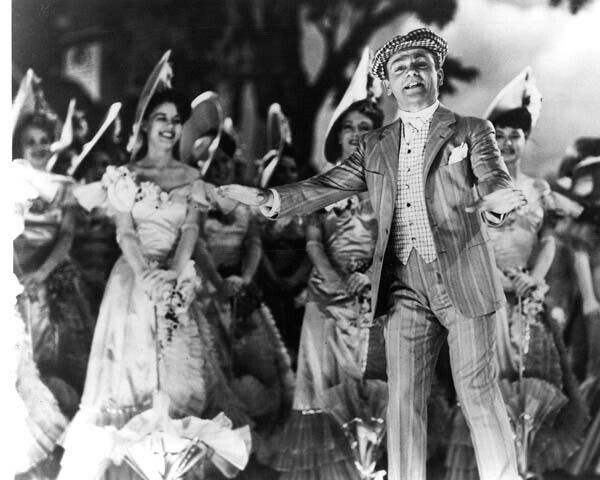
“No matter the genre of the film he was in, James Cagney always brought unique, riveting energy to the screen,” writes Jeremy Arnold for TCM.com. “Known best for his tough-guy and gangster roles, a persona cemented by his fourth picture, The Public Enemy (1931), Cagney had actually started his showbiz career in 1920s vaudeville as a song and dance man, and to the end of his life he thought of himself primarily as a hoofer. Hollywood didn’t give him a chance to show off those talents until his fourteenth film, Footlight Parade (1933), and even after that movie’s success, Cagney went on to make surprisingly few musicals.”

In 1934 and 1940, Cagney was accused of being a communist sympathizer and many say this is why he took the part in Yankee Doodle Dandy  — to attempt to clear his name and show that he really was a true patriot. His brother, in fact, urged him to take the part for that very reason.
Information online from various sources also suggests Cagney once had a hit on him by the mafia for work he did against the Chicago Outfit and the Mafia because they were extorting money from Hollywood studios by threatening to strikes by a mob-controlled labor union.

Cagney once shared that a hitman was sent and a heavy light was dropped on his head but it didn’t kill him, and the hit was eventually dropped when actor George Raft made a call to have the contract canceled. Raft was an American actor who played mobsters in movies and was (apparently) connected to the mob as well.

Some of Cagney’s most famous movies, besides the ones already mentioned, include:

White Heat (1949), Come Fill the Cup (1951), Love Me or Leave Me (1955), Mister Roberts (1955), and Man of a Thousand Faces (1957).

White Heat is one film that Cagney enthusiasts say you have to watch (and I will be). One reason is for the scene where Cagney breaks down after finding out his mother has been killed. The scene was shot with 300 extras in a prison cafeteria and none of the men knew what Cagney was going to do. Many of the men in the scene actually thought he had lost his mind which is why their reactions in the background are so real.

“I didn’t have to psych myself up for the scene in which I go berserk on learning of my mother’s death,” he wrote in his autobiography Cagney by Cagney. “You don’t psych yourself up for those things. You do them. I knew what deranged people sounded like. As a youngster I had visited Ward’s Island. A pal’s uncle was in the hospital for the insane. My God, what an education that was. The shrieks. The screams of those people under restraint. I remembered those cries. I saw that they fit the scene. I called on my memory to do as required. No need to ‘psych up.’”

White Heat is also where Cagney uttered one of his most famous lines, “On top of the world, Ma!”
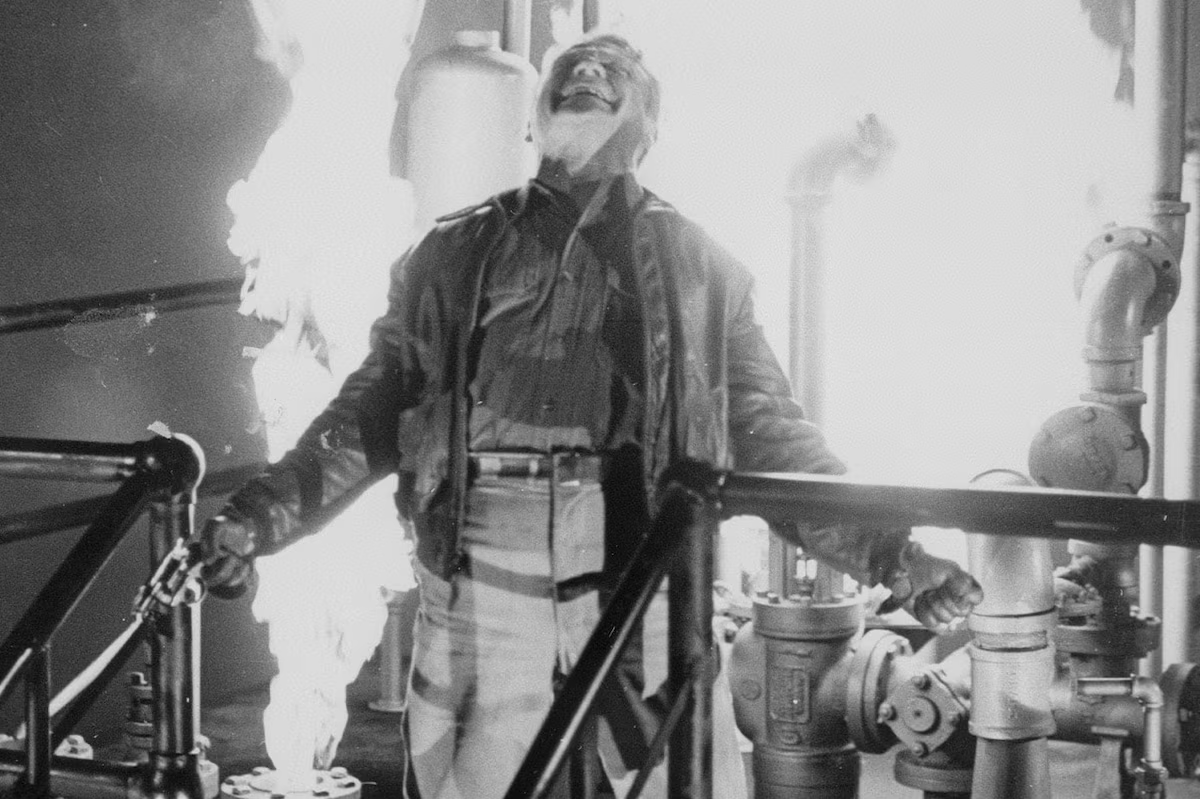
After playing the manic Coca-Cola executive in Billy Wilder’s One Two Three in 1961, Cagney retired from acting and moved to an 800-acre farm in Dutchess County, NY with his wife where he relaxed, read, played tennis, raised horses, swam, and wrote some poetry.

It was on that farm where he died on Easter Sunday, 1986, of a heart attack at the age of 86.

I was saddened to read from a couple of sources that he did have adopted children, but the relationships with them fell apart, and his adopted son died of a heart attack when Cagney was 84, without them really speaking to each other for years..

Many actors and famous people have commented on Cagney, his acting, his movies, and his life in general.

One of those actors was George C. Scott who never worked with him but met him toward the end of Cagney’s life and borrowed a quote about General Robert E. Lee that Scott said fit Cagney as well: “What he seemed he was, a wholly human gentleman. The essential elements of whose positive character were two and only two — simplicity and spirituality.”

Scott said he was “perfectly himself” and “he was what he seemed to be.”

I will be watching the following movies for my Winter of Cagney:

 Yankee Doodle Dandy

The Man of A Thousand Faces

Taxi

The Strawberry Blonde

Mister Roberts

Angels With Dirty Faces

Public Enemy

Love Me or Leave Me

White Heat

Bonus: The Seven Little Foys

What Cagney movies have you watched?


Sources:

https://en.wikipedia.org/wiki/James_Cagney

https://www.kennedy-center.org/artists/c/ca-cn/james-cagney/

https://www.tcm.com/articles/021761/wb100-james-cagney

https://www.britannica.com/biography/James-Cagney


If you want to find clips and thoughts about vintage movies and TV, you can visit me on Instagram on my Nostalgically Thinking Account https://www.instagram.com/nostalgically_thinking/ or on my YouTube account Nostalgically and Bookishly Thinking here: https://www.youtube.com/@nostaglicandbookish

Classic Movie Impressions: The Talk of the Town (1942)

This past weekend I watched the movie The Talk of the Town with Cary Grant, Jean Arthur, and Ronald Colman. I found this movie, among many other good ones, free on Tubi. It is also currently free on YouTube.

I had seen it before as a suggested move but ignored it, thinking it was a drama. After watching it, I asked myself, “What took me so long to watch this one?!”

I loved this movie and while I always love Cary Grant, I once again loved Ronald Colman who I first saw in The Prisoner of Zenda earlier this year.

This movie starts with a fire at a factory where a man dies. Cary, portraying Leopold Dilg, is arrested for arson and murder.

Soon he’s breaking out of jail and escaping through the woods on a rainy night. He makes his way in the dark toward a small house while dogs hunt him down. The name of the house is Sweetbrook and there is a woman inside getting it ready — maybe for a guest.

Leopold breaks in the door, startling the woman.

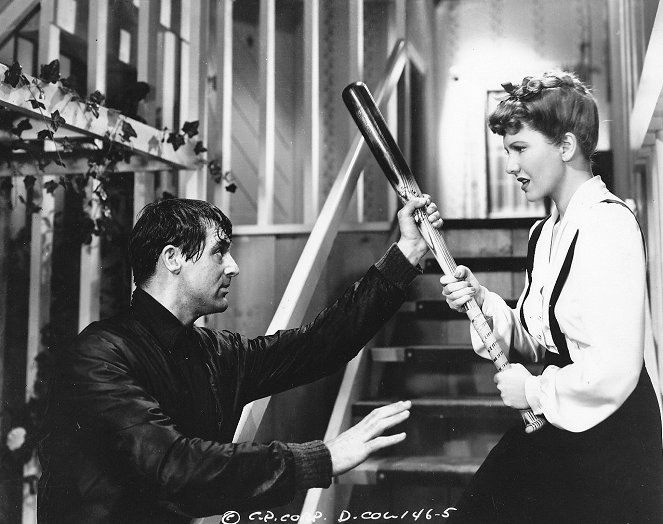
“Miss Shelley,” he says. “Please…let me…” And then he faints and falls down the stairs.

Miss Shelley wakes him up with a bucket full of water and he asks if she can stay at the house, which he knows is a rental. She tells him he can’t stay because she knows he has escaped jail. There is a knock on the door before she can finish explaining and she tells him to run upstairs and hide.

There is a Professor Michael Lightcap at the door and he’s standing in the rain. He reminds her that he’s rented the house out and he’s here to stay. Miss Shelley, whose first name is Nora, panics because Leopold is hiding upstairs and she doesn’t want the professor to find him.

Things will get more complicated as she makes up an excuse to stay in the house overnight to make sure the professor doesn’t find Leopold.

Complications just keep arising as Nora offers to become the professor’s secretary and housekeeper during his stay, a senator arrives to tell Professor Lightcap he’s up for nomination to the United States Supreme Court, and Leopold walks down one morning to argue about the role of the law in society and Nora has to introduce him as the gardener.

This is a non-stop movie full of hilarious mix-ups, near misses, and a love-triangle that won’t be resolved until the very last minute, literally, of the movie.

As I said above, I loved this movie.

It was engaging, funny, witty, and captivating. Mixed in all the lighthearted moments were a few philosophical moments about law and justice.

Jean Arthur was delightful as Nora Shelley, always quickly rescuing the day just at the last moment, taking care of both Leopold and the professor.

Ronald Colman pulled off the staunch, uptight professor well and it was fun to see him “let down  his hair” a bit later in the film. He didn’t let down his hair. It’s just a saying, of course.

Cary walked the line between an aggressive rebel and a falsely accused victim, putting his usual romantic charm on the backburner for most of the film and bringing it out in more subtle moments. This was a movie where he wasn’t a pursuing a woman as much as he was his own freedom and justice.

I spent much of the last half of the movie wondering which one of the men Nora was actually falling for and I think she was doing the same thing. She’d gathered affection for both of them but wasn’t sure if either of them had for her.

This movie was nominated for seven Oscars but it was about the same time that America started the war so more “patriotic” movies got the nod that year. Ironically the best picture went to Mrs. Minier, which was set in England, however.

According to TCM, even without the wins, The Talk of the Town “still marked an important moment in the careers of its stars Cary Grant and Ronald Colman.”

For Cary, it was a new movie after not working for a year and he was nominated for an Oscar as well. He didn’t win the Oscar but he did have his name legally changed  his name from Archibald Alexander Leach, became an American citizen and married heiress Barbara Hutton.

Colman was 51 at the time and needed a spark to reinvent his career. The Talk of the Town worked and he went on to star in Random Harvest, which earned him another Oscar nomination. He lost that to James Cagney in Yankee Doodle Dandy, but still kept him at a high point in his career. Films such as Kismet (1944) and Champagne for Caesar (1950).  He also finally earned his Oscar for portraying the delusional Shakespearean actor in A Double Life (1947).

I found it interesting to read that there was tension between Grant and Colman since both were used to being the lead actor and that tension was written into the script as they aggressively bantered back and forth with each other.

I also was fascinated to learn that two endings were filmed — one with Jean Arthur choosing Cary and the other with Colman. The director allowed the preview audiences to choose who she ended up with.

Trivia:

  • filming was to begin on January 17, 1942, the day Hollywood learned the sad news of Carole Lombard’s death in a plane crash. Stevens halted work on the set and sent both cast and crew home.
  •  
  • Screenwriter Sidney Buchman (who co-wrote the script with Irwin Shaw) was blacklisted in the 1950s. Consequently, Buchman, one of the men who penned Mr. Smith Goes to Washington (1939), left the U.S. and began working in Fox’s European division. Buchman would remain in France until his death in 1975.

When the professor is unconscious on the floor, Tilney (Rex Ingram) asks Sam if he is a doctor. Ironically, Rex Ingram was himself a trained physician in real life.

Cary Grant and Ronald Colman were both paid at least $100,000 for their work in the film. Jean Arthur, who was in Harry Cohn’s doghouse and just coming off suspension, was only paid $50,000.


Whilst many characters find Leopold Dilg’s penchant for adding an egg to his borscht unique (so much so that it becomes a means of determining his whereabouts), it was not an uncommon practice to add an egg to borscht in Poland and in Mennonite communities in Eastern Europe.

A radio theatre presentation of The Talk of the Town (1942) was broadcast on CBS radio on the Lux Radio Theatre on 5/17/1943 with Cary GrantRonald Colman, and Jean Arthur recreating their roles from the movie. It’s a 60-minute adaptation of the movie.

Nora tells the professor that he is, “as whiskered as the Smith Brothers.” This refers to a brand of cough drops with an illustration of the Smith Brothers on the front, both of whom have a beard. First introduced in 1852, they remained the most popular brand for a century.


Memorable quotes:

Well, it’s a form of self-expression. Some people write books. Some people write music. I make speeches on street corners.

– Leopold Dilg

What is the law? It’s a gun pointed at somebody’s head. All depends upon which end of the gun you stand, whether the law is just or not.

– Leopold Dilg

Stop saying “Leopold” like that, tenderly. It sounds funny. You can’t do it with a name like Leopold.

– Leopold Dilg

This is your law and your finest possession – it makes you free men in a free country. Why have you come here to destroy it? If you know what’s good for you, take those weapons home and burn them! And then think… think of this country and of the law that makes it what it is. Think of a world crying for this very law! And maybe you’ll understand why you ought to guard it.  – Michael Lightcap

He’s the only honest man I’ve come across in this town in 20 years. Naturally, they want to hang him. – Sam Yates


Sources:

TCM.com https://www.tcm.com/tcmdb/title/92288/the-talk-of-the-town#articles-reviews?articleId=187407

Comfy, Cozy Christmas: We’re No Angels

Erin from Still LIfe, With Cracker Crumbs and I have been posting about Christmas movies, books, and all things Christmas for the month of December. We’ve been sort of doing our own thing – such as watching whatever movies we wanted to watch on our own — but this week we both watched We’re No Angels (1955) so we would blog about it together. (This post is part of our Comfy, Cozy Christmas. Don’t forget to share your Christmas memory posts or any posts related to Christmas on our link up HERE, or at the top of my page.)

Erin suggested this movie and I’m glad she did because I had never heard of it before. It was certainly an out-of-the-box Christmas movie and a lot of fun. The subject matter and some of the lines were actually jaw-dropping to me and weren’t something I would have expected in a movie made in 1955.

The movie stars Humphrey Bogart (Joseph), Peter Ustinov (Jules), and Alto Ray (Albert).

The men are escaped convicts on an island called Devil’s Island off the coast of France. There are other convicts on the island in prison uniforms but they are on probation or parole, working at local businesses. The fact there are so many convicts wearing the same uniforms makes it easy for the men to blend in.

They make a plan to find a business they can rob and get money from so they can leave the island on a boat. A chance meeting with a doctor on a ship who needs to deliver a message leads them to a clothing store where they meet Felix Ducotel and his family. Felix is managing a store and they offer to repair his roof as a way to get their foot in the door, so to speak, so they can rob him later that night. He accepts and from the roof the three men begin to learn about Felix’s family – including his wife, Amelie and daughter, Isabelle.

Soon they are wrapped up in the family’s drama. They learn the business, owned by Felix’s cousin, is failing. Isabelle is in love with a man named Paul. Her mother wants to know why she isn’t married and giving them grandchildren already (umm…because she’s only 18. Hello??!) and the couple is stressed because the business is failing.

I will not spoil the movie but I will say that the men end up deciding to cook Christmas dinner for the family and steal most of what they need to do so. They keep offering to help the family, partially because they would like some of that dinner too, and partially to build trust to they can kill and rob them.

Things are crazy enough with their plan but get even crazier when Felix’s cousin (portrayed by Basil Rathbone, who was in the Sherlock Holmes movies of the 40s) arrives with Paul. Yes, that Paul. The Paul that Isabelle is in love with.

Absolute chaos ensues for the rest of the movie. So much of it was so funny but at times I felt bad for laughing at either how suggestive some of the jokes were or how they made light of horrible crimes. I would definitely say this movie featured a lot of dark humor.

Some particularly memorable quotes from this movie for me:

Isabelle: “I’ve never been attractive to men.”

Albert: “I’m a man.”

Isabelle: “And you find me attractive.”

Albert: “I could go to jail for the way I feel if I wasn’t there already. Now put a pretty smile on your face and don’t hurt your family.”

Isabella expresses surprise that Albert is a convict with the way he talks.

“I wasn’t born in a cell you know,” he tells her.

Isabella says, “You don’t look like a criminal to me.”

He responds. “If crime showed on a man’s face, there wouldn’t be any mirrors.

***

We came here to rob them and that’s what we’re gonna do — beat their heads in, gouge their eyes out, slash their throats. Soon as we wash the dishes.

– Joseph

***

  • Albert I read someplace that when a lady faints, you should loosen her clothing.

Joseph [Sarcastically]  It’s that kind of reading that got you into trouble.

****

  • Joseph I’m going to buy them their Christmas turkey.

Albert “Buy”? Do you really mean “buy”?

Joseph Yes, buy! In the Spirit of Christmas. The hard part’s going to be stealing the money to pay for it.

This movie was based on a play called We Three Angels. When it released as a movie some critics said it wasn’t as good at the Broadway play and that it was a “misguided” film.

The movie grossed only $3 million and was the 34th highest grossing film.

There was a remake of this movie in 1989 starring Robert DeNiro, Sean Penn, and Demi Moore.

The film was directed by Michael Curtiz whom Bogart had worked with three times before in the movies Angels with Dirty Faces (1938), Casablanca (1942) (Curtiz won a best director Oscar for this), and Marseille (1944).

This film was definitely a departure from their previous films.

To see what Erin thought of the film, hop on over to her blog:https://crackercrumblife.com/

Have you seen the film? What did you think of it?

I hope you will join Erin and me in January when we will be watching movies based on Jane Austen’s books. We’ll be sharing more about that toward the end of this month.

Comfy, Cozy Christmas Movie Impressions: Holiday Affair

Welcome to another post where I share my thoughts about a Christmas movie I recently watched.

(This post is part of the Comfy, Cozy Feature with Erin from Still Life, With Cracker Crumbs. Read more about it and join up to the linky here. )

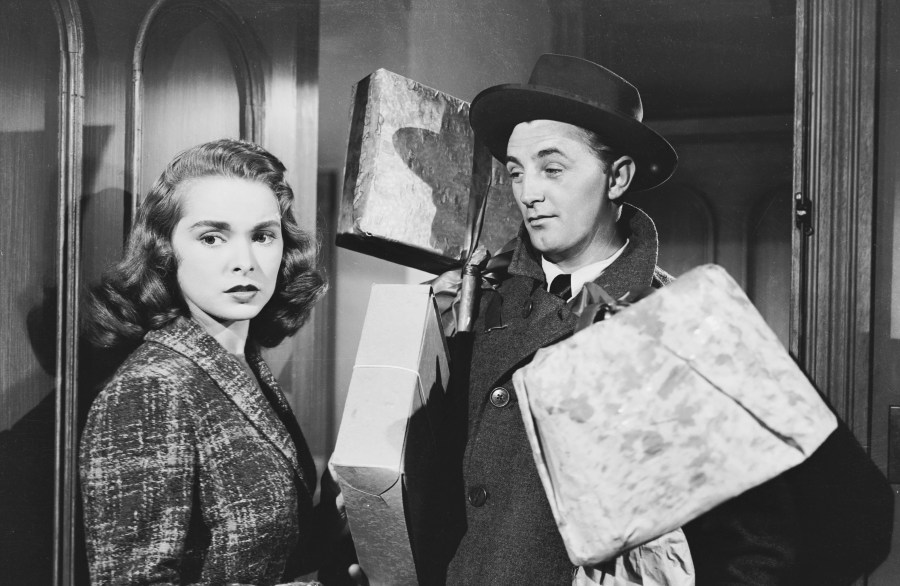
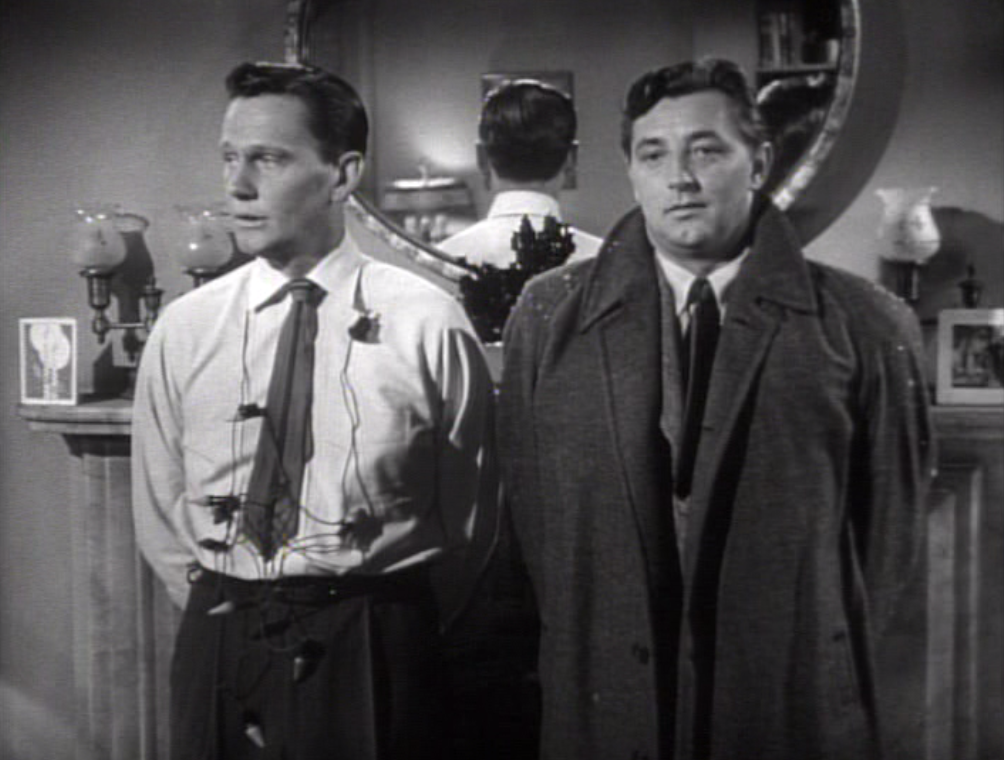
This movie stars Janet Leigh, Robert Mitchum, and Wendell Corey. Note: I will not be including large spoilers in this post.

Leigh plays Connie Ennis, a widower, whose husband died in World War II. She has a 6-year-old son, Timmy played by Gordon Gerbert , (ironically I worked with a man named Tim Ennis and my husband still works with him). She is dating a man named Carl (Wendell Corey) who is predictable and safe. You know, the ole’ boring boyfriend versus the dashing and bold potential boyfriend trope.

Mitchum plays Steve Mason, whom Connie meets at a department store when she’s there as a comparison shopper for another store. Steve pegs her in her role right away but doesn’t turn her in because she tells him she’s a single mom and her son’s only support.

That move gets him fired and one would think that means he is out of Connie’s life. On the contrary, they continue to have interactions when Connie goes to apologize to him and then he ends up helping her out on her next shopping trip.

That encounter leads to Steve meeting Timmy, who is enamored with Steve – much more so than Carl, who he knows wants to marry his mother.

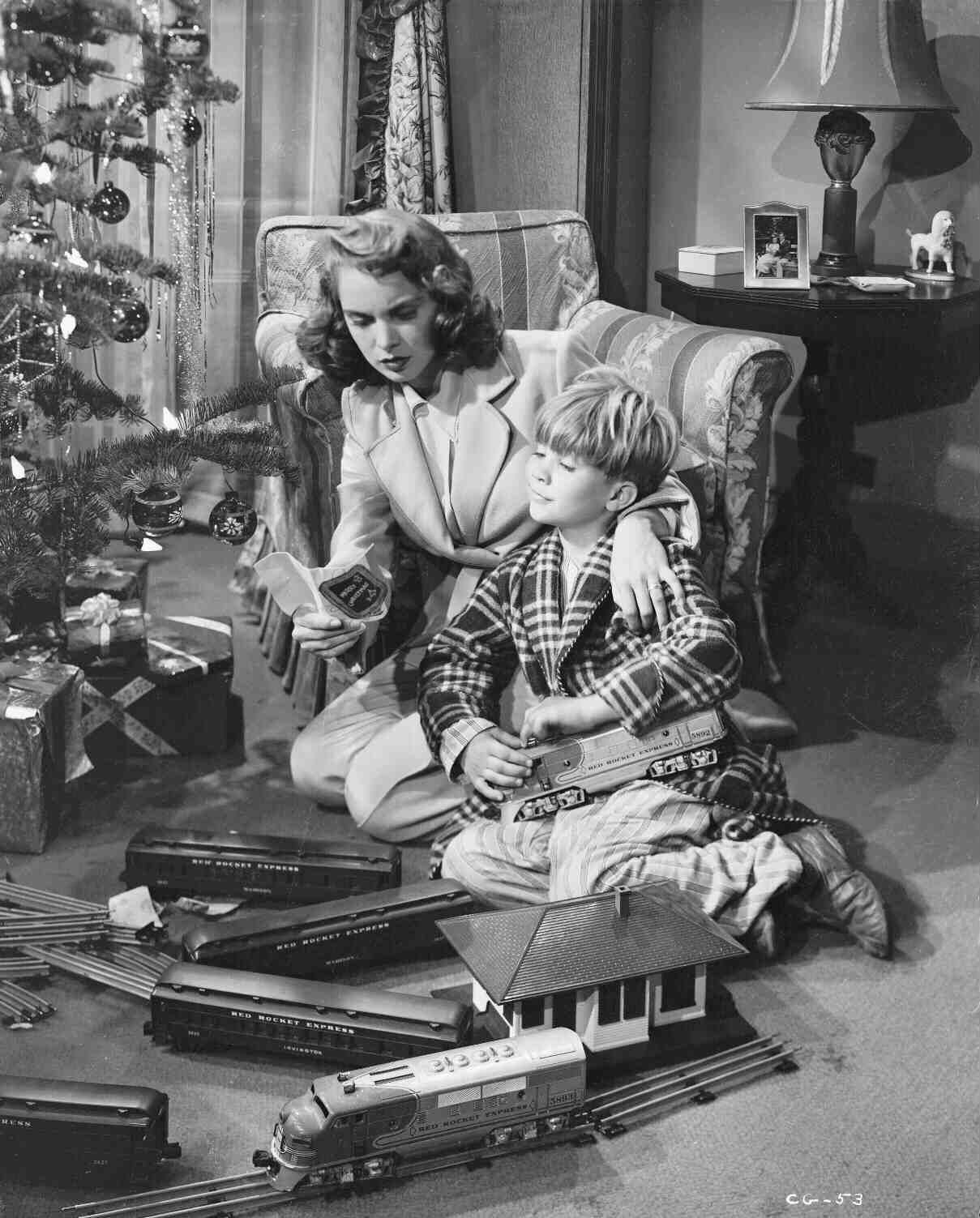
Timmy acts out with Carl and is sent to his room and this leads to a heart-to-heart with Steve who learns Timmy wants a train for Christmas.

Steve makes this happen and yet another interaction occurs between him and Connie.

There is a lot of back and forth in this film and more than one interaction between Connie and Steve when she walks away from him angry and he just watches her walk away with a smug grin.

Steve knows he gets under Connie’s skin and he knows there is a spark between them. Connie, though, isn’t willing to admit that she could have a passion for any man other than her late husband. She doesn’t really have passion for Carl.

Part of the time I felt like both Carl and Steve wanted Connie to just get over her dead husband already and that annoyed me. Both men seemed threatened by a dead man.

Since Timmy is six, it’s probably been about five or six years since Guy, Connie’s first husband, has been dead. That is a fairly long time but I didn’t think it was fair of either man to want Connie to just forget her late husband.

Then I realized that it wasn’t that the men wanted her to forget Guy – they wanted her to be able to remember the good times of her marriage with him while not being afraid to find happiness in the future. In fact, one of them says this explicitly but I missed it so I went back and watched their interaction again.

I felt much better about the intent of the men after that and could agree with others who called it a clever and touching film, even if there were a few times I thought Steve Mason should be smacked. Ha!

This is a movie with a definite love triangle, of course, and you’ll have to watch to see how all that works out. Some of the movie is predictable but some of it isn’t. There are plenty of surprises to make this movie a unique and non-traditional Christmas watch.

There are some great lines like when Steve says to Connie at one point: “I don’t think I should stay around – I might fall in love with you.”

I also loved Connie’s in-laws. They were one of the cutest elderly couples I’ve seen in a film with all their witty banter. Mr. Ennis had a cute quote: “Mother, I’ve been married to you 35 years. You boss me, you heckle me, you hide my things and pretend I’ve lost them just so I have to depend on you. You’ve spent 35 years trying to make me admit that I couldn’t possibly get along without you; and you’re right. I couldn’t. What’s more, I wouldn’t want to. Every one of those years was good, even the bad ones because you were with me. And so I drink to your health and all the wonderful years to come.”

I also liked:

  • Steve Mason: You see, if you aim higher than your mark, then you’ve got a better chance of hitting the mark.
  • Connie Ennis: But he shouldn’t feel that he’ll always get everything he wants.
  • Steve Mason: Well, not always, no, but every now and then, so that he’ll know that these things can happen.
  • Landlady: It’s the last room at the end of the hall.
  • Connie Ennis: Oh, thank you.
  • Landlady: And leave the door open.
  • Steve Mason: [Connie rings door bell] Come in.
  • [Connie opens door and enters]
  • Steve Mason: Well, you found the place. You know, very few people come here to eat anymore. Too much atmosphere. We’ve been thinking of closing down the joint to redecorate.
  • [Closes door]
  • Connie Ennis: Uh, the landlady said to keep the door open.
  • Steve Mason: Let’s worry her, huh?
  • [Closes Murphy bed closet]
  • Steve Mason: But let’s not worry you.

According to an article on Turner Classic Movies, Holiday Affair was a box office flop that became a hit through repeated television airings, much like It’s A Wonderful Life.

It’s A Wonderful Life became the bigger classic, of course.

Mitchum’s casting was seen as a little odd at the time considering he’d just come off an arrest and prison sentence for pot possession. RKO’s owner and tycoon Howard Hughes had faith in him, though, and pushed for his casting to be kept.

According to TCM, “In fact, just before filming started on Holiday Affair, RKO paid $400,000 to acquire sole ownership of Mitchum’s contract from independent producer David O. Selznick, who had shared the contract with RKO.”

Mitchum may have had a bad boy reputation, but according to articles about the making of the movie, he was a dedicated actor and a practical joker. He made a point of using his jokes for a purpose, like when he and Corey both put their hands on Leigh’s knee in a scene to get her to make a certain face that was perfect for the final cut.

Mitchum also kissed her for real during the kiss scene to throw her off and that move also made for a realistic shocked reaction.

Leigh wasn’t as comfortable with Hughes, though, according to TCM.

“Leigh wasn’t as happy about her relationship with Hughes, who had arranged to borrow her from MGM for a series of pictures starting with Holiday Affair,” the article reads. “But that didn’t prevent a very strange encounter when he summoned her for a private meeting toward the end of production. Hughes presented her with a private eye’s report on her activities, claiming her current boyfriend, Arthur Loew, Jr., had ordered the investigation out of jealousy. Leigh saw through the ruse at once – all of the people she was linked to in the report were members of Loew’s family. Clearly Hughes had ordered the investigation himself. She informed him that their future meetings would be strictly business if he wanted her to keep making films at RKO.”

I found this movie free on Tubi and also on Max. It is available to rent on other streaming services, including Amazon Prime and AppleTV. If you know of anywhere else it is streaming, please let me know.

Have you seen this movie?

What did you think about it?

Comfy, Cozy Cinema: Rebecca (1940)

For the rest of October and all of November, Erin from Still Life, With Cracker Crumbs and I will be watching cozy or comfy movies and some of them will have a little mystery, creepiness, or adventure added in.

This week we watched Alfred Hitchcock’s Rebecca from 1940 and, no, the movie isn’t comfy or cozy so we should have called this feature Comfy, Cozy, and Creepy. Regardless of what the feature is called, Rebecca is a bit of a creepy movie. Technically it is called a gothic psychodrama.

Whatever it is called — it has an eerie air about it all the way through.

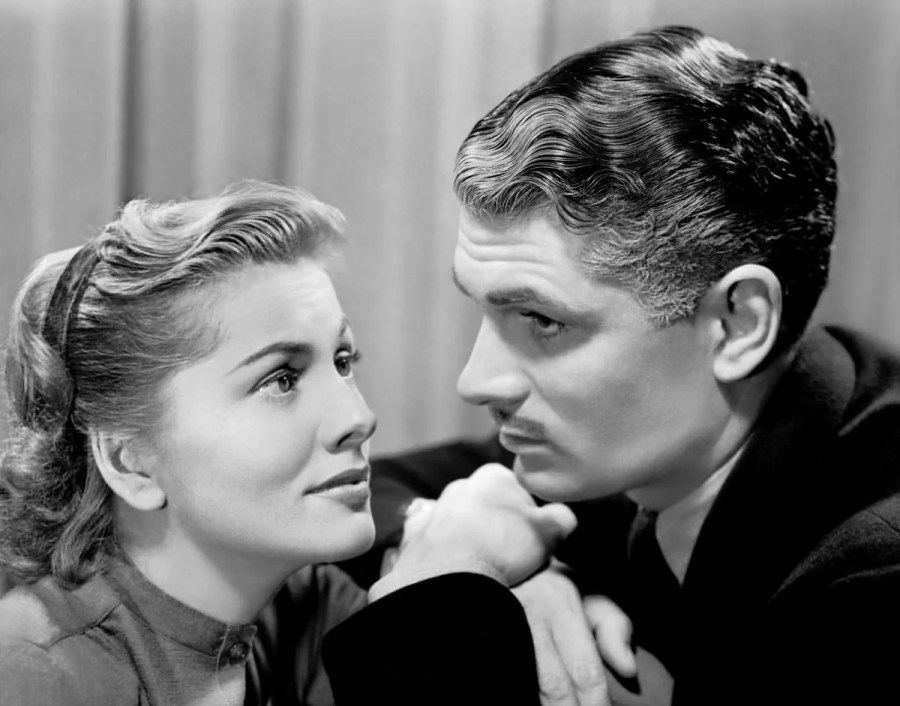
The story follows a woman (Joan Fontaine) who falls in love with Maximillian (Maxim) de Winter (Lauren Olivier), a brooding widower. Despite being told by her companion, Mrs. Van Hopper that Maxim is still obsessed with his dead wife Rebecca, this woman pursues a relationship with Maxim. The woman is also never named, apparently, that’s how unimportant she is to Maxim, I suppose. She’s simply ever called “the second Mrs. De Winter.” I find that odd, but anyhoo…

There are a lot of red flags when she is dating Maxim at first. Like his outbursts for one.

And the fact that Mrs. de Winter number two is completely obsessed with the man. Like desperately obsessed. Plus his proposal is a bit crazy. “I’m asking you to marry me, you fool.”

And that is only a short time after they meet. Insert wide-eyed face here. Can we say yikes?

Mrs. de Winter number two and Maxim get married very quickly and move to Maxim’s mansion, Manderley (because all rich people name their mansions and estates and I find that weird). Things start to get really creepy at the mansion because Maxim is even more broody there, but also because his housekeeper, Mrs. Danvers, is a real ghoul of a woman. Mrs. Danvers was a confidant of the first Mrs. de Winter, which she likes to tell the second Mrs. de Winter a lot. Mrs. Danvers has even kept Rebecca’s room like she had it before she died.

As the story continues, it is clear that the first Mrs. de Winters died under suspicious circumstances, even though Maxim told everyone she died by suicide.

Mrs. de Winter number two tries to cheer her new husband up by holding a house party but ends up wearing a dress Rebecca used to wear, which freaks Maxim all out. Of course, Mrs. Danvers told her to wear the dress.

It’s clear throughout this movie that Maxim needed some therapy after his first wife’s death but it will become even clearer that he needed that therapy for a reason other than her supposed suicide after a storm washes a boat ashore and –

Well, you will have to watch the movie to find out why.

Olivier is perfect in this movie as Maxim. He’s handsome, brooding, mysterious, and a bit jerky all at the same time. He reminds me of Cary Elwes in The Princess Bride, or Elwes reminds me of him actually since Elwes came afterward – you know what I mean.

Maxim is clearly in love with Mrs. de Winter number two (despite the fact she doesn’t have an identity apart from being his wife since her name is never used) but he can’t fully love her because of his past experience with wife number one.

This movie, by the way, is yet another adaptation of a book. Rebecca was originally written by Daphne du Maurier and producer David Selznick told Hitchcock he wanted the story of the movie to follow du Maurier’s story.

According to the American Cinematographers site, ” Kay Brown, East Coast story editor for Selznick, sent a synopsis to her boss with the highest recommendation (after reading the book). After consulting with his resident story editor, Val Lewton, the producer acquired the film rights to du Maurier’s book for a hefty $50,000.”

There was one huge difference between the book and the movie and it had to do with Hollywood codes and the ending, but I’ll leave you to figure that out on your own in case you have never seen the movie because it is a spoiler.

I did find it interesting to read during my research that du Maurier did not want Hitchcock to write the screenplay for this movie because she hated his adaption of Jamaica Inn, released in 1939. She said it reflected his cavalier attitude toward the original source material.

In the end, du Maurier didn’t have to worry because Selznick made Hitchcock keep the movie very close to the source material. It is interesting that the screenplay was written by Joan Harrison and Robert E. Sherwood and not Hitchcock.

Hitchcock told a magazine in 1938 that he planned to make the movie like he would a horror film.

Selznick and Hitchcock on the set of Rebecca,

“This is really a new departure for me,” he said in the November 5, 1938 edition of Film Weekly. “I shall treat this more or less as a horror film, building up my violent situations from incidents such as one in which the young wife innocently appears at the annual fancy-dress ball given by her husband in a frock identical to the one worn by his first wife a year previously.” (source American Cinematographer site: https://theasc.com/articles/du-maurier-selznick-hitchcock-rebecca). 

This was Hitchcock’s first time working with Selznick and it is clear that in some ways he didn’t like working with him since at the end of the movie Selznick wanted a large plume of smoke to form an “R” (having to do with the plot) but since Selznick was so busy with finishing Gone With the Wind, Hitchcock had the R on the pillow instead. Hitchcock also edited the film in-camera, which means he only shot the scenes he wanted in the final film. The idea behind this was to keep Selznick from being able to cut or rearrange things.

Selznick did, however, find a way to re-edit the film and add his own touches to it, including adding some of the music. As always in Hitchcock’s films, this movie included many incredible cinematography moments, including a reflection in a pool of water of couples dancing in one scene.

The film was nominated for nine Oscars and won for best picture and (no surprise) cinematography in 1940, but surpisingly no awards were given to the actors or the director.

According to one article I read, Selznick always lived in the shadow of Gone with the Wind, never feeling like anything he did afterward measured up to it. Rebecca was the only movie he felt came close to Gone With The Wind.

I also found it sad and interesting that the filming for the movie began on September 8, which was only five days after England declared war and eight days after the German Army invaded Poland.

They budgeted the production for 36 days, but in two weeks the company was five days behind schedule, partially because the cast and staff were so worried about the safety of friends and family.

I have a lot of positives about this movie, but one thing I didn’t like was the constant score in the background. I really found the constant playing of music in the background to be irritating. The movie could have been, and was, suspenseful without it.

Have you ever seen Rebecca? What did you think of it?
If you haven’t watched it, you can currently find it for free on YouTube:

To read Erin’s impression of the movie, visit her blog here: https://crackercrumblife.com/

If you wrote a blog post about the movie you can share it in our link up.

Coming up in our Comfy, Cozy feature:

Little Women (November 2)

Tea with The Dames (November 9)

A break for Thanksgiving

And

Sense and Sensibility (November 30th)

You are invited to the Inlinkz link party!

Click here to enter
https://fresh.inlinkz.com/js/widget/load.js?id=c0efdbe6b4add43dd7ef

Comfy, Cozy Cinema: The Lady Vanishes

For the rest of October and all of November, Erin from Still Life, With Cracker Crumbs and I will be watching cozy or comfy movies and some of them will have a little mystery or adventure added in.

This week we watched the 1938 Alfred Hitchcock Film The Lady Vanishes. This was my second time watching it but I honestly had forgotten half of it so I was glad Erin suggested it.

I needed the distraction watching it provided this week. I know. I say this every time I write about the movie we are watching, but I need a lot of distractions these days and this week especially.

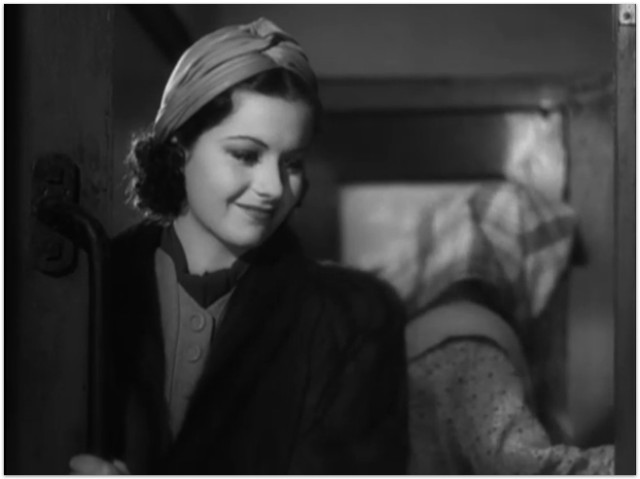
The movie begins in the fictional country of Bandrika where Iris Henderson (Margaret Lockwood) is vacationing with friends before she goes home to the United States to get married.

She is staying at a hotel with her friends and others, most of whom got stranded when an avalanche wiped out the train tracks. She interacts with the musician — Gilbert Redman (Michael Redgrave) — after he wakes her up with his loud music when she’s trying to get enough sleep for her trip the next day. Because she complains, the manager of the hotel kicks Gilbert out of his room. He makes a very nervy move and walks into her room uninvited and tells her he is going to stay and tell everyone she invited him in unless she calls the manager and tells him to put him back in his room.

There are so very funny quips in this movie and one of them is after Iris calls the manager back to get Gilbert out of her room.

“For the record, I think you are the most contemptible man I have ever met!” she yells at the door as he leaves.

He looks around the door and says in a soft voice. “Confidentially, I think you’re a bit of a stinker too.”

Earlier in the movie the manager tells two British men who are trying to return to Britain for a test match of Cricket in Manchester that he doesn’t have a room for them but they can stay in the maid’s room. There are a couple of funny scenes with the maid trying to change in front of them and them trying to tell her she can’t but her not understanding because her English isn’t very good.

There is actually a lot of humor in this movie, which isn’t always the case in an Alfred Hitchcock movie.

The two British men need some food so they head to the dining room, but are told by the waiter that there is no more food because there have been so many unexpected people staying there due to the avalanche. They can’t understand him because he doesn’t speak English so a woman named Miss Froy translates for them.

They chat with her for a while and she tells them how much she loves looking at the mountains in this country and how she’s been a nanny there for six years and is going home to England the next day.

Miss Froy also speaks to Iris when they both try to figure out where the music is coming from. That’s right before Iris has Gilbert removed from his room.

The movie seems to be all fun and games until someone strangles the musician Miss Froy enjoys listening to. She doesn’t know the man has been murdered, of course. She just thinks the music has stopped.

She also seems clueless the next day at the train station when someone tries to kill her by pushing a large concrete flower box out of the window. Instead of hitting her, though, it hits Iris in the head, which leaves Iris dazed – a perfect setup for a train ride that gets really weird when Miss Froy eventually disappears.  

Iris clearly has a concussion but Miss Froy seems to think putting perfume on a hankie and handing it to Iris to put on her head will help. Was that ever a thing for head injuries? I have no idea but it seemed weird. Anyhow, Iris falls asleep and when she wakes up Miss Froy is there and they walk to the dining car and have tea.

After they have tea, Miss Froy tells Iris to rest again. She does and when she wakes up Miss Froy is gone and when she asks the other couple in the car where she went, they tell her they never saw an older British woman and imply Iris is insane.

Implying Iris is insane is the plot for the next 20 minutes of the movie as everyone begins to say they never saw Miss Froy. We learn everyone has a various reason for saying they never saw the woman.

The British Cricket enthusiasts don’t want to be delayed any longer. They have a cricket match to get to. Another couple doesn’t want any attention brought to them because they are cheating on their spouses.

This movie is a master class in gaslighting.

If you don’t know what gaslighting is, it is saying something that happened isn’t what really happened or that the reason you think it happened isn’t the reason it happened. It’s also when a person tries to distract them from what they are concerned about by saying there is another issue altogether. Like if a woman catches her husband cheating and she confronts him, he might say, “You’re so bitter and mean all of the time. I don’t even know what is wrong with you,” to try to convince the woman she imagined it all and the real issue is that she’s mean and bitter. The goal is to make the person feel like they are crazy for being concerned or accusing someone of something.

When everyone starts lying, Iris is about to lose her mind and the only one who will listen to her is Gilbert – the musician she clashed with at the hotel.

Eventually, after seeing a wrapper for a certain tea (you’ll have to watch the movie to see what this means), Gilbert starts to believe Iris that the woman really was there and they begin to look for her together. They both feel something criminal is going on and eventually, it is implied that this crime is related to spying on another country.

Though the plot and issue is a serious one, there is humor involved. For example, humor is employed often in a fight scene between Gilbert and a man who is determined to take evidence of Miss Froy’s existence away from Gilbert and Iris.  Not only do animals in the freight car of the train watch the fight going on, but the fight also continues into a magic box placed there by the cheating man, who they learn is a musician.

There seemed to be quite a few subtle slams in this movie against the British who just can’t imagine anything bad is happening on the train and gets upset when anything interrupts their tea time, but I think Hitchcock did that a lot.

The movie is based on a book called The Wheel Spins by Ethel Lina White, but apparently deviated heavily from the plot of the novel. Actually, after reading the plot of the novel, I really want to read it because it sounds very good.

The British cricket enthusiasts were not in the book at all and were added to the movie.

The book was written in 1936 and the movie was released in 1938. The novel and movie’s plot clearly references the events leading up to the start of World War II.

Michael Redgrave was known for his work on the stage and almost didn’t agree to take part in the movie but in the end, his decision to take the park when Hitchcock offered it paid off for him because it made him an international star.

He and Hitchcock never worked together again, however, because Redgrave wanted more rehearsals and Hitchcock wanted more spontaneity.

The movie was a hit in the UK and the U.S. when it was released according to information online.

Geoffrey O’Brien from The Criterion (a movie review site) states: The Lady Vanishes (1938) is the film that best exemplifies Alfred Htchcock’s often-asserted desire to offer audiences not a slice of life but a slice of cake. Even Claude Chabrol and Eric Rohmer, in their pioneering study of Hitchcock, for once abandoned the search for hidden meanings and—though rating it “an excellent English film, an excellent Hitchcock film”—decided it was one that “requires little commentary,” while François Truffaut declared that every time he tried to study the film’s trick shots and camera movements, he became too absorbed in the plot to notice them. Perhaps they were disarmed by pleasure . .”

O’Brien points out that the screenwriters of the film, Sidney Gilliat and Frank Launder, were the ones who really added the rich wit that made the film a joy rather than an ominous mystery.

This film was filmed in England and at that time they didn’t have a large budget, which is why much of the movie was filmed in only two places – the hotel and a 90-foot-long train car or two. This constraint would have limited most movie makers, but not Hitchcock, who was still able to line up amazing, eye-catching shots, including one that I noticed with the camera focused squarely on two glasses where a drug has been placed all while a tense conversation is going on in the background.

The whole time there is this tension for the viewer, who knows that those glasses have a drug in them and leaves the viewer with a desperate desire to cry out for the characters not to drink the tainted wine.

I really liked what O’Brien said about the performance of Dame May Whitty and agreed: Since in a moment she is going to vanish, Miss Froy must for a moment dominate everything, and Whitty achieves just that, and even more: she makes us feel an affection for Miss Froy deep enough that her disappearance will seem an unspeakable affront, an assault on Englishness itself in its least threatening form.

If you want to read more of O’Brien’s view of the film you can find it HERE.

If you want to catch up with Erin’s thoughts on the movie, click here: https://crackercrumblife.com/2023/10/12/comfy-cozy-cinema-the-lady-vanishes/

If you want to join in on the review yourself feel free to add your link below.

Next week we are watching Strangers on a Train and will write about it on October 19.

After that we are watching:

Rebecca (Oct. 26)

Little Women (November 2)

Tea with The Dames (November 9)

A break for Thanksgiving

And

Sense and Sensibility (November 30th)

You are invited to the Inlinkz link party!

Click here to enter
https://fresh.inlinkz.com/js/widget/load.js?id=c0efdbe6b4add43dd7ef

Summer of Marilyn: Gentlemen Prefer Blondes

I am watching Marilyn Monroe movies for the summer.

I have a confession.

I think she might annoy me a bit.

I know. Isn’t that awful?

It’s just that her breathy voice and the weird things she does with her mouth are so distracting to me. I know. Sacrilege to any hardcore Marilyn fan.

Maybe all her little gestures are annoying to me because I am a heterosexual woman and none of that does a thing for me.

Regardless, I’ve heard so much about her over the years, I figured I should actually watch her movies and see if she was any good or not.

So far, I have watched two of her movies all the way through and have decided that, yes, she was a good actress, but she was also put in a lot of stereotypical roles because of her large chest and pouty lips. I am hoping not all of her movies were like that, but these first two on my list here.

Of course, I have only watched the screwball comedies she was in so they would focus on her beauty as part of the plot points.

This week I watched Gentlemen Prefer Blonds with Marily and Jane Russell.

The movie starts with Marilyn getting proposed to – well, she’s getting a ring at least – by a bit of a nerdy man. That’s a theme in her movies – she’s always attracted to nerdy men with glasses.

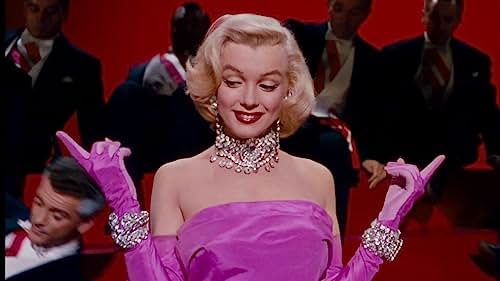
As I started to watch the movie, I remembered I have seen it before. It has been years since I have seen it, though, so I totally forgot it was a musical. I should have remembered since it is the movie where Marilyn performed Diamonds Are a Girl’s Best Friend.

Anyhow, the movie continues with Marilyn and Jane, who are showgirls, deciding to go on a cruise to Europe. The women are also best friends even though they are very different. Marilyn (Lorelei in the movie) likes a man to be rich and buy her diamonds while Jane (Dorothy) likes a man to be fit and doesn’t care about wealth.

HyperFocal: 0

They both like to make men watch them, however.

There is a lot of skin shown in this movie, including a scene where Jane dances with members of the Olympic team who are also traveling on the ship to Europe. They are wearing only tiny, skin-colored shorts, the entire time. Little Miss asked, “Why are those men naked?” I realized at that moment that watching the movie with her in the room might have been a bad idea, even though it is way more tame than the movies out today.

There are several ridiculous moments as a private detective follows Lorelei on behalf of the father of her fiancé, who thinks Lorelei is simply a gold digger. The private detective and Jane fall for each other, which, of course, complicates things. There is also this whole thing about Lorelei trying to con an old, rich, married man out of a diamond tiara and later being taken to court to answer for the theft of it. Then there is that sexy dance scene in court by Jane, which was totally bizarre to me, but supposed to be funny. I’m such a prude – I just found it disturbing.

When I watch Marilyn movies and see how absolutely gorgeous she is, I am one, jealous, but two, aware of what it took to get her to that place of beauty because I once read an article about all the plastic surgery, dental implants and other physical changes she had to read that perfection.

As I watched the movie I also wondered if her movie voice was really her voice. Like is that how she talked when she asked for a fresh towel at a hotel or asked her assistant to get her a cup of tea? Or did she yell at people with a thick accent – like a Brooklyn or Boston accent? “hey! I’m walkin’ here! Whatreya’ doin’”

I mean, why did she talk like that? Was it considered sexy back then? I find it a little annoying today but that’s probably because I’ve heard so many parodies of her voice.

After a Google search, I learned from Vogue magazine that the breathy, whisper she spoke in was something she used to overcome a childhood stutter. She kept it for her acting and it became her signature voice. So, yes. It was her real voice and she used it in her everyday life. Not like Michael Jackson who totally faked that high voice, but I digress….

Now, When I saw Marilyn sing that famous song, I wanted to know if it was her voice so I Googled that too. The answer was yes and no. She did most of the singing, but an actress and singer Marni Nixon actually supplied part of the notes – the higher notes – which are the notes I thought weren’t hers.

Jane Russell matched Marilyn in this movie with her talent and humor. I do believe she was the better singer, but she and Marilyn were such a fun pair and worked well together.

The bottom line is that I liked the movie, but, as a self-declared prude, there is a lot I could have done without. For one, I didn’t need to see Marilyn and Jane in such skimpy clothes so much. I definitely didn’t need to see all the cleavage and I found myself rolling my eyes more than once at these women essentially using their bodies and sexuality to get what they wanted. Men were portrayed in this movie as too stupid to think when the women were around because, according to the movie, they were both too hot to handle. Men couldn’t be around them without melting into a sexually aroused mess.

I know that some will say that a movie like this was needed to show that women can be in control too and use their sexual prowess to get what they want – like men have been doing for years – but I don’t like it when either sex does that. That doesn’t mean that I didn’t have some fun watching the movie. It just wasn’t my favorite movie because the whole theme of “Marilyn and Jane are hot so men will fall over them” just was overplayed and overused in my opinion.

If you would like to watch the movie I am sure you can find it streaming, but I also found it on Youtube here:

Next week I will be watching Some Like It Hot, which is another screwball comedy with Marilyn, Jack Lemon, and Tony Curtis.

If you would like to join in watching the movies with me, here is the rest of the schedule for the Summer of Marilyn:

July 6: Niagra

July 13: The Seven Year Itch

July 20: Monkey Business (because it’s Marilyn and Cary together)

July 27: All About Eve

August 3: The Misfits

Summer of Marilyn: How to Marry A Millionaire

Two weeks ago I watched How to Marry A Millionaire and decided that weekend I would watch Marilyn Monroe movies for the summer, similar to how I watched Paul Newman movies last summer.

How to Marry A Millionaire stars Marilyn, Lauren Bacall, and Betty Grable and was considered a screwball comedy.

It was released in 1953.

It follows the story of Schatze Page (Lauren), Loco Dempsey (Betty), and Pola Debevoise (Marilyn) who are all looking for ways to marry a rich man and live the high life.

Or at least that’s the goal when the movie starts.

As we progress into the movie, we see the goals of the women begin to shift based on the men who they end up meeting along the way.

Each woman works on snagging a rich man and to do that they need a home base, so Schatze finds a home to rent from a man who is out of the country. She’ll need money to pay for the rental, though, so she begins to sell off the fancy furniture in the home, even though it isn’t hers.

Eventually, she and the other women will meet men who they decide they can snag and marry. Schatze meets William Powell, one of my favorite “classic Hollywood” actors. He’s 30 years older than her and a widower. More importantly, he’s rich.

She sets out to make him her own, but there’s a man named Tom who is trying to get her attention. She wants nothing to do with Tom, though, since he’s poor and won’t support her high-end needs.

Marilyn’’s character meets a wealthy businessman who is also a crook and she’s about to run off with him when she gets on the wrong plane and meets the man who owns the apartment on the plane. The apartment owner, it turns out, is trying to escape the IRS.

Betty’s character meets a married man and thinks she’s on her way to a Elk’s Club meeting in Maine, but has actually been invited to his personal lodge. She tries to leave when she realizes what is going on, but comes down with the mumps and is quarantined. While there, and after the man she came with becomes ill himself, she meets a poor but charming forest ranger and has to decide if she wants to pursue love or money.

Betty was supposed to be the star of the film, according to some articles, but, of course, Marilyn ended up with top billing.

According to the blog, Classic Movie Hub, Fox created the movie using anamorphic lenses developed by Henri Chretien in France. These lenses “expanded the audience’s peripheral vision by creating a panoramic, curved screen triple the size of a conventional screen,” according to the blog. This was in an effort to combat the rise of televisions in the American home.

Fox had two things to compete with television with this movie – Marilyn and these new lenses. They made a movie called The Robe first with the technology, however, because they felt that movie would appeal more to a wider audience and was more family-friendly.

The Robe was about a Roman centurion who commanded the unit responsible for the crucifixion of Christ.

(I think it is interesting that the woman in this photo by Lauren’s name looks nothing like her.)

Marilyn originally wanted Betty’s role since that role had more “snappy lines.” Playing Pola would mean playing a nearsighted woman who felt insecure wearing her glasses and often slammed into walls when she took her glasses off. Marilyn wasn’t confident in her comedic skills and wanted to back out, but the director convinced her to continue and she managed to pull it off amazingly well.

Lauren Bacall was already a well-known actress at this point and I felt she really held the group together.

In some ways I felt Marilyn did overshadow the others with her performance and not just because of her beauty. She pulled off the quirky-plus-innocent role well.

I felt like Lauren was out of place in a comedy but that’s probably because I am used to watching her in Noir-type films with Humphrey Bogart (who she later married).

Betty impressed me with her comedic skills and matched Marilyn’s quirkiness. I guess Lauren was more of the “straight-man” in the trio.

I loved William Powell in this. None of the other men really stood out to me, but that may be because William was so sweet and doted on Lauren’s character even though he really should have known she was a gold digger. And because I have a soft spot for him after watching him in the Thin Man movies.

I won’t share the ending of the movie, but I will say that the women redeemed themselves from their selfishness as the movie progressed.

As for stories from the set, the Classic Movie Hub blog relayed that Lauren and Betty were annoyed that Marilyn was late on set a lot and there were other minor snits between the three women.

From the blog: “When the three female stars assembled on the soundstage for the first time, the press awaited a mushroom cloud of conflict and cattiness or, at least, Grable’s bitter resentment of Monroe. However, Grable immediately embraced Monroe and ceremoniously told her, “Honey, I’ve had mine. Go get yours. It’s your turn now.” In response to Bacall grumbling about Monroe’s tardiness, Grable said, “Honey, give it to her. Let’s listen to records until she gets here. It’s her time now. Let her have fun.” Before long, Bacall found herself also feeling protective of Monroe.

I think this is my first time watching a movie with Marilyn all the way through. I enjoyed it and am looking forward the other films, though I know at least a couple of them are much darker than this one.

The next movies I plan to watch and when I plan to write about them are:

June 22: Gentlemen Prefer Blonds

June 29: Some Like It Hot

July 6: Niagra

July 13: The Seven Year Itch

July 20: Monkey Business (because it’s Marilyn and Cary together)

July 27: All About Eve

August 3: The Misfits