A vlogger I watch recently suggested watching Meet Me In St. Louis as a Christmas movie, mainly because of the song Have Yourself A Merry Little Christmas, which is sung toward the end of the movie.
I had never watched the movie because I’ve never felt like I was a big fan of Judy Garland, even though I haven’t seen her in much other than The Wizard of Oz.
I decided to give the movie a try a couple of weeks ago, though, and it turns out I don’t mind Judy as much as I thought and the movie does have a few Christmas-themed scenes (including a Christas Eve dance at the end), but it is much more than a Christmas movie.
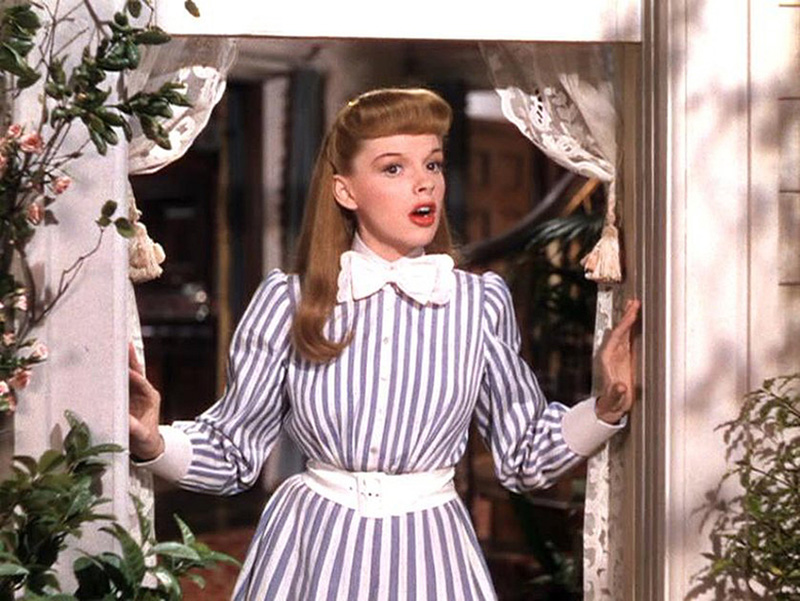
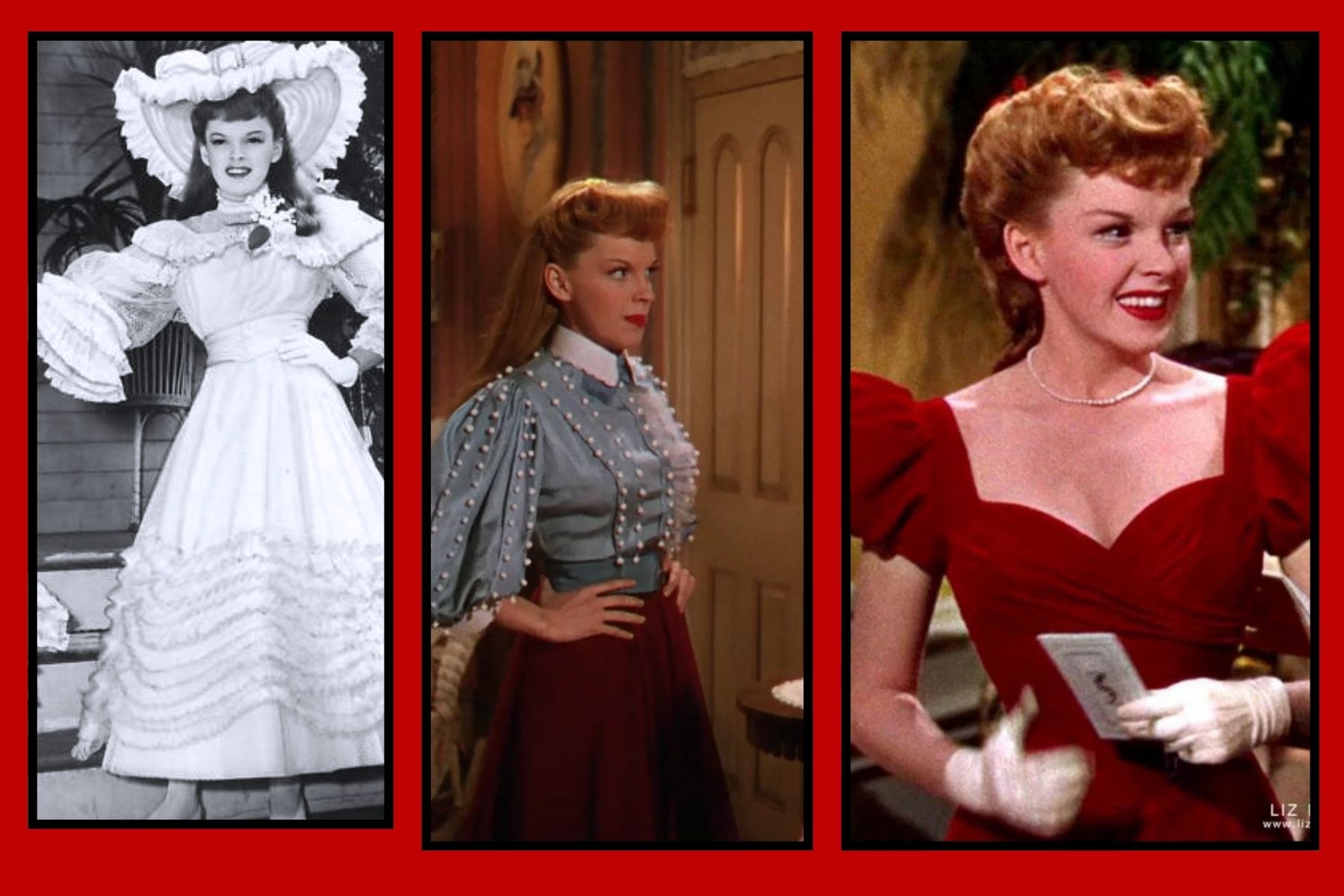
The movie is funny, fun, warmhearted, and full of really sweet or fun songs. The dresses worn by the young women are gorgeous and it was shot in technicolor which makes all the beautiful dresses even more captivating.
The movie is a musical, which I didn’t know when I started it. I didn’t even know that this is where the song Have Yourself A Merry Little Christmas came from. I also didn’t know this is where The Trolly Song (which I thought was just called Clang, Clang, Clang Goes the Trolly) came from. (That’s the song my husband always sings when he pretends he’s looped out from a knock on the head or when he is super tired. I’d say when he is drinking, but he doesn’t drink enough to get that drunk. I told him this movie is where the song he sings is from and he said he thought it was from The Simpsons. Ha! I think Homer does sing part of it in an episode.)
Yes, I have been living under a rock for my entire life.
If you’ve seen this movie you can skip over the next paragraph where I share what the movie is about.
The movie follows the Smith family, primarily Esther Smith (Judy) and her siblings as they grow up in St. Louis. The movie shows a year in the life of the family and there isn’t really a deep plot to the movie other than Judy trying to catch the eye of the college boy next door — John Pruitt — and her sister trying to get married. I don’t find the lack of a plot a detriment of the movie, by the way. The majority of the movie follows the different situations the youngest girls get themselves in, as well as the love life of Esther and her sister, and it is a fun journey.
The movie takes place in 1903.
The parents, grandfather, and housemaid are really all secondary characters but still very fun additions.
The youngest sisters, played by Margaret O’Brien (Tootie) and Joan Carroll (Agnes), are absolutely hilarious. The scenes with them are the funniest scenes in the movie. There is one that takes place on Halloween that is so insanely crazy I found myself gasping at the verbal “brutality” of these kids. (Written with a laugh, just to explain.)
If you’ve seen the movie, you know what I’m talking about. If you haven’t seen the movie, you’ll need to watch and find out.
In addition to Judy, the movie also stars Lucille Bremmer, Mary Astor, Leon Ames, and Harry Davenport.
The musical was released in 1944 and based on a series of short stories by Sally Benson.
Her stories story first appeared in the New Yorker magazine between June 21, 1941 and May 23, 1942. The twelve installments were published under at The Kensington Stories with Kensington referring to the fictional street address of the “Smiths’s” house.
Benson sold the rights to MGM in 1942 and was hired to work on the screenplay, which was ultimately written by Irving Brecher and Fred F. Finklehoffe with her help.
Benson published the stories as a novel of the same name with each chapter covering one month of the year the same year the movie came out.
According to AFI.com, Benson’s story was based on her own experiences growing up in St. Louis. “Tootie” was based on Benson, while “Esther” was inspired by her older sister.
The movie, incidentally, was directed by Vincent Morelli, who married Judy a year later. That marriage is a whole crazy story for another day.
Have Yourself A Merry Little Christmas was written by Hugh Martin and Ralph Blane who originally wrote it to be about celebrating Christmas during wartime. At the request of Judy, though, the lyrics were tweaked and the mood of the song was uplifted a bit. Judy, who was supposed to be 17 in the movie, is singing the song to her younger (5-year-old sister) in the movie and didn’t feel it was appropriate to sing a sad song at Christmastime to a little girl.
Meet Me In St. Louis was the second-highest grossing film that year behind the Bing Crosby movie Going My Way (the prequel to The Bells of St. Mary).
According to TCM.com, Meet Me in St. Louis received a very large amount of awards in 1944 and beyond. Here are some of those:
It was nominated for four Academy Awards including Best Cinematography, Best Original Song (for “The Trolley Song”), Best Musical Score and Best Writing, Screenplay.
In 1989 it won an ASCAP Award for the song “Have Yourself a Merry Little Christmas” which they named the Most Performed Feature Film Standard.
The National Board of Review named it one of the top ten films of 1944.
In 1945 the Library of Congress selected it as one of 7 films to be the first inclusions in the library’s film collection.
In 2005 the American Film Institute ranked it the 10th Greatest Movie Musical of All Time.
In 2004 the American Film Institute ranked “The Trolley Song” from it as the 26th Greatest Movie Song of All Time.
In 2005 Time Magazine named it as one of the Top 100 All-Time Movies.
An interesting story I read while researching this movie was that Margaret O’Brien’s juvenile Oscar was stolen by a former maid of her family’s. The Academy gave her a replacement Oscar, but she still hoped to one day have her original Oscar returned to her. She used to search flea markets and collector auctions for it.
The story is a bit long, but the Oscar was eventually found and returned to her during a special ceremony held by the Academy.
At the time she said, “For all those people who have lost or misplaced something that was dear to them, as I have, never give up the dream of searching—never let go of the hope that you’ll find it because after all these many years, at last, my Oscar has been returned to me.”
This post is part of the Comfy, Cozy Christmas feature hosted by me and Erin at Still Life, With Cracker Crumbs. If you have a blog post that you would like to share as part of this annual link-up, please find out more here.
This summer I am watching Angela Lansbury movies for the Summer of Angela. Up this week we have The Pirates of Penzance, which is a bit of a switch up from my original list. You can read more about that below, but first just a quick note — Last week, Cat from Cat’s Wire watched Gaslight and talked about it on her blog. You can read her thoughts here. She compared the British and American movie versions and a German televised version of the original play, and I think the post is so much fun!
And now on to this week’s movie, which I switched around from my original plan. I was going to watch the TV movie, The Shell Seekers, but instead, I thought that I would watch one of Angela’s Broadway/musical performances for fun — The Pirates of Penzance with her and Kevin Kline. The movie is a reproduction of the Joseph Papp’s Broadway production.
I will tell you upfront that halfway through the movie, I had to check that I wasn’t having a fever dream. I also realized I’m very old and my ears are in even worse condition than I thought because I had no idea what was being said in any of the songs. I even tried close captioning but because I watched it for free on YouTube, it didn’t work so well.
I also couldn’t figure out what was happening most of the time. Still, I pushed forward and ended up enjoying it in places and being utterly baffled in other places.
A description from Google:
“Frederic (Rex Smith), who has spent his formative years as a junior pirate, plans to mark his 21st birthday by breaking free from the Pirate King (Kevin Kline) and beginning his courtship of Mabel (Linda Ronstadt). But because he was born on Feb. 29, a date that only arrives every fourth year, Frederic isn’t technically 21 — and the Pirate King is still his master. Unless something gives, Frederic will soon be on a collision course with the Pirate King’s new nemesis: Mabel’s father.”
The movie starts with the people in town coming out of church, seeing the pirate ship off shore, and locking up all their doors.
Then we are on the pirate ship with Frederic and the Pirate King and the rest of the crew celebrating Frederic’s birthday. It is after all the singing that Frederic announces that now that he is 21 he can leave the ship and his service with the Pirate King.
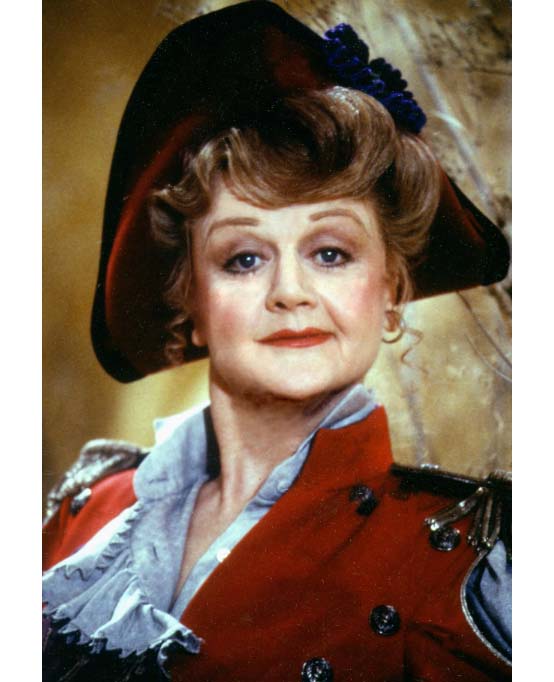
This is when Ruth (Angela), Frederic’s nursemaid, tells him that all those years ago when his father wanted him to apprentice with a pilot and she heard “pirate” instead.
Frederic has a strong sense of duty, which is why he stayed with the pirates and committed crimes with them all those years. But now that he is no longer bound to them, he vows that when he leaves the ship, he will fight against the pirate and the criminal acts he and his crew try to commit.
“Individually, I love you all, with affection unspeakable. But collectively, I look upon you with a disgust that amounts to absolute detestation.”
Frederic sees pirates as scum but if they are going to be actual pirates, he does wish they would attack people stronger than them instead of pretending they just don’t want to hurt anyone. Instead, they just don’t want to get beaten. There is also a whole song about how they won’t attack anyone who says they are an “orphan” because they are also orphans.
This word said in a British accent becomes important later in the movie when there is a whole hilarious debate about if they are saying “orphan” or “often.”
Anyhow, Ruth wants to leave with Frederic and marry him, but Frederic isn’t so sure about it. He’s never really met other women and wants to know if Ruth is attractive. The pirate and crew assure him that she is, simply because they would like to get rid of her too.
Frederic agrees to take Ruth with him but discovers, when he sees a group of women frolicking together near a small pond, that she is not actually attractive and is instead just old.
He sends Ruth away and approaches the women, who turn out to be sisters, and asks which one of them would like to marry him.
Yeah….this musical is weird.
What follows is a song where he hits an incredible note and does a little impression of Elvis.
A lot of silliness follows all this including the singing of the famous song “I Am The Very Model of a Modern Major General.” That was a lot of fun. I always wondered what the song came from. The speed which the nonsense for this song is spit out is insane.
Fun is the key word for this movie. The songs are fun – though I still don’t know what they were saying in half of them. Wait. I’ve mentioned it like ten times now that I didn’t know what they were saying half the time, didn’t I? Okay, I’ll stop doing that.
Also, I did finally look up the lyrics so I could follow along. They didn’t make much more sense that way, but, hey, at least I knew what was being said.
I should note that I did read that a lot of this musical is satire and making fun of some elements of British society during the time the original comedic opera was written in 1879, which is why it seems ridiculous at times.
One thing I can say after seeing this is that Angela was so talented — it seems like there wasn’t anything she couldn’t do — acting, singing, dancing, producing, writing… wow. I’m still trying to figure out if she actually hit the high note in the one song but if she did…wow again!
I am a huge fan of some musicals — Fiddler on the Roof, Singing in the Rain, South Pacific, etc., but this one? I didn’t know what to make of it at first, and from what I am reading, that is a bit of the point of Gilbert and Sullivan musicals.
Their musicals are, I guess, nonsensical at times, and that’s what makes them fun. After reading more about the musical/movie, I understood it more, watched parts again, and liked it more than I did with my first run through.
At first, I decided I’d never watch the movie or musical again, but it grew on me on the second time around — especially Kevin Kline and his unbuttoned shirt. I mean.. his musical and acting talent.
Rex Smith (who I’d never heard of before) was amazing. The pipes on him. WOW.
The resolution on this video is not great but the singing….sheesh!
I had to look him up to see if he had been in anything else and apparently, besides his stage work, he’s most well-known for starring in a show called Street Hawke in the 1980s as well as for being a popular singer in the late 70s with his song You Take My Breath Away.
I would be remiss if I didn’t mention Linda Ronsdadt. I really don’t think I had a clue she sang this amazingly. I don’t know a lot about her at all so her voice totally shocked me! I thought she was just a pop singer . . . I feel embarassed I didn’t realize her range.
The Pirates of Penzance was released on Pay TV at the same time it was released in the theater, which made it a flop at the box office because theater owners boycotted it as a form of protest. Boy, if the theater owners from back then could only see what’s going on these days with movie releases!
Because of the boycott, the film ended up making less than a $1 million total during it’s entire time in the theaters.
It also received mix reviews from critics, but over the years it has become a type of cult classic among musical theater fans.
Those who have seen it over the years, especially when they were young, hold a special place in their heart for it.
“The movie version of the Papp production came out in 1983. It’s pretty much the same experience as the stage. The biggest differences are some superfluous cuts to the score and the upgrading of the character Ruth. No offense to Estelle Parsons (we love her), but let’s face it—Angela Lansbury would be an upgrade of pretty much anyone.”
Of when Ruth and the Pirate King return to find Frederic she writes: “Apparently, once officially rejected by Frederic, Ruth went back to the pirates who not only welcomed her, they got her a fabulous makeover to boot. Not going to lie, my boyfriend and I have this head canon in which the Pirate King and Ruth wind up together since he knows better than to be prejudiced against a hot older woman. They do their best to frump her up for Act 1 but let’s face it—Queen Angela. Need I say more?”
(Aside: I had considered watching Angela in Sweeney Todd for this movie-watching event, but — wince — that really isn’t my type of movie/Broadway musical. Maybe I’ll watch it at some point, though.)
In past posts I have shared with Angela thought of the movie she was in, but….I couldn’t find any interviews with her about this one so I don’t have that. I do, however, have some trivia/facts.
Trivia or facts:
Kevin Kline won the 1981 Tony Award (New York City) for Best Actor in a Musical for “The Pirates of Penzance” Broadway 1981 to 1982 production and re-created his role in this cinema movie. It was Kline’s second Tony Award after having won one for “On the Twentieth Century”. Kline also starred in the precursor New York Central Park stage production and that park production’s subsequent made-for-television movie, The Pirates of Penzance (1980).
Linda Ronstadt loved the musical so much when she read about it that she played the part of Mable first in Central Park and then on Broadway for $400 a week. She then played it in the movie. It was her only movie role. She was nominated for a Tony when she played it on Broadway.
In Act II, there is an extra song (“My Eyes Are Fully Open”) that is not originally from “The Pirates of Penzance.” It’s a modified version of a song from Sir W.S. Gilbert and Sir Arthur Sullivan‘s “Ruddigore”. The inclusion of this song required Kevin Kline, Dame Angela Lansbury, and Rex Smith to sing one of most dizzyingly rapid songs in the entire Gilbert and Sullivan catalogue. (source IMdB)
The source Broadway stage production was preceded by a 1980 Joseph Papp production of “Pirates of Penzance”, which was part of a “Shakespeare in the Park” series of free plays in New York City’s Central Park, which had the same cast of principals as the movie and the Broadway stage production (except for Ruth). (source IMdB)
Writer and Director Wilford Leach, with this movie, knew what kind of movie he wanted to make. Leach wanted to create an “illusion of reality” which actually was “reality askew”. Leach, according to the January-February 1983 edition of Coming Attractions Magazine, “tried to delineate a colorful and comic world that is always true to its own logic.” (source IMdB)
Have you seen this version of the musical or the musical itself anywhere?
Cat from Cat’s Wire shared her thoughts about the movie here.
Up next in my movie watching journey, I have switched things up again and have replaced the Murder She Wrote two-part movie with Please, Murder Me from 1951, starring Angela with Raymond Burr.
The rest of the list remains the same:
July 25 – The Mirror Cracked
August 1 – The Court Jester
August 8 The Picture of Dorian Gray
August 15 – A Life At Stake
August 22 – All Fall Down
August 29 – Something for Everyone
Additional resources:
The Pirates of Penzance: For Some Ridiculous Reason…
This summer I am watching Angela Lansbury movies. This week — well, last week — I watched Bedknobs and Broomsticks.
First, a movie description:
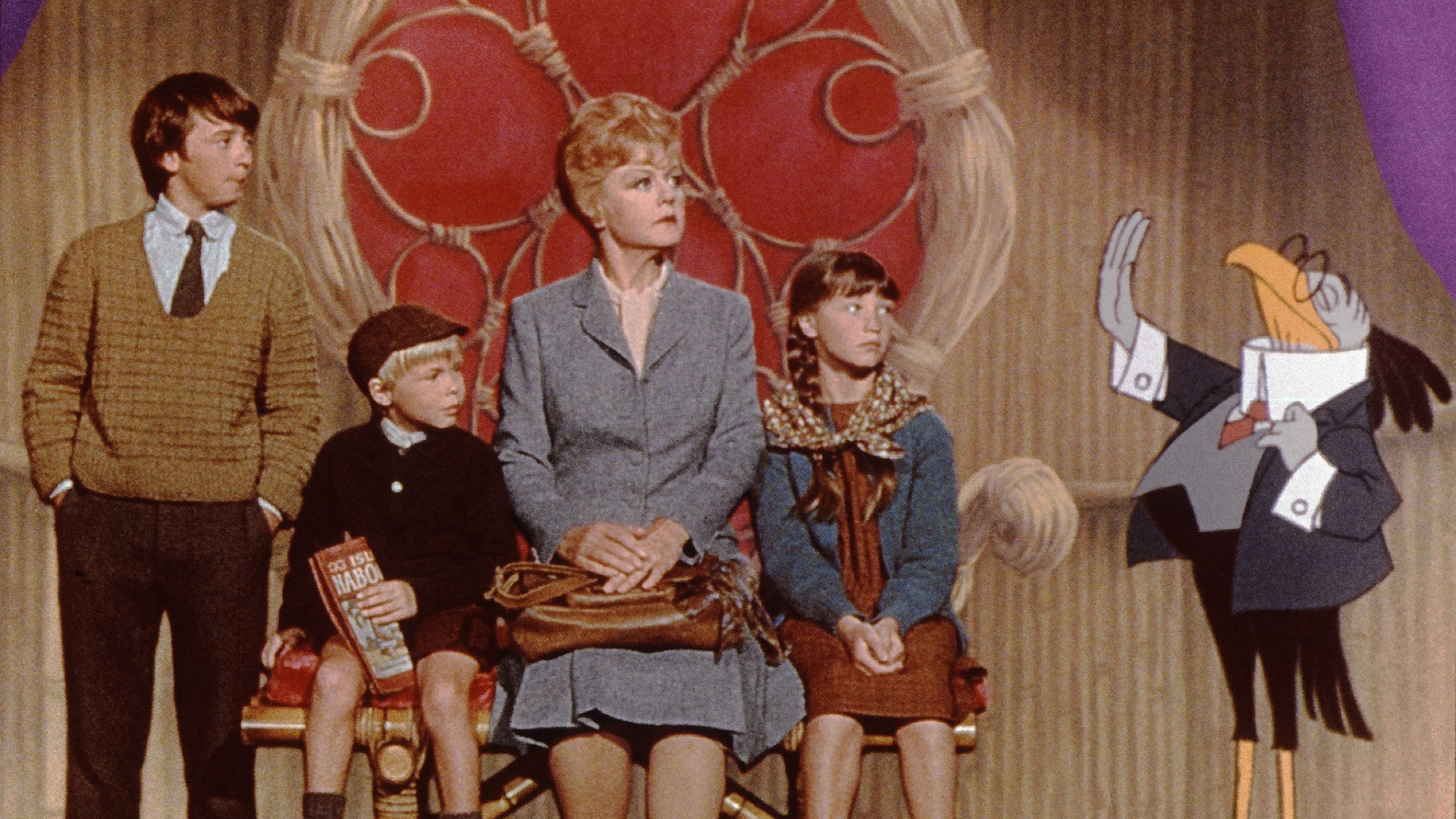
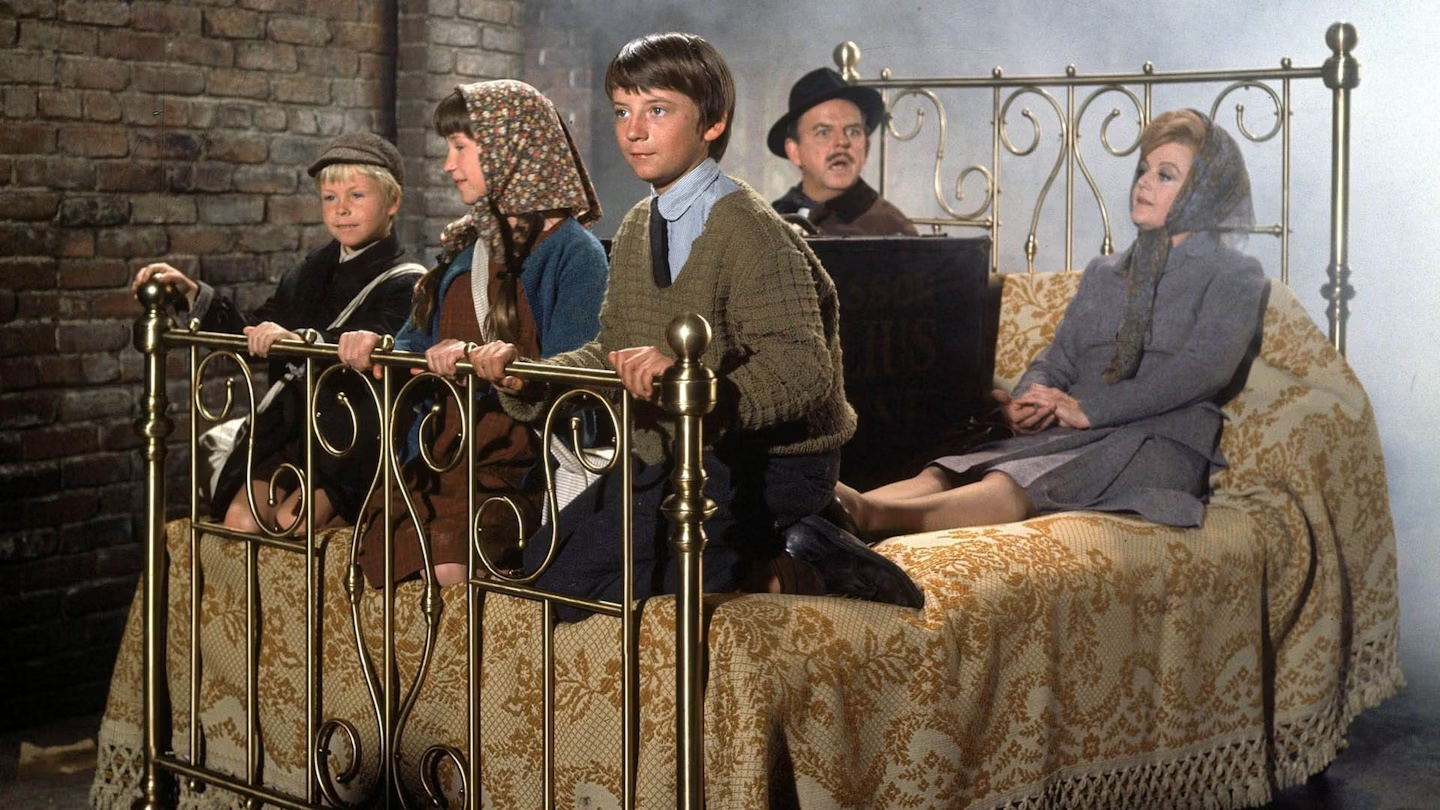
During the Battle of Britain, Miss Eglantine Price (Angela Lansbury), a cunning witch-in-training, decides to use her supernatural powers to defeat the Nazi menace. She sets out to accomplish this task with the aid of three inventive children who have been evacuated from the London Blitz. Joined by Emelius Brown (David Tomlinson), the head of Miss Price’s witchcraft training correspondence school, the crew uses an enchanted bed to travel into a fantasy land and foil encroaching German troops.
The children come to live with Eglantine Price not because she wants them to, mind you. She is sort of cohersed into it by a lady from the community who ran out of room for the other children who came from London.
Once there the children decide they are going back to London. Miss Price doesn’t eat normal food (she doesn’t eat any sausages at all!). Miss Price can’t let them go back to London because the city is being bombed but..oddly enough…later in the movie she takes them all back to London via a magical bed. Yes, you read that right. A magical, flying bed.
The movie is based on two novels by Mary Norton, The Magic Bed-Knob (1945) and Bonfires and Broomsticks (1957), about the adventures of an apprentice witch and the three children who come to stay with her to escape the bombing of London during World War II.
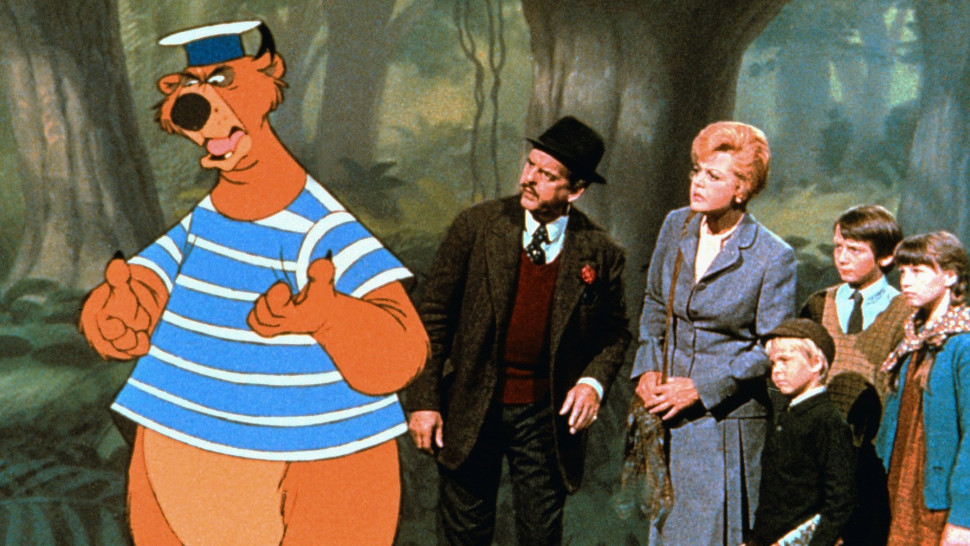
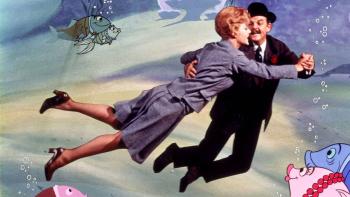
In some parts, the movie mixes live action and animation, similar to Mary Poppins.
Walt Disney (the man, not the company) purchased the rights to the first book the year it was published, but the movie wouldn’t be made until five years after his death, partially because of Mary Poppins. It took Disney years and years to convince P.L. Travers to give the rights to Mary Poppins. Walt wanted to make a movie based on Bedknobs and Broomsticks but decided he’d hold on to that one if he couldn’t get Mary Poppins. Of course, he did get Mary Poppins so Bedknobs was pushed aside for a bit.
Walt said the stories were very similar, so he wanted to wait to make Bedknobs and Broomsticks, a title that combined both book titles, when the frenzy from Mary Poppins had died down a bit. In the end, Walt died before Bedknobs and Broomsticks was developed and released.
Observer.com says this about the movie: “Bedknobs and Broomsticks is just as unhinged as it sounds. The 1960s through the 1980s was a period of decline for Disney, and the internal drama at the studio plus the Mary Poppins-related delays are evident in Bedknobs and Broomsticks, a film that’s all over the place (ironic, as Lansbury called her performance “acting by the numbers;” each scene was storyboarded ahead of time). At first, it strikes the same chord as Chitty Chitty Chitty Bang Bang (1968), but then it veers into West Side Story (1961) territory with extended dance numbers (including dancers in brownface). The scenes where the group travels using Miss Price’s magical bed are bizarrely psychedelic à la the tunnel scene in Willie Wonka and the Chocolate Factory, which premiered the same year. And the arcs featuring a mix of live action and animation, particularly the soccer scene on the cartoon island of Naboombu, feel like precursors to future hits like Space Jam (1996).”
Who is in it:
The movie stars Angela Lansbury and David Tomlinson (the father in Mary Poppins, incidentally) and three wonderful child actors Ian Weighill, Roy Snart, and Cindy O’Callaghan.
Highlights for me:
The children in this movie were absolutely amazing. They were hilarious, quick-witted and delivered their lines perfectly.
In one scene, the oldest boy decides he’s going to blackmail Miss Price into giving them better food (not vegetarian food that she eats) by telling her that the kids know she’s a witch. They know this because when they were trying to sneak out of the house to go back to London, they saw her trying to ride a broom for the first time and falling off into a bush.
“What we have here is an opportunity,” he says when he sees her fall off her broom. “She don’t want us to tell anyone she’s a witch so….”
Oh gosh, the kid is so funny in his delivery. His sister isn’t very pleased with him trying to manipulate Miss Price, by the way, and Miss Price isn’t easily manipulated so it doesn’t really work.
Angela, of course, was very good in this movie. I have to agree with some reviews that said she wasn’t as animated in the movie as she could have been. However, later in life she talked about how technical these types of movies have to be, adding that it is hard to improvise or do anything that breaks too much from the script when the movie is storyboarded so exact for the technical aspects.
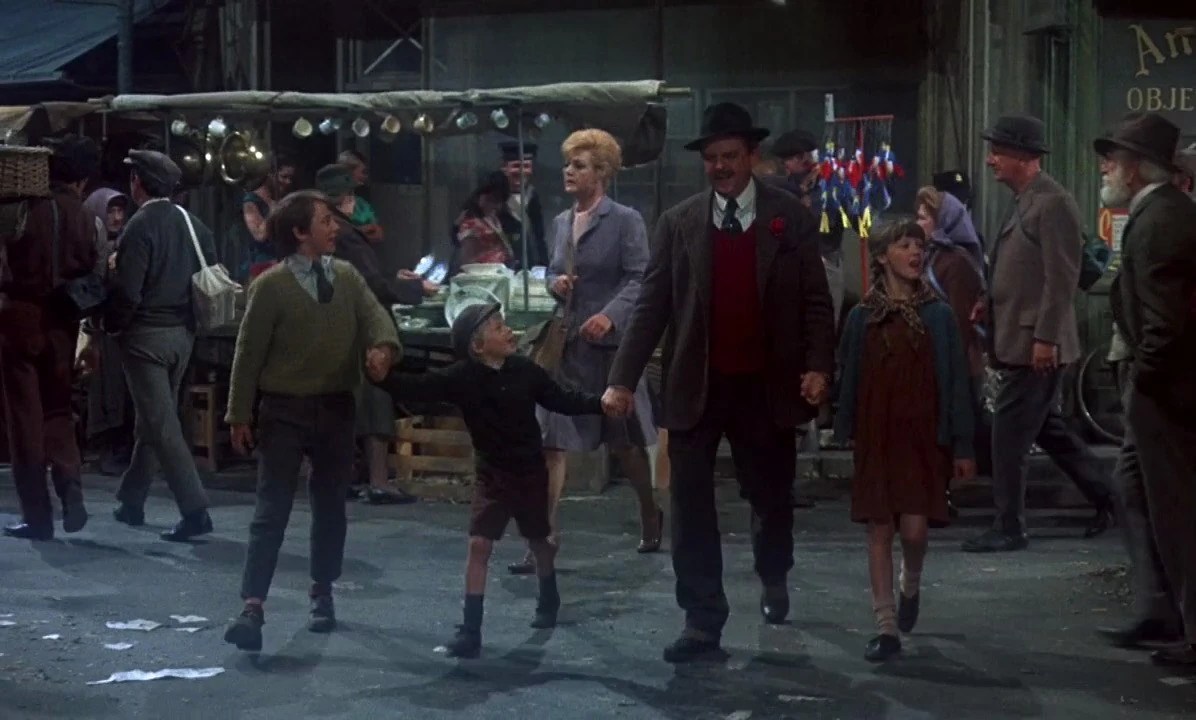
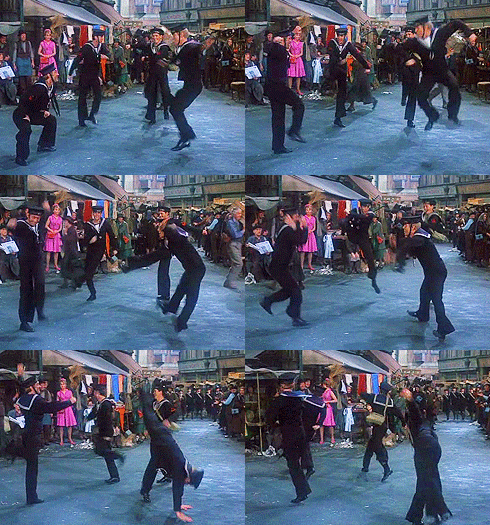
There was one song that sort of made my eyebrows raise: Portobello Road. Mainly because of the women who come up to the professor on Portobello Road and seem to be flirting with him. They are dressed in brightly colored dresses that have a certain “look” to them. These same women are in the background of the song flirting with the soldiers and even get their own break out dance moment. As my mom would say, “Oh. Oh my!”
I’m really surprised they put “those type of women” in the movie, which was, clearly, meant for children. I kept looking for any commentary online about this and did find some, but mainly from bloggers.
“I mean, it wasn’t until this viewing that I worked out that, yes, those are prostitutes attempting to pick up Professor Browne and not just friendly women,” Gillianred on The Solute.com wrote. “Which is . . . not something I expected from a Disney movie. But if you look at what they’re wearing and exactly how they size him up, it seems to me that, yup, they’re wondering if he’s got a few bob in his pocket to spare for a little bit of fun.”
I also enjoyed all the different cultures represented during the Portobello Road song. Soldiers who fought for the British during World War II were shown dancing in their own moments during the song, including Scottish, Indian, and Jamaica. Online there was at least one site that called this scene racist but I guess I didn’t see it that way. I just thought it was nice they were representing the other countries who fought with England.
I also felt that the Jamaican section in particular was very respectful because they were dancing to traditional music, the Jamaican women had the best dresses of anyone else in the dance sequence and everyone around them was clapping and enjoying themselves.
The children were even enjoying watching the dances and weren’t making fun of them, but trying to mimic them and try to dance like the people. To me the sequence is a chance to talk to children about the differences between culture. While the depictions are not completely accurate, to me, they are an attempt to bring awareness to all of those different countries that fought with the British during that time.
Eglantine’s cat looked like it had died – so that was funny to see. It looked like the cat we had, who we loved dearly, but was 19 when she died and looked awful. She looked like an animatronic cat that had gone through a garbage disposal at that point.
What I thought overall:
I liked this movie a lot but I don’t know that I would watch it again and again. Maybe if I had watched it as a child and had a sentimental connection, I would have loved it. Instead, I only liked it.
I almost loved it, maybe that’s a better way to say it. This was a comfy, cozy movie for me, even if it wasn’t my favorite Disney film. Yes, I know comfy and cozy are essentially the same word. Just go with it.
I loved the humor of the children and how they made the movie. I loved the silliness and the absolute detachment from reality it had , something people in the 40s would have really needed. Since the movie was released in 1971 it would have provided some people a happier way to frame that period, which was so dark for the world, but especially British people.
I’m actually glad children back then couldn’t see movies like this or read books like the Narnia Chronicles. They might have thought they were all going to mansion with professors or witches where they would disappear into a magical land via a wardrobe or fly away to adventure on a bed.
Nazis showing up at the end of the film was awkward and I imagine would have been very scary for children who watched it when really young.
Mr. Brown dreaming of Angela in a revealing acrobat outfit was also…er…interesting. Not inappropriate but a bit strange. In a funny way.
And, of course, the ending when — well, have you seen the film? I hate to give it away but I will say that a spell is cast and very exciting things happen to help make sure there is a happy ending.
If I were to boil down my overall opinion of the movie into one sentence I would say that it was a magical adventure for me that allowed me to escape life stresses and that is exactly what I think the makers of this movie wanted to do.
What Angela said about the movie:
I could not find the source for this again, but at some point, I was watching an interview with Angela and she said that what really made the movie was the children. Their acting was so good and, of course, children love to watch movies with other children in them.
In 1998 Disney released an extended version of the movie, adding in deleted scenes and musical numbers. Interviewed by Disney for the project, Angela said only those who acted in the movie knew what was missing all these years, but they were so glad to add those parts back.
“It was my passport to an entire generation of youngsters,” Angela said in the interview for Disney. “Now those children are all grown up and they are showing Bedknobs and Broomsticks to their kids.”
“To fly is everybody’s dream,” she continued in the interview. “And to have that experience of being suspended and moving freely through the air is a lovely feeling.”
Pullies and wires were used to help Angela and the other actors seem to fly but special effects also came into play.
“It has to do with make believe,” Angela said. “We had to understand that we were interacting with an animated creature, so your hand had to be in a certain position for him to put his hand on yours in the final print.”
A bit of trivia or facts:
Julie Andrews was offered the role of Miss Price in the movie but declined. When she made up her mind she did want to do it, it was too late. Angela had been offered the role and had accepted.
The Beautiful Briny was actually written for Mary Poppins, but saved out and filmed for Bedknobs and Broomsticks instead.
The song A Step in the Right Direction was cut from the movie and the footage could never be found to restore it to the restored version of the movie. Disney did, however, clip together some images and present it on the Disney Channel before airing the movie with all the deleted scenes added back in. (https://youtu.be/J-VwRkQGkAw?si=QpQ0jjsfKoP5H9wa
In the establishing shot of the animated soccer game, a bear wearing a Mickey Mouse T-shirt can be spotted in the crowd on the right side of the picture.
There were differences between the books and the movie. For example, in the first book of the series, the warm is not explicitly mentioned and the children are not orphans but are instead sent to spend the summer with their aunt in the country. It’s heard they meet Eglantine Price, who gives them the magic bedknob in exchange for not revealing she is a witch. In the second book, set two years after the first, the children travel back in time to 1666 before the Great Fire of London and that’s where they meet Emelius Jones (not Brown) and bring him back with them to the future.
Another difference between the movie and book is that Eglantine ends up traveling back with him to his time and takes the bed with her, which means the children will not have any more adventures or trips.
From TCM.com: “In an interview filmed for the thirtieth anniversary of the film that was included as added content on the DVD release, Richard M. Sherman and Robert B. Sherman, the brothers who were the film’s composer-lyricists, stated that they were given the task to write songs for Bedknobs and Broomsticks while the studio awaited permission from author P. L. Travers to film Mary Poppins. In an interview reprinted in a modern source, the brothers reported that Disney assured them that he owned another story about magic for which their songs could be used if Mary Poppins was not produced. According to the Shermans, the song “The Beautiful Briny” actually was written for, but never used in, Mary Poppins.”
According to 1971 studio production notes, three blocks of Portobello Road as it looked in 1940 were reproduced on Disney Studio soundstages. Among the props used for this sequence were carts rented from A. Keehn, a company that had a monopoly on them, according to set decorator Emile Kuri, who stated that for over a hundred years the company had collected a shilling a day for each barrow rented by vendors on Portobello Road. (Source TCM.com).
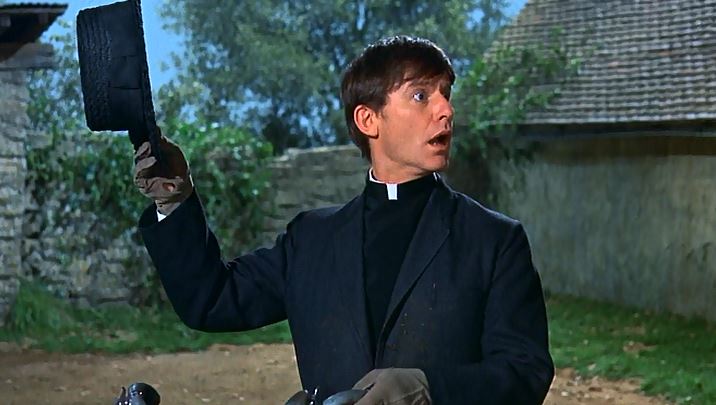
All longer scenes with Roddy McDowall as the local pastor “Mr. Jelk,” were cut from the film and he ended up in only a three-minute clip in the original film.
The New York Times stated in their review that Angela projected a “healthy sensuality” in the movie. (*giggle*)
This was the last Disney movie released while Roy O. Disney was still alive. He died a week after its U.S. premiere.
The armor in the climactic battle with the Nazis was authentic medieval armor, previously used in Camelot (1967) and El Cid (1961). When any item of armor was to be destroyed, exact fiberglass replicas were created and used.
In this movie, the King of Naboombu’s name is Leo. In official merchandise guidebooks, his full name is King Leonidas, after the Spartan King who died at the Battle of Thermopylae in 480 B.C.
This was the last Disney-branded movie to receive an Academy Award until The Little Mermaid (1989). Others received nominations, and two Touchstone Pictures movies, The Color of Money (1986) and Who Framed Roger Rabbit (1988), received awards before that.