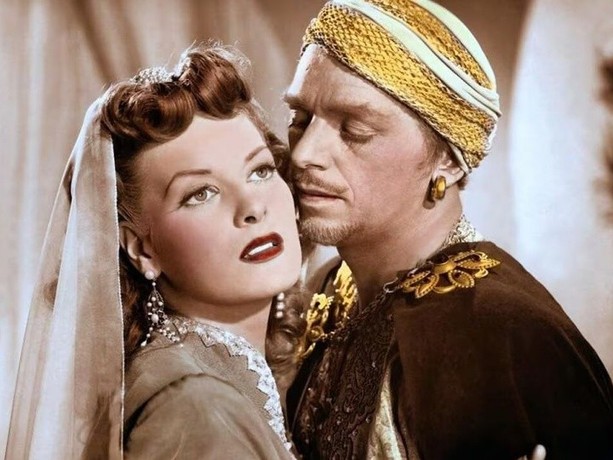
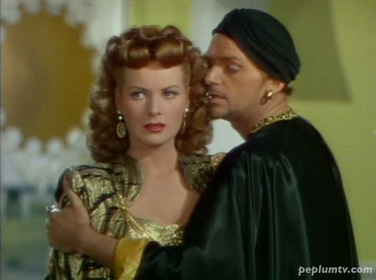
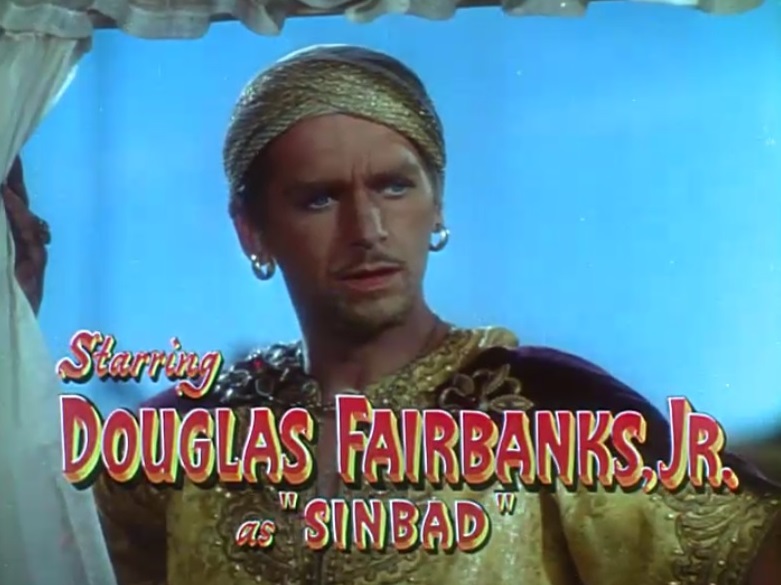
This week for Winter of Fairbanks Jr. I watched Sinbad the Sailor.
Oh my, readers.
I watched this one with a face you make after you’ve taken gross tasting medicine.
Not even my crush on Fairbanks Jr. could get me through this one.
What was I even thinking? I really should have read up on it more or watched a preview first.
Cheesy? Check.
Sort of disrespectful to other cultures? Check.
Horrid, garish colors and really bad makeup jobs complete with darkened skin and dark eyeliner? Check.
A red-haired Irish woman who is supposed to be a Middle Eastern princess? Check.
There were so many yikes with this one, I just couldn’t wait for it to end. I wasn’t sure if it was supposed to be in the adventure or slapstick comedy genre. I found myself singing “It’s Sinbad the Sailor man” to the tune of Popeye’s theme song throughout much of it.
We’re supposed to believe this American man wearing blue eye shadow and dark eyeliner is a Muslim from Baghdad? Oh be still my horrified heart.
There is nothing like hearing a thick Irish accent say, “I am Shireen, Princess of Baghdad” to really emerse you into a movie about a middle-eastern folklore hero. *facepalm*
That darkened skin? They apparently got bored of using it about 15 minutes in because everyone miraculously appeared white again for a scene or two. No idea what that was about because a few scenes later they were dark again. I think there might have been only two or three actors in this movie who were actually not white. Anthony Quinn was one of them but not even he was middle-eastern since he was born in Mexico.
*I just want to add a clarification here (that wasn’t in here when I originally posted this): I do not mean to imply that the people making this movie or starring in it were racist at all. I just mean that it jarred me out of the story to have them be so clearly pale, American, and Irish, or with horrible makeup. I don’t think any ill-will was meant toward any culture. It was common in the early days of movies just to want to make something fun and not really think about how they might be slighting cultures. I am not excusing that but I also don’t think that movie makers set out to be offensive.
Another thing that always puzzles me about these old movies — couples meeting each other one day and already kissing each other that same day.
What was with that anyhow?
I’ve done my share of ranting about the movie so far so how about a little plot for you as presented by an article on TCM.com:
“Surrounded by friends, charming storyteller and adventurer Sinbad (Douglas Fairbanks, Jr.) regales his audience with a tale of his derring-do in exotic lands. In this particular adventure, his ocean journey with sidekick Abbu (George Tobias) pauses in the remote Daibul where nefarious auctioneers commandeer his ship. A bidding war erupts between rightful owner Sinbad and the feisty Shireen (Maureen O’Hara), resolved only through a bit of Sinbadian sleight of hand.”
“Meanwhile the powerful Emir (Anthony Quinn) notices Sinbad’s attentions towards the headstrong Shireen, who saves the sailor’s life before being captured by the Emir. This time salvation arrives in the form of Eastern sailor Melik (Walter Slezak) who enlists the couple’s aid in tracking down the elusive treasure of Deryabar, located beneath the palace of Alexander the Great. Loyalties and vows shift as the trio races to the treasure with the furious Emir hot on their heels.”
The film was shot in Technicolor so it is way out there with crazy colors from the paint on the ship to Maureen’s gaudy dresses.
TCM says Douglas was “famously ignored by his father as a child” but still wanted to make the movie in honor of his father’s swashbuckling movies. It was the first movie that Douglas Jr. made after returning from voluntarily serving in the United States Navy during World War II.
The writer of the article on TCM, Nathaniel Thompson, did have an “obsession” (as I’m sure many did) with what he called Maureen’s “exquisitely endowed bosom.”
He wrote, “which she was wisely but discreetly at pains to exploit and which I, ever an untiring student of such anatomical addenda, discreetly admired.”
Writing in his autobiography, A Hell of A War, Fairbanks wrote that he knew no one in a lead in the movie was Arab at all.
“After all, I was not exactly a typical Arab any more than Walter Slezak was even remotely (with his taped-up blue eyes) Oriental.”
And I guess none of them really saw a problem with that. Sigh.
Anyhow…if you want to watch this movie simply to see how much you can cringe in 1 hr and 57 min (I felt like this movie would never end and fast forwarded a couple of times to get there), I would recommend it.
Holy eyeliner, Batman!Have you been playing with your mother’s curtains again, Douglas? Don’t lie…
I am hoping my next choice, The Rise of Catherine The Great (1934), is a bit better. It is streaming for free on YouTube. At least in the United States.
This winter I am watching movies starring Douglas Fairbanks Jr.
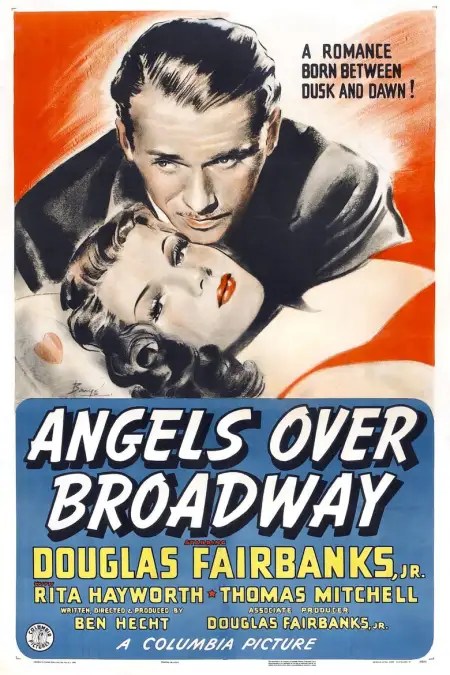
I had to switch movies for this week’s Winter of Fairbanks Jr. because I couldn’t find Chase a Crooked Shadow. Instead I chose Angels Over Broadway, which I found on YouTube.
It was a simple movie with a very sweet ending. It definitely had some plot holes and some vague back stories and some not great reviews online but I found it endearing.
Douglas (remember we are on a first-name basis now) plays a down-on-his-luck con man named Bill O’Brien who thinks he has found his way to fortune when he sees a man named Charles Engle (John Qualen) blowing cash left and right at a night club.
The issue is that Engle really isn’t loaded at all. He stole $3,000 from his business partner to make his wife happy and then his wife took the money to leave with another man.
Engle’s been confronted by his business partner and is ready to kill himself. Now he is spending one last night on the town before he ends it all.
Rita Hayworth is a lounge singer named Nina Barona who spots Engle and wonders if he might be a producer or director who can help her become famous.
O’Brien sees her and wonders if she might be someone that he can pull into one of his schemes. Also, you can tell he likes the look of her, if you know what I mean. *wink* *wink*
So, yes, we have a group of scammers ready to scam each other. O’Brien sees in Engle a quick buck because he’s going to talk him into going to an illegal poker game and throwing away some of his money and then getting a cut of whatever is taken from him. O’Brien’s main source of income is leading rich men to notorious gangster Dutch Enright (Ralph Theodore). Dutch then cheats them out of a fortune and gives Bill a cut of the profits for luring them in.
Thomas Mitchell portrays playwright Gene Gibbons (Thomas Mitchell….also known as Uncle Billy in It’s A Wonderful Life) whose last play fell on its face.
He’s intoxicated and handed the wrong coat when he goes to collect his. Its Engle’s coat and in the pocket is the suicide letter Engle has written for his partner and estranged wife to find after his death.
Gibbons reads the letter and asks who it belongs to. He doesn’t like the idea of someone killing themselves and tracks Engle down to try to talk him out of it.
Gibbons reveals himself to Engle to be a womanizer, adulterer, and a failure at success. He tells Engle he doesn’t want him to miss out on all the beautiful things in life so he decides to help Engle get the $3,000 back. His plan to do that fails so in walks O’Brien, who learns Engle doesn’t actually have any money. Nina thinks this is hilarious and blurts out the scheme O’Brien tried to pull her into.
O’Brien is a bit ticked at her move to blather about the plan but Gibbons believes they can still pull the plan off by pretending Engle is rich.
Scam a gangster? Eek. O’Brien doesn’t like the idea but if Engle can win more than $3,000 in the game then O’Brien can take whatever is left.
The bulk of the movie is watching three people try to play each other or others to benefit themselves and then later having to decide if this is the person they really want to be.
Douglas is a bit of a jerk and a softy in this one. He does, however, rescue Nina from a predatory man when she tries to use the man to get to an opportunity to make her famous. He also shows he’s not all about himself later in the movie.
I wasn’t sure what to make of his thick New York City accent in this one. All I know is that I kept talking like him for the rest of the night, including asking my kids, “Eh, you ready for dinner or what? You need me to wait to get dinner on the plates or do ya’ wants me to bring it to you while it’s still warm?”
My children didn’t find any of this amusing, by the way.
Hayworth got the role after Jean Arthur turned it down and it was her first “A” list film. As we all know, she flew to fame after this by becoming a heartthrob of the 1940s and a pin-up girl during World War II.
Before this movie she was in 35 different movies starting in 1926, but in most of those movies she portrayed secondary characters.
Angels Over Broadway was directed by Ben Hecht and co-produced by Douglas, who convinced Harry Cohn, head of Columbia Pictures, to finance the rest.
“Cohn couldn’t figure out what the picture was about but neither could we,” Fairbanks was later quoted as saying about the film.
Samantha Richards from Musings of A Classic Film Addict writes on her blog, “The plot and theme are clear to audiences today, as the screenplay, which earned iconic screenwriter Ben Hecht an Academy Award nomination for Best Original Screenplay for 1940, has since been regarded as far ahead of its time by critics. I find it difficult to understand why this film isn’t universally recognized that way that I see it: as a strong and riveting drama that blends the realism of New York City life, with a touch of fantasy and the idealism that maybe good guys can sometimes win in the end. To answer my own question, Rita Hayworth is miles apart from the calculated femme fatale image that she would later be known for, with a mousey voice and a doe-eyed look that would make even diehard fans of hers puzzled.”
Richardson continues, “Each performance in Angels Over Broadway (1940) is spot on and impeccably cast, made up of wildly underappreciated actors like Douglas Fairbanks, Jr. and Thomas Mitchell, both of whom rank highly in my book. Jean Arthur could never have portrayed a role like Nina Barona, but I also doubt that even Rita herself could have pulled this part off after being transformed by the Hollywood machine after this film’s release.”
I feel Douglas was very good in this, but in some ways Mitchell stole the show as the intoxicated, and later repentant and sober, Gibbons. He seems to play drunk fellows well. I hope that wasn’t because he knew a lot about it in real life.
It did hit me as I was watching the movie that Douglas always has a small mustache, no matter what movie he is in — other than one of his first movies, The Power of the Press.
There isn’t a ton of information about this movie online, so you won’t have to read through paragraphs of history, behind the scenes stories, or trivia today.
I do have a couple tidbits of trivia I read on Imdb, including:
“The tagline on the original movie poster – “A HECTIC ROMANCE TO BLOW THE FUSES OUT ALONG MAZDA LANE” – refers to the Broadway theater district in New York City as “Mazda Lane.” Mazda was a brand of light bulbs common in the first half of the 20th century, with a name referencing an ancient Persian god of light and good. Broadway was and is known for its brightly lit marquees, and had many nicknames in its heyday.”
And:
“The working title for this film was Before I Die.”
So, there is one line from Douglas in this movie that made me swoon a bit. I’ve gone to the trouble of clipping it for you to share here and it was a bit of an ordeal to do so I hope you appreciate it. *wink* Let me know if you figure out what the line is.
I would guess that many of you have not seen this movie but if you have, what did you think?
I found this for free one on YouTube, by the way.
Up next for me in my Winter of Fairbanks Jr. marathon is Sinbad The Sailor (1947) and I did make sure this one is streaming somewhere.
After that I am watching The Rise of Catherine the Great and writing about it February 27. It is also streaming.
This winter I am watching movies starring Douglas Fairbanks Jr.
I had planned to watch Having Wonderful Time, this week but I couldn’t find it streaming anywhere. Instead, I watched The Exile from 1947 after I found it streaming on YouTube. It wasn’t great quality, but it was good enough that I could make out what was going on.
The movie tells the story of King Charles of England who was exiled to Holland in 1690 by Oliver Cromwell and The Roundheads. Douglas plays King Charle who stayed in Holland for years with a small band of supporters. Cromwell and The Roundheads find out where he is and his advisor, chief advisor, Sir Edward Hyde (Nigel Bruce), suggests he hide out somewhere where he can get information but where Cromwell’s assassins can’t get to him.
Charles decides to hide out on the small farm of a flower girl he met in the market square.
The flower girl, Katie, is played by Rita Corday, who was billed as Paule Croset in later films (I have no idea why but I suppose I will have to look that up one day. There wasn’t a lot of information about her online.)
Charles begins to help on the farm and the two fall in love. While working there a man arrives who says he is King Charles, which of course Douglas’s character knows is untrue, but he lets him continue the ruse as he stays at the inn on the farm.
The next visitor to arrive at the farm is Countess Anabella de Courteuil (María Montez), an old lover of Charles’s and an emissary from King Louis of France. This totally threw me off because I can not figure out how she found the king. Like did everyone know where this dude was hiding out?
Anyhoooo…Anabella gives Charles a music box from the king of France, talks to him while sitting naked in a enclosed bathtub or sauna that looked like a spaceship to me, and sort of suggests they renew their past relationship.
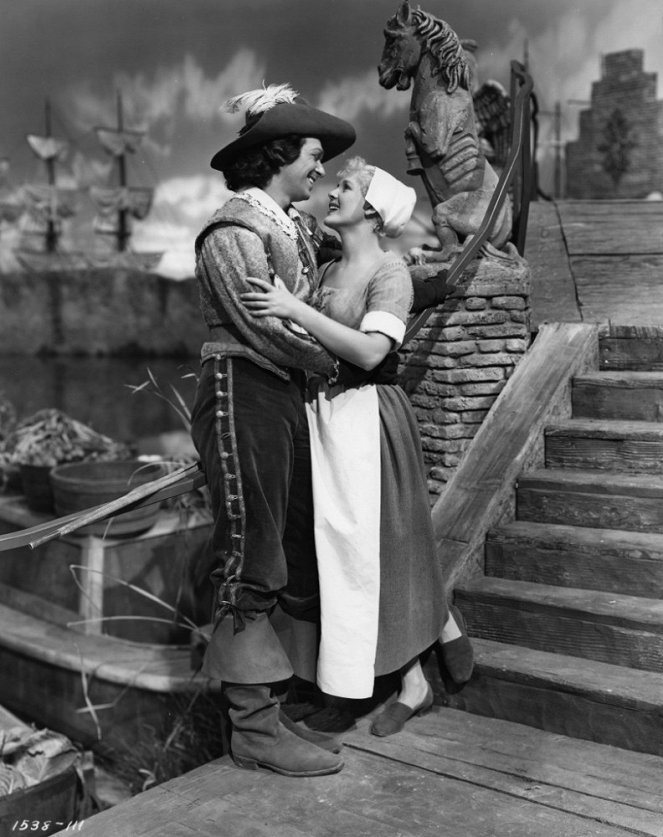
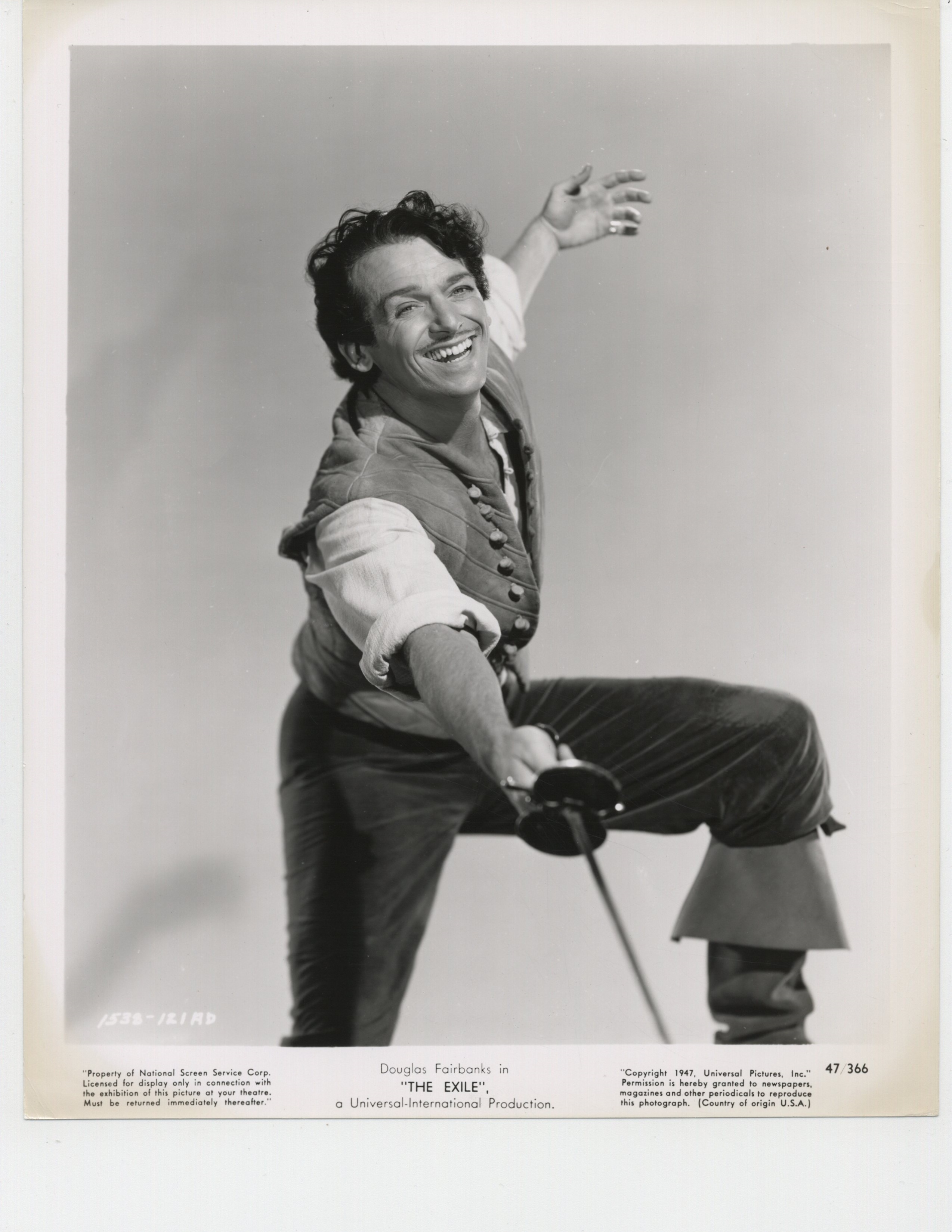
The promo photos for this film were a bit crazy.
Charles, however, is focused on the music box because he wants to sell it and give the money to Katie to pay off her abusive cousin so she can own the farm and inn free and clear. Annabelle overhears his plan, which will come in handy later when Katie thinks Charles loves Annabell instead. Charles is also discovered by one of Cromwell’s men and ….
And……well, I will leave you to find out the rest if you watch the movie.
I will tell you that there is at least one intense sword fight scene, which I think was always required in these type of adventure films. I do have to say, though, that it always cracks me up how these movies and books portray these kings as swashbuckling heroes who can wield swords and charm the pants (literally) off any woman.
In reality, they were probably overweight, out of shape, pampered and had no idea how to fight their way out of a paper bag, let alone fight against attackers or would-be-kidnappers.
Maria Montez is a secondary character in the movie and only appears in it about 15 minutes but she received top billing because she had in her contracts with Universal that she would receive top billing no matter what movie she was in.
The film is based on the 1926 novel His Majesty, the King: A Romantic Love Chase of the Seventeenth Century by Cosmo Hamilton, which Douglas bought the rights to so he could make a movie similar to the movies his father, Douglas Fairbanks, used to make. His father’s movies were classic swashbuckler films and Douglas Jr. said he wanted this film to honor his father’s memory. He also planned to produce two other similar films but those other movies were never made.
“When people ask me if I’m following in my father’s footsteps, I tell them his footsteps were so light they didn’t leave a trace”, Douglas said when he announced in 1946 he would be producing and starring in the film. “The proof of it is that his pictures were so carefully tailored to him that no remakes by others have ever been entirely successful. Still I find myself drifting back to the kind of roles he played – by public demand, as it were… However my stunting is more of a piece de resistance than the thing itself, if you get what I mean. Now that I have my own company I’ll probably go in for the swashbuckling type of thing. I’m not necessarily wedded to it; our stories will be of varied dramatic content, but I find that I can whip up more enthusiasm for those of a romantic and slightly fantastic nature, like The Exile.”
Douglas purchased the rights to the book in 1941 but then went off to fight in World War II, where he became a very decorated soldier. This, of course, delayed the movie being made.
This movie was made under Douglas’s own production company, the Fairbanks Company.
It was directed by Max Ophuls and was his first Hollywood film. He was set to direct Vendetta with Howard Hughes but the two didn’t get along.
The original plan was to make the movie in technicolor, which would have been beautiful, but Douglas ran out of money for the production, and it was shot in black and white instead.
Overall, I enjoyed the film but it wasn’t as captivating as The Prisoner of Zenda or as engaging as The Young In Heart.
Have you ever seen this one? If so, what did you think?
Up next for me in my marathon of Douglas Fairbanks Jr. movies is Chase a Crooked Shadow.
After that I will be watching (in parentheses are the dates I’ll write about them):
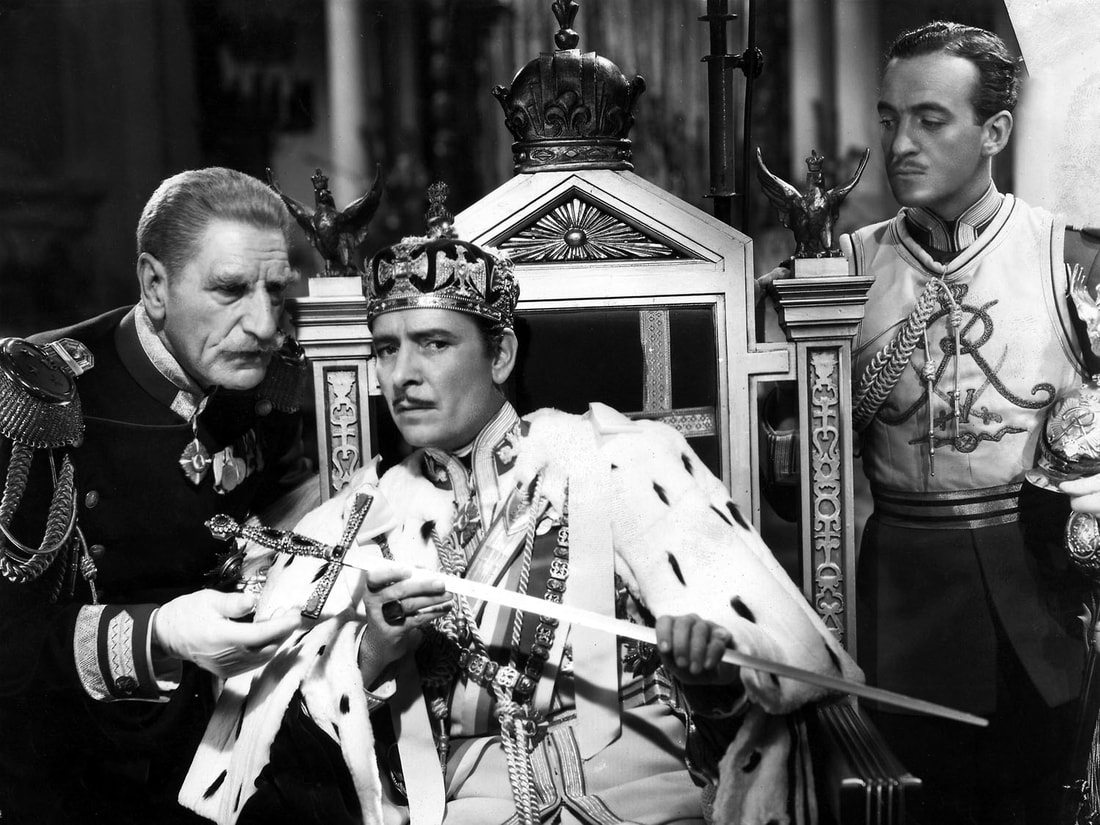
The Prisoner of Zenda (1937) is a cinematic spectacle. Grand halls, sweeping ballrooms, wildly decorated courtyards, and captivating costumes.
I absolutely loved it and am so glad I stumbled on to Douglas Fairbanks Jr. and decided to do a marathon of his movies to learn more about him so that I could discover this movie.
Douglas Fairbanks Jr. is not the leading man in this one but he steals the show in every scene he is in. He is deliciously evil.
The leading man, Ronald Colman, is absolutely amazing as well, especially since he is playing two parts in this one. He is so amazing I feel another marathon coming on but of his movies.
An article on TCM.com agrees with me about this version (Okay, I agree with the article).
“ . . . of all the dramatized versions of Anthony Hope’s 1894 tale of adventure, love and honor, the 1937 black-and-white movie version, produced by David O. Selznick for his Selznick International Pictures stands as the definitive adaptation.”
It is easy to see why this movie is called by critics one of the best “Swashbuckler” movies of all time. I say that since this is one of the original Swashbuckler movies without it we wouldn’t have Pirates of the Caribbean, The Princess Bride, and other more modern adventure movies.
And without the 1894 novel — ThePrisoner of Zenda: Being the History of Three Months in the Life of an English Gentleman by Anthony Hope — we wouldn’t have had the movie at all. Anthony Hope Hawkins was a part-time lawyer who wrote the book in one month from what I read.
The novel sold more than 30,000 copies in Britain and the U.S. and helped to establish the adventure genre that would later be explored even more by authors such as Sir Arthur Conan Doyle and H. Rider Haggard. The book, according to an article to TCM, has never gone out of print and has continued to sell thousands of copies each year.
The movie is the most referenced Swashbuckler film, TCM further states, which is probably why it was remade at least seven (!!) more times over the years, including one only about 15 years after the 1937 version, which was not the first. There were actually two silent movies of the book made before this version.
The 1952 version was shot frame for frame, according to articles I read online. I think I might watch the one released in 1952 later on and then compare the two, but I highly doubt that the 1952 movie or any of the others (including two made-for-TV movies and three television shows) will top the 1937 one, especially when it comes to Douglas’s performance. Yes, Doug and I are on a first-name basis now. I feel that we are getting to know each other enough now that we can dispatch with the formalities.
When I first saw Douglas in The Rage of Paris, I immediately thought how much he reminded me of Cary Elwes in The Princess Bride – his smile, his delivery, his expressions.
In this movie that similarity came even more into focus and especially during an amazingly well-choreographed and filmed fencing scene between him and Colman.
The two enjoyed a sparring of words while sparring with their swords, reminding me of the scene between Elwes and Mandy Patinkin on the Cliffs of Insanity in The Princess Bride. Perhaps Golding was influenced by the movie? I don’t know but if I research any more for this post, I’ll never publish it.
Let’s finally get to the plot of the movie. Finally…I know!
We have an Englishman named Rudolf Rassendyll (Colman) who has gone to a small country located somewhere between Vienna and Bucharest (not named in the film, but in the book it was called Ruritania). He has gone there for a fishing expedition at the same time the king of the country is being coronated. Zenda is a small area in this unnamed country where there is good fishing and boar hunting and where the king, Rudolph V (also portrayed by Colman), has a hunting preserve and cabin. RudolfV and his advisors Col. Zapt (C. Aubrey Smith) and Captain Fritz von Tarlenheim (David Niven, who I recognized immediately from other movies I’ve seen him in) run into Rassendyll in the woods and realize how much the two look alike.
I’m a little confused by the scene where Rassendyll tells the king they look alike because of their ancestors — the king’s great-great-great grandfather and Rassendyll’s great-great-great grandmother — most likely had an illicit affair. In the beginning of the film, he acts like he’s coming to the country to hunt and knows nothing about the king or how much he looks like him but five minutes later in the film he’s telling the king he knows he looks like him and why. This is probably something that is explained better in the book.
All I can say is thankfully they both have the same British accent even though the King is from a kingdom in Eastern Europe, or they wouldn’t be able to understand each other. Har. Har.
Minor complaint. Let us move on.
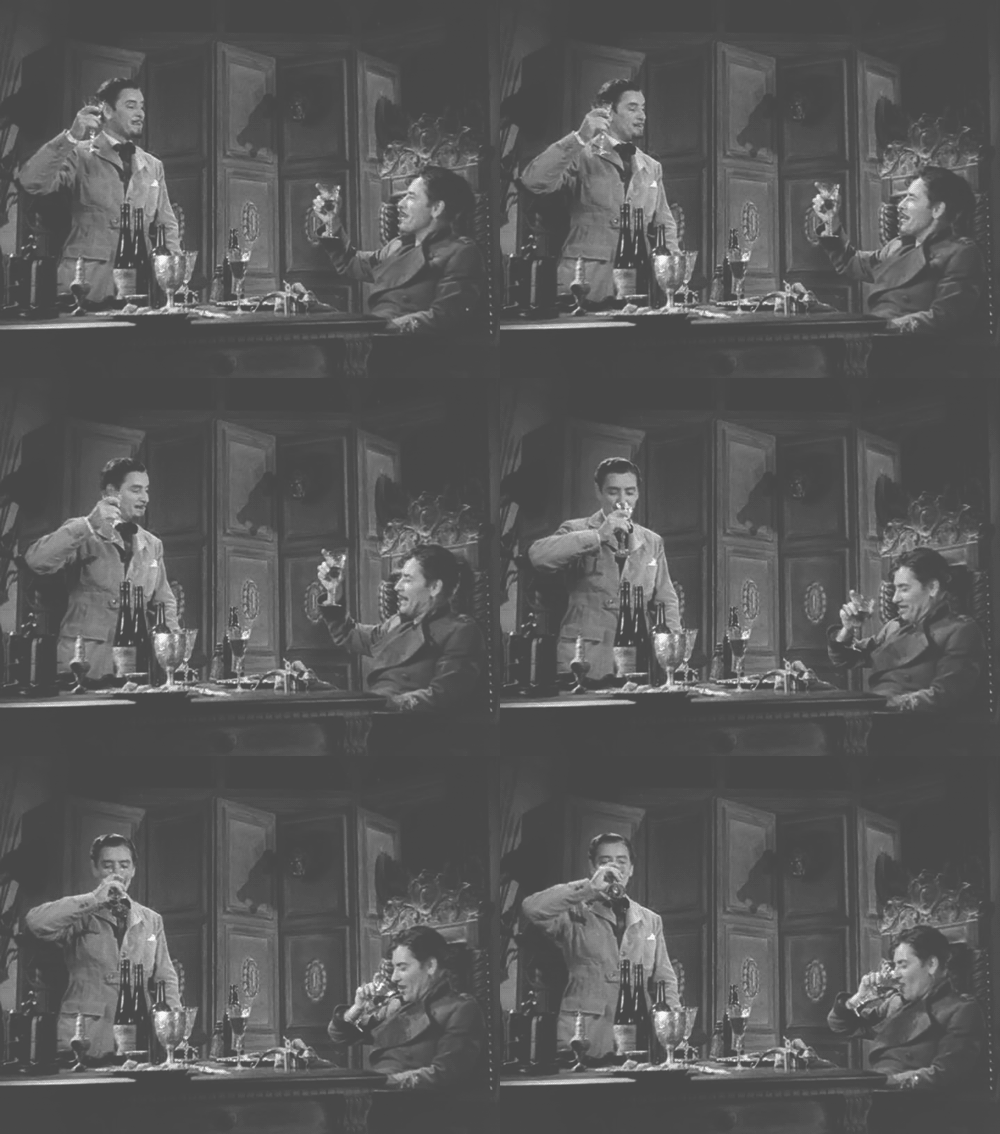
This news from Rassendyll about their probable relationship cracks the king up and he invites Rassendyll back to his hunting cabin where they get completely roaring drunk and Rudolftalks about his coronation scheduled for the next day and his half-brother Duke Michael, who hates him. He also speaks of his cousin Princess Flavia (Madeleine Carroll) who he will wed shortly after the coronation. After everyone else is unconscious from drinking too much, Rudolfdecides to drink a bottle of wine gifted to him by Michael.
Uh-oh. Bad idea.
When Rassendyll wakes up the King is unconscious on the floor, drugged. The king’s advisor says the king isn’t dead, but he won’t be in any shape to be coronated that which means that Michael could be crowned instead. A plan is hatched to have Rassendyll pose as the king only for the coronation and then to be smuggled out of the country and sent back home.
Of course, we have foreshadowing here that tells us that all will not go as planned and, indeed, it does not.
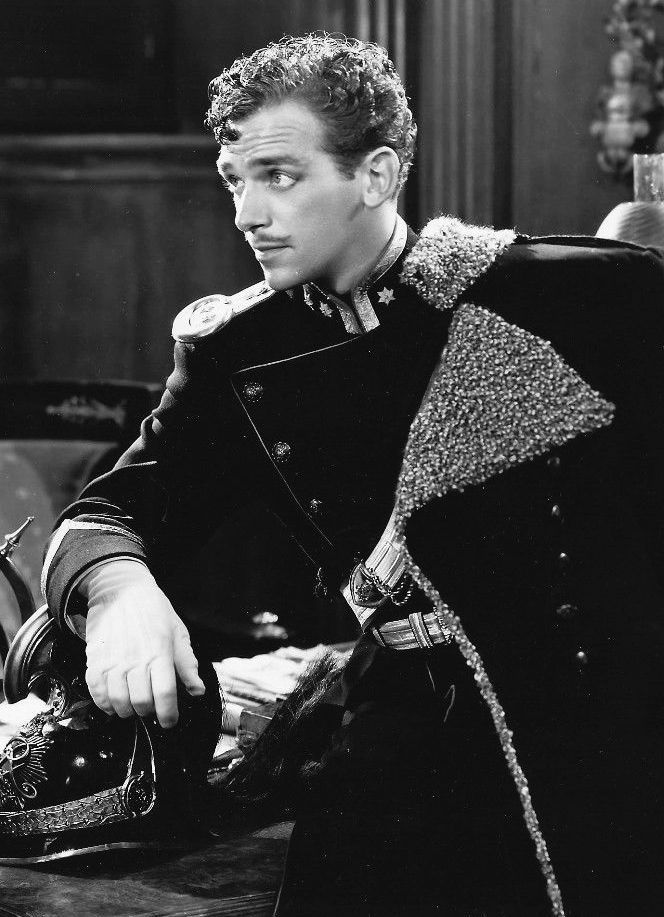
Douglas portrays Robert of Hentzau, the henchman (for lack of a better word) of Duke Michael, the king’s brother who wants to take over the throne.
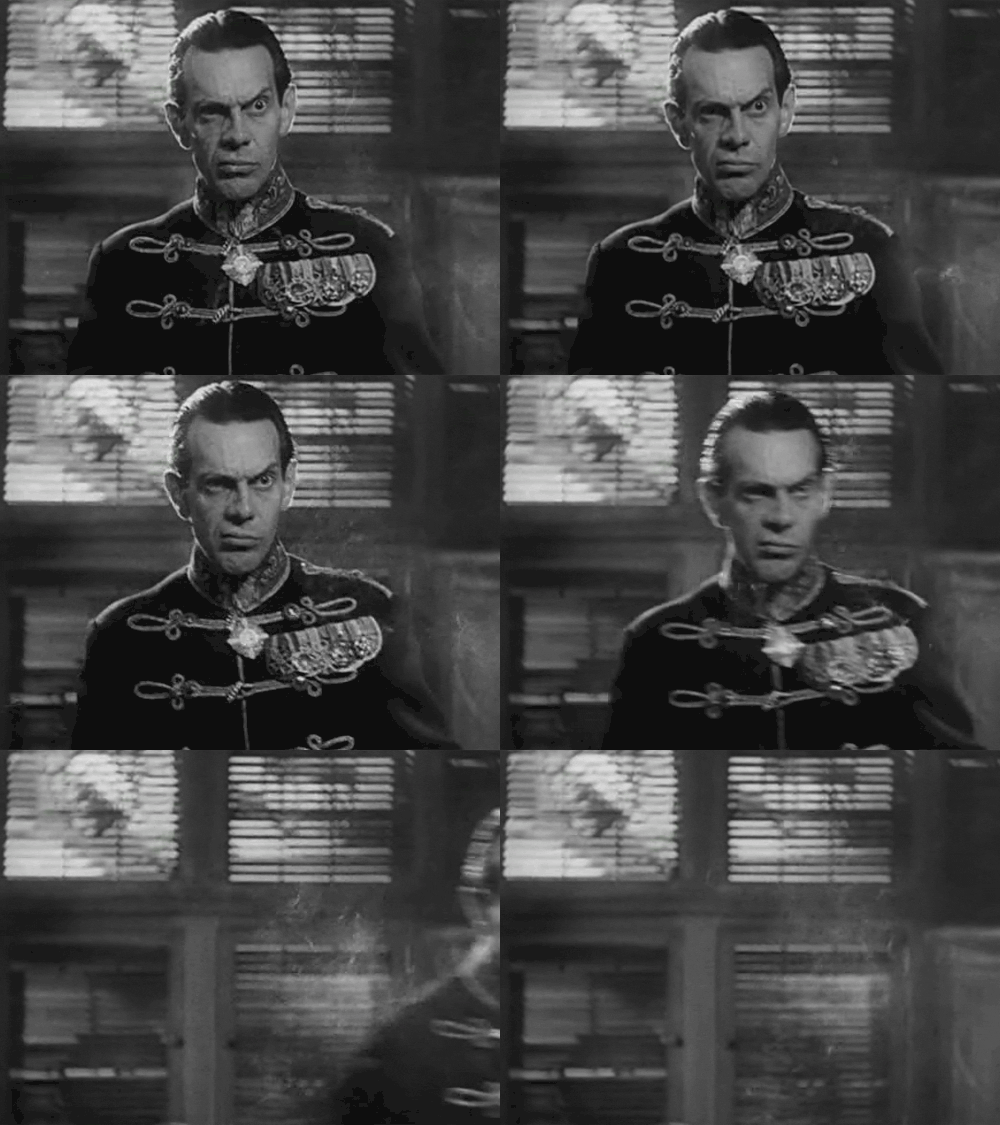
He shows up for the first time with a crooked, mischievous smile, like in many of his movies, and lets us know immediately he is the comic relief and a completely swarmy cad. A very attractive cad, though, I must say.
Let’s put it this way —Hentzau is all frat boy, and I could not stop watching him when he was on screen.
There was a lot about this movie I could not stop watching — the acting, the scenery, and the exquisitely detailed and breathtaking costumes designed by Ernest Dryden.
The Prisoner of Zenda was originally going to be released by MGM, but was bought by Selznick for his own studio, right around the same time he was working on Gone With The Wind (1939).
If MGM had produced it, they were going to use it as a vessel for more money makers from power team William Powel and Myrna Loy of the Thin Man movies. A musical was also a possibility. That all went out the window when Selznick bought it.
“Zenda was already a proven commodity in print, on the stage and in previous film versions,” writes Roger Fristoe for TCM.com. “And the recent abdication of England’s Edward VIII led Selznick to think that a story of kings and coronations would be timely.”
John Cromwell, a former actor who had previously only directed romantic dramas, was chosen to direct, which some questioned.
Selznick explained the decision had to do with Cromwell’s experience with European audiences.
“In doing a picture like The Prisoner of Zenda, which is aimed at least fifty percent toward a foreign market,” he wrote in a memo. “It becomes important to get a director who at least has the judgment and taste to respect the sensibilities of audiences which are sensitive, particularly in England, about the behavior of royalty.”
Cromwell had a lot of complaints about the cast, though, including Niven and Douglas, who he called lazy and overindulged. He even dismissed Niven at one point because he didn’t find his humor humorous. Ha. But Selznick overruled him and brought Niven back, saying he was bringing life to an otherwise dull role.
James Wong Howe was the cinematographer for the movie and his work was amazing, in my humble opinion. The various angles, the lighting, all of it.
Look at this fencing scene..the shadows on the walls..
The cinematography, great acting, and astounding costume and set design made this movie overwhelmingly enchanting.
There are a couple of scenes where Colman is filmed talking to himself and I was really interested to know how that was done before the days of digital special effects. Luckily the TCM article explained that for me.
“The special effects created by Howe included a subtle and convincing scene where Colman appears to shake hands with himself. A 3 X 4′ optical glass was placed in front of the camera, and Colman exchanged the handshake with a double, whose head and shoulders were subsequently matted out with masking tape on the glass. The scene was re-photographed with Colman in a different costume and everything matted out except his head and shoulders. When the images were combined, the effect was complete and quite realistic.”
Because I loved Douglas as Hentzau so much, I thought I’d close this post by sharing some quotes that show how delightfully jerky he is in the movie:
“I don’t like women who lie to me. They don’t usually do it, as a matter of fact. I usually do them to them.”
“Someone once called fidelity a fading woman’s greatest defense and a charming woman’s greatest hypocrisy. And you’re very charming. And Michael’s very busy and likely to be more so.”
[during his sword fight with Rupert, Rudolf Rassendyll “retreats” towards the drawbridge’s controls]: “You’d be a sensation in a circus. I can’t understand it. Where did you learn such roller skating?”
To Rassendyll: “Why don’t you let me kill you quietly?”
Rassendyll: Oh, a little noise adds a touch of cheer. You notice I’m getting closer to the drawbridge rope?
Henztau: You’re so fond of rope, it’s a pity to finish you off with steel. What did they teach you on the playing fields of Eton? Puss in the corner?
Rassendyll: Oh, chiefly not throwing knives at other people’s backs. (A reference to a previous scene).
Have you ever seen this version or any version of The Prisoner of Zenda?
What was your impression of it?
Up next in my series will be Gunga Din, one of his more famous movies, from what I’ve read.
The rest of the movies I will be watching include:
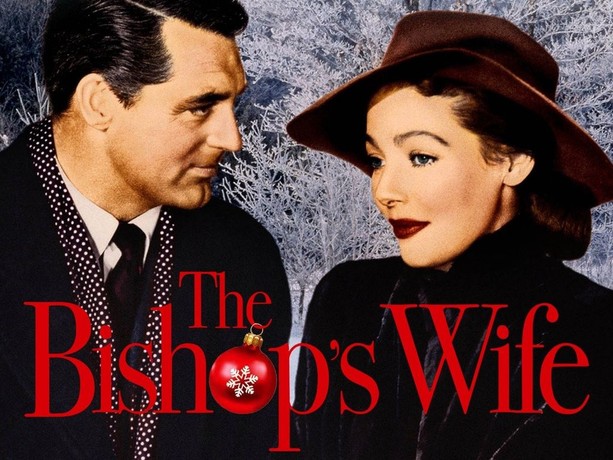
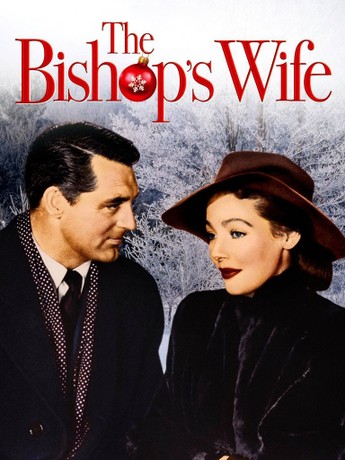
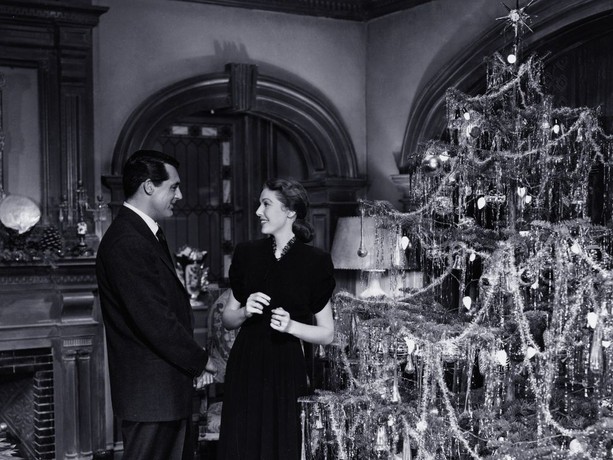
This weekend I watched The Bishop’s Wife (1947), which I have watched before but couldn’t remember the end of, so I watched it again.
The movie stars Cary Grant as an angel named Dudley who comes to earth to help Bishop Henry Brougham, (David Niven). Henry is so wrapped up in securing funding for a cathedral he begins to neglect his wife and daughter.
Dudley arrives at the Bishop’s house after the Bishop prays for God to help him with funding for the cathedral. Dudley tells him right up front that he’s an angel and he’s there to help him but introduces himself to others as Henry’s new assistant. He pretty much forces himself into Henry’s life and ends up charming the pants off all the women he meets and creating miracles for men, women, and children alike. At least one man, Henry’s retired professor friend (Monty Woolley), is very suspicious of him.
Henry isn’t really sure if he believes that Dudley is an angel, especially when the guy starts taking Henry’s wife, Julia, (Loretta Young) out on the town, having dinner with her, taking her skating, and buying her hats.
Still, Henry isn’t about to get distracted from his goal of building the cathedral and he ignores Dudley’s efforts to open his eyes to how much Julia needs him, plowing forward with fundraising instead.
L-R: Actors Cary Grant, David Niven and Loretta Young sit in the back of a car in a still from the film, ‘The Bishop’s Wife,’ directed by Henry Koster, 1947. (Photo by RKO Pictures/Courtesy of Getty Images)
I think Cary is supposed to be charming in this movie but instead I find him a bit devious. Maybe the goal of the movie is to leave the viewer trying to figure out if he is sweet or evil.
The site, The Viewer’s Commentary, had a similar feeling about Cary’s role and explains it better than I can.
“But, while I’m not certain “perfect” is necessarily the right word for Dudley as a character, I’m still not entirely convinced that the movie wasn’t actually trying to play him up as being in his right to step in on Henry’s marriage, either. This is based on the film’s affectionate depiction of his chemistry with Julia, the amount of sympathy the film has for her, and the apparent distaste it has for the stiff Henry beyond his admirable loyalty and good intentions.”
“That ice skating thing I mentioned before wasn’t some kind of non sequitur,” the post continues. “There’s a painfully long scene in which Dudley and Julia and their cab driver have a whimsical impromptu ice skating session where he romances her in front of everyone by secretly granting her expert skill while Henry toils away elsewhere, callously inattentive to Julia’s wifely needs. It would be one thing if it was intended to teach Henry a lesson about what could potentially happen, but it actually kinda left me with a gross feeling, given how wonderful it’s all supposed to be while knowing about Dudley’s infatuation – not to mention his manipulation of the situation and nonchalant demeanor when confronted about it.”
This is the scene in question:
At one point even Henry begins to wonder if Dudley is from heaven or hell and if he truly is trying to steal his wife from him.
It’s what I was wondering too and by the end of the movie . . . well if you’ve never seen it you will have to watch it and let me know what you think.
The movie is based on a book by Robert Nathan whose other fantasy romance, Portrait of Jennie, would later overtake The Bishop’s Wife on a literary level and later became a 1948 David Selznick movie.
According to an article on TCM.com, producer Samuel Goldwyn decided to take on this movie right after winning an Oscar for The Best Year of Our Lives in 1946.
Cary was originally set to play the Bishop, but as he read the script he began to suggest edits and finally decided he didn’t have the right part. He should be playing Dudley.
Later on, though, after the final casting decisions were made, Grant wanted to switch back.
Then there was the fact that Goldwyn didn’t like the set.
Niven wrote in his future autobiography, “The day before shooting was to start, Goldwyn decided that the interiors of the Bishop’s house were not ecclesiastical enough and ordered several sets to be torn down, redesigned and rebuilt. For three weeks, while this was going on, production was halted, then, two days after the cameras finally had a chance to turn, Goldwyn decided that Seiter’s hand was a little too heavy on the tiller: he was removed, paid his full salary and after a week, Goldwyn hired Henry Koster to start again from scratch – with another two weeks of rehearsal. All this must have cost Goldwyn several hundred thousand dollars….”
Niven was already struggling through the production because his wife tragically died during filming. Her fatal head injury occurred during a party game of “sardines” at Tyrone Power’s house. Her name was Primmie and she fell down a flight of cellar stairs after thinking she was running into a closet.
Problems further continued to plague the film when Cary and Loretta Young couldn’t get along part of the time.
Despite all of the hardships, the movie was well-received and remains a favorite Christmas film of many classic movie buffs today.
It was nominated for five Oscars but did not win any.
I’m not sure I found this movie as heartwarming as some of the Christmas movies I’ve watched, probably because I found it so difficult to read Cary in this one and was quite suspicious of him. I did, however, still enjoy the movie overall.
A few pieces of trivia about the movie for you:
I recognized the young actor who played the young George Bailey from It’s A Wonderful Life — Bobby Anderson —— in a snowball throwing scene in this film. I looked up his name and found out that Karolyn Grimes, who played Zuzu in It’s a Wonderful Life also played The Bishop and his wife’s daughter, Debby.
According to IMBd (I did not double check these to clarify they are true):
“At about 1:20, Henry and Julia are ready to make some Parish calls. Henry says to Julia, “We go first to the Trubshawes.” This is an example of David Niven’s attempt to mention the name of his friend (Michael Trubshawe) in every movie he made.”
“Over Cary Grant’s protests, a skating double wearing a mask with Grant’s features was used in the long shots of the complex skating routine. A skating double was also used for Loretta Young on all long shots.”
Market research showed that moviegoers avoided the film because they thought it was religious. So, Samuel Goldwyn decided to re-title it Cary and the Bishop’s Wife for some US markets, while adding a black text box with the question “Have you heard about CARY AND THE BISHOP’S WIFE?” on posters in markets where the film kept the original title. By adding Cary Grant’s first name to the title the film’s business increased by as much as 25 per cent.
“In Britain the film was selected for that year’s Royal Command Film Performance screening. Princess Margaret and her sister, the future Queen Elizabeth, both attended the screening of “The Bishop’s Wife” on November 25, 1947, at the Odeon Theatre in Leicester Square. According to David Niven, “The audience loved every second of it, and the Queen and Princess Margaret told me afterwards and at great length how much they had enjoyed it.”
Have you ever seen The Bishop’s Wife? What did you think of it?
*This post is part of the Comfy, Cozy Christmas Link Up for 2024. If you have a Christmas/holiday post you would like to share you can find the link HERE or at the top of the page here on my blog.
Erin from Still Life, With Cracker Crumbs and I have been watching movies from September through November for our Comfy, Cozy Cinema.
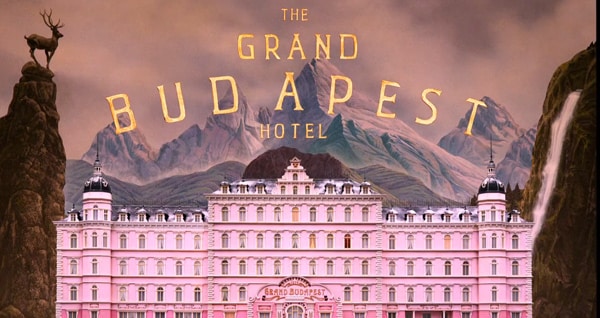
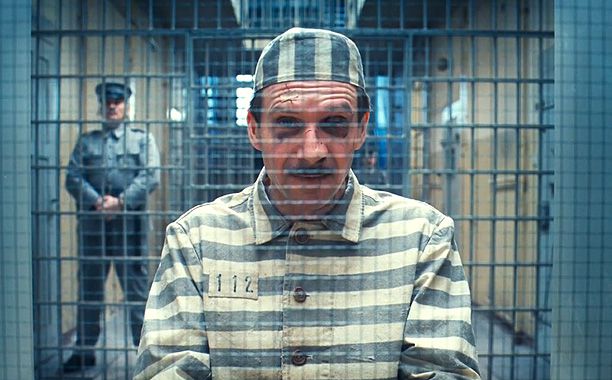
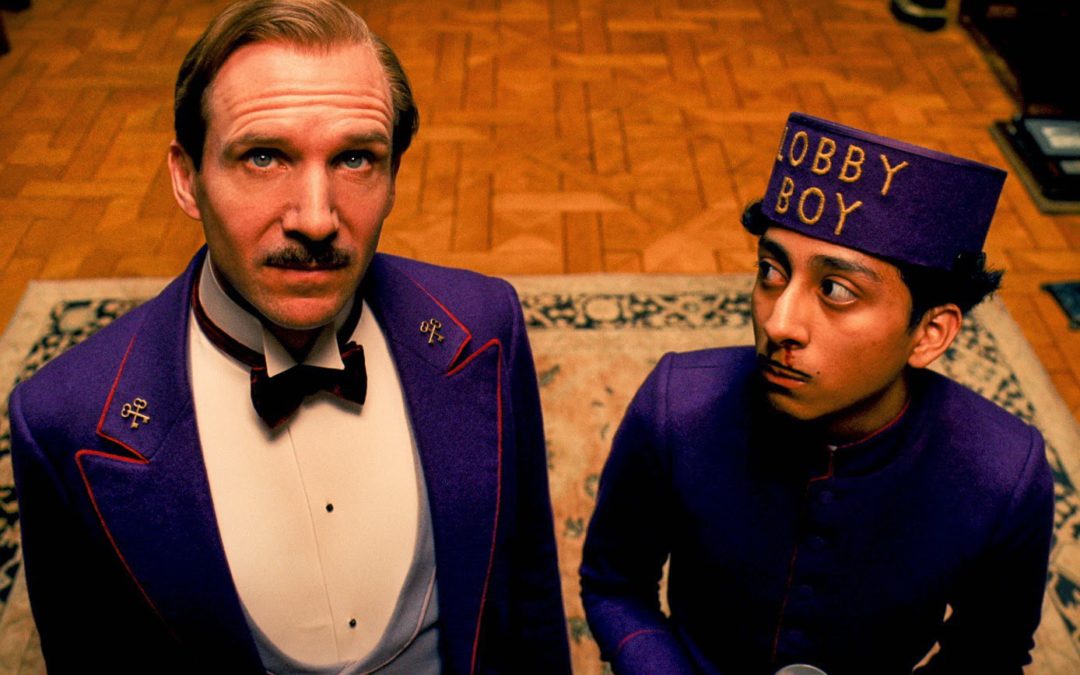
For this week Erin suggested Wes Anderson’s The Grand Budapest Hotel (2014), which I had never seen and wasn’t sure I wanted to until I watched the trailer and thought it looked like a fun ride. It was a fun ride but it was also so much more. It was mildly offensive to me in some places and heart wrenchingly endearing in others. Overall, it had me laughing and then a few minutes later I would feel a peculiar sadness because I wasn’t sure if I was supposed to feel sad or impressed with how Anderson can twist social commentary up into a neat, comical, satirical package that sends the mind spiraling off onto paths it did not originally plan to take when it pushed play.
The best way to explain this movie is bizarrely ridiculous, quirky, strange and fun while also being oddly delightful. It is not, however, “clean” in parts so if you don’t like movies with some nudity, crude references, or swear words, this is not the movie for you. It is not usually the movie for me either since I don’t watch a ton of rated R movies, but I do, on occasion, watch some rated R movies – so I am not a total puritan over here.
The movie is a story within a story. It is also full of so many famous actors it’s a bit overwhelming. Instead of saying who all is in this movie, one could really say, “who isn’t in this movie?”
Among the actors in the movie are Ralph Fiennes, Edward Norton, Adrien Brody, Tony Revolori, Tilda Swinton, Jason Swartzman, Owen Wilson, William Defoe, F. Murray Abraham, Saoirse Ronan, Jeff Goldblum, Jude Law, Harvey Keitel, Tom Wilkinson, Bill Murray, and …many, many more
We begin with and author, portrayed by Tom Wilkinson as an adult, talking about his time at a hotel called The Grand Budapest Hotel and then we switch to a younger version of himself portrayed by Jude Law. Law is leaning on the front desk of The Grand Budapest Hotel, which has seen better days. There is an older gentleman in the lobby of the hotel and Law’s character learns that he is the owner of the hotel.
Eventually the two end up talking and we find out how the owner – a man named Zero Moustafa – came to own the hotel. So, we are being told a story by Law’s future self, who is being told a story by Zero’s future self. Zero as an older man is portrayed by F. Murray Abraham.
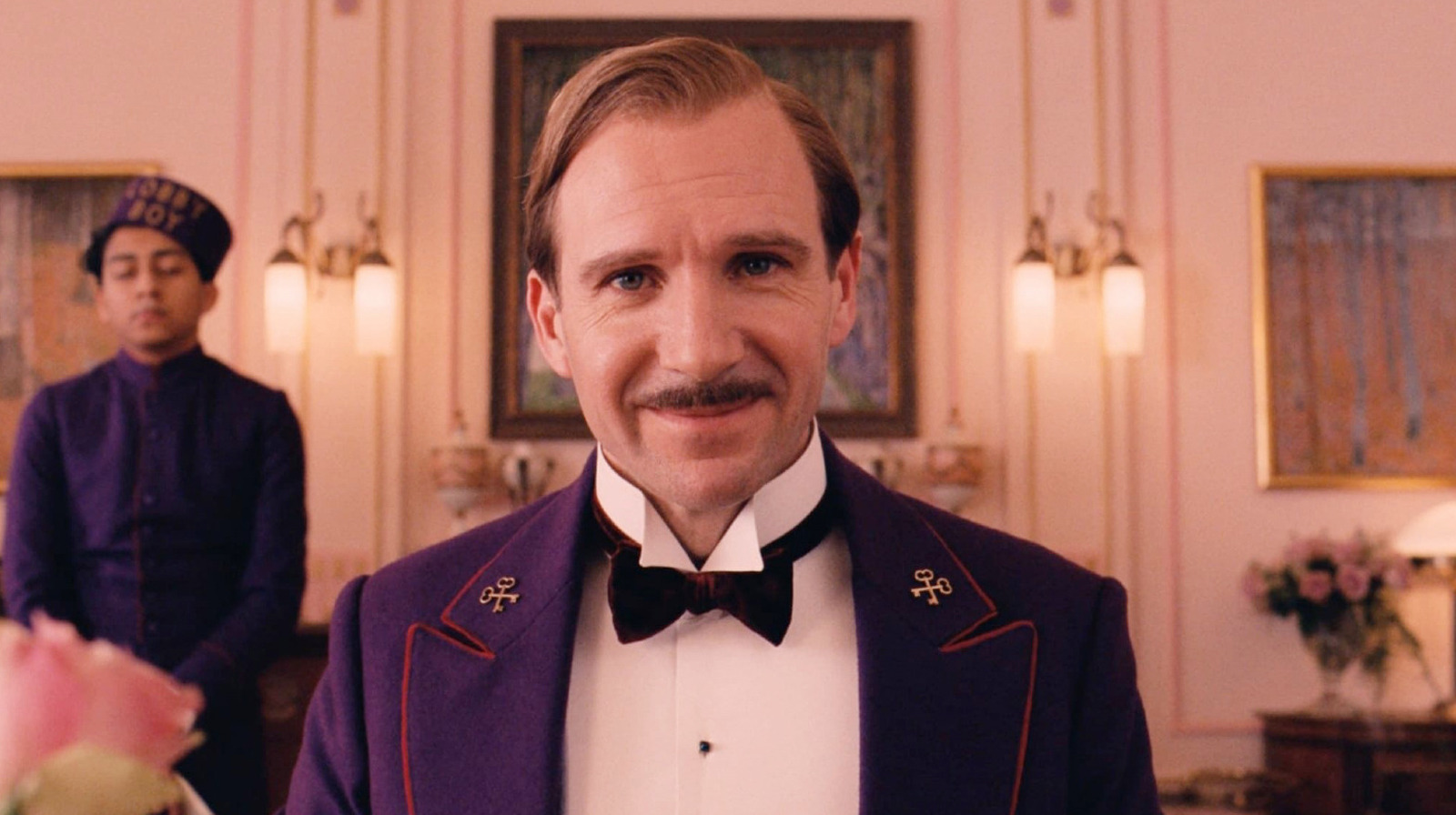
Zero tells of how he became a lobby boy under the tutelage of Monsieur Gustave H. (Fiennes), the hotel’s concierge, an eccentric man who liked to sleep with many of his guests.
One of those guests was a very wealthy Octogenarian (Swinton ) who ends up passing away. After she passes away, Gustave tells Zero (the younger zero is played by Tony Revolori) he must come with him to see the woman in her casket and say farewell to her. While at the mansion, Gustave finds out a will reading is going on and he has been bequeathed a very expensive painting called Boy With Apple.
The wealthy woman’s son (Adrien Brody) doesn’t want Gustave to have the painting and tells Gustave and Zero to leave the room. They do and Gustave takes Zero to see the painting. They are alone in the room so Zero suggests they steal the painting. They do and take off back to the Grand Budapest Hotel.
Unfortunately, the police arrive the next day – not to retrieve the painting but instead to charge Gustave with the murder of the wealthy woman.
All sorts of craziness ensue after the arrest (as if things haven’t already been crazy) and the friendship between Zero and Gustave deepens as zero works to help Gustave clear his name.
There is a lot of humor in this movie but also a dark undercurrent of commentary about the state of the world throughout the years in relation to wars, greed, and power.
I don’t know how to explain a Wes Anderson film if you haven’t seen one, but it is essentially like watching people act with little emotion yet still conveying emotions that make you think.
I’ve only seen drama movies with Ralph Fiennes so seeing him in a more comedic role was different for me, but, like Erin, I can’t imagine anyone else pulling this role off. I mean, maybe if I thought hard enough about it I could, but at this point, I couldn’t.
The script for this film was written by Anderson and Hugo Guinness, and, according to Wikipedia (reliable source? I’m not sure.), “Anderson customarily employs a troupe of longtime collaborators—Bill Murray, Adrien Brody, Edward Norton, Owen Wilson, Tilda Swinton, Harvey Keitel, Willem Dafoe, Jeff Goldblum, and Jason Schwartzman have worked on one or more of his projects. Norton and Murray immediately signed when sent the script.”
For some, this movie might not seem like a comfy or cozy movie and I get that. It’s more quirky than cozy. Like Erin mentioned to be yesterday (when she showed me part of her post), though, the part of the movie that is cozy is the friendship between Gustave and Zero. Zero is sort of yanked into Gustave’s world and become his friend without even knowing what it is going on, but it is still a friendship. Zero looks up to Gustave both as an employer and a person.
I think the theme of the movie can be somewhat explained with one of the popular quotes: You see, there are still faint glimmers of civilization left in this barbaric slaughterhouse that was once known as humanity.” As well as the extension of that, “There are still faint glimmers of civilization left in this barbaric slaughterhouse that was once known as humanity… He was one of them. What more is there to say?”
Have you ever seen this one? What did you think of it?
Also, we will be watching Chocolat, or next movie, together via a watch party at 7 p.m. on Sunday, November 17 and YOU are invited. We will be pressing play together on the movie and chatting in our Discord server, which you can join here: https://discord.gg/TpWNxJ4Z
I really hope you will join us! If not, it will just be Erin and I chatting with each other and that’s not all bad either. Haha!
It’s time for our Sunday morning chat. On Sundays, I ramble about what’s been going on, whatthe rest of the familyand I have been reading and watching, andwhat I’ve been writing. Some weeks I share what I am listening to.
The beginning of this week the weather was beautiful which led my dad to decide to take my kids for a hike along the old railroad tracks near his house two days in a row. I stayed back at my parents and helped my mom with cleaning the house.
The kids enjoyed walking the path where the train tracks used to be and my dad told them the history of where the station was and where the trains traveled. He also talked to Little Miss about where the old French mill used to be along the creek.
Zooma The Wonder Dog also loved the trip. She and Little Miss splashed in the creek and looked for fish, but didn’t see any.
The kids took some photos:
Two days later our little town was placed under a water boil advisory when there was a water main break. This made cooking and washing dishes a challenge, but we managed – not without complaint from me. The advisory was lifted on Friday, thankfully.
Last week I wrote a bit about our family’s cats over the years and barely scratched the surface of all the cats we’ve had over the years. I’ve decided I’m going to sit down one day this week and write about all the cats I can remember us having. Cats have such interesting personalities and each one seems to be different.
Mom and Dad’s cat Molly.
I also hope to write a blog post in the next month or so about the letters we have between my great-grea-grandfather and his brothers and mother that were written during the Civil War. They are very interesting.
What I/we’ve been Reading
The Marlow Murder Club by Robert Thorogood and The Anne of Green Gables Devotional by Rachel Dodge
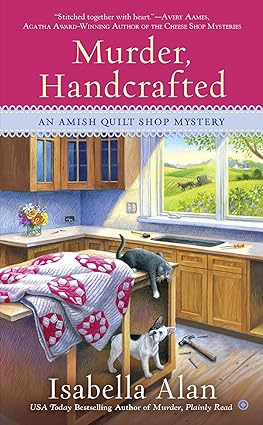
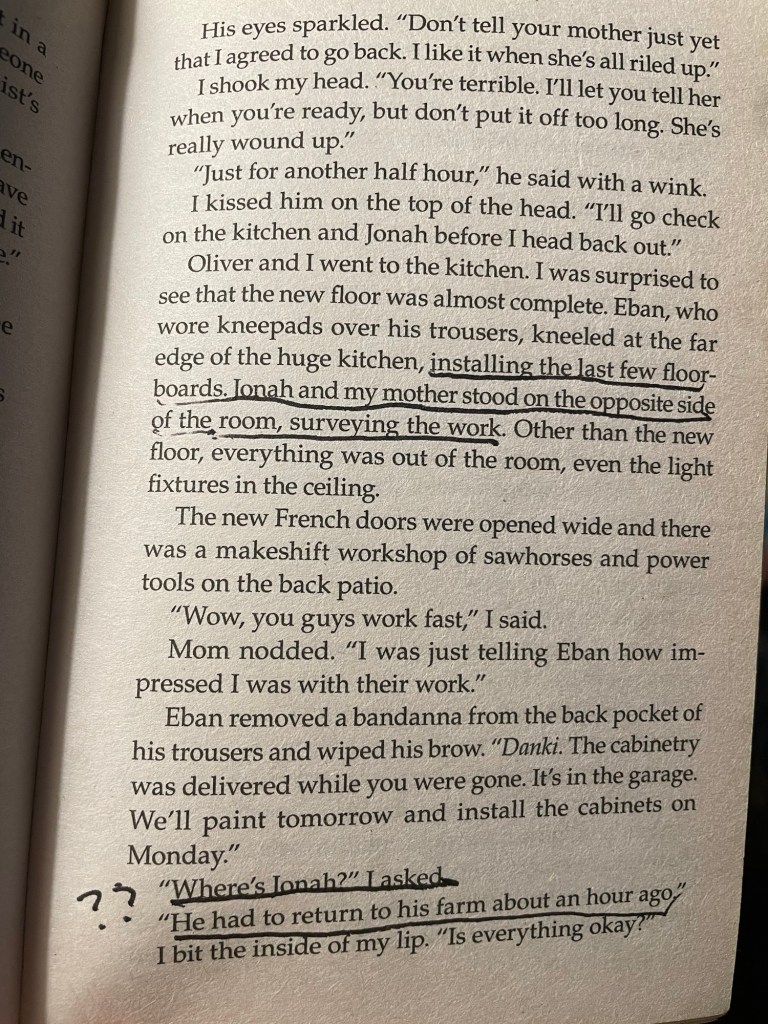
Murder Handcrafted by Isabella Alan, which I have been sharing the wrong title of for a couple of weeks. So this one was good but also annoying. First, I didn’t know it was the last book in the series until I read some reviews. Second, there were some super weird typo and consistency issues that really threw me out of the story. I was surprised to see this because the book was published by Random House Publishing.
I really shouldn’t have been surprised because I’ve seen some errors like this before in Amanda Flowers’ books and Isabella Alan and Amand Flowers are the same person. There are so many books out by Amanda that I feel like they are trying to push them out way too fast and therefore letting quality slide.
Now, as someone who is independently published and has a lot of errors in her book as well, I’m not trying to act superior. I’m just surprised because so many readers are so negative about independently published books because of their supposed lack of quality but I am seeing that lack across the board in publishing right now.
In some ways I think the production of books needs to slow down and focus on quality over quantity. There are just too many rushed books out there.
All of this said I did enjoy the story of the book. I was, however, really annoyed to find out this was the last book in the series and she did not wrap up the love story between the main character very well (I mean they were still together so I guess that’s good at least) and left the storylines of other characters hanging. I still enjoy the stories and her writing, though, so this doesn’t mean I won’t read further books by her. Just not for a while.
I need to take a break from mysteries for a bit so I am going to try either Miracle in a Season by Sarah Loudin Thomas or Finding Lady Enderly by Joanna Davidson Politano
I haven’t read either of these authors before.
I decided to put The Cat Who Brought Down the House by Lilian Jackson Braun aside for now since I learned it was one of the later books in the series. I read one or two of those and they weren’t as good, and I think it might have been because Lilian was quite old by then and others may have been writing them or she was, and they just weren’t as good.
The Husband is reading Satanic Verses by Salman Rushdie.
Little Miss is reading Harry Potter and The Sorcerer’s Stone. At night we are sometimes reading The Four Story Mistake. During the school days we are reading Johnny Tremaine.
The Boy is listening to an audiobook – Tales From The Gas Station Part Four.
What We watched/are Watching
Her Majesty, Mrs. Brown. This was my first time watching this one and I found it very interesting. It sent me down a rabbit hole of reading the real story of John Brown and Queen Victoria.
For Comfy, Cozy Cinema with Erin from Still Life, With Cracker Crumbs, I watched Dial M for Murder. If you want to join in on our movie marathon posts for the rest of October and November you can follow the list here:
You don’t have to blog about them if you watch them but if you do write a blog post about your impression about the movies, we will be adding a link up at the end of our posts.
On Nov. 14 we will be watching Chocolat as a group watch. We will be pushing play together at the same time and then chatting about the movie in our Discord group (The Dames), which you can join for free now here: https://discord.com/invite/J7qQ36Uf
On my own I watched The Secret Life of Walter Mitty (original with Danny Kaye) this weekend and really enjoyed it. I loved the music and Danny Kaye’s performance overall. I watched an episode of the first season of Only Murders In The Building as well last week. I am really enjoying it and it’s hard not to binge watch it but I’m trying to wait for my husband to be home to watch it with me.
What I’m Writing
I am getting much closer to the end of the third Gladwynn book.
I released the description this past week, if you are curious:
Now it’s your turn. What have you been doing, watching, reading, listening to or writing? Let me know in the comments or leave a blog post link if you also write a weekly update like this.
Erin from Still Life, With Cracker Crumbs and I are watching Comfy, Cozy movies this September and October and this week we watched Kiki’s Delivery Service, a Studio Ghibli animated movie.
We are also announcing a very fun and exciting giveaway for a comfy, cozy gift basket which you can enter to win at the giveaway link at the bottom of this post!
Kiki’s Delivery Service was released in 1989 in Japan by Hayao Miyazaki, a Japanese animator and filmmaker, and was based on a book called Witches Express Delivery Service.
The movie was animated by Studio Ghibli (which Miyazaki was a founder of) for Tokuma Shoten, Yamato Transport, and the Nippon Television Network.
According to information online, “The English dub was produced by Streamline Pictures for Japan Airlines international flights in 1989. Walt Disney Pictures produced an English dub in 1997, which became the first film under a deal between Tokuma and Disney to be released in English. It was released to home media in 1998.”
This was a very sweet movie with little action but a lot of heart.
First the background – Kiki is a witch and the tradition is that witches leave home at the age of 13 and travel away from their family for a year to learn what their skill in life is.
Kiki’s mother insists she take her old, reliable broomstick so Kiki flies off into the night with her all black cat JiJi and finds a small town to settle in. She ends up living with a baker and starts a delivery service – delivering packages with the use of her broom.
The bakery is owned by Osono and her husband, Fukuo, who are expecting a child.
Kiki also meets a friend – a boy named Tombo who wants to be her friend more than she wants to be his for most of the movie. Tombo likes to invent things – especially things with the potential to fly. At one point he invites Kiki to his aviation club but Kiki gets wrapped up in deliveries and gets caught in a rainstorm. This causes her to become very sick but Osono nurses her back to health and then pretends to have a delivery sent to Tombo so Kiki can see him and apologize.
During her first delivery, Kiki loses the toy she’s supposed to deliver and then she and her cat – who talks by the way – work to find a way to get it back to the child it belongs to.
Much of the movie is like this – just little stories or adventures that aren’t very exciting in some ways, but are calming and sweet.
It isn’t until more than halfway through the movie that more conflict arises because Kiki seems to be losing her powers, which she first notices when she can no longer understand JiJi.
Studio Ghibli is the design studio for many Japanese animated movies. Later many of these movies are dubbed into English and sometimes feature well-known American actors. In the one I watched (which was the Disney dubbed one from 1997) Kiki was voiced by Kiersten Dunst and the cat was voiced by Phil Hartman.
Kiki’s Delivery Service focuses on themes of independence and finding your place in this world.
It was the first Studio Ghibli film to find commercial success soon after being released – earning $31 million.
I wasn’t as swept up in this one as in previous Studio Ghibli films but as it continued it grew on me. It was a very quiet film and some of the Studio Ghibli films have a little more action so I wasn’t ready for it to be so toned down. Once I got into the story, though, I enjoyed it. The scenery and art, as in all Studio Ghibli films, was really beautiful.
I was rooting for Kiki – especially once she lost her powers and seemed confused about her next step.
While the makers of the movie and critics said the movie focuses on themes of maturity and independence, I also saw a strong theme of friendship, family, and trust.
Coming up next week will be the 1945 version of Blithe Spirit.
Feel free to link up your own impressions of the movies at our link-ups. The links close at the end of the week but feel free to leave your blog post on future link-ups, even if it is for another movie.
Also, Erin and I are announcing our Comfy, Cozy Gift Basket Giveaway today.
I’m just going to copy what Erin wrote to share here because I am lazy *wink*: “We have some fun little goodies to be sent off to one winner, with more surprises to be added as well! We want to celebrate the season and this is just one way we would like to do that this year.
You can enter anytime between today and October 15th, and the winner will be announced on our blogs on Thursday, October 17th. Please enter via Rafflecopter and it is only open to those 18 or older living in the US.” You can enter here: https://www.rafflecopter.com/rafl/display/3614a4fa2/?
Last year Erin from Still Life, With Cracker Crumbs and I watched comfy cozy movies during the fall and we are doing it again this year.
This week we watched What We Did On Our Holiday (2014).
I wasn’t sure what to expect of this one but chose it based on the trailer I saw of it. I thought it would be cozy and fun. I should have read the descriptions better since it is called a “black-comedy.” Oops.
So, it wasn’t exactly what I had hoped it would be, but it was a pretty okay movie, with humor mixed in with …. well…. some disturbing elements. Not like deep, deep dark disturbing – just a bit depressing disturbing. Yet also uplifting. It is hard to explain unless you see the movie. I’m handling this post with care because while I want to share one of the biggest plot twists in the movie, I don’t want to ruin it for anyone who hasn’t seen it.
So let’s keep it simple for now – David Tennant (Doug) and Rosamund Pike’s (Abi) character are getting a divorce but they are also going to visit Doug’s family and don’t want them to know about the divorce. Doug and Abi live in England. Doug’s family is Scottish (David is actually Scottish too so he got to use his normal accent this time). They instruct their young children to keep it on the down-low that Mum and Dad are living in separate houses and have lawyers.
Well, we, of course, know that this is going to go off the rails pretty fast with these precocious, bright children the couple has.
Meanwhile, in Scotland, Doug’s brother, Gavin (Ben Miller), is planning a huge party for their father. He’s inviting all kinds of bigwigs and other family members that no one but him wants there. His wife is inching toward menopause or is just stressed from dealing with him, and is having a hard time controlling her emotions so she’s crying in the kitchen some nights.
Their son seems to be a bit awkward but also might be autistic and he wants to play the music he loves on his violin but his father wants him to study classical music for college.
Oh and Gavin is rich. Very rich. Because he is a financial something or other which sounded like he’s a conman to me.
The kids in this film are – as the British might say – brilliant. They are hilarious and bright and quick witted. Great actors for being so young.
There are two girls and a boy. The youngest (between 4 and 5) reminds me of a mix of my daughter and one of my nieces – mouthy and sharp in the best way.
The oldest daughter (about 10) records all her thoughts in a little journal to try to organize them and deal with the chaos happening around her.
The boy (around 7) lives in fantasy worlds in a way, but he’s also a kid so it’s okay for him to do that.
There is a lot of serious subject matter in this movie but the humor that is woven throughout helps to alleviate that some.
I have to admit there were times I wasn’t sure whether to laugh or cry at the scenes in this movie. I think there was a healthy mix of both, to the point the kids had to check if I was okay.
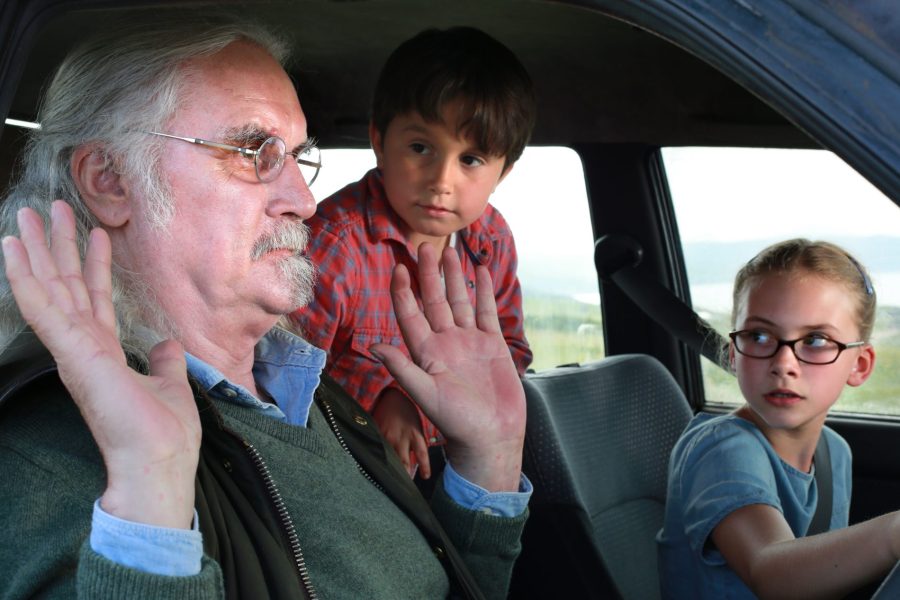
It isn’t much of a spoiler to say that Grandpa (Billy Connelly) is sick and one reason Doug and Abi don’t want anyone to know they are getting a divorce is that they don’t want to upset Gordie/Grandpa.
There is a huge plot twist in the middle of this one that had me gasping, saying, “oh no. No way,” crying, and then laughing.
I wouldn’t say this is a movie I will watch over and over again because it was tough in a lot of ways – especially since I have parents who are older and dealing with health issues themselves. I would probably watch it again with a family member (not alone like this time) while holding on to my Teddy bear and a box of tissues, though.
When I say a box of tissues, don’t jump to the conclusion that this movie doesn’t offer some hope. It does and that hope is for all of us with dysfunctional families who are trying to figure out what being a “normal” family is.
The kids really make this film – overshadowing Tennant and Pike for me. In fact, they overshadowed all the “big name” actors in the film. I found the adult actors’ performances to be pretty blah in many ways.
This movie sat with me a few days after I watched it and I found myself thinking about some of the scenes and tearing up again.
I definitely felt this film had to have been filmed in Scotland and a quick look online showed that it was actually filmed in – Detroit?!
Ha! Just kidding. It was filmed in Glasgow and the Scottish Highlands in 2013.
‘WHAT WE DID ON OUR HOLIDAYS’
According to Wikipedia, “The beach scenes were filmed at Gairloch. The family home of Gavin McLeod is in Drymen near Loch Lomond. The ostriches farmed by Gordie’s friend Doreen are actually located at Blair Drummond Safari Park.
Have you ever seen this one before? What did you think?