Is it just me or is it sort of weird and a bit sad that most of the classic romance authors of the 18th century never actually married?
Jane Austen?
Never married.
Emily and Anne Bronte?
Nope.
In fact, they died so young they never even had a chance to really have much of a life or enjoy their success in writing.
Yet all three women wrote about romance as if they knew all about it. I’m sure there are other classic romance authors who never married or had deep relationships either.
Of course, all three women may have known about romance and love even though they didn’t marry so it’s not like I believe you have to be married to fully understand love.
Also, before I get too into the topic of this post, let me explain a few things about my relationship with romances.
I’ve never been one to exclusively read or watch romances. I like romances but they aren’t my go-to genre.
I am a fan of romantic themes in a movie but strict romances often seem formulaic to me and I quickly lose interest – especially when it comes to books. This doesn’t mean I never watch or read romances. I certainly do. I get as giddy as the next girl when a couple finally professes their love to each other after pages and pages or two hours of dancing around their feelings.
At the same time, all the back and forth looks and touches and misunderstandings, etc. just get old to me at times, if not written or produced well. Listen, I’ve written four romances so I am in no way knocking romance stories, books, or movies.
My romances, however, have storylines in addition to the romance and I like books and movies that are similar. If I’m going to be honest, the idea of “keeping within the writing rules for a romance” became too much for me by book four and I decided I needed to write in a different genre – one that I read more of – cozy mysteries or mysteries in general. I will, however, be writing a book five of that series because I need to wrap up one character’s story. (Hello, Alex Stone, you’re getting your own book.)
One reason I don’t like reading a lot of romance is that I feel – and please read those words I feel again so you remember that this is an opinion — that they can create unrealistic expectations of love and romance for women and men, whether they want to admit it or not.
Some readers of romance books will say they don’t really believe that real-life love has to be the way it is written in the books but I feel that the idea of what romance should be is being subconsciously ingrained into their mind and many times they may judge their own lives on those books.
Thoughts like, “I know those books aren’t real life but if only my husband thought to bring me flowers like Patrick did in …” could creep in without them (us) even realizing it. Yes, even I have fallen prey to this way of thinking at times.
Now, even with all that being said, I don’t think all romance readers are this way. Sometimes they simply want a happy escape from life. They know the books aren’t realistic, but they are an idea of how life could be for them or others.
I also feel odd reading books that don’t have any romance at all in them. I like when a book has a romantic aspect to it – like a mystery with an underlying love story, so I am not, in any way, bashing romance itself or even strict romance books. There are some really good ones out there. I don’t endorse romance books with “smut” in them, of course, because that’s where the real unrealistic expectations of love lives set in.
One thing I’ve been noticing lately, though, is how at least three of the authors we consider the “founders” of romance books never married.
Does this make them frauds? No, I don’t think so.
Does it make them less reliable sources for the idea of romance? I don’t think so either.
I often wonder how hard it was for these women not to marry and have children, dreams they seem to have had and wrote about in their books. Though maybe it was just their characters that had these dreams of romance and marriage.
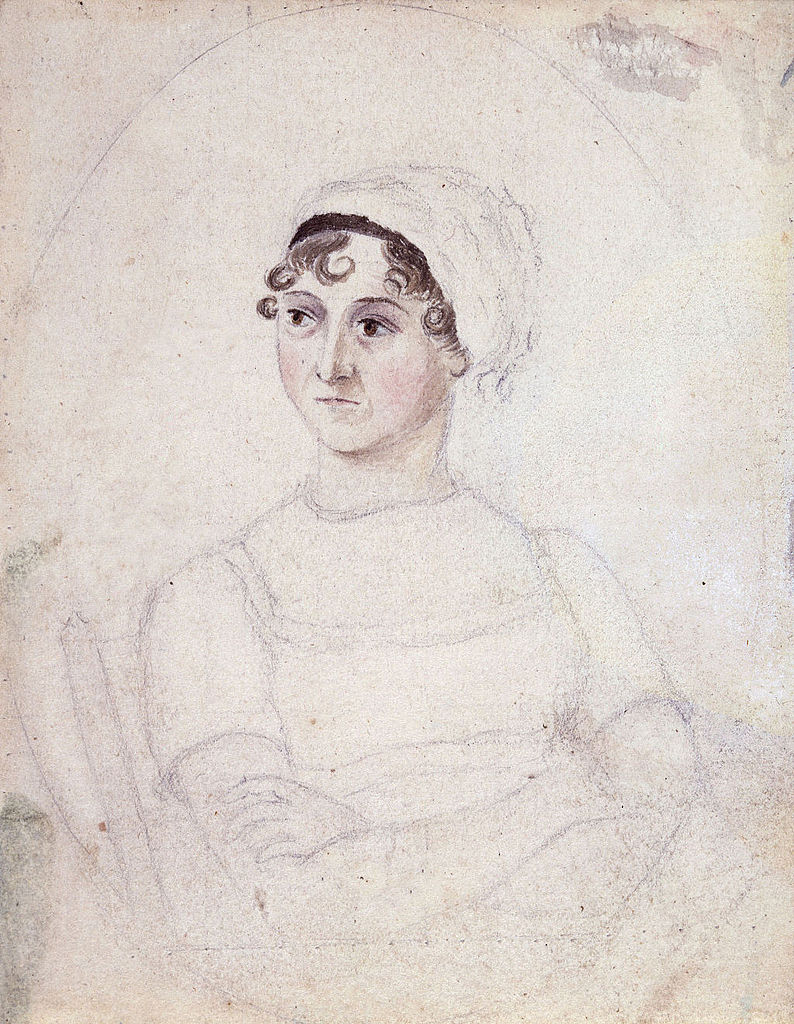
Jane Austen wrote about romance and how to find romance in books such as Sense and Sensibility and Pride and Prejudice, but she herself never married. There are different theories as to why and one of those theories is that she knew how to write about broken hearts because she absolutely had one.
Historians know from letters that Jane was proposed to once and she accepted it but then withdrew that acceptance a day later.
I wrote a bit about Jane’s love life in January when I wrote a review of the movie Miss Austen Regrets, which is very loosely based on letters between Jane and her sister Cassandra and her niece Fanny.

In that blog post, I mentioned that we don’t know a lot about Jane’s personal life because her sister burned tons of letters Jane sent to her. Some historians believe Jane wrote thousands of letters to her sister Cassandra over the years, but in the end, only about 150 survived and many of those were redacted or cut apart to keep certain information out of the public eye.
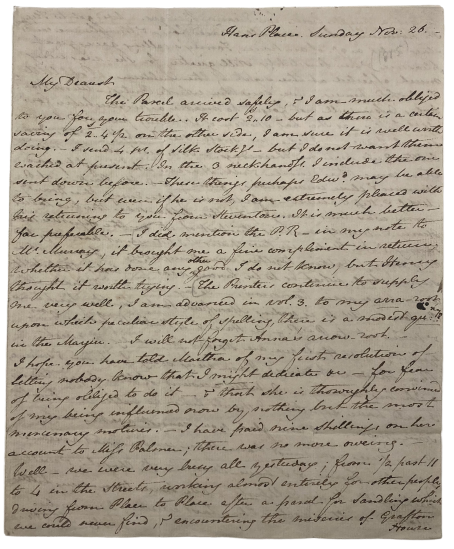
Some historians also surmise that Cassandra wanted to protect the privacy of her sister. Jane was known to be very blunt and straightforward in her commentary and it is possible she was a bit opinionated about some in the family or others the family knew. Cassandra didn’t want people to see those comments. Or she might have wanted to protect Jane’s love life from a curious family and public.
Either way, some vital information that would have shed even more light on who Jane was in her personal life is no longer available.
Some of those bits of information would have been about her love life – like if she really was going to marry Rev. Brooks Edward Bridges, who is mentioned in Miss Austen Regrets, or Tom LeFroy who is mentioned in her letters (and other movies).
According to an article on the Jane Austen Society website, in 1805 during a visit to Godmersham, Edward Austen’s estate in Kent, Austen wrote to her sister Cassandra: “[W]e could not begin dinner till six. We were agreeably surprised by Edward Bridges’s company to it. . . . It is impossible to do justice to the hospitality of his attentions towards me; he made a point of ordering toasted cheese for supper entirely on my account.”
While there are some who believe Bridges did propose to Jane and she may have turned him down, there is no evidence of this happening, mainly because of the above mentioned burning of the letters. Jane did, however, turn down an offer of marriage from the rich brother of a friend in 1802. She accepted, then rejected in one days time.
Someone else historians would like to know more about is Tom LeFroy who Jane was said to have flirted with quite often in her 20s. While some say Tom may have broken her heart at one point, some historians say they don’t believe so based on the lighthearted tones of letters she wrote to Cassandra that mentioned Tom.
Jane met Tom, an Irishman, in 1795 when he was studying law in London. They attended several balls and dances together but then he went back to law school and she went back to writing.
“We don’t even know if Jane wanted to marry, which would almost certainly have meant giving up any chance to be a writer,” reads an article on Jane Austen’s House. “She certainly didn’t pursue marriage at all costs, as some of her female characters do. . . Her great love was her writing. Her books were her children – she famously referred to Pride and Prejudice as her ‘darling child’.”
[Read more about Jane and Tom in this article: https://janeaustens.house/online-exhibition/jane-austen-in-love/.]
The Bronte sisters also didn’t marry, except Charlotte.

Right: The collodion photo which dates from the 1850s.
If these are the Bronte sisters then the photo is a copy of an 1840s daguerreotype.
(credit: https://brontesisters.co.uk/)
The Bronte sisters are famous for the books: Jane Eyre, Villette, and The Professor by Charlotte, Wuthering Heights by Emily, and Agnes Gray by Anne.
Though she married, Charlotte died without ever having a child leaving no Bronte heir, though there were many who believed she was pregnant at the time of her death. Some historians now believe she died of hyperemesis gravidarum, which causes pregnant women to become very sick and constantly throw up, leading to dehydration and death if not treated.
There are rumors that Charolette’s younger sister Anne was in love with a local curate and he may have felt the same about her, but Emily was never linked to anyone romantically, despite the passion of one of the Bronte sister’s most popular books, Wuthering Heights.
While some base their assumptions that Emily had a romance with someone named William Weighton from a movie loosely based on Emily’s life (it isn’t easy to make a movie about her life that isn’t conjecture since she was a recluse who died at the age of 30), an article on the Digital Spy says that there is more evidence that William and Anne were actually the ones in love with each other.
“William Weightman was a real person, and he really was Patrick Brontë’s curate in the Haworth parish from 1839 until his death from cholera in 1842,” the article states. “He became good friends with all the Brontë siblings, and, in his eulogy, Patrick said he was like a son.”
In a letter to a friend, Charlotte Bronte wrote, “He sits opposite Anne at church sighing softly and looking out of the corners of his eyes to win her affection – and Anne is so quiet, her looks so downcast – they are a picture.”
Some believe that Anne’s best-known novel, Agnes Gray, was written about her feelings for William. She also wrote some very heartbroken poems after his untimely death.
While most reports say the deaths of Emily and Anne and their brother were caused by tuberculosis, some information suggests their deaths were both from the effects of tuberculosis (which claimed two other sisters years before) and a weakened immune system caused by their drinking water being tainted by decomposing bodies from the town cemetery. (Read more about that here and here.)

Another one of Patrick Bronte’s curates fell for Charlotte Bronte and was married to her for the last nine months of her life, which I find so heartbreaking. Charlotte was 38 when she passed away. Her husband, Arthur Bell Nicholls lived until he was 87 years old. He cared for Patrick Bronte after Charlotte died because she was the last of Patrick’s children. Arthur eventually moved back to Ireland, left the ministry and remarried. There is a lot of debate over whether his marriage to Charlotte was really for love as well as how he handled her estate, including her manuscripts, after her death.
The love affair between him and Charlotte does seem legit, though, from what I’ve read. It almost didn’t happen because Patrick didn’t think a poor Irish curate should be asking his famous author daughter for her hand in marriage. Arthur apparently left the parish at one point because he could not marry Charlotte but continued to meet her in secret. He had originally asked Patrick for Charlotte’s hand in marriage in 1852 but it took Patrick until 1854 to allow them to marry.
Poor Charlotte was dead a year later.
Arthur ended up spending much of his life after her death defending her reputation and dealing with the fallout of it being announced that she was the real author of Jane Eyre. After Patrick died, he took the manuscripts and other personal items of the family and moved back to Ireland.
Here is an interesting blog post about images of the Bronte sisters (including the possible one above) for further reading: https://whatsupwithbrontemania.wordpress.com/2017/02/17/blog-post-title-2/
There is heartache in the stories of many people from the past but for some reason, I always seem to find the heartache of those who wrote about love — and either didn’t find it or found it for only a short amount of time — the saddest stories of all.
Maybe that’s just because as much as I don’t like reading strict romances, I am really a romantic at heart.
No, romantic love is not all that life is about.
There is family and friendship love, experiences like traveling and just having joy with those close to us, and a relationship with nature, wildlife, God, and the overall beauty of the earth.
But when a person writes about love as if they want to experience it or experienced it and lost it — that makes me sad. I hate to think about them missing out on what they wanted so much.