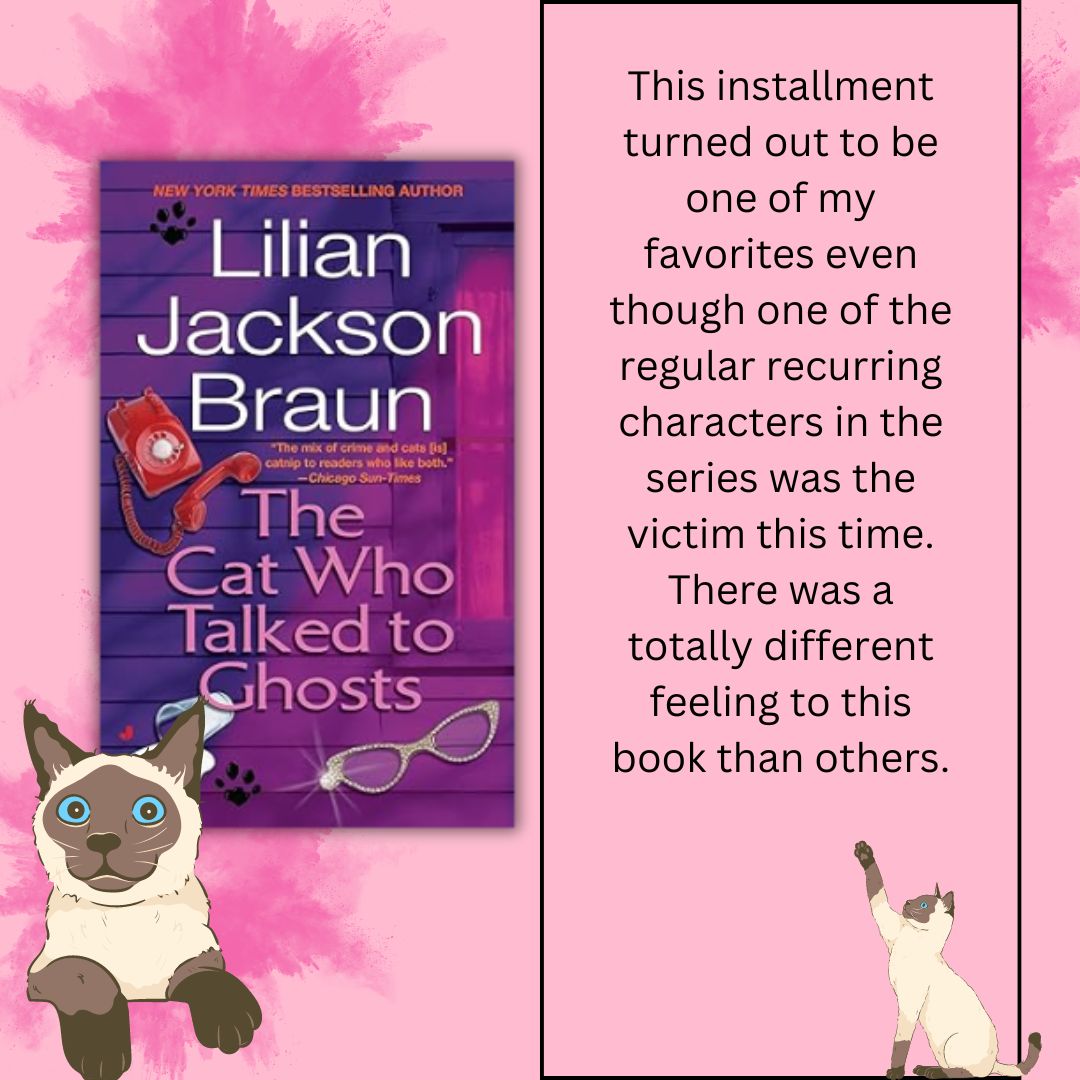
I have read almost all of the 29 books in The Cat Who series by Lilian Jackson Braun and there have been hits and misses and a couple all out duds – like any series.
Originally, I had skipped The Cat Who Talked To Ghosts because when I started it it seemed to be written in first person point of view and while I read books in first person POV, all of the other The Cat Who books are written in third. I wasn’t sure I would like the change.
It turns out, however, that only a section of the first chapter of the book is written in the first person point of view. The rest of the book is written in the third person.
I opened the book on my Kindle one night after a particularly hard day when I needed a comfort read. I’m glad I needed that type of read because this turned out to be one of my favorite books in the series.
For those who don’t know about this series, it features former big city newspaper reporter Jim Qwilleran (most commonly referred to Qwill in the series), now a small town newspaper columnist living in what I believe is Northern Michigan, though it’s never really said where the fiction town of Pickax in the fictional county of Moose County is.
Braun simply says Moose County is “north of everywhere.” According to the site Novel Suspects, “Though fictitious, Pickax is generally assumed to be based on the town of Bad Axe, Michigan, where Braun lived for many years.”
The series starts with Qwilleran living in the city (probably Chicago though it never really says), writing for a newspaper, and falling into a murder investigation or two. He ends up adopting two cats during that first book – a cat named Koko Kao Kung (Koko for short) and Yum-Yum. Koko is the one who has some mysterious skills that help Qwill solve crimes. Some of those skills include opening books, knocking things off shelves, or alerting Qwill to unsavory characters who look like nice people.
This installment deals with the murder of Qwill’s former housekeeper. She calls Qwill in the middle of the night, saying she has been hearing weird, ghostly noises at the apartment she lives in at the county museum, which she is the caretaker of.
Qwill heads out for the 20-minute-drive to her apartment but by the time he arrives, Iris Cobb is already dead on the floor of her kitchen, apparently frightened to death. Qwill wants to find out who killed her and the museum also needs a temporary caretaker so it works out perfectly when the chairman of the museum board asks if he knows anyone who can fill in temporarily. Qwill packs up the cats and moves into the museum himself to see if he hears the ghostly sounds Iris said she was hearing.
During the stay, Koko does his best to lead Qwill to the killer, including literally sniffing out clues and knocking particular books off shelves. In the process of trying to find Iris’s murderer, Qwill meets some interesting neighbors – a couple from the south who have a three year old daughter and a young woman living alone on a goat farm.
Qwill is thrown into a secondary mystery when another murder occurs but seems to be separate from the first. In all honesty, the first death very well could have been an accident since the woman had a heart condition and some health issues. Qwill will have to figure it out.
One thing to know about Qwill is that he is not a huge fan of children. He has no children. He doesn’t want children. The fact that a child was written into this story and he had to interact with said child offered a new layer to his character that was both funny and endearing.
This installment turned out to be one of my favorites even though one of the regular recurring characters in the series was the victim this time. There was a totally different feeling to this book than others. There seemed to be an actual focus on the mystery while in other books there is a lot of wandering around and rambling side stories that have nothing to do with the main mystery. That can be both a comforting and annoying aspect to the books.
I love reading about the quirky characters in Moose County but in some books, I think Braun forgot she was supposed to be writing a mystery.
Luckily The Cat Who Talked to Ghosts was not one of them. It revealed more of Qwill’s character as someone who cares more for children than he realized and who actually grieved more over a victim than in other books, most likely because he was so much closer to this victim than other victims.
This was also the book where we are introduced to Bootsie, Qwill’s girlfriend Polly’s cat who is hilarious referred to as a beast of a cat in future books.
The Cat Who books really do not need to be read in order since Braun briefly catches the reader up to who Qwill and the regular characters are in each book. I would highly recommend this one for any lovers of cozy mysteries.
I have been wanting to put together a list of cozy reads for Spring but then I realized something – I’m not sure if what I see is cozy is what others would see as cozy. Also, they are cozy for me, but do I only read them in spring? I don’t know. Not really. Unlike others who share such book recommendations, I don’t have a book I read each spring. It’s not something I do for whatever reason. I have re-read a couple of these books but not in spring.
Anyhow, I’m going for it anyhow before spring is gone (though it’s so cold out, my area thinks it is winter!) and recommend some books I feel fit spring and some that you could really read any time.
(Note: There are affiliate links in this post that I could monetarily benefit from. That’s not why I wrote the post though. The links were an afterthought.)
Really anything from The Mitford series fits for cozy reading in my opinion. Sure, there are some tough topics in the books, but they are mixed in with enough light humor and sweetness to make it easier to take in.
I enjoy this one because it chronicles the romance of Father Tim, an Episcopalian priest, and his neighbor, Cynthia Coppersmith.
It’s such a sweet romance that leaves you rooting for this older couple who are finding love in their golden years. It is nothing like the romances out there in the world today. It is a sweet, gentle story of friendship that blossoms into love. No kisses or swooning or cheesy physical descriptions of them checking each other out.
“Oh, Timothy, how could you not have loved someone all these years? Loving absolutely seeps from you, like a spring that bubbles up in a meadow.”
“Maybe you can convince me of that, but I doubt it. I find myself self-seeking, hard as stone somewhere inside. Look how I’ve treated you.”
“Yes, but you could never deceive me into thinking you were hard as stone. You’ve always betrayed your tenderness to me, something in your face, your eyes, your voice …”
“Then I have no cover with you?”
“Very little.”
“ ‘Violet only wanted a friend,’ ” he quoted, “ ‘but every time she tried to have one, she did something that chased them away.”
~ A Light in the Window
Throw in a bunch of other quirky and fun characters and I can’t help but to be charmed by the world Jan has created in the pages of this book and the entire series. There are 14 books in all.
This is the story of a pastor Jake Wilkerson who is disillusioned with his job when he meets a cat named Petey who seems to always be in the way and leading to situations that make Jake think differently about life. The story takes place in a tiny little town about an hour from where I live and close to where my brother lives, which I didn’t know when I first picked up the book. I have a copy of The Dog That Talked to God too by him, but I haven’t read it yet.
Book description:
Jake Wilkerson, a disillusioned young pastor who is an expert at hiding his fears, takes on a new assignment at a small rural church in Coudersport, Pennsylvania–which is a far piece from anywhere and full of curiously odd and eccentric people. His first day on the job, he is adopted by Petey–a cat of unknown origins and breed–but a very sentient cat who believes that he is on a mission from God to redeem Jake and bring him back to the truth. Jake must confront his doubts early on when he meets Emma Grainger, a single woman and a veterinarian who dismisses all Christians as “those people.” Then, Tassy, a young runaway with a secret, arrives at the door of the church looking for a place of refuge. How does Jake deal with this runaway and his interest in Dr. Grainger? More importantly, can Jake rekindle his faith? Petey does his best to lead all people to the truth, in a most subtle and feline way.
Most people are familiar with this book, even if you haven’t read it. On the off chance someone has no idea what the book is though, it is a book about a young orphan girl who comes to live with an elderly couple in Prince Edward Island, Canada. The couple think they are adopting a boy to help them with their farm, but instead, they are accidentally given a girl who enchants them and enriches their lives.
Anne is a girl who daydreams her way through life. She loves to read, pick flowers, imagine grand situations and think the best of everyone. She has had to use all of those things to help her deal with a difficult childhood where she was in foster care and treated horribly by those who took her in. Those who did take her in mainly did so to have her as someone to either care for their children or do their housework.
I read this book to Little Miss last year, and she really enjoyed it. I’m making my way through the series of books (there are eight) but I gave up on book four, Anne’s House of Dreams, because the cute and humorous moments that were in the original dissipated by book four.
Any of the Cat Who books are cozy reading to me, but I picked The Cat Who Wasn’t Therebecause it was on my shelf and I remember that being one of the better ones. The books are written by Lilian Jackson Braun and there are a few duds in the series, especially toward the end.
These books are the story of Jim Qwilleran, a retired newspaper reporter who moves to a small town called Pickax in Moose County, up toward the Canadian border after he founds out he has inherited a wealthy woman’s entire fortune, even though they weren’t actually related.
Qwill writes a column for the local paper and lives in a barn that has been turned into a house with his two Siamese cats. He frequently finds himself wrapped up in various mysteries that occur in the town. The series starts with Qwill living “Down Below” which refers to the city or anything south of this rural area in the north. I’m guessing this town is based in Minnesota or Michigan, but I don’t know that it’s ever really made clear what state it is in. Qwill used to work in Chicago, I believe. It’s Down Below where he acquires his cats. Koko, the male, is the one who “helps” Qwill solve crimes by conveniently knocking over plants or pawing at books or finding clues, or simply acting weird around a suspect. Yum-Yum is there mainly for comic relief. She’s a sweet kitty who often “steals” items from visitors so she can bat them around for fun later.
She was kidnapped in one of the books and I swear I almost had a heart attack. These are very light reads so I figured she would be fine but I just couldn’t stop reading until Qwill had her safely in his arms again.
Back to this particular book, which is about Qwill traveling to Scotland with other regular characters from the book. During that trip one of the people who comes with them as a guide (not a regular) is murdered and the crew returns to Pickax sad and in need of finding out who killed her. Koko wasn’t on the trip but even he gets in on the sleuthing when Qwill returns home.
There is also a little bit of romance in the books between Qwill and the town librarian, Polly Duncan, but like A Light in the Window, it is not a romance about kisses and physical description. It’s more like a friendship romance.
For a list of all of the 29 books in the series see this site:
I have been reading through the All Creatures Great and Small books by James Herriot over the last few years and they are cozy reads for me.
There are eight books in the main series, but Herriot, whose real name was actually Alfred Wight, also put out collections of short stories, and then other books were compiled with the original stories and photos so online there looks to be 19 different books by Herriot. I only own one in paperback. I own six of the eight main books about his beginning years as a vet in the Yorkshire Dales in ebook form.
I like how each chapter is a little story all its own. I read a chapter here and there when I do read the books and it is like escaping into a little cocoon of comfort. Right now, I am readingThe Lord God Made Them All.
I cannot tell you which each book is about because they all sort of blend together in a collection of stories about his life and job. The one I am reading now takes place after he was in the war. He’s now married with his first son and is no longer living in the same house as Siegfried Farnon, whose real name was Donald Sinclair. I don’t like the writing style in this book as much as the others because he seems to be slipping between past and present tense at times, even in mid-sentence, but the stories are still entertaining.
For spiritual books I enjoy in Spring, there is Gracelaced, a devotional book by Ruth Chou Simons. The art and words inside the book are beautiful. I only picked this up last year but I can tell it is going to be a favorite of mine in the spring when the flowers are blooming but also all seasons when I need to look at some beautiful paintings of flowers.
A children’s book I enjoy reading with Little Miss in spring is Share, Big Bear, Share by Maureen Wright, who is a local author to us.
The book is about Big Bear’s need to share his stash of blueberries with his friends and I guess blueberries often grow in the summer, not the spring, but for some reason the book feels spring-like to me.
I’m sure there are other books I enjoy in spring but haven’t thought about for this post. They’ll just have to wait for next year.
Since I got this idea after my friend Erin and a YouTuber we watch posted their favorite cozy spring reads, I thought I’d link to their suggestions as well.
I’m a stickler for books set in smaller towns with a large cast of fun and quirky characters, if you couldn’t tell by the stories I share on here for Fiction Friday.
I mention The Cat Who books by Lilian Jackson Braun from time to time and when I do I write that I am reading one as “comfort reading.” I consider them comfort reading because I used to read them when I was a teenager. For me, reading about James Mackintosh Qwilleran and his Siamese cats, Koko and Yum-Yum, and the cast of characters around them, feels oddly like coming home.
I call them The Cat Who . . . books because all of the book titles start with The Cat Who . . . followed by something the cat did.
Examples include The Cat Who Played Brahms, The Cat Who Sang for the Birds, The Cat Who Lived High, and The Cat Who Sniffed Glue. There were 29 books written between 1966 and 2007. There were 18 years between the third and fourth book and after reading that in an article while researching for this post, I started to wonder what the delay was all about. What did Braun do in between and what made her pick up the series again? I did some digging and learned there were a few reasons for the break, including the death of her husband and the fact that she was working at The Detroit Free Press as the “Good Living” editor during that time, and for 30-years, retiring in the late 70s. The other, bigger, reason for the break, though, was that when she turned in the manuscript for the fourth book, the publisher said they were interested in books with more sex and violence.
Luckily Braun was able to find a publisher in the future who recognized that not every reader wants books full of sex and violence.
As a writer who has started writing fiction fairly “late in life,” I found it interesting that Braun published her first fiction book at the age of 53. She was 97 when she passed away and her husband told a newspaper that her biggest regret was dying before she could finish her 30th book, The Cat Who Smelled Smoke.
When she did release a new book in 1986, after that 18 year break, it was called The Cat Who Saw Red. It was published under a new publisher and nominated for an Anthony Award and an Edgar Award in the best original paperback category. The new publisher also re-released her other three books.
The original cover of the first The Cat Who book.
The second book with the original cover.
The third book with the original cover.
The books always offer a mystery, of course, usually in the form of a murder or two, but woven within the mystery are hilarious anecdotes about the people of Pixax, the town James Qwilleran, a retired crime beat journalist and columnist, has settled into.
The series started out with Qwilleran working “Down Below”, as the country folk call the city of Chicago. After inheriting some money from an eccentric distant relative (who, if I remember correctly he wasn’t even biologically related to), he ends up moving to the tiny town where many of his mysteries occur, which makes me ask, “how many criminals live in this one tiny town?” That thought always makes me a bit paranoid, since I also live in a small town. After reading one of these books (or watching an episode of Murder She Wrote) I start looking at my neighbors in a different light.
“Do you think Mrs. Smith down the road is capable of murder?” I might ask my husband, but I don’t actually since there isn’t a Mrs. Smith down the road. Or sometimes I think, “What does Mr. So-and-So have in those containers in his back yard? Compost or . . . bodies?!”
Anyhow, back to the books. Not all of them aren’t all winners, a couple of them are stinkers, only saved by the cats and quirky characters. Still, I keep reading them, enjoying the feeling of coming home, in a way, much like I do when I read and re-read the Mitford books.
It isn’t only the quirky characters and pets that captures my interest in the books. Being a veteran of the journalism world, I also find myself drawn to the parts of the stories that involve reporting and the newspaper office. The characters of the small town newspaper are about as odd as some of the people I used to work with, but not quite.
When the subject of reporters and journalists come up in a conversation, I often comment that a newspaper’s newsroom is full of people who are two clicks away from being certifiably crazy. Then I remember I was once one of those people and wonder what that means about me. I guess it means I was the only sane person in the four newsrooms I worked in over my 15-year career.
Braun’s own career in journalism helped her to become a prolific novelist, releasing one or two books a year. She said she was used to continously writing after doing it for 50 years. I can relate to the idea of being used to writing often and a lot, since that’s what I did when I worked at newspapers, but of course I only did it for 15 years, not 50!
When I picture Qwill in my mind he’s a cross between Sam Elliott and a former boss of mine (who incidentally no longer has the mustache he used to have). Qwill is an old school newshound with a passion for digging up the answers to mysteries, even after he stops working as an investigative reporter and knows it isn’t his place.
How I picture Qwill but without the long hair.
Getting to the bottom of something was my favorite part of being a reporter. I loved to dig for the news, but I was nowhere near as good at is as my husband is. He’s like a dog with a bone. When he gets a tip, he’ll dig that thing out of the ground and bring it in the light no matter who tries to stop him.
He isn’t as obsessed with it as I am, though. I remember laying awake at night wondering what the local school board or district attorney was hiding from me while he comes home, drops the mystery at the door, picks up a book and doesn’t pick up work things again until the next morning. Usually anyhow. Some nights he does lay there worrying about work things, but not necessarily a story he is working on.
Throughout the books, Qwill ages from his late 40s to his mid-50s. He is a divorced, slightly overweight, former alocholic who now declines offers to drink any alcohol when the books first start. He loses the extra pounds as the series progresses.
Women find him irrestible, Braun writes, and one reason they do is because of his “luxurious mustache.” He also has salt-and-pepper hair, but it is the mustache that is the most intriguing, not only because of it’s appearance.
An excerpt from an article on Wikipedia describes the role of the mustache perfectly.
Whenever Qwilleran gets a suspicion that something is wrong or his instincts are right, he will get “a tingling sensation on his upper lip.” Depending upon the strength of the sensation, he may be seen “stroking it with his fingertips” to “pounding [his mustache] with his knuckles”.
Characters in the books (especially women) are also drawn to Qwill because of his willingness to listen, a skill he picked up in his job as a reporter. It’s a skill I picked up as well. I found that the more I let a person talk, the more they would tell me, without even realizing they were telling me it. Idle chitchat also helped relax the subject of a story or the person I was interviewing. I never felt like I was manipulating the person. I was simply reminding them that I was human too and helping them to feel comfortable with talking to me.
Qwill uses this tactic in his reporting, but also in his sleuthing. It may appear to the reader that the character is simply telling Qwilleran about the new decor in their homes, but Qwilleran might hear something quite different, including the fact that the person who designed the new look for their home new the victim in a recent crime.
Now, I would be very remiss if I did not mention that Q’s cat Koko helps him solve his crimes in unusual and distinct ways. Koko sometimes yowls at the guilty person, flips a book to a page that offers a clue, or leads Q to a clue when they go on their walks, with Koko on a harness and leash.
Koko’s full name is Kao K’o-Kung and he is named after a 13th-century Chinese artist of the same name. He was once owned by an art critic who Qwill used to work with at the Fluxion, a newspaper Down Under. His first owner fed Koko a gourmet diet of lobster, chicken, and other fancy meals, which means he won’t eat normal cat food.
Qwilleran later adopts Yum-Yum, another Siamese, and ends up having to feed both cats expensive food on his sometimes meager salary, which of course expands when he inherhits a fortune and mansion later in the series.
While locals often credit Qwill when he solves a crime, there are some who know Koko is the real brains in the operation, as shown by this exerpt from The Cat Who Played Brahms:
“Qwilleran’s Siamese cat was a celebrity at the Press Club. Koko’s portrait hung in the lobby along with Pulitzer Prize winners, and he was probably the only cat in the history of journalism who had his own press card signed by the chief of police. Although Qwilleran’s suspicious nature and inquisitive mind had brought a few criminals to justice, it was commonly understood at the Press Club that the brains behind his success belonged to a feline of outstanding intelligence and sensory perception. Koko always seemed to sniff or scratch in the right place at the right time.”
In addition to the newspaper angle, I, of course, like the way the books nail the personality of cats, especially Siamese, right on the head. I had a cat that our vet said was part Siamese and he was a very interesting cat, so I relate to the way Braun writes about cats as well as the mysteries.
Being a cat lover, and the owner of two Siamese herself, Braun certainly had first-hand experience about the behavior of cats.
Braun with the Siamese she named after her literary cats.
The good thing about these books is that they are fairly simple and straight forward. They aren’t raunchy, have very little to no swearing, and don’t feature grotesque or detailed descriptions of violence. They are almost completely void of romance, other than a very tame, chaste storyline involving Qwill and town librarian Polly Duncan.
I have been having fun snatching books from the series up at book sales but have also purchased a few through my Kindle. I don’t know why, but I prefer reading The Cat Who books as hard copies, maybe because that’s how I started reading them when I would sign them out at the local library.
So, how about you? Do you have a series of books that are like “comfort reading” to you? I would love to hear about the series.