Comfy, Cozy Cinema: The Englishman Who Went Up A Hill But Came Down a Mountain

Erin from Still Life, With Cracker Crumbs and I are hosting the Comfy, Cozy Cinema again this year.

Our movie this week was The Englishman Who Went Up A Hill But Came Down A Mountain.

There are three things to know about this movie: It is based on a Welsh legend (but not actually true), it a romantic comedy, and it has the longest title of any movie I have ever watched.

First, let’s have a little description from online:

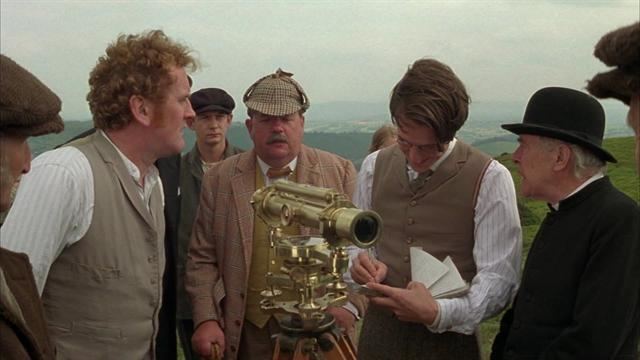
During the days of World War I, a small Welsh town relies on its local mountain as a source of pride. When two English cartographers, Reginald Anson (Hugh Grant) and George Garrad (Ian McNeice), arrive to measure the mountain, they discover the landmark is 16 feet short of achieving the official mountain classification. Disheartened that their mountain has been deemed a hill, the townsfolk devise a plan to make up those 16 feet. Meanwhile, Anson falls for a local woman (Tara Fitzgerald).

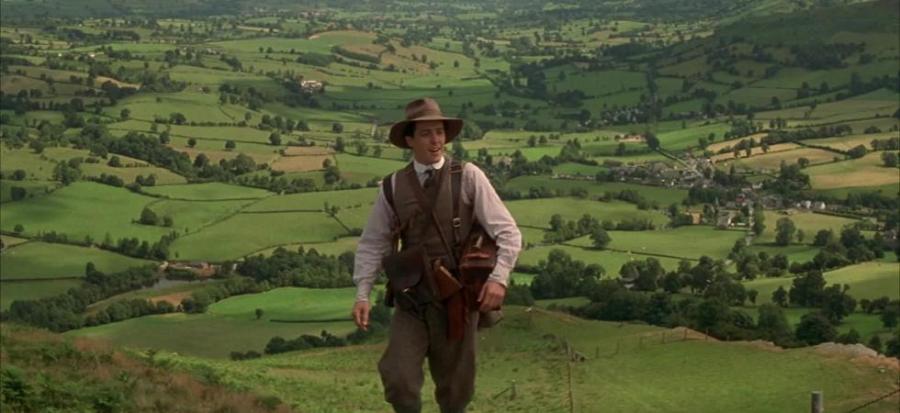
This movie has all the things I like — Quirky characters and story, beautiful views, dry British humor, and a bit of romance.
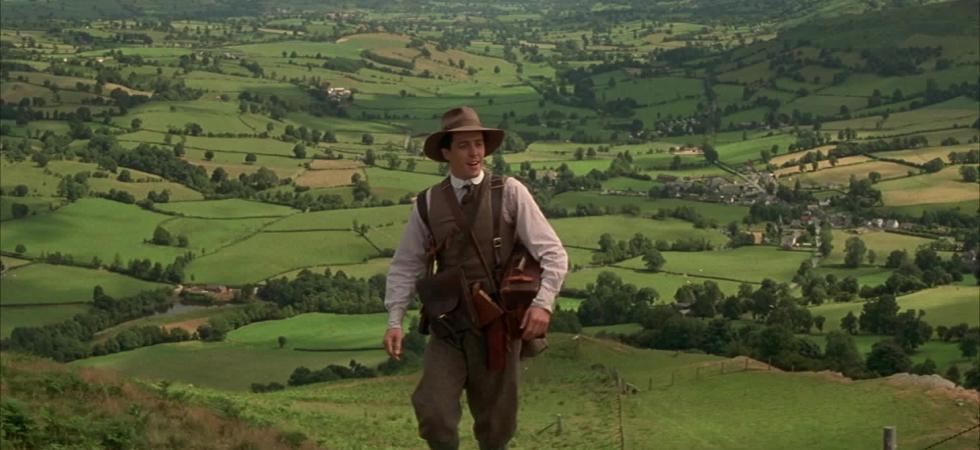
 Hugh Grant is adorable in it and Colm Meany ads a bit of humor (even if he is a dirty scoundrel).

It is free of bad language, sex, or violence.

Well, let’s talk about the sex a bit. There are suggestions of it being engaged in, but none is shown.

The movie starts with the narrator explaining that a lot of people in Wales, where the movie takes place, have the same last name so people began to attach their occupation to their name. This is why a little boy wants to know why one man had a very long occupation attached to his name. He asks his grandfather and the grandfather begins to tell the story.

We then switch to Hugh Grant’s character, Reginald Anson (there is no way to say that name without using a British accent by the way. Try it. I dare you. It doesn’t sound right in an American accent) riding into a small village with another man, George Garrad, portrayed by Ian McNeice.
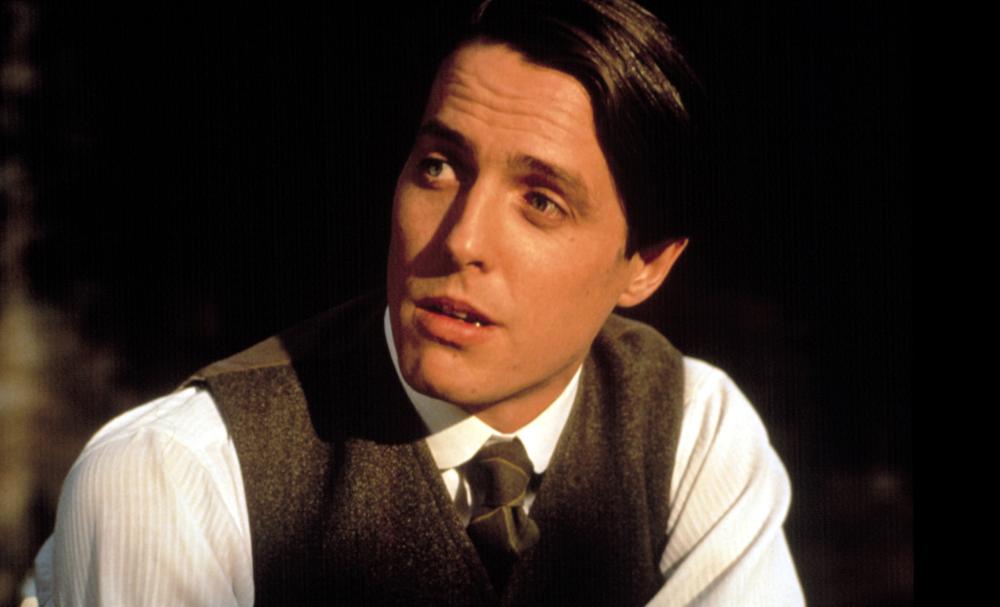
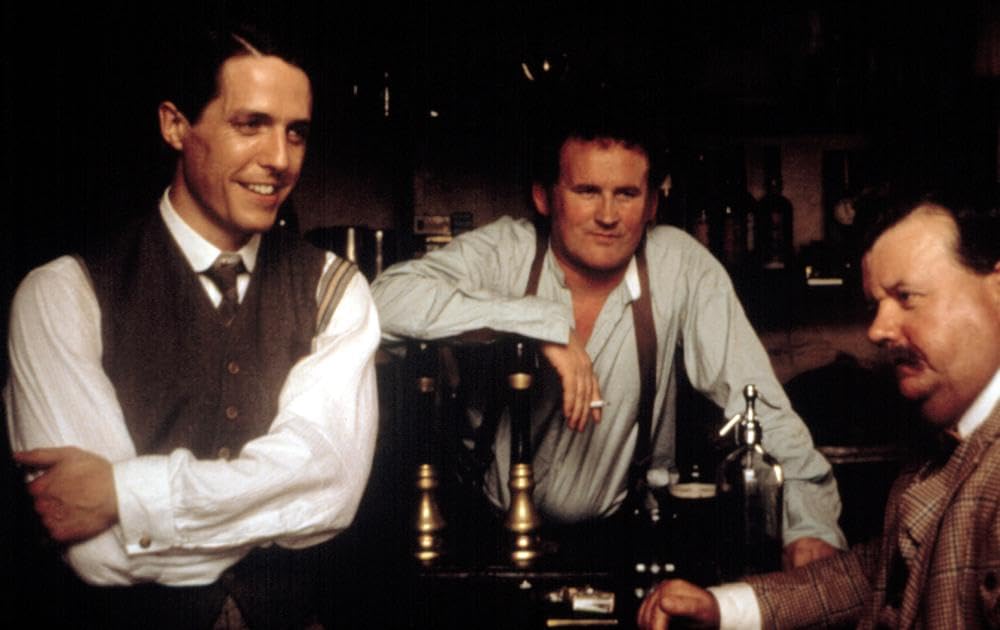
They pull up to a barn and inn, looking for a place to stay. The bar is owned by Colm Meany’s character.

Colm Meany is called Morgan the Goat. Why is he called this? Well, Morgan is taking advantage of the fact that man of the men of this village are in France fighting in the war. He’s keeping the wives of these men company, shall we say. This is why the church is full of babies that look a lot like Morgan, which absolutely infuriates the minister, Rev. Jones, portrayed by Kenneth Griffith.

So, Reginald and George explain to Morgan that they are there to conduct some surveys to record the topography of the area for the war effort because it is important to know the lay of the land in case the enemy invades.

If they are going to be checking out the local topography, Morgan suggests they check out the only mountain in Wales —  Ffynnon Garw.

George a bit of a laugh but eventually they agree they will check the “mountain” out as part of their effort. The only problem is that they don’t really think it is a mountain. See, to be considered a mountain in the UK, the elevation has to be at least 1,000 feet. The cartagrophes don’t think that will be the case when they measure. This upsets the people of the town who have pride in the fact they have the only mountain in their country.

The reverend is especially riled up at the prospect of the mountain being classified as a hill.
When it is discovered that Ffynnon Garw isn’t a mountain, well, all hell breaks loose and many touching, ridiculous, and heartbreaking moments unfold as Morgan decides to delay Reginald and George from leaving while the town’s people find a way to make the hill a mountain.

The reverend and Morgan don’t get along at all but the reverend agrees that it is important to make the hill a mountain to boost morale of the village during the war.

Some of the fun or interesting characters in this movie are the twins with the same name, Johnny Shellshocked (who suffered PTSD in the war), William the Petroleum Man, and Davies the School.

One con of this movie, for me, though, I loved it, was the romance. It was late in the movie, no time for development and I felt like it was just thrown in as a last-minute idea. The posters for this movie with the actress and Hugh Grant on the front are baffling to me because she really wasn’t that important of a part of the movie for me.

Some trivia/facts about the movie:

  • This movie was written by  Ifor David Monger, the grandfather of the director Christopher Monger who told his son about the real village of Taff’s Well, in the old county of Glamorgan, and its neighboring Garth Hill.
  • Due to 20th century urbanisation of the area, it was filmed in the more rural Llanrhaeadr-ym-Mochnant and Llansilin in Powys.
  • The narrator begins by remarking that “For some odd reason, lost in the mists of time, there’s an extraordinary shortage of last names in Wales.” Actually there is a known reason: as part of their increased domination of Wales in the 16th century, the English abolished the Welsh system of patronymics and introduced surnames arbitrarily. (source IMbd)
  • “Despite the implication in the film, and the real-life local legend, the story is fiction. Historians have determined that the mound at the summit of Garth Mountain (the inspiration for the movie) is a Bronze Age burial mound. In 1999, local officials and the History Society placed a sign on the mountain, telling the many climbers who’ve been coming there because of the movie’s popularity of the site’s real significance – and warning that they face two years in prison if they disturb the burial mound.” (source IMbd)
  • When Williams the Petroleum breaks a piece of the Englishmen’s car and pretends to discover it, he says he doesn’t know the English name for it, but in Welsh it’s called a “beth-yn-galw.” “Beth-yn-galw” translates more or less to “whatchamacallit”. (source IMbd)

To read what Erin thought about the movie, visit her blog:

Have you ever seen this one? What did you think of it?

You can see the rest of the list of movies in this cool graphic that Erin made:

Jane Austen January: Sense and Sensibility (limited spoilers)

This month Erin from Still Life, With Cracker Crumbs and I are watching movie adaptations of Jane Austen books.

First up is Sense and Sensibility.

Sense and Sensibility was the first Jane Austen movie adaptation I ever watched. I started it, thinking I’d hate it but ended up falling in love with it.

I’ve now watched it three or four times.

I’ve decided to “live blog” this one as I watch it, similar to how I wrote about Persuasion and again I will not provide spoilers in case you’ve never seen the movie or read the book.

Erin joked that last week’s post was like a Mystery Science Theater 3000 post and I liked that comparison so consider this a blog version of Myster Science Theater or Rifftrax.

Before I start I will relay a couple paragraphs from Wikipedia about the basic plot of the book and film:

“It tells the story of the Dashwood sisters, Elinor (age 19) and Marianne (age 16½) as they come of age. They have an older half-brother, John, and a younger sister, Margaret (age 13).

The novel follows the three Dashwood sisters and their widowed mother as they are forced to leave the family estate at Norland Park and move to Barton Cottage, a modest home on the property of distant relative Sir John Middleton. There Elinor and Marianne experience love, romance, and heartbreak. The novel is set probably between 1792 and 1797 in Sussex, West England.”

So the movie opens with a man dying and he wants his second family taken care of and asks his son, John, to take care of his second wife and three daughters.

We know right away that the promise the son makes to his father on his father’s deathbed will not be kept because he already looks swarmy.

Op, yep. Swarmy to the core and his wife is even worse. She has the most evil ideas and a very pinched face. It’s no surprise her name is Fanny.

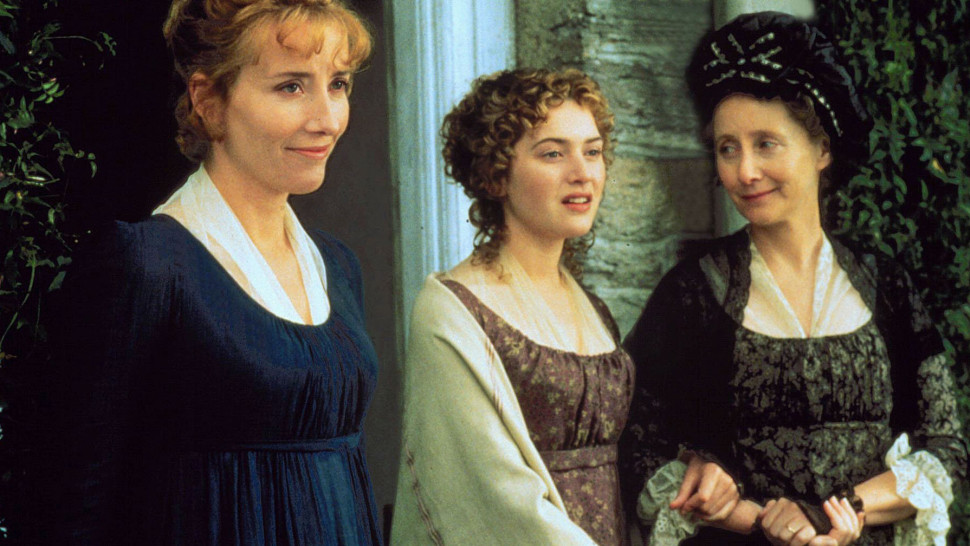
As we get to the young ladies who have been left behind, Marianne is playing a very sad song on the piano and we will be introduced to the humor injected into the film by Emma Thompson and her perfectly timed sarcasm and whit.

She asks Marianne to play something different because the music is making their mother weep even more over the death of their father.

Marianne tries a different song but it’s even more depressing than the first.

“I meant something less mournful, dearest,” Emma’s character (Elinor) quips from the other room.

It’s so funny to watch a family mourning yet feeling a bit like you want to giggle over the behavior of Marianne and the over dramatic mother who is flustered because they are being kicked out of their home by the cold and heartless half-brother and his wife.

It was an awful time, though – where men inherited everything and daughters were kicked out of their homes. These women will go from wealth to poverty very quickly which will be a shock to them but in some ways, I think they will be better off poor, without the stuck up rules of the rich back then.

Oh. Hugh Grant in his prime. Hello. Playing Edward Ferrars, Fanny’s brother.

Good grief those high collars look ridiculous, though.

He’s so polite. Unlike his sister. Odd how they were both raised in the same family and he is so much nicer.

Gemma Jones, Elizabeth Spriggs, Emma Thompson, Alan Rickman, Kate Winslet, Hugh Grant, James Fleet, Greg Wise

And he and Elinor – well, I promised no spoilers but, well, the fact they get along so well is certainly making Edward’s evil sister very, very upset. It’s making Elinor’s mother hopeful because she’d love to get her house back again or at least a very nice house.

Honestly, they’re both a bit conniving. The whole idea back then that men could only marry those who were in their “class” is so disgusting and annoying. I love that Jane knew that and instead writes about marrying for love and not prestige.

Barton Cottage. Sigh. It’s so cute. So much nicer than those big, drafty mansions. Well, then again, they are shivering and grabbing extra blankets in the cottage to show how drafty it was as well.

Sir John offers the women the cottage. He is Mrs. Dashwood’s eccentric cousin with an even more eccentric wife.Yes, Sir JohnOr as I remember him – Siegfried Farnon from the original All Creatures Great and Small show from the 1980s or 70s. Whichever. I used to watch it on PBS with my mom.

Or as I remember him – Siegfried Farnon from the original All Creatures Great and Small show from the 1980s or 70s. Whichever. I used to watch it on PBS with my mom.

Ah. Colonel Brandon. Strangely attractive even though I’ve never had a thing for Alan Rickman.

Not sure how I feel about him looking at Kate Winslet. He’s probably old enough in real life to be her father. He’s probably supposed to be younger in the movie. Or not. Who knows. It was a different time.

The cinematography and scenery in this movie is so beautiful – like most of the Jane Austen movies. Sweeping landscapes and towering Victorian mansions, beautiful dresses, handsome men and women.

Enter another handsome character – John Willoughby. Alas, he might not be as dashing as we think. We will have to watch and see.

Hugh Laurie. I totally forgot he was in this. He’s the guy who played House and the man who my son says is weird to hear with an English accent and that he thinks that Hugh’s English accent is actually fake.

I can’t figure this Willoughby out. He seems so delightful and interested and invested in the family, not just Marianne, but … there’s something just not right. He wants Marianne and her family yet – I won’t say. You’ll have to watch the movie.

Again, though, the rules of class and who you could and could not date back then were just ridiculous.

Poor Elinor. She is the only stable one in the whole family it seems. Holding it all together.

Everyone around her seems completely crazy.

Lucy Steele. She breezes in and just adds to the crazy. You’ll see. Completely delusional.

I pretty much want to throttle Marianne through this entire movie.

Robert Ferrars. Eek. That is all.

Were people really this uptight in the 1700s or just the British? I know they weren’t always uptight but these period dramas just make them so…proper. I’m drawn to the characters who aren’t very proper in these movies.

Elinor seems proper in some ways, but real in others.

There are a lot of confusing twists and turns in this one.

A couple people need a good slap across the face.

One needs a right shake and wake up call, but she’s young so I’ll try to cut her some slack. Plus, there are a couple of scenes where my heart just melts for poor Marianne. She had such high hopes and fell so hard only to be rejected in such a public way.

An aside – get Colonel Brandon some blasted blankets too! He’s an old man! He could catch his death. My goodness.

Alan Rickman was such a good actor too. At one point when Marianne finally notices him – his expression from hesitant to touching. Sigh. Just swoon-worthy.

I won’t spoil the ending so I will wander off here for a bit to discuss the history of the book and some behind-the-scenes of the making of the movie.

The book was published in 1811 and was Austen’s first novel. It was not published under her name but instead, the title page simply read: written by “a lady.”

It was published in three volumes to begin with and the cost to publish them cost more than a third of Austen’s annual household income. She paid for the books to be published and barely made a profit off them. She made $178 on the 750 publications sold, which would be about $6,358 today. As a self-published author myself, I certainly feel her pain and relate/

I did not know until this week that the screenplay for the movie was written by Emma Thompson and she won an Oscar and Golden Globe for it. She was 35 at the time the film was made.

According to Wikipedia, Thompson spent five years between other projects working on the screenplay. Thompson had never written a screenplay before so many studios were not interested in taking on the project. Showing a bit of a novice writer she was, she almost lost the entire project in a computer failure.

From Wikipedia, “As Thompson mentioned on the BBC program QI in 2009, at one point in the writing process a computer failure almost lost the entire work. In panic Thompson called fellow actor and close friend Stephen Fry, the host of QI and a self-professed “geek”. After seven hours, Fry was able to recover the documents from the device while Thompson had tea with Hugh Laurie who was at Fry’s house at the time.”

The film was directed by Ang Lee, a Taiwanese director and Lindsay Doran, the producer, chose him because of his past films about complex families. He was not familiar with Jane Austen at all.

In an interview, Lee said, “I thought they were crazy: I was brought up in Taiwan, what do I know about 19th-century England? About halfway through the script, it started to make sense why they chose me. In my films, I’ve been trying to mix social satire and family drama. I realized that all along I had been trying to do Jane Austen without knowing it. Jane Austen was my destiny. I just had to overcome the cultural barrier.”

In case anyone is wondering about Thompson’s age compared to how old Elinor was supposed to be, that was a concern brought up by Thompson herself. For one, she wanted Natasha Richardson and her sister Joely to be cast as the sisters, not herself, but Lee and the studio wanted Thompson because she was becoming well known as an actress.

Thompson finally agreed but they increased Elinor’s age to 27 instead of 19 to make the idea she was a spinster more believable to modern audiences.

I think the very ending is very fitting and serves a certain person right. If you’ve seen it let me know what you think in the comments.

In case you are interested, here is Emma accepting her Golden Globe for the film.

And here you can watch the making of the film:


If you have YouTube Prime you can also watch the full movie here:

If you want to read Erin’s impression of the movie, you can read her post on her blog.

Up next week we will be watching the 2005 edition of Pride & Prejudice.

Have you seen this version of Sense and Sensibility? What did you think of it?