
Since we couldn’t get to Paris for Spring, Erin from Still Life, With Cracker Crumbs and I have been watching movies this spring that take place in Paris.


This week we watched The Intouchables, a 2012 movie I suggested when I searched for movies that took place in Paris.
This was a rated R movie and had subtitles so it probably wasn’t the best choice for a movie watching event, but I’ll do a little better next time I choose movies. Despite those “drawbacks”, I really enjoyed this movie and felt it was fantastically acted and presented.
This movie was remade in America and retitled The Upside, starring Kevin Hart and Bryan Cranston. I have not seen the remake, but from what I’ve read online and just watching The Upside trailer, the original is much, much better.
The movie is based on the true story of Philippe Pozzo di Borgo and his French-Algerian carer Abdel Sellou, which Philippe wrote about in his 2001 memoir A Second Wind.
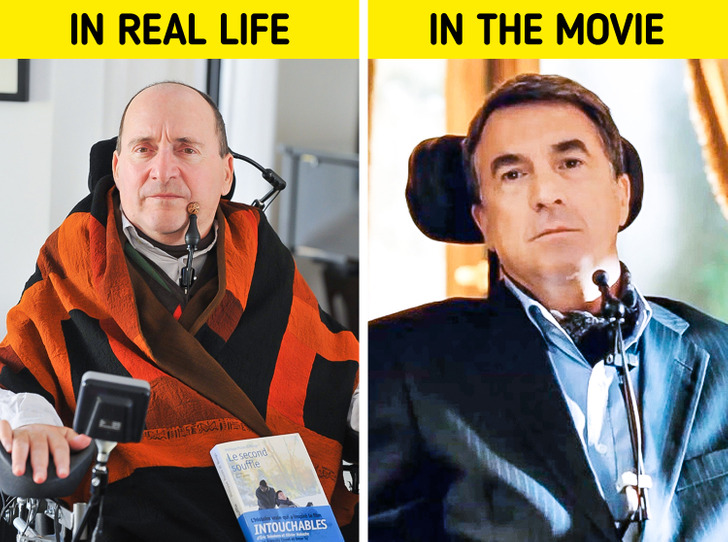
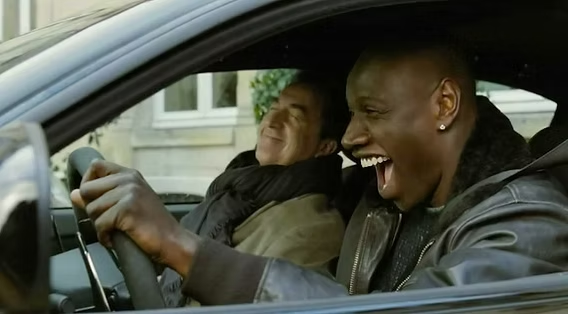
In the movie, the characters’ names are Philippe (Francois Cluzet) and Driss (Omar Sy). Driss needs a job after getting out of jail and arrives at Philippe’s mansion after seeing an ad for the job of helping to take care of Philippe, who is a quadriplegic.
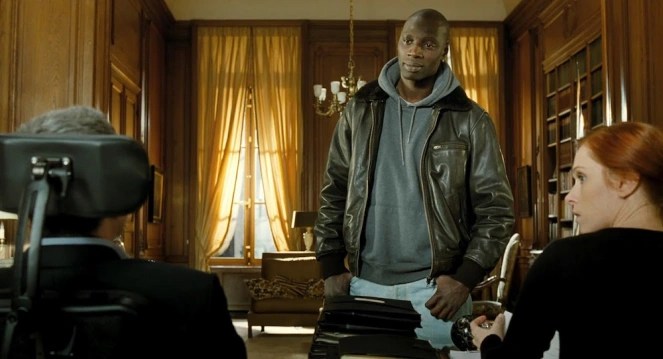
Driss doesn’t really want the job, he just needs his paper signed to show his parole officer that he is looking for work. He lets Philippe know that up front and not really in a very polite way. Not much is polite about Driss who has had a rough upbringing and was in jail for stealing.
Driss is in a for a surprise, though, because what Philippe’s assistant and others see as Driss’s rudeness, is refreshing to Philippe and he hires Driss to help care for him. He likes how Driss doesn’t pity him like others in his life. Driss doesn’t care about his disability and treats him as disrespectfully as he does everyone else.
Philippe let’s Driss know that part of the payment for the job includes a room in the mansion.
It’s a win-win for Driss who has recently been kicked out of his family’s home and needs money and a place to stay.
It’s also extremely overwhelming to him. At his family’s home he had to fight for time in the bathroom and to take a shower. At Philippe’s he is given his own bathroom with a large bathtub where he can relax and enjoy himself.
He definitely takes advantage of Philippe’s generosity, but he does begin to take his job seriously as he realizes all that it entails.
As the movie goes on the viewer learns how Philippe became a quadriplegic and more about his family, including his teenage daughter, who Driss often butts heads with, and how he became so rich.
We also learn more about Driss and his background, how he became involved in crime, his family, and what talents and dreams he has.


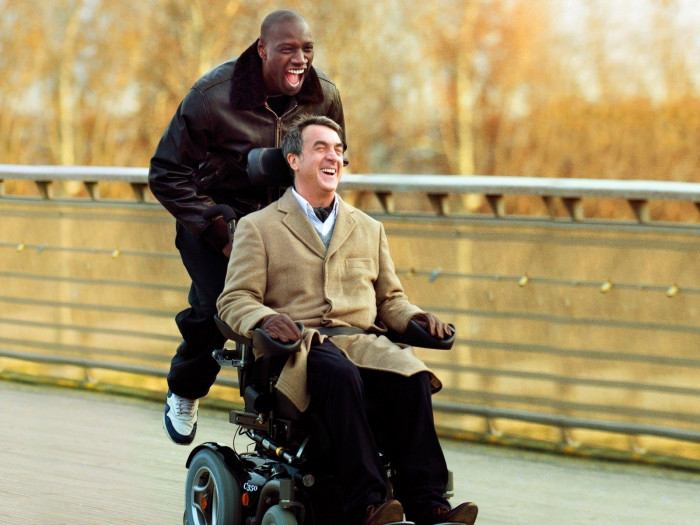
An unlikely friendship forms as Driss works to encourage Philippe to loosen up and live life again, while Philippe works to have Driss become a little more responsible.
Driss’s one big effort is to encourage Philippe to go on an in-person date with a woman he only writes letters to. Philippe is much more “sophisticated” and academic than Driss. He is “high society” and proper, but Driss dismisses all of this by asking him things like how he is able to feel pleasure if he can’t feel from the neck down, if he wants to be in a relationship again, and other off-colored topics that no one else in Philippe’s life would ask.
There is so much I loved about this movie, with the actors being at the top of that list.
They were both absolutely perfect for their roles.
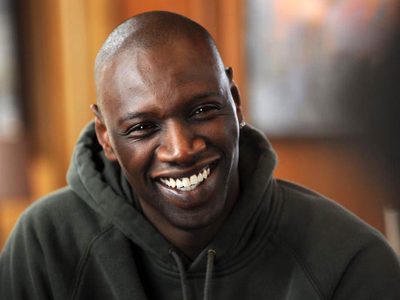
Sly’s subtle and no-so-subtle expressions to convey his emotions were great. Cluzet’s calm delivery in response to Sly’s more boisterous personality was perfection.
The movie has many messages but for me it shoed how a life can be changed when a person is shown that they are worth more and capable of more than they think they are. Driss and Philippe do this for each other.
Philippe shows Driss he can do more than steal and scrape by for a living. He opens Driss’s eyes to his talents and his intelligence and even a kindness Driss didn’t know he had. Driss opens Philippe’s eyes to all that he still has left in life despite his hardships and trials.
Their friendship was unexpected and what both of them needed to survive.

One spoiler I will give to relieve any worries that this movie will take a dark turn and end with Philippe’s death (which was my big worry) is that the real-life Philippe and Driss remained friends for years. Philippe passed away only two years ago at the age of 72, and lived a full, rich life as a philanthropist, friend, father, and husband.
From what I read online, this movie is beloved in France..
According to an article on Wikipedia: Nine weeks after its release in France on 2 November 2011, it became the second highest-grossing French film in France, after the 2008 film Welcome to the Sticks. The film was voted the cultural event of 2011 in France with 52% of votes in a poll by Fnac. Until it was eclipsed in 2014 by Lucy, it was the most-viewed French film in the world with 51.5 million tickets sold.
Film critic Roger Ebert reviewed the film shortly after it came out.
He did and he didn’t like it.
“The success of the film, despite its problems, grows directly from its casting,” Ebert wrote. “Francois Cluzet, who acts only with his face and voice, communicates great feeling. Omar Sy is enormously friendly and upbeat. He reminded me of the African immigrant played by Souleymane Sy Savane in Ramin Bahrani’s “Goodbye Solo” — a film that avoided the traps that “The Intouchables” falls into.”
Ebert continues, “The appeal of a film like this, and it is perfectly legitimate, is that when we begin to feel affection for the characters, what makes them happy makes us happy. Caught up in the flow of events, we allow many assumptions to pass unchallenged. The writer-directors, Olivier Nakache and Eric Toledano, are cheerfully willing to go for broad gags, and their style is ingratiating. But at the end, by looking through the foreground details, what we’re being given is a simplistic reduction of racial stereotypes.”
Umm…okay? He wrote this a year before he died so maybe he was sick at the time.
Did I ever mention that sometimes I thought Ebert was a pretentious jerk? If not, then I have now.
I enjoyed this film immensely and did not see the things Ebert saw.
Have you ever seen this movie or its remake?
You can read Erin’s take on the movie here.
Up next, Erin and I will be watching Charade. We both have a ton going on with our families and have had to cancel the group watch of the movie we had scheduled for this Sunday. Instead, we will be watching it on our own and invite all of you to do the same and share your thoughts on our blog, and then link up here.
If you want to share your thoughts on any of our movies and have links to your blog you can share at the link up below.


