

|| Top Ten Tuesday is hosted by That Artsy Reader Girl. ||
Today’s prompt: Books Involving Food (That are Not Cookbooks) (Submitted by Cathy @ WhatCathyReadNext and Hopewell’s Public Library of Life)
I read a lot of cozy mysteries and many of them focus on food in one way or another – the main character owns a bake or tea shop or restaurant, for example – so this list was a little easier for me than it might be for some. I also added a non-fiction book in there because I believe these prompts are about books in general, not only fiction books.
- Meet the Baker by Ellie Alexander

This is the first book in an entire series about a woman who owns a bakery with her mother.
Description: After graduating from culinary school, Juliet Capshaw returns to her quaint hometown of Ashland, Oregon, to heal a broken heart and help her mom at the family bakery. The Oregon Shakespeare Festival is bringing in lots of tourists looking for some crumpets to go with their heroic couplets. But when one of Torte’s customers turns up dead, there’s much ado about murder.
The victim is Nancy Hudson, the festival’s newest board member. A modern-day Lady Macbeth, Nancy has given more than a few actors and artists enough reasons to kill her, but still. The silver lining? Jules’ high school sweetheart, Thomas, is the investigator on the case. His flirtations are as delicious as ever, and Jules can’t help but want to have her cake and eat it, too. But will she have her just desserts?
Murder might be bad for business, but love is the sweetest treat of all.
2. Murder in an Irish Village by Carlene O’Connor

This family owns a small bistro in an Irish Village so there is definitely food but it’s not as prominent as some of the others I’ll mention.
Description: In the small village of Kilbane, County Cork, Ireland, Natalie’s Bistro has always been warm and welcoming. Nowadays twenty-two-year-old Siobhan O’Sullivan runs the family bistro named for her mother, along with her five siblings, after the death of their parents in a car crash almost a year ago. It’s been a rough year for the O’Sullivans, but it’s about to get rougher.
One morning, as they’re opening the bistro, they discover a man seated at a table with a pair of hot pink barber scissors protruding from his chest. With the local garda suspecting the O’Sullivans, and their business in danger of being shunned. It’s up to feisty redheaded Siobhán to solve the crime and save her beloved brood.
3. Miracles on Maple Hill by Virginia Sorenson

This is a middle grade book and one of the bigger parts of the book is the making of Maple syrup in rural Pennsylvania.
Description:
A father’s wounded heart. A mother’s patient love. An eager boy, an impetuous girl, and, above all, the healing power of nature. These are the classic ingredients that fill Virginia Sorensen’s Newbery Award-winning novel with a tender power and lift it to classic status.
First published in 1956, Miracles on Maple Hill is almost uncanny in its appeal for today’s young listeners. For here is the story of a father returned from war in a distant land, wounded in body but even more in spirit, and a family desperate for him to be returned to wholeness, a wholeness they hope can be found on Maple Hill.
With language that is tender, precise, evocative, and yet fiercely powerful, Sorensen draws listeners into a year in the family’s life, a year filled with small miracles that yield great reward.
4. A Troubling Case of Murder on the Menu by Donna Doyle
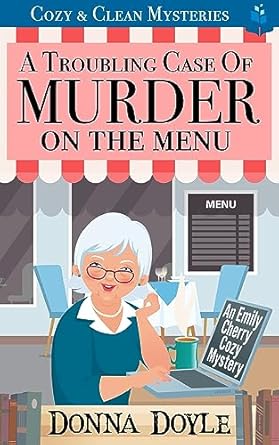
This is a cute little mystery book about an elderly woman who has retired and decides to start writing a food blog. It’s on her first trip out to learn more about a local restaurant that a murder happens and she is pulled into the mystery. She also tests several recipes to prepare for the blog.
Description: Emily Cherry may be retired, but she’s not about to roll over and die!
Defying the doubts of her three adult children this plucky computer-shy grandma embarks on a unique path by launching her very own food blog. The only problem is that during her inaugural restaurant review, she stumbles upon a lifeless body.
In an instant, Emily’s envisioned future as a food blogger plunges into uncertainty – and a brand-new amateur sleuth is born!
Cozy up in your favorite chair and prepare for a thrilling first adventure in this brand-new senior sleuthing series.
You are guaranteed to fall in love with retiree Emily Cherry and giggle at her uncanny ability to stumble into one head-scratching mystery after another.“
5. The Divine Proverb of Streusel by Sara Brunsvold

Description: Shaken by her parents’ divorce and discouraged by the growing chasm between herself and her serious boyfriend, Nikki Werner seeks solace at her uncle’s farm in a small Missouri hamlet. She’ll spend the summer there, picking up the pieces of her shattered present so she can plan a better future. But what awaits her at the ancestral farm is the past—one she barely knows.
Among her late grandmother’s belongings, Nikki finds an old notebook filled with handwritten German recipes and wise sayings pulled from the book of Proverbs.
With each recipe she makes, she invites locals to the family table to hear their stories about the town’s history, her ancestors, and her estranged father. What started as a cathartic way to connect to her heritage soon becomes the means through which she learns how the women before her endured—with the help of their cooking prowess and a healthy dollop of faith.
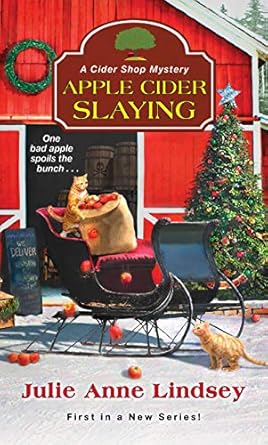
6. Apple Cider Slaying by Julie Anne Lindsey
Description:
Blossom Valley, West Virginia, is home to Smythe Orchards, Winnie and her Granny’s beloved twenty-five-acre farm and family business. But any way you slice it, it’s struggling. That’s why they’re trying to drum up business with the “First Annual Christmas at the Orchard,” a good old-fashioned holiday festival with enough delicious draw to satisfy apple-picking locals and cider-loving tourists alike—until the whole endeavor takes a sour turn when the body of Nadine Cooper, Granny’s long-time, grudge-holding nemesis, is found lodged in the apple press. Now, with Granny the number one suspect, Winnie is hard-pressed to prove her innocence before the real killer delivers another murder . . .
7. Live and Let Chai by Bree Baker (who is actually Julie Anne Lindsey so this book and the one above have a lot of similarities – trying to get a business going, falling for the investigating officer, etc. Still enjoyed both books.)

Description:
Life hasn’t been so sweet for Everly Swan over the past couple of years, but now she’s back in her seaside hometown of Charm, North Carolina. The proud new owner of Sun, Sand,
and Tea—a café right on the beach—Everly thinks that things are finally starting to look up.
Until a grouchy customer turns up dead on the boardwalk with a jar of one of her specialty
teas lying right next to him! When an autopsy reports poison in his system, things don’t look
good for Everly or her tea shop.
As the townspeople of Charm, formerly so welcoming and homey, turn their back on Everly, she fights to dig up clues about who could have had it in for the former town councilman.
With the maddeningly handsome Detective Grady Hays discouraging her from uncovering leads and a series of anonymous attacks on Everly and her tea shop, it will take everything she’s got to keep this murder mystery from boiling over.
8. Clueless At The Coffee Station by Bee Littlefield

Description: Betti Bryant knows she’s not supposed to be a barista five years after graduating from college, but her life is actually super adorable—except for the part where she has to endure her ex-boyfriend’s musical rendition of their breakup at the coffee shop’s Open Mic Night every Friday.
When an entire local art collection is stolen from the cafe during his performance, Betti sees her chance to persuade her panicked boss to cancel Open Mic Night, at least until the crime is solved. Instead, he announces plans to sell the beloved cafe to a real estate developer, who will demolish it. Betti believes her boss will change his mind once justice is served. So, armed with a list of drink orders from the night of the crime and the sleuthiest outfit she can find at the thrift store, she sets out to investigate the theft herself.
If she fails, she’s promised her sister she’ll accept whatever non-adorable entry-level corporate job she can get, abandoning her ideals about finding her own path in life. The Coffee Station will close forever.
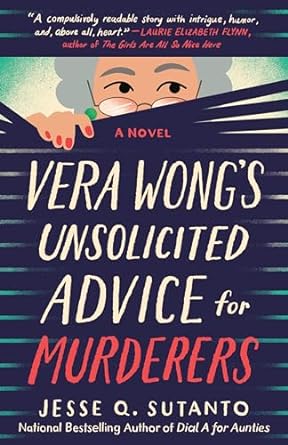
9. Vera Wong’s Unsolicited Advice for Murders by Jesse Q. Sutanto
(Disclaimer: If you don’t like swearing in your books, this does have some.)
Description: Vera Wong is a lonely little old lady—ah, lady of a certain age—who lives above her forgotten tea shop in the middle of San Francisco’s Chinatown. Despite living alone, Vera is not needy, oh no. She likes nothing more than sipping on a good cup of Wulong and doing some healthy detective work on the Internet about what her Gen-Z son is up to.
Then one morning, Vera trudges downstairs to find a curious thing—a dead man in the middle of her tea shop. In his outstretched hand, a flash drive. Vera doesn’t know what comes over her, but after calling the cops like any good citizen would, she sort of . . . swipes the flash drive from the body and tucks it safely into the pocket of her apron. Why? Because Vera is sure she would do a better job than the police possibly could, because nobody sniffs out a wrongdoing quite like a suspicious Chinese mother with time on her hands. Vera knows the killer will be back for the flash drive; all she has to do is watch the increasing number of customers at her shop and figure out which one among them is the killer.
What Vera does not expect is to form friendships with her customers and start to care for each and every one of them. As a protective mother hen, will she end up having to give one of her newfound chicks to the police?
10. Kitchen Confidential by Anthony Bourdain

This one is all about food and all about the restaurant business and I was completely enthralled. I was swept up in Anthony’s passion for food and flavor and what knife to use for the everyday cook. I was not as enthralled some of the language, sexual innuendos and references to male genitalia made throughout the book when Anthony was talking about some of his co-workers, but I still couldn’t put the book down, which is unusual for me when it comes to non-fiction. I’m not a big non-fiction reader but really enjoyed this one and have other Bourdain books on my Kindle to read soon.
Description:
Almost two decades ago, the New Yorker published a now infamous article, “Don’t Eat before You Read This,” by then little-known chef Anthony Bourdain. Bourdain spared no one’s appetite as he revealed what happens behind the kitchen door. The article was a sensation, and the book it spawned, the now classic Kitchen Confidential, became an even bigger sensation, a megabestseller with over one million copies in print. Frankly confessional, addictively acerbic, and utterly unsparing, Bourdain pulls no punches in this memoir of his years in the restaurant business.
Fans will love to return to this deliciously funny, delectably shocking banquet of wild-but-true tales of life in the culinary trade from Chef Anthony Bourdain, laying out his more than a quarter-century of drugs, sex, and haute cuisine—this time with never-before-published material.
What books have you read that had something to do with food but weren’t cookbooks?