I’m watching James Cagney movies this winter.
This week, my pick was Love Me or Leave Me (1955).
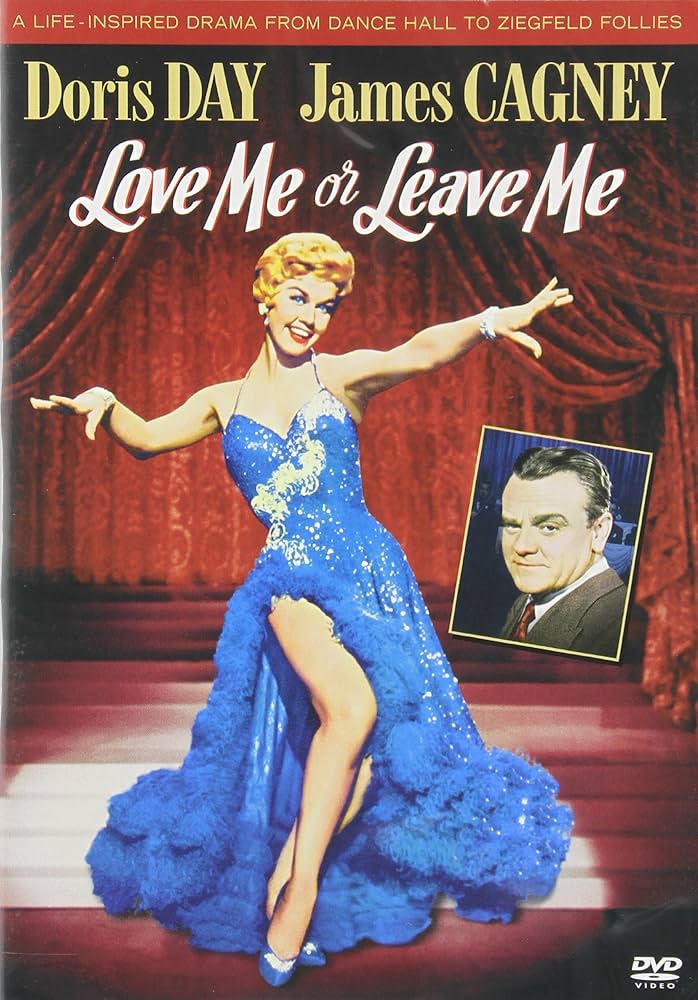
This was a hard one to watch because Cagney was such a jerk in it. I started it not knowing a thing about the true story, so I kept hoping he would transform and become a nicer person before the end of the film.
That certainly did not happen, even though the makers of this movie tried to make things seem nice and tied up at the end.
First, an online description:
During the 1920s, a small-time Chicago criminal, Martin Snyder (James Cagney), discovers a beautiful dancer, Ruth Etting (Doris Day), after she’s fired from her job at a nightclub. Under Martin’s management, Ruth works her way to the top of the entertainment industry, eventually becoming a famous jazz singer and Broadway actress. But as Ruth’s popularity grows, Martin’s obsessive and controlling behavior begins to threaten her success and happiness.
This movie was shot in technicolor so don’t let any black and white photos I share here fool you. It was directed by Charles Vidor.
This movie starts with something that was in another movie I just watched this week — men at clubs paying to dance with girls. They were called taxi dancers or dancehall dancers. https://en.wikipedia.org/wiki/Taxi_dancer
It doesn’t go beyond dancing, that I know of, but I had no idea this was a thing in the 1920s, 1930s, and 1940s or, well, ever. There were girls who were hired as dancers and were employed by clubs. Men would pay to dance with a woman for a dance or a few or the night.
Lucille Ball apparently did this before she went into acting and it is the job her character has in the movie from 1946. I’ll be sharing about this movie at some point here on the blog.
In this movie, Doris Day is a taxi dancer who is fired after the man who pays to dance with her gets a little too handsy…if you catch my drift.
Cagney sees her firing and her and he’s immediately hooked.
Cagney is playing Martin “Marty” Snyder, a small time Chicago gangster who also dabbled in the entertainment business.
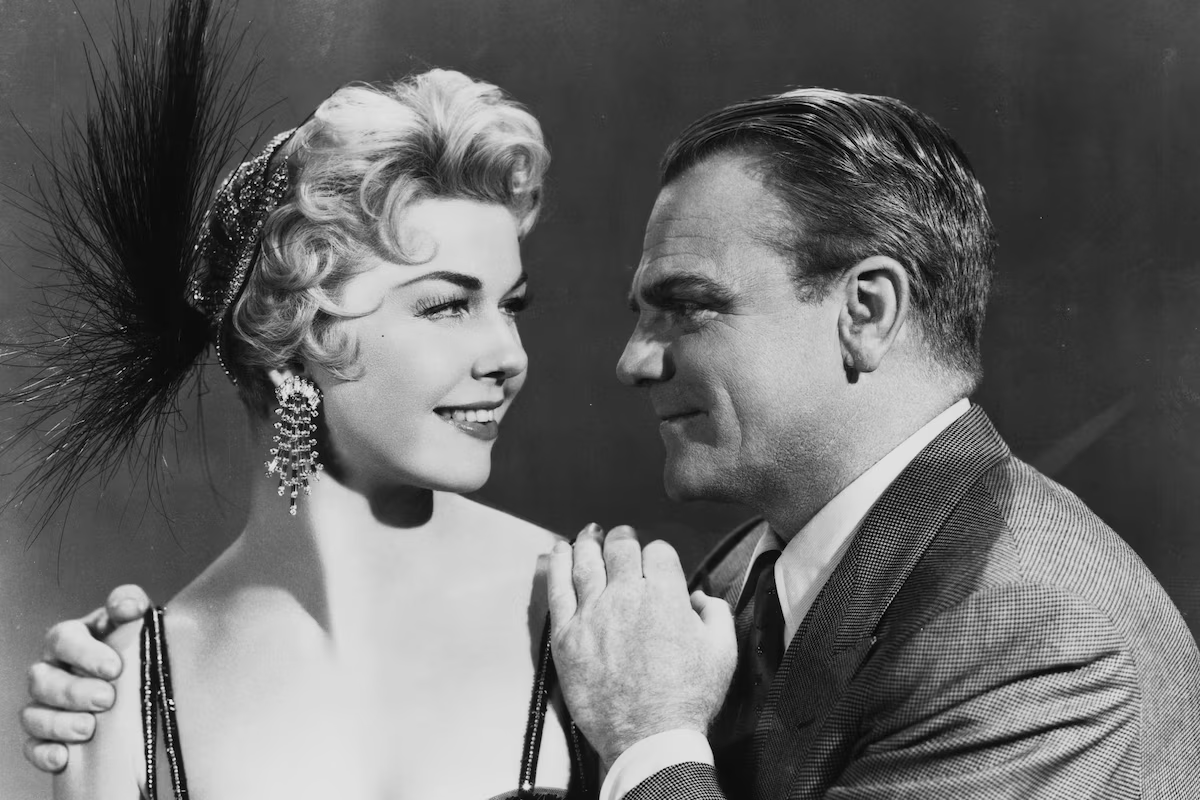
He is definitely physically attracted to Ruth, and at first, all he wants to do is get her a new job at one of his places as a dancer so he can make her one of his girls. He wants to take her to Florida with him. To stay with him. Wink. Wink. Nudge. Nudge.
Ruth doesn’t want to be a dancer or his lover, though. She wants to be a singer, and when she tells him this, he finds a way to make her a singer. One way he does that is by hiring a piano player named Johnny Alderman, who works at his club as her singing coach.
Of course, she and Johnny start to fall in love, but Marty is oblivious to this and keeps finding ways to boost Ruth’s career.
He seems to think that if he does that, she’ll eventually want to thank him and sleep with him. This movie was released in 1955, so none of these things about sleeping with him are said directly, but they are implied.
There are a lot of singing sequences in this movie, but I have to agree with Roger Fristoe who wrote an article for TCM.com, and said the movie isn’t really considered a musical despite the singing. It is, instead, a dramatic biography of Ruth Etting.
Cagney and Doris Day were in a previous musical together in 1950 —The West Point Story.
I’ve never been a huge fan of Doris Day or her singing, and I do NOT know why! There is something about her that just rubs me wrong. My previous impression of her was changed while watching this movie because she really does an amazing job as Ruth in this movie, or at least as far as I know, since I’ve never seen footage of Ruth Etting.
Doris made me feel so horrible for Ruth that I had to look for the real story of her.

It was depressing to find out that her experience with Martin, whose real name was Moe Snyder, was even worse, darker, and more complex than this movie portrayed.
In the movie, there is a culminating event that shows us even more of the true character of Marty and in real life there was one as well. I won’t tell you what happens in the movie but in real life Moe held Ruth, his adult daughter, and Ruth’s boyfriend hostage. Eventually, his daughter was able to get ahold of a gun, shot at the floor in front of her father, and then held the gun on him until the police arrived. It’s a little less dramatic in the movie.
You can read the full account here: https://en.wikipedia.org/wiki/Ruth_Etting
Ruth Etting lived into her 80s and would have been in her 60s when the movie came out. She reportedly said she felt that Doris played her a little harder and tougher than she really was and she said she never worked as a dancehall girl, suggesting the wrote that into the movie simply so they could use one of Etting’s songs, “10 Cents A Dance” in the movie.
“They took a lot of liberties with my life, but I guess they usually do that kind of thing,” Etting said.
There is a violent scene between Doris and Cagney at one point in the movie that was shocking, but, according to Doris, would have been more shocking if they had kept what Doris and Cagney actually filmed.
“He attacks me savagely, and the way Cagney played it, believe me, it was savage,” she was quoted as saying in her biography. “He slammed me against the wall, ripped off my dress, my beads flying, and after a tempestuous struggle, in which I tried to fight him off with every realistic ounce of strength I had, he threw me on the bed and raped me. It was a scene that took a lot out of me but it was one of the most fully realized physical scenes I have ever played…it wasn’t until I saw the movie in its release that I became aware that most of the scene had been cut.”
It had been cut because of the censors.
This was a movie that broke Doris out of her normal good-natured, bubbly roles, and the studio did worry that her fans would revolt at the idea of her in anything so gritty.
They didn’t need to worry since the movie earned six Oscar nominations, including a third Best Actor nomination for Cagney.
It ended up winning the Academy Award for Best Writing, Motion Picture Story.
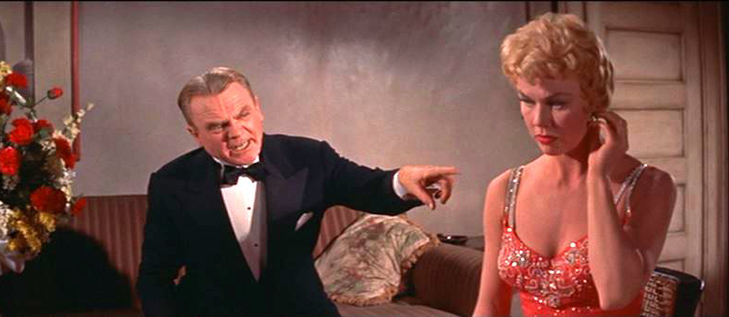
Of Doris’ performance, Cagney said in a biography about him that he watched the movie again in 1980, and “Just saw something I hadn’t noticed before. There are no other women to speak of in the cast. Doris is so very much alone, which heightens the effect of the male world upon her. How many nice girls there are, and were, in this business that were just so afflicted by the presence everywhere of intimidating males.’“
My impression of Cagney’s character is that he was a sad man who didn’t know how to get what he wanted without bullying people.
He loved Ruth Etting and was so afraid of losing her that he abused her mentally, emotionally, eventually physically, and sexually.
Ruth went for it because she wanted to be famous, and he was getting her to where she wanted to go.
I found it sad that not only did Ruth have to go through an abusive relationship with a “Marty” but Doris did as well.
According to TCM.com, “A final irony about Love Me or Leave Me is the fact that the relationship between Ruth Etting and Marty Snyder had some disturbing parallels to the relationship between Doris Day and her husband Marty Melcher. Like Snyder, Melcher also controlled Day’s business affairs, made creative decisions for her even though he had no musical experience, and lived through her work. When Melcher died in 1968, Day discovered that he had mismanaged her entire life savings of $20 million dollars, leaving her completely broke.”
While this was a well-acted and written film, I can’t say it is one I would want to watch again because of the tough subject matter. I noticed in this movie, as I have in other Cagney movies, that a lot of Cagney’s acting is done with his eyes and that signature smirk.
Next up in my Winter of Cagney is White Heat. I have heard a lot about this one and am really looking forward to it.
Here is my full revised list for the Winter of Cagney (I had to move some things around when I couldn’t find two of the movies in my original list streaming, and also haven’t yet ordered the rather expensive DVDs):
Love Me or Leave Me
White Heat
Angels With Dirty Faces
The Bride Came C.O.D. (which will move me into my Spring of Bette Davis)
I still hope to watch Man of A Thousand Faces when I order the DVD.
Angels With Dirty Faces
Sources:
https://www.tcm.com/articles/musical/18538/love-me-or-leave-me-1955
https://en.wikipedia.org/wiki/Love_Me_or_Leave_Me_(film)
https://www.dorisdaymagic.com/love-me-or-leave-me.html
If you want to find clips and thoughts about vintage movies and TV, you can visit me on Instagram on my Nostalgically Thinking Account (https://www.instagram.com/nostalgically_thinking/) or on my YouTube account Nostalgically and Bookishly Thinking here: https://www.youtube.com/@nostaglicandbookish