Erin from Still Life, With Cracker Crumbs and I are hosting Comfy, Cozy Cinema again this year and up this week was The Five-Year Engagement.
I am going to share right off the bat that this was not the movie for me. Erin enjoys it (though she had not watched in a long time and forgot some of the aspects of it) and you can find a more positive view of it on her blog.
Disclaimer: The fact I did not enjoy it is NOT an attack on anyone who did enjoy it. All views expressed here are my own opinions on the movie only. I don’t think anyone is awful for enjoying it. It simply was not my cup of tea.Everyone has different tastes.
I probably should have researched this one a little more when I agreed to watch it because it really wasn’t a movie I’d normally watch. It also was not cozy at all to me personally, but it probably has some sentimental value to others.
For my regular readers who know I usually recommend books and shows without a ton of swearing and crude “jokes” or references, you can know I don’t recommend this one because that’s the majority it.
When I did finally look up the movie this morning, I learned that it featured “more than 205 obscenities and profanities and lots of verbal sexual humor.”
Yeah. I really need to look this stuff up before I go into a movie. *wince*
I am not going to sit here and say that I do not swear. I certainly do. I wish I didn’t, but I do. I’m in a deep depression this week and have sworn about ten times already today (and asked God to forgive me).
Despite that personal flaw confessional moment, movies that throw swear words in for no reason aren’t my thing.
Here is a bit of a description of the movie from online:
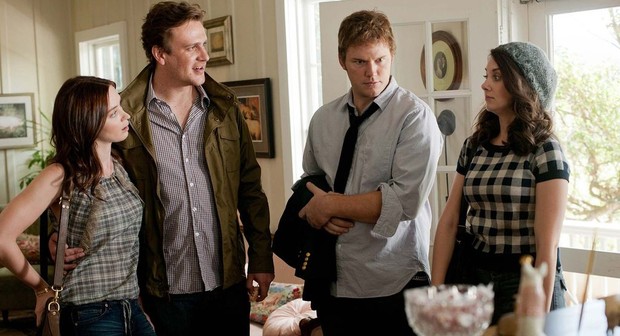
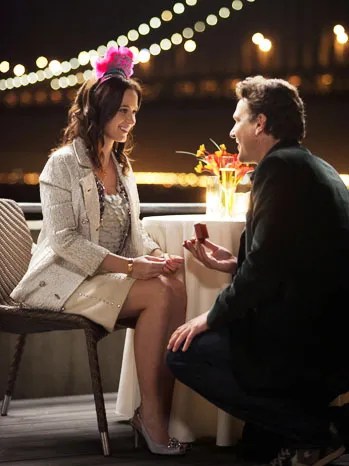
“On their one-year anniversary, sous chef Tom Solomon (Jason Segel) plans to surprise his girlfriend, Violet Barnes (Emily Blunt), with an engagement ring. The lovers do end up engaged, but the fact that the proposal does not go exactly as planned proves to be a harbinger of things to come. Each time they try to set a date, various obstacles stand in their way. As more and more time passes, Tom and Violet begin to wonder if perhaps their marriage is not meant to be.”
The movie is rated R, so a lot of it the languag and sex scenes are to be expected but I just wasn’t comfortable with the level of crudeness or how many times I had to see Jason Segel having sex. Eek.
Also, Jason Segel plays pretty much the same character in every movie or TV show he has ever been in so if you like him in other movies or TV shows you should like this – just add a few more penis jokes, f-words, and views of his naked butt.
Again, Erin has more positive reasons she enjoyed the film (and I totally get her reasons!) so you can check out her views and more information on her blog here:
Next week we are writing about The Young In Heart (1938), starring Douglas Fairbanks Jr.
The other movies we will be watching are on this list:
This past weekend I watched the movie The Talk of the Town with Cary Grant, Jean Arthur, and Ronald Colman. I found this movie, among many other good ones, free on Tubi. It is also currently free on YouTube.
I had seen it before as a suggested move but ignored it, thinking it was a drama. After watching it, I asked myself, “What took me so long to watch this one?!”
I loved this movie and while I always love Cary Grant, I once again loved Ronald Colman who I first saw in The Prisoner of Zenda earlier this year.
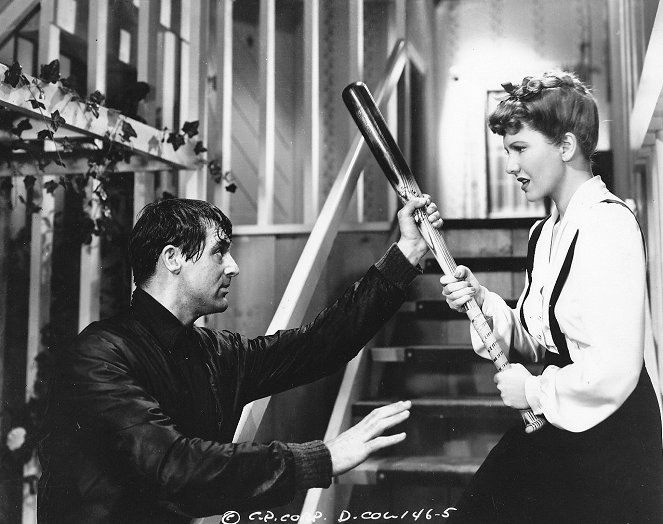
This movie starts with a fire at a factory where a man dies. Cary, portraying Leopold Dilg, is arrested for arson and murder.
Soon he’s breaking out of jail and escaping through the woods on a rainy night. He makes his way in the dark toward a small house while dogs hunt him down. The name of the house is Sweetbrook and there is a woman inside getting it ready — maybe for a guest.
Leopold breaks in the door, startling the woman.
“Miss Shelley,” he says. “Please…let me…” And then he faints and falls down the stairs.
Miss Shelley wakes him up with a bucket full of water and he asks if she can stay at the house, which he knows is a rental. She tells him he can’t stay because she knows he has escaped jail. There is a knock on the door before she can finish explaining and she tells him to run upstairs and hide.
There is a Professor Michael Lightcap at the door and he’s standing in the rain. He reminds her that he’s rented the house out and he’s here to stay. Miss Shelley, whose first name is Nora, panics because Leopold is hiding upstairs and she doesn’t want the professor to find him.
Things will get more complicated as she makes up an excuse to stay in the house overnight to make sure the professor doesn’t find Leopold.
Complications just keep arising as Nora offers to become the professor’s secretary and housekeeper during his stay, a senator arrives to tell Professor Lightcap he’s up for nomination to the United States Supreme Court, and Leopold walks down one morning to argue about the role of the law in society and Nora has to introduce him as the gardener.
This is a non-stop movie full of hilarious mix-ups, near misses, and a love-triangle that won’t be resolved until the very last minute, literally, of the movie.
As I said above, I loved this movie.
It was engaging, funny, witty, and captivating. Mixed in all the lighthearted moments were a few philosophical moments about law and justice.
Jean Arthur was delightful as Nora Shelley, always quickly rescuing the day just at the last moment, taking care of both Leopold and the professor.
Ronald Colman pulled off the staunch, uptight professor well and it was fun to see him “let down his hair” a bit later in the film. He didn’t let down his hair. It’s just a saying, of course.
Cary walked the line between an aggressive rebel and a falsely accused victim, putting his usual romantic charm on the backburner for most of the film and bringing it out in more subtle moments. This was a movie where he wasn’t a pursuing a woman as much as he was his own freedom and justice.
I spent much of the last half of the movie wondering which one of the men Nora was actually falling for and I think she was doing the same thing. She’d gathered affection for both of them but wasn’t sure if either of them had for her.
This movie was nominated for seven Oscars but it was about the same time that America started the war so more “patriotic” movies got the nod that year. Ironically the best picture went to Mrs. Minier, which was set in England, however.
According to TCM, even without the wins, The Talk of the Town “still marked an important moment in the careers of its stars Cary Grant and Ronald Colman.”
For Cary, it was a new movie after not working for a year and he was nominated for an Oscar as well. He didn’t win the Oscar but he did have his name legally changed his name from Archibald Alexander Leach, became an American citizen and married heiress Barbara Hutton.
Colman was 51 at the time and needed a spark to reinvent his career. The Talk of the Town worked and he went on to star in Random Harvest, which earned him another Oscar nomination. He lost that to James Cagney in Yankee Doodle Dandy, but still kept him at a high point in his career. Films such as Kismet (1944) and Champagne for Caesar (1950). He also finally earned his Oscar for portraying the delusional Shakespearean actor in A Double Life (1947).
I found it interesting to read that there was tension between Grant and Colman since both were used to being the lead actor and that tension was written into the script as they aggressively bantered back and forth with each other.
I also was fascinated to learn that two endings were filmed — one with Jean Arthur choosing Cary and the other with Colman. The director allowed the preview audiences to choose who she ended up with.
Trivia:
filming was to begin on January 17, 1942, the day Hollywood learned the sad news of Carole Lombard’s death in a plane crash. Stevens halted work on the set and sent both cast and crew home.
Screenwriter Sidney Buchman (who co-wrote the script with Irwin Shaw) was blacklisted in the 1950s. Consequently, Buchman, one of the men who penned Mr. Smith Goes to Washington (1939), left the U.S. and began working in Fox’s European division. Buchman would remain in France until his death in 1975.
When the professor is unconscious on the floor, Tilney (Rex Ingram) asks Sam if he is a doctor. Ironically, Rex Ingram was himself a trained physician in real life.
Cary Grant and Ronald Colman were both paid at least $100,000 for their work in the film. Jean Arthur, who was in Harry Cohn’s doghouse and just coming off suspension, was only paid $50,000.
Whilst many characters find Leopold Dilg’s penchant for adding an egg to his borscht unique (so much so that it becomes a means of determining his whereabouts), it was not an uncommon practice to add an egg to borscht in Poland and in Mennonite communities in Eastern Europe.
A radio theatre presentation of The Talk of the Town (1942) was broadcast on CBS radio on the Lux Radio Theatre on 5/17/1943 with Cary Grant, Ronald Colman, and Jean Arthur recreating their roles from the movie. It’s a 60-minute adaptation of the movie.
Nora tells the professor that he is, “as whiskered as the Smith Brothers.” This refers to a brand of cough drops with an illustration of the Smith Brothers on the front, both of whom have a beard. First introduced in 1852, they remained the most popular brand for a century.
Memorable quotes:
Well, it’s a form of self-expression. Some people write books. Some people write music. I make speeches on street corners.
– Leopold Dilg
What is the law? It’s a gun pointed at somebody’s head. All depends upon which end of the gun you stand, whether the law is just or not.
– Leopold Dilg
Stop saying “Leopold” like that, tenderly. It sounds funny. You can’t do it with a name like Leopold.
– Leopold Dilg
This is your law and your finest possession – it makes you free men in a free country. Why have you come here to destroy it? If you know what’s good for you, take those weapons home and burn them! And then think… think of this country and of the law that makes it what it is. Think of a world crying for this very law! And maybe you’ll understand why you ought to guard it. – Michael Lightcap
He’s the only honest man I’ve come across in this town in 20 years. Naturally, they want to hang him. – Sam Yates
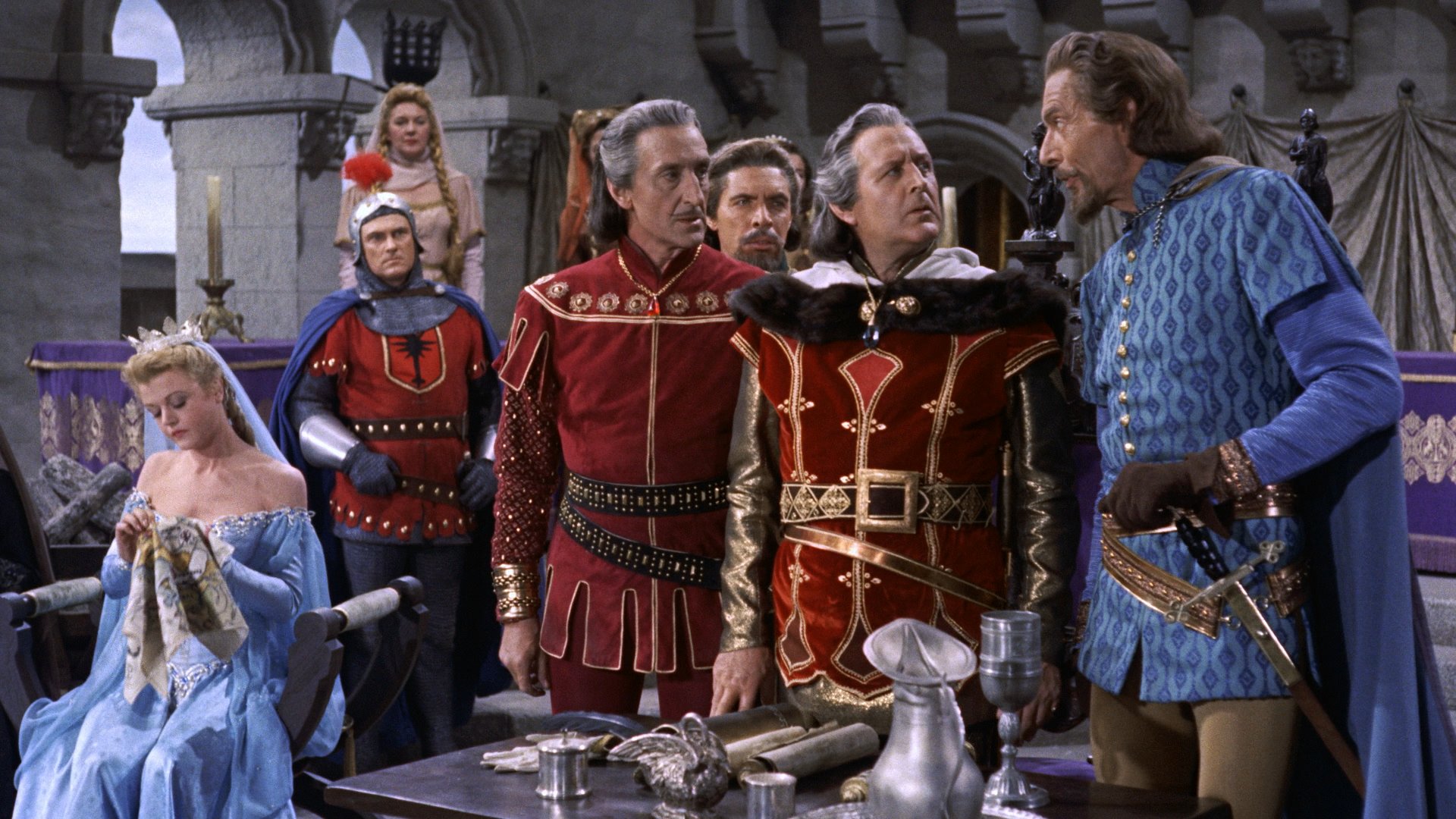
This week I watched The Court Jester (1955) with Angela, Danny Kaye, and Basil Rathbone. It is a musical/comedy.
The main words to describe this movie are silliness, ridiculousness, and peak Danny Kaye moments.
It really fell apart toward the end, I felt, but there were some hilarious moments that made up for it.
First, a bit of the plot with a description from Google:
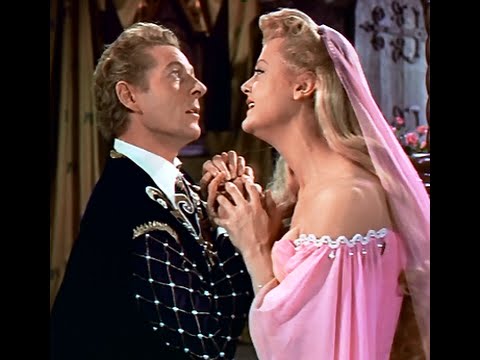
“Former carnival performer Hubert Hawkins (Danny Kaye) and maid Jean (Glynis Johns) are assigned to protect the infant royal heir from tyrannical King Roderick I (Cecil Parker). While Jean takes the baby to an abbey, Hawkins gains access to the court by impersonating the king’s jester, unaware that the jester is really an assassin hired by scheming Sir Ravenhurst (Basil Rathbone). When Princess Gwendolyn (Angela Lansbury), falls for Hawkins, a witch secretly aids him in becoming a knight.”
This film is just a lot of craziness caused by misunderstandings, misdirection, and generalized oopsies.
We start the movie by learning that an entire royal family was killed so that the current King, King Roderick I, could take the throne. Actually, though, the entire family wasn’t killed, according to rumors anyhow. The rumors say an infant survived and bears upon his bottom a birthmark of a purple pimpernel.
The rumors further say the child is being cared for in the forest by an “elusive, dashing outlaw” known as the black fox. As if to prove these rumors, one of the king’s men is killed as they are riding near the forest and a note attached to the arrow announces that the child is alive and The Black Fox has him.
Not sure why this was being announced because I would think it would be better to keep this all a secret until the child is older and then they bring the child in to overthrow the usurper, but…what do I know?
After the note scene we are taken to the castle where the king’s advisor, Sir Ravenhurst (Rathbone), is stating the rumor about the child being in the care of the black fox is simply a silly story to scare the king. The other advisors say there is something to the rumor and to the power of the black fox. They feel that the king should form an alliance with Griswold of the North because he is strong and has men who can help them fight against The Black Fox.
Ravenhurst is against this and the other advisors say it is because Ravenhurst wants to be the king’s right hand man and have more power.
The king says even if he wanted to form an alliance he doesn’t have anything to offer Griswold to sweeten the deal. The one advisor says that the king does have something he could give Griswold — the hand of his daughter Gwendolyn — our fair Angela — in marriage.
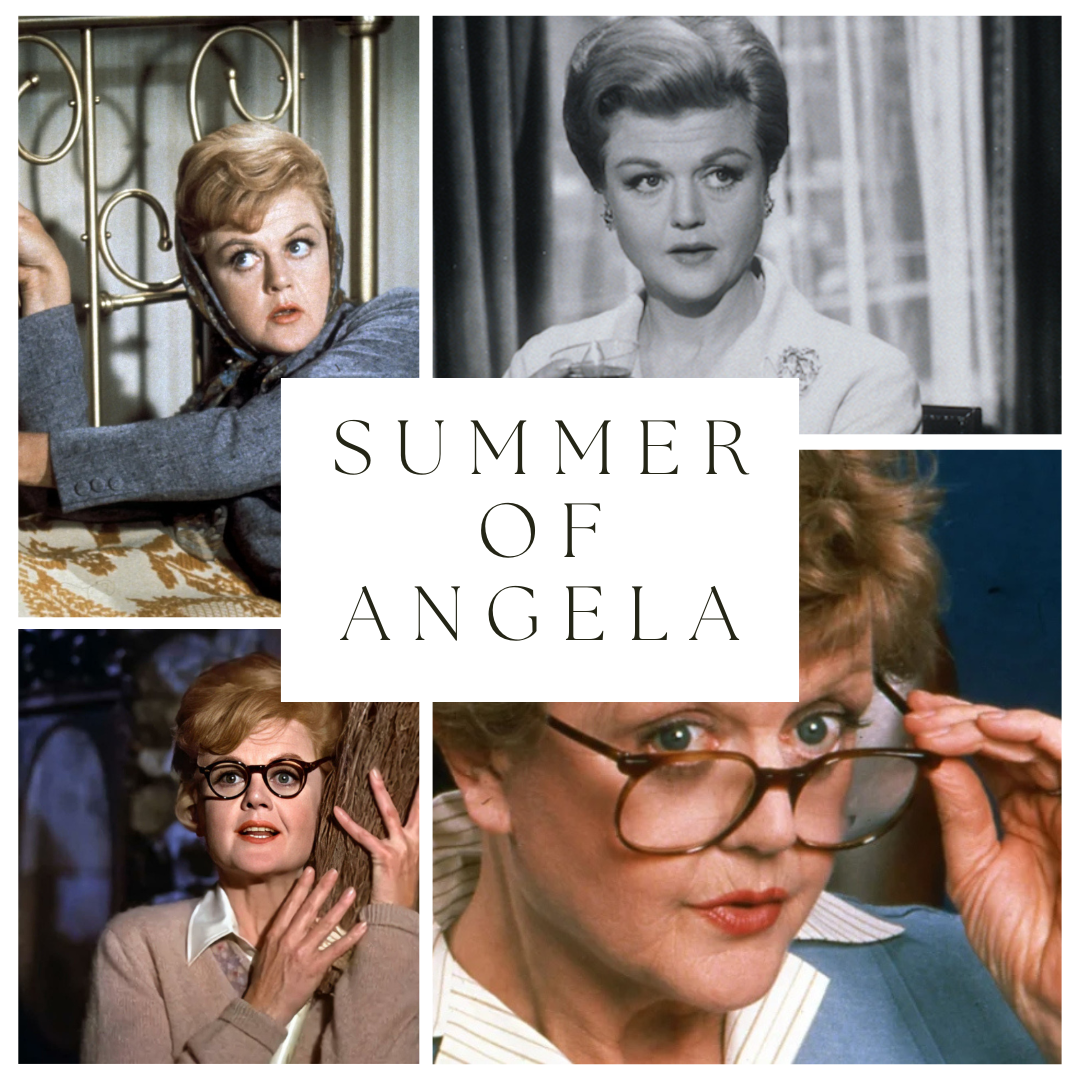
Angela is gorgeous in this movie. She’s super skinny (not that she’s ever been big), tall and elegant.
My son told me recently that young Angela was beautiful and that even “old Angela” in Murder She Wrote wasn’t so bad. I can’t wait to show him her in this film (I watched it on my own) because this will further solidify his feelings.
Gwendolyn says she is not interested in marriage because the castle witch, Griselda, told her that a more dashing man than Griswold would be coming along to sweep her off her feet.
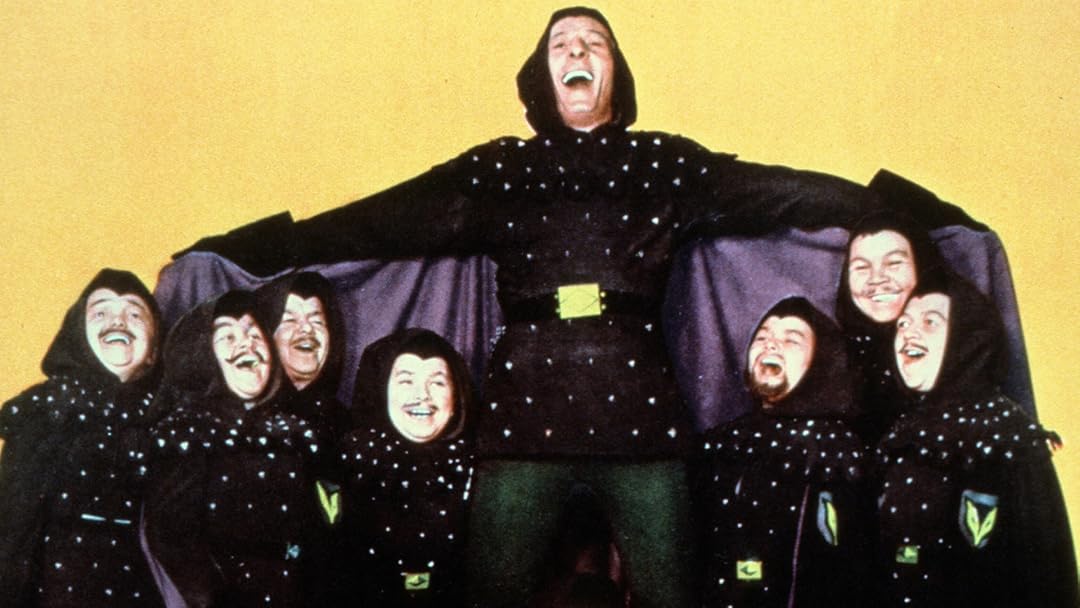
Now the scene switches to the lair of the black fox, where Hubert tells the black fox he has brought a group of midgets with him from the carnival (Hubert’s former job) to fight for The Black Fox. This brings me to one of the weirdest promo photos I’ve ever seen:
I’ll be seeing this one in my nightmares tonight.
It is the job of Danny’s character, Hubert, to care of the baby and he thinks it is a job that should go to a woman. Well! How rude.
But The Black Fox doesn’t agree and tells Hubert he will continue the job.
Hubert is a little more excited about having to take care of the baby when he is charged with traveling with the beautiful Jean to take the child to the abbey for protection.
When I was reading about the actors in this movie, I found out that Glynis Johns (Jean) also played the mother in Disney’s Mary Poppins. The first one, of course.
Anyhow, moving on — The pair stop for the night and that’s when they not only admit their feelings for each other (smoochy, smoochy) but a man stumbles into the small stable they are in and asks to stay with them for the night. He’s on his way to see the king, he says. He is a court jester and his name is Giacomo.
Ah-ha! Hubert and Jean were just talking about how it would be a good thing if they had a spy in the castle who could tell them if the king was coming after The Black Fox. How very fortuitous this unexpected meeting has been.
Giacomo is knocked out and Hubert steals his clothes and his wagon, which is emblazoned, for some weird reason, with Giacomo’s name across the back of it.
So Jean takes off toward the abbey and Hubert takes off toward the castle.
Sadly, Jean is captured by soldiers from the castle who are looking for good looking women for the king. The baby is hidden in a basket and she and the baby are taken to the castle where she manages to hide the baby away from the king and his men.
Meanwhile, Gwendolyn learns that Griselda lied to her about the dashing man and is about to have her killed when Hubert shows up on the road below and Griselda claims that he is the man that Gwendolyn is supposed to marry.
Whew. This plot is starting to get pretty twisted at this point. From here on out, things get pretty crazy with Griselda casting spells and poisoning people left and right. Ravenhurst also thinks that Giacomo (Hubert) is an assassin who is going to take out the three advisors who wanted to create the alliance with Griswold.
Before all is said and done there will be sword fights, a jousting match, fake and real romances, a midget army, and, of course, plenty of musical numbers by Mr. Kaye.
There is also the famous scene between Danny, Glynis Johns, and Mildred Natwick where they discuss which vessel the poison is in.
Here is a clip of it, in case you’ve never seen the movie:
I won’t share too much more in case you want to watch the movie yourself.
The movie was directed by Norman Panama and Melvin Frank.
According to an article on TCM.com, Panama and Frank formed a production company with Kaye called Dena Productions, named after Danny’s daughter, after Kaye’s success in 1947 with the film The Secret Life of Walter Mitty.
The idea behind the production company was to introduce the real Danny to film audiences. He had been acting on Broadway and in smaller productions on stage for years.
The Court Jester was the company’s second movie and proved to be a huge success but not right away. It actually bombed at the box office, despite it’s stellar cast. Years later though it was regarded as one of Danny’s finest films with, according to TCM, “comedy routines that have entered the annals of film history.”
Amazon features trivia and facts through their xray feature when you watch a movie there on a computer or device. I often forget that because I usually watch the movies on my TV but this time I watched part of the movie on my phone and bits of the trivia popped up.
One of them was a story from Danny’s daughter who said that fans often came up to him and recited the entire tongue twister scene for him.
What Angela said about the movie:
Angela had been playing mainly dramatic roles before this movie and was able to have some fun with the role. Part of that fun was watching Danny Kaye work she said in the Kaye bio Nobody’s Fool by Martin Gottfried.
“His use of hands was inspired by commedia dell’arte,” she said. “And in the way he moved, he was absolutely original; he was one off the mold.”
She added, “Danny wasn’t an ensemble player – he was the one around whom everyone danced, and we all dressed to him. We never stopped laughing. There was none of that moodiness he could have elsewhere, that abruptness, ignoring people. If something interested him, sparked him, he came alive. The minute that was over, he was closed for business, which I think is true of many of the great comic performers. They are constantly out to lunch. Where they are, I don’t know.”
Gottfried also wrote an autobiography on Angela and said of her role in the movie: “It allowed her to play not only a princess, but a princess her own age. She was made up to look young and lovely. She got to wear beautiful clothes that showed off her fine, slender figure.”
What I thought overall
This was a ton of fun. As I mentioned above, I wasn’t a huge fan of the ending when things started to fall apart in some ways and just descend into chaotic ridiculousness but that was a minor issue when there were so many other great moments and interactions in the film.
Angela wasn’t in this one a ton but she was in it enough to enjoy her mix of wide-eyed adoration of Danny’s character and her devious ways to get what she wanted. She truly was beautiful in the film as well.
I loved the wordplay and back and forth between the characters. None of the songs really stuck out to me but they were fun.
This is a great film to escape into and forget about your problems with. The bright and colorful outfits alone will distract you from the stresses of your days.
Trivia about the movie:
Basil Rathbone had made many movies where he was the sword-wielding villain so when it came to his role in this film, he was ready. He was 66 at the time, though, having already redefined Sherlock Holmes in 14 films from 1939 to 1946, and wasn’t ready for how quick Danny would be able to move the sword. A body double had to be called in to film some of the fencing scenes because Danny was moving so fast that Basil was almost injured. It was because of his superior fencing skills that no one was injured but he still couldn’t keep up with Danny’s fast, though less accurate, moves.
According to TCM.com. “(Basil’s) talents were carefully observed by Danny: With his quick reflexes and his extraordinary sense of mime, which enabled him to imitate easily anything seen once, Kaye could outfence Rathbone after a few weeks of instruction.” (various sources, including TCM.com.)
During the “Maladjusted Jester” sequence, King Roderick I (Cecil Parker) kicks Hawkins (Danny Kaye) every time he makes a mistake. It took 11 takes, and afterward, Kaye said he had bruises all over his hip. (source IMdB)
The “Now I can shoot and toot” speech during “The Maladjusted Jester” was previously said by Danny Kaye in Up in Arms (1944).
From IMdB: “This was composer Vic Schoen‘s first movie. He was not officially trained in the mechanisms of how music was synchronized to film, so he had to learn on the job. It took him a long time, but he was very proud of his work. Composer Igor Stravinsky listened to his score and later complimented Schoen, saying he had broken all of the rules.”
A U.S. Civil War reenactment group, The American Legion Zouaves of Richard F. Smith Post No. 29, Jackson, Michigan” performed the intricate high speed marching maneuvers during the knighting ceremony. (source, Classic Movie Hub)
Have you ever seen this movie?
What did you think?
Cat from Cat’s Wire shared her thoughts on the movie here..
Here is what is left of my Summer of Angela:
August 1 – The Court Jester
August 8 – The Picture of Dorian Gray
August 15 – A Life At Stake
August 22 – All Fall Down
August 29 – Something for Everyone
If you want to read about some of the other movies I watched you can find them here:
Erin from Still Life, With Cracker Crumbs and I are watching Comfy, Cozy movies this September and October and this week we watched the 1945 version of Blithe Spirit.
This is a movie my husband and I had started a few months ago and didn’t finish up because we got interrupted and distracted by life, so when Erin suggested it for our Comfy, Cozy Cinema, I was all for it.
After watching it, I can share that this was not one of my favorite movies overall but there were parts I enjoyed and performances I found very well done. I also found the dialogue brilliant.
Before I go into my impressions, here is a little online summary of the movie, which is based on a play by Noel Coward:
“Skeptical novelist Charles Condomine (Rex Harrison) invites self-proclaimed medium Madame Arcati (Margaret Rutherford) to his home for a séance, hoping to gather material for a new book. When the hapless psychic accidentally summons the spirit of Condomine’s late wife, Elvira (Kay Hammond), his home and life are quickly turned into a shambles as his wife’s ghost torments both himself and his new bride, Ruth (Constance Cummings). David Lean directed this adaptation of Noel Coward’s hit play.”
I am going to get this out of the way now – I could have completely done without Rex Harrison in this movie. I hated his character. In fact, none of the characters were likable to me, but, as Erin pointed out to me after I watched it, that’s really the point of the play/movie – hence the title.
After double-checking the definition of “blithe” it made even more sense.
Blithe: showing a casual and cheerful indifference considered to be callous or improper.
That is exactly how every character in this movie acted.
While watching this movie, I also started to wonder if Rex Harrison is only capable of playing, arrogant, tone-deaf, rude, and bullheaded characters.
After watching him in Dr. Doolittle and My Fair Lady and now this – I can’t help thinking his range of an actor didn’t go much beyond these typecasts. I’m teasing a bit here because I have not seen every Rex Harrison movie. If you know of one where he isn’t a total jerk, let me know in the comments.
During the whole film, I wanted to throat-punch Rex’s character. Repeatedly.
I mean, it could be a hormone issue (I am at that age) or Rex Harrison might really have just been that annoying of a human being in this movie.
I know he’s playing parts in his movies, but he did it so well that I imagine there must be some of himself in there. I’ll have to research that at some point.
What I did like about this movie was Margaret Rutherford and it is fitting that this is the movie where she became known nation-wide in the UK after already having established herself on the stage and on television.
I first heard her name when I was researching actresses who had played Miss Marple in the past. Her first film debut was in 1936 but it was this performance – as Madam Arcati – that is considered her breakout performance. There are two reasons she might have done so well as the character – she had already portrayed Madam Arcati in the stage version of Blithe Spirit and Coward actually wrote the part with her in mind.
According to Wikipedia, theatre critic Kenneth Tynan once said of her performances on stage: “The unique thing about Margaret Rutherford is that she can act with her chin alone.”
She received rave reviews of her performance on the stage and the movies – from both critics and audiences.
After watching this movie I can see why – she played the part of being a batty old lady very well and if you delve into her sad history and upbringing, you would see why. That’s another tale for another blog post, but I’ll leave the link to her Wikipedia page here:
Be warned there is some sadness about her life in that article, but also some joy and a great deal of success for her.
Even if this wasn’t a favorite movie of mine, I did not hate it. There were many humorous and witty moments in this movie and overall the acting was very good. I think in the end it simply wasn’t what I had expected – mainly because I had never seen the play.
One of the funny quotes from the movie was one that was removed from the U.S. versions by censors when it first released.
During an argument with Ruth, Charles tells her, “If you’re trying to compile an inventory of my sex life, I feel it only fair to warn you that you’ve omitted several episodes. I shall consult my diary and give you a complete list after lunch.”
As I read what other viewers thought about the movie online I saw that most enjoyed the movie immensely but a few wrote that they found that the movie felt flat because they were comparing it to the stage version. In the stage version there was more of a chance for the actors to bounce of the audience and for the audience to respond with laughter, one reviewer said. In the movie version some felt the jokes and humor just fell flat.
I spent much of the movie not finding the humor very funny because I was so horrified how Harrison didn’t seem upset by any of the events that happened. Again, though, I needed to go back to that definition of blithe when I decided to rewatch some scenes before writing this post. After that I found some of the humor a little funnier and recognized it as being more tongue-in-cheek in some places.
Some viewers might sense the lack of humor in some places because the director, David Lean, apparently did not do a good job translating the play to film, at least according to Coward, who had worked with Lean on one of his previous plays being transferred to film, and enjoyed that experience.
Coward, in fact, informed Lean, after he saw a rough cut of the film, that Lean had “screwed up” (but used a much more colorful term) the best thing he’d ever written.
Harrison later commented on Dean: ““When you’re on a comedy like Blithe Spirit, it is awfully hard working for a director who has no sense of humor.”
According to Wikipedia Harrison wrote in his memoirs:
“Blithe Spirit was not a play I liked, and I certainly didn’t think much of the film we made of it. David Lean directed it, but the shooting was unimaginative and flat, a filmed stage play. He didn’t direct me too well, either – he hasn’t a great sense of humour…..Lean did something to me on that film which I shall never forget, and which was unforgivable in any circumstances. I was trying to make one of those difficult Noel Coward scenes work… when David said: “I don’t think that’s very funny.” And he turned round to the cameraman, Ronnie Neame, and said: “Did you think that was funny, Ronnie?” Ronnie said: “Oh, no, I didn’t think it was funny.” So what do you do next, if it isn’t funny?””
The play, by the way, was written in six days at a seaside resort, where Coward had gone to escape the Blitz, according to Criterion.com.
Geoffry O’Brien writes in the article on Criterion: “..Blithe Spirit brought superficiality to another level of ambition: what audacity to write a comedy about death in the midst of bombing that would claim tens of thousands of civilian lives, a comedy in which the memory of a lost love became material for a punch line and mortality served as simply a piquant sauce for the same sexual dilemmas that were the staple of Coward’s brand of drawing room comedy. Blithe Spirit may be defined as a very British sort of resistance literature, encouraging resistance to encroaching catastrophe by blithely ignoring it.”
If you would like to read more about O’Brien’s thoughts (even he touched on how much better it is to see the play either before you see the movie or instead), you can find his very interesting (and full of big words) article here:
I have to agree with O’Brien that the ending of the film is much more satisfying than the ending of the play, but I won’t share what I mean about that here in case you haven’t seen it yet.
I watched this one on Amazon Prime, where it was free with a subscription. It is also free right now on YouTube.
Up next in our Comfy, Cozy Cinema is Alfred Hitchcock’s Rear Window. I’ve seen this one before but it’s been a few years so I am looking forward to watching it again and am glad that Erin suggested it.
Feel free to link up your own impressions of the movies at our link-ups. The links close at the end of the week but feel free to leave your blog post on future link-ups, even if it is for another movie.
Here is the rest of the schedule:
Also, don’t forget our Comfy, Cozy Care Package giveaway is still open until Oct. 15. We are giving away some things to make your autumn even cozier. The gifts include my book (Gladwynn Grant Gets Her Footing), Erin’s poetry compilation book, stickers, a journal, an autumn-themed mug, pumpkin-shaped chocolates, a book light, a blanket, and boxes of tea. We also hope to throw a few extras in to the winners!
You can enter anytime between today and October 15th, and the winner will be announced on our blogs on Thursday, October 17th. Please enter via Rafflecopter and it is only open to those 18 or older living in the US.” You can enter here: https://www.rafflecopter.com/rafl/display/3614a4fa2/?