
Winter of Cagney: White Heat (with some spoilers)

I’m watching James Cagney movies this winter and last week I watched one of his most acclaimed movies — White Heat (1949).

The movie is considered by film critics to be one of the best gangster films of all time.
As I often do, I’ll start this post with an online description of the movie:

“Gang leader Cody Jarrett (James Cagney) lives for his mother, planning heists between horrible headaches. During a train robbery that goes wrong, Cody shoots an investigator. Realizing Cody will never be stopped if he knows he’s being pursued, authorities plant undercover agent Hank (Edmond O’Brien) in Cody’s cell.”
This description is wrong, though, because the investigator is shot after the robbery. But the conductor is shot by Cody.

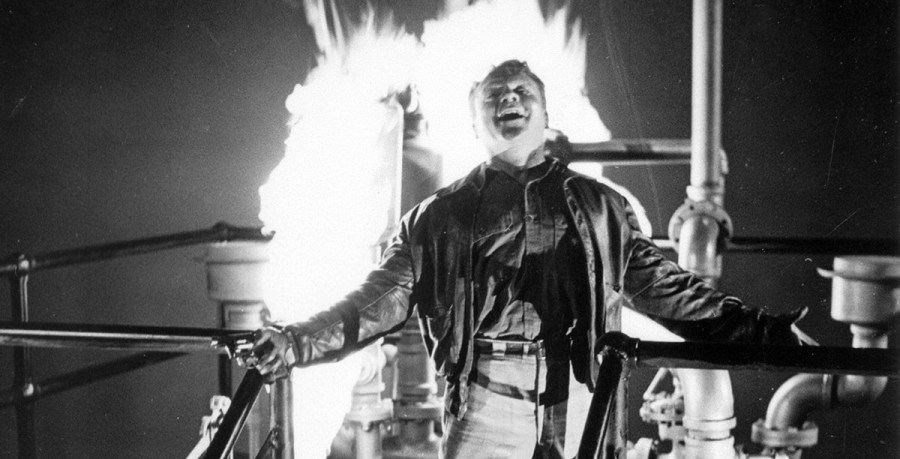
All that aside, the robbery does go wrong, partially because a member of the gang is horribly burned. The gang has to hide out and we learn that Cody is very close to his mother, who helps him plan crimes. Closer than he is to his wife who is very lazy and sleeps a lot.

This isn’t an inappropriate relationship like Hamlet or Macbeth or whichever play that was, but Cody relies on Ma for a lot — including helping him when raging headaches hit him and practically debilitate him. The gang believes his headaches are the same mental illness his father had.

His mother doesn’t want him to let the gang see him that way because he will look weak.

It doesn’t matter if he looks week because his gang is ready to turn on him and take the money they stole from the train and cut him out of the deal no  matter what.

He doesn’t know this, but he does know they have to split so the police don’t find them.

They have an injured gang member whom Cody orders one of his men to shoot. The man can’t do it, though, and leaves the burned man. The man still dies, and when he is found it is reported to the police, who eventually connect him to the gang.

A police officer sees Cody’s mom out by chance and they try to follow her back to the motel Cody, his mom and wife are staying at. She loses them but the police eventually find her car and corner Cody who shoots the investigator in the arm.

Cody is able to escape with his mom and wife, but finally decides if he really wants to shake the police, he will have to give himself up. He’s not going to admit to the big crime, though. He’s going to say he committed another crime that another criminal he knows pulled. He’ll only get about two years for that crime and it will be his alibi for the other crime. He couldn’t have robbed the train if he was committing a less serious robbery in another state, he says.

His wife and mom don’t like the idea, for different reasons.
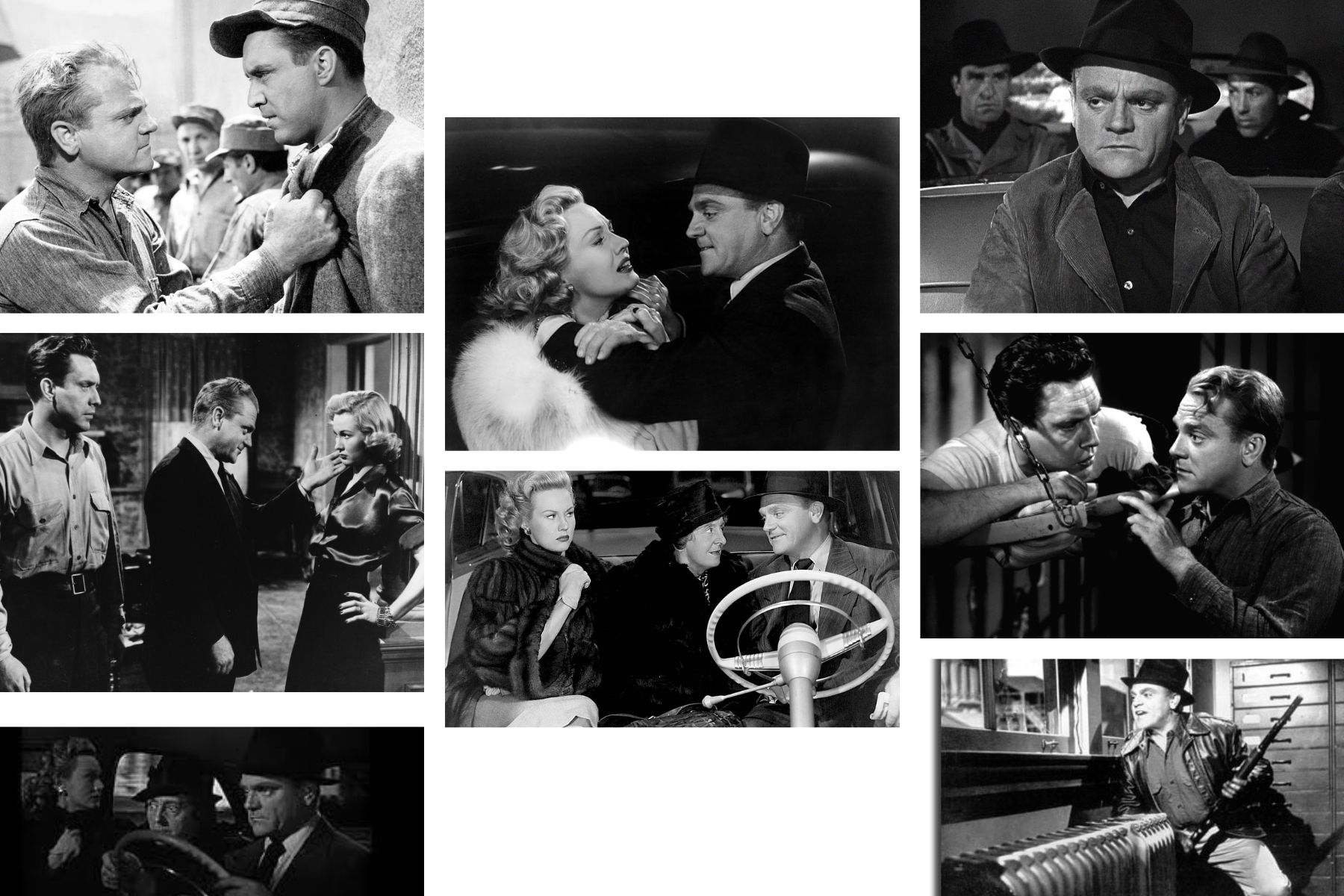
His wife likes the idea a lot more when she realizes that her husband being in jail in another state will give her time with her husband’s second hand man, who she’s been having an affair with.

Cody’s plan works — sort of. The police figure out what he is trying to do, though, and still want to pin the first crime on him so they send an undercover cop into jail with him to try to make friends with him and find out where he hid the money from the train heist.

I’ll leave it there, so I don’t spoil what happens, but I am going to have to give a big spoiler here to discuss in the paragraph following this next one so if you don’t want to know, you need to stop here.

This movie was dark, intense, and while Cody Jarrett was a horrible man and easy to hate, I also couldn’t help feeling a little sorry for him because he felt crime was the only way to make a living.

SPOILER ALERT!!
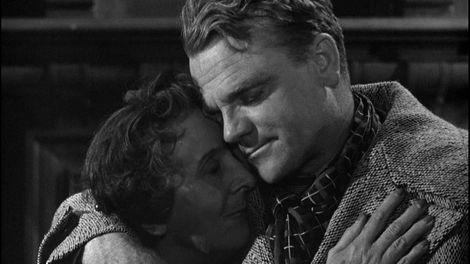

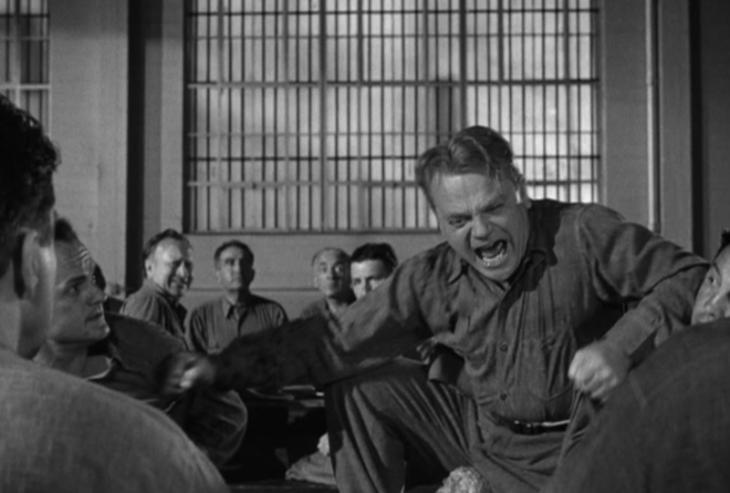
Also, the one person who loved him and he loved dies halfway through the movie. I won’t say how his mom dies but it is her death that leads to a much-talked-about scene where Cody absolutely flips out after he finds out she’s gone.

What is interesting about this scene is a couple hundred extras were used as the inmates inside the cafeteria and none of them were told what Cagney was going to do. Most of the shocked faces focused on during that scene were authentic because they were kept in the dark about Cagney’s plans. Some of them really thought Cagney had flipped out.
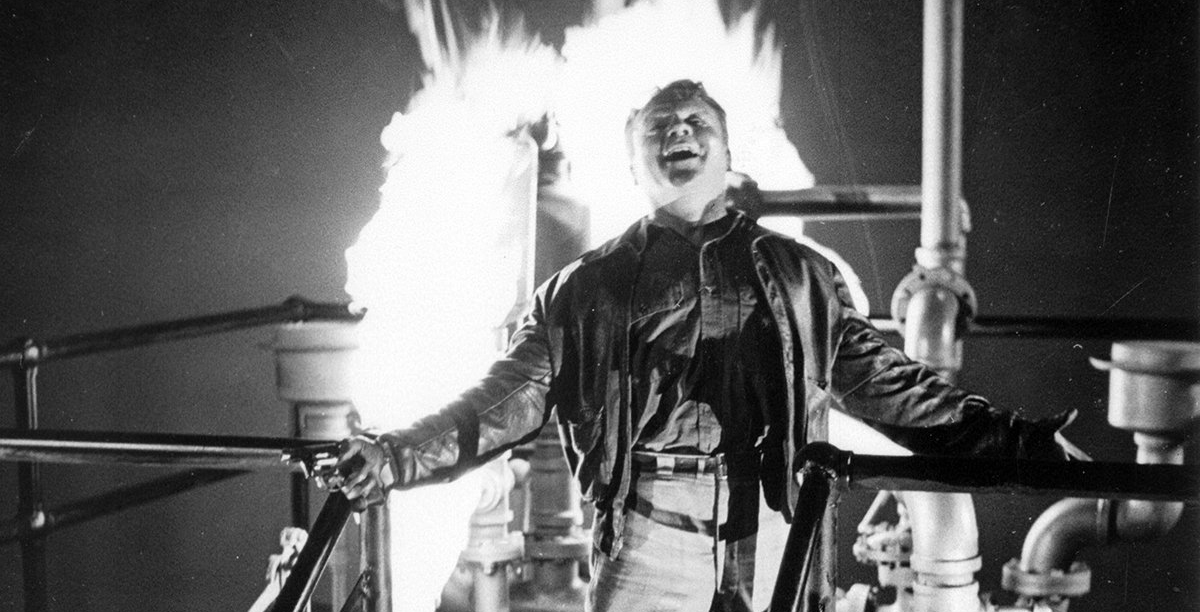
Another scene we need to talk about happens at the end. Throughout the movie Cody’s mom always ends their conversations by saying, “Top of the world, son! Top of the world!”

This is a line that has been used in pop culture references and parodies for years and I never knew what it was. Now I do and it’s honestly quite heartbreaking. There is so much Cody could have done with his life and not only did he choose crime but his own mother encouraged him to do so.

Cagney came back to Warner Brothers for this film after leaving for several years to start his own movie-making business with his brother. When that failed, he accepted an offer from Warner Brothers, even though Jack Warner really didn’t want him back, mainly because he needed the money.

Warner famously called Cagney, “that little b******.”

Cagney famously said of Warner in Rolling Stone Magazine, “I used to like to walk out on him, frankly, whenever my contract didn’t suit me. I’d cuss him out in Yiddish, which I had learned from Jewish friends in my days at Stuyvesant High School. Drove him wild. ‘What’d he say?!’ he’d yell. ‘What’d he just call me?!’”

Their arguments mainly started over Cagney’s contracts in the 30s.

Rob Nixon wrote for TCM.com that White Heat is considered Cagney’s last good gangster film.

“An exciting, dynamic film in its own right, White Heat also stands out as the flaming finale to the era of stark, fast-paced crime films made famous by Warner Brothers and James Cagney (among other stars) from the 1930s on ­ films in which the focus was on the often violent but charismatic gangster rather than the law enforcement officials who hunt him,” Nixon wrote. “It was also the apotheosis of Cagney’s brilliant career, a kind of summing up of the memorable outlaw characters he had created. His projects that followed in the 1950s were mostly lackluster affairs, and the cocky, pugnacious star audiences had come to love was glimpsed infrequently in such films as Love Me or Leave Me and Mister Roberts (both 1955).”

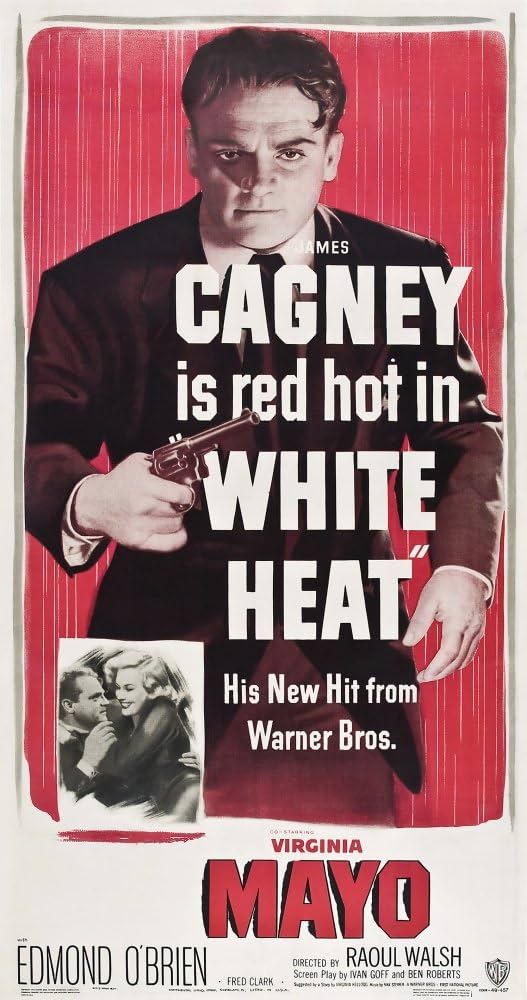
The film was directed by Raoul Walsh and in addition to Cagney it starred Virginia Mayo, Edmond O’Brien, and Margaret Wycherly as Ma.

Many scenes, such as the one mentioned above were adlibbed by Cagney or Walsh.

One of those was when he got annoyed at Mayo (his wife) and he was supposed to just glare at her but instead Walsh told Cagney to kick her off the chair she was standing on. For me, this showed how nasty and heartless Cody really was  – as if the opening scenes hadn’t already shown that.

The story for the movie was written by Virginia Kellogg and she was nominated for an Oscar for it, but didn’t win and no one else was nominated. Over the years, though, the film has been praised and named as the fourth best gangster movie by the American Film Institute, has been quoted or parodied too many times to count and in  2003, the American Film Institute named Cody Jarrett in its list of the best heroes and villains of the past 100 years.

I have to be honest and say that the end of the movie annoyed me. I don’t want to give it away but it was a typical movie from the 40s and 50s with the whole idea of the bad guy suffering and the “good guys/cops” being the heroes was very cliché.

In many ways there was nothing good that was going to come for Cagney’s character, though, so things ending badly for him was probably the only way for things to go.
Next week I will be watching Angels With Dirty Faces with Cagney and Humphrey Bogart. To end the event I will be watching The Bride Came C.O.D. (which will move me into my Spring of Bette Davis).

You can read about the other movies I watched by clicking the links below:


 Yankee Doodle Dandy

Taxi

The Strawberry Blonde

Mister Roberts

The Public Enemy

Love Me or Leave Me


Sources:

https://www.tcm.com/articles/89404/the-essentials-white-heat

https://en.wikipedia.org/wiki/White_Heat


If you want to find clips and thoughts about vintage movies and TV, you can visit me on Instagram on my Nostalgically Thinking Account (https://www.instagram.com/nostalgically_thinking/) or on my YouTube account Nostalgically and Bookishly Thinking here: https://www.youtube.com/@nostaglicandbookish


If you enjoy the kind of content on my blog and all that goes into it, you can support my writing for $2.99 a month or a single donation. Learn more here: https://lisahoweler.com/support-my-writing/

Classic Movie Impression: The Rage of Paris (1938)

I stumbled on The Rage of Paris, a movie from 1938, by accident when one movie I was watching on Amazon Prime ended and this one started. I ended up loving it and also fell in love with Douglas Fairbanks Jr. who I had never heard of before this movie.

Where had I been? He was so handsome and charming in this movie, which made me want to look up more information about him. I also now want to find more movies starring him. I feel a Winter or Spring of Douglas Fairbanks Jr. coming up

“Douglas Fairbanks Jr. must have been famous back in the day because his name is even in the title of the movie on Amazon,” I said to myself.

I later asked my mom and dad about him and they assured me he was very famous, but, Mom said, “That was way before my time, just so we are clear here.”

Mom and Dad were, incidentally, born in 1944. Fairbanks Jr. started his career much earlier.

Before we learn about him, though, I’ll share about the movie, which starts with the main character, Nicole de Cortillion, (Danielle Darrieux) a French woman in New York City, who is desperately looking for a job. There is a hilarious mixup where she asks the head of a modeling agency for work and he suggests a job with a photographer who wants female models who will model with drapes on – and nothing else. The photographer is impatient and wants the job done fast, she’s told.

Nicole is horrified and says she won’t do it, but when another model comes in and says she will, Nicole doesn’t want to lose the job and while the model and the head of the agency are chatting, she snatches the address from the top of the desk.

The only problem is that she’s grabbed the wrong address. The address she has is for a man simply looking for some proof photographs for an advertising campaign that doesn’t involve scantily clad women.

The man is Jim Trevor (Fairbanks) who is beyond confused when he walks into his office after a meeting and finds Nicole stripping to prepare for the photos.

It is one of the funniest scenes I’ve ever seen in a movie because it’s clear he doesn’t have any idea what she’s doing and both wants to stop her and not stop her. He tries to ask what she’s doing and she asks where his camera is. A very funny exchange occurs during which Jim starts to think this woman is looking for a quick buck in a very solicitous way.

I found a clip for you of the witty exchange:

Back at her apartment, her landlady says she’s kicking her out for not paying rent. Her neighbor, Gloria, (Helen Broderick) having it though and tells the landlady that she will cover her rent. She then brings Nicole into her apartment and tells her she wishes they could marry rich men and not have to worry about bills anymore. That’s when an idea strikes Gloria. She has a friend who is employed as a maitre’d at a famous hotel. Maybe he would give Nicole a job. They head to the hotel, but the man – Mike (Mischa Auer) – says he can’t give her a job because soon he’s going to open his own restaurant. All he needs is $3,000 to get the restaurant.

Another idea strikes Gloria when she sees all the women dancing with the wealthy men in the dining room. What if they have Nicole seduce a millionaire and marry him? Then she won’t have to find a job and she can also give money to Gloria and Mike. Gloria talks Mike into the scheme. They’ll rent a room at the hotel with his help. Gloria will pretend to be Nicole’s aunt and together they will set their eyes on millionaire Bill Duncan. If Nicole can convince him to marry her they’ve got it made.

All is going well until Nicole, Gloria, and Bill attend an opera and run into Bill’s friend – none other than Jim Trevor.

The scene where they recognize each other across two balconies is comedy gold.

I absolutely could not stop laughing.

I’ve left a clip of it that I found on YouTube here for you:

Nicole does her best to hide from Jim Trevors but it doesn’t work and when he gets her alone later in the evening he tells her she needs to tell Bill Duncan the truth – which is that she isn’t a rich baroness from Paris – but instead a poor girl trying to swindle him into marrying her.

She promises she’ll tell Bill Duncan but she double crosses Jim in a very funny scene that leaves Jim steaming and more determined than ever to make her tell the truth. The rest of the movie is him doing just this.

The Rage of Paris did well at the box office in 1938 and was nominated for two Venice Film Festival Awards, winning in the category of Special Recommendation.

I had never heard of either of these actors when I started the movie.

For some background on Douglas Fairbanks Jr. – his father, Douglas Fairbanks Sr., was one of cinema’s first icons, noted for swashbuckling adventure films as The Mark of Zorro, Robin Hood, and The Thief of Bagdad. Fairbanks had small roles in his father’s films American Aristocracy (1916) and The Three Musketeers (1921). Fairbanks Jr.’s mother was Anna Beth Sully, the daughter of wealthy industrialist Daniel J. Sully.

His parents divorced when he was nine and he lived part-time with his mother in France, New York, London, and California.

Fairbanks started acting at the age of 13 when he was given a contract simply because he was the son of a famous actor. The film he first starred in flopped, though, and he returned to Paris to continue his studies. He returned to Hollywood at the age of 14 and became a camera assistant at what he called “starvation wages.”

His father didn’t want him to get into acting at such a young age, but instead wanted him to continue his education.

He worked steadily from 1921 to 1956 but he took a break during World War II to become a highly decorated officer by serving in the U.S. Navy as a reserve officer. He was a part of many, many missions including one where he was part of a recruitment of 180 officers and 300 enlisted men for the “Beach Jumpers” program. This program was aimed at simulating amphibious landings with a limited force, operating miles from the actual landing but using deception to make the enemy believe it was the actual landing place.

I don’t like using Wikipedia as a source anymore for a variety of reasons, but according to their page on Fairbanks,  “For his planning the diversion-deception operations and his part in the amphibious assault on Southern France, Lieutenant Commander Fairbanks was awarded the United States Navy’s Legion of Merit with bronze V (for valor), the Italian War Cross for Military Valor, the French Légion d’honneur and the Croix de Guerre with Palm, and the British Distinguished Service Cross.

Fairbanks was also awarded the Silver Star for valor displayed while serving on PT boats and in 1942, made an Officer of the National Order of the Southern Cross, conferred by the Brazilian government.  . . . Fairbanks stayed in the US Naval Reserve after the war, and ultimately retired as a captain in 1954. In 1982, Fairbanks was awarded the German Federal Cross of Merit for his contribution to the relief of the needy in occupied Germany.”

He returned to acting after the war and starred in many “swashbuckling movies” as well as British films and television since he moved back to the UK after the war and stayed there for many years before moving to Florida (is it just me or do a lot of Brits move to Florida?).

As for his co-star, Darrieux, this was her first American film. She was a star in France before World War II. She started acting at the age of 14.

She continued acting during World War II and the German occupation of France, which was something she was frowned upon for. Later, though, it was believed she’d been threatened by the head of the only studio in operation at the time – owned by a German who threatened to have her brother deported if she didn’t perform.

Darrieux had a lengthy film career in France, the United States, and Britain, and starred in  Lady Chatterley’s Lover (1955), whose theme of uninhibited sexuality led to its being proscribed by Catholic censors in the United States. She then played a supporting role in her last American film, United Artists’ epic Alexander the Great (1956) starring Richard Burton and Claire Bloom.

She acted from 1931 to 2002.

Later in her career she became involved in musical theater and even performed concerts in the 1960s. She passed away at the age of 100 in 2017. What a full life!

According to a blog dedicated to Douglas Fairbanks Jr., Darrieux’s life was tough at times, even if it was full, especially while filming The Rage of Paris.

Fairbanks remembers working with Darrieux fondly,” Elizabeth from the blog Douglasfairbanksjr.wordpress.com. “Unfortunately at the time, she was a victim of physical abuse at the hands of her husband. Filming had to be postponed for a short while as she recovered from a black eye given to her by her husband.”

The blogger goes on to say that Darrieux’s overbearing husband kept her from socializing too much with others on set. Thankfully, not long after the premiere of The Rage of Paris, Darrieux left her husband.

Fairbanks wrote in his memoir, “I’ve always hoped she was consoled by the fact that the picture turned out well and proved very popular.”

I also agree with the author of the blog who said she felt The Rage of Paris “contains one of the best on-screen chemistries and one of the best romantic build-ups on film.”

The chemistry between Darrieux and Fairbanks Jr. was incredible and I was sad to read that they only made one film together. If they were only going to make one film together, though, I’m glad it was this one.

So, tell me, have you seen this film or any of Douglas Fairbanks Jr.’s other films? How about Darrieux? Have you seen any other films by her? And should I have a Douglas Fairbanks Jr. marathon for myself this winter?