Classic Movie Impressions: The Talk of the Town (1942)

This past weekend I watched the movie The Talk of the Town with Cary Grant, Jean Arthur, and Ronald Colman. I found this movie, among many other good ones, free on Tubi. It is also currently free on YouTube.

I had seen it before as a suggested move but ignored it, thinking it was a drama. After watching it, I asked myself, “What took me so long to watch this one?!”

I loved this movie and while I always love Cary Grant, I once again loved Ronald Colman who I first saw in The Prisoner of Zenda earlier this year.

This movie starts with a fire at a factory where a man dies. Cary, portraying Leopold Dilg, is arrested for arson and murder.

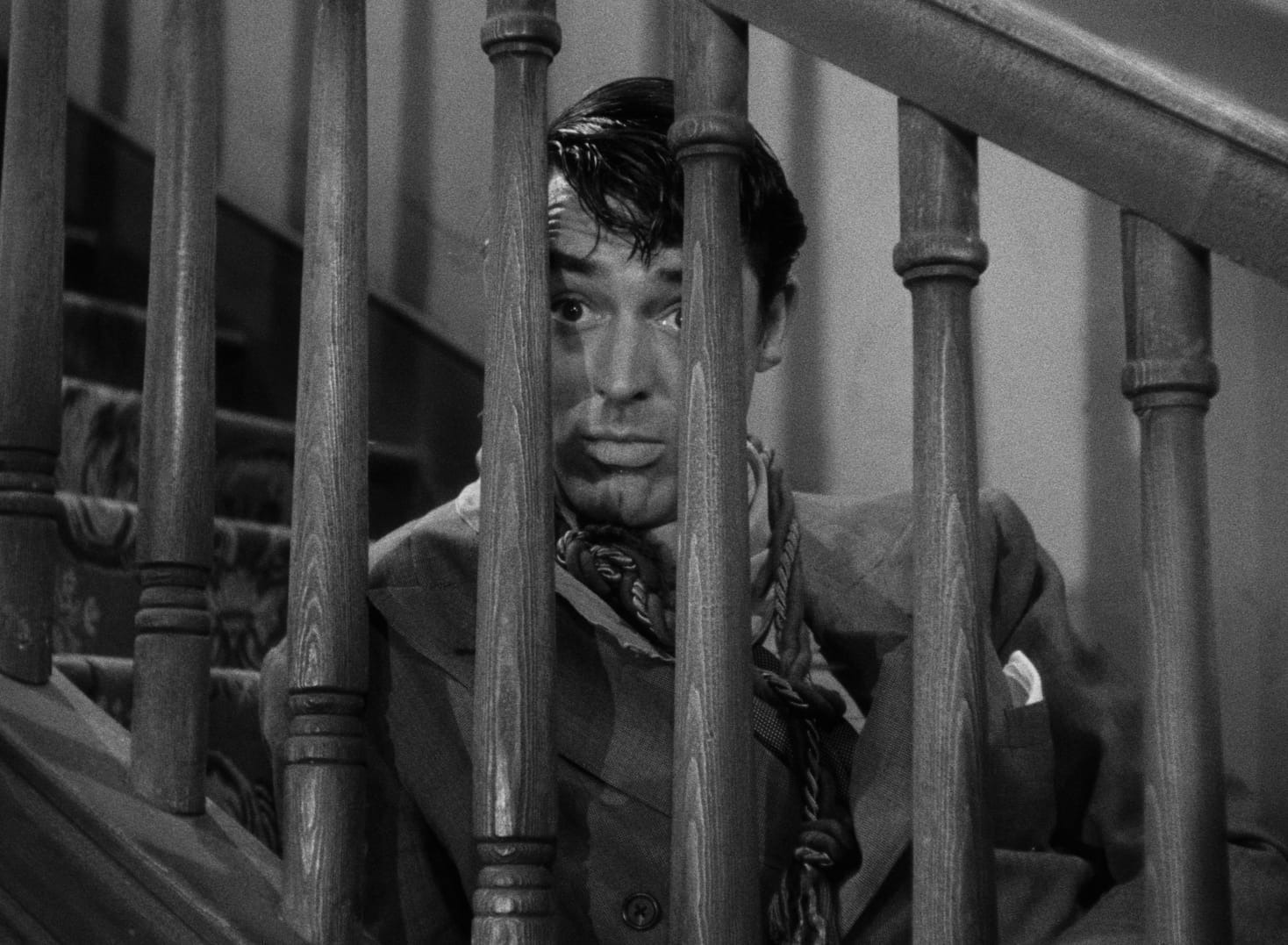
Soon he’s breaking out of jail and escaping through the woods on a rainy night. He makes his way in the dark toward a small house while dogs hunt him down. The name of the house is Sweetbrook and there is a woman inside getting it ready — maybe for a guest.

Leopold breaks in the door, startling the woman.
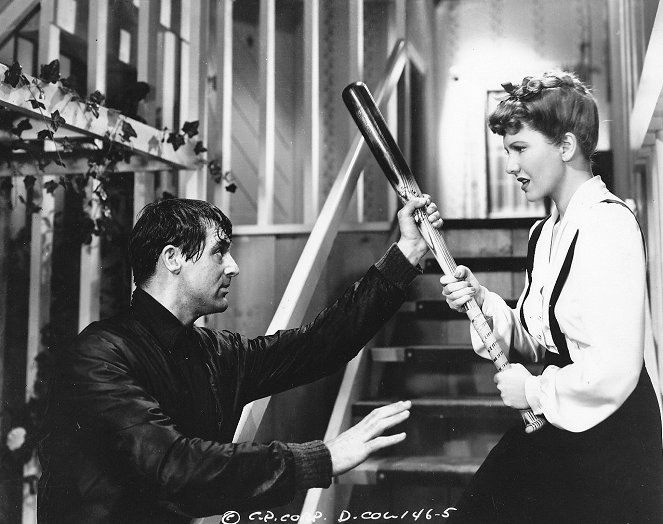
“Miss Shelley,” he says. “Please…let me…” And then he faints and falls down the stairs.

Miss Shelley wakes him up with a bucket full of water and he asks if she can stay at the house, which he knows is a rental. She tells him he can’t stay because she knows he has escaped jail. There is a knock on the door before she can finish explaining and she tells him to run upstairs and hide.

There is a Professor Michael Lightcap at the door and he’s standing in the rain. He reminds her that he’s rented the house out and he’s here to stay. Miss Shelley, whose first name is Nora, panics because Leopold is hiding upstairs and she doesn’t want the professor to find him.

Things will get more complicated as she makes up an excuse to stay in the house overnight to make sure the professor doesn’t find Leopold.

Complications just keep arising as Nora offers to become the professor’s secretary and housekeeper during his stay, a senator arrives to tell Professor Lightcap he’s up for nomination to the United States Supreme Court, and Leopold walks down one morning to argue about the role of the law in society and Nora has to introduce him as the gardener.

This is a non-stop movie full of hilarious mix-ups, near misses, and a love-triangle that won’t be resolved until the very last minute, literally, of the movie.

As I said above, I loved this movie.

It was engaging, funny, witty, and captivating. Mixed in all the lighthearted moments were a few philosophical moments about law and justice.

Jean Arthur was delightful as Nora Shelley, always quickly rescuing the day just at the last moment, taking care of both Leopold and the professor.

Ronald Colman pulled off the staunch, uptight professor well and it was fun to see him “let down  his hair” a bit later in the film. He didn’t let down his hair. It’s just a saying, of course.

Cary walked the line between an aggressive rebel and a falsely accused victim, putting his usual romantic charm on the backburner for most of the film and bringing it out in more subtle moments. This was a movie where he wasn’t a pursuing a woman as much as he was his own freedom and justice.

I spent much of the last half of the movie wondering which one of the men Nora was actually falling for and I think she was doing the same thing. She’d gathered affection for both of them but wasn’t sure if either of them had for her.

This movie was nominated for seven Oscars but it was about the same time that America started the war so more “patriotic” movies got the nod that year. Ironically the best picture went to Mrs. Minier, which was set in England, however.

According to TCM, even without the wins, The Talk of the Town “still marked an important moment in the careers of its stars Cary Grant and Ronald Colman.”

For Cary, it was a new movie after not working for a year and he was nominated for an Oscar as well. He didn’t win the Oscar but he did have his name legally changed  his name from Archibald Alexander Leach, became an American citizen and married heiress Barbara Hutton.

Colman was 51 at the time and needed a spark to reinvent his career. The Talk of the Town worked and he went on to star in Random Harvest, which earned him another Oscar nomination. He lost that to James Cagney in Yankee Doodle Dandy, but still kept him at a high point in his career. Films such as Kismet (1944) and Champagne for Caesar (1950).  He also finally earned his Oscar for portraying the delusional Shakespearean actor in A Double Life (1947).

I found it interesting to read that there was tension between Grant and Colman since both were used to being the lead actor and that tension was written into the script as they aggressively bantered back and forth with each other.

I also was fascinated to learn that two endings were filmed — one with Jean Arthur choosing Cary and the other with Colman. The director allowed the preview audiences to choose who she ended up with.

Trivia:

  • filming was to begin on January 17, 1942, the day Hollywood learned the sad news of Carole Lombard’s death in a plane crash. Stevens halted work on the set and sent both cast and crew home.
  •  
  • Screenwriter Sidney Buchman (who co-wrote the script with Irwin Shaw) was blacklisted in the 1950s. Consequently, Buchman, one of the men who penned Mr. Smith Goes to Washington (1939), left the U.S. and began working in Fox’s European division. Buchman would remain in France until his death in 1975.

When the professor is unconscious on the floor, Tilney (Rex Ingram) asks Sam if he is a doctor. Ironically, Rex Ingram was himself a trained physician in real life.

Cary Grant and Ronald Colman were both paid at least $100,000 for their work in the film. Jean Arthur, who was in Harry Cohn’s doghouse and just coming off suspension, was only paid $50,000.


Whilst many characters find Leopold Dilg’s penchant for adding an egg to his borscht unique (so much so that it becomes a means of determining his whereabouts), it was not an uncommon practice to add an egg to borscht in Poland and in Mennonite communities in Eastern Europe.

A radio theatre presentation of The Talk of the Town (1942) was broadcast on CBS radio on the Lux Radio Theatre on 5/17/1943 with Cary GrantRonald Colman, and Jean Arthur recreating their roles from the movie. It’s a 60-minute adaptation of the movie.

Nora tells the professor that he is, “as whiskered as the Smith Brothers.” This refers to a brand of cough drops with an illustration of the Smith Brothers on the front, both of whom have a beard. First introduced in 1852, they remained the most popular brand for a century.


Memorable quotes:

Well, it’s a form of self-expression. Some people write books. Some people write music. I make speeches on street corners.

– Leopold Dilg

What is the law? It’s a gun pointed at somebody’s head. All depends upon which end of the gun you stand, whether the law is just or not.

– Leopold Dilg

Stop saying “Leopold” like that, tenderly. It sounds funny. You can’t do it with a name like Leopold.

– Leopold Dilg

This is your law and your finest possession – it makes you free men in a free country. Why have you come here to destroy it? If you know what’s good for you, take those weapons home and burn them! And then think… think of this country and of the law that makes it what it is. Think of a world crying for this very law! And maybe you’ll understand why you ought to guard it.  – Michael Lightcap

He’s the only honest man I’ve come across in this town in 20 years. Naturally, they want to hang him. – Sam Yates


Sources:

TCM.com https://www.tcm.com/tcmdb/title/92288/the-talk-of-the-town#articles-reviews?articleId=187407
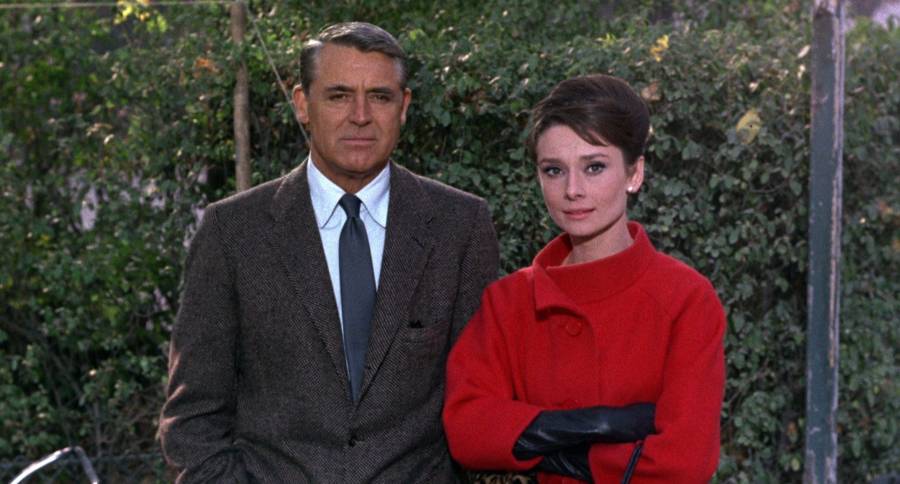
Springtime in Paris: Charade

Erin from Still Life, With Cracker Crumbs and I have been watching movies that take place in Paris for the last couple of months.

For our last week, we watched Charade with Audrey Hepburn and Cary Grant.

Directed by Stanley Donen this movie was released in 1996 and tells the story of Reggie Lambert (Hepburn) and Peter Joshua (Grant) who meet briefly on vacation in the Alps. When Reggie returns home, she finds that the husband she’d planned to divorce has been murdered, but before he was murdered, he sold the contents of their apartment, including all of her possessions.

A mystery ensues and what follows is a movie that was good but was very confused about which genre it should be in.

When Reggie returns to Paris and her empty apartment, a police officer approaches her and tells her that her husband was found in his pajamas dead by the train tracks and that he was apparently trying to leave Paris quickly.

While Reggie was discussing her husband at the beginning of the movie with a friend, and we learned he was wealthy, we learned very little about him and now it is clear that Reggie also learned very little about him. As the police show her several different passports from different countries with his face on them, she begins to realize she didn’t know the man at all.

Reggie is bewildered later when Peter Joshua shows up to her empty apartment and says he read about the murder in the newspaper and wanted to check on her.

She believes the police think she murdered him.

Peter offers to find her a hotel room until she can find a new job and apartment.

Peter asks what she’s going to do now that her husband has been murdered and she says she’s going to try to get her old job as a translator back.

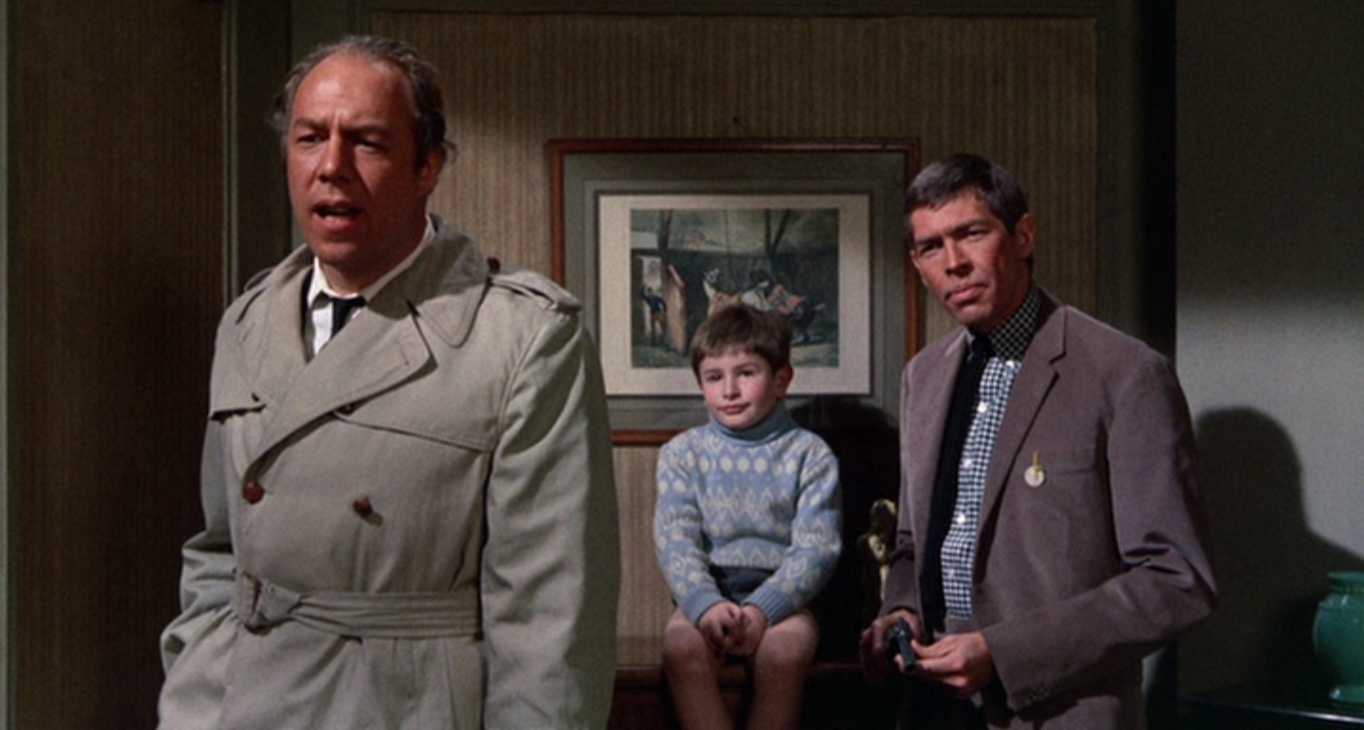
At his funeral, Reggie is even more bewildered, because there aren’t any guests other than her and her friend. Three American men (James Coburn, George Kennedy, and Ned Glass) show up and either spit on him, poke his body, hold a mirror to his nose, to make sure he is dead, or say something inappropriate. James Coburn approaches her and doesn’t offer condolences. He just says, “Charlie had no reason of doing it thatta way. No siree.” and walks away.

Um..okay…poor Reggie is even more bewildered.

A large man then approaches, handing her a letter requesting she visit the American embassy the next day to discuss the death of her husband.

She shows up to meet with Walter Matthau who seems to know her husband. He informs her that her husband was wanted by the CIA and his real name was Charles Voss. He also tells her that her life might be in danger.

He suggests that she somehow has the money her husband earned from selling all their possessions. That money is the same amount he stole from the United States government during World War II, he says. He instructs Reggie that she needs to find the money and return it to him before the other, dangerous men find her.  Looking for help and someone to talk to, Reggie contacts Peter, who decides one way to help is take her out for a night on the town to cheer her up. What results is a very strange game where people have to pass an apple down a line of people only using their chins and necks.

So..yeah..that was strange and uncomfortable to watch. *laugh* I am not sure how the actors did the scene without totally falling apart in laughter or embarrassment.

It was nice to see Cary’s familiar goofy expressions in this scene. I’ve noticed watching his later movies that he doesn’t loosen up the same way he did when he was younger which is natural, but also hard to watch sometimes.

The game leads Reggie and Peter in some compromising positions where they pause to look at each other for a long time and you can tell in that moment that Peter is thinking about what it would be like to kiss her and vice versa.

It’s all fun and games until all three men track Reggie down at the club and begin to threaten her for the money they think she has.

This movie is categorized as a comedy/thriller which makes it a little hard to figure out at times. I sometimes wondered if I was supposed to laugh or feel dread during certain scenes. There is a terrifying scene where one of the men (Coburn as Tex) keeps lighting matches and dropping them on her lap while she screams and cries and I couldn’t laugh at that scene so I don’t know what the director and writers were going for – maybe that was it — to have the viewer not sure what to think.

When Peter convinces Reggie to tell him what he is going on, he decides he will help her find out why she is being pursued and tells her that he will keep the men from hurting her. Now we viewers have to  decide with Reggie who Peter is and if he is really a good guy or not.

I read that Cary actually didn’t want this role at first because he said he felt like a predator, going after the younger Audrey.

That’s funny since he was in many movies in his older years where he was “going after” younger women and he married a woman much younger than him, but I digress….

Cary turned 59 during filming and it was this movie that made him decide it was time to stop playing the romantic lead. The reviews focusing on the 26 year age difference between him and Audrey was one big driving factor in this decision, he later said.

He was so uncomfortable with the idea of their age gap he asked for the script to be changed so screenwriter Peter Stone made Audrey the aggressor and Cary the man trying to fight her off.

Stone said he wrote things like “Can’t you just think of me as a woman?” and have Cary say, “I’m already about to get into trouble for transporting a minor above the first floor.”

He then says, “Come on, child, let’s go.”

Stone said, “Cary made me change the dynamic of the characters and make Audrey the aggressor. She chased him, and he tried to dissuade her. She pursued him and sat in his lap. She found him irresistible, and ultimately he was worn down by her. I gave him lines like “I’m too old for you, get away from me, little girl.’ And ‘I’m old enough to be your father.’ And in the elevator: ‘I could be in trouble transporting you beyond the first floor. A minor!’ This way Cary couldn’t get in any trouble. What could he do! She was chasing him.”

When I first started the movie, I was afraid I wasn’t going to like this film at all. Cary’s acting was stilted and “off” for me right from the start.

I found some parts of the movie confusing and odd because of its identity crisis, or inability to choose between being a comedy or a thriller, but I don’t want to spoil too much of the movie by commenting on which parts.

What I will say is that it was just weird to that Audrey’s character continued to throw herself at Cary’s character even when she isn’t sure who he really was. And this is just after her husband has been murdered and she is being pursued by people who want money her husband stole.

I enjoyed the action and the movie overall but really would have liked it the movie had picked a lane and stayed in it.

This was Cary’s chance to finally work with Audrey, by the way, after turning down leading roles in at least four movies she’d been in — Roman Holiday (1953), Sabrina (1954) and Love in the Afternoon (1957). He’d turned them all down because of the quarter-century age difference between them, according to TCM.com.

The rumor at the time was that he’d also turned down the role of Henry Higgins in My Fair Lady because he didn’t want to work with Audrey. This wasn’t true, but instead was a decision made out of respect of Rex Harrison who had created the role on Broadway.

The article on TCM.com reads: “In the Barry Paris biography, Donen recalled that “Cary thought he was going to do a picture with Howard Hawks called Man’s Favorite Sport? [so he] said no to Charade. Columbia said get Paul Newman. Newman said yes, but Columbia wouldn’t pay his going rate. Then they said get Warren Beatty and Natalie Wood. So I got them and Columbia decided they couldn’t afford them or the picture. So I sold Charade to Universal. In the meantime, Cary had read Hawks’s script and didn’t like it. So he called me and said he would like to do Charade.”

I want to share another quote from the TCM article because it is such a funny story: “ In Audrey Hepburn: A Biography by Warren G. Harris, the director recalled: “I arranged a dinner at a wonderful Italian restaurant in Paris. Audrey and I arrived first. Cary came in, and Audrey stood up and said, ‘I’m so nervous.’ He said, ‘Why?’ And she said, ‘Meeting you, working with you – I’m so nervous.’ And he said, ‘Don’t be nervous, for goodness’ sake. I’m thrilled to know you. Here, sit down at the table. Put your hands on the table, palms up, put your head down and take a few deep breaths.’ We all sat down, and Audrey put her hands on the table. I had ordered a bottle of red wine. When she put her head down, she hit the bottle, and the wine went all over Cary’s cream-colored suit. Audrey was humiliated. People at other tables were looking, and everybody was buzzing. It was a horrendous moment. Cary was a half hour from his hotel, so he took off his coat and comfortably sat through the whole meal like that.”

Despite that awkward first meeting, the pair apparently hit it off very well, even ad-libbing some of their lines.

Do you ever look up trivia like this for movies when you watch them or am I just the weirdo in the group?

Have you ever seen this one? What did you think of it?

You can read Erin’s thoughts here: https://crackercrumblife.com/2025/05/08/springtime-in-paris-charade/

If you wrote about today’s movie, or any of the movies we watched during this movie event, you can post your links below.

Also, thank you so much for participating and I hope you all had fun taking part! Do you have an idea for a themed movie event? Let us know in the comments!

I hope you will join us for the next one, though I am not sure when we will do it. Erin and I both have a lot going on in our personal lives with family health situations so we might not hold one until autumn. Not sure yet. We will have a meeting of the minds on it at some point.

We are, however, holding Drop In Crafternoons where we meet on Zoom and do crafts of any kind while chatting.

I had planned to try one this weekend but things are a bit up in the air right now with my parents’ health and the fact my whole family came down with a cold/virus and I am waiting to see if I am next, so we are sticking with one on May 24th for now.

You are invited to the Inlinkz link party!

Click here to enter
https://fresh.inlinkz.com/js/widget/load.js?id=c0efdbe6b4add43dd7ef

Classic Movie Impressions: That Touch of Mink

I needed something to distract me from every day life last week so I watched That Touch of Mink with Doris Day and Cary Grant. I am very certain I’ve watched either all or part of this movie before but it has been years so I didn’t remember much about it.

This is quite a modern movie for 1962.

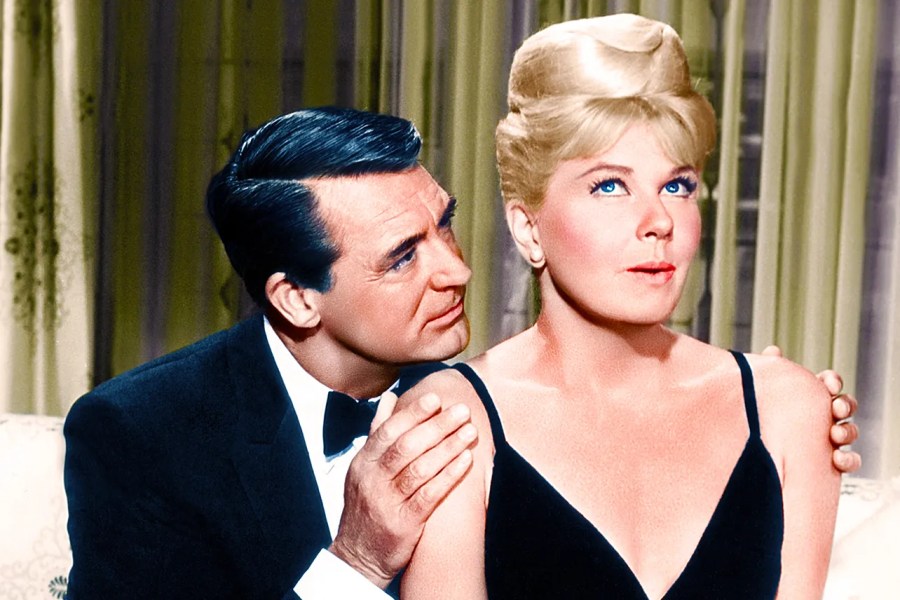
Cary Grant is a no nonsense, yet still kind and understanding, businessman and Doris Day is a young woman from a small town living in a big city and trying to find a job.

This movie was meant to be a comedy, so I tried not to be too uptight about how Cary Grant was essentially trying to get into Doris Day’s pants without actually committing to a relationship for the entire movie.

I have to say that I didn’t really like Cary for most of this movie and my husband said it is probably because of the fact Cary really didn’t want to make the movie, according to articles he has read about it. While I didn’t find articles online specifically saying he didn’t like the film, I did find information that Doris Day wrote in her autobiography that Cary was polite and professional on set but that there was really no “give and take” between them.

First a little summary:

This movie takes place in 1962 starts with Doris Day walking down the street and getting splashed by a car that Cary’s character (Philip Shayne) is riding in. He feels bad but he can’t stop because he is on his way to a very important meeting. We find out later that Doris’s character (Cathy Timberlake) is looking for a job and Philip is a shrewd but also generous businessman with a friend, Roger, (played by Gig Young) who is a bit of a leach. Philip does actually feel awful about splashing Cathy and tells Roger he’d love to find the woman and apologize.

Luckily they are looking out the office window not long afterward and see Cathy walking into a diner across the street.

He orders Roger to take her some money to apologize. Roger is hoping the woman will want to tell Phillip off. He’s sick of Phillip getting all the women despite his flippant attitude. Cathy does want to tell Phillip off so Roger takes her to Phillip immediately.

Unfortunately for Roger, Cathy falls for Phillip immediately. Phillip sees this as a chance to sweep another woman off her feet by taking her on trips around the world.

He starts to do just that and Cathy wants him to like her so she goes along with him — flying to Baltimore for a speech he’s giving, then to Philadelphia for a quick dinner. One night he even takes  her to a New York Yankees game, into the dugout where we meet the real Roger Maris, Mickey Mantle, and Yogi Berra.

Soon though, Phillip wants her to go on vacation with him to Bermuda and she’s not sure if she means he wants her to stay in the same room with him or if they will have separate rooms. He definitely wants her to stay in the room with him, which causes her to breakout in a full body rash and skuttles his plans.

She’s a good girl from Sandusky, Ohio after all. Girls from Sandusky don’t go running off with men on vacation and sleep with them unless they have a ring on their finger and have said “I do” to marriage vows.

Cathy returns home disappointed in herself because she didn’t sleep with Phillip but also fairly annoyed at him for thinking she would after they’ve known each other for only a short time.

She wants to break out of her boring girl mold, though, and decides to try again — telling Phillip she’ll go with him again to Bermuda and she will give him what he wants. She doesn’t say exactly that but the viewer gets her drift.

Sadly, things don’t work out this time either but you will have to watch the movie to find out why.

The movie is a series of miscommunications, silly tropes, and goofy interactions. One of those miscommunications is between Roger and his therapist. Roger is sharing the story about Cathy and Phillip but the therapist walks out of the room and only hears part of the story, leading him to believe that Roger is becoming involved with another man, which I thought was a very progressive (for lack of a better word) joke for the early 1960s. That joke carries on throughout the movie with Roger continually trying to update the therapist on Phillip and Cathy but the therapist instead believing that Phillip has been trying to woo Roger instead.

I found it interesting that this movie was one of the last ones where Cary was a leading man.

It was his 69th movie and he was in his 50s. An article on TCM.com states that he must have known his time for playing leading men was waning.

“He made one more picture in which he was the dashing leading man, Charade (1963), opposite Audrey Hepburn,” the article reads. “After that, he appeared as a grizzled old beachcomber in Father Goose (1964), then as a British gentleman who plays Cupid for the young romantic leads in Walk Don’t Run (1966), his last film before retiring from the screen.

The article goes on: “Doris Day’s string of box office hits continued though with somewhat diminishing returns over the next six years in ten more films. After With Six You Get Eggroll (1968), the actress retired from the big screen. Her hit TV sitcom, The Doris Day Show, ran from 1968 to 1973, changing formats and storylines almost very season.”

As for my feelings on the film, I liked it overall but didn’t like the message that women should just go sleep with men they are not married to. The end of the movie would have feminists of today growling in anger but it was most likely what made most every day movie goers happy at the time.

I couldn’t figure out while I watched it if Cary was bored during the movie or if it was how he was playing Phillip Shayne. Maybe he wanted Phillip to have no real personality beyond seeming bored and like he expected women to fall in bed with him. The man didn’t even seem excited by the prospect of sex. He just seemed to expect that it would happen, and he would move on to the next woman.

Years ago, I was reading about Cary and his use of LSD as an attempt to help him with his depression and other mental issues. Many psychiatrists at the time prescribed LSD as part of psychological therapy. It wasn’t yet a recreational drug.

Both Gig Young and Cary used the therapy and as I researched for this film I read that Gig sadly killed his 31-year-old wife and then himself in 1978 when  he was 64. I wonder how much the drug affected his brain at the time and left him worse off than he had been. He was also an alcoholic, though, so that most likely played an even larger role than the LSD. Either way it is sad.

 I also sometimes wonder if the drug was why Cary seemed so blasé and uninterested in his movies during this particular time period.

I don’t think this is a movie I would watch again but it was a fun escape.

I should also  mention the other star of the movie: The Automat.

The Automat was an automatic-type diner where restaurant goers could go in and choose what they wanted by pushing a button on what looked like post office boxes and then could open a door and the food would be slid to them through the tiny hole. I had never seen anything like it before this movie. Cathy’s friend Connie worked at one and delivered the food. That’s where Cathy would go to talk to her. It seemed like a very busy job since Connie and only one or two other co-workers would have to slide the food into the little box for the people to retrieve.

Have you ever seen this movie? What did you think of it?

Classic Movie Impressions (Winter of Douglas Fairbanks Jr.): Gunga Din

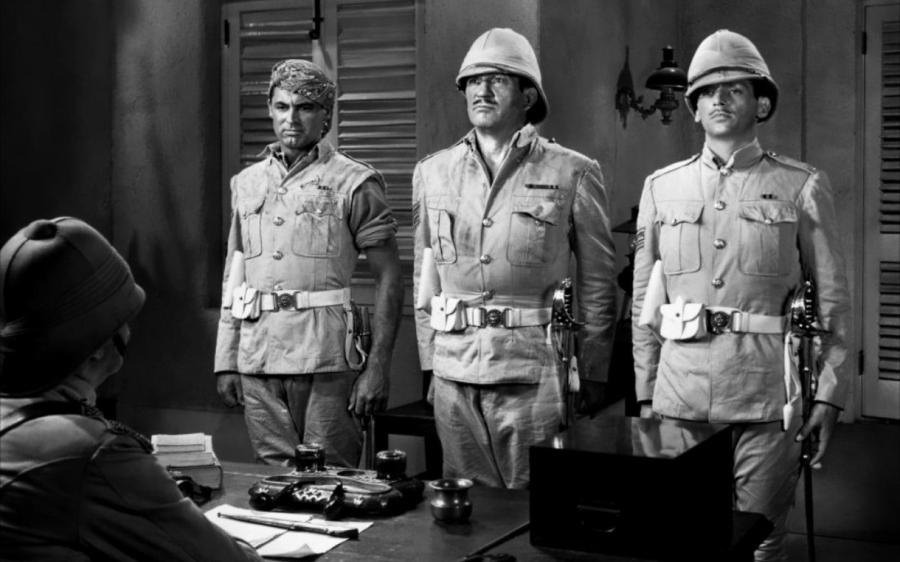
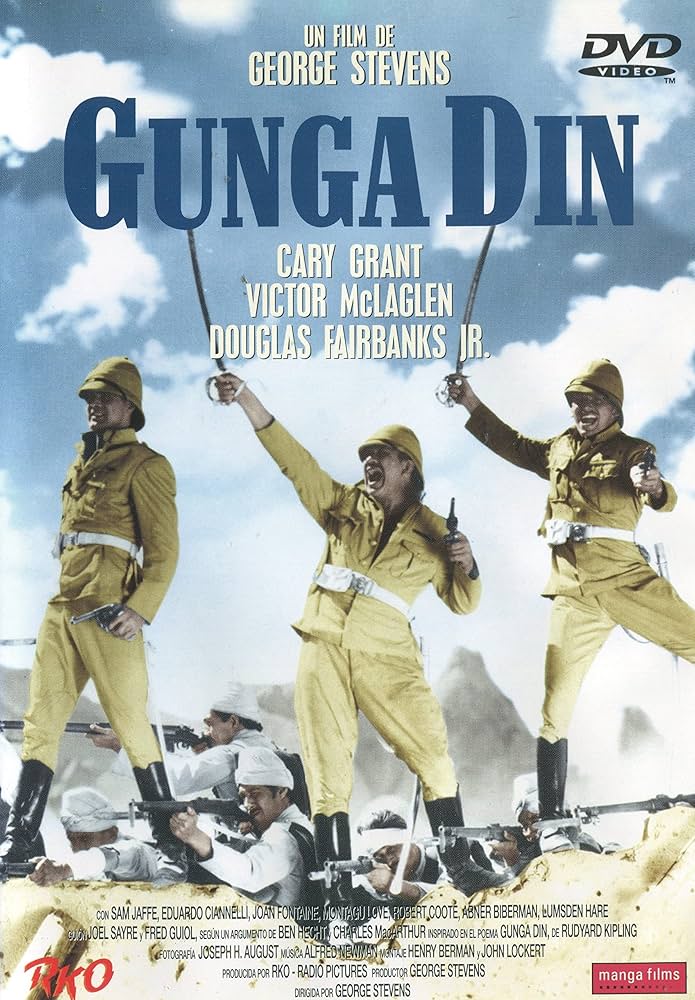
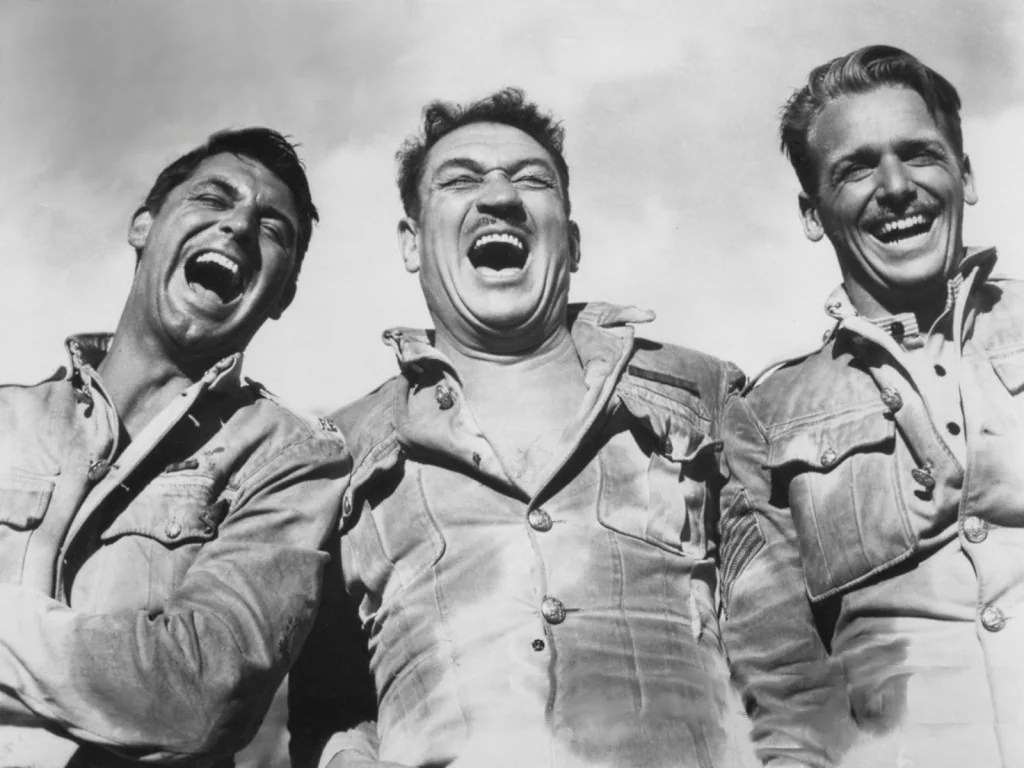
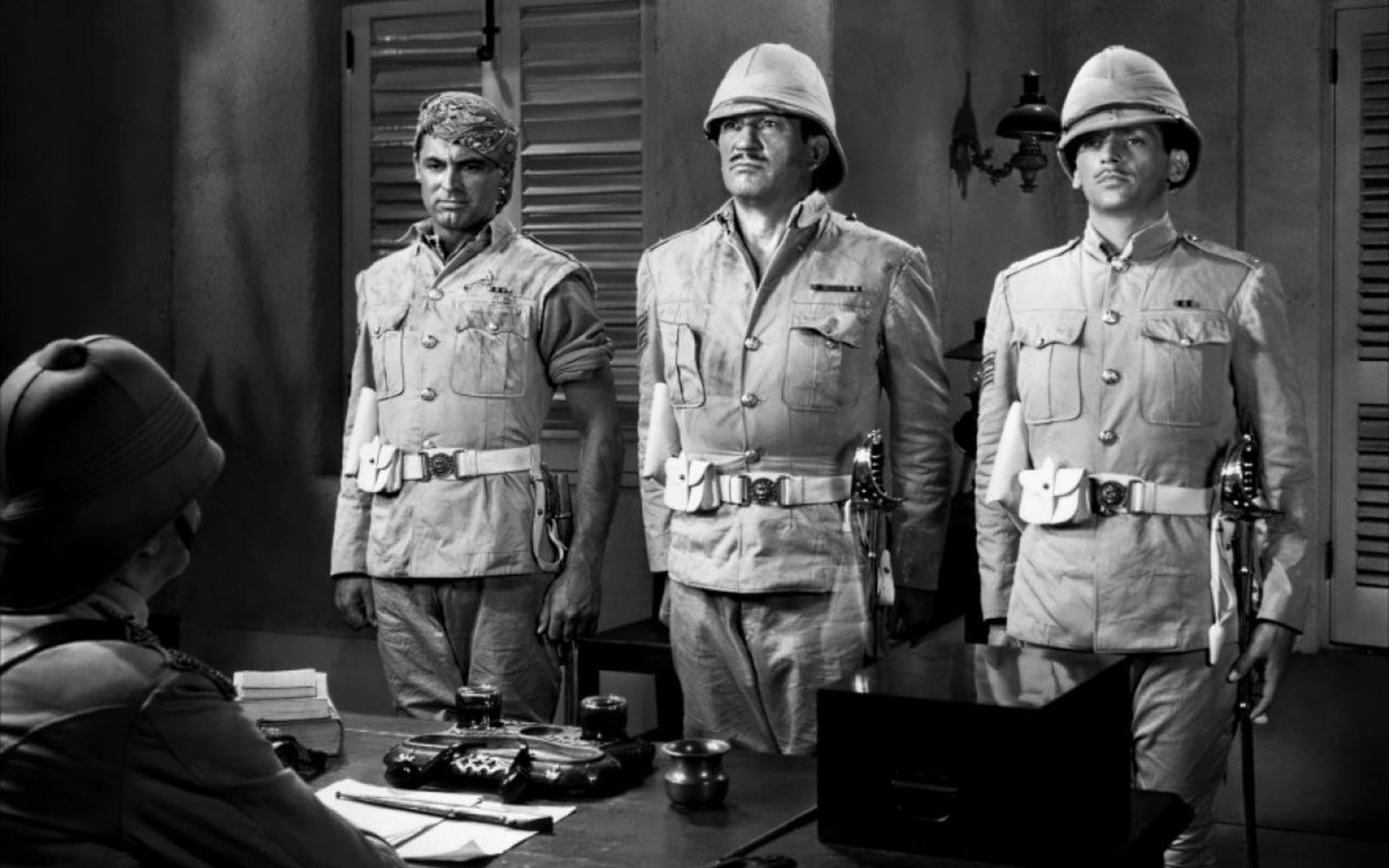
Up this week for the Winter of Douglas Fairbanks Jr. is Gunga Din (1939), said to be one of his most famous movies.

I am going to let you know right up front that I rarely hate classic movies that I watch, but I pretty much hated this movie. This movie was a train wreck for me from beginning to end. Possibly a bit of a racist train wreck at that. It had a severe identity crisis — it wasn’t sure if it was a comedy or a drama.

For me this movie was Gunga Do..n’t.

When I first started it I thought, “Two of my favorite actors. Cary Grant and Douglas Fairbanks, Jr! Be still my heart!!!”

As I continued it, I thought things like:

 “Are these guys supposed to be British?”

“What accent is that? Is he trying to do an accent? Why is he trying to do an accent?”

“Why didn’t they let the Irish actor just have an Irish accent? His British accent is horrible.”

“Douglas looks bored out of his mind and like he wishes he could get out of his contract.”

“Is that a white man painted brown to look Indian? And that one too? And that one? And…

First a snippet of the synopsis of the movie from TCM.com:

In an encampment of Her Majesty’s Lancers in Colonial India, the commanding officer (Montagu Love) is distressed by the cutoff of communications from an outpost ten miles distant. He wants three of his most dependable sergeants to embark on an investigative mission; however, the trio must first be pulled away from a bar brawl to receive their orders. The comrades in arms include the calculating Cutter (Cary Grant), ever dreaming of finding a cache of riches; the grizzled veteran MacChesney (Victor McLaglen); and the gentlemanly Ballantine (Douglas Fairbanks, Jr.), whose sole focus is his imminent discharge and marriage to his fiancée (Joan Fontaine), much to the chagrin of his comrades.

Among the troops taken on the mission is the humble bhisti Gunga Din (Sam Jaffe), for whom life would hold no greater honor than to serve as regular Army. They arrive at the outpost to find the streets empty; the soldiers’ rousting of the homes turns up one small cluster of ostensible survivors.

Cutter’s drunken fixation with a legendary golden temple leads to a one-sided slugfest with MacChesney, a stint in the brig, and an audacious escape courtesy of Din and MacChesney’s beloved pet elephant. In their flight, Cutter and Din discover the mythical temple which, as they unfortunately learn too late, is also the gathering place of a criminal sect devoted to the Hindustani goddess of destruction Kali. Cutter offers himself to the cult to buy Din time to escape, and the quest for his rescue drives Gunga Din to its rousing conclusion.”

I don’t know what to say about this movie. I really don’t. It was a mix between a comedy and drama with a lot of racist undertones against the Indian people who Great Britain took over for no reason other than greed and power.

Then at the end they acted like these three idiots were heroes, when half of the people who died wouldn’t have if Cary’s character hadn’t been looking for gold.

To me it was a great big statement on imperialism and while the movie was trying o portray British patriotism I found it fairy sickening to watch them gun down Indians whose land it was in the first place.

And the music playing throughout this movie tried to make it seem like it was a goofy romp, even while the footage before our eyes tried to play it off as a serious epic. I was so thoroughly confused.

Also, Douglas Fairbanks Jr. looked so bored in much of this movie. It was like he was trying to figure out what was going on with the rest of us.

The movie was overbudget and took longer to film than promised, according to an article on TCM.com.

“Filming began in June of 1938 and was set to last for 64 days. Due to the working methods of director Stevens and to a studio anxious to produce its most prestigious picture to date, Gunga Din would ultimately go over budget, miss its release date of Christmas, 1938, and the shooting schedule would stretch well beyond the allotted 64 days to a total of 104 days.”

The movie was shot in the deserts of Lone Pine, California, and temperatures of up to 115 degrees took a toll on the cast and crew.

A number of scenes that involved journalist and poet Rudyard Kipling — who wrote the poem and short stories that the movie was based on — were cut at the request of his widow who knew that at that time audiences would have been shocked and laughed at the idea of a journalist being embedded with the army. This is something modern audiences wouldn’t even blink an eye at today.

I found it interesting that author William Faulkner worked on the original screenplay for $750 a week. I guess I always thought of him as more highbrow than writing screenplays for movies. In the end it wasn’t his screenplay that was used, but instead one by  Charles MacArthur and Ben Hecht.

The expenses paid out for the movie was one reason the movie ended up costing the most of any movie that the RKO Studio had made so far at $1.9 million. Of course it wasn’t the most expensive movie released that year. That went to Gone With The Wind produced by David Selznick’s Selznick International Pictures and Metro-Goldwyn-Mayer with $3.8 million.

Gunga Din only brought in $2.8 million but was re-released in 1941 and again in the 50s and gained back even more of it’s production costs over the years.

While I thought Douglas looked bored in this movie, he looked back on it with fondness, even though a biography on Cary reports that the veteran actor stole a scene from Douglas so Cary would look better.

From TCM.com: “In his biography Cary Grant: A Touch of Elegance, Warren G. Harris relates a story from the set in which “…Grant deliberately cheated Douglas Fairbanks, Jr., out of one of the most memorable moments in the picture. In a rooftop scene, Fairbanks had to wrestle with a native, pick him up and hurl him into the street below. Grant coveted the bit himself, so he told his co-star, ‘Doug, you really shouldn’t do this. It looks like you’ve killed the guy. It wouldn’t help your image. And you know your father would never have done such a thing on the screen.'” The ruse worked, and when Stevens asked for a volunteer for the shot, Grant jumped at the chance.”

This didn’t stop Douglas from still admiring Cary though because he later told another biographer writing about Cary: “ . . . .the most generous player I’ve ever worked with. He wasn’t just taking his salary. He was concerned that the picture be a good picture. He thought that what was good for the picture was good for him, and he was right. He was very shrewd that way. He was a master technician, which many people don’t realize, meticulous and conscious of every move. It might have looked impetuous or impulsive, but it wasn’t. It was all carefully planned. Cary was a very sharp and intelligent actor who worked out everything ahead. I called him Sarge or Sergeant Cutter, and he called me Ballantine right to the end of his life.”

There are other reviews online bothered by the racist undertones of the movie and just the confusing antics of the three main characters.

“I can see how the film would be epic at the time,” writes the author of Opus.ing.com. “But in this day and age, where epics are tossed off every six months or so, it’s hard to look past the film’s dated-ness and timely flaws. Not an unenjoyable film, but if you’re looking for a “classic” epic, you may wish to look elsewhere — and if you’re looking for an honest, unromantic view of British imperialism, you’ll definitely want to look elsewhere.”

This author also noticed Cary’s accent issues: “Far too much time is spent on the hijinks of the three officers, played by Victor McLaglen, Douglas Fairbanks Jr., and Cary Grant (whose accent seems to change with every scene), such that the titular character, an Indian bugler who wants more than anything to prove himself a soldier, easily becomes overshadowed.”

When I describe Cary’s accent issue, think Kevin Costner in Robin Hood: Prince of Thieves.

Yeah.

That bad.

TCM admits that there have always been issues with the movie regarding it’s political correctness (for lack of a better term). The film was even banned in India.

“But as a pure adventurous lark,” writes TCM’s Jay Steinberg. “Gunga Din holds up as well now as then, and retains its place amongst the top films of 1939, Hollywood’s greatest year.”

If he thinks so….I will just agree to disagree.

Have you ever seen this one? What did you think of it?

Up next for my Winter of Fairbanks Jr. is: The Young At Heart 

The rest of the movies I will be watching include:

Having Wonderful Time (February 6)

Chase a Crooked Shadow (February 13)

Sinbad The Sailor (February 20)

The Rise of Catherine the Great (February 27)

The Sun Never Sets (March 6)

You can also find my impressions of previous movies in the series, as well as other classic movies here: https://lisahoweler.com/movie-reviews-impressions/

I loved this history-filled post about the movie by Cat’s Wire.

Classic Movie Impression: The Bishop’s Wife

This weekend I watched The Bishop’s Wife (1947), which I have watched before but couldn’t remember the end of, so I watched it again.

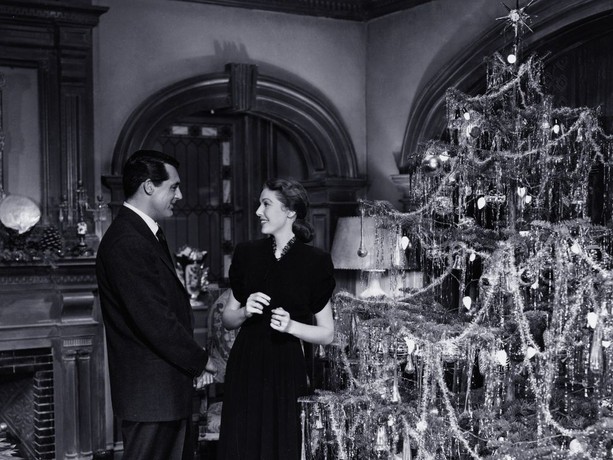
The movie stars Cary Grant as an angel named Dudley who comes to earth to help Bishop Henry Brougham, (David Niven). Henry is so wrapped up in securing funding for a cathedral he begins to neglect his wife and daughter.

Dudley arrives at the Bishop’s house after the Bishop prays for God to help him with funding for the cathedral. Dudley tells him right up front that he’s an angel and he’s there to help him but introduces himself to others as Henry’s new assistant. He pretty much forces himself into Henry’s life and ends up charming the pants off all the women he meets and creating miracles for men, women, and children alike. At least one man, Henry’s retired professor friend (Monty Woolley), is very suspicious of him.

Henry isn’t really sure if he believes that Dudley is an angel, especially when the guy starts taking Henry’s wife, Julia, (Loretta Young) out on the town, having dinner with her, taking her skating, and buying her hats.

Still, Henry isn’t about to get distracted from his goal of building the cathedral and he ignores Dudley’s efforts to open his eyes to how much Julia needs him, plowing forward with fundraising instead.

L-R: Actors Cary Grant, David Niven and Loretta Young sit in the back of a car in a still from the film, ‘The Bishop’s Wife,’ directed by Henry Koster, 1947. (Photo by RKO Pictures/Courtesy of Getty Images)

I think Cary is supposed to be charming in this movie but instead I find him a bit devious. Maybe the goal of the movie is to leave the viewer trying to figure out if he is sweet or evil.

The site, The Viewer’s Commentary, had a similar feeling about Cary’s role and explains it better than I can.

“But, while I’m not certain “perfect” is necessarily the right word for Dudley as a character, I’m still not entirely convinced that the movie wasn’t actually trying to play him up as being in his right to step in on Henry’s marriage, either. This is based on the film’s affectionate depiction of his chemistry with Julia, the amount of sympathy the film has for her, and the apparent distaste it has for the stiff Henry beyond his admirable loyalty and good intentions.”

“That ice skating thing I mentioned before wasn’t some kind of non sequitur,” the post continues. “There’s a painfully long scene in which Dudley and Julia and their cab driver have a whimsical impromptu ice skating session where he romances her in front of everyone by secretly granting her expert skill while Henry toils away elsewhere, callously inattentive to Julia’s wifely needs. It would be one thing if it was intended to teach Henry a lesson about what could potentially happen, but it actually kinda left me with a gross feeling, given how wonderful it’s all supposed to be while knowing about Dudley’s infatuation – not to mention his manipulation of the situation and nonchalant demeanor when confronted about it.”

This is the scene in question:

At one point even Henry begins to wonder if Dudley is from heaven or hell and if he truly is trying to steal his wife from him.

It’s what I was wondering too and by the end of the movie  . . . well if you’ve never seen it you will have to watch it and let me know what you think.

The movie is based on a book by Robert Nathan whose other fantasy romance, Portrait of Jennie, would later overtake The Bishop’s Wife on a literary level and later became a 1948 David Selznick movie.

According to an article on TCM.com, producer Samuel Goldwyn decided to take on this movie right after winning an Oscar for The Best Year of Our Lives in 1946.

Cary was originally set to play the Bishop, but as he read the script he began to suggest edits and finally decided he didn’t have the right part. He should be playing Dudley.

Later on, though, after the final casting decisions were made, Grant wanted to switch back.

Then there was the fact that Goldwyn didn’t like the set.

Niven wrote in his future autobiography, “The day before shooting was to start, Goldwyn decided that the interiors of the Bishop’s house were not ecclesiastical enough and ordered several sets to be torn down, redesigned and rebuilt. For three weeks, while this was going on, production was halted, then, two days after the cameras finally had a chance to turn, Goldwyn decided that Seiter’s hand was a little too heavy on the tiller: he was removed, paid his full salary and after a week, Goldwyn hired Henry Koster to start again from scratch – with another two weeks of rehearsal. All this must have cost Goldwyn several hundred thousand dollars….”

Niven was already struggling through the production because his wife tragically died during filming.  Her fatal head injury occurred during a party game of “sardines” at Tyrone Power’s house. Her name was Primmie and she fell down a flight of cellar stairs after thinking she was running into a closet.

Problems further continued to plague the film when Cary and Loretta Young couldn’t get along part of the time.

Despite all of the hardships, the movie was well-received and remains a favorite Christmas film of many classic movie buffs today.

It was nominated for five Oscars but did not win any.

I’m not sure I found this movie as heartwarming as some of the Christmas movies I’ve watched, probably because I found it so difficult to read Cary in this one and was quite suspicious of him. I did, however, still enjoy the movie overall.

A few pieces of trivia about the movie for you:

I recognized the young actor who played the young George Bailey from It’s A Wonderful Life — Bobby Anderson —— in a snowball throwing scene in this film. I looked up his name and found out that Karolyn Grimes, who played Zuzu in It’s a Wonderful Life also played The Bishop and his wife’s daughter, Debby.

According to IMBd (I did not double check these to clarify they are true):

“At about 1:20, Henry and Julia are ready to make some Parish calls. Henry says to Julia, “We go first to the Trubshawes.” This is an example of David Niven’s attempt to mention the name of his friend (Michael Trubshawe) in every movie he made.”

“Over Cary Grant’s protests, a skating double wearing a mask with Grant’s features was used in the long shots of the complex skating routine. A skating double was also used for Loretta Young on all long shots.”

Market research showed that moviegoers avoided the film because they thought it was religious. So, Samuel Goldwyn decided to re-title it Cary and the Bishop’s Wife for some US markets, while adding a black text box with the question “Have you heard about CARY AND THE BISHOP’S WIFE?” on posters in markets where the film kept the original title. By adding Cary Grant’s first name to the title the film’s business increased by as much as 25 per cent.

“In Britain the film was selected for that year’s Royal Command Film Performance screening. Princess Margaret and her sister, the future Queen Elizabeth, both attended the screening of “The Bishop’s Wife” on November 25, 1947, at the Odeon Theatre in Leicester Square. According to David Niven, “The audience loved every second of it, and the Queen and Princess Margaret told me afterwards and at great length how much they had enjoyed it.”

Have you ever seen The Bishop’s Wife? What did you think of it?


*This post is part of the Comfy, Cozy Christmas Link Up for 2024. If you have a Christmas/holiday post you would like to share you can find the link HERE or at the top of the page here on my blog.

Comfy, Cozy Cinema: Bringing Up Baby

Erin from Still Life, With Cracker Crumbs and I have been watching Comfy Cozy mmovies This week we had to switch up the movie we were watching because Amazon and Frevee and all the other free streaming services removed Skylark, which is the second movie in the Sarah, Plain, and Tall series.

Instead we chose Bringing Up Baby at my suggestion because I wanted something funny and goofy but also cozy.

I’ve seen this movie twice before and it is absolute chaos and craziness. Everyone except poor Cary Grant is off their rocker and it is glorious.

The movie stars Cary Grant and Katherine Hepburn. Katherine is absolutely batty in this film which makes it all even more hilarious.

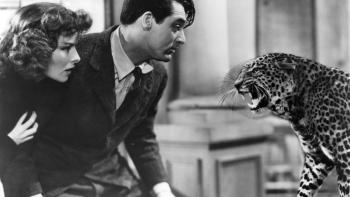
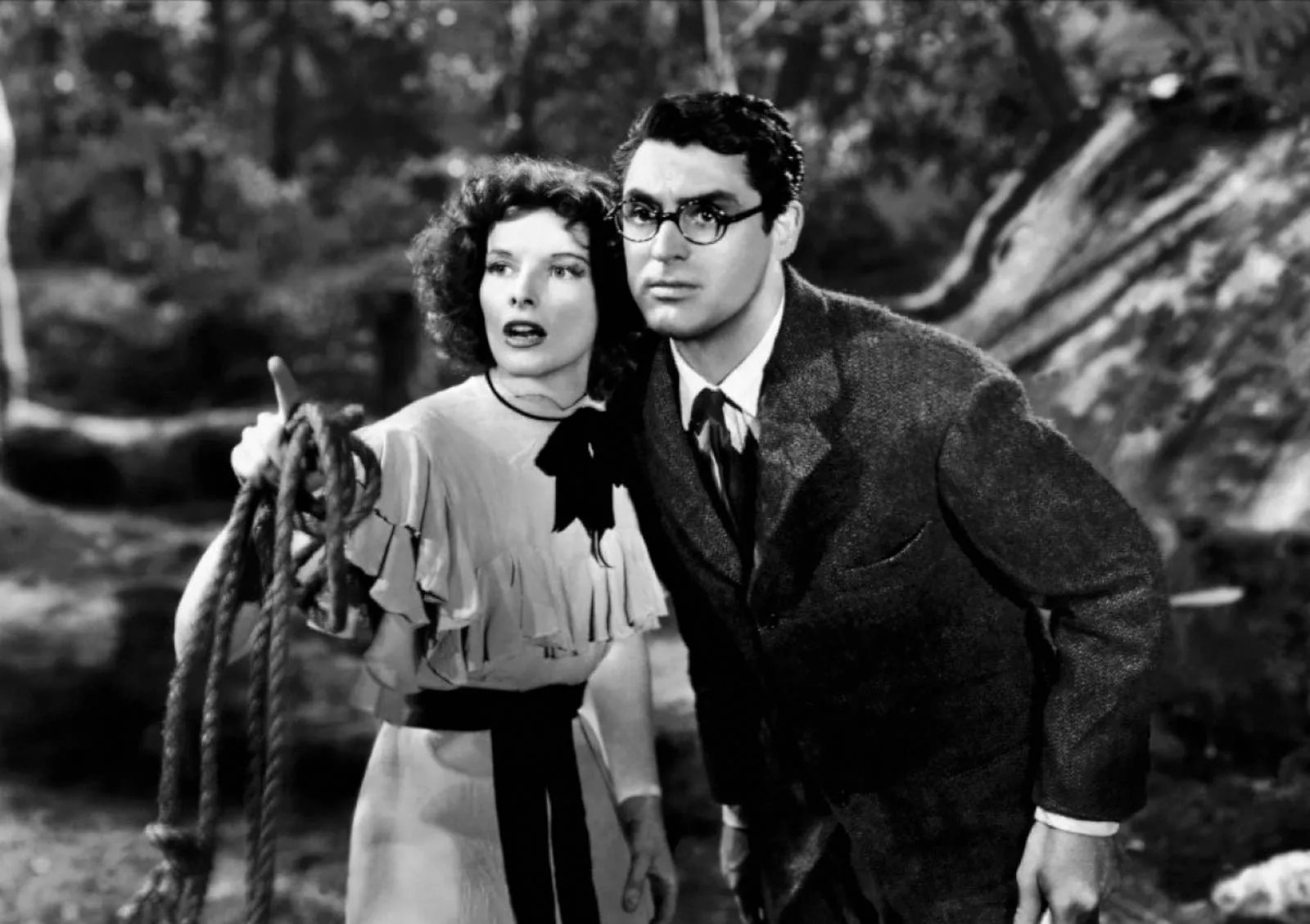
Cary Grant’s character (Dr. David Huxley) is a paleontologist who accidentally runs into Katherine Hepburn’s character (Susan Vance) a totally nuts socialite who immediately latches on to Cary and decides she’s going to become obsessed with him and make his life a living hell.

In the beginning of the movie, David has been building a dinosaur skeleton for years and the last piece of it has just been found. He and his fiancé – Alice Swallow – are thrilled that the intercostal clavical has been found and will be arriving soon in the mail. Alice – a very uptight, proper women who says the point of their marriage will be to only advance his research and not for love — also knows that more money needs to be secured for his research so she tells David he must go golfing with an important doner.

This is where he meets crazy Susan who tries to steal his car, takes off with him riding on the footboard while he tries to tell her it is his car, and then leads him on various crazy adventures. He runs into her again at a dinner where he is trying to secure a donation from a woman named Elizabeth Randall who is considering a $1 million donation.

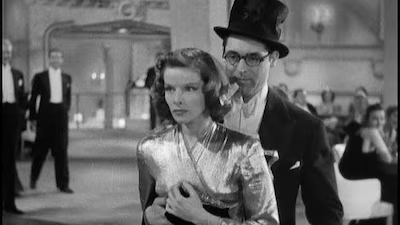
The scenes at the dinner party include this a hilarious scene where Katherine’s dress gets ripped and she and Cary have to make their way through a crowded dining room with Cary against her back to make sure nothing is scene. It is so classic and hilarious and always has me laughing.

David thinks he has shaken Susan loose after a bizarre journey with her where she tries to wake up the doner he’d been trying to meet at the golf course and David ends up knocking him out with a rock.

The next morning the clavical arrives and David is thrilled, but somehow Susan gets his number and, thinking he is a zoologist rather than a palentologist, she asks him how she should take care of a leopard named Baby that her brother sent her from Africa.

David promptly tells her he doesn’t care about her Leopard and doesn’t know anything about it, but when she trips and falls while on the call, he thinks she’s being attacked. She’s thrilled he thinks this and hams it up even more, which sends him flying out the door to her apartment to “rescue” her.

Collection Christophel / RnB © RKO Radio Pictures

Of course, when he gets there, Susan is fine, but yet another plot twist is coming up when Susan says she needs to go to Connecticut with the leopard because she doesn’t want her aunt to find the leopard there when she decides to visit. The aunt is going to give Susan $1 million someday and if the aunt finds the leopard there, she won’t give her the money.

So Susan decides they need to take Baby to the country in Connecticut and begs David to take her. Somehow David gets caught up in taking her, even though it is his wedding day and he needs to be in New York to get married. While in Connecticut, Susan realizes she is in love with David.

 I should also mention that to calm Baby they have to sing, “I Can’t Give You Anything But Love, Baby.”

The movie is – as I said earlier – absolute chaos from start to finish.

Cary and Katherine are the perfect pair to play against each other in a screwball comedy and had some experience with it already since they also starred opposite each other in Sylvia Scarlett (1935), and Holiday , which released the same year as Bringing Up Baby (1938). They also starred together in The Philadelphia Story in 1940.

This is a risqué movie in many ways with a lot of double entendre moments and innuendos that are clean but a bit sassy. I suppose some people could make the double entendre moments more crude, but there are people who can do that with anything.

I wanted to know about the leopard that was used in the film and while looking up information about it, I thought it was interesting to read that the Jack Russell Terrier in the film was the same dog used to play Asta in The Thin Man film series, which is a favorite series of mine. The dog’s real name was Skippy incidentally. The tame leopard (Baby) and another leopard (you will have to watch the movie to know what that is all about) were both played by a trained leopard named Nissa.

The trainer was a Swedish woman named Olga Celeste, who would stand by with a whip during shooting. According to Wikipedia, at one point, when Hepburn spun around, her skirt twirled and Nessa lunged at her. She was subdued when Celeste cracked the whip. After that Hepburn wore heavy perfume to keep Nessa Calm but Grant was terrified of Nissa and a stand in had to be brought in with his scenes with the leopard.

This movie has some terribly hilarious quotes including:

Cary: “In moments of quiet, I am strangely drawn to you, but well there haven’t been any moments of quiet with you.”


Cary: “It never will be clear while she’s explaining it.”

Cary: “You don’t understand: this is my car!”

Katherine: “You mean this is your car? Your golf ball? Your car? Is there anything in the world that doesn’t belong to you?

Cary: “Yes, thank heaven, YOU!”


Katherine:” Anyway, David, when they find out who we are they’ll let us out.”

Cary: “When they find out who you are they’ll pad the cell.”


The movie was directed by Howard Hawks. The screenplay was written by Dudley Nicholas and Hagar Wilde and was based on a short story by Wilde that appeared in Collier’s Magazine in 1937.

Have you ever seen this chaotic comedy? What did you think of it?

You can read Erin’s impression here:https://crackercrumblife.com/2024/11/07/comfy-cozy-cinema-bringing-up-baby/

Next week we will be watching Grand Budapest Hotel and the following week we will be having a group watch of Chocolate on November 17 at a time to be announced.

You can catch up with my impressions of the movies we’ve watched here: https://lisahoweler.com/movie-reviews-impressions/

Comfy Cozy Cinema: Arsenic and Old Lace

For the next two months, Erin from Still Life, With Cracker Crumbs and I will be watching cozy or comfy movies and some of them will have a little mystery or adventure added in.

This week we watched Arsenic and Old Lace which was based on a 1941 play by Joseph Kesselring. The play, in fact, was still on Broadway when the movie was filmed in 1942. The play’s producers stipulated in the contract for the rights to the play that the movie would not be released until after the play finished its Broadway run. The play was so popular, though, that it ran for three years so the film didn’t hit theaters until 1944.

The movie was directed by Frank Capra.

This movie is completely crazy and off the wall in the start and then gets a bit dark and creepy in the middle and then it goes back to goofy again.

I prefer the goofy and eccentric portions of the movie to the creepy parts because the one actor in the creepy parts – Raymond Massey — well, he’s good at his job, that’s all I’ll say about that.

I am a huge Cary Grant fan, which you might know if you’ve been following this blog for very long. Erin and I even did a Spring of Cary feature this past spring.

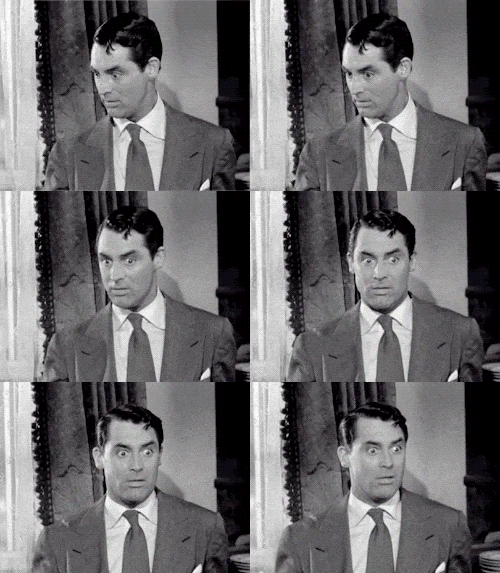
My husband commented while we were watching this movie that he thinks he likes Cary in comedies more than his dramas and I have to agree. Cary makes the best faces when he’s acting in a comedy and pulls off the comedic element so flawlessly that I’m often left laughing so hard during his comedies that my sides hurt.

There are several hilarious parts of this movie but one of the most hilarious aspects is how everyone acts like death and murder and attempted murder are everyday things. Everyone except Cary’s character, except when it comes to the attempted murder of his new wife, which he seems to shrug off because he has a one-track mind and wants to get his uncle committed to an insane asylum and protect his murderous aunts from being arrested.

Let me back up a bit here to explain some things.

Cary’s aunts are brutal killers but they are also sweet and wholesome and no one would know they are murderers until Cary (who portrays Mortimer Brewster in this movie) finds a dead man in their window seat.

Cary’s uncle thinks he’s President Theodore Roosevelt, which has worked well for the aunts who are having him pretend he’s digging the Panama Canal in their basement.

While Mortimer is trying to figure out what to do with his murderous aunts and his crazy uncle, his new wife – who he just married at the beginning of the movie — keeps trying to get his attention so they can run off together for their honeymoon to Niagara Falls.

Mortimer is way too distracted with shock and horror over his new discovery about his aunts to pay attention to his wife, who, by the way, is the daughter of the pastor who lives across the street. Then, as if things couldn’t get any crazier, Mortimer’s brother Jonathan returns home from his travels around the world where he’s been killing people. He returns with his partner in crime, a doctor played by Peter Lorre, who has botched Jonathan’s facelift, making him look like Boris Karloff, which is ironic because Karloff played Jonathan Brewster on Broadway. Karloff stayed on as the character in the play to appease the producers because they were concerned that losing all of the main actors for the movie would kill ticket sales.

According to Wikipedia: “Josephine Hull and Jean Adair portray the Brewster sisters, Abby and Martha, respectively. Hull and Adair, as well as John Alexander (who played Teddy Brewster), reprised their roles from the 1941 stage production.[4]Hull and Adair both received an eight-week leave of absence from the stage production, which was still running, but Karloff did not, as he was an investor in the stage production and its main draw. The entire film was shot within those eight weeks. The film cost just over $1.2 million of a $2 million budget to produce.”

The movie is absolutely hilarious and eccentric and I’m glad I stuck it out this time because the first time I watched it, my husband and I bailed in the middle when the creepy brother came back. The entire tone of the film switched from goofy to dark and creepy, but now that I’ve watched it all the way through, I understand the reason for the creepiness. It is to lay the groundwork for the silliness and off the wall behavior to return. At one point the brother is terribly creepy and then a bit later his reactions to discovering secrets about his aunts are so funny because he’s supposed to be the tough, scary guy.

You just have to see the film to understand.

Incidentally, Raymond Massey was nominated for an Oscar in 1940 for playing Abraham Lincoln in Abraham Lincoln in Illinois.

Massey played Lincoln several times in film, television and on stage. Someone, though articles online don’t say who, once said that Massey would keep perfecting his role as Abraham Lincoln until someone assassinated him too.

One thing I want to make sure I mention about this film is the cinematography. There are some really amazingly lit and positioned scenes from the film, including one where Jonathan’s shadow is towering over the doctor who is sitting on the stairs.

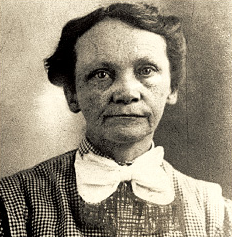
As I was preparing this blog post and sharing about the movie on Instagram this week, a very interesting story popped up about how the play was possibly based on a true story about a woman in Connecticut who ran a nursing home and was charged in 1917 with the murder of five people between the years of 1907 to 1917.

Amy Duggan “Sister” Archer-Gilligan poisoned five people, including her second husband Michael Gilligan. The others were residents in the nursing home. Some reports say up to 60 people died in the nursing home that was called The Archer Home for the Elderly and Infirm but Gilligan was only charged in five deaths. She may have killed her first husband, John Archer, in 1910 but the official cause of death was listed as Bright’s disease. Oddly, though, Gilligan had taken an insurance policy out on her husband a few weeks before his death. The payment from it allowed her to keep the home open.

She married Michael Gillian in 1913 and he mysteriously died of “indigestion” three months later. He was a wealthy man and despite the short length of their marriage, Michael had left his estate to her, not his four adult sons. It was later determined that Amy had forged Michael’s signature and that the will was a fake.

To make a long story short, the family member of a deceased resident tried to get the district attorney in the county to investigate Gilligan but he blew her off. Finally, the woman contacted a journalist who ran a story about the home and from there everything unraveled. The bodies of five people were exhumed and all had been poisoned with either arsenic or strychnine.

Kesselring never said if Gilligan’s story inspired the play, but it is interesting to note the similarities.

If you want to read more about her case you can see it here, but remember Wikipedia might not always be totally accurate.

In one article I read that Capra had considered both Jack Benny and Bob Hope for the role of Mortimer. No offense to either of those men (I love listening to old Jack Benny radio shows as I fall asleep at night), but I can’t see the film with anyone other than Cary.

One site – Movies! Reel Variety – said that Cary doubted his performance later. He felt he overplayed the character and that Jimmy Stewart would have played the part better.

This was the only film he made with Capra, whom he called “a dear man.”

Criterion.com (https://www.criterion.com/current/posts/7952-arsenic-and-old-lace-madness-in-the-family) states that while Capra worried that delaying the film would cause it to miss out on the box office war boom or make the subject, or actors stale, but instead Cary was just coming into his own and was one of the hottest actors in Hollywood by 1944.

Cary said he wanted to do the film because he “just wanted to have fun” after being in so many films in the 1930s that were social commentaries.

After playing the part, though, he complained about it, but, according to the Criterion article, he complained about many of his performances and worried over them even when the audience loved them.

Arsenic and Old Lace is one of these films.

I enjoyed this paragraph in the Criterion article: “In his book on Grant, Richard Schickel defends Grant’s and Capra’s bold choices, asking, “What’s a man supposed to do when he finds bodies buried all over his maiden aunts’ house? Arch an ironic eyebrow?” The playing is entirely appropriate to a character in such circumstances in a farce, even if, as Schickel concedes, it is “not Grant’s most urbane performance.”

Shooting of the film was finished five days after Pearl Harbor was bombed. Frank Capra joined the Signal Corps, but luckily was given some time to first finish what proved to be his only black comedy, or the world might have had to wait even longer to see it.

To read Erin’s impressions of the film, you can visit her blog here: https://crackercrumblife.com/2023/09/28/comfy-cozy-cinema-arsenic-and-old-lace/

Next week we are taking a break from watching movies to give time for any of you to catch up on the films yourself and write about them, if you want to.

If you’ve watched any of the movies and would like to take part in our Comfy, Cozy Cinema, you can sign up on the link below.

When we return to the feature on Oct. 13 we will be writing about The Lady Vanishes.

After that, we will be watching the following movies:

Strangers on a Train (Oct. 19)

Rebecca (Oct. 26)

Little Women (November 2)

Tea with The Dames (November 9)

A break for Thanksgiving

And

Sense and Sensibility (November 30th)

You are invited to the Inlinkz link party!

Click here to enter
https://fresh.inlinkz.com/js/widget/load.js?id=c0efdbe6b4add43dd7ef

Summer of Marilyn: Monkey Business and All About Eve

A sinus thing that wasn’t exactly an illness but a weather change thing hit me last week so I ended up forgetting to finish watching my one Marilyn movie and watching the other one. In other words, I have a good excuse for being late on my Marilyn movie impressions.

I’m going to be sharing about two Marilyn Monroe movies this week since I have been so behind on watching and writing about them. They are two very, very different movies on different ends of the spectrum – Monkey Business and All About Eve.

First up: Monkey Business.

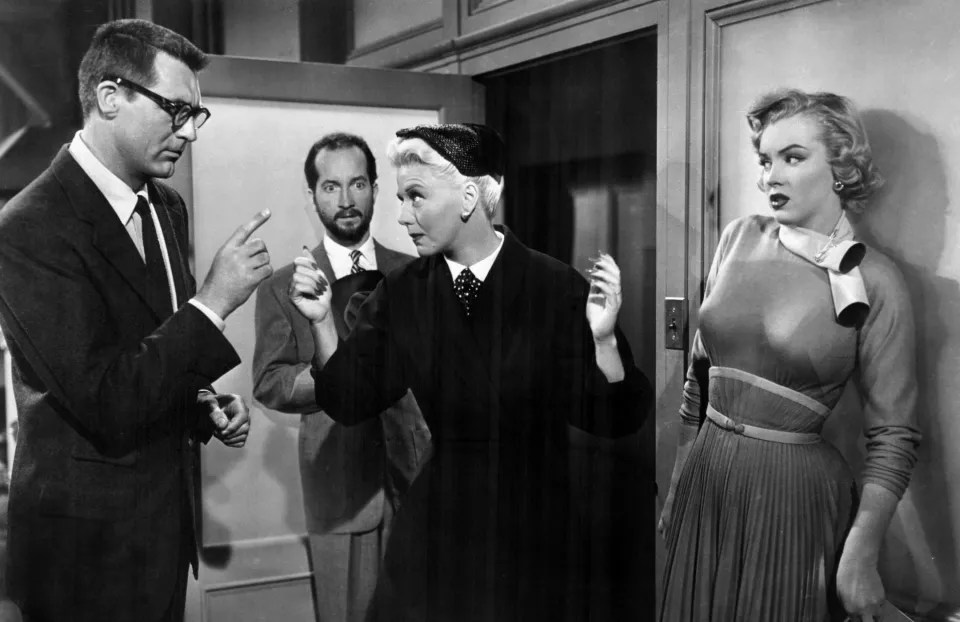
Cary Grant is an absent minded professor in this screwball comedy that he stars in with Marilyn and Ginger Rogers.

Ginger is the straight man (woman) in this one with Cary being more of the goofball with the biggest bottle cap glasses I have ever seen him in. They looked more like something Jerry Lewis would wear.

This is very early Marilyn, so she almost likes like Norma Jean probably looked before she became Marilyn, but not quite. She still has the pouty lips and short hair, but the hair looks darker to me in th is film.

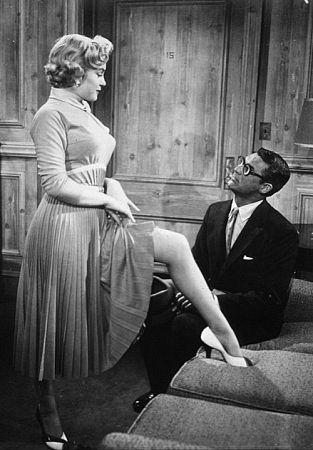
Marilyn plays the secretary of Cary’s boss and in their first scene together she shows Cary the stockings he invented and how they look on her legs. Cary’s character, showing his true nerdy self, is more interested in the stocking than the legs they are covering, of course.

The premise of the movie is rather silly but silly is a wonderful escape from life so I liked that it was silly.

Cary is working on a formula that could help people look and feel younger. It also, apparently, makes them more virile – ahem. The monkey they test it on is very interested in the female monkey, despite being 84 in monkey years. The monkey Is also able to move around like a young monkey after taking the formula.

This is after many of the tests did not yield any results.

 
(As I side note here, I must say that I don’t know many other actresses who have a hip sway like Marilyn. I am completely jealous of it and the shape of her. Sigh.)

It’s the monkey that finally mixes the winning concoction for a type of youth formula and then proceeds to pour it in the water cooler. Cary and his fellow professors don’t know this, of course, so when Cary decides he’s going to be the guinea  pig and take his own formula and then wash it down with the water from the cooler. So Cary believes that his formula is what helps him when he suddenly can see without his glasses and then becomes like a teenager and runs off with Marilyn’s character to buy a new car.

After Ginger learns that Cary tested the formula on himself, she decides she should be the test subject and she takes the formula, which we know doesn’t work, but it tastes so awful she washes it down with the cooler water.

Now she becomes the young and crazy 20 something year old.

She ends up with teenage angst complete with crying and breaking down at Cary. It’s a hilarious but ridiculous scene. I have a feeling Ginger had a blast filming it.

Ginger even gets a chance to dance a bit in the film, even though that isn’t the main focus, when she’s feeling a lot younger.

The film is a low-key romance with the two of them realizing even under the influence of the formula how much they love each other.

Luckily the formula does wear off and when both have had it wear off, they decide the formula could cause more harm than good. Cary is going to destroy the formula and that’s when they decide to make a pot of coffee with the water from the cooler. Ah, yes, I’m sure you know where this is going. Craziness is about to ensue so hold on to your seats.

You’ll have to watch it to see what happens, which reminds me, you can watch it for free on YouTube here:

I pulled a bit of trivia off of IMbd about the movie and some of it was very interesting. Here are a few tidbits:

  • The exterior shots of the Oxly Chemical Co. office building where Barnaby works were actually shots of the Executive Building on the 20th Century Fox studio lot. The building is now known as the Old Executive Building.
  • The sports car used in the film was a red 1952 MG TD Roadster, which was put into storage by 20th Century-Fox after filming wrapped. It was purchased by Debbie Reynolds in a 1971 sale of Marilyn Monroe memorabilia (despite the fact Monroe herself never owned the car). It sustained a dent in the front bumper when Cary Grant hit a fence while driving it. Reynolds had the transmission rebuilt, then put it up for auction in 2011. It sold for $210,000.
  • Among the movie star photos Marilyn Monroe taped to her bedroom wall when she was a foster child were several of Cary Grant. She was thrilled to be co-starring with him in this film, a break-through role in her then fast-rising movie career.
  • Forty year old (forty-one at the time of release) Ginger Rogers was the oldest leading lady to ever star in a Howard Hawks picture.
  • Marilyn Monroe plays the character Lois Laurel. The real Lois Laurel is the only daughter of comedian Stan Laurel of the comedy team Laurel & Hardy.
  • Shares a title with the otherwise unrelated 1931 Marx Brothers comedy “Monkey Business,” though the films have some vague connections: Early in his career, Cary Grant was partly inspired by Zeppo Marx, the team’s parodic juvenile straight man. In addition, the 1931 film co-starred Thelma Todd, whose life, career, and mysterious death parallel Grant’s co-star here, Marilyn Monroe.

This movie was so much fun and I really did enjoy it. I mentioned above that Ginger must have had so much fun filming that one scene but I have a feeling they all had a ton of fun. It was absolute ridiculous and hilarious fun.

All About Eve

Now, Marilyn is not a main actress in this film, but it was one of her first movies and she was considered a standout in it, and my husband suggested it, so I included it in my list to watch this summer. Marilyn was 23 when the movie was made and just about to break her career wide open.

This movie was nominated for 14 Oscars and won six, including best picture. It is the only film in Oscar history to have four women nominated, including Bette Davis, Anne Baxter for actress and Celeste Holm and Thelma Ritter for supporting actress. Released in 1950, it made $3.1 million, more than half of it’s $1.4 million production costs.

Bette Davis is a famous stage actress named Margo who Eve Harrington, played by Anne Baxter, goes to meet one night after watching her show every single night during its run.

This is my first movie with Bette, by the way, and it did not disappoint.

Eve is very peculiar to say the least as this movie starts. She tells the actress and the producer and writers about her sad life of losing her husband early in their marriage and staying in San Francisco to make a new life for herself and her love of acting and the theater.

You know right away that something just feels off about her, even though the movie starts with her being honored as a well-known actress. She really inserts herself into the lives of these people and weasels her way into the acting jobs she wants, pushing others out of the way for it.

With her sob story, Margo welcomes her into her home and she becomes her confidant, her assistant, and everything you can think of that requires Eve to wait on Margo. It’s clear that Eve wants Margo’s job and as time goes on it is clear she’ll find a way to get it, mainly by being Margo’s everything. Actually, she’s a little too everything. She starts doing things that Margo doesn’t ask her to do and making herself look better than Margo. It’s a very strange obsession.

Margo begins to notice how attentive Eve is to her boyfriend and everything else. She also begins to compare herself to Eve and feel old around her. To her it’s time for Eve to move on because she has a feeling Eve is much more interested in taking her place, not just waiting on her. |

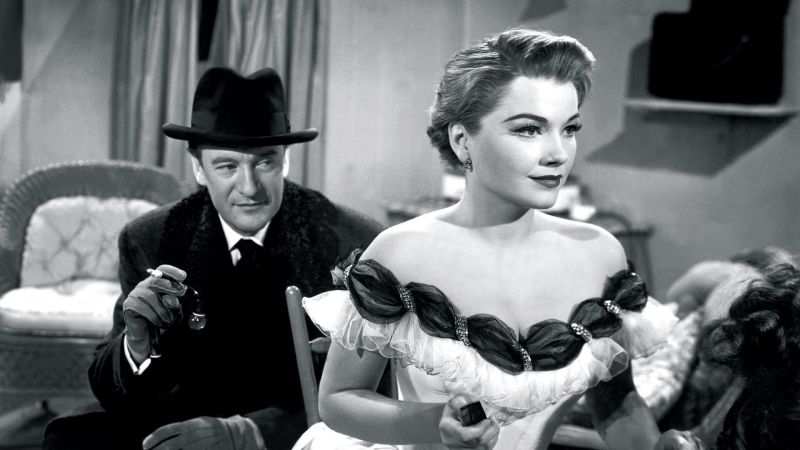
Marilyn doesn’t come in until more than 40 minutes into the movie and I didn’t even recognize her. She was beautiful, sure, but her hair was styled differently and she was a minor character. It was clear she was ready for stardom though and George Sanders uttered a premonition of sorts when he said, “Well done. I can see your career rising in the east like the sun.”

And soon after this movie, it did just that.

Her character Miss Casswell has the middle name of the author of the short story that was never credited for her part in the movie – Mary Orr.

She’s so young looking in the movie – it’s crazy. And, of course, she’s sort of passed off as someone sent in to make producers and directors happy because she’s sexy and flirtatious.

I searched online to see what critics said of Marilyn’s performance and found a few opinions. Here s one:

Lyvie Scott on Slashfilms.com said Marilyn stole the scenes she was in in All About Eve and I’d have to agree. She had some of the best lines, such as where Eve says she doesn’t know what she’d talk about with Dr. Dewitt (George Sanders) and Marilyn says, “Don’t worry about it. You won’t even get a word in the whole time.” Or something along those lines.

A bit off topic here, but George Sanders always reminds me of John De Lancie who played Q on Star Trek.

Scott wrote of Marilyn, “Monroe’s role in “All About Eve,” though small, is one of the most memorable of the film. It’s difficult to focus on anyone but Monroe when she’s in the room. Knowing just how famous she would become, it all feels like a testament to her inescapable star power.”

Scott, of course, details what others detail about Marilyn on film sets throughout the years. She was often late and had a hard time nailing her lines and was a bit difficult to work with overall. Marilyn tried to blame her inability to remember her lines on nerves and that very well may have been the case since she was acting next to Bette Davis and the fact that she’d only come off the success of one other film, “The Asphalt Jungle” before this.

Davis wasn’t really buying her excuses. According to Scott’s article: “Unfortunately, Davis was less than impressed with Monroe. Famously temperamental on set, she was already put off by the younger actress’s tardiness. And after so many retakes for a scene which, to her, must have been a breeze, Davis apparently snapped — and Monroe had to excuse herself to vomit offstage.”

Read More: https://www.slashfilm.com/806889/filming-all-about-eve-was-more-than-marilyn-monroe-could-handle/

It’s just so humorous to me that in this movie they pan Marilyn’s audition to be the understudy of Bette’s character when she would rise to stardom faster than almost all of them, except Bette. She might not have been as good of an actress, especially when compared to Bette, but she still seemed to shoot up even faster – probably because of her looks (aka breasts and hips).

I’m talking more about Marilyn in this post because my feature is called Summer of Marilyn, but I should be talking about Anne Baxter and Bette Davis more, especially considering Marilyn was only in this movie about ten minutes, if that. Both of the other actresses were very good in this, even though I could not stand the way Anne Baxter talked and how overly dramatic and maudlin she was. That was, however, her character so, in other words, she was brilliant in making me hate her.

As for Bette – wow. She knocked it out of the park. Here is what Roger Ebert said about her performance on his site:

Growing older was a smart career move for Bette Davis, whose personality was adult, hard-edged and knowing. Never entirely comfortable as an ingenue, she was glorious as a professional woman, a survivor, or a b***** predator. Her veteran actress Margo Channing in “All About Eve” (1950) was her greatest role; it seems to show her defeated by the wiles of a younger actress, but in fact marks a victory: the triumph of personality and will over the superficial power of beauty. She never played a more autobiographical role.”

Besides Bette and Anne Baxter, George Sanders was absolute perfection at being a dirty, crooked journalist. His speech toward the end of the movie was just absolutely outstanding and  

She seems so innocent and idealistic but deep down she’s just pretty selfish to me. She wants a career and she doesn’t care whose coat tails she rides, or whose head she steps on, to get there. She’ll do it with big, watery eyes and a tipped head, of course.

The film is mainly about jealousy and ambition and the tangled web that both can weave, but it is also very much about the dread of getting older, especially for women. Margo feels that Eve is stealing everything from her because she is young. Off screen, Bette Davis was terrified of growing old and this part fit her well, as Ebert said. When she was talking about the dread of growing old in the movie, she was speaking from personal experience, not just from the experience of the character.

At one point she says, “Funny business, a woman’s career — the things you drop on your way up the ladder so you can move faster. You forget you’ll need them again when you get back to being a woman. That’s one career we gals have in common is being a woman.”

So far All About Eve has been one of the best films I’ve watched but not because of Marilyn, even though she was great in it. The best film I watched with her in it was a tie between Niagra and Some Like it Hot. We will see if The Misfits knocks one of those movies off the list when I watch it later this week.

Have you seen either of these movies? What did you think?

Spring of Cary: Suspicion


Erin from Still Life, With Cracker Crumbs and Katja from Breath of Hallelujah and I have been watching Cary Grant movies this spring.

Up this week was Suspicion.

This one starred Cary and Joan Fontaine.

It was released in 1941 but takes place in 1938 and is based on a 1932 novel called Before the Fact by Frances Iles.

As soon as you see who directed the film – Alfred Hitchcock – you know this isn’t going to be your regular, happy-go-lucky Cary Grant film.

Here we are again with Cary playing a playboy named Johnnie , which I guess was the popular bad boy name back in the day. Or potential bad boy. This time he is Johnnie Aysgarth.

He meets Lina McLaidlaw (Fontaine) on a train by chance. Or is it by chance?


He sees her again at the horse track, where he is well known.

When he asks the women crowded around him who she is they tell him that she’s not really up his alley.

His response? “I’m a little bored with people up my alley.”

He’s clearly looking for a new conquest.

He’s very excited to meet her and she’s, of course, taken by him because, well, hello. It’s Cary Grant and he’s very delicious in this movie. He even knows she’s taken with him by the fact he finds a newspaper clipping featuring a photograph of him that she’s saved and placed inside the book she is reading.

(An aside: as a glasses wearer, I do think it is unnecessary that she keeps taking off her glasses to look more attractive. That is a minor issue, of course.)

At first it appears that Cary is really pursuing Joan in this film.

The question is why? He seems to have some underlying reasons for his apparent affection,

The movie seems very light hearted and he seems very charming and even full of humor.

But here seems to be something more sinister going on. You can feel it rumbling under the surface.

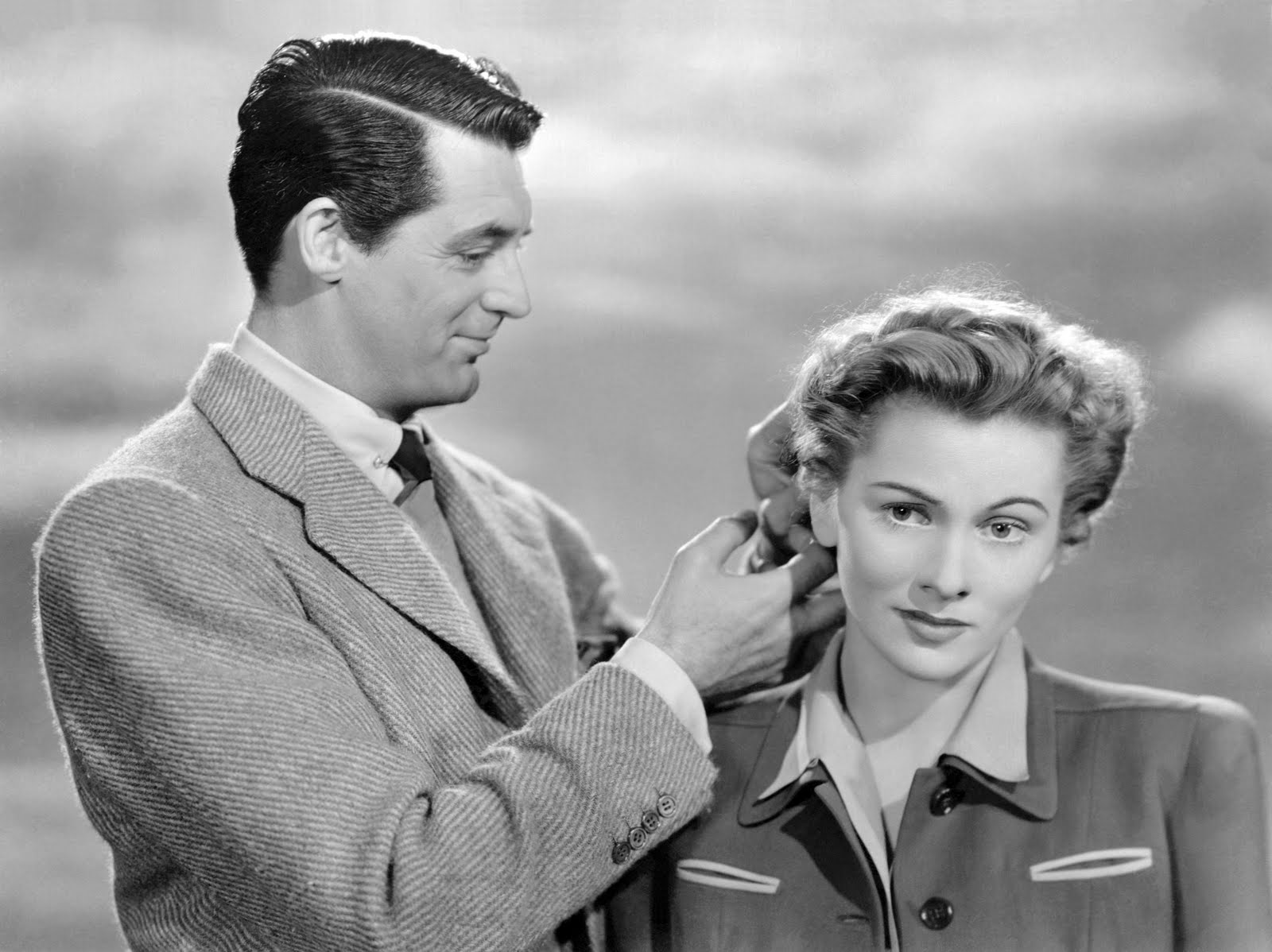
That rumble starts when Johnnie circumvents a trip to church by demanding she go on a walk with him instead. We immediately cut to a scene of them struggling.

“Now what did you think I was trying to do, kill you?” he asks. “Nothing less than murder could justify such a violent reaction.”

Whoa. Say what?

He claims he just wanted to touch and fix her hair. “Your hair has such exciting possibilities that I became passionate.”

Oh. Okay. Creepy.

He’s very handsy and touchy, even showing her first hand where her occipital maxillary bone is by reaching inside the top of her shirt to touch it. Like um…dude. Back off.

He even tries to kiss her on the hill outside the church and they barely know each other. Very forward and if I were her I would have slapped him but it’s clear the woman hasn’t had a lot of male attention in her life so she is wary, but is clearly eating up his pushy behavior. This is the first time he calls her “monkey face” which becomes his affectionate term for her throughout the movie. One I find irritating and degrading.

When he walks her back to her parents house he tells her he’ll see her at three that afternoon. She says she’s busy but then she hears her father saying she’ll never get married because she’s just not marrying material, she turns around and kisses him hard on the mouth.

From there her obsession begins and she starts pursuing him more than him pursuing her.

Now we, the viewers, are thrown onto a path of constantly wondering what this guy is really all about.


Her father suggests that he is wild and this seems to intrigue her even more. Now she wants him even more and begins calling him and sending letters. All of them go unanswered.

It’s actually a bit sad how desperate she becomes.

She finally meets up with him at a dance and all the girls rush to him but he has eyes only for her. He swings her out onto the dance floor and then out the door where they escape in his car.

“Have you ever been kissed in a car?” he asks.

“Never,” she says.

“Would you like to be?” he asks.

This all seems romantic for the most part, but, yet . . . something is just off.

He seems to be choosing someone who isn’t used to dating or attention from men for a purpose.

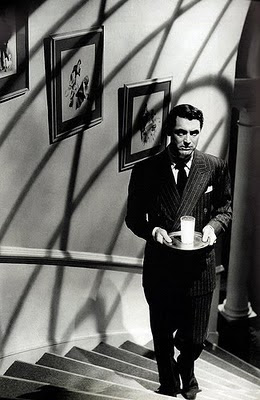
The camera angles in this movie are so well done – like all Alfred Hitchcock movies. Spinning cameras while they are kissing and panning out and in at the most interesting times. Then there is the play with light and shadows. They create such foreshadowing and a feeling of foreboding, especially toward the end of the movie when Lina really starts to question the motives of this man, who she incidentally marries.

After they marry, she’s whisked off to Europe for tours and excursions that blows the mind of her usually timid self.

Johnnie must have money, she thinks. He spent all this money and rented a beautiful home for them. But then Johnny asks for her help in paying a friend back $1,000 that he borrowed for the honeymoon and the red flags start flying everywhere. She ignores all those red flags and steps all over them.

I’m not going to give away too much about the movie in case you have never seen it but there is a lot of dark behavior by Cary in this movie and even though he is handsome and charming he is also inconsiderate of others and emotionally manipulative when it comes to his wife. Eventually he’s also outright abusive.

There is also way too much denial from this woman for most of the movie. I feel for her and how she was completely swept up by Cary’s charm, but I have to admit I might have done the same. I mean, that smile. Come on. So captivating.

One of the many odd things about this movie is apparently everyone is supposed to be British and it’s supposed to be in England but almost no one has a British accent.

I found it interesting that Fontaine won an Oscar for this movie and that it was the only Oscar won by any actor in a Hitchcock film. I was shocked that Cary didn’t win and wasn’t even nominated for his role because I really thought he did a phenomenal job of being both charming and creepy.

I also thought it was interesting to see a woman dressed as a man at one of the dinners with a local crime novelist (whose books Johnnie loves to read and that’s all I’m going to say about that. Ahem.), which was not common in movies back then. A blog says that the woman dressed as a man is the female novelist’s wife or partner, but I have no idea. I suppose that’s what is implied but it wasn’t the main focus of that scene.

The film, according to an article on Wikipedia, shows what happens when Hollywood transfers a novel to film because this film changed the intent of the book. The book’s message was about how a person feels knowing they might be murdered. Again, not to give away the end of the movie, this was changed in the film under pressure from the studio and it’s something that Hitchcock was not happy about and apparently complained about for years.

It was his own fault, though. He caved under the pressure and let the screenplay writers write the ending the studio wanted. It is not the same ending as the book and now I want to read the book and see how it differs.

This was definitely my favorite of the movies we watched other than Holiday.

Next week is Notorious, which is another Hitchcock film and that will round out our Spring of Cary features.

I don’t know if we will do a Summer of … whomever or not yet. I am considering doing one on my own but…I haven’t really committed yet.

So, if you want to read Erin’s impressions of Suspicion you can do so HERE and you can read about Katja’s views HERE.