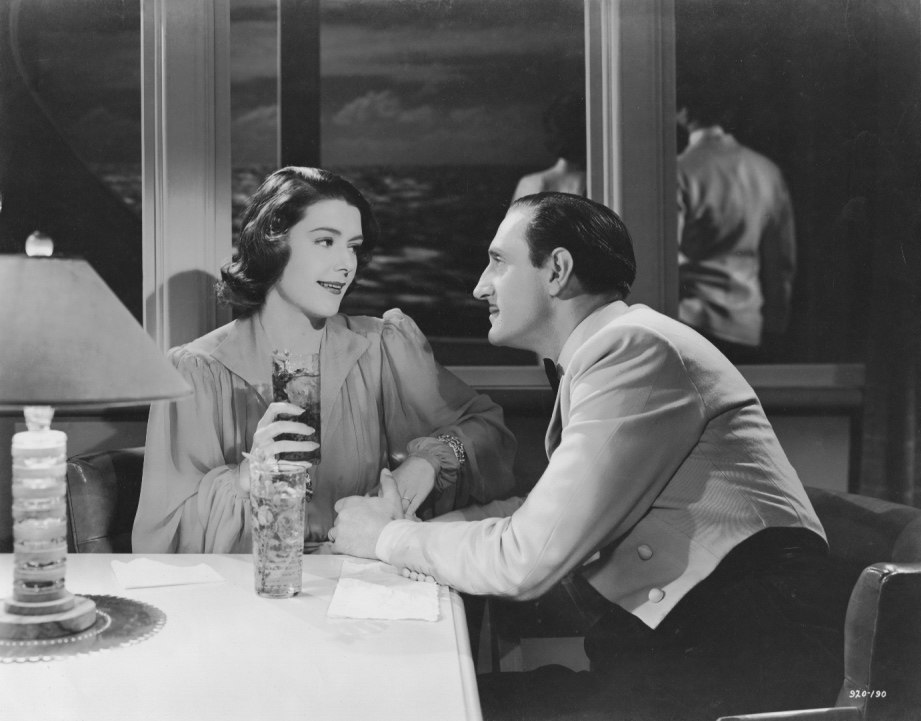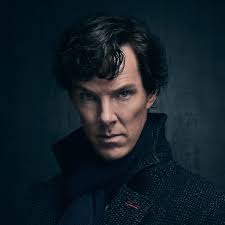
Summer of Angela: The Court Jester (with some spoilers but not the ending)

This summer I am watching Angela Lansbury movies.
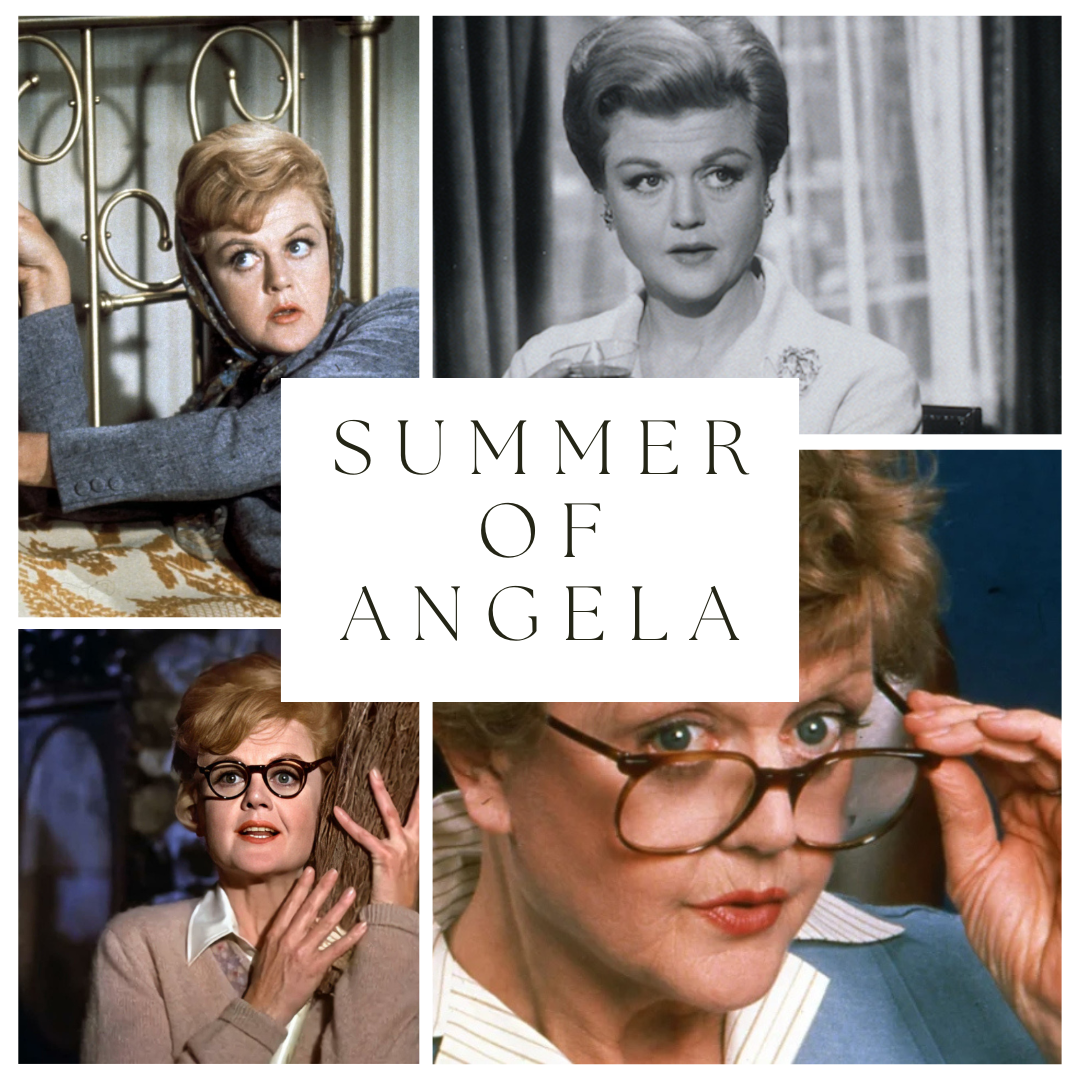
This week I watched The Court Jester (1955) with Angela, Danny Kaye, and Basil Rathbone. It is a musical/comedy.

The main words to describe this movie are silliness, ridiculousness, and peak Danny Kaye moments.

It really fell apart toward the end, I felt, but there were some hilarious moments that made up for it.

First, a bit of the plot with a description from Google:

“Former carnival performer Hubert Hawkins (Danny Kaye) and maid Jean (Glynis Johns) are assigned to protect the infant royal heir from tyrannical King Roderick I (Cecil Parker). While Jean takes the baby to an abbey, Hawkins gains access to the court by impersonating the king’s jester, unaware that the jester is really an assassin hired by scheming Sir Ravenhurst (Basil Rathbone). When Princess Gwendolyn (Angela Lansbury), falls for Hawkins, a witch secretly aids him in becoming a knight.”

This film is just a lot of craziness caused by misunderstandings, misdirection, and generalized oopsies.

We start the movie by learning that an entire royal family was killed so that the current King, King Roderick I, could take the throne.  Actually, though, the entire family wasn’t killed, according to rumors anyhow. The rumors say an infant survived and bears upon his bottom a birthmark of a purple pimpernel.

The rumors further say the child is being cared for in the forest by an “elusive, dashing outlaw” known as the black fox. As if to prove these rumors, one of the king’s men is killed as they are riding near the forest and a note attached to the arrow announces that the child is alive and The Black Fox has him.

Not sure why this was being announced because I would think it would be better to keep this all a secret until the child is older and then they bring the child in to overthrow the usurper, but…what do I know?

After the note scene we are taken to the castle where the king’s advisor, Sir Ravenhurst (Rathbone), is stating the rumor about the child being in the care of the black fox is simply a silly story to scare the king. The other advisors say there is something to the rumor and to the power of the black fox. They feel that the king should form an alliance with Griswold of the North because he is strong and has men who can help them fight against The Black Fox.
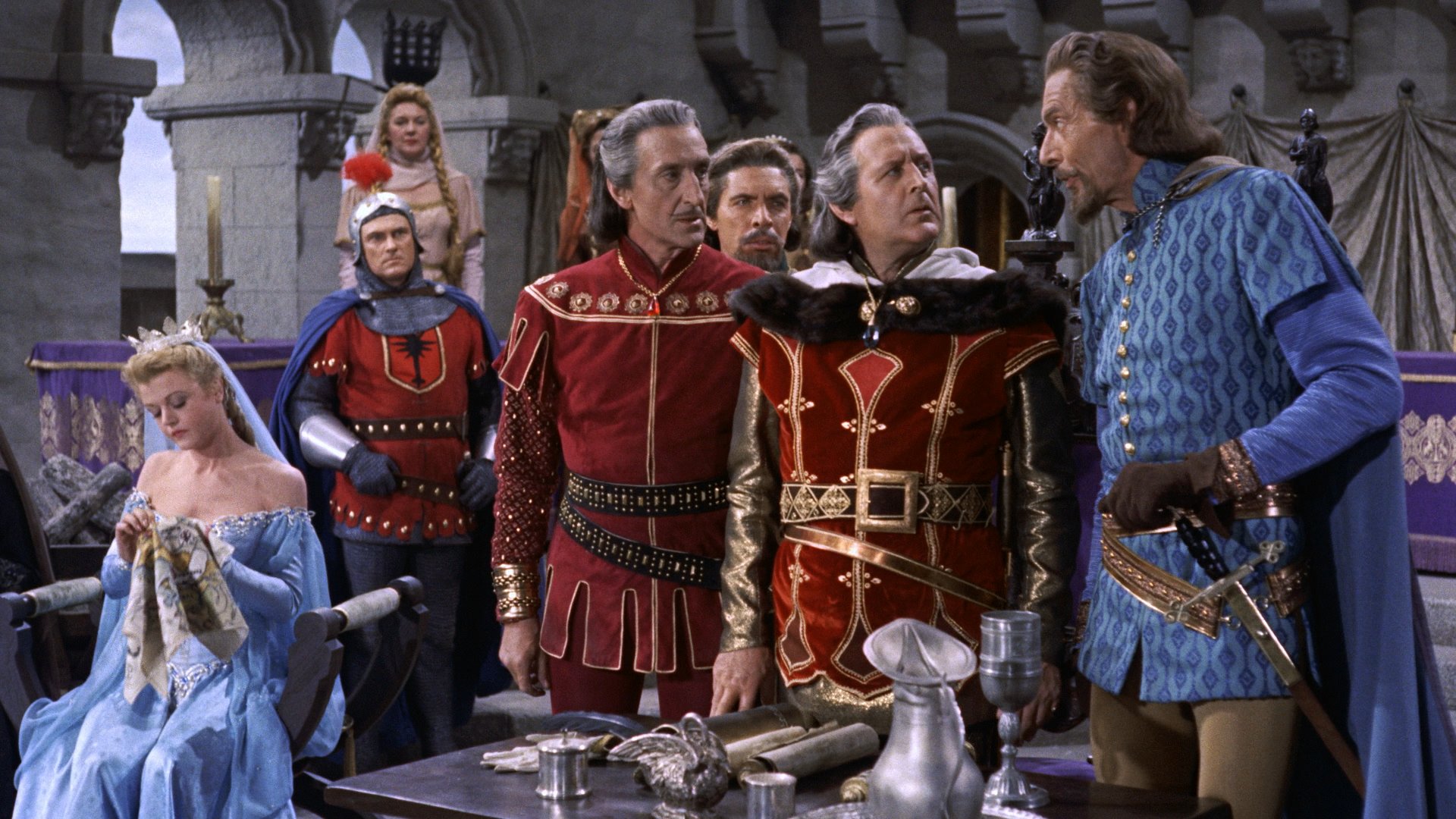
Ravenhurst is against this and the other advisors say it is because Ravenhurst wants to be the king’s right hand man and have more power.

The king says even if he wanted to form an alliance he doesn’t have anything to offer Griswold to sweeten the deal. The one advisor says that the king does have something he could give Griswold — the hand of his daughter Gwendolyn — our fair Angela — in marriage.

Angela is gorgeous in this movie. She’s super skinny (not that she’s ever been big), tall and elegant.

My son told me recently that young Angela was beautiful and that even “old Angela” in Murder She Wrote wasn’t so bad. I can’t wait to show him her in this film (I watched it on my own) because this will further solidify his feelings.

Gwendolyn says she is not interested in marriage because the castle witch, Griselda, told her that a more dashing man than Griswold would be coming along to sweep her off her feet.

Now the scene switches to the lair of the black fox, where Hubert tells the black fox he has brought a group of midgets with him from the carnival (Hubert’s former job) to fight for The Black Fox. This brings me to one of the weirdest promo photos I’ve ever seen:
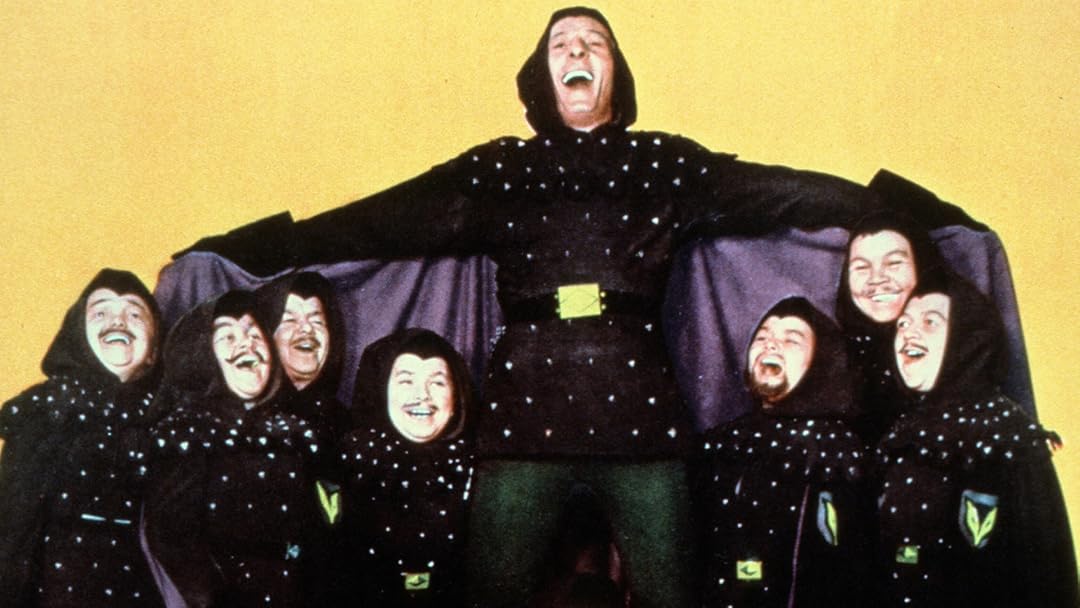
I’ll be seeing this one in my nightmares tonight.

It is the job of Danny’s character, Hubert, to care of the baby and he thinks it is a job that should go to a woman. Well! How rude.

But The Black Fox doesn’t agree and tells Hubert he will continue the job.

Hubert is a little more excited about having to take care of the baby when he is charged with traveling with the beautiful Jean to take the child to the abbey for protection.

When I was reading about the actors in this movie, I found out that Glynis Johns (Jean) also played the mother in Disney’s Mary Poppins. The first one, of course.

Anyhow, moving on — The pair stop for the night and that’s when they not only admit their feelings for each other (smoochy, smoochy) but a man stumbles into the small stable they are in and asks to stay with them for the night. He’s on his way to see the king, he says. He is a court jester and his name is Giacomo.

Ah-ha! Hubert and Jean were just talking about how it would be a good thing if they had a spy in the castle who could tell them if the king was coming after The Black Fox. How very fortuitous this unexpected meeting has been.

Giacomo is knocked out and Hubert steals his clothes and his wagon, which is emblazoned, for some weird reason, with Giacomo’s name across the back of it.

So Jean takes off toward the abbey and Hubert takes off toward the castle.

Sadly, Jean is captured by soldiers from the castle who are looking for good looking women for the king. The baby is hidden in a basket and she and the baby are taken to the castle where she manages to hide the baby away from the king and his men.

Meanwhile, Gwendolyn learns that Griselda lied to her about the dashing man and is about to have her killed when Hubert shows up on the road below and Griselda claims that he is the man that Gwendolyn is supposed to marry.

Whew. This plot is starting to get pretty twisted at this point. From here on out, things get pretty crazy with Griselda casting spells and poisoning people left and right. Ravenhurst also thinks that Giacomo (Hubert) is an assassin who is going to take out the three advisors who wanted to create the alliance with Griswold.

Before all is said and done there will be sword fights, a jousting match, fake and real romances, a midget army, and, of course, plenty of musical numbers by Mr. Kaye.

There is also the famous scene between Danny, Glynis Johns, and Mildred Natwick where they discuss which vessel the poison is in.

Here is a clip of it, in case you’ve never seen the movie:

I won’t share too much more in case you want to watch the movie yourself.

The movie was directed by Norman Panama and Melvin Frank.

According to an article on TCM.com, Panama and Frank formed a production company with Kaye called Dena Productions, named after Danny’s daughter, after Kaye’s success in 1947 with the film The Secret Life of Walter Mitty.

The idea behind the production company was to introduce the real Danny to film audiences. He had been acting on Broadway and in smaller productions on stage for years.

The Court Jester was the company’s second movie and proved to be a huge success but not right away. It actually bombed at the box office, despite it’s stellar cast. Years later though it was regarded as one of Danny’s finest films with, according to TCM, “comedy routines that have entered the annals of film history.”

Amazon features trivia and facts through their xray feature when you watch  a movie there on a computer or device. I often forget that because I usually watch the movies on my TV but this time I watched part of the movie on my phone and bits of the trivia popped up.

One of them was a story from Danny’s daughter who said that fans often came up to him and recited the entire tongue twister scene for him.

What Angela said about the movie:

Angela had been playing mainly dramatic roles before this movie and was able to have some fun with the role. Part of that fun was watching Danny Kaye work she said in the Kaye bio Nobody’s Fool by Martin Gottfried.

“His use of hands was inspired by commedia dell’arte,” she said. “And in the way he moved, he was absolutely original; he was one off the mold.”
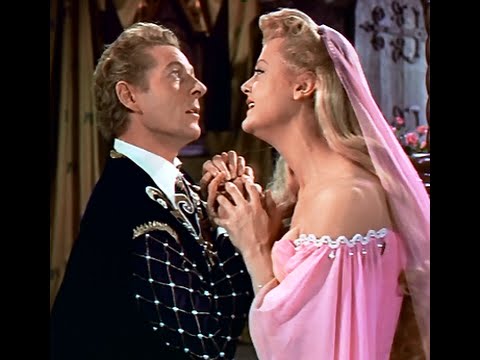
She added, “Danny wasn’t an ensemble player – he was the one around whom everyone danced, and we all dressed to him. We never stopped laughing. There was none of that moodiness he could have elsewhere, that abruptness, ignoring people. If something interested him, sparked him, he came alive. The minute that was over, he was closed for business, which I think is true of many of the great comic performers. They are constantly out to lunch. Where they are, I don’t know.”

 Gottfried also wrote an autobiography on Angela and said of her role in the movie: “It allowed her to play not only a princess, but a princess her own age. She was made up to look young and lovely. She got to wear beautiful clothes that showed off her fine, slender figure.”

What I thought overall

This was a ton of fun. As I mentioned above, I wasn’t a huge fan of the ending when things started to fall apart in some ways and just descend into chaotic ridiculousness but that was a minor issue when there were so many other great moments and interactions in the film.

Angela wasn’t in this one a ton but she was in it enough to enjoy her mix of wide-eyed adoration of Danny’s character and her devious ways to get what she wanted. She truly was beautiful in the film as well.

I loved the wordplay and back and forth between the characters. None of the songs really stuck out to me but they were fun.

This is a great film to escape into and forget about your problems with. The bright and colorful outfits alone will distract you from the stresses of your days.

Trivia about the movie:

Basil Rathbone had made many movies where he was the sword-wielding villain so when it came to his role in this film, he was ready. He was 66 at the time, though, having already redefined Sherlock Holmes in 14 films from 1939 to 1946, and wasn’t ready for how quick Danny would be able to move the sword. A body double had to be called in to film some of the fencing scenes because Danny was moving so fast that Basil was almost injured. It was because of his superior fencing skills that no one was injured but he still couldn’t keep up with Danny’s fast, though less accurate, moves.

According to TCM.com. “(Basil’s) talents were carefully observed by Danny:  With his quick reflexes and his extraordinary sense of mime, which enabled him to imitate easily anything seen once, Kaye could outfence Rathbone after a few weeks of instruction.” (various sources, including TCM.com.)

During the “Maladjusted Jester” sequence, King Roderick I (Cecil Parker) kicks Hawkins (Danny Kaye) every time he makes a mistake. It took 11 takes, and afterward, Kaye said he had bruises all over his hip. (source IMdB)

The “Now I can shoot and toot” speech during “The Maladjusted Jester” was previously said by Danny Kaye in Up in Arms (1944).

From IMdB: “This was composer Vic Schoen‘s first movie. He was not officially trained in the mechanisms of how music was synchronized to film, so he had to learn on the job. It took him a long time, but he was very proud of his work. Composer Igor Stravinsky listened to his score and later complimented Schoen, saying he had broken all of the rules.”

A U.S. Civil War reenactment group, The American Legion Zouaves of Richard F. Smith Post No. 29, Jackson, Michigan” performed the intricate high speed marching maneuvers during the knighting ceremony. (source, Classic Movie Hub)

Have you ever seen this movie?

What did you think?

Cat from Cat’s Wire shared her thoughts on the movie here..

Here is what is left of my Summer of Angela:

August 1 – The Court Jester

August 8 – The Picture of Dorian Gray

August 15 – A Life At Stake

August 22 – All Fall Down

August 29 – Something for Everyone

If you want to read about some of the other movies I watched you can find them here:

Bedknobs and Broomsticks

The Manchurian Candidate

National Velvet

The Pirates of Penzance

Gaslight

Please Murder Me

Death on the Nile


Sources:

TCM.com     https://www.tcm.com/tcmdb/title/4501/the-court-jester#articles-reviews?articleId=99293

Classic Movie: https://www.classicmoviehub.com/facts-and-trivia/film/the-court-jester-1956/#google_vignette

IMdB: https://www.imdb.com/title/tt0049096/?ref_=tttrv_ov_bk
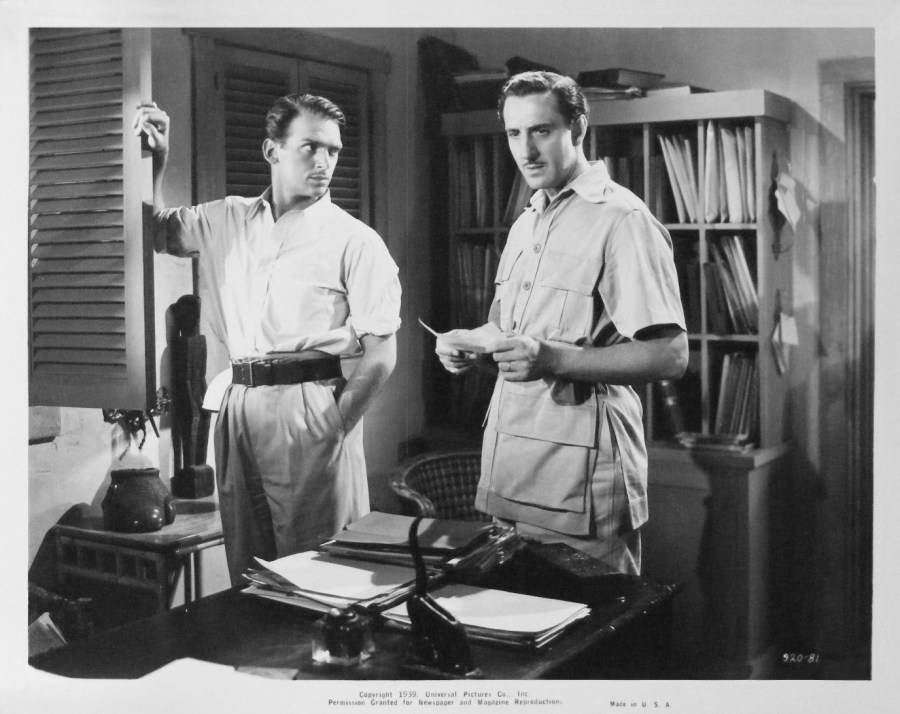
Winter of Fairbanks Jr.: The Sun Never Sets (1939)

This winter I watched Douglas Fairbanks Jr. movies for fun.

This week for the last movie of the series,  I watched The Sun Never Sets (1939) starring Douglas, Basil Rathbone, Barbara O’Neil and Virginia Fields.

It was directed by Rowland Lee.

Before I launch into my feelings about the movie, here is the plot, without spoilers, copied from Google:

Two British brothers (Douglas Fairbanks Jr., Basil Rathbone) squelch a radio-made dictator on the Gold Coast of Africa.

Oh. Well, that wasn’t much of a description.

A little more for you: This movie is about a brother (Douglas) who doesn’t want to go into the miliary like the rest of his family but is shamed into it by his grandfather who says what an honor it is to fight for the empire and by his brother who says there is no greater love than to leave ones family to fight for the empire.

Even his fiancé (Virginia Fields) begins to feel like her future brother and sister-in-law’s love is enviable because their relationship was strengthened during their time together on the Gold Coast.

So poor John Randolph (Douglas) is broken down and signs up for the military to take his brother, Clive Randolph’s (Basil Rathbone) place in Africa, which Clive’s wife hated. Once John agrees to capitulate and follow in the footsteps of all his family members, risking himself for the Empire, Clive is then called up for a secret mission and also has to return to the Golf Coast. He tells his wife she can’t come because she’s pregnant but she loves him and is determined to be with him.

Her pregnancy becomes a source of stress for poor ole Clive who must choose between being there for his wife when she gets sick from walking in the rain (because everyone knows that walking in the rain automatically means you get sick) and capturing a bad guy who wants to (I kid you not) take over the world.

For me this is a British propaganda movie similar to the American propaganda movies that actors like Cary Grant and Jimmy Stewart were in around World War II.

My overall view on the movie: It is about restoring ones reputation for the sake of the Empire when you choose to help your family instead of completing your mission for the British Army and furthering their take over of African nations.

The movie does touch on the difficulties of serving one’s country while also being there for their family but by the end we are reminded how important it is for a British man to have a reputation as a fine soldier even more so than having a reputation as a weak man who cares about his pregnant wife.

There is forgiveness between the brothers for the failings of one brother that cost Clive being able to capture a criminal and that was nice. Not sure if the forgiveness had been there if he had failed yet again though.

 “Failing the empire twice?! My God, John! Once I can understand but twice! You’ll have to work as a dirty businessman and get rich and stand on the heads of poor people in another way now!”

One review online said this movie was more focused on family relationships than anything else and I suppose that is true. But it was also wrapped up in making sure the men were loyal to the Empire, the King, etc. while also having a family.

I was absolutely baffled by the one part where a brother chooses to bring the other brother back from a mission because his wife is dying and then the first brother is ostracized by the sister-in-law he saves. Apparently, she’d rather be dead than go back to England with a husband shamed for failing his military assignment. Just … what?!

So, this movie really wasn’t my favorite of those I have watched as part of the Fairbanks Jr. marathon, though I didn’t hate it as much as I hated Gunga Din. This movie still made sure to remind us that the British were all-knowing and that the natives of the land wouldn’t have survived without them (har. Har.) but at least refrained from calling them all savages like they did in Gunga Din.

There are a couple of movies of Douglas’s that I wish I had chosen instead of this one but I’ve seen Rathbone in Sherlock Holmes movies so figured it wouldn’t hurt to see him in something else. He is a very good actor so saying I don’t like this movie is not a slight on him or any of the actors. They did a nice job. I just didn’t enjoy the movie overall. It was somewhat like an infomercial for British military recruitment.

The author of Basilrathbone.net enjoyed the movie and was able to overlook the flaws.

“While I can point out several flaws with the film, the fine performances by the cast brought the characters to life, making them very real. I really cared about what happened to the characters and I was so caught up in the drama, that I hardly noticed or cared that the plot was rather contrived. Rathbone and Douglas Fairbanks Jr. have some great scenes together.”

This was essentially a military recruitment film, though, the writer admits.

“Universal had high hopes for this story of the British Colonial Service. In 1939, when this film was made, the British civil services administered to more than 500 million people over territory that covered 13 million square miles all over the world.”

Time Magazine did not like the film at all based on this review:

“Only slightly more agonizing than young Mr. Fairbanks’ throes in putting this subversive two & two together is the sight of middle-aged Mr. Rathbone, as a sort of Imperial Rover Boy, lashing about the jungle in bush jacket and shorts, caught barekneed between Love & Duty.” —Time magazine, June 19, 1939

Ouch.

They weren’t alone in their dislike of the film based on the reviews posted on this article on Basilrathbone.net.

By the way, I enjoyed reading the article about this movie on this site. There is a ton of information about Basil and his other movies there as well so I will be exploring it more.

This ends my Douglas Fairbanks Jr. marathon. If you want to read my impressions of the other movies I watched you can find them here:

https://lisahoweler.com/movie-reviews-impressions/

Up next in April, Erin from Still Life, With Cracker Crumbs and I will be watching movies set in Paris. We will be announcing our movie list at a later date. Stay tuned!

Jeremy Brett. The definitive Sherlock Holmes?

When you think of Sherlock Holmes there may be a certain image that comes to your mind if you’ve only read the books but if you’ve watched any of the television or movie portrayals of him then a certain actor may come to mind.

For me, there are two actors – Jeremy Brett and Benedict Cumberbatch.

Others may think of Basil Rathbone or – and I cringe even saying this one – Robert Downey Jr.

No offense to those who like Robert as Sherlock but…he’s not Sherlock to me at all. He’s … well, Tony Stark or just Robert Downey Jr. being Robert Downey Jr.

To each our own though.

My husband is the one who introduced me to Sherlock Holmes and to Jeremy Brett portraying Sherlock Holmes in The Adventures of Sherlock Holmes.

My husband is a Holmes connoisseur of sorts and in addition to Brett, he is also a fan of the Basil Rathbone version of Sherlock.

Full confession time: I have not read all of the Sherlock Holmes stories. In fact, I don’t believe I’ve ever read one in full. I have listened to them and to radio dramas of them and I have seen shows based on them. I have also read Moriarity by Anthony Horowitz, which is one of two books he wrote about Sherlock with the permission of the estate of Arthur Conan Doyle.

I hope to delve into the short stories in May or June.

Based on the stories I have heard and partially read, though, Jeremy Brett truly is the embodiment of Sherlock. His mix of seriousness and humor. His brash laughter. His borderline manic excitement when he’s found a clue or close to solving a case. His expressions convey so much in a simple eye roll or smirk.

Jeremy Brett played Sherlock Holmes from 1984 to 1994 in The Adventures of Sherlock Holmes. Some Sherlock Holmes enthusiasts declare him the definitive Holmes – at least when it comes to the classic Sherlock Holmes portrayals. There is, of course, Benedict as the more modern “Sherlock.” He has been claimed by younger Sherlock Holmes fans as the best Sherlock and I don’t deny his version is excellent, but it’s not necessarily how Sherlock is in the books. That isn’t a bad thing, of course. Benedict’s version is his interpretation of the genius detective and I love it, but what I am talking about is the “classic 1880s to early 1900s” Sherlock.

The Adventures of Sherlock Holmes ran from 1984 to 1994 and presented all 56 short stories and four novels by Doyle. David Burke portrayed Dr. Watson in the show until 1985 and then Edward Hardwick took over in 1986 and carried on from there. Rosalie Williams portrayed Mrs. Hudson.

According to an article from The Telegraph, Brett fought hard to make sure the show kept close to the source and insisted on using Arthur Conan Doyle’s original dialogue. When it was once suggested that a non-Doyle novel was used, Brett refused, supposedly saying, “No, I’m not doing anything that isn’t pure Doyle!”

Bretts originally hesitated to take on the role because he had played happier characters on the stage in My Fair Lady and The Three Musketeers and in the movie version of My Fair Lady. I was surprised to see this week that he played Freddie Eynsford-Hill in My Fair Lady.

Brett didn’t feel he could bring anything to the role after Basil Rathbone played Homes in 14 films between 1939 and 1946.

It was a trip to Barbados that gave him time to read the novels and short stories. He said if he did take on the role, he did not want to change Doyle’s original intentions or words. He took meticulous notes on Holmes’ mannerisms and online sources say he referred to all 80 pages of those notes during filming.

“I think the character of Sherlock Holmes is frankly inhuman,” Gus Holwerda, who hosts the Jeremy Brett Sherlock Holmes Podcast with his brother, Luke, told The Telegraph in 2021. “Jeremy was a ‘becomer’, as he would say – a method actor [‘Try to become the creature and erase yourself,’ Brett once said]. Becoming such a heavy and challenging character is a feat that few actors would have seriously attempted. Fans of the show appreciate the enterprise, and the toll it took on him.”

Brett, who was born Peter Jeremy William Huggins in 1933, immersed himself in the character. Some say almost too much. If a person hasn’t read the Holmes short stories they may not be aware of the darker elements of the character – his depression, mood swings, and opium/cocaine/morphine addiction. Some articles online say that Brett, being a method actor in many ways, pulled some of those darker elements into his own personality. Though I didn’t read that he had any drug addictions he did deal with bipolar disorder and then heart problems later in life.

To Brett, no screenwriter could outwrite Doyle, which was why he insisted on keeping the stories so close to the source material and even used Doyle’s dialogue himself.

As for who presents the best portrayal of Sherlock?

Brett himself believed the best Sherlock in the eye of the reader so to speak:

“I’ve done 33 Sherlock Holmes stories and bits of them are all right. But the definitive Sherlock Holmes is really in everyone’s head. No actor can fit into that category because every reader has his own ideal.”

Have you seen Brett’s portrayal of Sherlock? Or any others that you enjoyed? Let me know in the comments. Even if it is Robert Downey Jr. *wink*

(Note: You can find The Adventures of Sherlock Holmes on Amazon/Britbox but you can also find some episodes for free on YouTube.)