Classic Movie Impression: The Bishop’s Wife

This weekend I watched The Bishop’s Wife (1947), which I have watched before but couldn’t remember the end of, so I watched it again.
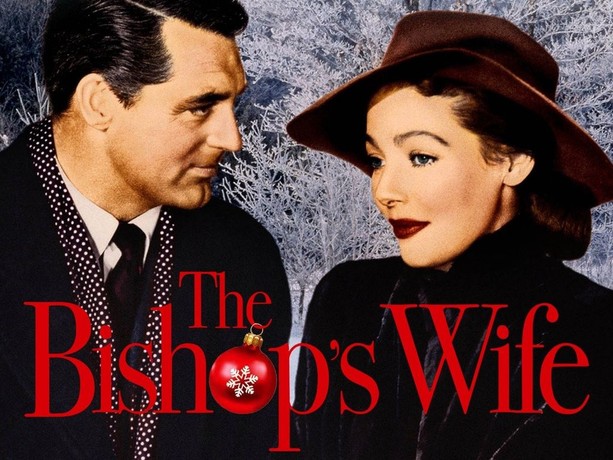
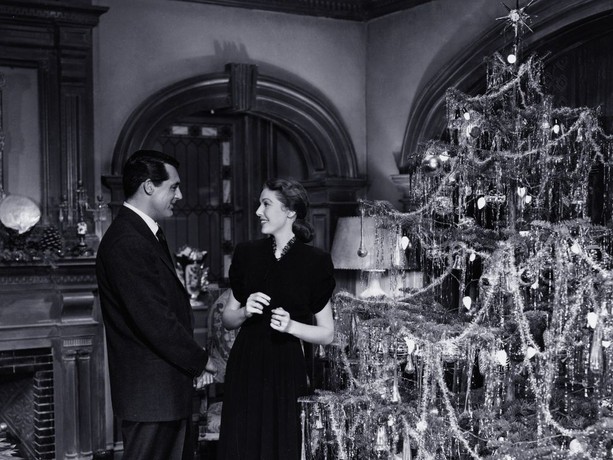
The movie stars Cary Grant as an angel named Dudley who comes to earth to help Bishop Henry Brougham, (David Niven). Henry is so wrapped up in securing funding for a cathedral he begins to neglect his wife and daughter.

Dudley arrives at the Bishop’s house after the Bishop prays for God to help him with funding for the cathedral. Dudley tells him right up front that he’s an angel and he’s there to help him but introduces himself to others as Henry’s new assistant. He pretty much forces himself into Henry’s life and ends up charming the pants off all the women he meets and creating miracles for men, women, and children alike. At least one man, Henry’s retired professor friend (Monty Woolley), is very suspicious of him.

Henry isn’t really sure if he believes that Dudley is an angel, especially when the guy starts taking Henry’s wife, Julia, (Loretta Young) out on the town, having dinner with her, taking her skating, and buying her hats.

Still, Henry isn’t about to get distracted from his goal of building the cathedral and he ignores Dudley’s efforts to open his eyes to how much Julia needs him, plowing forward with fundraising instead.

L-R: Actors Cary Grant, David Niven and Loretta Young sit in the back of a car in a still from the film, ‘The Bishop’s Wife,’ directed by Henry Koster, 1947. (Photo by RKO Pictures/Courtesy of Getty Images)

I think Cary is supposed to be charming in this movie but instead I find him a bit devious. Maybe the goal of the movie is to leave the viewer trying to figure out if he is sweet or evil.

The site, The Viewer’s Commentary, had a similar feeling about Cary’s role and explains it better than I can.

“But, while I’m not certain “perfect” is necessarily the right word for Dudley as a character, I’m still not entirely convinced that the movie wasn’t actually trying to play him up as being in his right to step in on Henry’s marriage, either. This is based on the film’s affectionate depiction of his chemistry with Julia, the amount of sympathy the film has for her, and the apparent distaste it has for the stiff Henry beyond his admirable loyalty and good intentions.”

“That ice skating thing I mentioned before wasn’t some kind of non sequitur,” the post continues. “There’s a painfully long scene in which Dudley and Julia and their cab driver have a whimsical impromptu ice skating session where he romances her in front of everyone by secretly granting her expert skill while Henry toils away elsewhere, callously inattentive to Julia’s wifely needs. It would be one thing if it was intended to teach Henry a lesson about what could potentially happen, but it actually kinda left me with a gross feeling, given how wonderful it’s all supposed to be while knowing about Dudley’s infatuation – not to mention his manipulation of the situation and nonchalant demeanor when confronted about it.”

This is the scene in question:

At one point even Henry begins to wonder if Dudley is from heaven or hell and if he truly is trying to steal his wife from him.

It’s what I was wondering too and by the end of the movie  . . . well if you’ve never seen it you will have to watch it and let me know what you think.
The movie is based on a book by Robert Nathan whose other fantasy romance, Portrait of Jennie, would later overtake The Bishop’s Wife on a literary level and later became a 1948 David Selznick movie.

According to an article on TCM.com, producer Samuel Goldwyn decided to take on this movie right after winning an Oscar for The Best Year of Our Lives in 1946.

Cary was originally set to play the Bishop, but as he read the script he began to suggest edits and finally decided he didn’t have the right part. He should be playing Dudley.

Later on, though, after the final casting decisions were made, Grant wanted to switch back.

Then there was the fact that Goldwyn didn’t like the set.

Niven wrote in his future autobiography, “The day before shooting was to start, Goldwyn decided that the interiors of the Bishop’s house were not ecclesiastical enough and ordered several sets to be torn down, redesigned and rebuilt. For three weeks, while this was going on, production was halted, then, two days after the cameras finally had a chance to turn, Goldwyn decided that Seiter’s hand was a little too heavy on the tiller: he was removed, paid his full salary and after a week, Goldwyn hired Henry Koster to start again from scratch – with another two weeks of rehearsal. All this must have cost Goldwyn several hundred thousand dollars….”

Niven was already struggling through the production because his wife tragically died during filming.  Her fatal head injury occurred during a party game of “sardines” at Tyrone Power’s house. Her name was Primmie and she fell down a flight of cellar stairs after thinking she was running into a closet.

Problems further continued to plague the film when Cary and Loretta Young couldn’t get along part of the time.

Despite all of the hardships, the movie was well-received and remains a favorite Christmas film of many classic movie buffs today.

It was nominated for five Oscars but did not win any.

I’m not sure I found this movie as heartwarming as some of the Christmas movies I’ve watched, probably because I found it so difficult to read Cary in this one and was quite suspicious of him. I did, however, still enjoy the movie overall.

A few pieces of trivia about the movie for you:

I recognized the young actor who played the young George Bailey from It’s A Wonderful Life — Bobby Anderson —— in a snowball throwing scene in this film. I looked up his name and found out that Karolyn Grimes, who played Zuzu in It’s a Wonderful Life also played The Bishop and his wife’s daughter, Debby.

According to IMBd (I did not double check these to clarify they are true):

“At about 1:20, Henry and Julia are ready to make some Parish calls. Henry says to Julia, “We go first to the Trubshawes.” This is an example of David Niven’s attempt to mention the name of his friend (Michael Trubshawe) in every movie he made.”

“Over Cary Grant’s protests, a skating double wearing a mask with Grant’s features was used in the long shots of the complex skating routine. A skating double was also used for Loretta Young on all long shots.”

Market research showed that moviegoers avoided the film because they thought it was religious. So, Samuel Goldwyn decided to re-title it Cary and the Bishop’s Wife for some US markets, while adding a black text box with the question “Have you heard about CARY AND THE BISHOP’S WIFE?” on posters in markets where the film kept the original title. By adding Cary Grant’s first name to the title the film’s business increased by as much as 25 per cent.

“In Britain the film was selected for that year’s Royal Command Film Performance screening. Princess Margaret and her sister, the future Queen Elizabeth, both attended the screening of “The Bishop’s Wife” on November 25, 1947, at the Odeon Theatre in Leicester Square. According to David Niven, “The audience loved every second of it, and the Queen and Princess Margaret told me afterwards and at great length how much they had enjoyed it.”

Have you ever seen The Bishop’s Wife? What did you think of it?


*This post is part of the Comfy, Cozy Christmas Link Up for 2024. If you have a Christmas/holiday post you would like to share you can find the link HERE or at the top of the page here on my blog.

Classic Movie Impression: The Rage of Paris (1938)

I stumbled on The Rage of Paris, a movie from 1938, by accident when one movie I was watching on Amazon Prime ended and this one started. I ended up loving it and also fell in love with Douglas Fairbanks Jr. who I had never heard of before this movie.

Where had I been? He was so handsome and charming in this movie, which made me want to look up more information about him. I also now want to find more movies starring him. I feel a Winter or Spring of Douglas Fairbanks Jr. coming up

“Douglas Fairbanks Jr. must have been famous back in the day because his name is even in the title of the movie on Amazon,” I said to myself.

I later asked my mom and dad about him and they assured me he was very famous, but, Mom said, “That was way before my time, just so we are clear here.”

Mom and Dad were, incidentally, born in 1944. Fairbanks Jr. started his career much earlier.

Before we learn about him, though, I’ll share about the movie, which starts with the main character, Nicole de Cortillion, (Danielle Darrieux) a French woman in New York City, who is desperately looking for a job. There is a hilarious mixup where she asks the head of a modeling agency for work and he suggests a job with a photographer who wants female models who will model with drapes on – and nothing else. The photographer is impatient and wants the job done fast, she’s told.

Nicole is horrified and says she won’t do it, but when another model comes in and says she will, Nicole doesn’t want to lose the job and while the model and the head of the agency are chatting, she snatches the address from the top of the desk.

The only problem is that she’s grabbed the wrong address. The address she has is for a man simply looking for some proof photographs for an advertising campaign that doesn’t involve scantily clad women.

The man is Jim Trevor (Fairbanks) who is beyond confused when he walks into his office after a meeting and finds Nicole stripping to prepare for the photos.

It is one of the funniest scenes I’ve ever seen in a movie because it’s clear he doesn’t have any idea what she’s doing and both wants to stop her and not stop her. He tries to ask what she’s doing and she asks where his camera is. A very funny exchange occurs during which Jim starts to think this woman is looking for a quick buck in a very solicitous way.

I found a clip for you of the witty exchange:

Back at her apartment, her landlady says she’s kicking her out for not paying rent. Her neighbor, Gloria, (Helen Broderick) having it though and tells the landlady that she will cover her rent. She then brings Nicole into her apartment and tells her she wishes they could marry rich men and not have to worry about bills anymore. That’s when an idea strikes Gloria. She has a friend who is employed as a maitre’d at a famous hotel. Maybe he would give Nicole a job. They head to the hotel, but the man – Mike (Mischa Auer) – says he can’t give her a job because soon he’s going to open his own restaurant. All he needs is $3,000 to get the restaurant.

Another idea strikes Gloria when she sees all the women dancing with the wealthy men in the dining room. What if they have Nicole seduce a millionaire and marry him? Then she won’t have to find a job and she can also give money to Gloria and Mike. Gloria talks Mike into the scheme. They’ll rent a room at the hotel with his help. Gloria will pretend to be Nicole’s aunt and together they will set their eyes on millionaire Bill Duncan. If Nicole can convince him to marry her they’ve got it made.

All is going well until Nicole, Gloria, and Bill attend an opera and run into Bill’s friend – none other than Jim Trevor.

The scene where they recognize each other across two balconies is comedy gold.

I absolutely could not stop laughing.

I’ve left a clip of it that I found on YouTube here for you:

Nicole does her best to hide from Jim Trevors but it doesn’t work and when he gets her alone later in the evening he tells her she needs to tell Bill Duncan the truth – which is that she isn’t a rich baroness from Paris – but instead a poor girl trying to swindle him into marrying her.

She promises she’ll tell Bill Duncan but she double crosses Jim in a very funny scene that leaves Jim steaming and more determined than ever to make her tell the truth. The rest of the movie is him doing just this.

The Rage of Paris did well at the box office in 1938 and was nominated for two Venice Film Festival Awards, winning in the category of Special Recommendation.

I had never heard of either of these actors when I started the movie.

For some background on Douglas Fairbanks Jr. – his father, Douglas Fairbanks Sr., was one of cinema’s first icons, noted for swashbuckling adventure films as The Mark of Zorro, Robin Hood, and The Thief of Bagdad. Fairbanks had small roles in his father’s films American Aristocracy (1916) and The Three Musketeers (1921). Fairbanks Jr.’s mother was Anna Beth Sully, the daughter of wealthy industrialist Daniel J. Sully.

His parents divorced when he was nine and he lived part-time with his mother in France, New York, London, and California.

Fairbanks started acting at the age of 13 when he was given a contract simply because he was the son of a famous actor. The film he first starred in flopped, though, and he returned to Paris to continue his studies. He returned to Hollywood at the age of 14 and became a camera assistant at what he called “starvation wages.”

His father didn’t want him to get into acting at such a young age, but instead wanted him to continue his education.

He worked steadily from 1921 to 1956 but he took a break during World War II to become a highly decorated officer by serving in the U.S. Navy as a reserve officer. He was a part of many, many missions including one where he was part of a recruitment of 180 officers and 300 enlisted men for the “Beach Jumpers” program. This program was aimed at simulating amphibious landings with a limited force, operating miles from the actual landing but using deception to make the enemy believe it was the actual landing place.

I don’t like using Wikipedia as a source anymore for a variety of reasons, but according to their page on Fairbanks,  “For his planning the diversion-deception operations and his part in the amphibious assault on Southern France, Lieutenant Commander Fairbanks was awarded the United States Navy’s Legion of Merit with bronze V (for valor), the Italian War Cross for Military Valor, the French Légion d’honneur and the Croix de Guerre with Palm, and the British Distinguished Service Cross.

Fairbanks was also awarded the Silver Star for valor displayed while serving on PT boats and in 1942, made an Officer of the National Order of the Southern Cross, conferred by the Brazilian government.  . . . Fairbanks stayed in the US Naval Reserve after the war, and ultimately retired as a captain in 1954. In 1982, Fairbanks was awarded the German Federal Cross of Merit for his contribution to the relief of the needy in occupied Germany.”

He returned to acting after the war and starred in many “swashbuckling movies” as well as British films and television since he moved back to the UK after the war and stayed there for many years before moving to Florida (is it just me or do a lot of Brits move to Florida?).

As for his co-star, Darrieux, this was her first American film. She was a star in France before World War II. She started acting at the age of 14.

She continued acting during World War II and the German occupation of France, which was something she was frowned upon for. Later, though, it was believed she’d been threatened by the head of the only studio in operation at the time – owned by a German who threatened to have her brother deported if she didn’t perform.

Darrieux had a lengthy film career in France, the United States, and Britain, and starred in  Lady Chatterley’s Lover (1955), whose theme of uninhibited sexuality led to its being proscribed by Catholic censors in the United States. She then played a supporting role in her last American film, United Artists’ epic Alexander the Great (1956) starring Richard Burton and Claire Bloom.

She acted from 1931 to 2002.

Later in her career she became involved in musical theater and even performed concerts in the 1960s. She passed away at the age of 100 in 2017. What a full life!

According to a blog dedicated to Douglas Fairbanks Jr., Darrieux’s life was tough at times, even if it was full, especially while filming The Rage of Paris.

Fairbanks remembers working with Darrieux fondly,” Elizabeth from the blog Douglasfairbanksjr.wordpress.com. “Unfortunately at the time, she was a victim of physical abuse at the hands of her husband. Filming had to be postponed for a short while as she recovered from a black eye given to her by her husband.”

The blogger goes on to say that Darrieux’s overbearing husband kept her from socializing too much with others on set. Thankfully, not long after the premiere of The Rage of Paris, Darrieux left her husband.

Fairbanks wrote in his memoir, “I’ve always hoped she was consoled by the fact that the picture turned out well and proved very popular.”

I also agree with the author of the blog who said she felt The Rage of Paris “contains one of the best on-screen chemistries and one of the best romantic build-ups on film.”

The chemistry between Darrieux and Fairbanks Jr. was incredible and I was sad to read that they only made one film together. If they were only going to make one film together, though, I’m glad it was this one.

So, tell me, have you seen this film or any of Douglas Fairbanks Jr.’s other films? How about Darrieux? Have you seen any other films by her? And should I have a Douglas Fairbanks Jr. marathon for myself this winter?

Comfy, Cozy Cinema: Dracula

Erin from Still Life, With Cracker Crumbs and I are watching Comfy, Cozy movies from September through November.

This week we had a Halloween freebie/wildcard.

Originally, I was going to write about Practical Magic because Erin was watching the movie and I thought I would too. Then I watched Practical Magic and…plans changed. I’ll leave it at that.

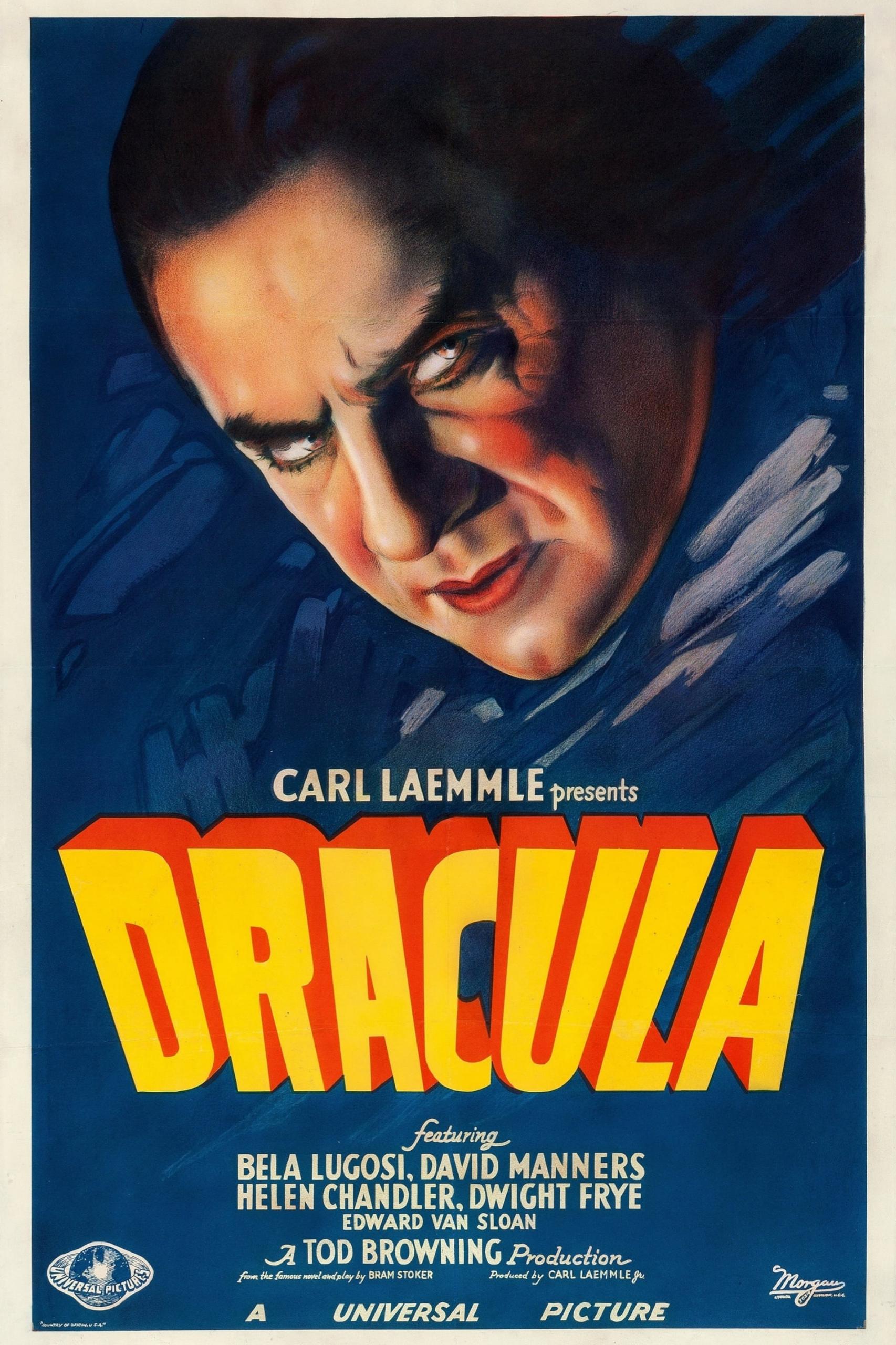
Instead, I decided to rewatch the original black and white Dracula movie from 1931 and write about that. I will admit this movie is neither comfy or cozy!

At the beginning of the movie, we see a group of people traveling through a remote area – where it is we aren’t told but later the movie subtitles say they are speaking Hungarian.

One woman is reading about the area and says there are ruins of castles in the area that can be seen. She almost falls over as the carriage continues and a man asks for the driver to slow down.

“No!” one man declares. “We need to get to the village before sundown. It is Walpurgisnight, the night of evil.”

There are dark things afoot when the sun sets, he says.

Soon the carriage stops and we have one of the men telling the villagers that he isn’t going to stay in their village but instead is going to go up the mountain around midnight to meet a carriage and go on to the house of Count Dracula. The villagers are clearly upset at this news and urge him not to go. They tell him there are vampires at the castle of Count Dracula and, in fact, they come into the village and drink the blood of anyone who stays outside after sunset.

The man is determined though and off he goes, much to the disappointment of the villagers and carriage driver. One of the women even hands him a necklace with a cross and begs him to take it for the sake of his mother to protect him.

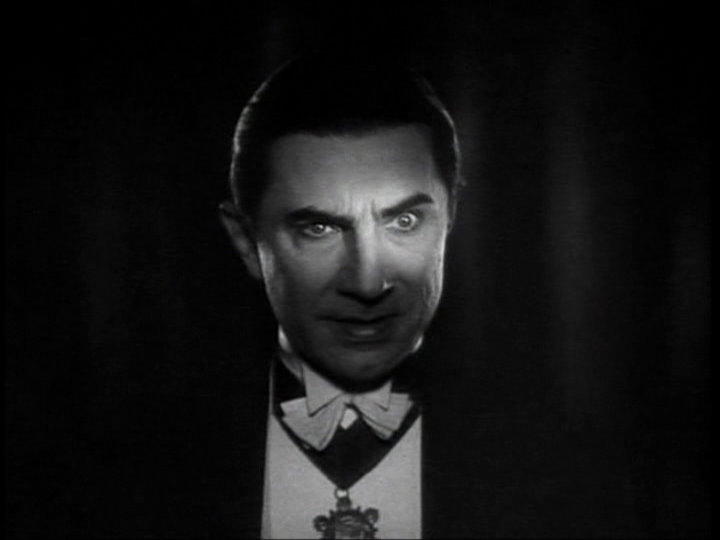
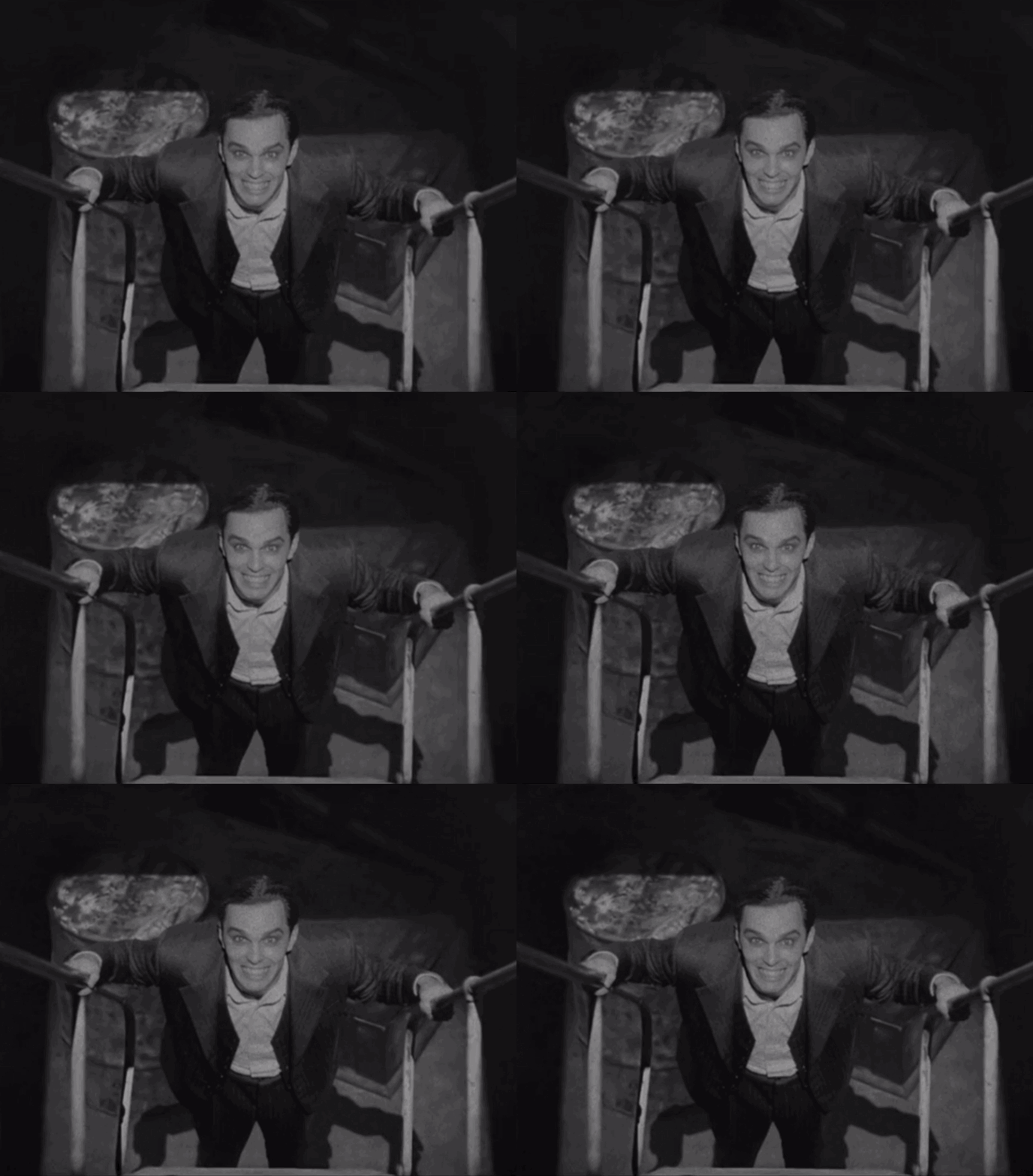
The carriage takes off over the desolate hills and next we see a clip of a man and woman climbing from a coffin in a dark basement or crypt and the man looking ominously at the camera, dark shadows all around him except for a spotlight on his dark eyes. The three women in long white dresses walk around inside the crypt, carrying candles.

This movie is 93 years old this year and still had shivers sliding up my spine. A foreboding atmosphere hangs over the scenes, telling the viewer that something bad is going to happen or the bad is going to continue to get worse.

The movie is shot very, very dark, which sometimes makes it hard to see what is going on, but the viewer can certainly tell that the man – R.M. Renfield (played by Dwight Frye) — is very nervous when the carriage pulls up in the rain to pick him up. He’s regretting his decision even more when he walks into the ruins of the castle. Renfield is there to arrange the lease of an abbey in London for the count.

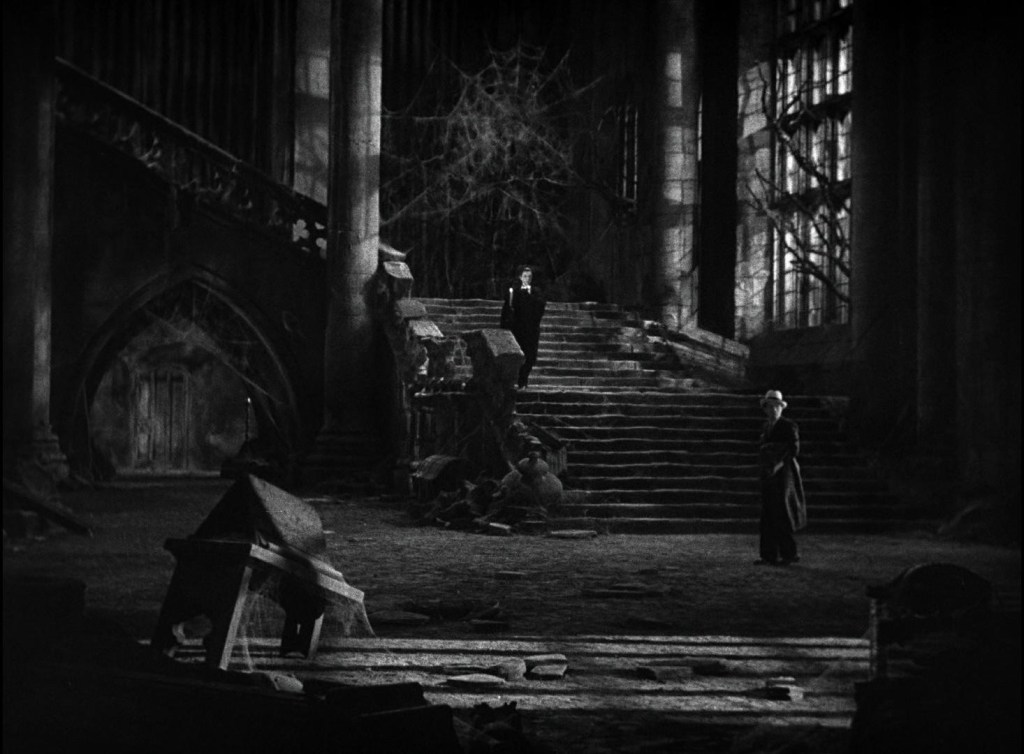
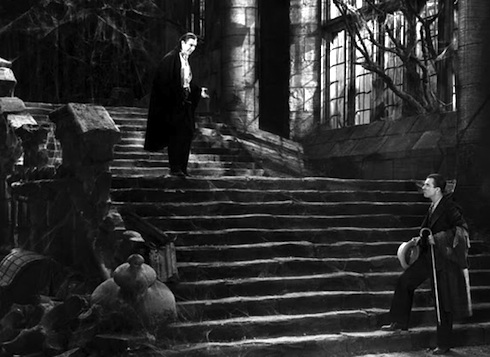
The view of this castle from the inside is insane and if it was today, I’d say it was CGI, but this movie was made at a time when they didn’t have CGI. The inside shot when the man first walks in and sees the scope of this castle is mesmerizing.

I was shocked when I read that the scenes in the castle were shot in Universal City, California on a sound stage. The set was painstakingly built and the ruins of the castle were used for years in other movies, one article stated.

Much of the so-called special effects of the movie were created with fog, camera angles, and lighting.

The effects are in full force when a man walks down the long stairway, out of the dark shadows to meet Renfield.

“I am Dracula,” the man says, his face lit by the candle.

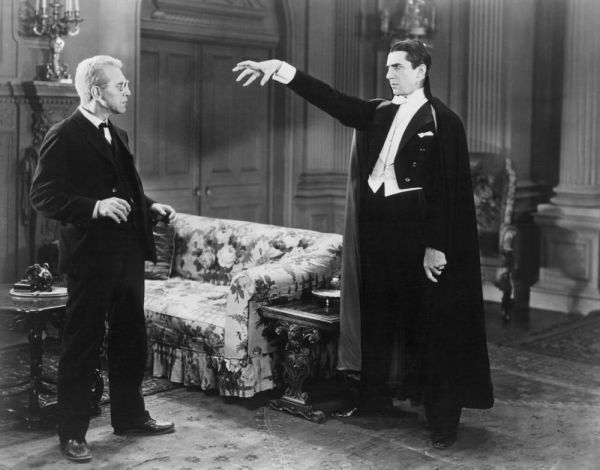
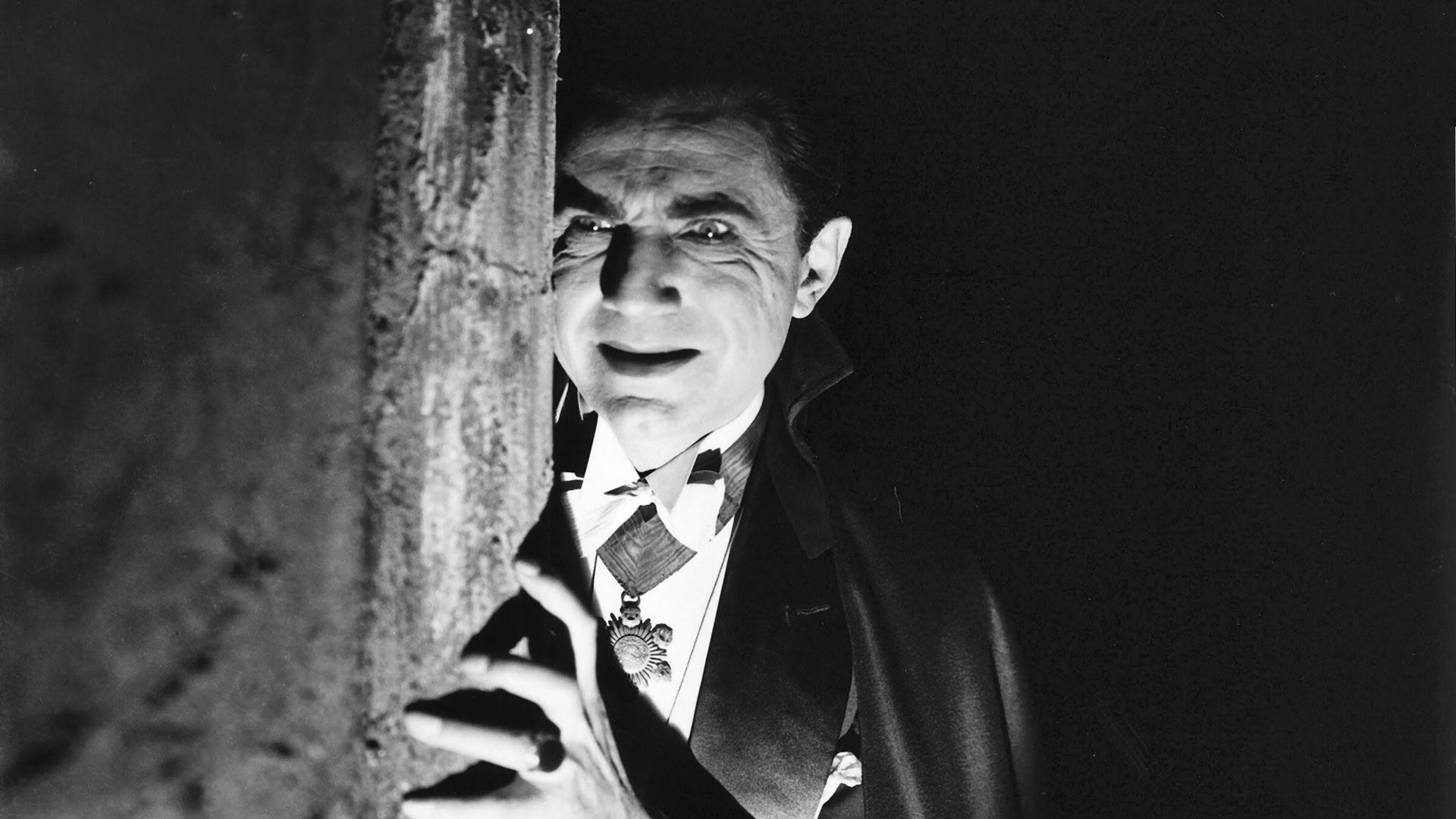
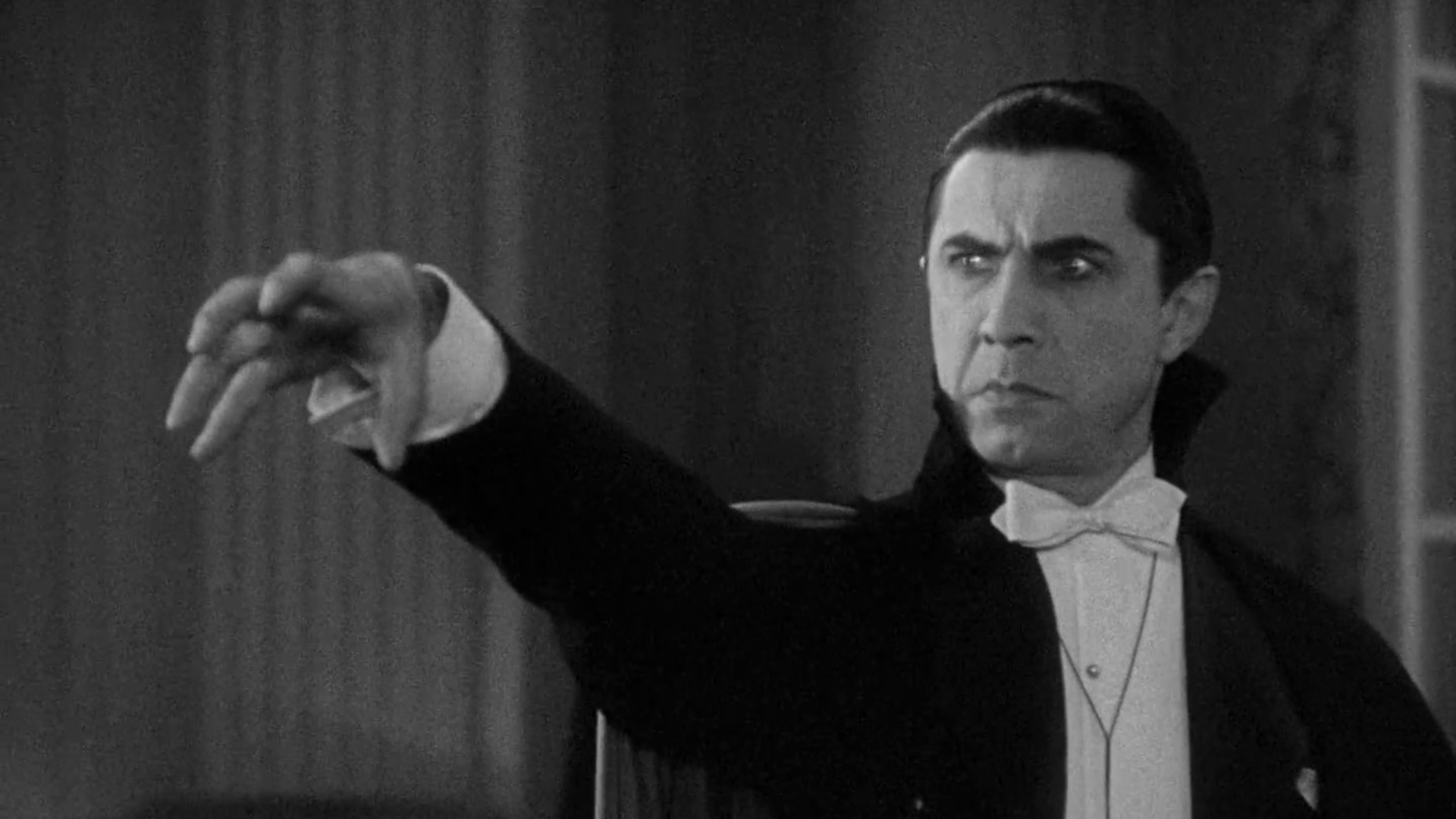
The actor who plays Dracula is, of course, Bela Lugosi, whose portrayal, according to the Encyclopedia Britannica is considered the definitive portrayal of Count Dracula. Bela’s version of Dracula is absolutely haunting. Old movie or not, the acting in this movie is done terrifyingly well.

Dracula is a character created by author Bram Stoker who wrote the novel of the same name in 1897. This movie was based on the 1920s stage production of the book. Lugosi portrayed Dracula in that production on Broadway, in 1927, as well.

According to the Encyclopedia Britanica web page, “[Lugosi’s] halting speech, in his own thick Hungarian accent, contributes to the frightening appeal of the film, along with its eerie atmosphere, long tension-raising pauses, and lack of music.”

That lack of music is quite chilling. Apparently, in 1998, Philip Glass was commissioned to score music for the film and it was added to a re-released version of the film. I watched the original film without the music and I prefer it that way. Much like black-and-white photography strips away the distractions of color, the lack of music in Dracula leaves the viewer even more immersed in the horror experience – undistracted by a melody or a tone of a musical piece.

“These first 20 minutes are predominantly silent – in fact, beyond a few snatches of Tchaikovsky and Wagner, there is no background music in the film at all,” TCM’s Rob Nixon writes. “A rising sense of dread is accomplished by the creaking sounds of coffin lids and by cinematographer Karl Freund and Director Tod Browning’s floating camera creating an atmosphere of mystical terror reminiscent of the German silent fantasies.”

When Lugosi comes down the stairs carrying a candle and announces, “I am Dracula,” in a very calm, but eerie voice, Renfield looks slightly relieved. Afterall the carriage driver drove off with his luggage, the cobwebbed-covered castle is bathed only in moonlight, and there are wolves howling outside. Surely this man will be leading him into the cozier setting in the upstairs of the castle.

When Dracula says the wolves are the children of the night, this should have alarmed Renfield more   but, no, he continues on, even when he sees a large spider web and spider inside.

Things, of course, go off the rails for poor Renfield when he gets a cut from a paperclip and starts to bleed. This must have reminded the count he was a bit peckish because the look he gets on his face is pure obsession over the blood on Renfield’s finger. The cross that falls from around Renfield’s neck is the only thing that saves him in that moment.

Sadly, it won’t save him for long but I’ll let you find out what happens if you watch the movie, or if you don’t know the story.

Later in the movie, we will be introduced to Professor Van Helsing (Edward Van Sloan) who will try to stop Dracula from his murderous feasting throughout London.

I won’t give the ending of the movie away but it was seriously not the exciting ending I was hoping for.

This film was filmed in 36 days for $341,191, just under the planned $350,000 budget. When the movie was first discussed, it was going to be a large, sprawling remake of the stage production, according to TCM.com, but the Great Depression hit and the movie had to be scaled back.

People on set say that Lugosi used to practice saying his lines and getting into character by posing in front of a mirror and tossing a cape across his shoulder. He spoke very little to the cast, saying only hello when he came in and goodbye when he left.

According to Nixon, Lugosi was typecast after Dracula to the point he couldn’t break into any other style of acting.

“Typecasting is an inherent danger for any star; for Lugosi, it crept strangely into his private life as well,” Nixon wrote. “For many years, he appeared in public in his trademark costume and demeanor, and was even buried in Dracula’s black cape. When he looked in the mirror, did he only see the Transylvanian count staring back at him? Or, like the vampire character he portrayed, did he see nothing at all?”

A note on him being buried in the cape: other online articles state that Lugosi did not request to be buried in the cape. His son and fifth wife chose to do so because they thought he would like it. Yes, you read that right. His fifth wife.

Anyhow, back to the movie – while it was directed by Tod Browning, some said that Freund was the actual director. Freund was an Academy Award-winning cinematographer for his work on The Good Earth from 1937 and at the end of his career filmed various television shows – including I Love Lucy.

In some ways Dracula holds up more than many films of today. The creep factor was definitely there – especially Frye’s manic/insane portrayal of Renfield after his interaction with Dracula. I don’t think it is a movie I will watch again because I could barely make it through it without wanting to flip to Anne of Green Gables to clear my movie-watching palette.

Have you ever seen this version of Dracula? What did you think of it?

If you want to read Erin’s impressions of Practical Magic, you can find it here.

Up next week for the Comfy, Cozy Cinema is Skylark, the second movie in the Sarah, Plain and Tall series. This one really is a comfy, cozy watch.

Here is our remaining list, including a group watch of Chocolat (date to be announced) that we will be writing about on Nov. 21. You do not have to write about the movie to watch with us.

We will be pushing play together on Chocolat and then chatting about the movie in our Discord group (The Dames), which you can join for free now here: https://discord.com/invite/J7qQ36Uf

If you want to join in and add a blog post you wrote about the movie you watched this week you can leave a link here:

You are invited to the Inlinkz link party!

Click here to enter
https://fresh.inlinkz.com/js/widget/load.js?id=c0efdbe6b4add43dd7ef

Comfy, Cozy Cinema: Dial M for Murder

Erin from Still Life, With Cracker Crumbs and I are watching Comfy, Cozy movies from September through November.

This week we watched Dial M for Murder (1954), directed by Alfred Hitchcock.

This was a great follow up to Rear Window and I’m so glad Erin suggested both of these. I’ve been wanting to watch Dial M for Murder for years but just never got around to it with all the other great movies out there to watch.

Now that I’ve watched it, I wouldn’t say it’s my favorite Hitchcock movie of all time but I really did enjoy it. In some ways I thought things fell together a little too easily at points in this movie but the way they fell into place made me enjoy it – if that makes any sense. It might not make sense if you haven’t watched the movie but if you have then you probably know what I mean.

xr:d:DAEexVzeeIc:4716,j:6082518224336963441,t:23102317

Here we have another Hitchcock movie with one of his favorite actresses, Grace Kelly. The movie also stars Ray Milland and Robert Cummings.

Dial M for Murder, based on a very popular play and screenplay by Frederick Knott, was made before Rear Window but both movies released at the same time. It was this movie that made Hitchcock decide he wanted Kelly for Rear Window.

First a little bit about the plot of the film. Tony Wendice is a retired professional British tennis player who is married to his socialite wife, Margot, who has had an affair in the past with American crime-fiction writer Mark Halliday.

Margot doesn’t think Tony knows about the affair. She burned all the letters she received from Mark when she broke it off with him. All the letters except one. She kept that one in her handbag and though we are never definitely sure what was in the letter, we know it was something that meant a lot to her.

Mark has now come to London for a visit and wants to see both Margot and Tony. They are set to go out to a performance together that night but Tony bails at the last minute and tells  them to go on without him and have some fun.

Tony’s eagerness to stay home is what first clued me in that something a bit criminal was about to go down and go down it does.

Tony blackmails a former college classmate to kill Margot. Tony jokes with Mark later when he and Margot come home about how he, Mark, would know more about how to murder a person since he’s a crime writer.

Margo suggests that he and Tony write a book together after Mark is looking through all their clippings of all they did while Tony was a tennis pro and suggests Mark write a book.

“Yes, Mark, will you provide me with the perfect murder?” Tony asks.

Mark quips back, that his books focus less on the detecting and more on the crime itself. “I usually put myself in the criminal’s shoes and then ask what do I do next.”

Mark laughs and says he thinks he can plan a murder on his own but knows that in real life mistakes can be made. It’s not the same as it is in the book, he reminds Tony.

Tony is cocky though. He seems to think he’s a murder-planning master.

Foreshadow much?

My husband says that Hitchcock loved Grace Kelly for his movies and when I looked online that was indeed true. While I thought I had once read that Hitchcock had a strange obsession with Kelly, The Husband says it is more like he felt she was like his muse. That weird obsession thing was with another actress – Tippi Hedren.

To Hitchcock, Kelly was simply extremely beautiful and talented and he felt like there was no actress like her.

According to Offscreen.com, Hitchcock told Donald Spoto, who wrote his biography, that “The subtlety of Grace’s sexuality —her elegant sexiness— appealed to me. That may sound strange, but I think that Grace conveyed so much more sex than the average movie sexpot. With Grace, you had to find out – you had to discover it.”

Before concluding production on Dial M for Murder Hitchcock was already planning his next film – with Kelly in the lead. That next film was Rear Window.

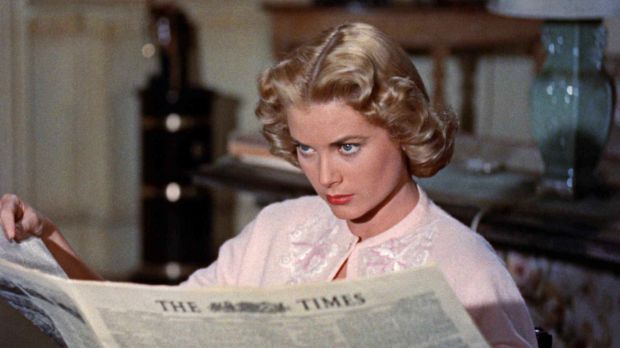
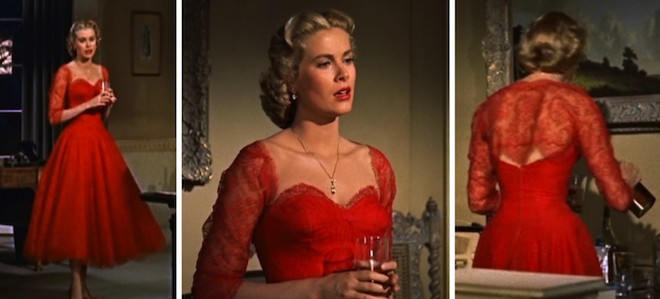
Like Rear Window, Kelly wears some amazing outfits in this movie, by the way. The one that stands out for me is the red dress in the beginning. What a stunner.

I like what the writer on Offscreen said about the dress and the relationship of her outfits to scenes in the movie:

“Hitchcock starts the opening sequence at a breakfast table where Kelly is dressed demurely in a beige dressing gown; she reads a notice about the arrival of her lover on the Queen Mary; the ship arrives in dock; in seconds she is costumed in a red dress, embracing him in the flat where hours earlier she breakfasted with her supposedly unsuspecting husband. They are in the classic London flat but the picture presented is quite different as a result of clever writing, editing and colour coding. It also played on Hitchcock’s private perception of Kelly: he nicknamed her “the snow princess.”

I thought it was interesting that it was Cary Grant who told Hitchcock about the play version of Dial M for Murder, which debuted in 1952. Grant saw himself as the potential wife-killer, something Offscreen.com says Hitchcock always wanted Grant to play. Unfortunately Grant’s agents asked for way too much money so Hitchcock turned to Milland.

As a huge fan of Cary Grant I can honestly say I could see him playing the part Milland played, but Milland pulled it off in more dramatic fashion than I think Cary might have. Sometimes I have trouble seeing Cary in a dramatic role because even when I know he’s trying to be serious I think of his more playful movies and struggle to focus on him being the “bad guy.”

Milland, by the way, had won an Academy Award in 1945 for The Lost Weekend, so Hitchcock felt he was a good second pick.

Hitchcock chose not to change the play when he made the film and was quoted as saying this: “You buy a play for its construction. It’s the construction that makes it a hit. If you change that you’re ruining the very thing you bought. Just shoot the play.”

I thought this was ironic since he did change the endings of films that were based on novels he bought the rights to.

Have you ever seen this one? What did you think of it? Is it among your favorite Alfred Hitchcock films?

I was looking through a list of Alfred Hitchcock films the other day and I realized there are a ton I have never seen. I hope to make a marathon of his movies sometime soon.

I found Dial M For Murder on Tubi, by the way.

You can read Erin’s impression of the movie here:https://crackercrumblife.com/2024/10/24/comfy-cozy-cinema-dial-m-for-murder/

Up next in our Comfy, Cozy Cinema is a Halloween wildcard but Erin and I are both watching Practical Magic if you want to join us.

Here is our complete list of movies that we’ve watched and will be watching.

You can find links to my impressions of the ones we’ve watched so far here.

If you want to link up your own post about this movie, or even other ones, you can do so at this link:

You are invited to the Inlinkz link party!

Click here to enter
https://fresh.inlinkz.com/js/widget/load.js?id=c0efdbe6b4add43dd7ef

Comfy, Cozy Cinema: Ladies in Lavender

Erin from Still Life, With Cracker Crumbs and I are watching Comfy, Cozy movies this September and October and this week we are discussing Ladies in Lavender.

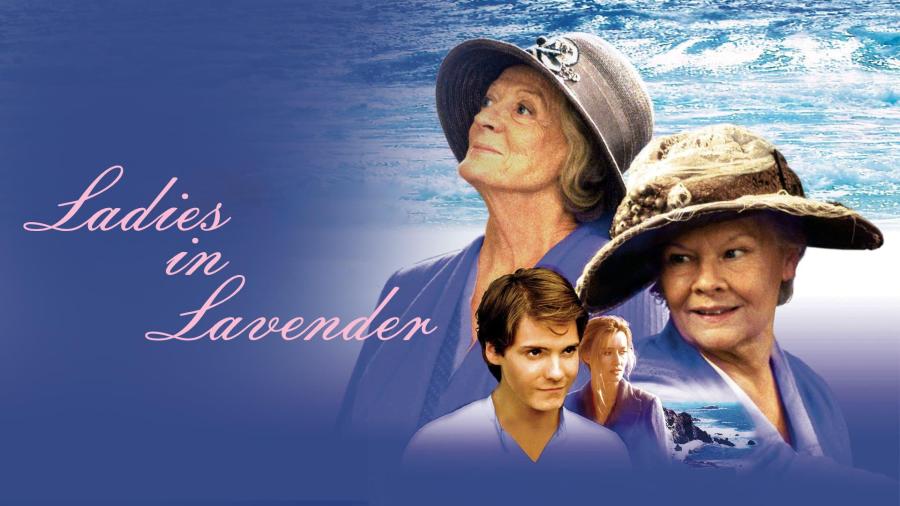
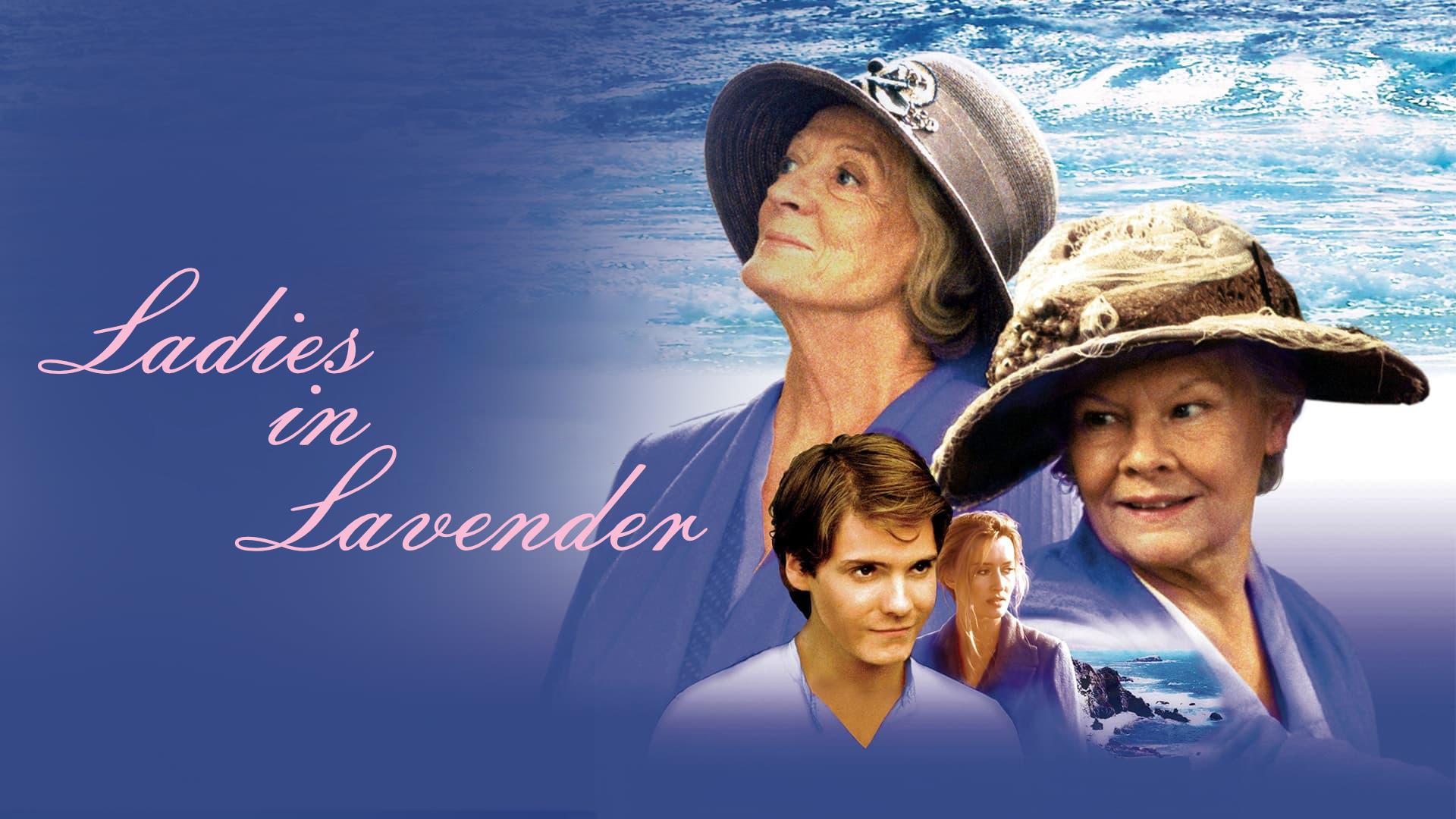
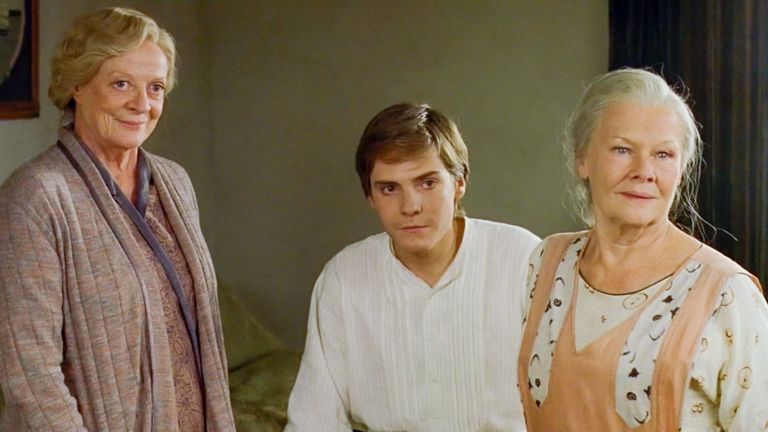
Ladies in Lavender stars Judi Dench and Maggie Smith. It was released in 2004 and was written and directed by Charles Dance, who is also a well-known British actor (Game of Thrones).  It was his directorial debut. The screenplay that Dance wrote, according to information online, is based on a short story by the same name written by William Locke in 1908. I also thought it was interesting to find out that a play based on the movie was later developed.

 I watched it on Amazon Prime for free (with a membership) but it is also free on Peacock, Tubi, the Roku Channel, and PlutoTV.

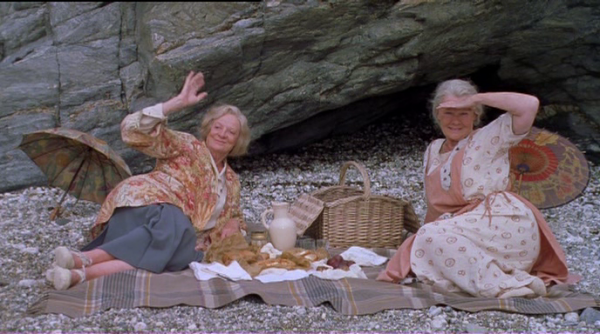
Janet (Maggie Smith) and Ursula Widdington (Judi Dench) are spinster sisters living in a small coastal English town. Their life is pretty slow and mundane from what we can tell at first. They clean and knit and have tea but not much else.

One morning Ursula is looking out her upstairs window when she sees a man on the beach. She and her sister run to him and with the help of the local doctor bring him inside. They believe he’s been washed up from a shipwreck of some sort.

As they nurse him back to health they realize he doesn’t speak English. After some effort they discover he speaks Polish and his name is Andrea (Daniel César Martín Brühl González – A German/Spanish actor who is known to comic book fans as Helmut Zemo/Baron Zemo).

Since this is right before World War II this makes the people in the small town a bit anxious when they learn of where he’s from later on. It doesn’t help that there is also a woman living in the area who speaks German. This puts everyone on edge but at the same time, people begin to like Andrea when he is able to move around.

First, he is nursed back to health by Janet and Ursula and Ursula teaches him some English.

At one point Janet is playing piano downstairs. Andrea has been upstairs recovering and when he hears the music he covers his ears and asks for it to stop. Janet has a book of German and knows a few words so she finds a way to communicate with him and learns he loves music but prefers the violin. So the ladies find the local fiddler player who plays a few tunes for the recovering Andrea. We can tell that Andrea is trying to be polite but that he’s not excited by the man’s inferior performance. He asks if he can play the fiddle and ends up kicking a much more polished and classical version of the folk song out, which tells us he is an accomplished violinist.

I won’t lie – I did worry that this movie was going to go a bit weird at one point because Andrea had to stay with the sisters while he recovered and Ursula became very infatuated with him but it didn’t go where I worried it would.

To explain a bit without giving too much away – Judi Dench’s character becomes enamored with Andrea and though she knows she’s too old for him she sort of imagines what it would like to be younger and be able to fall in love with him.

Both she and her sister really become attached to him but more in a matronly way for Maggie Smith’s character. They both want to take care of him. He brings such happiness and love into their lonely lives. He brightens their otherwise mundane existence and reveals to them experiences they never had – being wives and mothers.

They are afraid he will leave them when they see his talent and they see the German woman, who is also an artist, speaking to him and becoming friends with him.

This is a very artistic movie with beautiful scenery, superb acting, and a sweet story. I wouldn’t say it is the best movie I’ve ever seen as if feels like there was more that could have been done with some of the characters – especially Andrea who I would have liked to know more about in regards to his background and upbringing.

Still, I enjoyed this one and find it a very comfy, cozy watch since the characters are so endearing. The sisters are caring and sweet in their own ways and the housekeeper is very funny. She’s a bit rough on the edges but even she becomes attached to Andrea.

The short story that the movie was based on was first published in Collier’s magazine and later included in a book of other short stories by Locke called Faraway Stories in 1916.

Dance said Smith and Dench were the only ones considered for the roles and if he had not been able to get them, he wouldn’t have made the movie. He asked them when they were in a play together and accepted the offer without even seeing the script.

This was González’s first English-speaking movie. I also thought it was very interesting that he did not play the violin in the movie. Instead, it was the famous violinist Joshua Bell.

I thought it was interesting that we chose this as a comfy, cozy movie for this year and a New York Times critic said of the movie “[Dench and Smith] sink into their roles as comfortably as house cats burrowing into a down quilt on a windswept, rainy night… This amiably far-fetched film… heralds the return of the Comfy Movie…”

To read Erin’s take on the movie, click here:https://crackercrumblife.com/2024/09/26/comfy-cozy-cinema-ladies-in-lavender/

Next up on our Comfy, Cozy Cinema is Kiki’s Delivery Service.

And here is a list of the rest of the movies we are watching through November.

Feel free to link up your own impressions of the movies at our link-ups. The links close at the end of the week but feel free to leave your blog post on future link-ups, even if it is for another movie.

You are invited to the Inlinkz link party!

Click here to enter
https://fresh.inlinkz.com/js/widget/load.js?id=c0efdbe6b4add43dd7ef

Comfy, Cozy Cinema: Somewhere in Time

Erin from Still Life, With Cracker Crumbs and I are watching Comfy, Cozy movies this September and October and this week we are discussing Somewhere in Time.

I am going to warn you that I know this movie is sacred to many, but that I am going to pick a bit here. If you are a fan, take my teasing as affectionate teasing. There were aspects I liked and aspects I just didn’t get.

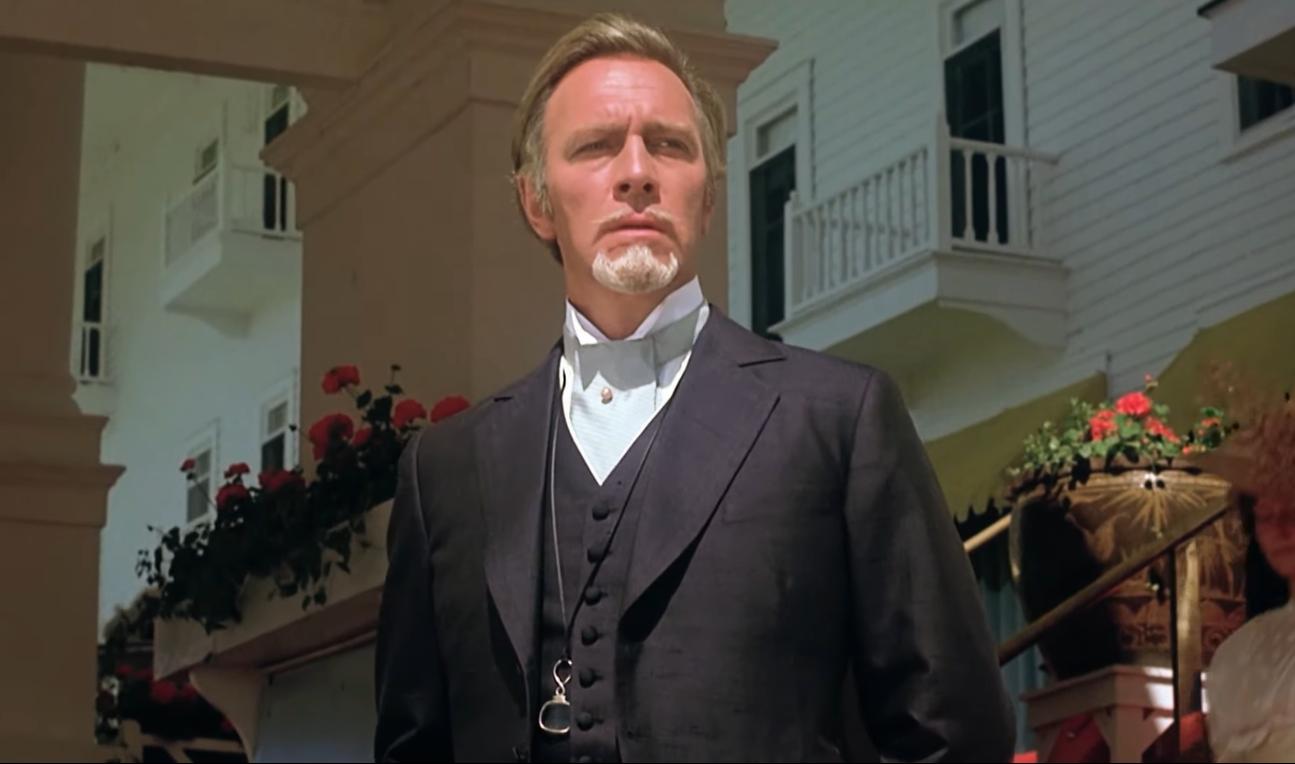
Somewhere in Time was released in 1980 and stars Christopher Reeve, Jane Seymour, and Christopher Plummer. It is based on the book Bid Time Return by science fiction/horror author Richard Matheson who also wrote a few other well known books I Am Legend (1954), What Dreams May Come (1978), Hell House (2008), and The Omega Man (1975). Many of his books were made into movies. He also wrote the screenplay for Somewhere In Time.

The story is about a playwright who travels back in time by merely wishing he can be there.

That’s pretty much the plot of the movie, but I’ll explain further.

Richard Collier is approached by an elderly woman after one of his plays and she hands him a watch and says, “Come back to me,” and then leaves.

It’s a creepy moment, if you ask me, and in real life Richard would have said, “Who was that old lady?” and then thrown the watch out. But this is Hollywood so he holds on to the watch and eight years later when he hits a slump in his career he decides to head to Michigan to take a break from life – because that’s the first place I think to go when I need a break from life. Not Hawaii or the Bahamas but Michigan.

This is a joke Michiganers! Honestly, I’m so jealous when Erin tells me of all the lovely places Michigan has. Sometimes she even sends pictures to rub it in more! *wink* Plus a ton of cozies I read all take place in Michigan. So it is either very lovely or there are a lot of murders there. Either way – much more exciting than Pennsylvania.

Okay, back to Richard. He travels to Michigan and Mackinac Island where he decides to visit The Grand Hotel because as a student at a nearby college he’d always heard about the hotel but had never visited it.

We, the viewer, have already heard of the hotel because this is where the old lady in the beginning of the movie returned to after she gave Richard the watch.

While staying at the hotel Richard becomes enamored with a photo of Elise McKenna (Seymour) who was an actress from the early 1900s. She performed at the hotel in 1912. He begins to research everything he can about her and finds an up to date photo of her in a library book and realizes she’s the woman who gave him the watch.

After visiting a former caretaker/friend of Elise’s, Richard learns Elise died the night she gave him the watch. While visiting the woman he also finds a book on time travel and for some unexplained reason, Richard decides he must find a way to go back in time to meet Elise.

Conveniently, the man who wrote the book about time travel is also in Michigan and tells Richard that to go back in time he must lock himself in a room and remove all distractions that would make him think he was still in modern times. He must instead focus solely on what time period he wants to go to and say over and over he is actually in that time period.

Sigh. Yes. As if the movie already wasn’t a bit cheesy – this is where it turns the ridiculous corner.

There were so many moments in this movie that I am sure were meant to be romantic or moving or suspenseful but all I could do was giggle.

The way the light hits her photo in the beginning of the film like a spotlight from heaven and the cheesy music starts playing – super, super loud? That was one of them.

Then when he’s trying to go back in time he looks like he ate too much shrimp at dinner so he’s having major cramps.

I should add that before he tries to go back in time he buys a suit he thinks fits the time period and then uses a pair of scissors and the hotel room mirror to cut his hair perfectly to fit the time period. Yeah. Okay. Like he could do that all by himself. Ha. But it’s a movie so we will go with it.

Since you already know the movie is called Somewhere in Time you know that he arrives in the past. I won’t say much beyond this other than there was so much more I wanted them to do with the time the couple had together. Like Erin said to me, the pacing of this movie felt off – things were so rushed and squished and sort of discombobulated.

Despite that, I somehow sort of liked the movie. Reeve, Seymour, and Plummer (who plays Elise’s manager/guardian since she was 16. Let us not focus too much on what that means. Ahem. I believe he really was just her guardian) acted well giving great – or at least commendable – performances. I think this was only Reeve’s second movie with his first being Superman.

The concept of the movie was very interesting and it was a lovely location for a movie as well. Much better than San Diego, where the book was set.

You can read Erin’s post to learn more about the location because I’m sure she mentions that she has visited the location a few times since she lives near there.

The book, by the way, had Richard visiting the Hotel del Coronado because he had an inoperable brain tumor and wanted to spend his last days there. It’s while there he sees Elise’s photos and things proceed like the movie in most ways. The only thing is the ending of the book makes more sense than the ending of the movie, in my opinion. I won’t share either ending here but I will say I didn’t like the ending of the movie so I wish Matheson had not changed it for the movie. Not sure why he did.

Incidentally, the book was inspired by a true story – sort of.

According to information I read and watched online, Matheson was traveling with his family when he was entranced by the portrait of American Actress Maude Adams that was hanging in the Piper’s Opera House in Nevada.

“It was such a great photograph,” Matheson said, “that creatively I fell in love with her. What if some guy did the same thing and could go back in time?”

Matheson proceeded to research her life and became fascinated with her being a recluse. To write the novel he stayed at the Hotel Del Coronado for several weeks and dictated what he saw and learned into a tape recorder, personally experiencing himself in the role of Richard Collier. He based most of the biographical information about Elise on Adam’s life and said the books original title came from a line in William Shakespeare’s Richard II: “O call back yesterday, bid time return.”

I am personally glad the name was changed for the movie. It made it much more marketable, even though from what I read about this movie, Universal Pictures did very little to promote it, which may be one reason it wasn’t a huge commercial success.m at the time. It did, however, become a huge cult classic.

Of the book Matheson said: “, “Somewhere in Time is the story of a love which transcends time, What Dreams May Come is the story of a love which transcends death…. I feel that they represent the best writing I have done in the novel form.”

There you go – now you can keep that in mind if you ever choose to read the books, or if you have read them.

If you would like to know more about Maude Adams, by the way, you can visit this Wikipedia page (which can easily be changed and manipulated as we have learned over the years, so also look at legit sources for your facts): https://en.wikipedia.org/wiki/Maude_Adams

While looking for reviews and trivia about this movie I found a hilarious review by movie critic Roger Ebert.

I do not recommend reading this review if Somewhere in Time is a favorite of yours or holds some kind of sentimental value. While the review made me giggle, it is quite harsh. You can find it here: https://www.rogerebert.com/reviews/somewhere-in-time-1980

Erin told me about a Somewhere in Time package you can book at The Grand Hotel and I’ll include that link here without the jokes she and I made about what the package would include since sharing the jokes would include spoilers.

https://www.grandhotel.com/packages/somewhere-in-time-weekend/

While reading about the package I learned that Jane Seymour still visits the hotel often for personal and professional reasons. Sadly, both Plummer and Reeve are no longer with us and can’t visit.

This movie was not a box office success, as I mentioned above, but over the years it has developed a cult following, hence the hotel offering a package in its name and hosting events related to it.

The theme song of Somewhere in Time, in case you are wondering, was not written for the movie like some might think. It is “Rhapsody on a Theme of Paganini” by Sergei Rachmaninoff, written in 1934.

A few more trivia tidbits I found online included:

  • Score creator John Barry’s parents both died shortly before he began to work on the film, making the music that much more emotional. (source TVTropes.com)
  • Christopher Reeve took the role even though it didn’t pay as much as others because he was very touched by the story and script. (source TVTropes.com)
  • The first time Richard sees Elise is also the first time Christopher Reeve saw the picture because the director Jeannot Szwarc wanted his authentic reaction. (source TVTropes.com) (Thank God he looked enamored because otherwise they might have had to edit out his reaction. Not that I can imagine anyone making a disgusted expression when looking at Jane Seymour.)
  • According to Seymour, she and Reeve really did fall in love while filming and they hid the relationship from the cast and crew but that the relationship ended when Reeve found out his ex-girlfriend was pregnant with his child. The two remained close friends and Seymour even named her son after him. (source TVTropes.com)
  • While Christopher Reeve was filming this movie, the local theater decided to show his latest hit Superman (1978). Many of the “Somewhere” cast joined the locals for the event. Early into the screening, the sound went out. Reeve, who was seated next to Jane Seymour, stood up in the audience and delivered all the lines. (source imbd.com)
  • As of 2008, the numbers of Elise McKenna and Richard Collier’s rooms do not exist at the Grand Hotel. However, there is a Somewhere in Time suite. (source imbd.com)

Here is a trailer of Somewhere in Time if you’ve never seen it and think you might want to:

I will add that Roger Ebert suggested another movie that he felt better represented a time travel movie with romance included.

It sounds quite a bit darker to me but here is a preview for Time After Time:

I watched this movie on Amazon but it can be rented from a variety of streaming services, purchased on DVD, and probably found at local libraries.

Erin’s post about the movie can be found here: https://crackercrumblife.com/?p=25718

Next up for our movie-watching pleasure is another pick by me, Ladies in Lavender.

The rest of our schedule can be found here:


Please feel free to join up with us and add your link to our link up each week. You can add it up to a week after we post.

I hope you will join in or at least follow along as we discuss these movies.

You are invited to the Inlinkz link party!

Click here to enter
https://fresh.inlinkz.com/js/widget/load.js?id=c0efdbe6b4add43dd7ef

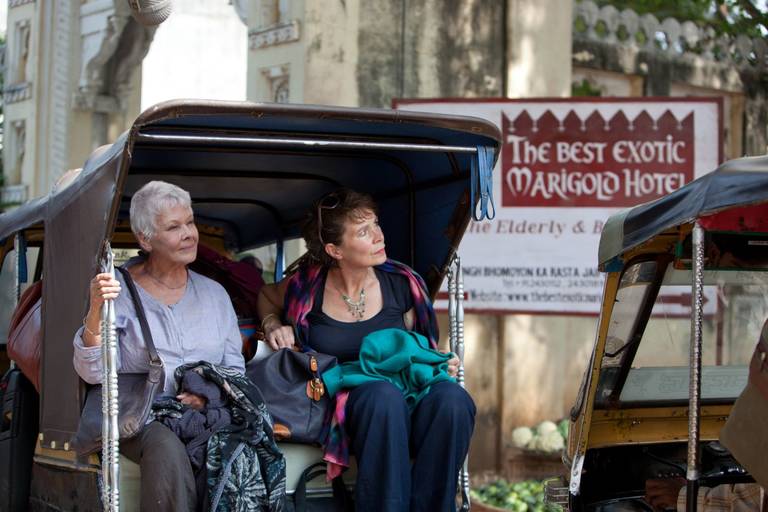
Comfy Cozy Cinema: The Best Exotic Marigold Hotel

Erin from Still Life, With Cracker Crumbs, and I are continuing our Comfy Cozy Cinema this week with our impressions of The Best Exotic Marigold Hotel, a movie based on the book These Foolish Things by Deborah Moggach. It was released in 2011 and directed by John Madden and includes an all star line up.

“We have a saying in India – ‘Everything will be alright in the end so if it is not alright, it is not the end’,”

Sonny Kapoor in The Best Exotic Marigold Hotel

We are watching movies each week and then writing about them on Thursdays on our blogs from September to the end of October. If you want to join in with us, we will have link ups at the end of the posts each week that will be open several days after the posts are published. In other words, you don’t have to post your impressions on the day we do.

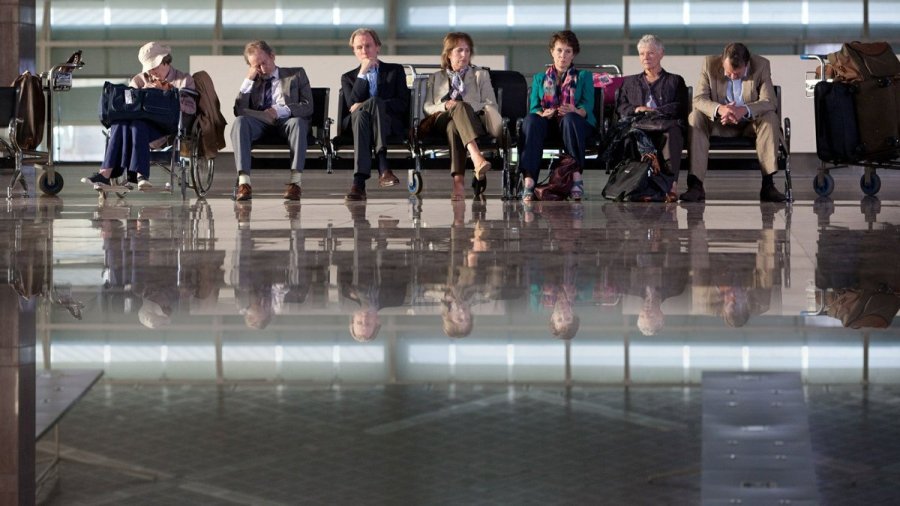
To summarize a bit first, this movie is about a couple and five other people who all see an ad online about a hotel in India where they can move to for a different experience and to save money. The ad boasts that the hotel is exotic and beautiful and recently remodeled.

Sadly, once the residents arrive, they find out the ad was very misleading. Less sadly, the manager is a wonderful young man who means well.

Sonny (Dev Patel) is trying to run the hotel and build it up so he can stand on his own, without the support of his rich mother and brothers who think he’s a screw up like their father apparently was.

Sonny is also dating a young woman (Tina Desai) but wants to have something to show that he is successful before he proposes to her. He is also afraid to tell her he loves her because he feels like he doesn’t have to say it. He has to show it.

I watched this movie several years ago and enjoyed watching it again – this time with a different set of eyes, so to speak.

Confession time – I love Judi Dench in pretty much anything I see her in, honestly. I did not plan on suggesting two movies with her and Maggie Smith together but, well, that’s happened because I love the two together. I actually forgot Maggie was in this one when I picked it, but I love that she was. I wish they had had more time together on screen since they are best friends in real life (hello Tea With The Dames.)

Each character in this movie is facing their own challenge.

We have Judi’s character, Evelyn, who is dealing with the aftermath of the death of her husband who she realizes did everything for her over the years and has left her with nothing and nowhere to go.

There is Jean (Penelope Wilton) and Doug Ainslie (Bill Nighy) who have come to the harsh realization that all the money they thought they had to use in their retirement is gone. They are now being forced to buy a smaller home and travel less, but they hope moving to the hotel will give them the opportunity to do something new and exciting and experience life fresh again. Jean is hoping for more prestige and riches, if we’re honest, and she’s in for a rude awakening.

Celia Imrie is a woman who moves from man to man but feels like because she is getting older that ship has sailed so she decides to head to India to see if she can hook one more rich man.

Norm (Ronald Pickup….that’s  his real name) wants to – ahem – sow his seeds, so to speak, one or several more times with a pretty woman and looks at the trip to India as a chance to do that.

Graham (Tom Wilkinson) is a judge who has burnt out and returns to India to look up an old lover – a man whose life he’s sure he ruined when they had an affair when they were younger. That affair went against the Indian man’s faith and he is certain it ruined the man’s life over the next 40 years. He wants to find him to tell him he still loves him but also apologize.

Muriel (Maggie Smith) needs hip surgery but will have to wait a long time if she stays in England so a doctor offers her the opportunity to travel to India to  have the surgery done quicker. One big problem? She’s a raging racist/bigot. Eek. Of course there is more to her story and we never do exactly understand why she is racist but we do see some redemption.

I believe it is absolutely possible to fall in love with every single character in this film with exception to one but even in that case I could actually understand her.

Jean is a difficult character. She’s nasty, stuck up, and selfish. It might be an unpopular opinion but I feel that she’s also scared. She is absolutely terrified of what her life is going to be like now that she’s older. She thought life would turn out differently than it has and now she is lost and she is frightened and though that isn’t an excuse of how she acts, it is probably why she is so snotty and negative.

She not only makes her husband’s life miserable but ruins the experiences of everyone around her. She sucks the fun out of everything and toward the end of the movie it is clear that she is desperately trying to hang on to the control she has had her entire life, partially thanks to her weak husband. Doug is sweet and excited to experience India, don’t get me wrong, but he should have stood up to his wife long ago.

According to information online, “most of the filming took place in the Indian state of Rajasthan, including the cities of Jaipur and Udaipur. Ravla Khempur, an equestrian hotel which was originally the palace of a tribal chieftain in the village of Khempur, was chosen as the site for the film hotel.”

I always like sharing some trivia about the movies I watch so here are a few from this one:

  • Tom Wilkinson, who plays Graham, is actually married to Diana Hardcastle, who is the woman Norman hits on in the movie.
  • The hotel is actually the Ravla Khempur; a hotel with stables that is located in Khempur in the state of Rajasthan. Built in 1620, it served for centuries as the residence of a series of village chieftains, eventually being converted into a hotel. Due to the success of this film, the place was renamed The Best Exotic Marigold Hotel.
  • Jean Ainslie (Dame Penelope Wilton) reads “Tulip Fever” by Deborah Moggach, on whose novel, “These Foolish Things”, this movie was based. Tulip Fever (2017) was filmed a few years later.
  • The cast includes two Oscar winners: Dame Judi Dench and Dame Maggie Smith; and three Oscar nominees: Tom Wilkinson and Dev Patel and Bill Nighy.
  • Bill Nighy and Hugh Dickson previously worked together in the BBC Radio drama The Lord of the Rings, as Sam and Elrond, respectively. The roles of Bilbo and Aragorn were played by Ian Holm and Robert Stephens, who were formerly married to Penelope Wilton and Maggie Smith.

(trivia sources Imbd.com.)

This is a movie that drew me in from the beginning. I truly wanted to know what happened to each character. I laughed and cried – you know – all the cliché things but I think I understood the movie even more now that I am also getting older.

There is a lot of fear and uncertainty for these “pensioners” as they are called in the UK. They are over the age of 60 and in some cases they’ve never even really experienced life. They have a lot to teach and a lot to learn and we learn right along with them.

My favorite characters are Evelyn and Sonny. We see changes in all of the characters but these two truly transform and connect throughout the movie.

I just saw that there is a sequel to this film that was released in 2015 and I hope to watch that this weekend.

Have you seen this one? What did you think of it?

Here is a copy of our schedule for the next few weeks:

I hope you will join in or at least follow along as we discuss these movies.

You can find Erin’s impression of the movie here: https://crackercrumblife.com/2024/09/12/comfy-cozy-cinema-the-best-exotic-marigold-hotel/

You are invited to the Inlinkz link party!

Click here to enter
https://fresh.inlinkz.com/js/widget/load.js?id=c0efdbe6b4add43dd7ef

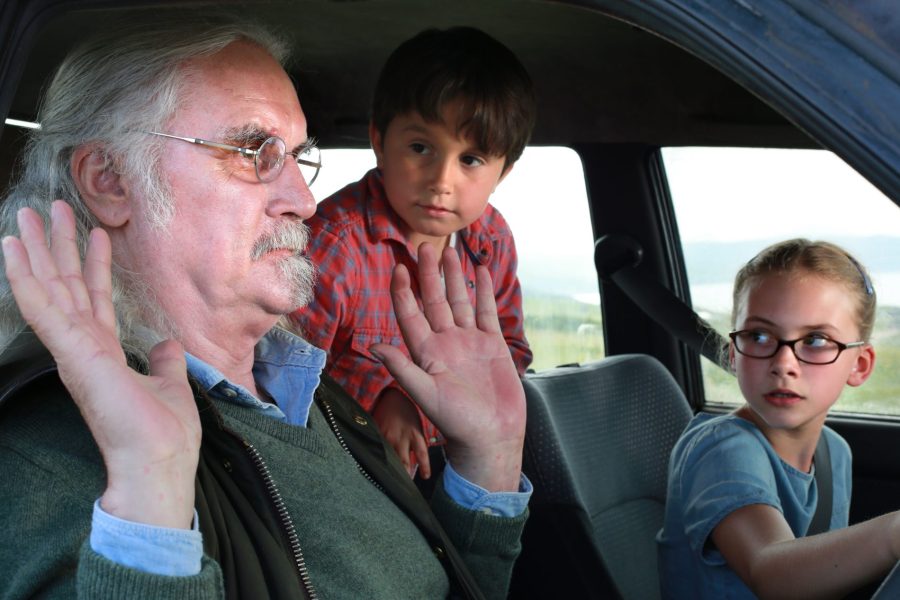
Comfy, Cozy Cinema: What We Did On Our Holiday

Last year Erin from Still Life, With Cracker Crumbs and I watched comfy cozy movies during the fall and we are doing it again this year.

This week we watched What We Did On Our Holiday (2014).

I wasn’t sure what to expect of this one but chose it based on the trailer I saw of it. I thought it would be cozy and fun. I should have read the descriptions better since it is called a “black-comedy.” Oops.

So, it wasn’t exactly what I had hoped it would be, but it was a pretty okay movie, with humor mixed in with …. well…. some disturbing elements. Not like deep, deep dark disturbing – just a bit depressing disturbing. Yet also uplifting. It is hard to explain unless you see the movie. I’m handling this post with care because while I want to share one of the biggest plot twists in the movie, I don’t want to ruin it for anyone who hasn’t seen it.

So let’s keep it simple for now – David Tennant (Doug) and Rosamund Pike’s (Abi) character are getting a divorce but they are also going to visit Doug’s family and don’t want them to know about the divorce. Doug and Abi live in England. Doug’s family is Scottish (David is actually Scottish too so he got to use his normal accent this time). They instruct their young children to keep it on the down-low that Mum and Dad are living in separate houses and have lawyers.

Well, we, of course, know that this is going to go off the rails pretty fast with these precocious, bright children the couple has.

Meanwhile, in Scotland, Doug’s brother, Gavin (Ben Miller), is planning a huge party for their father. He’s inviting all kinds of bigwigs and other family members that no one but him wants there. His wife is inching toward menopause or is just stressed from dealing with him, and is having a hard time controlling her emotions so she’s crying in the kitchen some nights.

Their son seems to be a bit awkward but also might be autistic and he wants to play the music he loves on his violin but his father wants him to study classical music for college.

Oh and Gavin is rich. Very rich. Because he is a financial something or other which sounded like he’s a conman to me.

The kids in this film are – as the British might say – brilliant. They are hilarious and bright and quick witted. Great actors for being so young.

There are two girls and a boy. The youngest (between 4 and 5) reminds me of a mix of my daughter and one of my nieces – mouthy and sharp in the best way.

The oldest daughter (about 10) records all her thoughts in a little journal to try to organize them and deal with the chaos happening around her.

The boy (around 7) lives in fantasy worlds in a way, but he’s also a kid so it’s okay for him to do that.

According to an article I read, the kids were essentially let loose and the adults worked around the things they would said. You can read more about how the kids and the cast grew a bond to make the movie seem more natural here: https://weminoredinfilm.com/2015/10/13/film-review-what-we-did-on-our-holiday-aka-british-kids-say-the-darndest-things/

There is a lot of serious subject matter in this movie but the humor that is woven throughout helps to alleviate that some.

I have to admit there were times I wasn’t sure whether to laugh or cry at the scenes in this movie. I think there was a healthy mix of both, to the point the kids had to check if I was okay.

It isn’t much of a spoiler to say that Grandpa (Billy Connelly) is sick and one reason Doug and Abi don’t want anyone to know they are getting a divorce is that they don’t want to upset Gordie/Grandpa.

There is a huge plot twist in the middle of this one that had me gasping, saying, “oh no. No way,” crying, and then laughing.

I wouldn’t say this is a movie I will watch over and over again because it was tough in a lot of ways – especially since I have parents who are older and dealing with health issues themselves. I would probably watch it again with a family member (not alone like this time) while holding on to my Teddy bear and a box of tissues, though.

When I say a box of tissues, don’t jump to the conclusion that this movie doesn’t offer some hope. It does and that hope is for all of us with dysfunctional families who are trying to figure out what being a “normal” family is.

The kids really make this film – overshadowing Tennant and Pike for me. In fact, they overshadowed all the “big name” actors in the film. I found the adult actors’ performances to be pretty blah in many ways.

This movie sat with me a few days after I watched it and I found myself thinking about some of the scenes and tearing up again.

I definitely felt this film had to have been filmed in Scotland and a quick look online showed that it was actually filmed in – Detroit?!

Ha! Just kidding. It was filmed in Glasgow and the Scottish Highlands in 2013.

‘WHAT WE DID ON OUR HOLIDAYS’

According to Wikipedia, “The beach scenes were filmed at Gairloch. The family home of Gavin McLeod is in Drymen near Loch Lomond. The ostriches farmed by Gordie’s friend Doreen are actually located at Blair Drummond Safari Park.

Have you ever seen this one before? What did you think?

Read Erin’s impressions on her blog here.

Up next for our Comfy, Cozy Cinema is The Best Exotic Marigold Hotel.

If you want to watch this one with us we will be posting our impressions next week.

Here is our full list for the entire Comfy, Cozy Cinema feature this year:


You can read Erin’s impression of the movie here: https://crackercrumblife.com/2024/09/05/comfy-cozy-cinema-what-we-did-on-our-holiday/

Link up here if you’ve written about the movie this week.

You are invited to the Inlinkz link party!

Click here to enter
https://fresh.inlinkz.com/js/widget/load.js?id=c0efdbe6b4add43dd7ef


Summer Movie Marathon: Summertime (1955) with a spoiler

Continuing with my Summer Movie Marathon today I am focusing on the movie Summertime, released in 1955 and starring Katherine Hepburn and Rossano Brazzi and directed by David Lean.

First, a little description of the movie:

Middle-aged Ohio secretary Jane Hudson (Katharine Hepburn) has never found love and has nearly resigned herself to spending the rest of her life alone. But before she does, she uses her savings to finance a summer in romantic Venice, where she finally meets the man of her dreams, the elegant Renato Di Rossi (Rossano Brazzi). But when she learns that her new paramour is leading a double life, she must decide whether her happiness can come at the expense of others.

Summertime isn’t exactly a summer movie in my opinion, other than the fact that Katherine Hepburn travels to Venice in the summer. It could really take place anytime, but it’s called Summertime because Katherine has her first big international adventure and her first big romance on this trip that is in the summer.

Okay, fine, maybe it is a summer movie, but I guess I think of summer movies being on the beach and being a bit silly. This movie is not silly. It is, in fact, quite serious at times. There are funny moments but there are also some big life issues that hit Katherine’s character, Jane.

Jane is a lonely woman who can’t seem to fit in. She’s a little odd by some standards, though I love her character – except when she flies off the handle at this one small thing in the movie and is all over dramatic at other times.

She likes to read and take photos and film little movies on her reel-to-reel camera and doesn’t believe she could ever be loved. (She sort of sounds like me.)

At first I found Katherine’s way of acting in this part grating. I wondered why they picked her for this role, but the more I watched, the more I got it. Yes, she is a bit grating in the way she talks and handles herself but that is how the character is. She’s abrasive and bold and overly excited and also suspicious of others who seem interested in her romantically.

In this case she ends up being correct to suspect Renato De Rossi and here is where spoilers will come in so if you haven’t seen the movie and want to, you might want to stay clear of the following paragraphs.

Jane meets Renato in one of the sexiest scenes I have ever seen in a movie. No, there is no sex or nudity or crude language. The actor who plays Renato simply looks at Katherine Hepburn in a way I could only dream of being looked at. The resolution on this clip is not great but this is the look:

Brazzi absolutely oozes sex appeal throughout this whole movie – from the first moment he checks her out, his gaze gliding down her legs and back up to the back of her neck while she films the scenes around her.

Jane is embarrassed by his attention and decides to leave the restaurant but a couple of days later she’s face to face with him when she wants to buy a goblet for sale in his antique shop. He is thrilled to see her again because he could not stop checking her out at the restaurant. He asks where she is staying and the next day he shows up and wants to take her out on the town.

But, back to Jane being suspicious – she has every right to be. Renato is not who he says he is. I mean, he is attentive and passionate and romantic and very possibly in love with her but he isn’t exactly unencumbered, shall we say. He has a family – not just nieces and nephews like he eludes to but a wife and children. The wife, he claims, is living somewhere else, by her choice. She’s fine with him seeing others because she’s doing the same. That’s how Italians are, he claims. Maybe they are, but that isn’t who or how Jane is.

Still, she is drawn to Renato and can’t seem to let him go and…well,  you will have to watch the movie to know what happens, but I will say there was one scene that suggested….okay. Again. You will have to watch it.

I love the scenery in this movie. It was shot on location in 1954 and it is gorgeous. The film had a budget of $1.1 million and was one of the first British-produced films to be shot entirely on location.

According to the site Luca’s Italy, (https://lucasitaly.com/2017/11/30/venice-in-the-movies-summertime-1955/) “Most of Summertime was filmed in and around the Piazza di San Marco and Campo San Barnaba, where Brazzi’s shop was located. The building is still a shop, but today sells toys rather than red Murano glass goblets, but curiously, never seems to be open.”

The blog post also states, “The Pensione Fiorini, where Hepburn stays, is now the stunningly named Splendid Hotel on Rio dei Bareteri.”

If you would like to read more about the movie here are a couple of reviews:

https://www.criterion.com/current/posts/32-summertime

https://www.criterion.com/films/368-summertime

http://thefilmexperience.net/blog/2014/7/16/a-year-with-kate-summertime-1955.html

https://lwlies.com/articles/summertime-katharine-hepburn-performance/

I watched this movie on Amazon but I do see it is free on YouTube. I can’t vouch for the quality:


I had to switch things up for my next movie because I couldn’t find Having A Wonderful Time streaming anywhere. I also decided not to watch Clambake because I tried to watch it and I couldn’t push through. Plus, if I had watched Clambake and written about it, I would have run into the Comfy, Cozy Cinema that Erin from Still Life, With Cracker Crumbs and I are planning and going to start September 5.

If you are interested in joining in, Erin has designed some wonderful graphics again this year and you can see the list below:

Next week I am going to write about Summer Magic with Hayley Mills to wrap up my Summer Movie Marathon.

So far I’ve written about the following movies:

Gidget

Beach Blanket Bingo

Mr. Hobbs Takes A Vacation