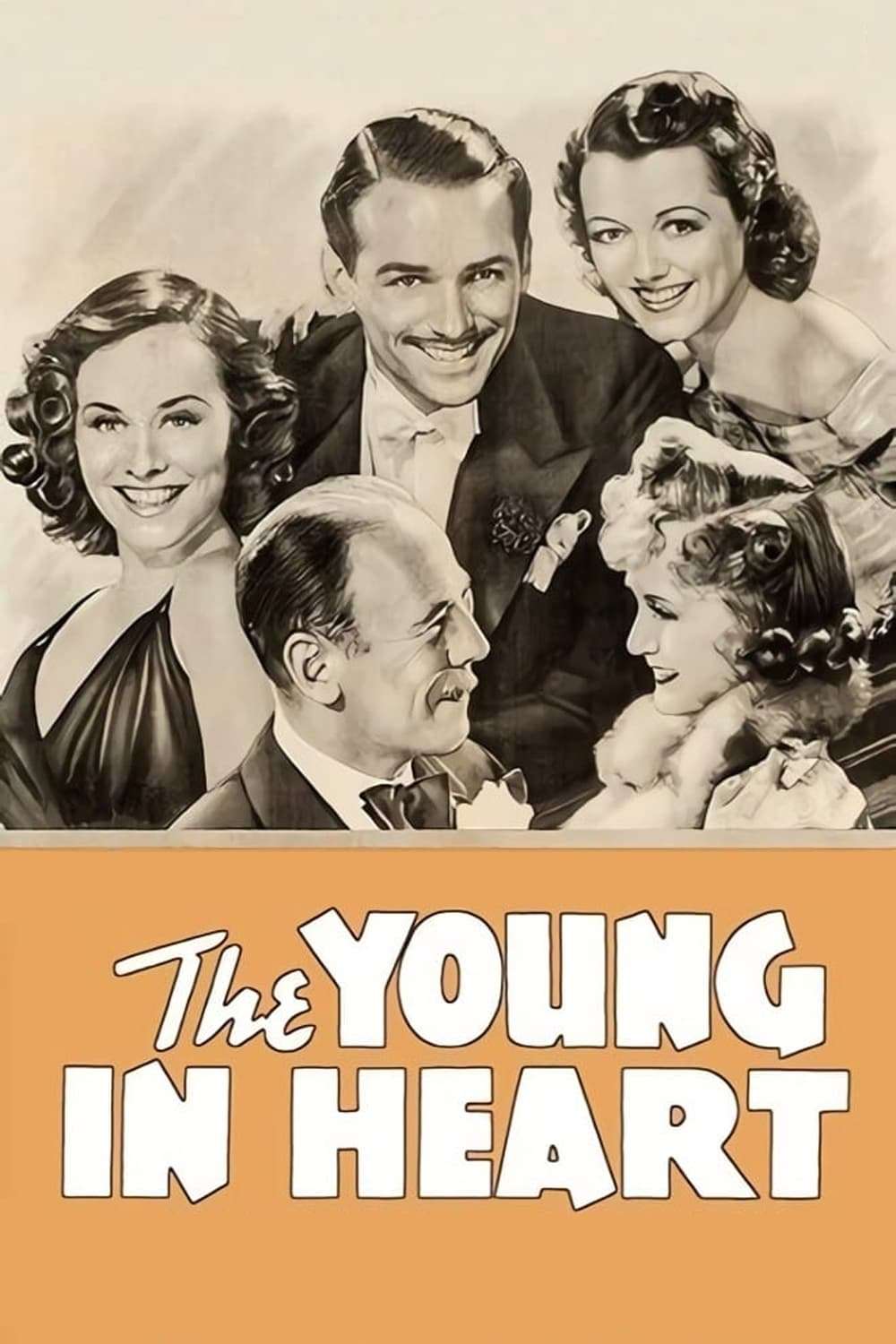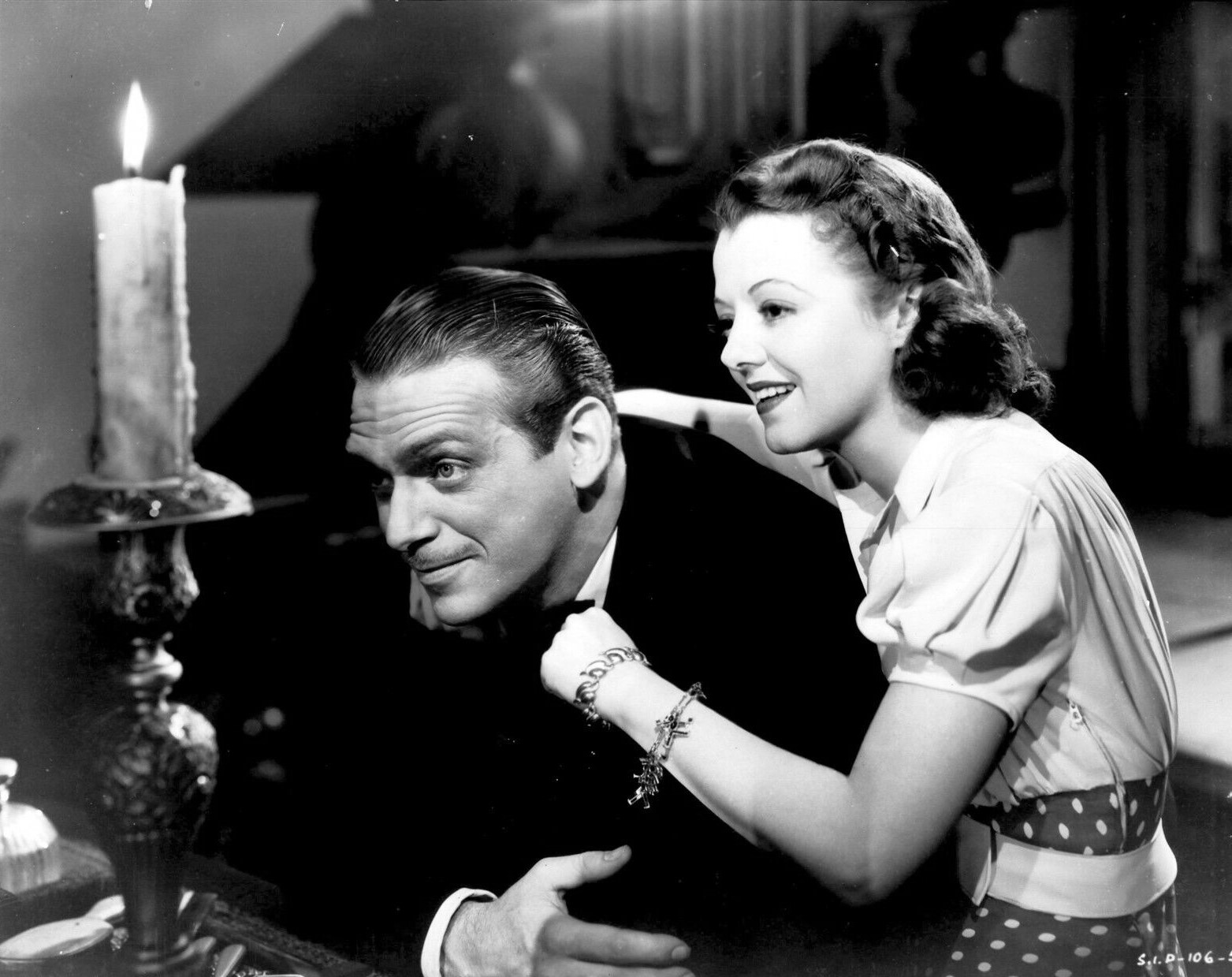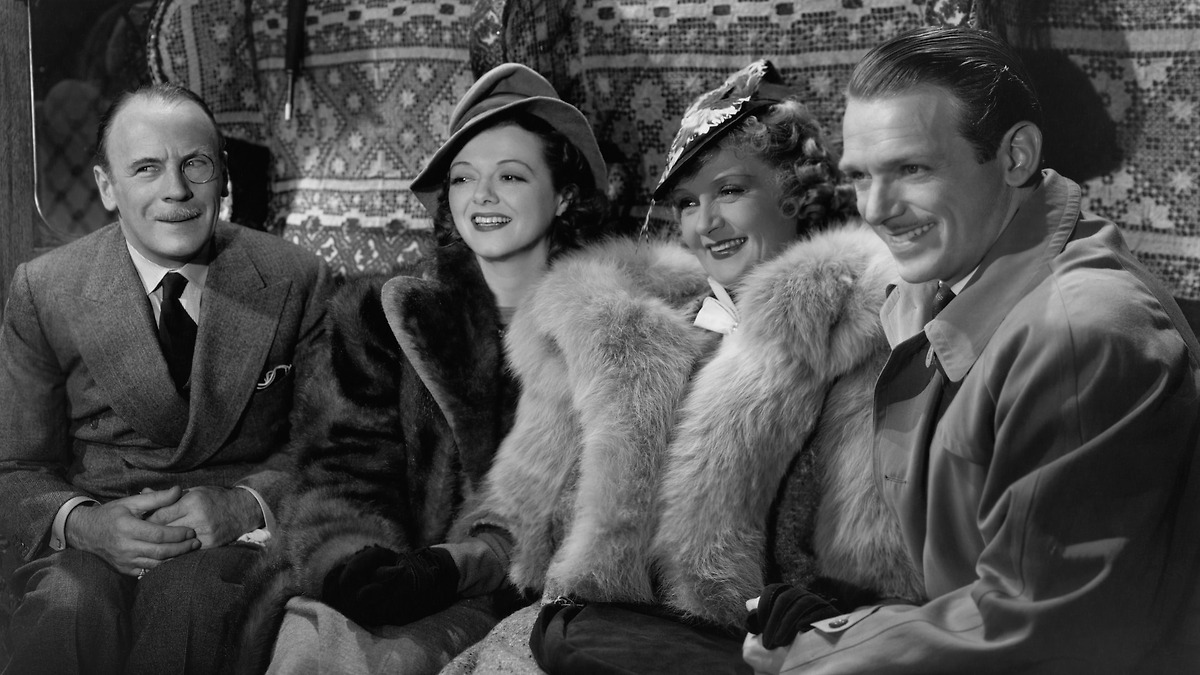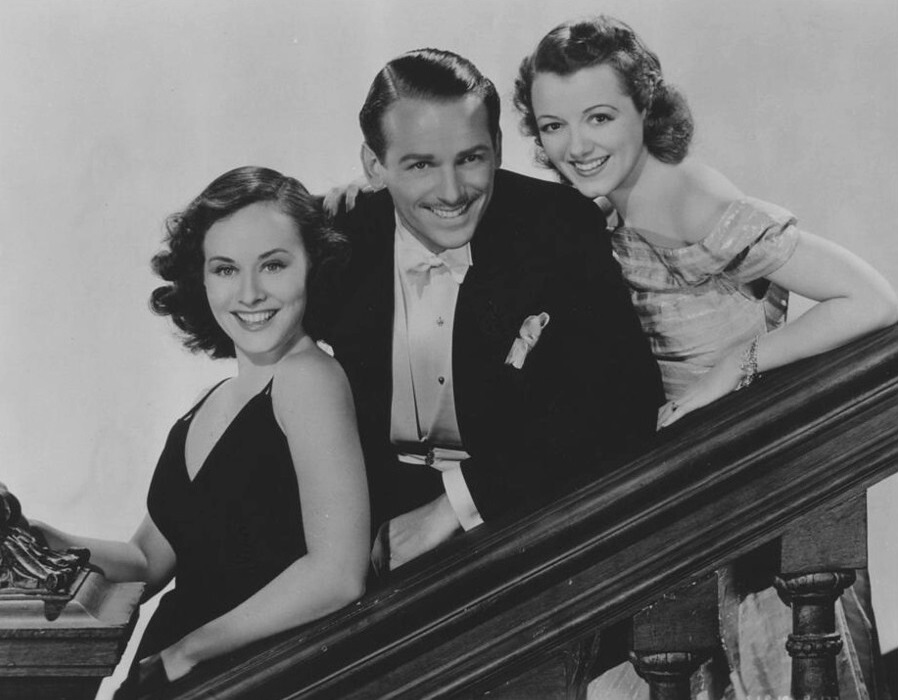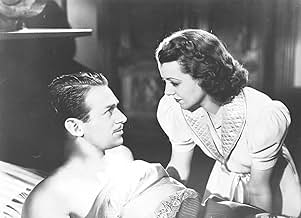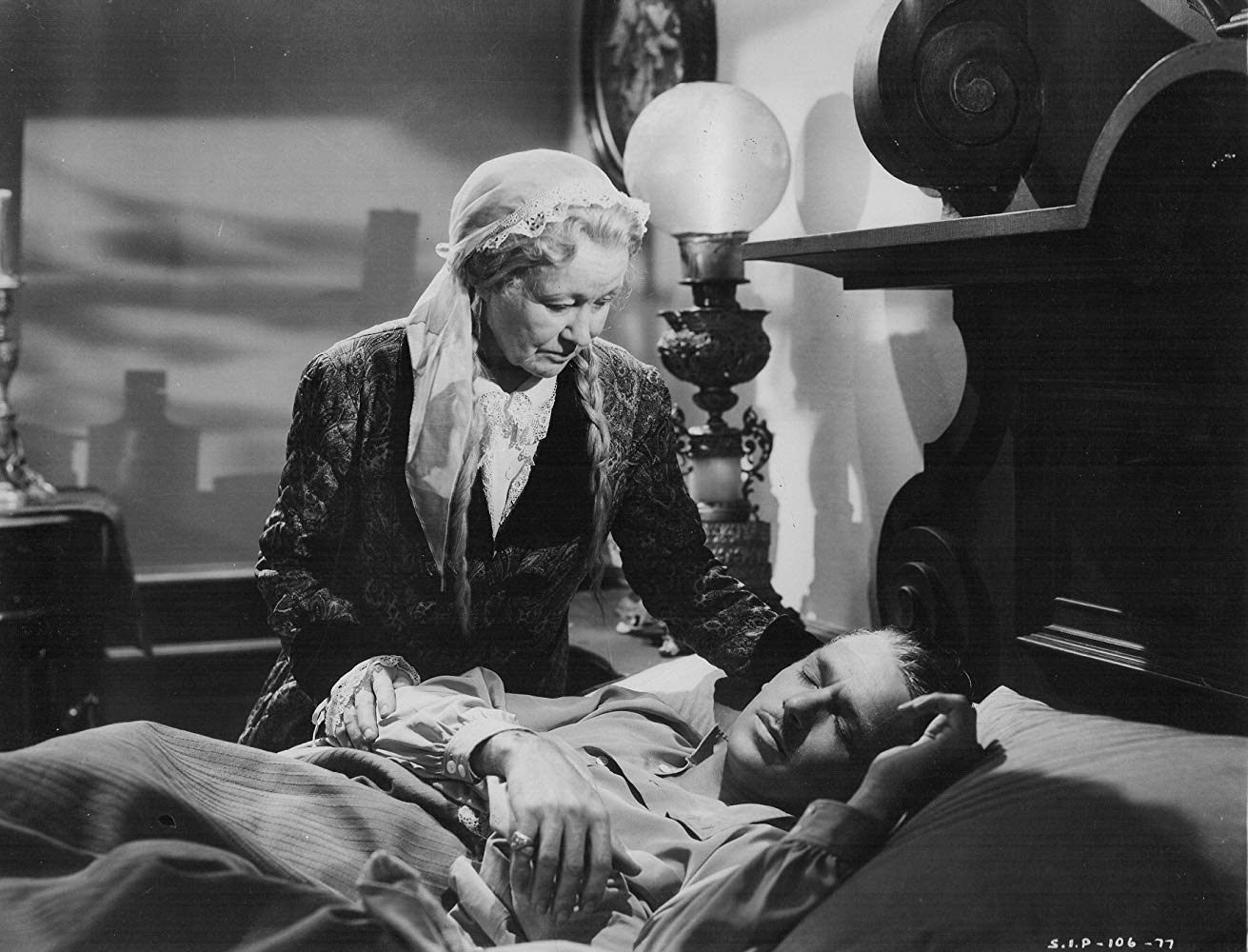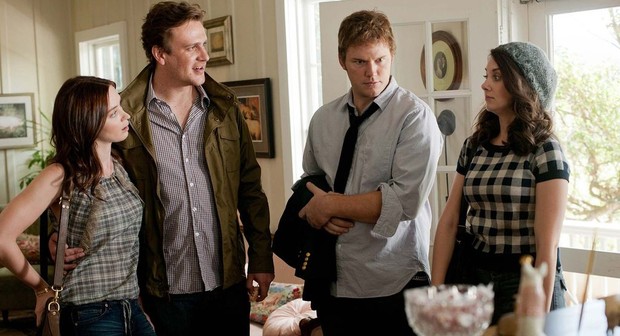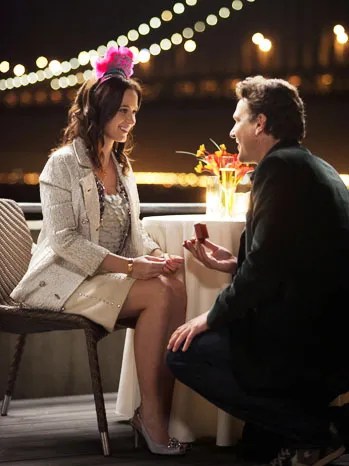
I was surprised this past weekend to find a ton of classic movies for free on Tubi so I thought I’d share some of the better classic (before 1970) movies with my blog readers today. I have watched these and really enjoyed them! I’ll have a part two for this one down the road sometime.
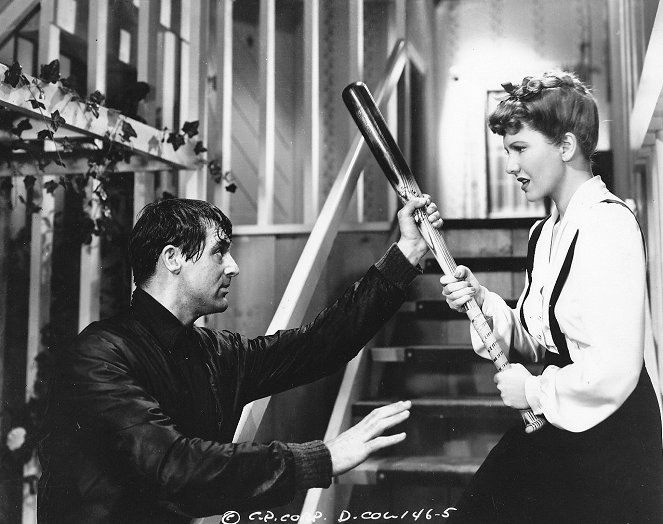
Talk of the Town
Leopold Dilg (Cary Grant), who was wrongfully convicted of arson, manages to escape from prison. While on the lam, he finds the home of Nora Shelley (Jean Arthur), an old friend from school for whom he harbors a secret affection. Nora believes in Dilg’s innocence and lets him pose as her landscaper; meanwhile, Professor Lightcap (Ronald Colman), a legal expert, has just begun renting a room in Nora’s home. Lightcap, like Dilg, also has eyes for Nora, leading to a series of comic misadventures.
My Man Godfrey
Fifth Avenue socialite Irene Bullock needs a forgotten man to win a scavenger hunt, and no one fits that description more than Godfrey Park, who resides in a dump by the East River. Irene hires Godfrey as a servant for her riotously unhinged family, to the chagrin of her spoiled sister, Cornelia, who tries her best to get Godfrey fired. As Irene falls for her new butler, Godfrey turns the tables and teaches the frivolous Bullocks a lesson or two.
The Philadelphia Story
This classic romantic comedy focuses on Tracy Lord (Katharine Hepburn), a Philadelphia socialite who has split from her husband, C.K. Dexter Haven (Cary Grant), due both to his drinking and to her overly demanding nature. As Tracy prepares to wed the wealthy George Kittredge (John Howard), she crosses paths with both Dexter and prying reporter Macaulay Connor (James Stewart). Unclear about her feelings for all three men, Tracy must decide whom she truly loves.
The Third Man
Set in postwar Vienna, Austria, “The Third Man” stars Joseph Cotten as Holly Martins, a writer of pulp Westerns, who arrives penniless as a guest of his childhood chum Harry Lime (Orson Welles), only to find him dead. Martins develops a conspiracy theory after learning of a “third man” present at the time of Harry’s death, running into interference from British officer Maj. Calloway (Trevor Howard) and falling head-over-heels for Harry’s grief-stricken lover, Anna (Alida Valli).
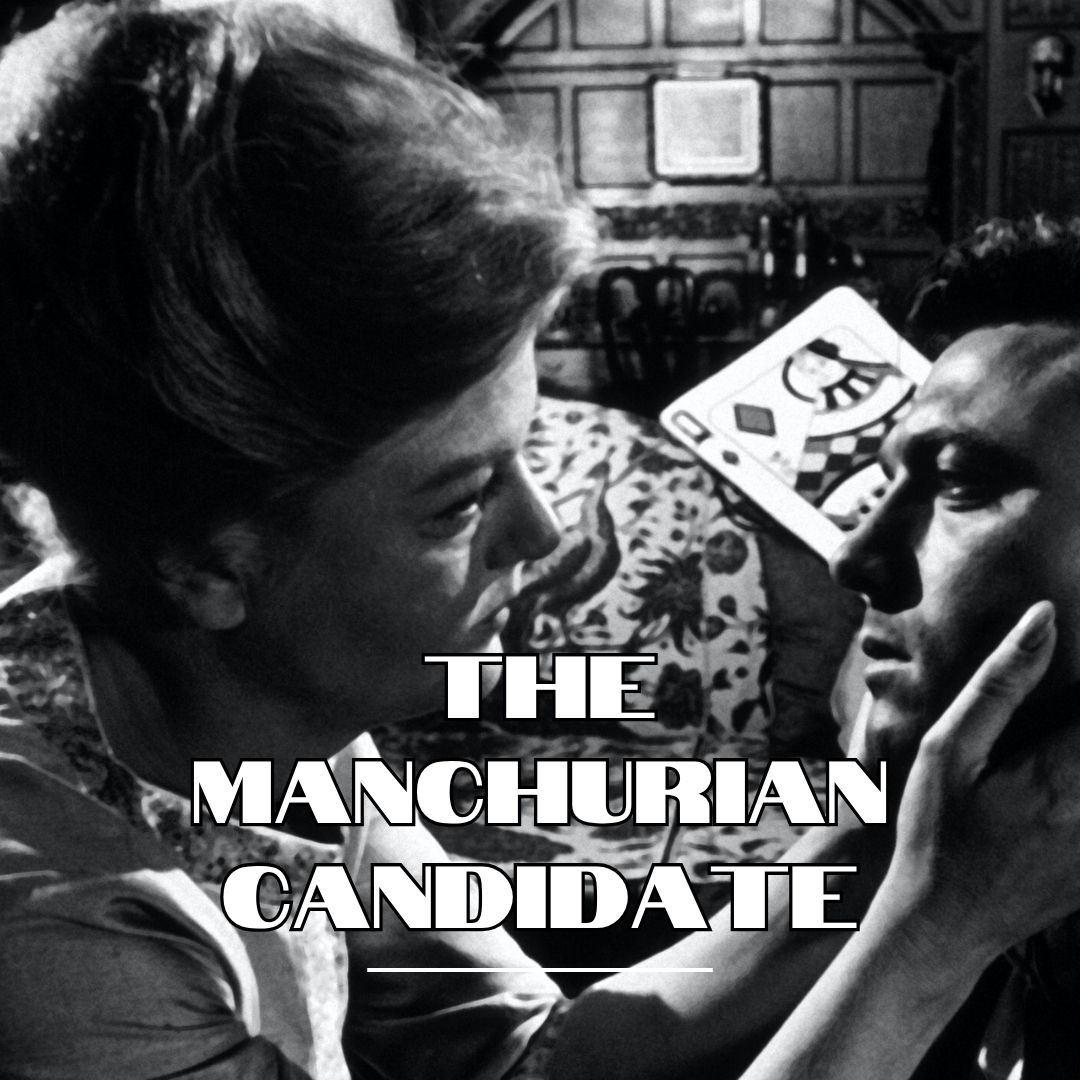
The Manchurian Candidate
Near the end of the Korean War, a platoon of U.S. soldiers is captured by communists and brainwashed. Following the war, the platoon is returned home, and Sergeant Raymond Shaw (Laurence Harvey) is lauded as a hero by the rest of his platoon. However, the platoon commander, Captain Bennett Marco (Frank Sinatra), finds himself plagued by strange nightmares and, together with fellow soldier Allen Melvin (James Edwards), races to uncover a terrible plot.
Merrily We Live
The wealthy Kilbourne family is tired of Mrs. Kilbourne (Billie Burke) hiring ex-convicts as servants. After a servant steals the family’s silver, Mrs. Kilbourne agrees to never hire another drifter for help. But when a rough-looking man named Rawlins (Brian Aherne) arrives at her doorstep, she cannot help but hire him as the new chauffeur. As Rawlins catches the eye of their oldest daughter, Jerry (Constance Bennett), the Kilbournes realize that he may not be the vagrant he claims to be.
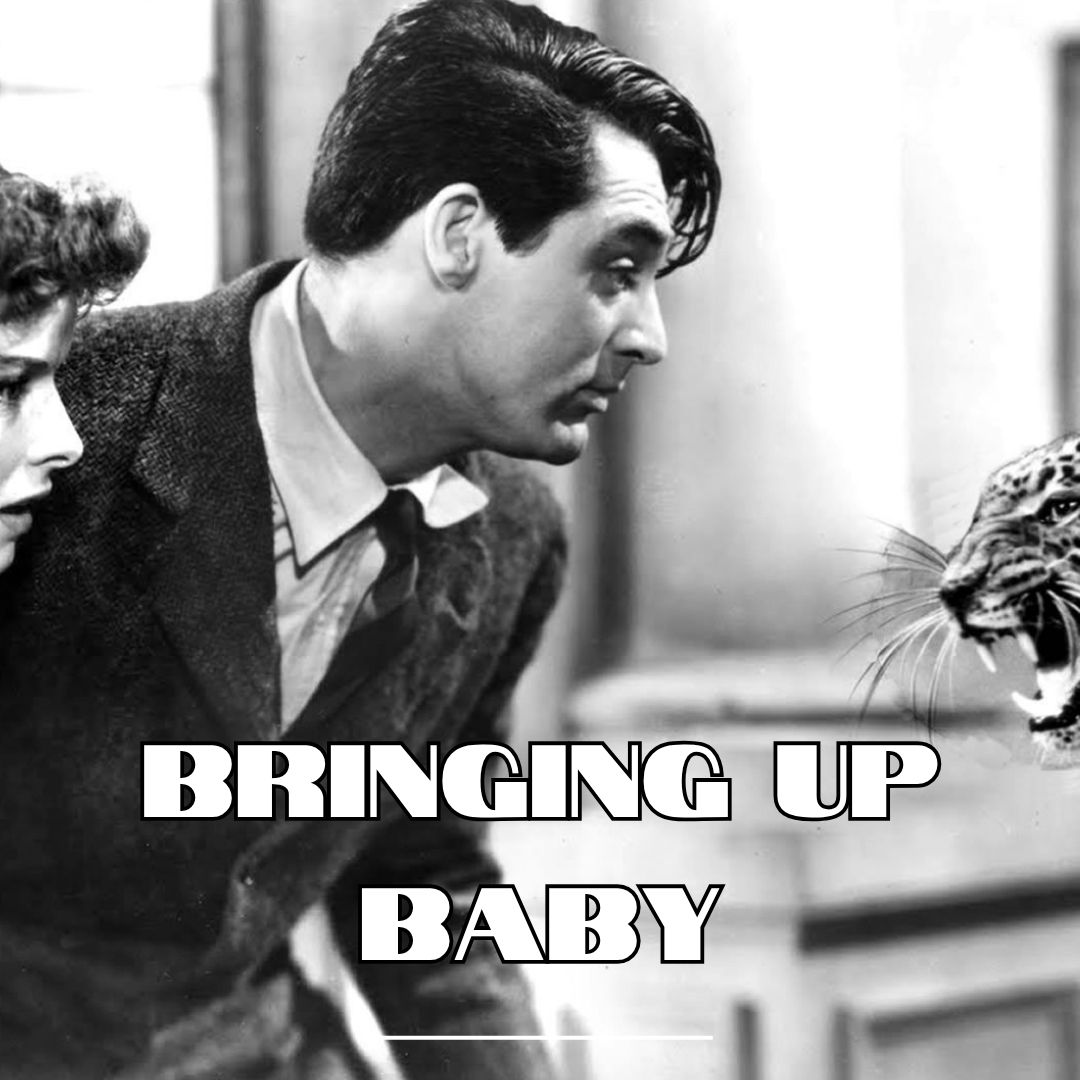
Bringing Up Baby
Harried paleontologist David Huxley (Cary Grant) has to make a good impression on society matron Mrs. Random (May Robson), who is considering donating one million dollars to his museum. On the day before his wedding, Huxley meets Mrs. Random’s high-spirited young niece, Susan Vance (Katharine Hepburn), a madcap adventuress who immediately falls for the straitlaced scientist. The ever-growing chaos — including a missing dinosaur bone and a pet leopard — threatens to swallow him whole.
Without Reservations
Famous author “Kit” Masterson (Claudette Colbert) needs an actor to portray the lead character, a soldier, in the upcoming movie version of her book. While on a train to California, she meets Marine Rusty Thomas (John Wayne) and his friend, Dink (Don DeFore). She begins to imagine the macho Rusty as the lead, and attempts to stay in his company. However, since Rusty did not like her book, Kit must conceal her identity, all the while growing more attracted to her potential actor.
It Happened One Night
In Frank Capra’s acclaimed romantic comedy, spoiled heiress Ellie Andrews (Claudette Colbert) impetuously marries the scheming King Westley, leading her tycoon father (Walter Connolly) to spirit her away on his yacht. After jumping ship, Ellie falls in with cynical newspaper reporter Peter Warne (Clark Gable), who offers to help her reunite with her new husband in exchange for an exclusive story. But during their travels, the reporter finds himself falling for the feisty young heiress.
A Woman of Distinction
Reserved college dean Susan Middlecott (Rosalind Russell) is all business and can’t be bothered with love. However, when Susan meets charming British astronomy professor Alec Stevenson (Ray Milland), it seems that romance could be in the air. Though she resists being paired with Alec, things don’t go as planned — particularly when a publicity agent and even Susan’s amiable father (Edmund Gwenn) get involved. Soon, Susan may just be in love, whether she likes it or not.
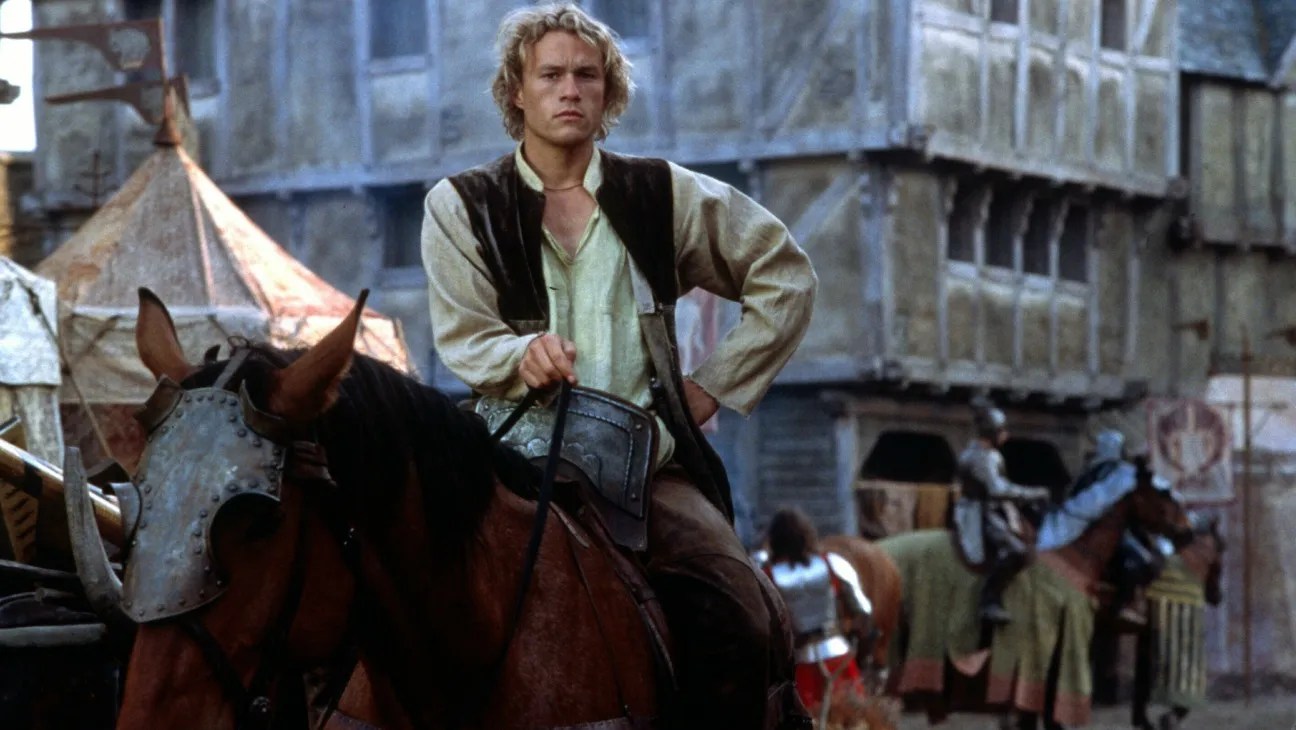
Erin from Still Life, With Cracker Crumbs and I are hosting Comfy, Cozy Cinema again this year and up this week is A Knight’s Tale.
I remember watching this one shortly after it came out but not in the theater. It’s a fun one that I’ve watched more than once over the years.
I was not in the group of girls who fawned all over Heath Ledger when he was popular (and alive..his death was so sad) because I wasn’t into popular culture at the time. I was a nerd, I don’t know what to say.
I really didn’t discover Heath until he passed away.
Regardless, I enjoyed watching Heath when I finally watched this movie.
It should be noted, too, that Heath was actually not well-known when this movie was made. His breakout role was The Patriot and that had not yet been released when he was hired for A Knight’s Tale. Lucky for the director of A Knight’s Tale, Brian Hedgeland, and everyone else involved, The Patriot was hugely successful and made A Knight’s Tale more marketable once the movie when to DVD sales. It was through DVD sales that the movie made more money.
Okay, but let’s go back a bit and talk a bit about the plot of the movie for those who aren’t familiar with it.
Here is a Google description: Peasant-born William Thatcher (Heath Ledger) begins a quest to change his stars, win the heart of an exceedingly fair maiden (Shanynn Sossamon) and rock his medieval world. With the help of friends (Mark Addy, Paul Bettany, Alan Tudyk), he faces the ultimate test of medieval gallantry — tournament jousting — and tries to discover if he has the mettle to become a legend.
I read a review that called this movie whimsical and I think that is a good description.
It is full of adventure and fun and is just a perfect escape. The movie blends modern music with a story set in the medieval times.
We start with William being an assistant to a knight who, tragically, dies. William decides to become him so he can finish the tournament and he and the other serfs can get the money.
From there they decide to continue the ruse, training hard to make Will an actual jousting knight. Along the way they meet a young Geoffrey Chaucer (the writer) who is destitute and agrees to forge a patent of nobility so Wil can enter under the name Sir Ulrich von Liechtenstein from Gelderland. Chaucer has a lot of problems, though, the main one being his gambling problem, which leads William to be brought before Simon the Summoner and Peter the Pardoner who demands payment from Chaucer. Will then demands Chaucer be released and promises payment.
Will’s armor is damaged and he must go to Kate, a female blacksmith, to repair it and she agrees to do so without payment. She is pulled into their circle of friends.
Will is also delighted to find that Jocelyn, a local noblewoman, is watching. He is infatuated with her and will spend most of the movie trying to get her attention.
There will be more jousting as William travels to the World Championships and those scenes are quite fun and exciting. There is, of course, a “bad guy” — Count Adhemar of Anjou portrayed by Rufus Sewell.
I love the mix of modern or semi-modern music with the medieval time period in this movie. Bettany is fantastic as Chaucer and Alan Tudyk is just always awesome and hilarious. If you want to know more about what he’s been in you can check him out on IMdb. You won’t even believe all the voices he’s done and movies he’s been in.
One of the more famous lines from this movie is “You have been weighed, you have been measured, and you have been found wanting.” You may have heard this before over the years since this movie, while it didn’t make a ton of money at the box office compared to some, became a cult classic of sorts. The movie did make $117 million after being made for $65 million so I don’t think that is too bad.
Trivia:
“The movie was filmed in the Czech Republic, mainly in Prague. When Chaucer first introduces “Sir Ulrich” in his speech, the crowd doesn’t react at first because the Czech extras didn’t understand it. Mark Addy‘s loud prompt tipped them off to start cheering. The awkward moment was left in because it made the scene funnier.”
“Plenty of effort was expended creating lances that would splinter convincingly without taking out the stunt riders as well. The body of each lance was scored so it would break easily, and the tips were made of balsa wood. Each was also hollowed out, and the hole filled with balsa chips and uncooked linguine to make convincing splinters.”
Paul Bettany’s nude scene was shot on his very first day in front of a crowd of extras.
There was a period of about a year in Geoffrey Chaucer’s life when historians have no records of what happened to him. This film is supposed to be set in that year.
The first scene of two knights jousting is actually footage of an accident involving Heath Ledger’s stunt double. While filming a later scene, the opponent’s lance moved off target. The stunt double was hit in the head, and fell to the ground unconscious. The entire scene was used for the introduction.
“Heath Ledger knocked out one of director Brian Helgeland’s front teeth with a broomstick when the two were demonstrating a jousting move. It was several months before Helgeland’s mouth had healed enough to repair the damage. He says it was the only jousting injury during filming.”
“Several of the named knights were, in fact, real, though many of them are from different time periods. Ulrich von Lichtenstein was a knight and author who was said to have invented the concept of chivalry and courtly love. He boasted that he would give a golden ring to any knight who could break a lance on his armour, giving away 271 in total, but remaining undefeated. Piers Courtenay was a descendant of Edward I, born in the 15th Century. Sir Thomas Colville was a knight from the 13th Century. Roger Mortimer was the name of several related noblemen in 13th- and 14-century England. One was the lover of King Edward II’s wife – Isabella of France – and was hanged, drawn, and quartered by the Black Prince’s father, King Edward III, for his complicity in Edward II’s death.”
This past weekend I watched the movie The Talk of the Town with Cary Grant, Jean Arthur, and Ronald Colman. I found this movie, among many other good ones, free on Tubi. It is also currently free on YouTube.
I had seen it before as a suggested move but ignored it, thinking it was a drama. After watching it, I asked myself, “What took me so long to watch this one?!”
I loved this movie and while I always love Cary Grant, I once again loved Ronald Colman who I first saw in The Prisoner of Zenda earlier this year.
This movie starts with a fire at a factory where a man dies. Cary, portraying Leopold Dilg, is arrested for arson and murder.
Soon he’s breaking out of jail and escaping through the woods on a rainy night. He makes his way in the dark toward a small house while dogs hunt him down. The name of the house is Sweetbrook and there is a woman inside getting it ready — maybe for a guest.
Leopold breaks in the door, startling the woman.
“Miss Shelley,” he says. “Please…let me…” And then he faints and falls down the stairs.
Miss Shelley wakes him up with a bucket full of water and he asks if she can stay at the house, which he knows is a rental. She tells him he can’t stay because she knows he has escaped jail. There is a knock on the door before she can finish explaining and she tells him to run upstairs and hide.
There is a Professor Michael Lightcap at the door and he’s standing in the rain. He reminds her that he’s rented the house out and he’s here to stay. Miss Shelley, whose first name is Nora, panics because Leopold is hiding upstairs and she doesn’t want the professor to find him.
Things will get more complicated as she makes up an excuse to stay in the house overnight to make sure the professor doesn’t find Leopold.
Complications just keep arising as Nora offers to become the professor’s secretary and housekeeper during his stay, a senator arrives to tell Professor Lightcap he’s up for nomination to the United States Supreme Court, and Leopold walks down one morning to argue about the role of the law in society and Nora has to introduce him as the gardener.
This is a non-stop movie full of hilarious mix-ups, near misses, and a love-triangle that won’t be resolved until the very last minute, literally, of the movie.
As I said above, I loved this movie.
It was engaging, funny, witty, and captivating. Mixed in all the lighthearted moments were a few philosophical moments about law and justice.
Jean Arthur was delightful as Nora Shelley, always quickly rescuing the day just at the last moment, taking care of both Leopold and the professor.
Ronald Colman pulled off the staunch, uptight professor well and it was fun to see him “let down his hair” a bit later in the film. He didn’t let down his hair. It’s just a saying, of course.
Cary walked the line between an aggressive rebel and a falsely accused victim, putting his usual romantic charm on the backburner for most of the film and bringing it out in more subtle moments. This was a movie where he wasn’t a pursuing a woman as much as he was his own freedom and justice.
I spent much of the last half of the movie wondering which one of the men Nora was actually falling for and I think she was doing the same thing. She’d gathered affection for both of them but wasn’t sure if either of them had for her.
This movie was nominated for seven Oscars but it was about the same time that America started the war so more “patriotic” movies got the nod that year. Ironically the best picture went to Mrs. Minier, which was set in England, however.
According to TCM, even without the wins, The Talk of the Town “still marked an important moment in the careers of its stars Cary Grant and Ronald Colman.”
For Cary, it was a new movie after not working for a year and he was nominated for an Oscar as well. He didn’t win the Oscar but he did have his name legally changed his name from Archibald Alexander Leach, became an American citizen and married heiress Barbara Hutton.
Colman was 51 at the time and needed a spark to reinvent his career. The Talk of the Town worked and he went on to star in Random Harvest, which earned him another Oscar nomination. He lost that to James Cagney in Yankee Doodle Dandy, but still kept him at a high point in his career. Films such as Kismet (1944) and Champagne for Caesar (1950). He also finally earned his Oscar for portraying the delusional Shakespearean actor in A Double Life (1947).
I found it interesting to read that there was tension between Grant and Colman since both were used to being the lead actor and that tension was written into the script as they aggressively bantered back and forth with each other.
I also was fascinated to learn that two endings were filmed — one with Jean Arthur choosing Cary and the other with Colman. The director allowed the preview audiences to choose who she ended up with.
Trivia:
filming was to begin on January 17, 1942, the day Hollywood learned the sad news of Carole Lombard’s death in a plane crash. Stevens halted work on the set and sent both cast and crew home.
Screenwriter Sidney Buchman (who co-wrote the script with Irwin Shaw) was blacklisted in the 1950s. Consequently, Buchman, one of the men who penned Mr. Smith Goes to Washington (1939), left the U.S. and began working in Fox’s European division. Buchman would remain in France until his death in 1975.
When the professor is unconscious on the floor, Tilney (Rex Ingram) asks Sam if he is a doctor. Ironically, Rex Ingram was himself a trained physician in real life.
Cary Grant and Ronald Colman were both paid at least $100,000 for their work in the film. Jean Arthur, who was in Harry Cohn’s doghouse and just coming off suspension, was only paid $50,000.
Whilst many characters find Leopold Dilg’s penchant for adding an egg to his borscht unique (so much so that it becomes a means of determining his whereabouts), it was not an uncommon practice to add an egg to borscht in Poland and in Mennonite communities in Eastern Europe.
A radio theatre presentation of The Talk of the Town (1942) was broadcast on CBS radio on the Lux Radio Theatre on 5/17/1943 with Cary Grant, Ronald Colman, and Jean Arthur recreating their roles from the movie. It’s a 60-minute adaptation of the movie.
Nora tells the professor that he is, “as whiskered as the Smith Brothers.” This refers to a brand of cough drops with an illustration of the Smith Brothers on the front, both of whom have a beard. First introduced in 1852, they remained the most popular brand for a century.
Memorable quotes:
Well, it’s a form of self-expression. Some people write books. Some people write music. I make speeches on street corners.
– Leopold Dilg
What is the law? It’s a gun pointed at somebody’s head. All depends upon which end of the gun you stand, whether the law is just or not.
– Leopold Dilg
Stop saying “Leopold” like that, tenderly. It sounds funny. You can’t do it with a name like Leopold.
– Leopold Dilg
This is your law and your finest possession – it makes you free men in a free country. Why have you come here to destroy it? If you know what’s good for you, take those weapons home and burn them! And then think… think of this country and of the law that makes it what it is. Think of a world crying for this very law! And maybe you’ll understand why you ought to guard it. – Michael Lightcap
He’s the only honest man I’ve come across in this town in 20 years. Naturally, they want to hang him. – Sam Yates
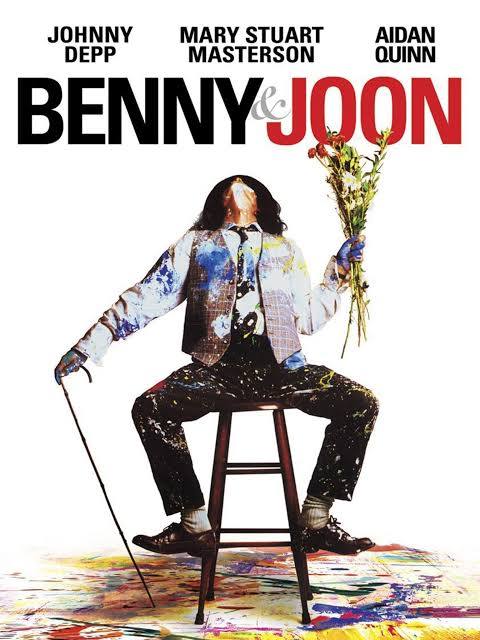
Erin from Still Life, With Cracker Crumbs and I are hosting Comfy, Cozy Cinema again this year and first up on our movie-watching list was Benny & Joon.
Benny & Joon (1993)is a quirky film I watched in 1990s and really enjoyed. It was when I first saw Johnny Depp because I never watched 21 Jump Street or anything else he was in back then.
I already knew Mary Stuart Masterson from Fried Green Tomatoes.
For the most part, the movie is funny, comfy, and sweet, but there are a couple of hard moments. In the end, though, (small spoiler ahead —–à) things actually turn out okay.
Let’s start with an online description of the movie:
Benny (Aidan Quinn), who cares for his mentally disturbed sister, Joon (Mary Stuart Masterson), also welcomes the eccentric Sam (Johnny Depp) into his home at Joon’s request. Sam entertains Joon while he dreams of a job at the video store. Once Benny realizes Joon and Sam have started a relationship, he kicks Sam out of the house. This leads to an altercation between brother and sister. Joon runs away with Sam, who soon realizes that she may need more support than he alone can provide.
This movie starts with someone painting and a train rolling across the tracks to the soundtrack of The Proclaimers singing I’m Gonna Be (500 miles). Yes, that very annoying song that is an earworm and was overplayed in 1993. Okay, it’s not actually annoying. I like it! But it won’t get out of my head once I’ve heard it. And I mean for more than a week!
Anyhow, back to the movie.
After we see a woman painting we are at Benny’s Car Clinic where we see Benny (Aiden Quinn) fixing a car and chatting with his friends when a call is made from his home. His sister Joon wants him to know that they are out of peanut butter Crunch cereal.
Later at Benny’s home we meet Joon who seem a little different but otherwise fairly sane and smart.
She’s clearly very intelligent with the way she uses large phrases and big words. Still, she also seems somewhat childlike.
As the movie goes on we will lean that Joon has mental issues and sometimes likes to light things on fire.
She rarely leaves the house alone, instead staying in the house and painting. Housekeepers take care of her during the day but on this day one of them, apparently one of many, is calling it quits.
Joon is out of control she tells Benny. That means Benny is without someone to sit with Joon during the day and he’ll have to miss his card game with his friends that night because Joon can’t be left home alone very much.
His friend, Eric (Oliver Platt), tells him just to bring Joon, but Benny hesitates.
“What’s the big deal?”Eric says. “She paints and she reads.”
“Yeah, she paints. She reads. She lights things on fire,” Benny responds.
As my Mom would say, “Oh. Oh. My.”
Once at the game, though, Joon does fairly well, even if she does like holding her hand over the flame of a candle a bit too much..
We learn that Benny’s friends place real items in the pot for their poker game and this will come into play later in the movie when Joon decides to play a round while Benny is outside and Benny’s friend Mike says if she loses the hand she has to take his eccentric cousin off his hands.
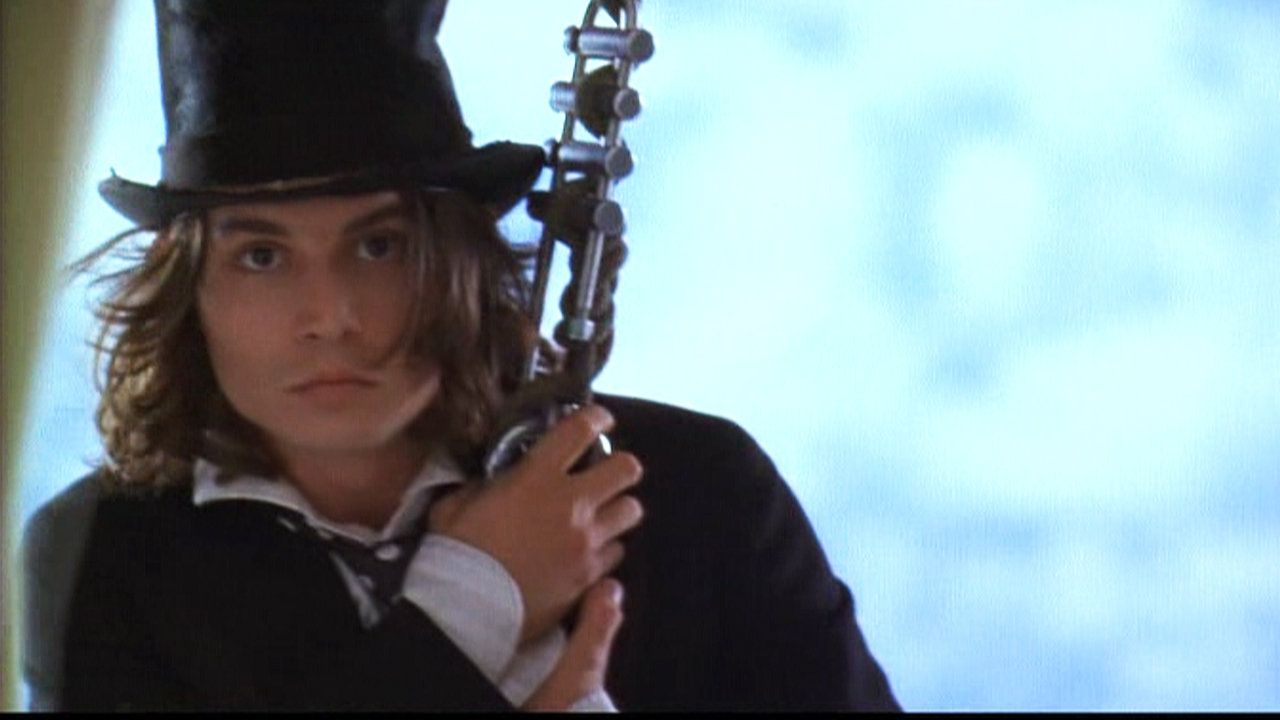
That cousin is a 26-year-old name Sam (Johnny Depp) who can’t read or write and doesn’t know what he wants to do with his life. He likes Buster Keaton and has been studying him, though, dressing like him and taking on his persona while being generally …. Weird.
At first Benny says he won’t take Sam but then he agrees and over time Sam becomes the housekeeper and a whole lot more to Joon who falls hard for him.
Before all of this, though, Joon’s doctor suggests that Benny have Joon placed in a group home where she will be among her peers.
Benny laughs. “She has a home.” Not only that but, “She hates her peers.”
The doctor sighs. “You might want to consider there are people more capable of handling these outbursts than you.”
Benny rejects this idea over and over again even though his whole life is put on hold so he can care for Joon. He doesn’t have a love life or any life outside of work.
There will come a time, though, when it does have to be seriously considered. I won’t give away anymore than all of this because this movie is worth a watch. It is actually sweet and when you think it is going some place you don’t want it to, it will change directions and pleasantly surprise you.
Don’t let the dark music that sometimes pops up scare you.
Mixed in with all the drama with Joon, by the way, is a potential romance between Benny and Ruthie, a local waitress who used to be in B-movies.
This movie has always charmed me. It’s made me laugh, smile, and enchanted me. I’m a big sucker for quirky movies with quirky characters.
As I watched the movie this time around (maybe my fifth time watching it), I realized that I think I am attracted to this movie because my great-aunt was schizophrenic and an artist. Maybe I saw some of her in Joon, even though I never met her. Mental illness has always frightened me. My great-aunt was sent to a mental hospital when she was in her 40s after years of acting odd. From what I understand she was diagnosed with schizophrenia and I always wondered if it might happen to me too. I liked art and I was even a little odd at times. Ha! So far I’m just depressed and have anxiety. No schizophrenia.
I should clarify that this movie never defines what Joon has but many viewers suspect a combination of conditions, including schizophrenia.
There are several classic scenes in this movie for me.
One is when Sam uses forks to make buns dance:
The other is when Sam reenacts Ruthie’s horrible acting in the B-movie (which can also be seen at the above clip)
Another is the absolute look of delight Sam gets when Benny says Joon sometimes hears voices in her head. That makes me crack up every time. It’s like he thinks the idea of her hearing voices is absolutely delightful.
Then there is Sam making grilled cheese sandwiches with an iron.
Then there is also a scene toward the end of the movie that you will have to see — you’ll know what it is when you see it.
There are also so many good quotes that come from either Joon or Sam too
When Sam is staring at Joon at one point she says, “Having a Boo Radley moment are we?”
As a huge fan of To Kill A Mockingbird, that one always cracks me up.
Later when she and Benny watch Sam make the grilled cheese sandwiches she says, “Some cultures are defined by their relationship to cheese.”
In the restaurant one day Joon picks the raisins out of her tapioca pudding and Sam asks her why she doesn’t like raisins.
“They used to be fat and juicy and now they’re twisted,” she says. “They had their lives stolen. Well, they taste sweet, but really they’re just humiliated grapes. I can’t say I am a big supporter of the raisin council.”
He then asks her if she saw those dancing raisins on TV and she says they scare her. That always cracks me up because they used to scare me too!
Some Trivia and Facts
I always wondered this so I looked it up and Johnny does do his own stunts and tricks when imitating Buster Keaton. This does not surprise me in the least.
Apparently, Wynonna Ryder was going to play Joon but she had Johnny had been dating at the time and broke up so she dropped out. I think I could actually see her playing Joon, even though Mary Stuart Masterson did great.
Johnny improvised a scene where he tasted the paint of one of Joon’s paintings. This also doesn’t surprise me.
From IMdb: “During the filming of the scene where Benny rushes to Joon’s aid after she is put into an ambulance, a house party was happening less than a block away from the shooting in Spokane’s Peaceful Valley area (it was a day scene actually filmed at night). After hours of re-takes, Jeremiah S. Chechik bribed the local revelers with a cornucopia of food from the crew’s food tent, which kept them pacified long enough to finish the scene (at around midnight).”
Though released in the UK and Australia in 1988, the song I’m Gonna Be (500 Miles) was not well-known in the United States until this movie. Once it was in the movie it reached number three on the Billboard Charts in the U.S. and was played ad nauseum until many people, such as me, were sick of hearing it. (Again, I do like the song. It was just overplayed that year.)
Another tidbit directly quoted from IMbD: “In the restaurant scene between Sam and Joon, as they are discussing raisins, Sam says, “It’s a shame about raisins.” This is a tongue-in-cheek reference to the video for the Lemonhead’s hit, “It’s a Shame about Ray,” which was released the year before and in which Johnny Depp starred. (At the end of the video, Johnny can be seen carrying a curved cane almost identical to Sam’s.)”
Of the film, Rogert Ebert (a famous movie critic back in the day) said, “Benny and Joon” is a film that approaches its subjects so gingerly it almost seems afraid to touch them. The story wants to be about love, but is also about madness, and somehow it weaves the two together with a charm that would probably not be quite so easy in real life.”
For once, he actually liked a film I liked and ended his review with this: ““Benny and Joon” is a tough sell. Younger moviegoers these days seem to shy away from complexities, which is why the movie and its advertising all shy away from any implication of mental illness. The film is being sold as an offbeat romance between a couple of lovable kooks. I was relieved to discover it was about so much more than that.”
Have you ever seen this one? What did you think if you did?
You can read Erin’s impressions of the movie here.
Up next in our Comfy, Cozy Cinema is: A Knight’s Tale.
You can see the rest of the list of movies in this cool graphic that Erin made:
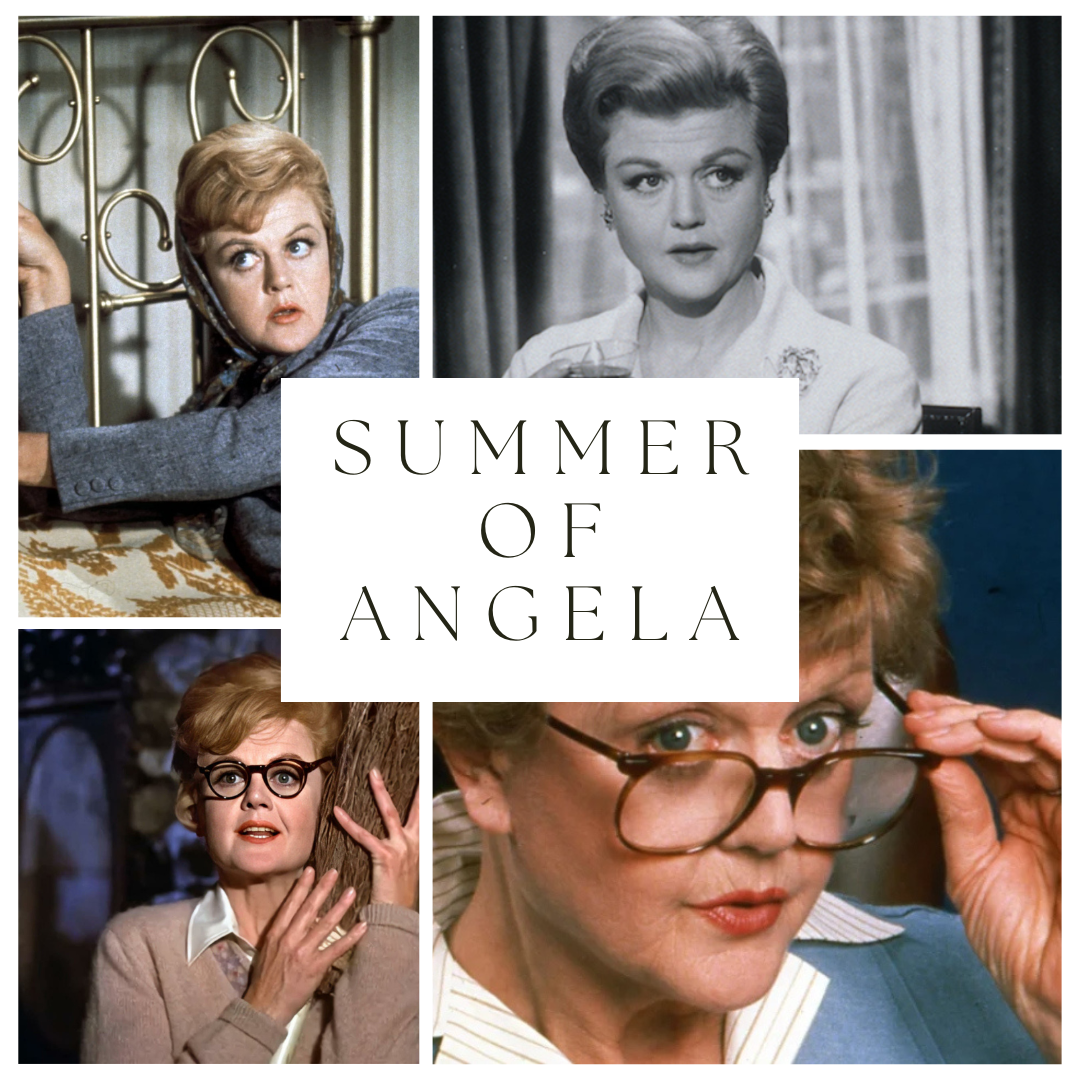
This summer I have been watching movies that Angela Lansbury starred in or co-starred. This week I watched my last movie for this particular event.
Up next will be Comfy, Cozy Cinema for autumn with Erin from Still Life, With Cracker Crumbs. The list of movies we are watching is at the bottom of this post.
On Wednesday, I decided the movie I had picked all the way back at the beginning of this marathon wasn’t really something I was interested in at all. I had not looked the movie up or watched anything about it before I picked it and I should have. So, instead, I decided to cap off my Angela Lansbury movie watching marathon with a TV movie from the show that made her a household name — Murder, She Wrote.
When Murder, She Wrote was canceled in 1996, Angela Lansbury and loyal fans of the show were heartbroken. Lansbury was also angry and disappointed. One thing that soothed the shocking blow was when CBS agreed to make a series of TV movies featuring the character to appease Lansbury and fans.
Sadly, none of the movies took place in Cabot Cove with the original cast, but they at least featured Angela as Jessica.
The last of those movies, The Celtic Riddle, which I chose to watch for this week, aired in 2003.
I thought it was interesting that Angela’s son, Anthony Shaw, was the director and producer for all four of the films. This movie was also dedicated to the memory of Peter Shaw, Jessica’s husband, who died that same year. I thought it was also interesting that Amazon just put the movie up this past week. Perfect timing for me!
Here is a bit of description from online: Intrepid investigator Jessica Fletcher travels to Ireland to attend the reading of an old friend’s will, but a series of murders which follow have the police baffled. Jessica realizes that the will contains clues to the whereabouts of a secret treasure, as well as pointing to the real killer.
In the beginning of the movie, Jessica arrives at a mansion in a taxi and then rushes inside to the will reading. She sits down and receives several glares from the others in attendance. It’s clear she is not welcome but we don’t know yet why or even who the people are.
We slowly begin to learn about the family as a man gives his last will and testament on a video on a TV at the front of the room. The man has an Irish accent and it’s soon clear we — er, Jessica I mean — is now in Ireland.
There is a woman wearing sunglasses who looks sour, another sour-looking woman next to her, a free-spirited girl with a tortoise, a youngish man with spiked hair who is glaring, another young man, an older man who is drinking from a flask, a nervous-looking housekeeper, and another man who is sort of plain.
Each of those people will later either become suspects or victims after the man who passed away — Eamon Byrne — has his lawyer give each of them an envelope with a clue inside that will lead them to a treasure. His hope seems to be that they will work together to find out the meaning of the clues. That will be hard to do when each person seems to have a gripe against another person in the group.
The people in the room, it turns out, are his lawyer, his two daughters, his one daughter’s (Breeta’s) boyfriend, a man who wants to be Breeta’s boyfriend, a drunk man, and the housekeeper (Nora).
They will all have to join forces to find the treasure but before that can happen people in the group start dropping like flies. The saddest murder to me was the last one but I won’t spoil why.
Jessica isn’t very welcomed by the family and she especially isn’t welcome when Eamon leaves her Rose Cottage for once saving his life when he was visiting Cabot Cove. This is a small cottage on the property but not the main house, which his called, fittingly, Second Chance.
The problem is that Breeta (Sarah Jane-Potts) is living in Rose Cottage to be away from her money and power-hungry family members. While she’s at first hostile toward Jessica for being given the cottage, they eventually become friends as they try to figure out Breeta’s father’s riddle and who is killing people off.
An aside: The little cottage reminded me of the house my elderly friend Rev. Reynolds and his wife Maud lived in. Rev. Reynolds built his home to look just like an Irish cottage since he was from Northern Ireland. It was so cozy and warm. I loved visiting them there (except when he had another project for me) It brings tears to my eyes to think of it and the memories there. I’m so glad another couple is living there now and keeping the cozy feel of it alive. I need to go visit them soon since I met them through Rev. Reynolds.
Anyhow…back to the show:
The lead inspector in this movie, by the way, was quite amused by Jessica’s suspicions and deductions after the first murder. He looked like he was about to burst into laughter as she laid out her theory.
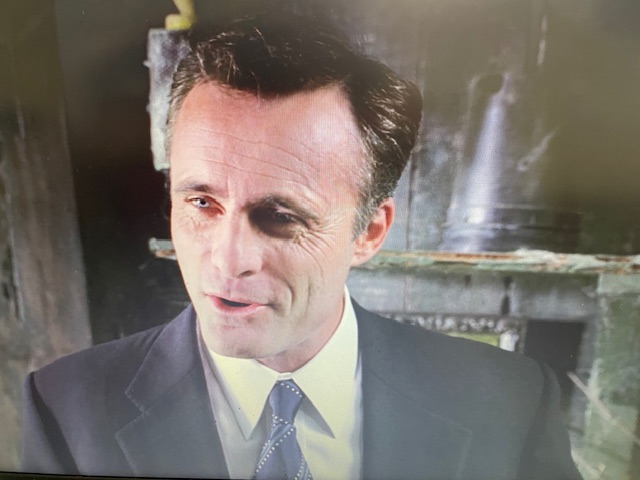
He seemed to think it was super cute that this old lady mystery writer thought the man might have been hit on the head. I really liked the actor — Timothy V. Murphy. I thought he played the part perfectly. I felt like he was saying in his mind, “Aw..she’s so cute. The mystery writer thinks she knows how to solve a real crime.”
(Excuse the reproduction here – it’s from my computer because there were not a lot of images online from the movie.)
Of course he had to eat his words when it turned out she was right and from then on, he treated her gently and seemed to want to take care of her and also believe every theory she had.
This video is also from my laptop so not the best reproduction:
The Irish accents in this were on point which made me look up the actors to see if they were actually Irish. With names like Cyril O’Reilly, Timothy Murphy, and Fionnula Flanagan how could they not have been Irish? I didn’t have time to research each actor but most of them did seem to actually be Irish and from Ireland.
I did recognize Fionnula Flanagan, but I’m not sure from what. I must have seen her in something or other, though. It will come to me eventually.
As in any Murder, She Wrote episode there were moments where I was like, “Well, that was a stupid move!” Like at one point Jessica runs out the door in the middle of her and Breeta and Breeta’s boyfriend, Paddy, (Cyril O’Reilly) brainstorming who the murderer is and she just says, “Wait here. I’m going to check something out.”
I literally said to the screen: “Jessica! Tell them where you are going! You can’t just run off places alone. That’s dangerous and you’re an old lady now!”
That’s the thing about these mystery shows —someone is always doing something dumb and the characters and us viewers just shrug it off like it is normal — well, after we yell at them of course. *wink*.
Also, Breeta’s boyfriend looked waaay too old for her. Like he could have been her dad old. When I looked up the actors, he was indeed 20 years older than her. Ick.
I feel bad in some ways, that Angela Lansbury, an Oscar-nominated actress, chose to be in these movies. They apparently didn’t have much of a budget because the rocks in the one scene were so clearly fake. Like plastic or Styrofoam fake. Eeek. Angela Lansbury loved Murder, She Wrote, though, and she liked the escape it gave people so I know that’s why she agreed to do them. I like watching the reruns for the same reason. She really gave us a gift by playing Jessica, even is she knew it wasn’t always “great TV” exactly.
Excuse the reproduction here – it’s from my computer because there were not a lot of images online from the movie.
Despite all those weird little quirks and fake rocks in the movie, the story itself and the acting wasn’t too bad.
I will say I guessed the killer about ten minutes into the show because of his expressions (smiling and five seconds later frowning menacingly) but the mystery may be harder for you. They did a good job of dropping red herrings throughout the show to distract me and others, though.
I don’t know that I’d watch this again and again or even … again once, but it was a fun little escape, much like the show. I think this autumn I might watch the other movies and see what I think of those too.
But for now, this is the end of my Summer of Angela.
If you’d like to read what I thought of the other movies I chose you can find the links to them here:
If you were to ask me which ones from this list were my favorites I’d have to say Gaslight and The Manchurian Candidate. The biggest surprise for me was The Pirates of Penzance and the films that made me forget Angela as Jessica Fletcher was The Manchurian Candidate followed by A Life at Stake and then The Picture of Dorian Gray.
Up next, Erin from Still Life, With Cracker Crumbs and I will be watching movies for Comfy, Cozy Cinema. Yes, we do know those two words are pretty much the same word and, no, we don’t care if that bothers anyone. *wink*
Here is the list of what we will be watching and the dates we will be writing about those movies:
You can also find impressions of movies we watched in the past Comfy, Cozy Cinemas HERE.
Have you ever seen this TV movie? What did you think of it?
Hello! Welcome to my blog. I am a blogger, homeschool mom, and I write cozy mysteries.
You can find my Gladwynn Grant Mystery series HERE.
This summer I am watching Angela Lansbury movies for the Summer of Angela.
This week I dropped the movie with Angela and Warren Beatty that seemed super dark and replaced it with The Long Hot Summer, which I actually watched in 2022 during my first ever movie marathon called The Summer of Paul (Newman that is). For the life of me, though, I could not find that I wrote a blog post about the movie, so I am starting from scratch here.
The Long Hot Summer is not an Angela Lansbury focused movie, but she is in it and fills the screen with her personality when she is on it. The main stars are, of course, Paul Newman and Joanne Woodward, but Angela provides some comic relief as Orson Welles’ mistress, Minnie Littlejohn.
First, a bit of background/description of the movie with the Google description:
Handsome vagabond Ben Quick (Paul Newman) returns to the Mississippi town his late father called home, but rumors of his dad’s pyromaniac tendencies follow him as soon as he sets foot there. The proud young man’s determination eventually wins over civic leader Will Varner (Orson Welles), who decides Ben might be just the man for his daughter, Clara (Joanne Woodward) — much to the displeasure of Will’s gutless son (Anthony Franciosa) and Clara’s society boyfriend (Richard Anderson).
The movie’s main focus is the sexual tension between Paul and Joan’s characters, which worked out fine since the two were having an affair before this and were on the cusp of being able to announce that since Paul Newman’s divorce was essentially final. Yes, I have always been a fan of Paul, but, no, I don’t like that part of his and Joanne’s story, and I have a feeling there were times they didn’t like it either.
Paul was always good at playing loners, sad men who don’t know who they are or what they want in life except the woman they set their sights on.
It’s the same in this movie, where Paul seems to want prestige but really just wants Clara to like him as much as he likes her. Clara is uptight, though. She does everything proper and never lets her guard down, especially around Ben Quick. She seems to have a feeling if she does let her guard down all of those feelings she’s been trying to protect all her life will spill out.
It’s no surprise since her daddy (Welles), is also pretty uptight and fights for control over everything in his life. That’s why he won’t marry Minnie, who desperately wants to be married.
The movie opens with Ben Quick being told to get out of a county because he is charged with burning a man’s barn because he got mad at the man. There was no proof, though, so instead of jailing him, the town tosses him out.
He rides a couple of steamers down the river to his family’s old town and when he’s hitch-hiking he’s picked up by sour Clara and her bubbly friend.
We find out how sour she is when he asks, “So you girls just take your fun wherever you can find it?” And Clara responds with, “Don’t jump to conclusions, young man, we’re giving you a ride and that’s all we’re giving you.”
The sparring between Clara and Ben kick off right from there and continue on in the movie.
The first sign we see is a welcome sign to Fishermen’s Bend, home to – well, everything owned by someone named Varner.
Ben tells the girls that it sounds like Varner is the man to see about work in that town and the bubbly girl says that he can see Mr. Varner every night at their house. He asks if they are connected to Varner and the girl giggles that they are indeed and then drive off and leave him there at the town hall.
Back at the Varner house, Eula, Clara’s sister-in-law, is gushing to her husband Jody about all the clothes she bought, and Clara is on the terrace sipping lemonade with her friend Agnes when Ben shows up again.
The ladies were talking about how they are single and lonely before Ben showed up. Agnes mentions how he might be an option and Clara quips that they haven’t gotten so desperate as to be turning to strangers.
Ben asks Jody about working one of the tenant farms to make some money off of. Jody agrees before running back upstairs to make out with Eula. The servant comments when he sees muddy footprints on the rug after Ben leaves, “Mister, you sure do leave your calling card.”
That’s a bit of foreshadowing and an understatement.
As the movie goes on Ben will work his way into the family in more ways than one, upsetting the apple cart, so to speak.
Clara walks the carpet back to Ben’s tenant house with a little black boy (yep, another servant down here in the South) and tells him you dirty it, you clean it.
What follows is some great dialogue, which continues throughout the movie.
“A lot of fuss to be making about a rug lady, if it’s the rug that’s bothering you.”
Clara tips her chin up. “What else would it be?”
Ben spits out a watermelon seed. “Well now you correct me if I’m wrong but I have a feeling I rile ya’. I mean me being so mean and dirty and all.”
“Mr. Quick, you being personal with me, I’ll be personal with you. I spent my whole life around men who push and shove and shout and think they can make anything happen just by being aggressive and I’m not anxious of ‘nother one around the place.”
Ben smirks. “Miss Clara, you slam a door in a man’s face before he even knocks on it.”
All Clara says is for him to have the rug at the house by 6.
It shows how bigger than life Varner is when he comes back into town in an ambulance or police car (not sure which ) with the sirens blaring. The people in town who watch him drive through talk about how he was in the hospital and had something cut out of him.
Then it’s time for Angela, the point of this here Summer marathon. She comes running out of the Littlejohn Boarding House and Hotel as soon as he pulls up, wearing a tight and tiny white dress, and throws her arms around him. Her Southern accent is so jarring being familiar with her original accent and the American one she ended up developing as the years went on.
He laughs and declares she seems to be getting fatter and blonder on him.
Oh yeah…Didn’t I mention what a charmer he is?
He tells her he will be back…later. *wink* *wink*
He greets his family at home, with a clear critical eye on his son who seems desperate to please his father. That will come to play in a big way in the movie.
Orson Welles’ color is so horrible in this film, and I don’t know if that is because he is supposed to look sick or if it was bad makeup or if Orson Wells was that color back then. Then again, a couple of the other men had that weird color to their skin too. Maybe it was just bad makeup or the film itself.
Despite his color, Minnie wants to marry Daddy Varner, and she lets him know that. He avoids her as much as possible, preferring to keep control of his world.
What Angela said about the movie:
Angela’s plays a playful flirt in this film, not a dark femme fatale like A Life At Stake and she credited the director, Martin Ritt, for bringing that playfulness out in her.
“Martin Ritt had a wonderful enthusiasm and earthy sexy quality himself,” she said. “He loved the idea of the dirtiness of the carryings on, and he certainly brought every bit of kind of naughty sexuality out of me in that role.”
As for Orson Welles, Angela agreed with others who said he was used to getting his own way because he normally had control of his own projects. This project wasn’t his though.
“He was always nudging and pushing for things and wanted to change lines,” said Angela. “But had to be carefully handled so that he didn’t always get his way because his way wasn’t necessarily the best way for everybody else in the scene.”
Welles would irritate his co-stars by overlapping his own lines with their dialogue, ad-libbing, and mumbling to the point where his lines were barely comprehensible, she added.
Despite him being annoying, Angela also said of him: “There was something you couldn’t resist about Orson.”
In a 2001 interview, quoted on TCM.com, Angela said of Paul and Joan: “They seemed to have such a total understanding of each other that they were able to work in scenes where they were at each other’s throats or falling under each other’s spell.”
My thoughts on the movie:
I like the Southern feel of this movie, the acting, the complex relationships. I love watching Ben try to break through Clara’s hard exterior. No matter how hard she tries to resists him or how many times she pushes him away he keeps trying.
I love how the women are very strong in the movie but not so strong that they are outright disrespectful, even though they probably should be in some cases.
Paul’s smirk works well in just about every movie he’s in but it really works in this one. It’s hard to read what his real motives are sometimes, but deep down I feel like he does want something better than what he’s had. I feel like he does want a family and to be successful on his own merit.
This movie has a Tennessee Williams feel to it even though it is based on one main story and other stories by William Faulkner. It did not have a Tennesse Williams’ ending, at least.
On a more shallow level, I don’t know what they were thinking with Joanne’s big eyebrows and those way too short bangs. Despite how much I didn’t like the look they went for, I really enjoyed watching her character develop and blossom and reveal herself to be different than who we think she is for the first half of the movie.
Watching the jealousy unfold in Jody as he desperately tried to be what his father wanted him to be was difficult to see. The poor guy has no idea how to be a man of his own and is always trying to be what he thinks his daddy wants him to be.
Orson really wasn’t good in this movie. He really wasn’t. I don’t know what happened to him or why he performed so awful but from what I read online it was flat out jealousy over his younger counterparts who were associated with the Actor’s Studio. I also read he was only 10 years older than Paul in this film – 42 years old – but he looks terrible! He wore a prosthetic nose which I can not figure out the point of.
As for Angela, she pulled off her part well and it was fun to watch her with a thick Louisiana accent. Every time I see her in one of her early movies, I really do find myself forgetting she was Jessica Fletcher. She would have been so much better in this one if she hadn’t had to act across from Orson who was way over acting.
Trivia and Facts:
Orson Welles always wore a fake nose when he worked, so when he would sweat on this film, his fake nose would slip. Make-up people had to keep applying material to keep the fake nose from falling. (source TCM.com)
The director was Marty Ritt and Paul filmed five other films with him including Hombre, Paris Blues, The Outrage, Hemingway’s Adventures of a Young Man, and Hud. (source, excerpt from Paul Newman biography on Lit Hub)
In his biography Paul Newman wrote of Orson: “Orson couldn’t understand screen generosity, where one actor allows another player in his scene to deservedly get the best camera shots. Screen generosity was not part of Orson’s vocabulary. After a number of retakes on a scene he did with me, Orson asked Marty if he could have a private word with him. They stepped away together, and seemed to be discussing something rather serious. When they came back, we did another take, and afterwards, I asked Marty what was going on.
“Orson thought you were submarining him,” he said; it was an actor’s way of saying someone was stealing his screen time.” (source, excerpt from Paul Newman biography on Lit Hub)
The director, ‘Martin Ritt’ , was forever known after this movie as the man who tamed Orson Welles. During filming Ritt drove Wells into the middle of a swamp, kicked him out of the car and forced him to find his own way back in the hot Louisiana heat. (various/several sources)
Joan and Paul were married in January 1958 and the movie released in March. (TCM.com)
When the movie was complete, the director and others watched it and noticed they could barely here Orson at times. The director felt sure Orson had purposely mumbled his lines to make the sound more difficult because he was unhappy with not having control.
From TCM.com: “The success of The Long, Hot Summer helped Martin Ritt reestablish himself as a major director following his 5-year blacklisting from Hollywood. It also showcased the talents of young up-and-comers Joanne Woodward and Paul Newman, who won Best Actor that year at the Cannes Film Festival for his portrayal of Ben Quick. It marked both the beginning of long and distinguished careers for the talented couple as well as the beginning of one of Hollywood’s longest and happiest marriages.”
The Long, Hot Summer was based on the works of southern writer William Faulkner, most notably his 1940 novel The Hamlet. (source: TCM.com)
The movie was turned into a television series in 1965. It starred Roy Thinnes as Ben Quick, Nancy Malone as Clara, and Edmond O’Brien as Will Varner. O’Brien eventually left the show and was replaced with Dan O’Herlihy. Legendary director Robert Altman directed the pilot. (source: TCM.com)
Copied directly from TCM.com’s article because I thought it was interesting and I didn’t want to summarize it: Although William Faulkner was best known as a novelist and short story writer, he did work as a screenwriter in Hollywood for 20th-Century-Fox during the thirties and forties. A good deal of his work went uncredited and he was never successful in adapting any of his own work for the screen (although he did do a screen treatment for “Barn Burning” but it was never produced). He did, however, receive credit for the screenplay adaptations of Ernest Hemingway’s To Have and Have Not (1944), Raymond Chandler’s The Big Sleep (1946) and a few other scripts such as Submarine Patrol (1938) for director John Ford and The Road to Glory (1936) for director Howard Hawks.
Other William Faulkner film adaptations include The Story of Temple Drake (1933, based on his novel Sanctuary), Intruder in the Dust (1949), The Tarnished Angels (1958, based on his novel Pylon), The Sound and the Fury (1959), Sanctuary (1961), The Reivers (1969), Tomorrow (1972, based on his story), and an uncredited Russian adaptation of Sanctuary entitled Cargo 200 (2007, aka Gruz 200).
Have you ever seen this one?
My last Angela movie will be Something for Everyone. I don’t know anything about it so I’m going into it blind.
If you want to read about some of the other movies I watched, you can find them here:
Last week I finished the book The Scarlet Pimpernel by Baroness Orczy.
I enjoyed the book so much that I looked forward to a couple chapters each night before bed just like I used to read books before there were all these devices and social media sites and everything else to distract me. Losing myself in the story completely forgetting about everything around me going on was exactly what I needed. Yes, the book could be a bit dramatic at times, but, come on, it was written in 1905!
I loved the hardcover copy I found too. It was printed about 30 years ago by Reader’s Digest but I love how it had a vintage feel to it.
Even though I’ve seen the 1982 TV serial movie with Jane Seymour, Anthony Andrews, and Ian McKellen and therefore knew the story, I still wanted to read the book because I wanted to see if the book was different or the same.
The baroness (yes, she actually was one) wrote the play, The Scarlet Pimpernel, before she wrote the book. There are also several sequels to the book, and some don’t focus on the same characters.
First, a little description of the book and movie for those who might not be familiar with it.
Armed with only his wits and his cunning, one man recklessly defies the French revolutionaries and rescues scores of innocent men, women, and children from the deadly guillotine. His friends and foes know him only as the Scarlet Pimpernel. But the ruthless French agent Chauvelin is sworn to discover his identity and to hunt him down.
I first watched the movie version of The Scarlet Pimpernel years ago and then watched it again about a month ago. It was a CBS production with all British actors that ran three hours, maybe over a couple of nights, but I’m not sure.
After I watched the movie, I remembered I had found a hardcopy of the book by Baroness Orczy last year at a used book sale.
I couldn’t figure out how to write this without giving spoilers so … there will be spoilers. You have been warned.
First, let’s go to the book which begins with a French family being rescued from the guillotine. They’ve been brought to an inn in England by the band of men who work with The Scarlet Pimpernel. They’re exhausted but grateful. The mother in the family, referred to by the author as The Comtesse is also worried because her husband has remained in France and could be next to have his head cut off. While talking about who is who in England that she will be able to rub elbows with now that she is there, the name Lady Blakeny, formerly known as Marguerite St. Just comes up and the Comtesse balks. She doesn’t want to meet that woman because that woman turned in the Marquis de St. Cyr to the revolutionists and he and his entire family were guillotined.
The men in the inn are taken aback by this charge but don’t seem surprised the woman says it. What they are nervous about is that Lady Blakeny is currently on her way to the inn with her husband Sir Percy Blakeny, who is known as a lazy “fop”. He’s rich and simply putters his days away by hobnobbing with the Prince of Wales and other elites. He’s also terribly obnoxious. He met his wife in France and brought her back with him to live in England.
Unfortunately, the Comtesse sees Lady Blakeny and lets the woman know she wants nothing to do with her because of how she turned in the de St. Cyr family.
Lady Blakeny is confused by the charge and laughs it off.
It isn’t long before we learn that Marguerite did turn the family in but not on purpose. She dropped a hint that the Marquis was a traitor after the Marquis beat her brother Armand St. Just because he was in love with the Marquis’s daughter. She told her husband shortly after they were married and had returned to England what happened and it was after that he became very cold toward her and barely spoke to her in private, making their marriage more of a show than anything else.
The main plot of the book is a romantic one involving the misunderstandings between Marguerite and her husband.
Early on, Marguerite is approached by Citizen Chauvelin, an agent of the revolutionists in France, and he requests her to spy on those she associates with in England to see if she can find out who The Scarlet Pimpernel is.
The revolutionists want him stopped so he can no longer smuggle out aristocrats that the revolutionists want to murder.
Marguerite refuses but later in the book Chauvelin and his men find a letter that reveals her brother Armand is involved with The Scarlet Pimpernel and his men. In fact, Armand is on his way to France to set up arrangements to save another aristocrat family.
Chauvelin blackmails her, forcing her to help find out The Scarlet Pimpernel’s identity or he will have Armand killed.
She and Armand are very close because they lost their parents, and he helped to raise her so she reluctantly agrees to this plan.
Secretly Marguerite admires The Scarlet Pimpernel and his daring escapades to rescue aristocrats who are about to be killed. She harbors a ton of guilt for what happened to the Marquis and wants others to be rescued. Despite not wanting to stop The Scarlet Pimpernel, she agrees to spy in her husband’s circle of friends to see if she can learn anything about The Pimpernel’s identity, simply so Armand is not killed.
She does learn something at a future ball that the Prince of Wales is attending when she finds out that The Scarlet Pimpernel will be meeting with his men in the supper room at 1 a.m. that night. She tells Chauvelin this but when Chauvelin goes to wait all he finds is lazy, silly Sir Percy asleep on the couch.
Now in the book, Marguerite goes back to her home with Sir Percy and confronts him over how he’s been treating her. Sir Percy fights his emotions because he truly loves her despite what she did in France and believes it must have been a misunderstanding.
There is one big reason Sir Percy can’t show his love to her though. He can’t trust her and he needs to trust her because SPOILER ALERT!!!! Do not read further if you don’t want to know the truth ——
.
.
.
.
.
.
Sir Percy is actually The Scarlet Pimpernel!!! WHAT?! Now, when we watch the movie, we already know this and it makes the sexual tension even more heightened between Marguerite (Seymour) and Sir Percy (Andrews), especially after the scene where Chauvelin (McKellen) thinks he’s going to find The Pimpernel but instead only finds Sir Percy.
In the movie Marguerite runs to the dining room instead of home. The room is dark and she hears someone behind her, but she doesn’t turn around. She assumes it must be The Pimpernel so she tells him that Chauvelin is after him and trying to trap him.
This warning lets Sir Percy know that Marguerite truly supports the mission of The Scarlet Pimpernel and his band and his heart begins to melt. He steps forward, almost puts his hand on her shoulder, clearly wants to kiss her neck, but he steps back again. He doesn’t tell her who he is, preferring to protect her from any interrogation from Chauvelin.
In the book, Marguerite figures out who Sir Percy is after he leaves for France and the daughter of a man who could be killed says she heard that The Scarlet Pimpernel had left that very morning to rescue her father.
I feel like the TV movie actually fleshed some things out a bit better and added another layer which would have made the book even better.
In the movie, we see more of Lady and Sir Percy’s romance and then their marriage about halfway through. The coldness comes when Sir Percy finds out her involvement in the Marquis’s murder from someone else at their wedding reception. The person tells Sir Percy that her name was on the warrant for the Marquis’s arrest, but really we viewers know that it it is the villain Chauvelin who put her name on the arrest warrant.
Another difference between the book and the movie is that in the movie there is an underlying story of the Scarlet Pimpernel and his men trying to rescue Prince Louise XVII before he is killed in the tower, which is what happened in real life. Their goal is to smuggle the prince out of France to England and keep him there until he is older and can come back to France and take over the throne again.
There is no mention of the prince in the book and that would have been a fun layer to add.
In both the book and the movie, Marguerite sets off to rescue Percy when she learns who he is. She learns who he is the same way in the book and the movie — she runs into Percy’s office and notices there are pimpernels along the molding of the room and in other places, which helps her to put the pieces together. In the movie, though, Sir Percy leaves a note for her in his office/study, which indicates he hoped she’d figure it out. I didn’t get that in the book, but maybe I just missed that part.
Marguerite can’t bear the thought of Percy being captured and killed by Chauvelin. I liked that she went off to rescue him, which she sort of did in the movie but not in the same way.
In the book she was sneaking around and risking her life much more than she did in the movie.
I liked the show own in the movie, which didn’t happen in the book. In the book Sir Percy uses the many disguises he used to help smuggle aristocrats out to disguise himself and keep him from being discovered by Chauvelin. He disguises himself as a Jew, which seems to be a popular thing for the English to do back then. Jews were always looked down on as disgusting and dirty at that time so they were easily overlooked.
Disguised as a Jew, Percy tells Chauvelin he saw the man that might be the Scarlet Pimpernel and leads him on a wild goose chase so that his men have enough time to escae to Sir Percy’s ship.
Chauvelin believes The Scarlet Pimpernel is leaving on his ship so he leaves a bruised and beat up Marguerite behind with the bruised and beat up Jew. Of course, Sir Percy reveals himself to Marguerite once Chauvelin and his men are gone and they have a romantic reunion.
In the movie, Sir Percy is captured when Armand goes back to his lover to rescue her. In the book Armand didn’t have a lover to go back to. Chauvelin says he will only release Sir Percy if he gives the prince back, so Sir Percy leads him to a castle near the ocean. By then, though, the prince has been released.
Chauvelin is pissed off and sends Sir Percy out to be shot. Unfortunately for him, Sir Percy has managed to switch Chauvelin’s men for his own and that means Sir Percy returns to the castle unscathed, has a dual with Chauvelin and wins, and then they leave Chauvelin stranded at the castle before escaping on Sir Percy’s ship to England.
The ending to the movie was a lot more exciting to me with that added dual. I’m sure it was easier to have a dual than having to explain why the French thought Jews were so gross that they would have ignored Sir Percy who was dressed up as one. Not to mention the stereotypical description of Sir Percy’s makeup, etc. would have been — well…insensitive to say the least.
The bottom line is that while I loved the book, I also loved that the movie flushed the book out even more for me.
I do hope to read the other books in the series, even if I don’t get my satisfaction of the full story of Sir Percy and Lady Blakeny.
A bit of trivia/facts about the movie taken from various sources around the web, including articles, interviews, and IMdB:
This movie was produced by London Films and directed by Clive Donner.
Filming took place at various eighteenth century sites in England, including Blenheim Palace, Ragley Hall, Broughton Castle, and Milton Manor; also Lindisfarne.
The subplot with the Dauphin was taken from another one of Orczy’s novels, Eldorado, which was what the screenplay for the 1982 TV adaptation of The Scarlet Pimpernel was based on.
Timothy Carlton, who played the Count De Beaulieu, is the father of actor Benedict Cumberbatch and ironically, McKellen would appear with Benedict in the Hobbit trilogy – or at least was in the same movies that Benedict did the voice of Smaug for. Seems Timothy felt he’d better change that last name while Benedict knew his first and last name would be an attention getter, I guess.
Jane Seymour sometimes took her infant daughter with her to the set and had never seen the original movie from 1934 starring Leslie Howard, Merle Oberon, and Raymond Massey. (I hope to watch this in the fall or winter and compare it to the TV movie since many sources online say it is still considered the best adaptation. I saw part of it years ago, but do not remember finishing it.).
Julian Fellowes (Prince Regent) also played the Prince Regent (the future George IV) in Sharpe’s Regiment (1996)
London Films hoped that Andrews would one day star in a Scarlet Pimpernel series in the US, but this never occurred.
In his 2006 work Stage Combat Resource Materials: A Selected And Annotated Bibliography, author J. Michael Kirkland referred to the sword fight between Percy and Chauvelin as “nicely staged, if somewhat repetitious … but still entertaining.” Kirkland also observed that the weapons used were in fact German sabres, which were not used during the Napoleonic era. (source Wikipedia).
A little about the Baroness herself summarized from the back of the book:
She was born…get ready for this one! Baroness Emmuska Magdalena Rosalia Maria Josepha Barbara Orczy on Sept. 23 1865 in Tarna-Ors, Hungary. Her father was a notable composer and a nobleman and in 1868 the family was chased from Hungary during a peasant uprising, eventually settling in London when the Baroness was 15. Before that she attended schools in Paris and Brussels. She was once quoted as saying that London was her “spiritual birthplace.”
Emmuska learned to speak English quickly, fell in love with art and writing and eventually married illustrator Montaque Barstow. They had one son.
She and her husband wrote the play about Sir Percy Blakeny in 1903 based on a short story Emmuska had written. The play ran in London. Emmuska wrote the novelization and released it in 1905. The book was a huge success and she went on to write other stories about Sir Percy Blakeny and his friends, but she also wrote more plays, mystery fiction, and adventure romances.
Have you read the book and/or seen the movie of The Scarlet Pimpernel? If so, what did you think of them?
How about the Baroness’s other books – have you read any of them?
I found this movie for free on YouTube, but it is streaming on various other services, including Amazon, Sling TV, Roku, and Apple.
This summer I am watching Angela Lansbury movies for the Summer of Angela.
Up this week was A Life At Stake, another crime noir “B-movie” and another chance for Angela to show her evil side. Honestly, she’s been evil in a lot of the movies I watched with her throughout this summer, which cracks me up since a lot of people associate her with being sweet in kind from things like Murder She Wrote and Bedknobs and Broomsticks.
This movie was not the best I’ve ever seen plot-wise but the dialogue was actually very well written and the sexual tension was something I didn’t expect for a 1954 movie.
The movie is essentially about a man who is very paranoid and thinks everyone is out to get him. Or, as Google describes it: “After an out of work architect accepts a business proposition from a married woman, he soon begins to suspect her motives, and fear for his life.”
Edward Shaw, portrayed by Keith Andes had a business failing and now he’s been approached by a lawyer with the prospect of a new business.
Edward tells the lawyer he really doesn’t really want to get involved. He keeps a $1000 bill framed on his wall to remind him of his failures and encourage him to try again. I didn’t know there was such a thing as a $1,000 bill by the way.
Anyhow, I digress, the lawyer puts him in contact with Doris Hillman (Angela), wife of Gus Hillman (Douglass Dumbrille). Edward goes to Doris’s home and the housekeeper says he needs to call out before he goes to the pool because Doris has been known to swim in the nude. Edward quips back, “That’s okay. I’ve been known to swim in the nude too.”
Doris isn’t naked but she does tell Edward he should have called out. From their first meeting the flirting begins in earnest. Doris even covers herself with a towel but removes the top of her swim suit underneath it because she says it’s uncomfortable.
Eventually they get to business talks and Doris says Gus wants Edward to run the company, buying up property with money Gus will give him and for Doris to sell the property using her past real estate experience.
Edward is agreeable but feels suspicious about it all, especially when Doris says they will need to take an insurance policy out on him for half a mil. He doesn’t, however, seem to feel suspicious about Doris and later that night at home when he gets a call, he asks his land lady if it is a woman calling. It is clear he’s hopeful Doris will be calling soon and about a lot more than business.
Doris does call another day and asks him to meet her a hotel room. From there he’s laying it on heavy, flirting all over the place, but she lets him know she’s not interested. She’s only interested in business. Edward (sort of a horny jerk if you ask me) leaves but later that night Doris pulls up outside his apartment.
She says something flirty and then before we know it, he’s in the car practically shoving his tongue own her throat.
All is going well with their little liaisons and business dealings until Edward meets Doris’s sister, Madge (Claudia Barrett). Madge thinks he’s just lovely and starts hitting on him. She invites him to dinner in front of Doris and Gus and because he doesn’t want Gus to know about his affair with Doris, he agrees.
During dinner Madge drops a bombshell and says that Gus is Doris’s second husband because her first husband died a few years ago in an accident. What’s weird is that Doris and Gus were in a business with him too and when he died Gus and Doris got the insurance money since they’d taken out a policy on each of them for the business.
Edward is incensed. He had a feeling Doris and Gus were up to something and now he knows what it is. They really do want to kill him and get the money for the insurance policy they took out in his name.
He’s still thinking about this when Doris calls and says she wants to show him something.
He reluctantly agrees and she drives him up on a hill. She shows him some property she says will be great for development but when she goes to park, the brake slips and the car keeps rolling. She gets it in park and says she’s going to go get the property owner because he said he would show them around.
After she leaves, though, with Edward sitting in the passenger side, the car starts to roll toward a bank with a long drop and Edward just barely stops it.
That cinches it for him. Doris and Gus are in on this together and they are going to kill him.
I won’t give away the ending but most of the rest of the 70 minute movie (yes, it’s that short) will be Edward waffling back and forth between suspecting the couple and being in love with Doris while Madge is in love with Edward and knows all about the affair. Later she also knows about Edward’s suspicions.
This is a dark movie and it took the path I thought it might but I did think there might be more of a plot twist toward the end. Actually, there did seem to be a bit of a plot twist based on something said by a character right at the end but I wasn’t sure if I was reading too much into it or not.
I will share that I did read Cat’s review (found on her blog Cat’s Wire) before finishing this post up and I have to agree that I did not really connect with or like the main character.
I don’t think I would have cried much if he had been murdered (okay, so I gave a little away here…..he isn’t murdered). He was very unlikable and rude. He wanted to have his little fling with Doris but also keep her and her husband from killing him. He was sort of ruled by his privates to me and it severely affected his judgment. And though there were some good lines in this one – the writing overall was just not very strong.
I’m sure this is just motion blur in the image, but all I can think of when I see Angela’s hand in this photo is that episode of Seinfeld when Jerry dates a woman with “man hands.”
I liked Angela’s performance and thought she succeeded once again in pulling off playing someone evil and making it hard for the viewer to figure out if she was really in love with Edward or not.
I listened to an interview with Angela last week when writing about The Picture of Dorian Gray, and she said she made a lot of not-so-great movies over the years. This may be one of them she was referring to.
The movie was directed by Paul Guilfoyle, for those who care about such things. The film was restored in 2021 and resulted in a few noir crime movie buffs blogging about it.
One of those, Michael Barrett from the site Pop Matters, wrote: “You’d have to know me to understand how unlikely it is that I’d never heard of this picture, but the commentary by scholar Jason A. Ney points out that this film is so obscure, it’s not listed in most noir references, despite the presence of a major star. So this might count as more of a rediscovery than restoration.”
About the acting and plot he writes, “The film runs only 76 minutes, but a bunch of stuff happens at a nice clip, sometimes too quickly for us to analyze how much adds up, with some elements more obvious than others. In a sense, everyone is clumsy and transparent, and that feels reasonably credible. The story mixes common sense (e.g., going to the cops and the insurance company) with devious cupidity and lust amongst tawdry, small-minded people.”
Glenn Erickson on Trailers from Hell wrote: “Filmed in 1954, producer Hank McCune’s A Life at Stake is notable for its fairly competent production and a decent if somewhat thrill-challenged screenplay — and the fact that it stars an actress one wouldn’t think would be associated with an 11-day cheapie thriller. The great Angela Lansbury is the odd star out on a list of creatives that reads like a call sheet for ambitious Hollywood underachievers, all thirsting for the right show to get their career in motion.”
I have to agree with Erickson when he writes: “The movie generates some tension but can’t quite convince us that Ed Shaw is as helpless as presented.”
I enjoyed Erickson’s entire review and background so if you would like to know even more about the film and Angela’s role in it, please check it out.
Some facts and trivia:
“The unusual convertible Doris Hillman (Dame Angela Lansbury) drove was a Kaiser Darrin. Only 435 production Darrins and six prototypes were built. Its entry doors slid on tracks into the front fender wells behind the front wheels, which was patented in 1946, had no side windows and a three-position Landau top. The car’s only criticism by enthusiasts was the front grill, which looked like it “wanted to give you a kiss.” (Source: imdb)
This was an independent feature produced by Hank McCune, who briefly starred in his own free-wheeling TV sitcom, The Hank McCune Show. (source: Pop Matters)
McCune created the story and hired people from his television series, including writer Russ Bender and supporting actor Frank Maxwell. (source: Pop Matters)
The director’s wife, Kathleen Mulqueen, plays Shaw’s mom-like secretary. (source: Pop Matters)
Directly from imbd.com: “In the first scene, Edward Shaw (Keith Andes) roams about his room in the boarding house wearing only form-fitting pajama bottoms and stripped to the waist, giving audiences ample chance to view his impressive musculature from every conceivable angle. In a comic twist, an attorney enters the room, and one of his first lines of dialogue to Edward is “Come now, you’re not the first man to lose his shirt!””
In order to please the Italian music unions, an agreed number of American films had to be re-scored by Italian composers for release in Italy. A bit of irony is that Les Baxter had his original music replaced by Costantino Ferri, Baxter himself would later join AIP and re-score over a dozen movies previously done by Italian composers. (Source: imbd)
When Edward Shaw (Keith Andes) gets into a taxi after leaving his office, in the background, the old Sunset Theatre is seen, which was located on Western Avenue just north of Sunset Boulevard; the double feature shown on the marquee is Da Vinci also Julius Caesar (with Marlon Brando) , which dates the shot as May 1954. The theatre no longer exists. The intersection has been redeveloped.
Left on my Summer of Angela list for August are:
August 22 – I’ve decided to substitute A Long Hot Summer for All Fall Down for a couple reasons — I’ve watched A Long Hot Summer before and it will allow me to admire Paul (Newman) again and I watched a preview for the film and this annoying kid kept calling the main character Barry-Barry and that just seemed super, super annoying. Plus, I’ve heard it is a dark film. I originally wanted to watch it because I’ve never seen a Warren Beatty film (don’t you dare ever remind me of Dick Tracy! Never! Ever! I would like to burn that memory out of my brain with the end of a cigarette! My brother and I walked out of that film and I have never attempted to watch it again and I still have PTSD!). I can always watch another Warren Beatty film instead.
August 29 – Something for Everyone
If you want to read about some of the other movies I watched, you can find them here:
This summer I am watching Angela Lansbury movies for the Summer of Angela.
This week I watched The Picture of Dorian Gray (1945), which I had never seen before. I’ve also never read the book that it is based on.
I had to sit and process this one for a bit and also watch a comedy or two afterward.
Wow, what a creepy, dark, and unsettling film.
Yes, unsettling is the perfect word for this movie and while I am glad to see the second film that Angela received an Oscar nomination for, I don’t plan to watch it again.
I shuddered too many times while watching it.
First, a quick description of the movie for those who are not familiar with it.
From TCM.com, this one-sentence description tells us what we need to know about the movie:
“A man remains young and handsome while his portrait shows the ravages of age and sin.”
The movie is based on the book of the same name by Oscar Wilde, written in 1898. There is even a moment where the main character quotes Wilde.
The movie stars Angela, Hurd Hatfield, George Sanders, Donna Reed, and Peter Lawford.
Dorian Gray is a young man without any family who gets mixed up with a man who is a bit of a chauvinist, cynical jerk. This man, Lord Henry Wotton (George Sanders, who plays villains absolutely perfectly), comments on how awful it is to age when he is looking at a painting of Dorian being made by artist Basil Hallward.
Lord Henry, a man who enjoys manipulating the lives of others and talking down to women and everyone around him, says that youth is fleeting and that the pursuit of desire should be the only real goal in life. Dorian, who seems super impressionable to me, thinks about what Lord Henry has said and says that he would give his soul if the painting would grow old while he remained forever young.
Lord Henry tells him to be careful about making such a wish in front of his Egyptian statue of a cat.
Dorian decides to explore new places, experience new things, and later he visits a bar where he watches a beautiful young woman names Sibyl Vane (Angela) performing a song called Little Yellow Bird. He is enamored with her and her with him.
Consider yourself warned that the song she sings, Goodbye, Little Yellow Bird, is an earworm. I’ve been humming the thing all week!
He’s in love, but Lord Henry is cynical and mean and tells Dorian to give Sibyl a challenge. Invite her to stay overnight, and depending on what she decides, Dorian will know if she is virtuous or not.
Things will go downhill for Dorian after the outcome of the challenge. Tragedy strikes, causing him to become hardened to the world. He decides that living only for his own pleasure, no matter who it hurts, is the way to go in life.
I won’t spoil the whole movie in case you haven’t watched the movie or read the book, but want to. I will say: be prepared to be fairly depressed by the end.
I will say that two additional characters were added to this movie that were not in the book — a woman named Gladys (Donna Reed) who has loved Dorian since she was a child, and her boyfriend David Stone (Peter Lawford). Gladys was terribly annoying and stupid to me. They should have left her and David out, quite frankly.
The part of Dorian Gray is played by Hurd Hatfield.
His absolutely creepy and dead-behind-the-eyes expression is the central reason I felt unsettled by the movie.
I saw his demeanor as perfect for this part but one critic I read said it resulted in his character feeling too one-dimensional and detached.
“On all accounts, (director Alfred) Lewin micromanaged Hatfield’s every gesture (to the point of not letting the actor perform after four o’clock in the afternoon, for fear fatigue would show), resulting in a central performance that is appropriately strange, but which never engages,” wrote Richard Harlin Smith on TCM.com. “One doesn’t see what others see in this Dorian Gray, who seems as inflexible as a mortician’s wax even in his mysteriously protracted youth.”
I thought not emotionally engaging with anyone is the point of a character who essentially gives up his soul, feelings, and love for anything, to be as nasty as he wants to be (yes, a bit of a spoiler there).
The movie was only Hatfield’s second film (his first being Dragonseed from 1944).
Smith wrote in his review of the film on TCM that, “Hurd Hatfield, in his second screen appearance, was so effectively evil in the title role that it actually handicapped his career with casting directors.”
According to Hurd Hatfield Luv on Tumbler, Angela once said that Lewin would stop rolling the cameras once Hatfield made an obvious expression on his face. This was frustrating to Hurd because his usual acting style was animated and he wanted to perform the character like he was written in the novel.
Lewin’s wishes always overrode the wishes of the actors, though.
“Also to point out, halfway through the film Dorian said he wanted to be in control of his emotions and refrain from yielding to them,” the author of the Tumbler site wrote. They continued: “Here’s another possible reason on why Lewin wanted Hatfield to act with little feeling in this film. Now this is actually my conjecture, but it makes sense with my research. As many would understand, making strong facial expressions would wrinkle the face. Smile lines and crows’ feet form when happy. Forehead creases when worrying. Eyebrows close in and skin folds in between when angry. Bursting up in tears crying gives out the most unflattering face of all. To put it short, it’s impossible to look extraordinarily “beautiful” without scrunching the face.”
Ronald Bergen wrote in The Guardian that he interviewed Hatfield on time about his role in the film The Diary of a Chambermaid and the actor said he was glad to speak about something other than Dorian Gray.
Hatfield called the role both a blessing and a curse.
“A blessing in that it gave him a reputation; a curse in that he found it difficult to escape,” Bergen wrote.
After the movie, he was cast mainly as handsome, narcissistic young men.
Hatfield was ambivalent about having played Dorian Gray, according to the magazine Films in Review, feeling that it had typecast him. “You know, I was never a great beauty in Gray…and I never understood why I got the part and have spent my career regretting it.”
The casting director for The Picture of Dorian Gray, Robert Alton, referred Angela to the casting director for Gaslight. He saw her in the role of Sibyl, but also felt she might work for the maid in Gaslight. That role as the maid led to her first Oscar nomination.
Angela’s role as Sibyl was her second Oscar nomination and came only a year after the first.
“Great send off,” she joked in an interview with the Screen Actors Guild Foundation. “Everything went down hill from there.”
By the time Angela worked on The Picture of Dorian Gray she had filmed Gaslight and National Velvet and had started to become used to working on a set. And she meant “working.” She said in the SAG Foundation interview that she was very conscientious as a young person. She was conscientious of how she needed to be professional for the sake of the other actors and the film overall.
This was both a good and a bad thing.
“I never had any fun. I never goofed off,” she said. “I missed a lot of fun along the way but perhaps in the end it contributed to me to being able to build such a very strong base for what would was to later become an enormously successful career.”
Facts and Triva about the movie:
Lansbury’s mother appears in the movie as “The Duchess” in the dinner scene at “Lady Agatha’s”. (source Jay’s Classic Movie Blog)
The hideous portrait of Dorian shown later in the movie was painted by Ivan Le Lorraine Albright. According to TCM.com, he was hired after director Lewin saw a painting of his at the Art Institute of Chicago entitled That Which I Should Have Done I Did Not Do. It is not owned by the Art Institute of Chicago.
A scene in the movie staged beneath a wildly swinging chain lamp was an effect that would be duplicated by Alfred Hitchcock in Psycho some fifteen years later.
Several years after this movie premiered, a friend of Hurd Hatfield’s bought the Henrique Medina painting of young Dorian Gray that was used in this movie at an MGM auction, and gave it to Hatfield. On March 21, 2015, the portrait was put up for auction at Christie’s in New York City (from the Collection of Robert Hatfield Ellsworth) with a pre-auction estimate of between five thousand and eight thousand dollars. It sold for one hundred forty-nine thousand dollars. (source IMdB)
Oscar Wilde’s Dorian was blond-haired, blue-eyed, and highly emotional, but Writer and Director Albert Lewin’s conception of Dorian was of an icy, distant character.
The dark musical piece that is heard repeatedly is Frédéric Chopin’s “Prelude in D Minor”, the last of the twenty-four pieces of “Opus 28”. (Source IMdB)
Writer and Director Albert Lewin was obsessed with retakes. In this movie, he asked for one hundred and ten retakes and ended up using only one. (Source IMdB)
Basil Rathbone campaigned in vain for the part of Lord Henry Wotton and believed that his typecasting as Sherlock Holmes was the reason he failed to get it. MGM’s loaning of Rathbone to Universal Pictures to play Holmes was very profitable for the studio, another reason for not casting him. (Source IMdB)
According to Angela, a friend of hers, Michael Dyne, was considered for the role of Dorian Gray. Dyne suggested Lansbury for the role of Sibyl Vane. The casting director liked her for the part and suggested her to George Cukor for Gaslight (1944). She saw Cukor and Writer and Director Albert Lewin the same day and was cast for her first two movies. (source IMdb)
My overall view of the movie:
This movie creeped me out immensely and made me very sad. It was extremely thought-provoking. As I mentioned above, the movie left me with a very unsettled feeling. I didn’t really want to keep going at points but knew I had to find out how it ended.
The cinematography and the use of light and shadows was amazing. The best example of this is during a climatic turning point in the movie that involves a very dark action by Dorian. As the act is completed he stands with a light swinging back and forth above him and it’s casting light on his face, then it swings back and he’s in darkness. The shadows around and behind him move in the pattern of a monster’s mouth, as if signaling he’s been officially swallowed by and turned into a monster.
Another shocking part of this movie is the use of color. Yes, the movie was filmed and presented in black and white, but there are three scenes that are shown in brilliant, and later terrifying, technicolor. You have been warned because a couple of the images truly are terrifying.
I probably wouldn’t watch this movie again, but only because it disturbed me, not because it is a good movie. It is a good movie, and it is too good in presenting that icky, dark, and demoralizing feeling it’s meant to present.
Have you seen this movie? What did you think of it?
Cat from Cat’s Wire wrote about her views of it here and she does have spoilers, but it is such a good, interesting post. I loved it. If you’ve already seen the movie or read the book, definitely hop over to her blog.
Left on my Summer of Angela list for August are:
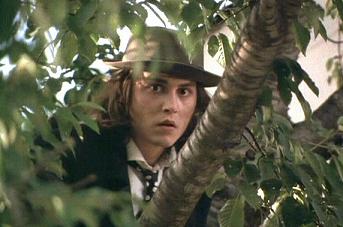
August 15 – A Life At Stake
August 22 – All Fall Down (keep an eye out. I might switch this one up.)
August 29 – Something for Everyone
If you want to read about some of the other movies I watched, you can find them here: