Erin from Still Life, With Cracker Crumbs and I are taking a break from our joint Comfy, Cozy Cinema this week, instead both choosing our own movies to watch and write about. We will be back next week with …. Which I hope you will all join us in watching and blogging about. We will have a way for you to link up if you are joining in.
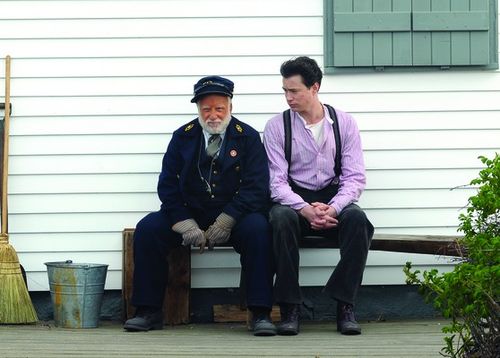
This week I decided to write about a cute movie I started a few weeks ago and forgot to finish – The Lightkeepers.
This was a film that was released in 2009 and starred Richard Dreyfus, Blythe Danner, Bruce Dern, Tom Wisdom, Mamie Gummer, and Julie Harris.
The film is set in Cape Cod, 1912 and tells the story of a lightkeeper and a young man who washes ashore and becomes the lightkeeper’s assistant.
Seth Atkins, the lightkeeper, is a very abrasive and cantankerous character and while I kept expecting him to soften up during the movie he really didn’t for most of it. That irked me a bit only because I wanted to slap him more than once for his behavior. At the same time I liked that he stayed the same and didn’t change simply to make the movie more comfortable to watch. Seth’s character did make me uncomfortable because of his bluntness, but that’s what made him – well, him.
The story was fairly simple with a fairly weak plotline, but it was still sweet. I fell in love with the subdued nature of Tom Wisdom who played Mr. Brown/Russell Brooks and couldn’t help but root for him to find some happiness.
I needed Seth to find some happiness as well since he seemed like such a grump. I knew that deep down he really wasn’t though.
Both Mr. Brown and Mr. Atkins are self-proclaimed women-haters and the movie starts out with Mr. Atkins telling his former assistant how much he hates women. In fact, he tells anyone who will listen that he hates women.
This becomes an issue when two women come from Boston to stay at the cottage down the hill from the lighthouse. He wants nothing to do with them and warns Mr. Brown away from them as well.
Staying away isn’t easy when they call for help on their first day there because there are bees inside the cottage. It also isn’t easy when the young woman, Ruth, decides to go swimming and invites a brooding Mr. Brown to go in with her. He reluctantly does and a friendship develops. It’s a friendship he does his best to keep a secret from Mr. Atkins since he agreed to stay away from women while working for him.
Incidentally, Mr. Brown arrived at the lighthouse when Mr. Atkins found him washed up on shore. Mr. Brown/Russell has a very distinct and proper British accent and it’s clear right away he doesn’t have a clue how to work with his hands or really work at all. He does his best, however, to become a real workman and as the movie progresses, we find out why he was in the ocean, why he wants to work hard, and why he “hates” women.
This was a very light watch and a nice escape for a couple of hours. I rented it through Amazon but I am sure it is available other places as well – maybe even your local library. (Update: Elizabeth let me know in the comments it is currently free on Tubi, with ads but still free).
Have you ever seen The Lightkeepers?
Next week Erin and I will return with The Lady Vanishes.
If you want to watch it as well and then blog your impressions, please do.
Here is the rest of our schedule for October and November:
For the next two months, Erin from Still Life, With Cracker Crumbs and I will be watching cozy or comfy movies and some of them will have a little mystery or adventure added in.
This week we watched Arsenic and Old Lace which was based on a 1941 play by Joseph Kesselring. The play, in fact, was still on Broadway when the movie was filmed in 1942. The play’s producers stipulated in the contract for the rights to the play that the movie would not be released until after the play finished its Broadway run. The play was so popular, though, that it ran for three years so the film didn’t hit theaters until 1944.
The movie was directed by Frank Capra.
This movie is completely crazy and off the wall in the start and then gets a bit dark and creepy in the middle and then it goes back to goofy again.
I prefer the goofy and eccentric portions of the movie to the creepy parts because the one actor in the creepy parts – Raymond Massey — well, he’s good at his job, that’s all I’ll say about that.
I am a huge Cary Grant fan, which you might know if you’ve been following this blog for very long. Erin and I even did a Spring of Cary feature this past spring.
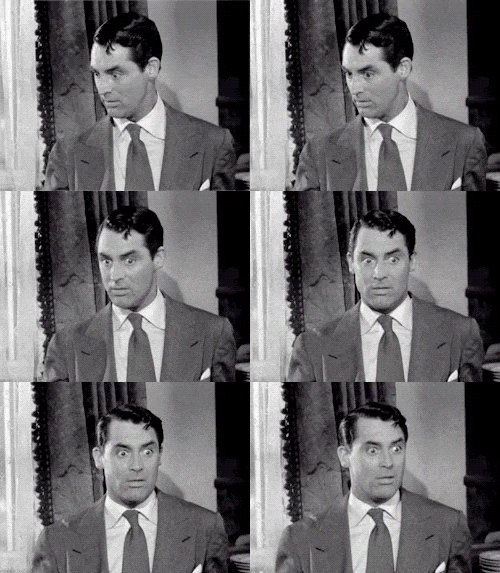
My husband commented while we were watching this movie that he thinks he likes Cary in comedies more than his dramas and I have to agree. Cary makes the best faces when he’s acting in a comedy and pulls off the comedic element so flawlessly that I’m often left laughing so hard during his comedies that my sides hurt.
There are several hilarious parts of this movie but one of the most hilarious aspects is how everyone acts like death and murder and attempted murder are everyday things. Everyone except Cary’s character, except when it comes to the attempted murder of his new wife, which he seems to shrug off because he has a one-track mind and wants to get his uncle committed to an insane asylum and protect his murderous aunts from being arrested.
Let me back up a bit here to explain some things.
Cary’s aunts are brutal killers but they are also sweet and wholesome and no one would know they are murderers until Cary (who portrays Mortimer Brewster in this movie) finds a dead man in their window seat.
Cary’s uncle thinks he’s President Theodore Roosevelt, which has worked well for the aunts who are having him pretend he’s digging the Panama Canal in their basement.
While Mortimer is trying to figure out what to do with his murderous aunts and his crazy uncle, his new wife – who he just married at the beginning of the movie — keeps trying to get his attention so they can run off together for their honeymoon to Niagara Falls.
Mortimer is way too distracted with shock and horror over his new discovery about his aunts to pay attention to his wife, who, by the way, is the daughter of the pastor who lives across the street. Then, as if things couldn’t get any crazier, Mortimer’s brother Jonathan returns home from his travels around the world where he’s been killing people. He returns with his partner in crime, a doctor played by Peter Lorre, who has botched Jonathan’s facelift, making him look like Boris Karloff, which is ironic because Karloff played Jonathan Brewster on Broadway. Karloff stayed on as the character in the play to appease the producers because they were concerned that losing all of the main actors for the movie would kill ticket sales.
According to Wikipedia: “Josephine Hull and Jean Adair portray the Brewster sisters, Abby and Martha, respectively. Hull and Adair, as well as John Alexander (who played Teddy Brewster), reprised their roles from the 1941 stage production.[4]Hull and Adair both received an eight-week leave of absence from the stage production, which was still running, but Karloff did not, as he was an investor in the stage production and its main draw. The entire film was shot within those eight weeks. The film cost just over $1.2 million of a $2 million budget to produce.”
The movie is absolutely hilarious and eccentric and I’m glad I stuck it out this time because the first time I watched it, my husband and I bailed in the middle when the creepy brother came back. The entire tone of the film switched from goofy to dark and creepy, but now that I’ve watched it all the way through, I understand the reason for the creepiness. It is to lay the groundwork for the silliness and off the wall behavior to return. At one point the brother is terribly creepy and then a bit later his reactions to discovering secrets about his aunts are so funny because he’s supposed to be the tough, scary guy.
You just have to see the film to understand.
Incidentally, Raymond Massey was nominated for an Oscar in 1940 for playing Abraham Lincoln in Abraham Lincoln in Illinois.
Massey played Lincoln several times in film, television and on stage. Someone, though articles online don’t say who, once said that Massey would keep perfecting his role as Abraham Lincoln until someone assassinated him too.
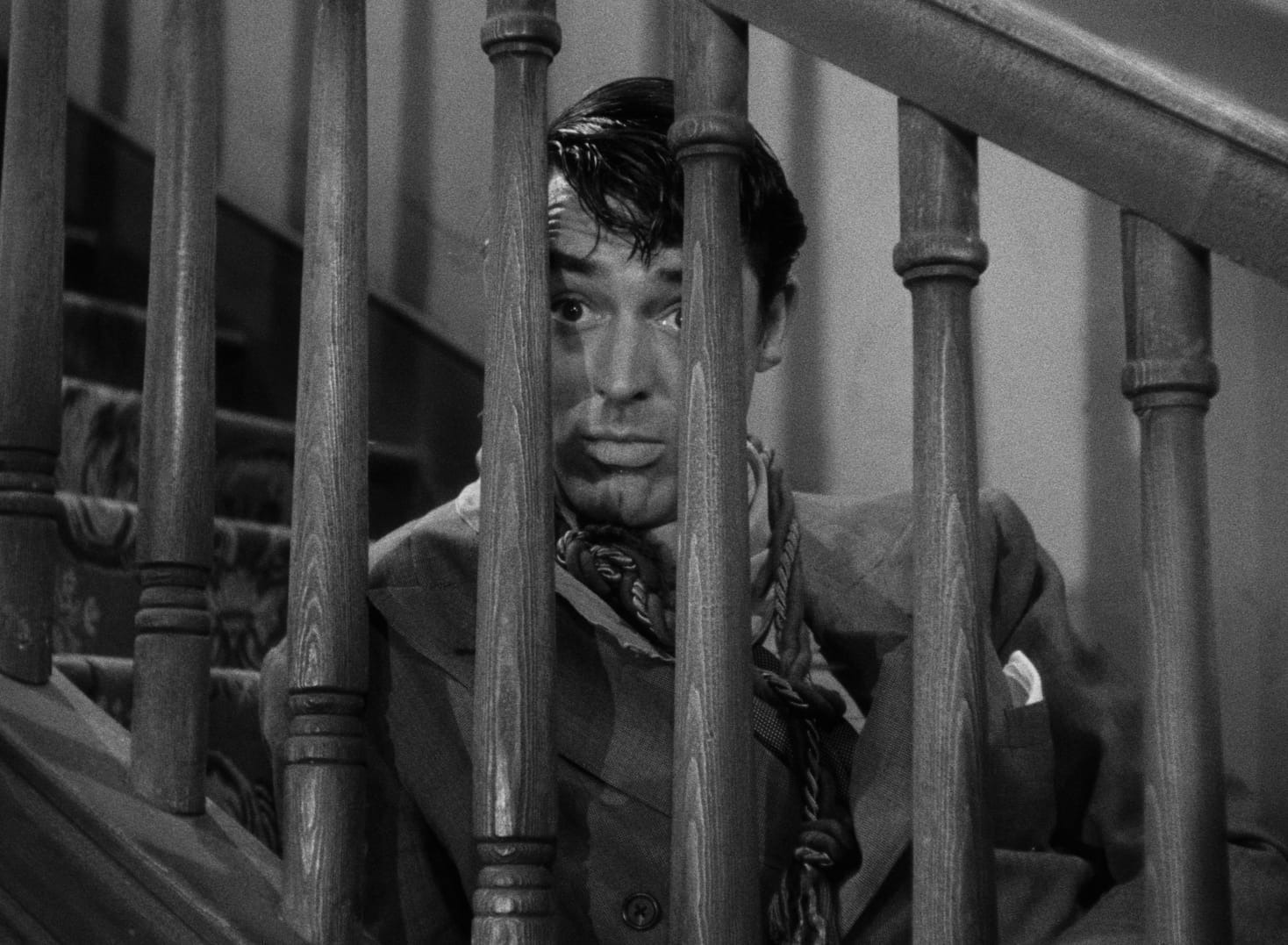
One thing I want to make sure I mention about this film is the cinematography. There are some really amazingly lit and positioned scenes from the film, including one where Jonathan’s shadow is towering over the doctor who is sitting on the stairs.
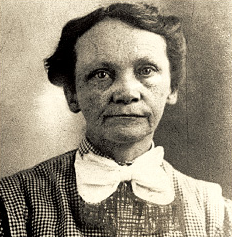
As I was preparing this blog post and sharing about the movie on Instagram this week, a very interesting story popped up about how the play was possibly based on a true story about a woman in Connecticut who ran a nursing home and was charged in 1917 with the murder of five people between the years of 1907 to 1917.
Amy Duggan “Sister” Archer-Gilligan poisoned five people, including her second husband Michael Gilligan. The others were residents in the nursing home. Some reports say up to 60 people died in the nursing home that was called The Archer Home for the Elderly and Infirm but Gilligan was only charged in five deaths. She may have killed her first husband, John Archer, in 1910 but the official cause of death was listed as Bright’s disease. Oddly, though, Gilligan had taken an insurance policy out on her husband a few weeks before his death. The payment from it allowed her to keep the home open.
She married Michael Gillian in 1913 and he mysteriously died of “indigestion” three months later. He was a wealthy man and despite the short length of their marriage, Michael had left his estate to her, not his four adult sons. It was later determined that Amy had forged Michael’s signature and that the will was a fake.
To make a long story short, the family member of a deceased resident tried to get the district attorney in the county to investigate Gilligan but he blew her off. Finally, the woman contacted a journalist who ran a story about the home and from there everything unraveled. The bodies of five people were exhumed and all had been poisoned with either arsenic or strychnine.
Kesselring never said if Gilligan’s story inspired the play, but it is interesting to note the similarities.
If you want to read more about her case you can see it here, but remember Wikipedia might not always be totally accurate.
In one article I read that Capra had considered both Jack Benny and Bob Hope for the role of Mortimer. No offense to either of those men (I love listening to old Jack Benny radio shows as I fall asleep at night), but I can’t see the film with anyone other than Cary.
One site – Movies! Reel Variety – said that Cary doubted his performance later. He felt he overplayed the character and that Jimmy Stewart would have played the part better.
This was the only film he made with Capra, whom he called “a dear man.”
Criterion.com (https://www.criterion.com/current/posts/7952-arsenic-and-old-lace-madness-in-the-family) states that while Capra worried that delaying the film would cause it to miss out on the box office war boom or make the subject, or actors stale, but instead Cary was just coming into his own and was one of the hottest actors in Hollywood by 1944.
Cary said he wanted to do the film because he “just wanted to have fun” after being in so many films in the 1930s that were social commentaries.
After playing the part, though, he complained about it, but, according to the Criterion article, he complained about many of his performances and worried over them even when the audience loved them.
Arsenic and Old Lace is one of these films.
I enjoyed this paragraph in the Criterion article: “In his book on Grant, Richard Schickel defends Grant’s and Capra’s bold choices, asking, “What’s a man supposed to do when he finds bodies buried all over his maiden aunts’ house? Arch an ironic eyebrow?” The playing is entirely appropriate to a character in such circumstances in a farce, even if, as Schickel concedes, it is “not Grant’s most urbane performance.”
Shooting of the film was finished five days after Pearl Harbor was bombed. Frank Capra joined the Signal Corps, but luckily was given some time to first finish what proved to be his only black comedy, or the world might have had to wait even longer to see it.
Next week we are taking a break from watching movies to give time for any of you to catch up on the films yourself and write about them, if you want to.
If you’ve watched any of the movies and would like to take part in our Comfy, Cozy Cinema, you can sign up on the link below.
When we return to the feature on Oct. 13 we will be writing about The Lady Vanishes.
After that, we will be watching the following movies:
For the next three months, Erin from Still Life, With Cracker Crumbs and I will be watching cozy, mysterious, or comfy movies. Erin made these awesome graphics detailing what we are doing and what movies we will be watching.
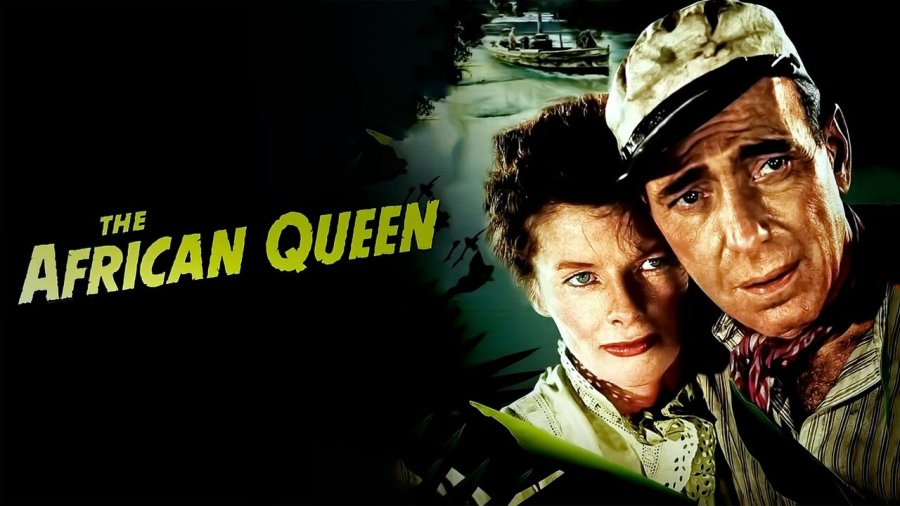
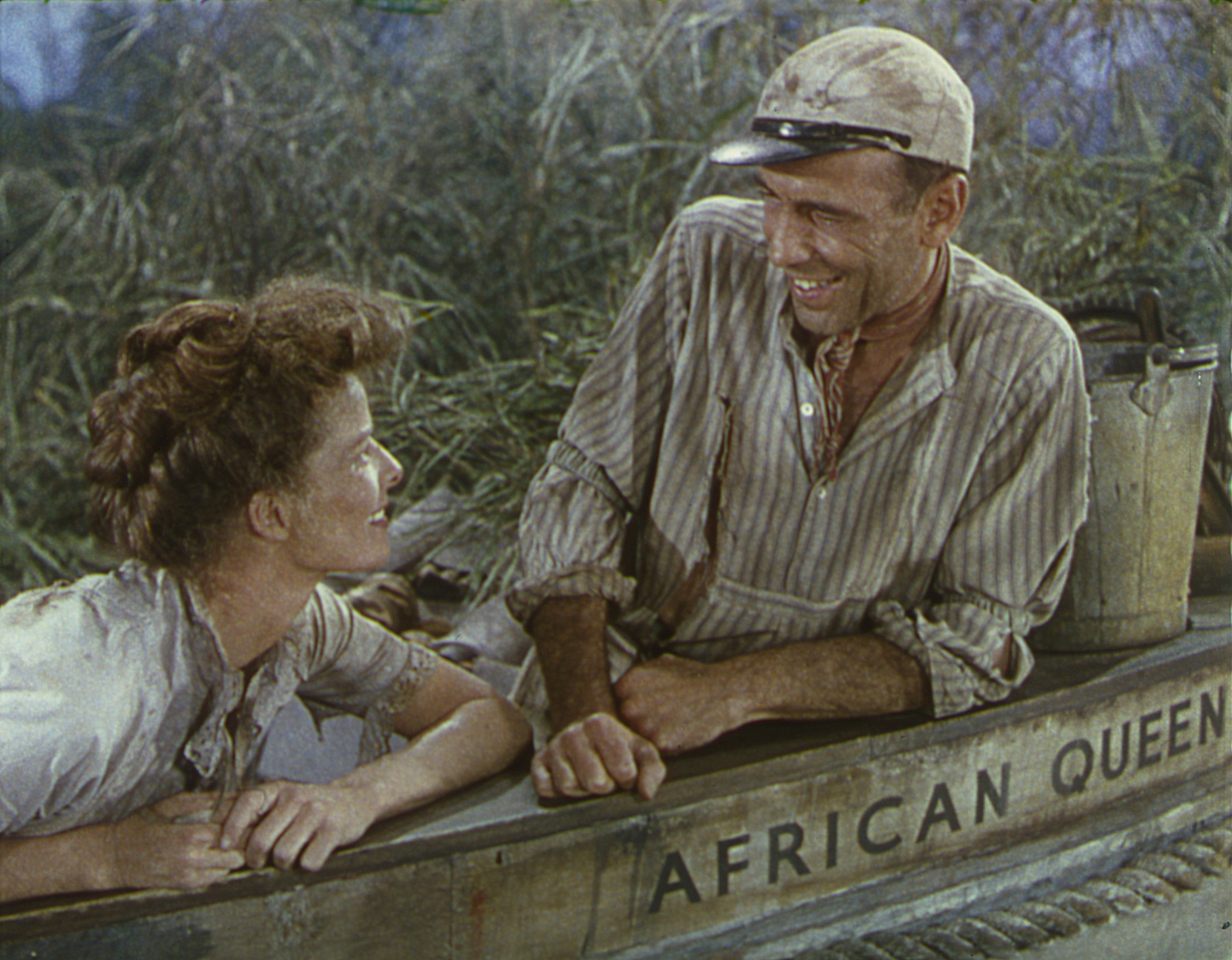
This week we watched The African Queen, which I am not sure was really a comfy, cozy movie but I forgot some of the details when I suggested it. I’m not sure why I picked it for this feature, but it’s still a good movie and we did find some cozy(ish) moments in it as a romance began to blossom in the middle of a very stressful situation.
The movie, released in 1951, stars Katherine Hepburn and Humphrey Bogart. It was directed by John Huston.
It is both an adventure movie and a romance.
Katherine plays Rose Sayer, a missionary in Africa, and Humphrey portrays Charlie Allnut (which Katherine pronounces as Ulna throughout the movie).
Rose had stationed been in African villages with her brother for a decade and meets Charlie when he travels up the river in his small, rickety steamboat to deliver mail and other supplies. The steamboat was dubbed The African Queen by Charlie.
On one visit Charlie tells Rose and her brother Sam that he probably won’t be there for two months because war has broken out. The movie starts in 1914 so this is the beginning of World War I.
He leaves and within a matter of hours or days, or I’m not sure which, the Germans march through with an army made up of Africans and begin to burn down the village. This leaves Rose’s brother in a state of shock and also affects his physical health and he passes away a couple months or so later.
Rose is now alone in the village but luckily not for long as Charlie finds her and she asks him to take her with him up the river.
Rose and Charlie are very different. She is very prim and proper and British and he is very “uncouth” one might say. My husband said that the movie is based on a 1935 novel and that the main characters in the novel are both British. Charlie has a cockney accent. Humphrey refused to try to pull that accent off so he was made Canadian for the sake of this movie.
The chemistry between the two is great with them bouncing quips off each other throughout the film.
When Rose finds out they are upriver from a German ship that will be used to launch an offensive against the British, and that Charlie has potential weapons on The African Queen, she decides they will travel this very dangerous river with rapids, crocodiles, and a German fort, and blow up the German ship.
Charlie, for his part, thinks she’s nuts but agrees to help her – that is until things get more and more dangerous and he’s certain they are going to die in the rapids.
When he tells her in the beginning that it isn’t possible to take the steamboat down the river she says, “How would you know? You’ve never tried.” He scoffs. “I’ve never tried shooting myself in the head either.”
In another scene, Charlie gets drunk on the gin that’s on the boat and Rose is not happy about it.
“Oh come on,” Charlie says. “It was just human nature.”
Rose raises her chin and says, “Human nature, Mr. Allnut, is what we are put on this world to rise above.”
There are several comments or lines like that throughout the film which turns romantic somewhat by accident when Charlie celebrates one of their accomplishments and kisses Rose on impulse.
Kissing and being romantic was most likely a huge challenge for Katherine because she, like most of the cast and staff, caught dysentery and malaria and was very sick for the time in Africa.
Huston wanted the film to be as realistic as possible so he shot on location in Uganda and the Congo for part of the film with the rest being shot in London, outside and on a sound stage. Scenes where the actors were in the water were deemed to be too dangerous in Africa.
It was so realistic that Katherine and others got sick, as I mentioned, and during one scene when she’s playing the piano, she actually had a puke bucket off-scene just in case and I guess there were a few “cases.” Poor woman.
Boggie later joked that he and Huston didn’t get sick because they drank whiskey instead of the local water.
As a bit of trivia, the only Oscar Boggie ever won was for this film. Katherine was nominated for best actress but did not win. Huston was also nominated for best director but didn’t win.
Katherine won four Oscars and was nominated 12 times over the years. She also won an Emmy and two Tony Awards.
This comment came from my husband who always has a cheery note about when or how one of the actors died as we watch a movie: “To think he (Boggie) would only have five more years after this.”
At one point, when Charlie apologizes for getting drunk Rose says that is not upset about that.
“You think it was your nasty drunkenness I minded? You promised me you’d go down the river.”
“Well, I’m taking my promise back,” Charlie says.
Little Miss looked at me and said, “Fun fact. You can’t take back a promise.”
So there you go. Some wisdom for your day.
When this movie came out, both Boggie and Hepburn were older and some critics said moviegoers wouldn’t want to see two old actors fall in love.
According to movie critic Roger Ebert, though, that wasn’t true. Many people wanted to see the movie and loved it despite it being released at the same time as A Streetcar Named Desire with Marlon Brando and Vivien Leigh.
The novel was much darker but Huston credited Boggie and Hepburn with making the movie have some humor in it.
“They were just naturally funny when they worked together.” Miss Hepburn, on the other hand, gives the credit to Huston. “The humor didn’t just grow, it was planted. The picture wasn’t going well until Huston came up with the inspiration that Rosie, my role, should be played as Eleanor Roosevelt.”
Ebert said of Bogart’s role: “Whatever the case, the many scenes Bogie and Kate play together are superb. Bogart, as the gin-swilling proprietor of a banged-up riverboat, created a strange little laugh for his role. He was shy, amused and intimidated by this Bible-reading missionary lady who washed out her unmentionables each and every night. And the laugh, meant to conceal his unease, also serves to display the thoughts of a taciturn man. He does not often laugh at the things Rosie finds funny.”
There was one scene with leeches and I wanted to know if they were really on Boggie. A quick search online brought me to a site full of trivia which let me know that: “While filming the scene where Charlie finds his body covered with leeches, Humphrey Bogart insisted on using rubber leeches. John Huston refused, and brought a leech-breeder to the London studio with a tank full of them. It made Bogart queasy and nervous, qualities Huston wanted for his close-ups. Ultimately, rubber leeches were placed on Bogart, and a close-up of a real leech was shot on the breeder’s chest.”
It is an interesting site and I was going to leave a link here to it but it says the site is not secure so I won’t do that – just in case.
The bottom line was that I did like this film but it wasn’t necessarily comfy, cozy or creepy. I guess it was a mix of comfy and adventure.
For the next three months, Erin from Still Life, With Cracker Crumbs and I will be watching cozy, mysterious, or comfy movies. Erin made these awesome graphics detailing what we are doing and what movies we will be watching.
This week we had a double-feature. Erin chose Fantastic Mr. Fox and The Secret World of Arrietty. I had never watched either of them. I love how Erin pulls me out of my comfort zone and introduces me to knew things.
The Secret World of Arrietty is a Studio Ghibli film.
Studio Ghibli is a Japanese animation studio for those of you who are like me and have no idea.
I honestly didn’t understand what Studio Ghibli was until Erin talked about it and then my son wanted me to watch Howel’s Castle with him a couple of months ago. These are animated films made in Japan and later dubbed into English to watch in the United States. Or you can watch the Japanese version and read the subtitles. The movies have become very popular and big-name actors are now being used to voice the American versions.
The movies from Studio Ghibli are often quirky and fantastical, strange but also poignant. They aren’t everyone’s cup of tea and I honestly had no interest in watching one until The Boy suggested it and then Erin said she wanted to watch this one.
I ended up liking Arrietty more than I expected.
As my son said, “I can see why she likes this movie so much. It’s just really creative and cool.”
And it was.
Arrietty and her family members are very tiny people – like two inches high, not like the cast of TLCs Little People, Big World (who are actually called little people and who I am almost as short as).
It is similar to The Borrowers, the book and movie, and is actually the inspiration for the movie.
The movie has a very, cozy feel to it . . . until you realize the stinking ants are bigger than the people and can eat them. Ack!
This isn’t essential to the movie, but I love Arrietty’s outfits…she’s so cute. I want to be cute.
The Boy commented on how he likes how the studio pays such attention to details, including using the wood staples as the ladder.
The movie starts with a human family coming to a new house. We are clued in very quickly that the young boy is sick for some reason – something with his heart.
The young boy sees Arrietty in the bushes when he first arrives but she runs away.
Later that day her father agrees to let her come with him when he goes into the house of the beans (which is what they call humans) to borrow items, such as a sugar cube and a pin, that they can use. This is Arrietty’s first time helping her father borrow and she’s nervous but excited. She’s even more nervous when the boy spots her again and this time, he speaks to her and tells her not to be afraid.
She isn’t afraid but she and her dad quickly leave without speaking to the boy.
The next day the boy leaves the sugar cube Arrietty accidentally dropped in his room to try to get to know her.
Her parents, however, tell her to stay away from the boy, afraid traps will be set for them and that they will be killed.
Of course, Arrietty doesn’t listen to her parents because if she did then there wouldn’t be a movie.
She does go to meet the boy – whose name is Shawn – and is almost killed by a crow. Luckily, Shawn rescues her.
They don’t talk much but later Shawn’s aunt shows him a dollhouse that his mother made with her father for the Borrowers to use. The Borrowers never came, though, and this made the mom sad. Shawn knows that the little family would love the kitchen so he takes it from the dollhouse, rips up the floor and practically gives them a heart attack by giving them the kitchen.
This traumatizes the family and Arrietty’s father says they have to leave so they won’t be chased out, trapped or killed.
Shawn likes to say uncomfortable and awkward things like the antagonist in any anime film, The Boy says.
He says things like, “There’s less and less of you every year, isn’t there?” and “We can’t all live forever.”
The Boy said, “Bro’s got that unsocial riz, doesn’t he?”
So while Shawn is not a threat to the Borrowers, the housekeeper, voiced by Carol Burnett, totally is. For some reason, she wants to find and destroy The Borrowers. I don’t get what her behavior is about at all but she’s creepy as anything.
This, yet again, isn’t related to the overall plot of the movie but the beds these characters have look so comfortable. There is a lot of cozy feelings to this movie overall.
I won’t give away what happens to the family or the boy but I was so nervous for them throughout the movie.
I will comment on one thing about these movies though – the voice actors don’t emote very well sometimes so the characters end up giving very weird and monotone effects to the line delivery. For example, there are times when they should be alarmed but instead, they respond in a very monotone way and it makes the kids and I giggle. Little Miss does an amazing imitation of those moments when the characters deliver bored sounding responses to otherwise alarming situations.
I am not complaining about the sometimes monotone delivery, but just commenting on how it is just a little odd quirk of the movies when they are dubbed. An odd quirk that makes us giggle.
For the next three months, Erin from Still Life, With Cracker Crumbs and I will be watching cozy, mysterious, or comfy movies. Erin made these awesome graphics detailing what we are doing and what movies we will be watching.
This week we had a double-feature.
Today we are writing about Fantastic Mr. Fox and Thursday we are writing about The Secret World of Arrietty.
The Fantastic Mr. Fox, released in 2009, is a stop-motion animation movie directed by Wes Anderson.
I don’t know much about Wes Anderson but I’ve heard his movies are always a bit weird. This one is no exception, but it isn’t the weirdest movie I’ve ever seen. It’s weird but the animation and direction are amazing.
The movie is based on the Roald Dahl book of the same name. Anderson signed on for the project because he said Dahl was a hero of his. He even made the scenery look like Dahl’s hometown of Great Missenden.
The kids and I cuddled up in cool fall weather (even though today is supposed to be close to 80. Grrr) to watch it last night.
Mr. Fox is voiced by George Clooney.
He is a former bird thief whose wife has asked him to turn his life around so now he writes a column for a newspaper, which I know firsthand is not a lucrative job.
Despite that, he purchases a house above the ground in a tree. This tree is close to three very mean farmers – Boggis, Bunce, and Bean. One farms chickens, the other geese, and the third turkeys.
Mr. Fox is feeling a bit antsy in his newspaper job (again – firsthand experience with this right here) and decides he needs some excitement. He concocts a plan to pull off a bird heist at each of the farms, despite being warned about how dangerous the farmers are.
He enlists the help of a new clueless opossum friend named Kylie, who isn’t the best sidekick for a dangerous heist, but was one of our favorite characters (“Apple juice. A flood of apple juice.”)
There are a ton of big name voices characters in this one: Clooney, Meryl Streep as Mrs. Fox, Owen Wilson, Willem Defoe, Bill Murray, Michael Gabon, Jason Schwartzman, and Anderson himself.
In between Mr. Fox’s story of wanting to experience the thrill of the steal, if you will, is an underlying story of how his son feels left out and inferior to his cousin Kristoffersen.
Then it all comes to a heart-pounding climax when the farmers join together to take Mr. Fox and his family – and subsequently other animals underground – out.
According to Wikipedia: “Fantastic Mr. Fox premiered as the opening film of the 53rd edition of the London Film Festival on October 14, 2009, and was released in the United States on November 13, to critical acclaim, with praise for Anderson’s direction, humor, and stop-motion animation. However, it underperformed at the box office, grossing just $46.5 million against a $40 million budget. The film received Academy Award nominations for Best Animated Feature and Best Original Score.”
Anderson did add some to the movie that was different from the book, with the second act being mainly from the book.
The movie for the music, which is fun and quirky, was composed by Alexandre Desplat.
The kids and I really liked the film, even if I was so nervous about what was going to happen in the end. It was quirky, funny, and very creative.
For the next three months, Erin from Still Life, With Cracker Crumbs and I will be watching cozy, mysterious, or comfy movies. I think maybe cozy and comfy is the same thing, but you know what I mean. Erin made these awesome graphics detailing what we are doing and what movies we will be watching.
If you want to join in and give us your impressions of the movies we watch you are more than welcome to do so!
This week we watched The Shop Around the Corner with Jimmy Stewart, Margaret Sullavan (yes, this spelling threw me off but that was her actual last name), and Frank Morgan.
If you watch this movie and think that Frank Morgan looks very familiar but you just can’t place him, just imagine him saying, “Pay no attention to the man behind the curtain.”
Yes. He was The Wizard in The Wizard of Oz.
In this movie, he is Mr. Matuschek, who owns a leather goods store in Budapest, Hungary called Matuschek and Company. They pronounced Matuschek as “Matachek” in the movie. His top salesman and most trusted employee is Alfred Kralik (Jimmy).
The movie opens with all the employees gathering together and letting us all get to know a bit about them.
Besides Kralik there are Kralik’s coworkers include Karlik’s friend, Pirovitch (Felix Bressart), a kindly family man; Ferencz Vadas (Joseph Schildkraut), a two-faced womanizer; saleswoman Ilona Novotny (Inez Courtney); clerk Flora Kaczek (Sara Haden); and Pepi Katona (William Tracy), a sassy errand boy.
We also learn in the beginning that Stewart has been writing letters to a woman he connected with through a newspaper ad she placed.
They’ve been hitting it off, and he’s getting ready to actually meet her.
On this same day, Mr. Matuschek comes into the store with a bunch of musical cigarette boxes that he has to figure out how to sell. Mr. Kralik disagrees that Mr. Matuschek can sell the cigarette boxes and they have a brief spat.
Enter Margaret Sullavan as Klara Novak. She’s looking for a job and proceeds to sell one of the boxes to a customer. Mr. Matuschek hires her on the spot, much to the disappointment of Mr. Kralik, who doesn’t like the threat to his position but also finds her a bit pushy.
Enter a very popular trope in romance movies – enemies to lovers.
This trope has a couple twists, though, and that makes the movie interesting and more than just a romance.
The funny thing about the movie is that it is supposed to take place in Hungary but almost everyone has a New York/American accent.
This was a bit of a goofy movie with a couple of serious themes mixed in. It features wonderful bantering between Stewart and Sullivan and some really great acting from Stewart, especially. I don’t know that I would say Sullivan was a “great” actress in this, but she was very good and held her own against Stewart’s strong personality.
According to TCM: “James Stewart and Margaret Sullavan had known each other a long time before making The Shop Around the Corner. Both were in a summer stock company called the University Players. It was there that Stewart realized his potential as an actor, so he followed Sullavan and fellow player Henry Fonda to New York to begin an acting career in earnest.
Even though Margaret Sullavan was infamous for her quick temper and disdainful attitude towards Hollywood, James Stewart counted working with her as one of the great joys of his professional career. And because he knew her personally, he was more equipped than most of the cast and crew members to deal with her frequent and volatile emotional outbursts.”
I also loved this tidbit that TCM shared: “Stewart said: “We were in this little restaurant and I had the line: ‘I will come out on the street and I will roll my trousers up to my knees.’ For some reason, I couldn’t say it. She was furious. She said, ‘This is absolutely ridiculous.’ There I was standing with my trousers rolled up to my knees, very conscious of my skinny legs, and I said, ‘I don’t want to act today; get a fellow with decent legs and just show them.’ Margaret said, ‘Then I absolutely refuse to do the picture.’ So we did more takes.”
The movie was based on the 1936 Hungarian play Parfumerie. The 1998 movie You’ve Got Mail, which starred Meg Ryan and Tom Hanks, was based on that play as well.
The musical In The Good Ole’ Summertime is an almost scene-for-scene musical remake of The Shop Around the Corner.
I don’t want to give too much of the movie away, but there is a falling out between Mr. Matuschek and Kralik and a firing, but it is all over a misunderstanding involving Mrs. Matuschek. There are actually a lot of misunderstandings in this movie, and some of them are quite funny and interesting.
There are some great lines in this movie including:
Alfred Kralik: There might be a lot we don’t know about each other. You know, people seldom go to the trouble of scratching the surface of things to find the inner truth.
Klara Novak (Miss Novak) : Well I really wouldn’t care to scratch your surface, Mr. Kralik, because I know exactly what I’d find. Instead of a heart, a handbag. Instead of a soul, a suitcase. And instead of an intellect, a cigarette lighter… which doesn’t work.
Klara: [In her letter to Alfred] : Oh, my Dear Friend, my heart was trembling as I walked into the post office, and there you were, lying in Box 237. I took you out of your envelope and read you, read you right there.
Klara : Mr. Kralik, it’s true we’re in the same room, but we’re not on the same planet.
Alfred: Why Miss Novak, although I’m the victim of your remark, I can’t help admiring the exquisite way you have of expressing yourself. You certainly know how to put a man in his planet.
And this one from Klara, I would love to put on a T-shirt for myself: “Psychologically, I’m very confused… But personally, I don’t feel bad at all.”
The movie was directed by Ernst Lubitsch who told a reporter from the New York Times: “It’s not a big picture, just a quiet little story that seemed to have some charm. It didn’t cost very much, for such a cast, under $500,000. It was made in twenty-eight days. I hope it has some charm.”
I would definitely say the movie has a lot of charm.
Next up for our movies is a double feature with Fantastic Mr. Fox and The Secret World of Arrietty (a Studio Ghibli film). Erin and I will share about them next week.
This week is my final week of Summer of Marilyn, where I watched Marilyn Monroe movies. My final movie was The Misfits with Marilyn, Clark Gable, Montgomery Clift, and Eli Wallach.
I’m going to be honest and admit right off the bat that I hated this movie in many ways. Part of me was confused why my husband recommended I add it to my list for my Summer with Marilyn feature. Once I watched the movie all the way through, I got why he suggested it but I still know I won’t watch this one again. It was too raw for me at this season in my life.
In other words, it isn’t that movie is bad – it’s that it is depressing with a capital D. Or most of it is. There are some moments toward the end where things start to look up.
I am so glad to be done with Marilyn movies – even if they were good. This capped off a depressing stagger through Marilyn movies that made me sad about her life.
My son says the same thing about Marilyn – watching her movies is sort of depressing when you think about how her life ended up and how used she was through her whole life.
I barely made it through this movie and found myself mentally tuning out through a few scenes to emotionally protect myself from the darkness and depression.
This movie was shot documentary style and I liked that about it.
I read another review of this movie and agree with the writer that this is not a movie you can really figure out. You just have to take it as it is.
“Haunting. That’s the word that best describes “The Misfits”.” Jay’s Classic Movies Blog writes. “It sums up this film’s atmosphere, performances, story, visuals, and even its legacy. Filled with symbolic overtones, it is one of the very few films that is better to think about and feel than figure out.
Marilyn’s character is Roslyn Tabor.
Guido is the tow truck driver who drivers Roslyn and her friend Isabelle to town so Rosalyn can get a divorce to a man she’s only been married to a couple of years.
After the divorce hearing, Isabelle and Rosalyn go to get a drink and run into Guido and his womanizing cowboy friend played by Clark Gable. Clark’s character is Gay. No, I mean his name is Gay or Gaylord Langland actually.
I have no idea why but Isabelle and Rosalyn accept Guido’s invitation to go see the home Guido built for his late wife.
The movie is already a bit dark and depressing but gets worse when Guido shows Rosalyn his wife’s room where she died. She was pregnant at the time and both she and the baby died. Guido never finished the house but offers Gaylord and Rosalyn the place if they want to fix it up.
Again, all very weird because Rosalyn agrees and becomes connected to Gaylord who is like 20 years older than her in real life and in the movie.
There is a series of sad moments that finally lead to running into Montgomery Clift who is riding broncos and bulls to earn money but agrees to go up in the mountains with Gaylord to round up Mustangs which they will sell for dog and cat food.
Rosalyn is completely devastated when she finds out they will be selling the horses to be made into dog food. It is just another reminder for her how cruel and awful life can be.
One thing I find super creepy about this movie is how all the men are attracted to Rosalyn and want to get in bed with her pretty much. They just leer at her most of the time and say things like, “Your eyes are so innocent. It’s like you were just born.”
It’s clear by some of the things she says that she’s been through a lot. She’s weird and deep and yet not deep all at the same time.
At one point she asks Guido if he danced with his wife. He says he didn’t because she wasn’t graceful.
“Why didn’t you teach her to be graceful?” Rosalyn asks.
“You can’t learn that,” Guido retorts.
“She died, she didn’t know you could dance,” Rosalyn says sadly. “To a certain extent you two were strangers. We’re all dying aren’t we? All the husbands and all the wives and we’re not teaching each other what we really know.”
And the sad thoughts and melancholy commentary continues from there.
The movie is based on a play by Arthur Miller, who Marilyn was married to at the time. She divorced him the same year and died a year later from a drug overdose.
Gable died before the movie came out. This movie was both of their final completed movies.
Everyone is very sad and broken in this movie. Like everyone. It’s very depressing. Clark Gable’s character is especially cruddy with no real feelings except for money.
Rounding up the wild horses in the end is like stomping down everything wild and free in life and Gaylord is all for that. He just can’t admit that it is the wrong thing to do. And Guido – well he just wants something in return for doing the right thing.
The best lines and the most intense acting Marilyn does starts when she turns to Guido in shock after he says he’ll stop the horses from being killed if she will consider getting together with him.
“You have to get something to be human? To do what’s right? You’ve never felt anything for anybody in your whole life. You could blow up the whole world and all you’d feel sorry for is yourself.”
Five minutes later she’s in the desert screaming “Murders! Liars! You’re only happy when you can see something die!”
It was like she was screaming at all of Hollywood in that moment and it was a kick in the gut for me.
There was way too much that was too close to Marilyn’s real life in this movie.
A woman used for her looks and her uncertainty and her lack of self-esteem to stand up for herself and decide what she wanted for her own life.
She seems so young in this film in some ways.
Young and hopeful and full of life, but inside she was truly dying – not just her physical body but her soul.
During the filming of this movie her co-stars felt she was on the way to doom and she was.
According to articles online, filming of the movie was hard because the weather was 100 degrees in Nevada, her marriage to Arthur Miller was failing, Miller was rewriting the film as it progressed, and at the end of the day she was drinking and taking pills to get through it all.
This movie might be the most honest movie I’ve seen her in – the way she doesn’t know what to do with her life, her confusion about life, her sadness, her melancholy chats about the meaning of life and the loss of life.
Like I said in the beginning, this whole marathon has made me hurt.
It’s made me hurt for Marilyn but also for all the people in the world who are beautiful on the outside and hurting on the inside. The people who search for their worth in the eyes of other people without realizing they were created for a bigger and better purpose – that life is worth living because there is a lot of good to be experienced, not simply because other people might see them as worthy.
I think sometimes it is better to watch movies and not know the personal lives of the actors in them.
Otherwise I find myself focusing too much on their personal lives and how they intersected with their movie roles. If you want to see what I said about the other movies I watched, you can find the posts by visiting the search bar to the right and typing in “Summer of Marilyn.”
My next movie impressions will be with Erin from Still Life, With Cracker Crumb when we take on a variety of movies including noir, cozy, fun, and mysterious for autumn.
A sinus thing that wasn’t exactly an illness but a weather change thing hit me last week so I ended up forgetting to finish watching my one Marilyn movie and watching the other one. In other words, I have a good excuse for being late on my Marilyn movie impressions.
I’m going to be sharing about two Marilyn Monroe movies this week since I have been so behind on watching and writing about them. They are two very, very different movies on different ends of the spectrum – Monkey Business and All About Eve.
First up: Monkey Business.
Cary Grant is an absent minded professor in this screwball comedy that he stars in with Marilyn and Ginger Rogers.
Ginger is the straight man (woman) in this one with Cary being more of the goofball with the biggest bottle cap glasses I have ever seen him in. They looked more like something Jerry Lewis would wear.
This is very early Marilyn, so she almost likes like Norma Jean probably looked before she became Marilyn, but not quite. She still has the pouty lips and short hair, but the hair looks darker to me in th is film.
Marilyn plays the secretary of Cary’s boss and in their first scene together she shows Cary the stockings he invented and how they look on her legs. Cary’s character, showing his true nerdy self, is more interested in the stocking than the legs they are covering, of course.
The premise of the movie is rather silly but silly is a wonderful escape from life so I liked that it was silly.
Cary is working on a formula that could help people look and feel younger. It also, apparently, makes them more virile – ahem. The monkey they test it on is very interested in the female monkey, despite being 84 in monkey years. The monkey Is also able to move around like a young monkey after taking the formula.
This is after many of the tests did not yield any results.
(As I side note here, I must say that I don’t know many other actresses who have a hip sway like Marilyn. I am completely jealous of it and the shape of her. Sigh.)
It’s the monkey that finally mixes the winning concoction for a type of youth formula and then proceeds to pour it in the water cooler. Cary and his fellow professors don’t know this, of course, so when Cary decides he’s going to be the guinea pig and take his own formula and then wash it down with the water from the cooler. So Cary believes that his formula is what helps him when he suddenly can see without his glasses and then becomes like a teenager and runs off with Marilyn’s character to buy a new car.
After Ginger learns that Cary tested the formula on himself, she decides she should be the test subject and she takes the formula, which we know doesn’t work, but it tastes so awful she washes it down with the cooler water.
Now she becomes the young and crazy 20 something year old.
She ends up with teenage angst complete with crying and breaking down at Cary. It’s a hilarious but ridiculous scene. I have a feeling Ginger had a blast filming it.
Ginger even gets a chance to dance a bit in the film, even though that isn’t the main focus, when she’s feeling a lot younger.
The film is a low-key romance with the two of them realizing even under the influence of the formula how much they love each other.
Luckily the formula does wear off and when both have had it wear off, they decide the formula could cause more harm than good. Cary is going to destroy the formula and that’s when they decide to make a pot of coffee with the water from the cooler. Ah, yes, I’m sure you know where this is going. Craziness is about to ensue so hold on to your seats.
You’ll have to watch it to see what happens, which reminds me, you can watch it for free on YouTube here:
I pulled a bit of trivia off of IMbd about the movie and some of it was very interesting. Here are a few tidbits:
The exterior shots of the Oxly Chemical Co. office building where Barnaby works were actually shots of the Executive Building on the 20th Century Fox studio lot. The building is now known as the Old Executive Building.
The sports car used in the film was a red 1952 MG TD Roadster, which was put into storage by 20th Century-Fox after filming wrapped. It was purchased by Debbie Reynolds in a 1971 sale of Marilyn Monroe memorabilia (despite the fact Monroe herself never owned the car). It sustained a dent in the front bumper when Cary Grant hit a fence while driving it. Reynolds had the transmission rebuilt, then put it up for auction in 2011. It sold for $210,000.
Among the movie star photos Marilyn Monroe taped to her bedroom wall when she was a foster child were several of Cary Grant. She was thrilled to be co-starring with him in this film, a break-through role in her then fast-rising movie career.
Forty year old (forty-one at the time of release) Ginger Rogers was the oldest leading lady to ever star in a Howard Hawks picture.
Marilyn Monroe plays the character Lois Laurel. The real Lois Laurel is the only daughter of comedian Stan Laurel of the comedy team Laurel & Hardy.
Shares a title with the otherwise unrelated 1931 Marx Brothers comedy “Monkey Business,” though the films have some vague connections: Early in his career, Cary Grant was partly inspired by Zeppo Marx, the team’s parodic juvenile straight man. In addition, the 1931 film co-starred Thelma Todd, whose life, career, and mysterious death parallel Grant’s co-star here, Marilyn Monroe.
This movie was so much fun and I really did enjoy it. I mentioned above that Ginger must have had so much fun filming that one scene but I have a feeling they all had a ton of fun. It was absolute ridiculous and hilarious fun.
All About Eve
Now, Marilyn is not a main actress in this film, but it was one of her first movies and she was considered a standout in it, and my husband suggested it, so I included it in my list to watch this summer. Marilyn was 23 when the movie was made and just about to break her career wide open.
This movie was nominated for 14 Oscars and won six, including best picture. It is the only film in Oscar history to have four women nominated, including Bette Davis, Anne Baxter for actress and Celeste Holm and Thelma Ritter for supporting actress. Released in 1950, it made $3.1 million, more than half of it’s $1.4 million production costs.
Bette Davis is a famous stage actress named Margo who Eve Harrington, played by Anne Baxter, goes to meet one night after watching her show every single night during its run.
This is my first movie with Bette, by the way, and it did not disappoint.
Eve is very peculiar to say the least as this movie starts. She tells the actress and the producer and writers about her sad life of losing her husband early in their marriage and staying in San Francisco to make a new life for herself and her love of acting and the theater.
You know right away that something just feels off about her, even though the movie starts with her being honored as a well-known actress. She really inserts herself into the lives of these people and weasels her way into the acting jobs she wants, pushing others out of the way for it.
With her sob story, Margo welcomes her into her home and she becomes her confidant, her assistant, and everything you can think of that requires Eve to wait on Margo. It’s clear that Eve wants Margo’s job and as time goes on it is clear she’ll find a way to get it, mainly by being Margo’s everything. Actually, she’s a little too everything. She starts doing things that Margo doesn’t ask her to do and making herself look better than Margo. It’s a very strange obsession.
Margo begins to notice how attentive Eve is to her boyfriend and everything else. She also begins to compare herself to Eve and feel old around her. To her it’s time for Eve to move on because she has a feeling Eve is much more interested in taking her place, not just waiting on her. |
Marilyn doesn’t come in until more than 40 minutes into the movie and I didn’t even recognize her. She was beautiful, sure, but her hair was styled differently and she was a minor character. It was clear she was ready for stardom though and George Sanders uttered a premonition of sorts when he said, “Well done. I can see your career rising in the east like the sun.”
And soon after this movie, it did just that.
Her character Miss Casswell has the middle name of the author of the short story that was never credited for her part in the movie – Mary Orr.
She’s so young looking in the movie – it’s crazy. And, of course, she’s sort of passed off as someone sent in to make producers and directors happy because she’s sexy and flirtatious.
I searched online to see what critics said of Marilyn’s performance and found a few opinions. Here s one:
Lyvie Scott on Slashfilms.com said Marilyn stole the scenes she was in in All About Eve and I’d have to agree. She had some of the best lines, such as where Eve says she doesn’t know what she’d talk about with Dr. Dewitt (George Sanders) and Marilyn says, “Don’t worry about it. You won’t even get a word in the whole time.” Or something along those lines.
A bit off topic here, but George Sanders always reminds me of John De Lancie who played Q on Star Trek.
Scott wrote of Marilyn, “Monroe’s role in “All About Eve,” though small, is one of the most memorable of the film. It’s difficult to focus on anyone but Monroe when she’s in the room. Knowing just how famous she would become, it all feels like a testament to her inescapable star power.”
Scott, of course, details what others detail about Marilyn on film sets throughout the years. She was often late and had a hard time nailing her lines and was a bit difficult to work with overall. Marilyn tried to blame her inability to remember her lines on nerves and that very well may have been the case since she was acting next to Bette Davis and the fact that she’d only come off the success of one other film, “The Asphalt Jungle” before this.
Davis wasn’t really buying her excuses. According to Scott’s article: “Unfortunately, Davis was less than impressed with Monroe. Famously temperamental on set, she was already put off by the younger actress’s tardiness. And after so many retakes for a scene which, to her, must have been a breeze, Davis apparently snapped — and Monroe had to excuse herself to vomit offstage.”
It’s just so humorous to me that in this movie they pan Marilyn’s audition to be the understudy of Bette’s character when she would rise to stardom faster than almost all of them, except Bette. She might not have been as good of an actress, especially when compared to Bette, but she still seemed to shoot up even faster – probably because of her looks (aka breasts and hips).
I’m talking more about Marilyn in this post because my feature is called Summer of Marilyn, but I should be talking about Anne Baxter and Bette Davis more, especially considering Marilyn was only in this movie about ten minutes, if that. Both of the other actresses were very good in this, even though I could not stand the way Anne Baxter talked and how overly dramatic and maudlin she was. That was, however, her character so, in other words, she was brilliant in making me hate her.
As for Bette – wow. She knocked it out of the park. Here is what Roger Ebert said about her performance on his site:
Growing older was a smart career move for Bette Davis, whose personality was adult, hard-edged and knowing. Never entirely comfortable as an ingenue, she was glorious as a professional woman, a survivor, or a b***** predator. Her veteran actress Margo Channing in “All About Eve” (1950) was her greatest role; it seems to show her defeated by the wiles of a younger actress, but in fact marks a victory: the triumph of personality and will over the superficial power of beauty. She never played a more autobiographical role.”
Besides Bette and Anne Baxter, George Sanders was absolute perfection at being a dirty, crooked journalist. His speech toward the end of the movie was just absolutely outstanding and
She seems so innocent and idealistic but deep down she’s just pretty selfish to me. She wants a career and she doesn’t care whose coat tails she rides, or whose head she steps on, to get there. She’ll do it with big, watery eyes and a tipped head, of course.
The film is mainly about jealousy and ambition and the tangled web that both can weave, but it is also very much about the dread of getting older, especially for women. Margo feels that Eve is stealing everything from her because she is young. Off screen, Bette Davis was terrified of growing old and this part fit her well, as Ebert said. When she was talking about the dread of growing old in the movie, she was speaking from personal experience, not just from the experience of the character.
At one point she says, “Funny business, a woman’s career — the things you drop on your way up the ladder so you can move faster. You forget you’ll need them again when you get back to being a woman. That’s one career we gals have in common is being a woman.”
So far All About Eve has been one of the best films I’ve watched but not because of Marilyn, even though she was great in it. The best film I watched with her in it was a tie between Niagra and Some Like it Hot. We will see if The Misfits knocks one of those movies off the list when I watch it later this week.
Have you seen either of these movies? What did you think?
So here I am, behind yet again on my Marilyn movie-watching.
That’s okay, though. Summer is meant to be easy going and relaxed so I will take my time on these and if summer busyness gets in the way, I’ll just have to push my posts off.
If you are new here, I am watching Marilyn Monroe movies this summer and I have called the The Summer of Marilyn.
This week I watched The Seven Year Itch, which was nothing like I expected it to be.
I thought this movie was a drama until I started it and realized it was definitely not a movie to be taken seriously. This is the movie with the famous scene of Marilyn’s dress being blown upward by her standing over the subway grate.
This is a movie made in 1955 that jokingly explores the idea that middle-aged men who have been married seven years feel like they need to break out of the mundane and sow some more wild oats. I, personally, did not find it that funny that the movie makers thought it was funny to make fun of men in New York City sending their wives and children to the country for the summer so they can go meet other women and have parties, therefore feeling free and easy again.
We start the movie with Richard Sherman, a man working in book design, who sends his wife and son off to the country for the summer. Richard is determined he won’t be like other men who drink, smoke, and chase after women while their wives are gone.
Not long after he decides this, though, he heads home to a house that’s been made into apartments and starts complaining as he unlocks the door about how his wife wants to live in a house and not an apartment. Their apartment is nice, he decides, especially with nice neighbors upstairs and – he turns around and someone needs help being buzzed in through the main door.
That someone is Marilyn Monroe who is looking, of course, drop-dead gorgeous.
Richard has to renew his resolve not to forget himself and go crazy while his wife and son are gone with Marilyn acting all clueless and walking around upstairs either naked or half naked. When she almost drops a tomato pot on his head his resolve cracks and he invites her down for a drink.
It’s then he realizes she’s gorgeous but not too bright and that is totally fine with him.
He’s already been daydreaming a lot and Marilyn kicks his daydreams into high gear.
He enjoys daydreaming about how Marilyn will fall for him but, truly, Marilyn is just absolutely clueless to his advances and his more interested in getting into his apartment to take advantage of his air conditioning, which she does not have in her apartment.
Marilyn, incidentally, does not have a name in this movie. Her name is just The Girl.
This is another Billy Wilder film with Marilyn – like Some Like It Hot.
The movie is based on a play written by George Axelrod.
In addition to Marilyn it stars Tom Ewell who played Richard Sherman in the play as well.
Many lines from the play had to be cut because they were deemed indecent by the Hayes office, which determined what was and wasn’t allowed in movies at that time.
There has long been rumors that during the filming of the famous scene with Marilyn, there was too much noise to use the final footage and it had to be shot again on a sound stage. While it is true that the scene was shot twice, footage was used from both shoots, according to an article on Wikipedia. Marilyn really did stand over a grate outside the Trans-Lux 52nd Street Theater, then located at 586 Lexington Avenue in Manhattan. She also did get a lot of attention from the press and onlookers when this happened because Wilder invited them to drum up attention for the film.
This left Marilyn’s then-husband Joe DiMaggio pretty ticked off, but, alas, the scene became one of the most iconic ever in a movie.
Overall I enjoyed this movie, even if I didn’t like some of the messages underlying the plot. In the end, the craziness was drawn to a close before it got too crazy but the in-between stuff that seemed to suggest that men running around on their wives was okay wasn’t a great message for me. I do know that most of it was being said as a joke and that part of the message really was that it wasn’t actually okay to be done. And, yes, I really liked Marilyn in this movie. She was so free and joyful. Yes, she was sexualized, just like in her other movies, but she also held her own as an actress, playing the comedic parts with ease and pure entertainment.
Next up for me for Marilyn Movies is Monkey Business.
After that, I only have two more movies:
All About Eve and The Misfits.
Both are dramas.
If all goes to plan, I’ll be writing about Monkey Business next week, on August 3, All About Eve on August 10 and The Misfits on August 17th.
(Monkey Business is available for free on YouTube, for those who might like to watch along.)