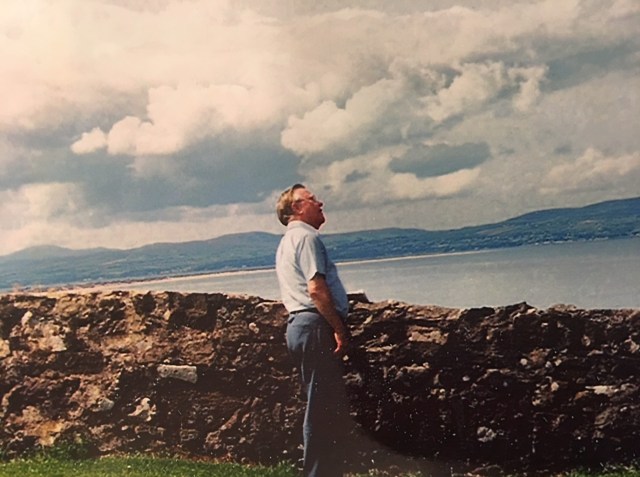
I pulled into the driveway of a little house that looked as if it had been lifted out of Northern Ireland and dropped, unscathed, into the hills of Pennsylvania. The ceilings were low, the windows were small and cute and the stone fireplace had been built by hand.
On one side of the house was a cow pasture and on the other a tiny, century-old cemetery with a sign on the metal gate that read “Enter At Your Own Risk.”
I blew my nose as I parked and began to rehearse what I would say to the elderly Irishman inside, determined to not let him talk me into staying for tea. I did not want tea. I wanted to go home, lay down and fall asleep after a long day of work at the local weekly newspaper and catching a cold that had only gotten worse as the day went on.
I would simply tell Rev. Charles Reynolds, the aforementioned Irishman, that I was too ill to come in, but would stop again another day when I was feeling better.
The door swung open and a man with blond-white hair, glasses slipping down his nose, stood there in a button up dress shirt and a pair of dress pants, his traditional garb for as long as I had known him; as if he had just returned from church.
“Hello, Rev. Reynolds, I’m sorry I can’t stay long, but I seem to have a cold and I don’t want to get you and Maud sick,” I steeled my resolve to not be swayed by his Celtic charm.
“Come, come. Have a cup of tea,” his Irish brogue was thick. “Maude, put the kettle on. We’ll have some tea and Lisa will feel better.”
“But I -”
“Come. Come.”
He was already walking away from me, gesturing for me to close the door.
Maude, his gray-haired wife, had dutifully shuffled into the kitchen, off to the left of the front door, and placed the kettle on the stove.
“Yes, Paddy.” She nodded curtly at her husband, like a soldier to a superior.
Her tone hovered somewhere between affection and sarcasm.
I sat at the kitchen table and waited for the whistle of the kettle as cookies, crackers, plates, tea cups, a bowl of sugar cubes and cream was placed on the table before me. water was poured into a teapot filled with loose tea and steam rose as it was poured into my cup and bits of the leaves settled at the bottom.
Rev. Reynolds leaned over the table and added a cube of sugar to my cup. Two, round white horse pills pills showed up next.
“There now. That will be just what you need. Tea and vitamin c.”
Rev. Reynolds’ had a doctorate but sometimes he seemed to forget it was in theology.
The dainty tea cup covered in blue patterns was warm in my hand and clinked against the plate when I set it down. Being served tea this way was a far cry from tea at my house, served in a mug with a tea bag after pulling it from the microwave.
“So, have you talked to Ian lately?”
I marveled at how Rev. Reynolds had the worst timing and the least tact of almost anyone I knew, other than my former editor.
I had no interest in talking about my former editor. My departure from the daily newspaper I had once worked at hadn’t been pleasant.
But if it hadn’t been for that job, my first in newspapers, I wouldn’t have met Rev. Reynolds.
********
“Hey, Lisa – this is Rev. Reynolds.”
Ian was the editor of the local daily I had started working at while still in college. He had a slight nasal tone when he spoke, like he had a permanent stuffed nose.
“He’s from Northern Ireland and would be a great source for a story about all the drama going on over there. We can localize an AP story. Interview him and give me 15 inches for the front page tomorrow.”
Localizing, or “adding local color” to a national or international story, was a favorite pass time of Ian, or as Rev. Reynolds would often call him “eeeeeahn”. The concept of localizing involved using an interview or information from a local resident and adding it to a story we had pulled off the Associated Press wire. Ian wanted me to add Rev. Reynolds’ comments to a story about the possible peace deal being negotiated between the Irish Republican Army and the United Kingdom.
“Oh, you’re Irish! Do you speak Gaelic?”
The elderly man with a slightly bulbous nose and holding a stack of papers, looked indignant.
“Noooo!” he cried in a drawn-out Irish accent. “That is the language of the rebels!”
I had no idea who “the rebels” were. Had we just switched to talking Star Wars? I didn’t know, but for the basis of needing to write a story for the next day’s paper, I needed to know.
Even after we talked I was a bewildered by it all. to this day I remain bewildered. It wasn’t until later I started to connect that rebels appeared to be synonymous with “Catholics.” In the world of Rev. Reynolds. As a Protestant, Rev. Reynolds had been raised in a family who supported Northern Ireland remaining within the United Kingdom. Most of those who supported the province remaining within Great Britain were protestant and those who wanted to break off and be part of the Republic of Ireland were Catholics. That’s about all I can explain because even after he explained it to me, wrote a book about it and told me to read it, and I looked it up online, I still can’t wrap my head around why there is an Ireland and a Northern Ireland.
In some sort of ironic twist straight out of a Hollywood script, Rev. Reynolds ended up in the hospital at one point after our friendship grew and his roommate was a local priest, who was well known to my husband and I. Not only did a friendship develop between the two but through him Rev. Reynolds developed a friendship with an Indian priest who was serving as an assistant priest at our local Catholic Church. I remember Rev. Reynolds inviting my family, including my parents, and the local priests to dinner at a local restaurant where he spoke about his life coming full circle – from a distrust of Catholics at a young age to an affection for members of the church he had come to call friends.
From that day at the paper, I became the contact for Rev. Reynolds for his various projects. And he always had a project underway. A fundraiser for an Indian village damaged by a tsunami; a new book he was writing and wanted publicity on; a need to bring awareness to the need for more women in the medical field in India. They were all worthy causes but sometimes it was hard to keep up with his ever-growing list of charitable pursuits.
********
 “Tea has healing properties,” Rev. Reynolds slipped another cube of sugar into my tea.
The tea came from a 50-year old stash in the shed across the dirt road that they’d brought back from India during their time as missionaries. Rev. Reynolds pulled back a tarp one time to show me the small, square white and green boxes stacked high, each full of traditional, loose leaf Indian tea. They’d had it shipped to them from India and knowing Rev. Reynolds he’d found a way to get it there at little to no cost to him. Rev. Reynolds had a way of convincing people they wanted to help him.
I began to realize my headache and body chills were fading. Maybe Rev. Reynolds was right about the healing properties of tea after all.
It was often hard for me to imagine this man, sitting across from me at the table, now in his mid-70s, as a young man living in Northern Ireland. During World War II he joined the Royal Air Force and was stationed in India, where he fell in love with the Indian people, but also with a young woman from a little farming village in Pennsylvania who was in the country as a missionary. After the war he and Maud became missionaries to the country for 20 years. Maud had been an only child who had grown up on a farm and had been taught how to do anything a man could do – including fixing cars and hiking through some of the most remote areas of the world.
Over the years they met many famous people, including Mother Theresa, the Dalai Lama and several American and British political leaders. Rev. Reynolds also once lead the leader of Northern Ireland around the United States in a public relations campaign in support for Great Britain continuing it’s rule over Northern Ireland. In 1995 he was also appointed as an OBE (Order of the British Empire) by Queen Elizabeth II.
But to me he was simply the man who called me to help him send an email, figure out why his computer wasn’t working, write a news story, or eat a traditional Irish meal of boiled ham, potatoes, carrots, turnips and cabbage with him and his wife, or sometimes some new person he had taken under his wing. In truth, we were almost family, since Maud was related to my grandfather’s family, but we were also family because we somehow adopted each other.
*****
The day before our wedding my strong-willed great aunt and the maybe slightly more strong-willed Rev. Reynolds battled over where the main flower arrangement would be placed for the ceremony.
“The arrangement will go on the altar because it deserves to be the center of the ceremony,” Aunt Peggy said in her thick Southern accent.
She had designed all the flower arrangements, full of gorgeous purple lilies. She transported them to Pennsylvania from Cary, North Carolina, stopping several times along the way to spritz them with water and make sure they stayed cool. Once she arrived at the century old house I had grown up in, she rushed them into the cool stone basement.
On rehearsal day she placed a large, expansive arrangement on the altar between the unity candles and stepped back to inspect her handiwork.
We all stepped back.
We all admired its beauty.
All except Rev. Reynolds.
Rev. Reynolds picked it up and moved it to a stand that was sitting off to one side of the altar.
“It can not be on the altar. The altar is for the candles and the holy book.”
“It will be fine in the center of the table.”
“Noooo….you can no’ place it there.”
The more agitated they became, the thicker their respective accents became.
The exchange went on for several moments longer with the flowers being moved back and forth as each person explained their position.
It was like a scene from a sitcom.
The rest of us wished we had a bowl of popcorn for the show.
I thought my aunt’s eyebrow, which arched when she was indignant, was going to fly right off her face. Her lips, pursed tight to keep herself from saying something “unpleasant”, were now a thin red line.
Rev. Reynold’s ears and nose were glowing red.
Eventually, a compromise was reached and the arrangement was placed to one side of the altar, still in an appropriately visible location, but not in a place that would detract from “the holiness of the altar.”
Rev. Reynolds could be bull-headed, sometimes even rude, but those moments were overshadowed by a deep desire to serve, to be the hands and feet of God. No matter where he was, from the green hills of Northern Ireland to the remote forests of India, to the tiny Pennsylvania farming community, he never shied away from sharing the gospel. In the last book he wrote, “He Leadeth Me,” he wrote about meeting with the Dalai Lama with a contingent of missionaries and leaders from the United Methodist Church. They hoped to help the exiled Tibetan leader and his people, who had been pushed from their country.
The Dalai Lama turned abruptly to Rev. Reynolds during one conversation and asked, in English, “Why do you help my people? We are not of your faith or your culture, yet you help us.”
Rev. Reynolds said he wasn’t sure how to respond at first, surprised by the question, but believes the Holy Spirit directed his words when eventually relayed Luke 10:33.
“I repeated the simple story of the Good Samaritan and the teaching of our Lord Jesus that we are to love our neighbor, even though that person was not of our faith, our race or our culture. Anyone in need of help and who could not help himself was to be touched by the grace and love of our Lord. This discussion continued on into our knowledge and kinship with God.”
I have many regrets in my life and one of them is driving by the hospital that day, ignoring Mom’s warning that it might be my last chance to say my goodbyes. I was in denial that death could ever come for someone so full of life. A few days later I stood in the back of the church the day of the funeral and held my crying baby, mourning loss and celebrating new life simultaneously.
There are many times since I have felt the void of the insistent Irishman who often drove me to my wits end, blessed me with his kindness, and demonstrated to me what it means to truly live in the footsteps of Christ.
*******
“I believe God made us all as individuals, each with their own life’s work, calling and talents. We should therefore find a place of service in this gigantic jigsaw puzzle that we see as the world, and as having found it, we should serve to the best of our ability. Shakespeare understood this when he had Polonius say ‘This above all to thine own self be true.; However, we know that Polonius was not true to that affirmation, so Shakespeare added a contra when he wrote, ‘All the world’s a stage, and all the men and women merely players.’ True, many people wear masks and act a role, but nobility of spirit requires identifiable personal characteristics.”
~ Rev. Charles Reynolds

 “I’m hungry.”
 Then I tiptoed into my son’s room, where he had already fallen asleep, and kissed his head. Suddenly, in that darkened room, a sliver of light from the street leaking in, he wasn’t 11 anymore in my eyes. He was still five and innocent and little and all I wanted to do was scoop him up and hold him against me.


Read More →
Money saving tips: Don’t be afraid to buy cheaper cuts of meat, your veggies whole
Panic set in when money got tight this last year but after a lot of prayer I’ve been learning more about how to save money and reduce expenses. This learning is a long process that is coming in stages.
Currently my money saving focus is on groceries and household items.
Groceries is one of the biggest expenses for our family, and probably most families, so that’s where I first started looking for ways to save. While groceries are expensive overall anymore, the highest costs are in the meat department. In the past I didn’t pay much attention to the cost of meat per pound but when Ihad to fit my purchases within a certain budget I knew I would need to start focusing on it.
Of course the better quality meats cost more, which was frustrating to me until I started to watch a couple of cooking shows and learned that meats that are thought of as “lower quality” can be used to create a variety of delicious meals.
There are many sites and cook books available to help you use not only cheaper cuts of meat to make amazing meals, but also supporting ingredients and dishes.
Stretching these cuts of meat by cutting them up and freezing them for later can also reduce the grocery budget.
I try to cook mainly Paleo meals for my family since gluten, dairy and sugar cause different health issues for each of us. If a recipe isn’t Paleo, I do my best to adapt it to fit our food lifestyle (I am not a fan of calling Paleo a diet, because I don’t eat that way to lose weight, but simply to feel better).
Because the rest of my family is not full Paleo, not every meal I cook adheres to the Paleo guidelines. I do add wheat and dairy to some meals, but avoid it for myself.
If you’re wondering what Paleo even means, Michelle Tam of Nom Nom Paleo has a great explanation on her blog.
Michelle’s blog is a new source for me for meal planning after she turned me on to cooking with an Instapot via her Facebook live videos. I purchased the Instapot this past week (no, I am not getting any kind of payment from them) and am excited to see how it not only saves on time, but money, in relation to preparing meals for our family.
You can find her instapot recipes HERE.
About a year ago I read some invaluable information on a blog about cutting food expenses. One of the suggestions was to buy meats with the bone still in and skin still on and cut the meat up yourself to avoid the butcher passing the cost of cutting up the meat on to you. It’s the same for vegetables and fruits which are priced higher if you purchase them already cleaned and cut for you. While convenient, buying your meats, vegetables and fruit prepackaged can increase your grocery budget. It’s also not always the healthiest option as sometimes extra sugar or preservatives are added to keep the products “more fresh” for a longer period of time.
Ree Drummond, otherwise known as The Pioneer Woman, recently opened my eyes to cost saving ways to use various cuts of beef, the highest priced meat on the market. In the past I cooked an entire roast in a crockpot and sometimes used the leftovers for vegetable beef stew. Based on Ree’s ideas I’ve started buying a roast and then cutting it into either cubes for stew, slices for breakfast steak (haven’t tried this yet) or strips for stir fry. For chicken I have been buying split chicken breasts with the bone and skin still on, deboning it and then either keeping the breast whole or slicing it into tenders or chunks. I can use the chunks for chicken spiedies (if you’re not from the Northeastern part of the United States you can find a definition of those HERE), to add to salads, to make chicken nuggets or to add to a one-pan bake.
I plan to buy whole chickens in the future and cut them up into the cuts I want to use later. Tips on how to cut up and entire chicken or roast or debone chicken and fish, can be found on many sites online, including video tutorials like this one by Gordon Ramsey on YouTube (no swear words in this series, but beware of his salty language in other YouTube clips, of course.). Tips on how to cook a variety of recipes and food can also be found on YouTube.
A few YouTube video tips I’ve enjoyed include:
How to make the perfect rice by Gordon Ramsey;
How to make the perfect omelet by Jamie Oliver (apparently I like the British chefs).
How to make crackling chicken by Nom Nom Paleo.
Adding vegetables or beans, rice or fruitcan help stretch your meat and budget even more. When it comes to vegetables and fruit savings, a great idea is either growing your own and freezing them for later or stocking up on your favorites when they are on sale and freezing them for later. Buying items you use a lot of when they are on sale is one way my parents, who are on a fixed income, save money. This tactic can be used for groceries, household items, clothing, and just about any other needed product (versus wanted ones.)
Another great idea by Ree to stretch the budget, and make sure you get your veggies, is to make one pan meals with ingredients all piled into a roasting pan. You can find her one pan recipes on her site here.
I will make a quick disclaimer about Ree’s recipes – they are not Paleo in the least and often not super healthy. If you have watched her show or bought her cookbook you know she uses tons of flour, grains, dairy and sugar. Despite the fact I try not to use any, or at least less, of these ingredients I enjoy watching her Food Network show and reading her blog (which I followed before she became famous) . She offers some money and time saving tips, I enjoy her posts about her family, she seems very authentic in how she presents herself and I can often “hack”
her recipes to fit my family’s eating style.
I’ve given you a few ideas I’ve been using to reduce our grocery budget, now it’s your turn. I’d love to hear some of your tips in the comments or on my Facebook page at http://www.facebook.com/lisahoweler and with your permission I’ll use them in a future blog post about ways to save money.
Featured
He listened to hear. Remembering a Wyalusing treasure
The line to the funeral home stretched down a long sidewalk to the driveway and inside there were more lines, weaving through rooms, people waiting to tell his family what he had meant to them.
We only have one life to live and he’d lived his well.
Was he perfect?
No human is.
But he was loved and loved back.
He smiled and laughed and made days better.
He made my days better when I saw him at council meetings or fire department events.
He made my dad laugh and shake his head often when they were in school together and afterwards.
Sometimes when you read someone has died you feel a twinge of sadness and you mourn briefly and gently because you knew of them but didn’t know them. Other times you read someone has died and you look down to see who just kicked you in the chest. You realize that ache right there in the center of your heart is your spirit cringing in shock and grief.
Tears rising from somewhere deep in your soul and they come suddenly, without warning.
That’s how I’ve felt before and how I felt last week when I read about the sudden passing of Wayne Felter, a friend of my dad’s and the cornerstone of the community I used to work in.
We’d stand outside council meetings during executive sessions, him and I, and Dave, the publisher of the weekly newspaper, the man who later became my boss. Wayne would tell stories about pretty much everything and Dave would often stop him and remind him I was there, young and a female. I guess Dave was trying to protect me from Wayne’s more salty tales, but few of them were inappropriate.
Many times the story would end with “you ask your dad about that. That’s a true story.”
And I would ask Dad and he would say “it’s true … for the most part” and wink at me.
I never made it to talk to his family that day, due to a hot and tired toddler squirming in my arms and the long, winding lines.
I’m not sure what I would have said if I had reached them. I didn’t know them well enough to offer much more than a brief condolence and to be honest I was feeling selfish.
I glanced only once at the casket, only briefly from a distance and saw him motionless there. In those few seconds I knew that wasn’t how I wanted to remember him. I wanted to remember his smile, the twinkle in his eye when he was about to say something inappropriate for the moment or tease me, and his laugh when he’d succeeded in making someone else laugh.
As my dad said, Wayne made people who met him feel like they were worth talking to. He would seek people out simply to say “hello” and that made them feel special. There aren’t many people who do that anymore.
Today many people are distracted, uninterested and thinking about what they’re going to say next when someone is talking to them.
They listen to speak but don’t listen to really hear.
Wayne listened and heard and usually found a way to laugh at what he’d heard.
I will have to remind myself now when I visit Wyalusing that he’s not around anymore.
At least not physically.
The people of his tiny community will still see him, though.
Anyone who knew him, even only a little, will still see him.
They’ll see him when someone is sliding down frozen streets when they were supposed to be cindering or when someone is making a joke although others think the moment calls for seriousness.
They’ll see him when someone is laughing with a waitress or joking with the customers at the local diner.
They’ll see him in his children and his grandchildren.
And they will see him when someone stops and listens – really listens – making a person feel they are worth being listened to.
More Posts
Mom guilt is the best
I totally pulled the grandma-wouldn’t-want-you-to-do that card this week.
Totally.
Little Miss is in a mean phase.
At least I hope it’s a phase.
When she wants to sit somewhere her brother is sitting she shoves him until he moves. When she wants what her brother has she takes it. When she wants to play with his Legos she tries to shove him out of the way so she can stand at his Lego table.
She doesn’t do this with other children. Only her brother.
He’s eight years older than her. She doesn’t care. The age gap doesn’t intimidate her.
She is a bully.
I’ve been reading articles and wracking my brain how to teach her not to be mean. So far it’s been time outs and long talks asking her how she’d feel if her brother was mean to her instead.
But the other night I changed my strategy, one my own mother has been grooming me for since I was born.
I used mother guilt.
I knew it would all be worth it one day.
My son was hugging me at bedtime, laying across me, and his sister didn’t want him to hug me so she stuck her toes in his armpits and pushed hard with her foot, trying to dislodge him.
That’s when brilliance struck. I felt very proud of myself when I said: “Oh my, this would make Grandma so sad. She thinks you are just the sweetest little girl and if she saw you being mean to your brother she would be so disappointed and so sad.”
She continued to push but was watching me and I could tell she was thinking.
“She would. She says you’re so sweet and your brother loves you…she’d just be upset.”
“Grandma? She’d be upset?” She asked. Her legs weren’t pushing as hard now. “With me?”
“Sad, yes,” I said. “Not mad, but very disappointed and sad.”
She took her toes out of his armpits and lowered her legs.
“Oh my! Grandma would be upset at me! She’d be sad!”
She turned to her brother.
“Grandma is upset at me! She sad!”
The mother guilt was getting a little out of hand so I reassured her Grandma would be happy now because she had stopped being mean to her brother.
“Oh. Okay.” She said, hesitantly relieved.
I’m quite pleased my tactic worked.
For now.
I may not be as happy when the therapy bills start coming in though.
However, none of my therapy bills were related to my mom’s superior mom guilt so I think it will be okay.
More posts
The yard sale and the lonely old man
I was inside when he pulled up to our yard sale. My son and husband were outside with him but I stepped out to see if he had any questions about the items he was looking at. He did but only about a film camera I was selling, which turned out to be his launching point for telling stories about his life.
“I took photos a long time ago, when I was in Korea in the service. Of course I traveled other places too. I have a box of color slides at home. My son takes photos, he knows more about these things than I do. You say it still works?”
It did, that I knew of, but had been passed down to me from someone else. I always told myself I was going to learn how to shoot film, but I’d never got there and had decided it was time to give up and sell the cameras, one of which had a broken lever.
Before I knew it and without speaking much at all myself, I learned the hunched over older man was 88, had flown planes for years, had traveled the world, had lost his wife in 2009, and had almost remarried two years ago.
As we talked I realized I knew the man but thankfully he didn’t remember me at all.
It was one of those times I was happy to see someone suffering from the ill mental effects of old age. I had written a feature story on him in my old life as a small town newspaper reporter and had been quite proud of the story of a war veteran and local hero who had established a fundraiser for cancer research with his wife in memory of their son. He wasn’t as impressed. His lack of praise for the article didn’t come from inaccurate information I had presented but the fact I had made him look “too good.”
Apparently I had idealized him too much and given him so much positive coverage he felt embarrassed and humiliated, as if he had been bragging about himself. So there I stood one day, in the front of the office of the small town paper I worked for, listening as he scolded me for saying too many nice things about him. I didn’t even know how to respond, other than to silently consider digging up some nasty dirt on him to balance out the portrayal.
This annoyed response to a positive article actually wasn’t the only of its kind for me. A few years before that the mom of a friend had told me the same about an article I wrote on their dairy farm. My personal affection for what I saw as an idyllic rural upbringing transferred the story, in her opinion, into an unrealistic view of their world and made it appear that she and her family were perfect, when she knew they weren’t.
Again, I was stumped. After these incidents if I began to second guess positive feature stories I wrote, wondering if should throw in some negative antidotes about the subject or ask them to provide me with some personal failings to flush out the story and make them look less appealing as a human being. I tried my best after those complaints to never make a person look “too good” again.
The man at the yard sale talked away, saying my name sounded familiar, thought he knew someone with my last name (he does and it’s me and my husband, who he’s also been interviewed by for another story about the fundraising event held in memory of the man’s late son.).
“I used to have one of these. Took photos when I was in the Air Force,” he says, the camera strap hooked around his neck now. “I’ve got some old color slides in my attic. Korea and Greece and places like that. My son knows about cameras. He takes photos. He lives over in South Waverly. Just down the road here.”
Each item he looked at seemed to trigger another thought.
“I almost got remarried a couple years ago. I knew her in high school or course. We used to go to the roller rink. She got married and has some kids and so did I. My wife, Joan, she died in 2009 and her husband had died. She would pull up in front of house and I’d go out and we’d talk. Well one night I went to hug her and she pulled away and said “what are you doing? I’m not a hugger.’ I said to myself ‘well, that’s that, because I’m a hugger.'”
He talked away, about nothing and everything.
I listened because I knew he needed someone to listen.
Even though he didn’t remember me or know that I knew him, I did remember and I did know.
I knew he was alone in a tiny little house he’d once shared with his wife and his twin boys and a daughter. I knew one boy had died from cancer as a teenager.
I knew his life had been hard, full of pain, but also joy. I knew he was humble and didn’t like anyone to think he thought he was better than anyone else.
I knew he needed to talk and he needed someone to really listen because really it’s what we all want – someone to really listen when we talk and not just listen, but really hear.
I told him to stop by and show me the photos he took with the camera. He said my address out loud a couple of times, to commit it to a memory slowly failing him and promised he’d stop by again.
He crossed our busy street, back to his van, and we waved our goodbyes.
I didn’t know if he’d remember me later, or even the conversation we’d had that day, but I was glad to have been someone who listened to stories of his past on that summer day.