Last year Erin from Still Life, With Cracker Crumbs and I watched several Christmas movies and wrote about them. We had a two-month-long Christmas-themed celebration and it was lovely.
Today I thought I’d share with you a list of those posts so you can find some old favorites you haven’t seen in a while or maybe some new Christmas watches.
You can click on whichever title catches your attention and see what I said about them.
I don’t remember if I shared where you can find the movies in these posts, but I can tell you that I watch most of my movies on either Amazon Video, Paramount, or Max, but sometimes I can also find them for free on Tubi or YouTube.
Are any on this list that you have enjoyed or plan to watch? What others would you add?
*This post is also part of the Comfy, Cozy Christmas Link Up for 2024. If you have a Christmas/holiday post you would like to share you can find the link HERE or at the top of the page here on my blog.
Erin from Still Life, With Cracker Crumbs and I have been watching movies from September through November for our Comfy, Cozy Cinema.
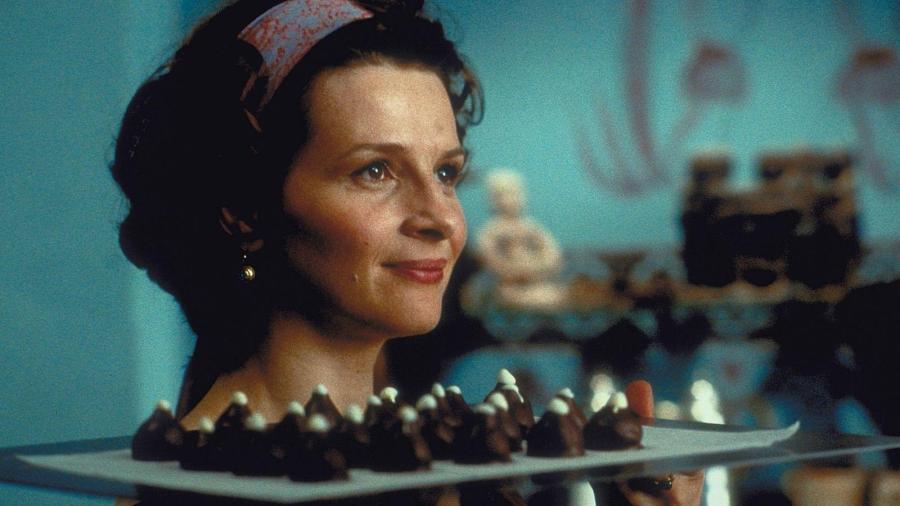
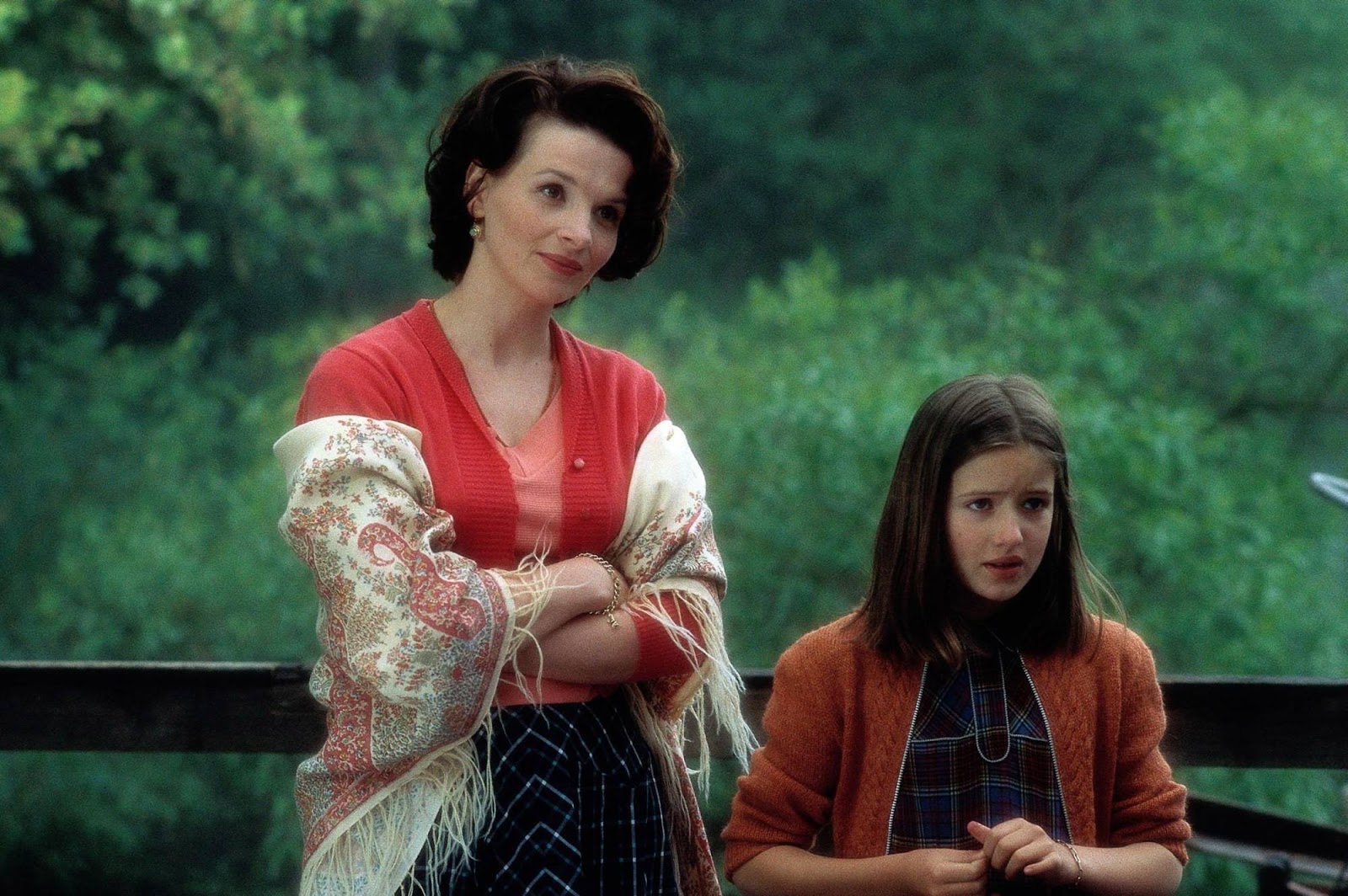
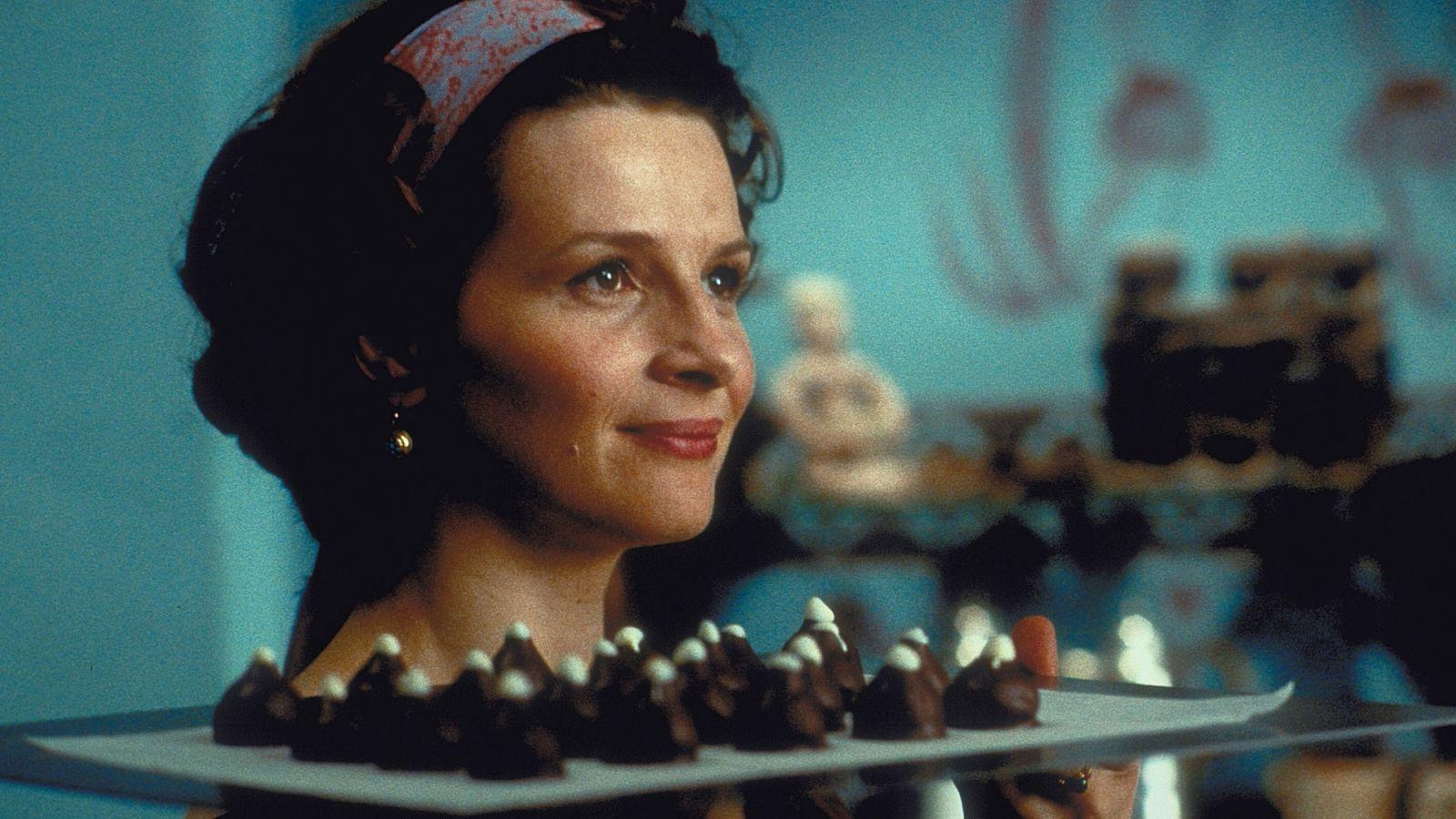
This week we had a watch party for the movie Chocolat and we were the only two who showed up, but it was still fun.
We were hoping for at least one or two more people to join in but maybe next time around.
Chocolat is a movie from 2000 starring Juliette Binoche, Judi Dench, Johnny Depp, and Alfred Molina, among others.
The plot of the movie is about Vianne Rocher, played by Binoche, who travels from town to town with her daughter, Anouk, never staying in one place because, she says, a type of curse was put on her family that causes the female members feel the need to travel to another place when the east wind blows.
This means the women in the families, are always on the move, rarely making long term connections with spouses or significant others, or really anyone.
Anouk, is becoming drained from the traveling and it’s clear she’s longing for a place to call home.
Friends are made somewhat slowly in the small town thanks to the iron-fisted rule of the mayor Comte de Reynaud (Molena) who is also in control of the church and uses religious guilt as a weapon against the people of the town. He is wealthy but is very lonely due to the fact his wife has gone to Venice and seems to have not come back.
Vianne opens her chocolate shop at the beginning of Lent, which is the time when Christians abstain from temptations, which sometimes include sweets, for about a 40-day period before Easter.
Vianne is not a Christian – in fact she’s probably more into Paganism — and is confused why Molina’s character is offended by her opening the shop. She also doesn’t really care that he is offended, if we want to be honest.
She wants to be welcomed with open arms but also seems to want to show that she is a free spirit who doesn’t care much about their traditions. She’s well-meaning, though, especially when it comes to wanting to changed the lives of a neglected wife, an abused wife, a grandmother who has been cut off from getting to know her grandson (Dench), and an older couple who simply need an extra push toward romance.
The movie is charming and shows the importance of accepting others who are different from you but also brings to light the dogmatic nature that can settle into organized religion.
Molina’s character thinks he controls everything even while he fights for control within himself. He tells the young priest at the church what to say and suggests that anyone who steps away from his will is also defying God.
The story becomes even more complex when Johnny Depp’s character, an Irish gypsy or “boat rat” shows up via his riverboat and faces the wrath of Comte de Reynaud who seems to see any outsider as a threat to the village.
Vianne feels a connection to Roux who is also an outcast in town and pretty much anywhere he goes.
Erin and I were chatting during this one so I shared with her that I felt someone like Colin Ferrell could have played Johnny’s part better than him. He was all the rage in the 1990s and early 2000s, I know, but he’s not actually Irish and I felt his accent sort of showed that. Ferrell is Irish and could have given the same type of smoldering looks that Johnny gave to Binoche.
I also shared with her during a scene where Johnny pretends to eat a worm that a classmate of mine in elementary school actually did eat a worm. My teacher was horrified and yelled, “Jeremy! You just ate a living thing! Go inside and think about what you’ve done!”
Chocolat was nominated for 35 different awards, but only won three.
It was nominated for five Academy Awards including best picture, actress (Binoche) and best supporting actress (Dench). It did not win any, sadly.
Directed by Lasse Halstrom the screenplay was written by Robert Nelson Jacobs and based on the book of the same name by Joanne Harris.
Halstrom said in an interview that one thing he really liked about the book was how complex Harris’s female characters were. They had a lot of layers and he wanted to make sure that was conveyed in the movie as well.
This movie is a favorite of mine because of all of the superb performances – especially Binoche, Molina, and Dench.
Have you seen this one? What did you think?
I’m leaving the trailer here for you in case you would like to watch it.
With this movie, we have reached the end of our Comfy, Cozy Cinema for Autumn but will begin our link-ups for our Comfy, Cozy Christmas after Thanksgiving. As usual, these will be any posts related to the holiday season – books, movies, traditions, events, thoughts, analysis, etc. and you can post your links to the link up at any time during the month of December.
If you would like to share your review of this movie you can link to your post here:
Erin from Still Life, With Cracker Crumbs and I have been watching movies from September through November for our Comfy, Cozy Cinema.
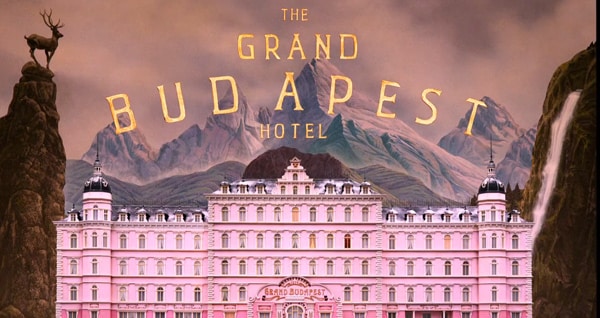
For this week Erin suggested Wes Anderson’s The Grand Budapest Hotel (2014), which I had never seen and wasn’t sure I wanted to until I watched the trailer and thought it looked like a fun ride. It was a fun ride but it was also so much more. It was mildly offensive to me in some places and heart wrenchingly endearing in others. Overall, it had me laughing and then a few minutes later I would feel a peculiar sadness because I wasn’t sure if I was supposed to feel sad or impressed with how Anderson can twist social commentary up into a neat, comical, satirical package that sends the mind spiraling off onto paths it did not originally plan to take when it pushed play.
The best way to explain this movie is bizarrely ridiculous, quirky, strange and fun while also being oddly delightful. It is not, however, “clean” in parts so if you don’t like movies with some nudity, crude references, or swear words, this is not the movie for you. It is not usually the movie for me either since I don’t watch a ton of rated R movies, but I do, on occasion, watch some rated R movies – so I am not a total puritan over here.
The movie is a story within a story. It is also full of so many famous actors it’s a bit overwhelming. Instead of saying who all is in this movie, one could really say, “who isn’t in this movie?”
Among the actors in the movie are Ralph Fiennes, Edward Norton, Adrien Brody, Tony Revolori, Tilda Swinton, Jason Swartzman, Owen Wilson, William Defoe, F. Murray Abraham, Saoirse Ronan, Jeff Goldblum, Jude Law, Harvey Keitel, Tom Wilkinson, Bill Murray, and …many, many more
We begin with and author, portrayed by Tom Wilkinson as an adult, talking about his time at a hotel called The Grand Budapest Hotel and then we switch to a younger version of himself portrayed by Jude Law. Law is leaning on the front desk of The Grand Budapest Hotel, which has seen better days. There is an older gentleman in the lobby of the hotel and Law’s character learns that he is the owner of the hotel.
Eventually the two end up talking and we find out how the owner – a man named Zero Moustafa – came to own the hotel. So, we are being told a story by Law’s future self, who is being told a story by Zero’s future self. Zero as an older man is portrayed by F. Murray Abraham.
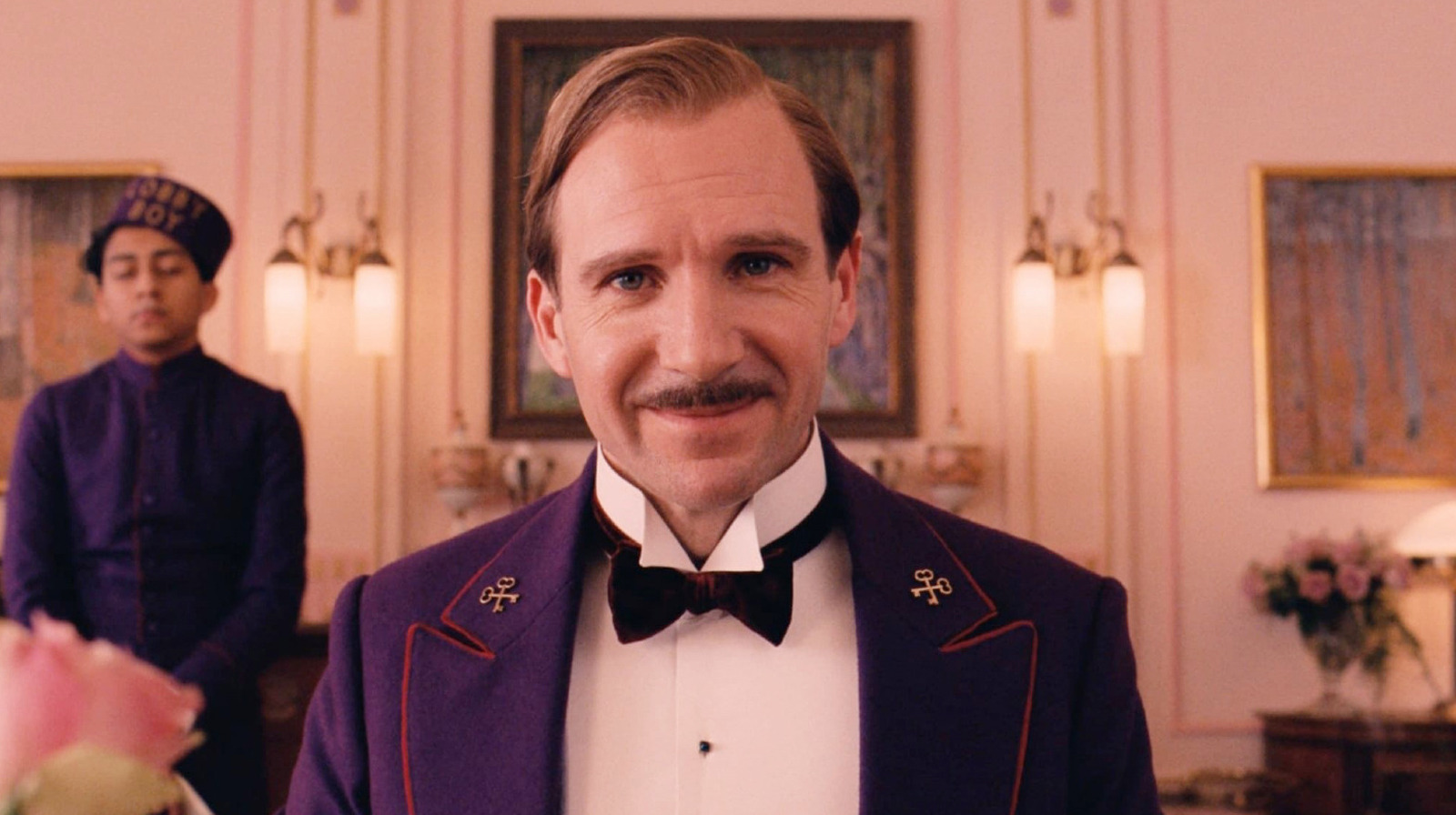
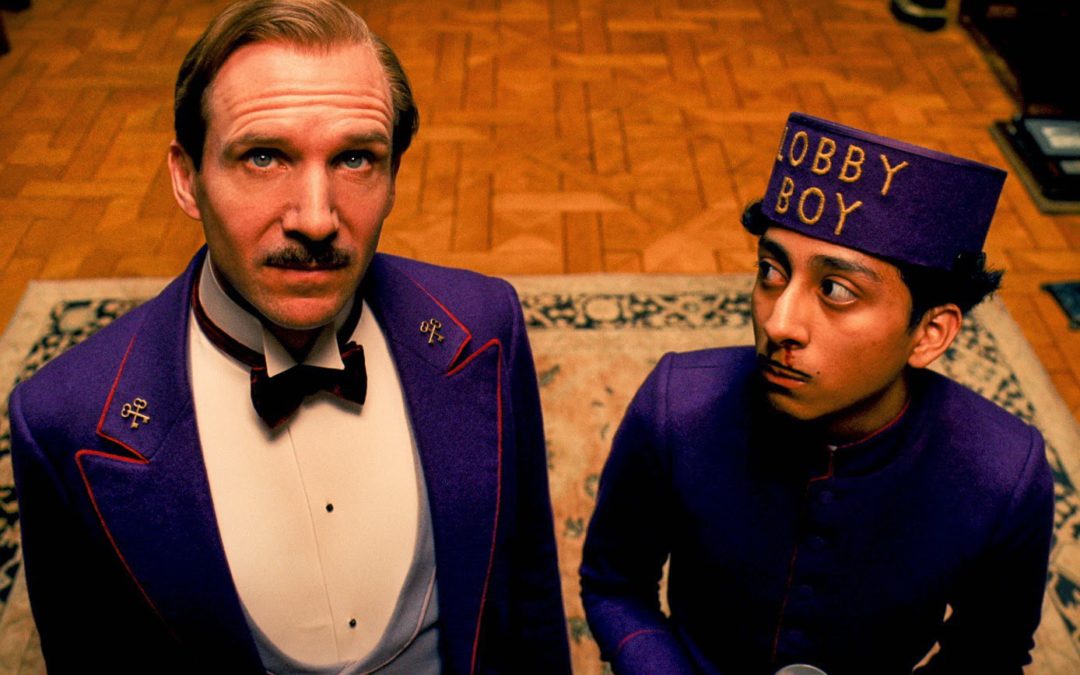
Zero tells of how he became a lobby boy under the tutelage of Monsieur Gustave H. (Fiennes), the hotel’s concierge, an eccentric man who liked to sleep with many of his guests.
One of those guests was a very wealthy Octogenarian (Swinton ) who ends up passing away. After she passes away, Gustave tells Zero (the younger zero is played by Tony Revolori) he must come with him to see the woman in her casket and say farewell to her. While at the mansion, Gustave finds out a will reading is going on and he has been bequeathed a very expensive painting called Boy With Apple.
The wealthy woman’s son (Adrien Brody) doesn’t want Gustave to have the painting and tells Gustave and Zero to leave the room. They do and Gustave takes Zero to see the painting. They are alone in the room so Zero suggests they steal the painting. They do and take off back to the Grand Budapest Hotel.
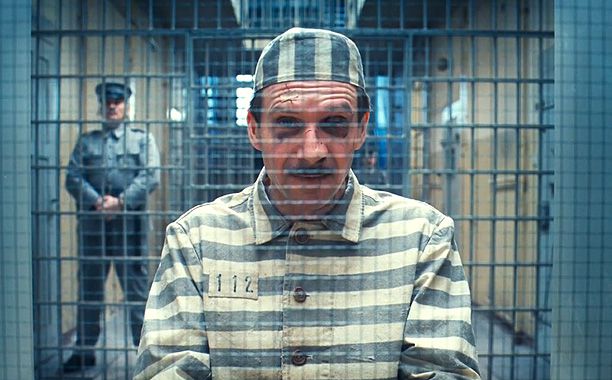
Unfortunately, the police arrive the next day – not to retrieve the painting but instead to charge Gustave with the murder of the wealthy woman.
All sorts of craziness ensue after the arrest (as if things haven’t already been crazy) and the friendship between Zero and Gustave deepens as zero works to help Gustave clear his name.
There is a lot of humor in this movie but also a dark undercurrent of commentary about the state of the world throughout the years in relation to wars, greed, and power.
I don’t know how to explain a Wes Anderson film if you haven’t seen one, but it is essentially like watching people act with little emotion yet still conveying emotions that make you think.
I’ve only seen drama movies with Ralph Fiennes so seeing him in a more comedic role was different for me, but, like Erin, I can’t imagine anyone else pulling this role off. I mean, maybe if I thought hard enough about it I could, but at this point, I couldn’t.
The script for this film was written by Anderson and Hugo Guinness, and, according to Wikipedia (reliable source? I’m not sure.), “Anderson customarily employs a troupe of longtime collaborators—Bill Murray, Adrien Brody, Edward Norton, Owen Wilson, Tilda Swinton, Harvey Keitel, Willem Dafoe, Jeff Goldblum, and Jason Schwartzman have worked on one or more of his projects. Norton and Murray immediately signed when sent the script.”
For some, this movie might not seem like a comfy or cozy movie and I get that. It’s more quirky than cozy. Like Erin mentioned to be yesterday (when she showed me part of her post), though, the part of the movie that is cozy is the friendship between Gustave and Zero. Zero is sort of yanked into Gustave’s world and become his friend without even knowing what it is going on, but it is still a friendship. Zero looks up to Gustave both as an employer and a person.
I think the theme of the movie can be somewhat explained with one of the popular quotes: You see, there are still faint glimmers of civilization left in this barbaric slaughterhouse that was once known as humanity.” As well as the extension of that, “There are still faint glimmers of civilization left in this barbaric slaughterhouse that was once known as humanity… He was one of them. What more is there to say?”
Have you ever seen this one? What did you think of it?
Also, we will be watching Chocolat, or next movie, together via a watch party at 7 p.m. on Sunday, November 17 and YOU are invited. We will be pressing play together on the movie and chatting in our Discord server, which you can join here: https://discord.gg/TpWNxJ4Z
I really hope you will join us! If not, it will just be Erin and I chatting with each other and that’s not all bad either. Haha!
Erin from Still Life, With Cracker Crumbs and I have been watching Comfy Cozy mmovies This week we had to switch up the movie we were watching because Amazon and Frevee and all the other free streaming services removed Skylark, which is the second movie in the Sarah, Plain, and Tall series.
Instead we chose Bringing Up Baby at my suggestion because I wanted something funny and goofy but also cozy.
I’ve seen this movie twice before and it is absolute chaos and craziness. Everyone except poor Cary Grant is off their rocker and it is glorious.
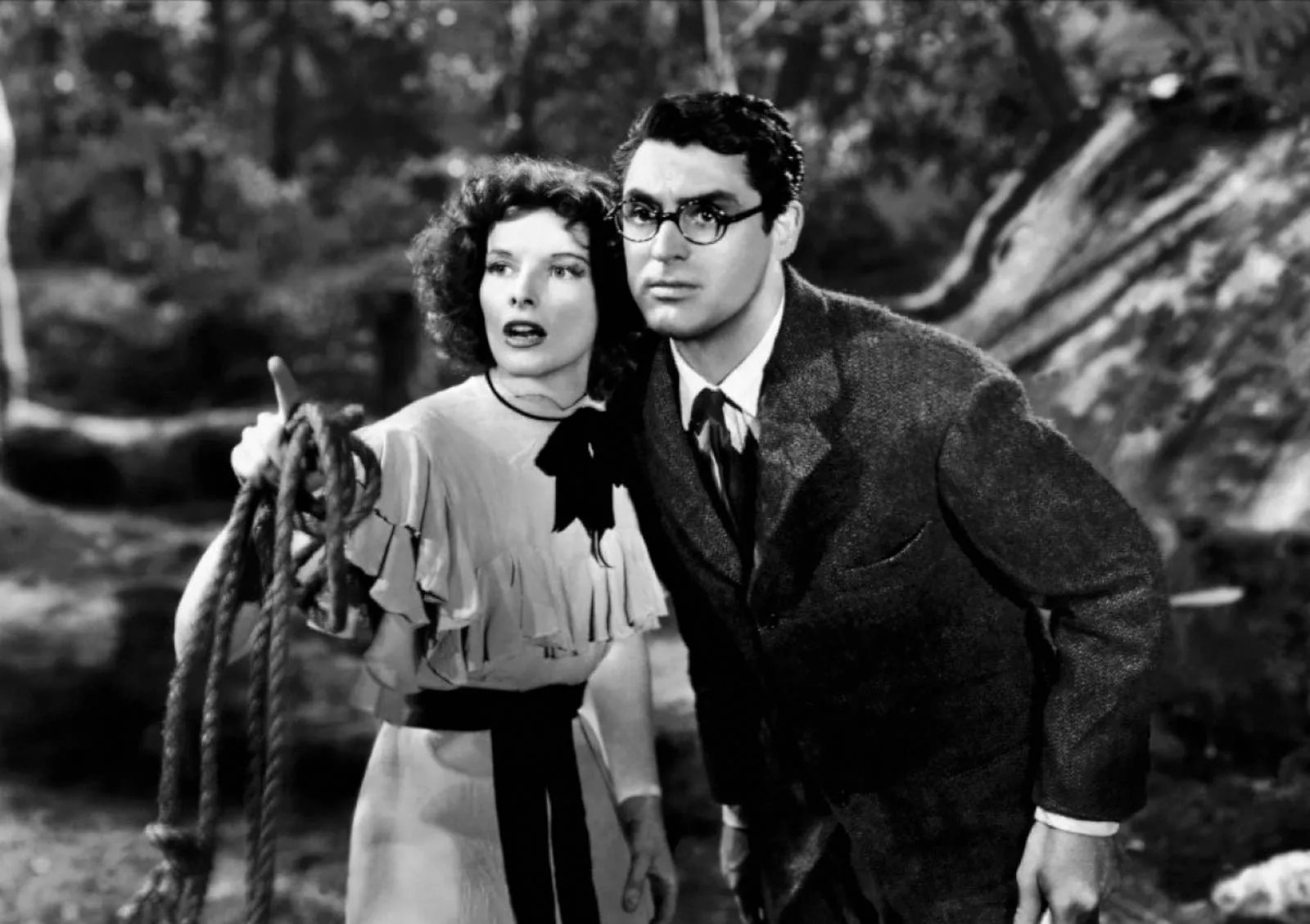
The movie stars Cary Grant and Katherine Hepburn. Katherine is absolutely batty in this film which makes it all even more hilarious.
Cary Grant’s character (Dr. David Huxley) is a paleontologist who accidentally runs into Katherine Hepburn’s character (Susan Vance) a totally nuts socialite who immediately latches on to Cary and decides she’s going to become obsessed with him and make his life a living hell.
In the beginning of the movie, David has been building a dinosaur skeleton for years and the last piece of it has just been found. He and his fiancé – Alice Swallow – are thrilled that the intercostal clavical has been found and will be arriving soon in the mail. Alice – a very uptight, proper women who says the point of their marriage will be to only advance his research and not for love — also knows that more money needs to be secured for his research so she tells David he must go golfing with an important doner.
This is where he meets crazy Susan who tries to steal his car, takes off with him riding on the footboard while he tries to tell her it is his car, and then leads him on various crazy adventures. He runs into her again at a dinner where he is trying to secure a donation from a woman named Elizabeth Randall who is considering a $1 million donation.
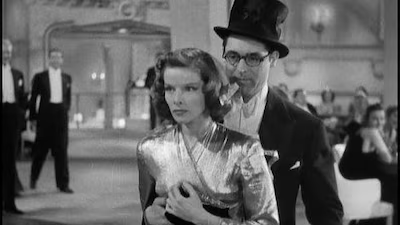
The scenes at the dinner party include this a hilarious scene where Katherine’s dress gets ripped and she and Cary have to make their way through a crowded dining room with Cary against her back to make sure nothing is scene. It is so classic and hilarious and always has me laughing.
David thinks he has shaken Susan loose after a bizarre journey with her where she tries to wake up the doner he’d been trying to meet at the golf course and David ends up knocking him out with a rock.
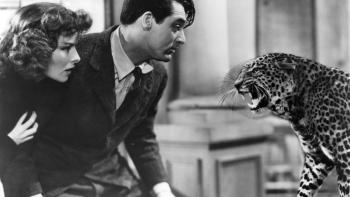
The next morning the clavical arrives and David is thrilled, but somehow Susan gets his number and, thinking he is a zoologist rather than a palentologist, she asks him how she should take care of a leopard named Baby that her brother sent her from Africa.
David promptly tells her he doesn’t care about her Leopard and doesn’t know anything about it, but when she trips and falls while on the call, he thinks she’s being attacked. She’s thrilled he thinks this and hams it up even more, which sends him flying out the door to her apartment to “rescue” her.
Of course, when he gets there, Susan is fine, but yet another plot twist is coming up when Susan says she needs to go to Connecticut with the leopard because she doesn’t want her aunt to find the leopard there when she decides to visit. The aunt is going to give Susan $1 million someday and if the aunt finds the leopard there, she won’t give her the money.
So Susan decides they need to take Baby to the country in Connecticut and begs David to take her. Somehow David gets caught up in taking her, even though it is his wedding day and he needs to be in New York to get married. While in Connecticut, Susan realizes she is in love with David.
I should also mention that to calm Baby they have to sing, “I Can’t Give You Anything But Love, Baby.”
The movie is – as I said earlier – absolute chaos from start to finish.
Cary and Katherine are the perfect pair to play against each other in a screwball comedy and had some experience with it already since they also starred opposite each other in Sylvia Scarlett (1935), and Holiday , which released the same year as Bringing Up Baby (1938). They also starred together in The Philadelphia Story in 1940.
This is a risqué movie in many ways with a lot of double entendre moments and innuendos that are clean but a bit sassy. I suppose some people could make the double entendre moments more crude, but there are people who can do that with anything.
I wanted to know about the leopard that was used in the film and while looking up information about it, I thought it was interesting to read that the Jack Russell Terrier in the film was the same dog used to play Asta in The Thin Man film series, which is a favorite series of mine. The dog’s real name was Skippy incidentally. The tame leopard (Baby) and another leopard (you will have to watch the movie to know what that is all about) were both played by a trained leopard named Nissa.
The trainer was a Swedish woman named Olga Celeste, who would stand by with a whip during shooting. According to Wikipedia, at one point, when Hepburn spun around, her skirt twirled and Nessa lunged at her. She was subdued when Celeste cracked the whip. After that Hepburn wore heavy perfume to keep Nessa Calm but Grant was terrified of Nissa and a stand in had to be brought in with his scenes with the leopard.
This movie has some terribly hilarious quotes including:
Cary: “In moments of quiet, I am strangely drawn to you, but well there haven’t been any moments of quiet with you.”
Cary: “It never will be clear while she’s explaining it.”
Cary: “You don’t understand: this is my car!”
Katherine: “You mean this is your car? Your golf ball? Your car? Is there anything in the world that doesn’t belong to you?
Cary: “Yes, thank heaven, YOU!”
Katherine:” Anyway, David, when they find out who we are they’ll let us out.”
Cary: “When they find out who you are they’ll pad the cell.”
The movie was directed by Howard Hawks. The screenplay was written by Dudley Nicholas and Hagar Wilde and was based on a short story by Wilde that appeared in Collier’s Magazine in 1937.
Have you ever seen this chaotic comedy? What did you think of it?
Next week we will be watching Grand Budapest Hotel and the following week we will be having a group watch of Chocolate on November 17 at a time to be announced.
Originally, I was going to write about Practical Magic because Erin was watching the movie and I thought I would too. Then I watched Practical Magic and…plans changed. I’ll leave it at that.
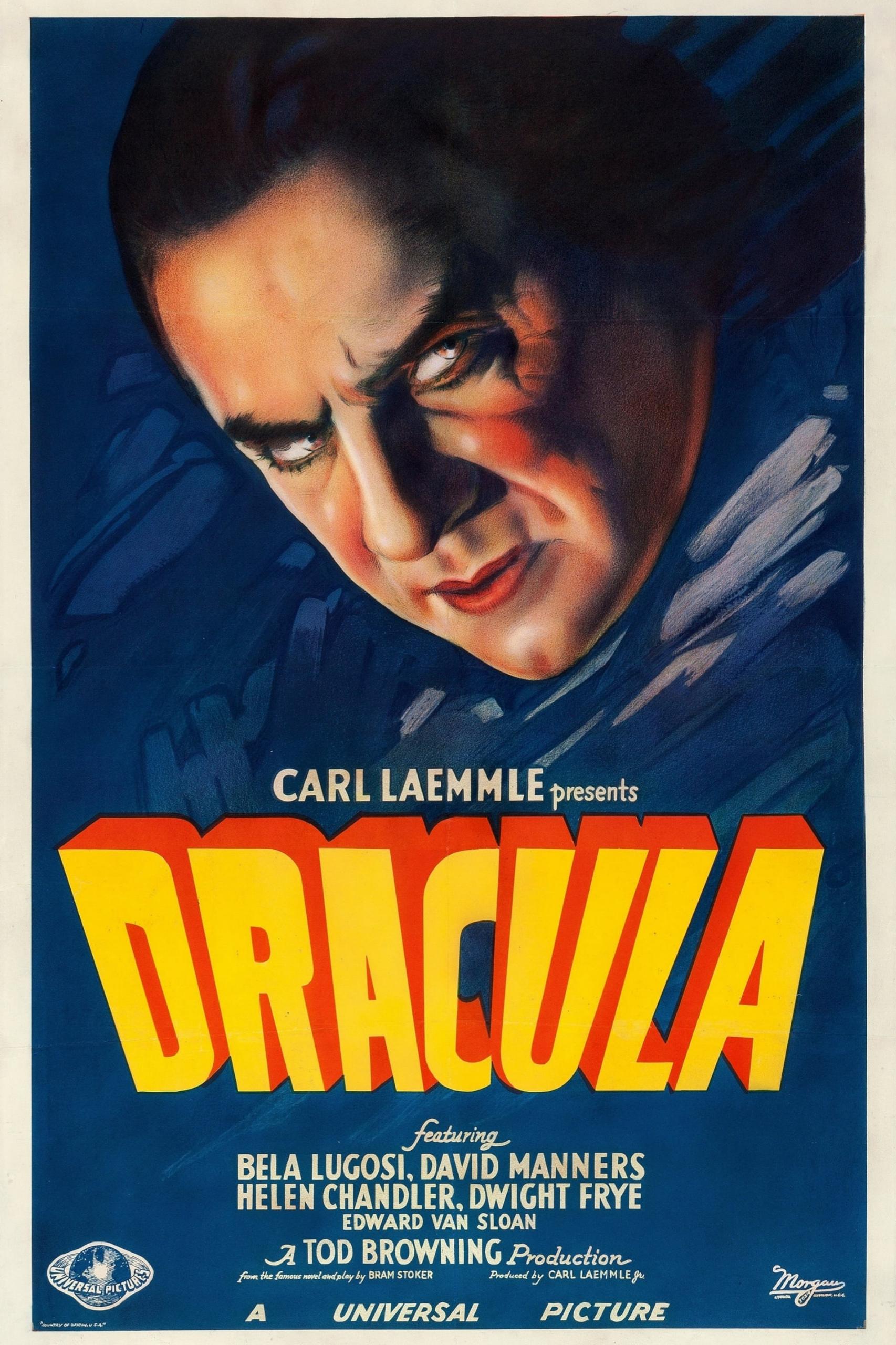
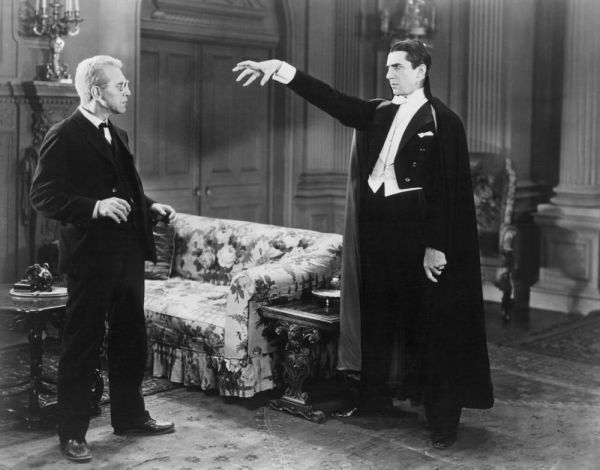
Instead, I decided to rewatch the original black and white Dracula movie from 1931 and write about that. I will admit this movie is neither comfy or cozy!
At the beginning of the movie, we see a group of people traveling through a remote area – where it is we aren’t told but later the movie subtitles say they are speaking Hungarian.
One woman is reading about the area and says there are ruins of castles in the area that can be seen. She almost falls over as the carriage continues and a man asks for the driver to slow down.
“No!” one man declares. “We need to get to the village before sundown. It is Walpurgisnight, the night of evil.”
There are dark things afoot when the sun sets, he says.
Soon the carriage stops and we have one of the men telling the villagers that he isn’t going to stay in their village but instead is going to go up the mountain around midnight to meet a carriage and go on to the house of Count Dracula. The villagers are clearly upset at this news and urge him not to go. They tell him there are vampires at the castle of Count Dracula and, in fact, they come into the village and drink the blood of anyone who stays outside after sunset.
The man is determined though and off he goes, much to the disappointment of the villagers and carriage driver. One of the women even hands him a necklace with a cross and begs him to take it for the sake of his mother to protect him.
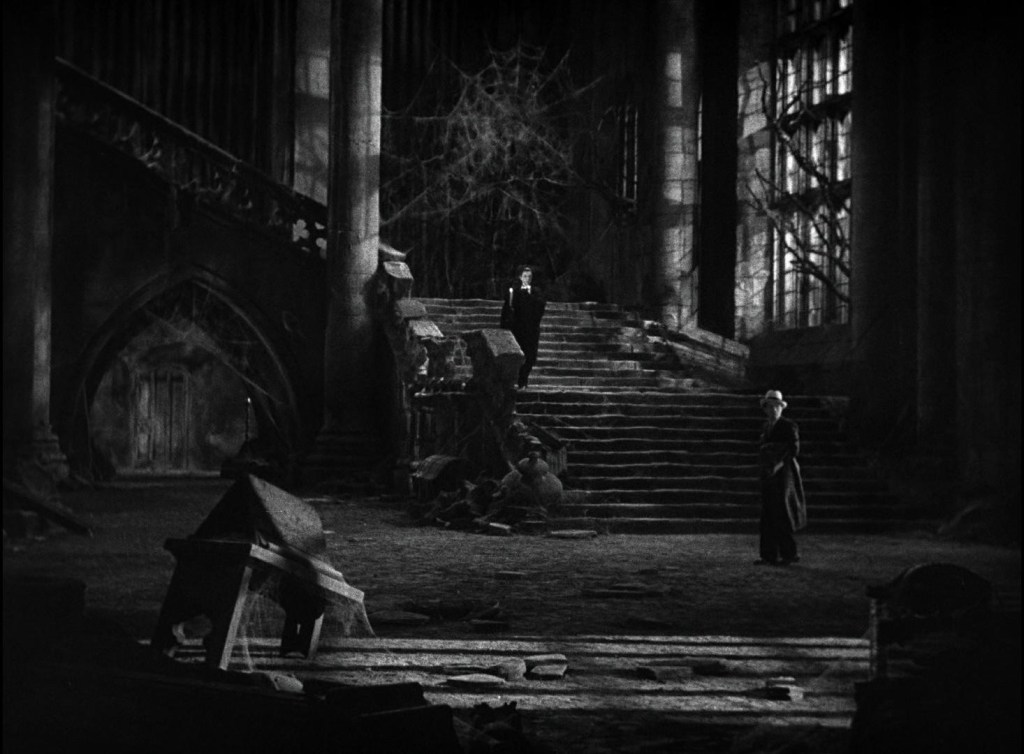
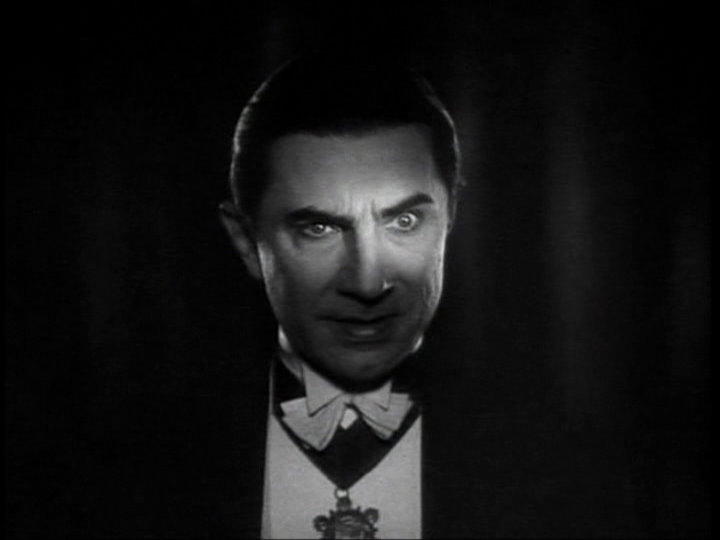
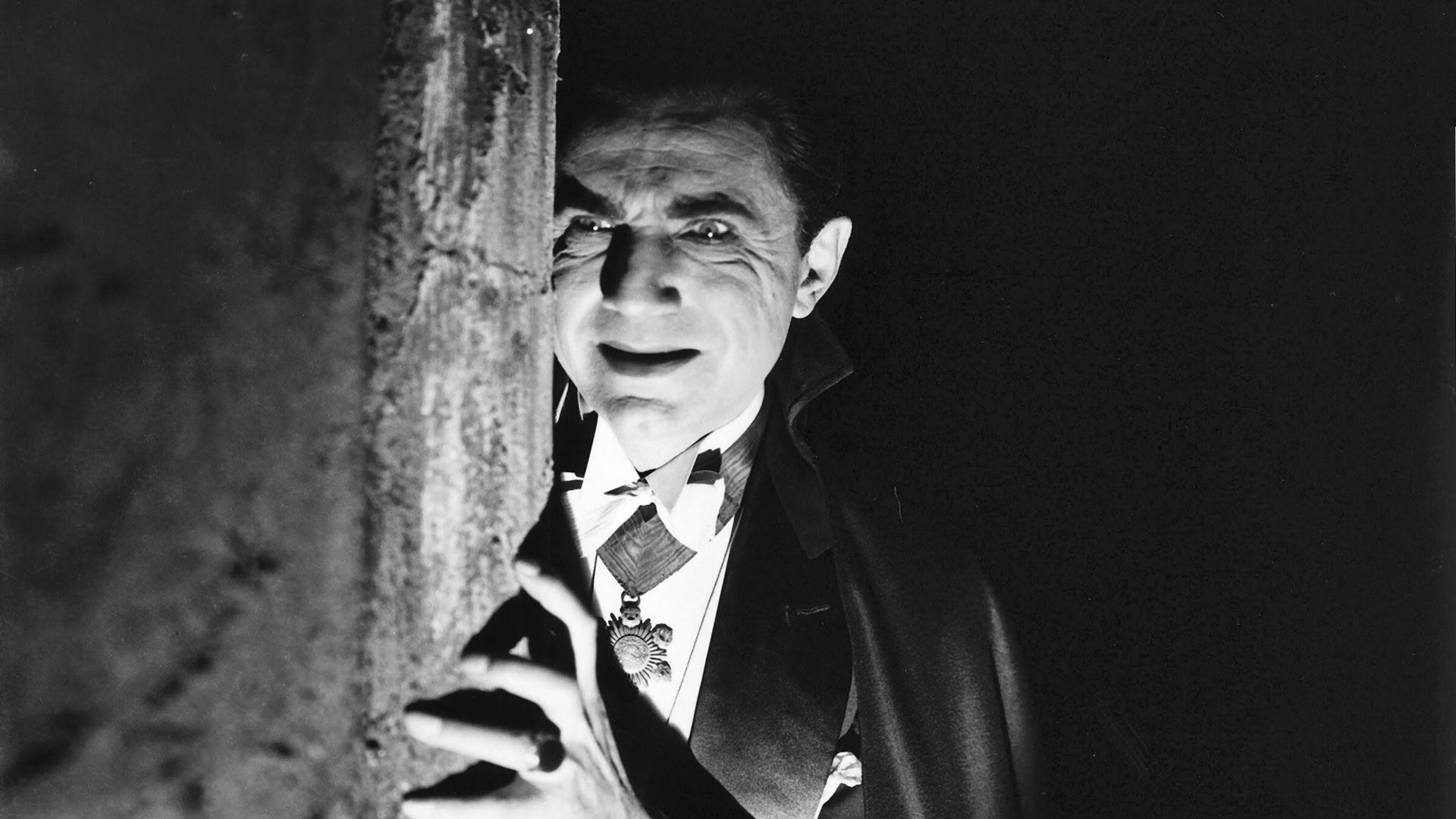
The carriage takes off over the desolate hills and next we see a clip of a man and woman climbing from a coffin in a dark basement or crypt and the man looking ominously at the camera, dark shadows all around him except for a spotlight on his dark eyes. The three women in long white dresses walk around inside the crypt, carrying candles.
This movie is 93 years old this year and still had shivers sliding up my spine. A foreboding atmosphere hangs over the scenes, telling the viewer that something bad is going to happen or the bad is going to continue to get worse.
The movie is shot very, very dark, which sometimes makes it hard to see what is going on, but the viewer can certainly tell that the man – R.M. Renfield (played by Dwight Frye) — is very nervous when the carriage pulls up in the rain to pick him up. He’s regretting his decision even more when he walks into the ruins of the castle. Renfield is there to arrange the lease of an abbey in London for the count.
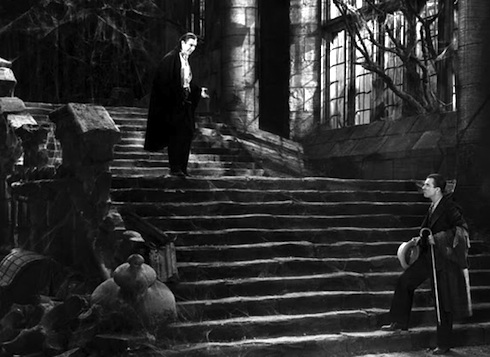
The view of this castle from the inside is insane and if it was today, I’d say it was CGI, but this movie was made at a time when they didn’t have CGI. The inside shot when the man first walks in and sees the scope of this castle is mesmerizing.
I was shocked when I read that the scenes in the castle were shot in Universal City, California on a sound stage. The set was painstakingly built and the ruins of the castle were used for years in other movies, one article stated.
Much of the so-called special effects of the movie were created with fog, camera angles, and lighting.
The effects are in full force when a man walks down the long stairway, out of the dark shadows to meet Renfield.
“I am Dracula,” the man says, his face lit by the candle.
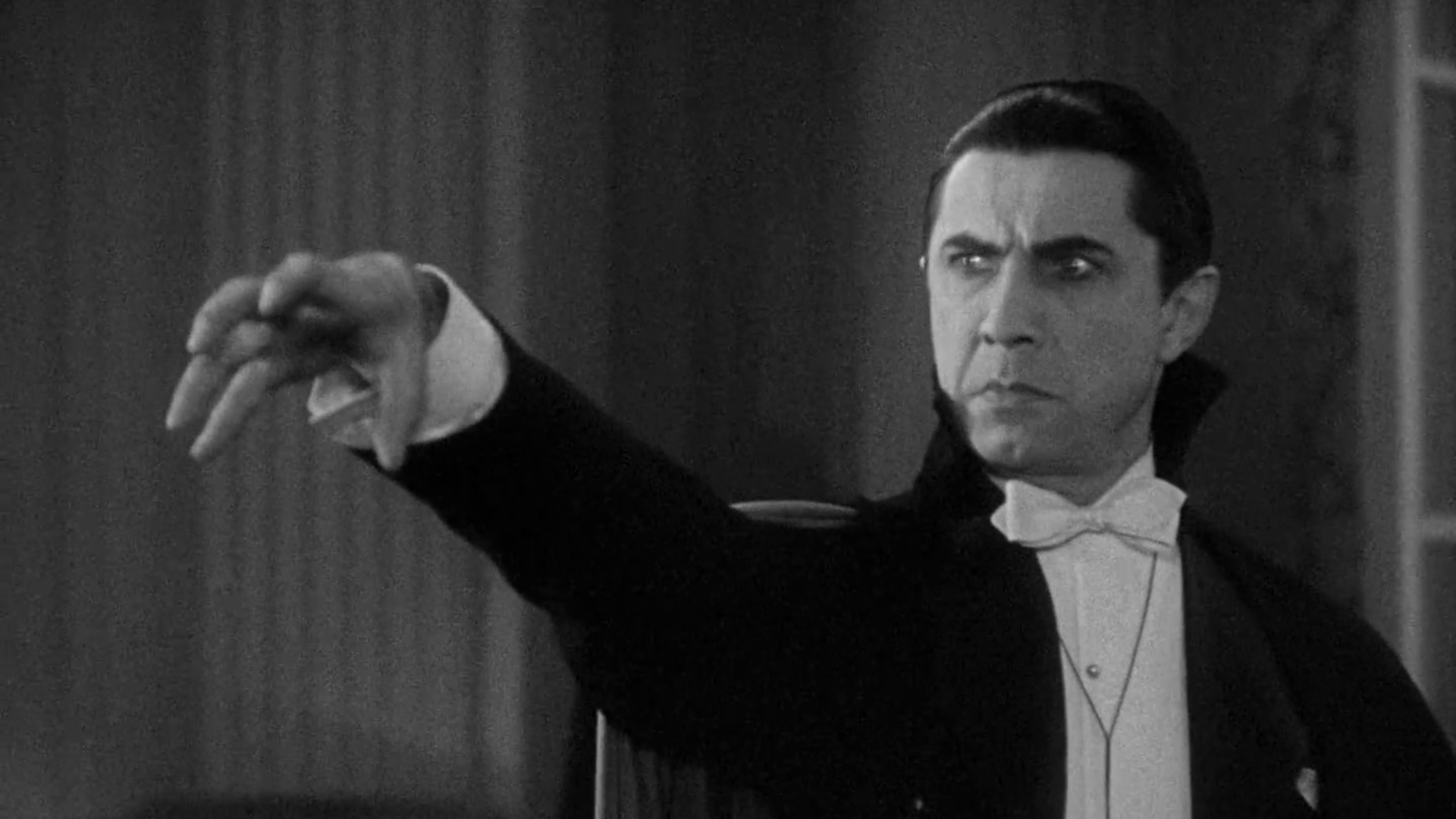
The actor who plays Dracula is, of course, Bela Lugosi, whose portrayal, according to the Encyclopedia Britannica is considered the definitive portrayal of Count Dracula. Bela’s version of Dracula is absolutely haunting. Old movie or not, the acting in this movie is done terrifyingly well.
Dracula is a character created by author Bram Stoker who wrote the novel of the same name in 1897. This movie was based on the 1920s stage production of the book. Lugosi portrayed Dracula in that production on Broadway, in 1927, as well.
According to the Encyclopedia Britanica web page, “[Lugosi’s] halting speech, in his own thick Hungarian accent, contributes to the frightening appeal of the film, along with its eerie atmosphere, long tension-raising pauses, and lack of music.”
That lack of music is quite chilling. Apparently, in 1998, Philip Glass was commissioned to score music for the film and it was added to a re-released version of the film. I watched the original film without the music and I prefer it that way. Much like black-and-white photography strips away the distractions of color, the lack of music in Dracula leaves the viewer even more immersed in the horror experience – undistracted by a melody or a tone of a musical piece.
“These first 20 minutes are predominantly silent – in fact, beyond a few snatches of Tchaikovsky and Wagner, there is no background music in the film at all,” TCM’s Rob Nixon writes. “A rising sense of dread is accomplished by the creaking sounds of coffin lids and by cinematographer Karl Freund and Director Tod Browning’s floating camera creating an atmosphere of mystical terror reminiscent of the German silent fantasies.”
When Lugosi comes down the stairs carrying a candle and announces, “I am Dracula,” in a very calm, but eerie voice, Renfield looks slightly relieved. Afterall the carriage driver drove off with his luggage, the cobwebbed-covered castle is bathed only in moonlight, and there are wolves howling outside. Surely this man will be leading him into the cozier setting in the upstairs of the castle.
When Dracula says the wolves are the children of the night, this should have alarmed Renfield more but, no, he continues on, even when he sees a large spider web and spider inside.
Things, of course, go off the rails for poor Renfield when he gets a cut from a paperclip and starts to bleed. This must have reminded the count he was a bit peckish because the look he gets on his face is pure obsession over the blood on Renfield’s finger. The cross that falls from around Renfield’s neck is the only thing that saves him in that moment.
Sadly, it won’t save him for long but I’ll let you find out what happens if you watch the movie, or if you don’t know the story.
Later in the movie, we will be introduced to Professor Van Helsing (Edward Van Sloan) who will try to stop Dracula from his murderous feasting throughout London.
I won’t give the ending of the movie away but it was seriously not the exciting ending I was hoping for.
This film was filmed in 36 days for $341,191, just under the planned $350,000 budget. When the movie was first discussed, it was going to be a large, sprawling remake of the stage production, according to TCM.com, but the Great Depression hit and the movie had to be scaled back.
People on set say that Lugosi used to practice saying his lines and getting into character by posing in front of a mirror and tossing a cape across his shoulder. He spoke very little to the cast, saying only hello when he came in and goodbye when he left.
According to Nixon, Lugosi was typecast after Dracula to the point he couldn’t break into any other style of acting.
“Typecasting is an inherent danger for any star; for Lugosi, it crept strangely into his private life as well,” Nixon wrote. “For many years, he appeared in public in his trademark costume and demeanor, and was even buried in Dracula’s black cape. When he looked in the mirror, did he only see the Transylvanian count staring back at him? Or, like the vampire character he portrayed, did he see nothing at all?”
A note on him being buried in the cape: other online articles state that Lugosi did not request to be buried in the cape. His son and fifth wife chose to do so because they thought he would like it. Yes, you read that right. His fifth wife.
Anyhow, back to the movie – while it was directed by Tod Browning, some said that Freund was the actual director. Freund was an Academy Award-winning cinematographer for his work on The Good Earth from 1937 and at the end of his career filmed various television shows – including I Love Lucy.
In some ways Dracula holds up more than many films of today. The creep factor was definitely there – especially Frye’s manic/insane portrayal of Renfield after his interaction with Dracula. I don’t think it is a movie I will watch again because I could barely make it through it without wanting to flip to Anne of Green Gables to clear my movie-watching palette.
Have you ever seen this version of Dracula? What did you think of it?
If you want to read Erin’s impressions of Practical Magic, you can find it here.
Up next week for the Comfy, Cozy Cinema is Skylark, the second movie in the Sarah, Plain and Tall series. This one really is a comfy, cozy watch.
Here is our remaining list, including a group watch of Chocolat (date to be announced) that we will be writing about on Nov. 21. You do not have to write about the movie to watch with us.
We will be pushing play together on Chocolat and then chatting about the movie in our Discord group (The Dames), which you can join for free now here: https://discord.com/invite/J7qQ36Uf
If you want to join in and add a blog post you wrote about the movie you watched this week you can leave a link here:
This week we watched Dial M for Murder (1954), directed by Alfred Hitchcock.
This was a great follow up to Rear Window and I’m so glad Erin suggested both of these. I’ve been wanting to watch Dial M for Murder for years but just never got around to it with all the other great movies out there to watch.
Now that I’ve watched it, I wouldn’t say it’s my favorite Hitchcock movie of all time but I really did enjoy it. In some ways I thought things fell together a little too easily at points in this movie but the way they fell into place made me enjoy it – if that makes any sense. It might not make sense if you haven’t watched the movie but if you have then you probably know what I mean.
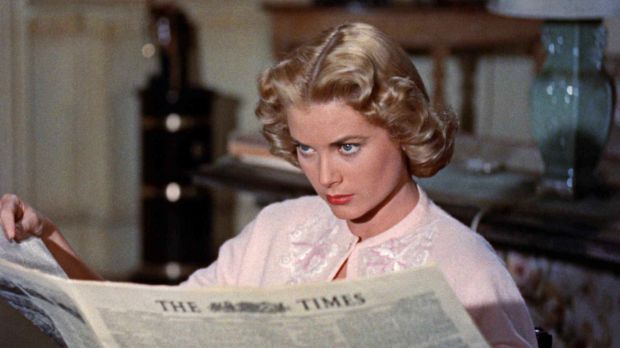
Here we have another Hitchcock movie with one of his favorite actresses, Grace Kelly. The movie also stars Ray Milland and Robert Cummings.
Dial M for Murder, based on a very popular play and screenplay by Frederick Knott, was made before Rear Window but both movies released at the same time. It was this movie that made Hitchcock decide he wanted Kelly for Rear Window.
First a little bit about the plot of the film. Tony Wendice is a retired professional British tennis player who is married to his socialite wife, Margot, who has had an affair in the past with American crime-fiction writer Mark Halliday.
Margot doesn’t think Tony knows about the affair. She burned all the letters she received from Mark when she broke it off with him. All the letters except one. She kept that one in her handbag and though we are never definitely sure what was in the letter, we know it was something that meant a lot to her.
Mark has now come to London for a visit and wants to see both Margot and Tony. They are set to go out to a performance together that night but Tony bails at the last minute and tells them to go on without him and have some fun.
Tony’s eagerness to stay home is what first clued me in that something a bit criminal was about to go down and go down it does.
Tony blackmails a former college classmate to kill Margot. Tony jokes with Mark later when he and Margot come home about how he, Mark, would know more about how to murder a person since he’s a crime writer.
Margo suggests that he and Tony write a book together after Mark is looking through all their clippings of all they did while Tony was a tennis pro and suggests Mark write a book.
“Yes, Mark, will you provide me with the perfect murder?” Tony asks.
Mark quips back, that his books focus less on the detecting and more on the crime itself. “I usually put myself in the criminal’s shoes and then ask what do I do next.”
Mark laughs and says he thinks he can plan a murder on his own but knows that in real life mistakes can be made. It’s not the same as it is in the book, he reminds Tony.
Tony is cocky though. He seems to think he’s a murder-planning master.
Foreshadow much?
My husband says that Hitchcock loved Grace Kelly for his movies and when I looked online that was indeed true. While I thought I had once read that Hitchcock had a strange obsession with Kelly, The Husband says it is more like he felt she was like his muse. That weird obsession thing was with another actress – Tippi Hedren.
To Hitchcock, Kelly was simply extremely beautiful and talented and he felt like there was no actress like her.
According to Offscreen.com, Hitchcock told Donald Spoto, who wrote his biography, that “The subtlety of Grace’s sexuality —her elegant sexiness— appealed to me. That may sound strange, but I think that Grace conveyed so much more sex than the average movie sexpot. With Grace, you had to find out – you had to discover it.”
Before concluding production on Dial M for Murder Hitchcock was already planning his next film – with Kelly in the lead. That next film was Rear Window.
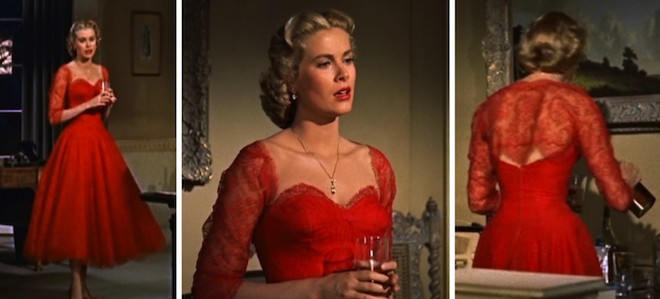
Like Rear Window, Kelly wears some amazing outfits in this movie, by the way. The one that stands out for me is the red dress in the beginning. What a stunner.
I like what the writer on Offscreen said about the dress and the relationship of her outfits to scenes in the movie:
“Hitchcock starts the opening sequence at a breakfast table where Kelly is dressed demurely in a beige dressing gown; she reads a notice about the arrival of her lover on the Queen Mary; the ship arrives in dock; in seconds she is costumed in a red dress, embracing him in the flat where hours earlier she breakfasted with her supposedly unsuspecting husband. They are in the classic London flat but the picture presented is quite different as a result of clever writing, editing and colour coding. It also played on Hitchcock’s private perception of Kelly: he nicknamed her “the snow princess.”
I thought it was interesting that it was Cary Grant who told Hitchcock about the play version of Dial M for Murder, which debuted in 1952. Grant saw himself as the potential wife-killer, something Offscreen.com says Hitchcock always wanted Grant to play. Unfortunately Grant’s agents asked for way too much money so Hitchcock turned to Milland.
As a huge fan of Cary Grant I can honestly say I could see him playing the part Milland played, but Milland pulled it off in more dramatic fashion than I think Cary might have. Sometimes I have trouble seeing Cary in a dramatic role because even when I know he’s trying to be serious I think of his more playful movies and struggle to focus on him being the “bad guy.”
Milland, by the way, had won an Academy Award in 1945 for The Lost Weekend, so Hitchcock felt he was a good second pick.
Hitchcock chose not to change the play when he made the film and was quoted as saying this: “You buy a play for its construction. It’s the construction that makes it a hit. If you change that you’re ruining the very thing you bought. Just shoot the play.”
I thought this was ironic since he did change the endings of films that were based on novels he bought the rights to.
Have you ever seen this one? What did you think of it? Is it among your favorite Alfred Hitchcock films?
I was looking through a list of Alfred Hitchcock films the other day and I realized there are a ton I have never seen. I hope to make a marathon of his movies sometime soon.
“Nothing has caused the human race so much trouble as intelligence .” – Stella from Rear Window
Erin from Still Life, With Cracker Crumbs and I are watching Comfy, Cozy movies this September and October and this week we watched Alfred Hitchcock’s Rear Window – or rewatched for me.
Rear Window is one of Hitchcock’s more well-known and praised movies because of the intricacy of the story, the attention to detail, and the masterful storytelling that makes the viewer as desperate as the main character to find out what happens.
Laid up with a broken leg, our main character, photojournalist Jeff Jefferies (Jimmy Stewart) is stuck in a two-room apartment looking out on all his neighbors on the other side of his apartment complex.
It’s like he has a bunch of TV channels in each window to watch. There’s always something on. He uses a pair of binoculars to watch what they’re doing part of the time and part of the time he can see them with the naked eye.
There is a newlywed couple who are – ahem – getting to know each other; a couple who appear to be arguing; a woman who lowers her dog down to do his business in the little yard below each day; an athletic dancer who likes to stretch in front of her window; a lonely woman who eats her dinners alone; and many other characters for Jeff to watch.
One night he wakes up in his wheelchair, where he has been sitting for the whole movie, because he hears a scream and breaking class. He can’t figure out where the sounds came from and drifts back to sleep but later, when he wakes up again, he notices the one neighbor – the jewelry salesman who argued with his wife — acting very mysterious.
The neighbor in question, Lars Thorwald, (Raymond Burr) starts going in and out of his apartment with a suitcase. It’s around 2 a.m. when this starts at it’s pouring out. Jeff can’t figure out what that’s all about and struggles to stay awake to watch the man but finally succumbs to exhaustion.
I should mention that Jeff has a girlfriend, Lisa, (Grace Kelly) who is absolutely perfect, but he is making all kinds of excuses not to marry her and one of those excuses is that she won’t enjoy traveling with a journalist.
He tells his nurse (Thelma Ritter) and Lisa about it on their separate visits, but both seem to think he just has a bad case of cabin fever.
As he continues to ponder it all and notices that the man’s wife is no longer in the apartment, Jeff pulls out the zoom lens of his camera and watches the man cutting something up, putting it in bags, and carrying it out. Now he’s starting to really get antsy about what he’s witnessed. It isn’t until Lisa is over one night and he’s telling her what he thinks that she begins to get a little interest as well. What piques both their interest is how the man is tying up a trunk and removing the mattress from the room.
Soon the nurse, Stella, is also pulled in, and all three of them begin to speculate what really happened.
Before long Jeff has Stella and Lisa acting as willing spies for him to find out what really happened.
If you want suspense then this the right movie for you. It is one of Hitchcock’s most suspenseful and nail biting movies.
The movie is based on a short story by Cornell Woolrich. I read an essay online (the author of which I couldn’t find, but it did say it wasn’t AI) that said this movie didn’t attempt to copy the story but instead recreated the plot based on the idea of it.
I did find a summary of the story and the ending is different in some ways to the movie, but with the final outcome being the same.
This writer, as other critics, point out that one aspect of this film that makes it so brilliant is that the viewer knows as much as Jeff does during the movie. We, the viewer, are watching it all unfold as he is and are seeing it from his same vantage point. We aren’t taken into apartments where he isn’t or into scenes that he isn’t looking at from his window. We are a participant in the film, so to speak.
Rear Window was filmed on a budget of $1 million but pulled in $36 million and became the top grossing film of 1954.
According to the site, All The Right Movies, the original story was based on a high-profile murder case in 1924 in Sussex England where a man named Patrick Mahon — committed a crime – well, I won’t tell you what happened in case you haven’t seen Rear Window.
Stewart had already been in one Hitchcock movie before this one (Rope) and would film two others afterward – Vertigo and The Man Who Knew Too Much.
For this film he was anxious to work with Hitchcock and said he wouldn’t take a salary but would take part of the film’s profits, which I think worked out very well for him. While the two got along, there were also times they spoke very little to each other, according to other actors who worked with them.
Wendell Corey, who played Detective Doyle in the movie, said, “Jimmy and Hitch would communicate in unspoken glances, and Jimmy would give him a steely look if Hitch said something he didn’t like. The only direction I ever saw Jimmy take was ‘the scene feels tired’ – there was steel under all that mushiness.”
Corey wasn’t a fan of Stewart in some ways. He was a nice guy, he said, but claimed he was also very arrogant on the set of Rear Window.
Others didn’t apparently didn’t hold this assessment and to me I think it was Corey who had the arrogance issue.
I thought it was interesting that Stewart’s wife asked to be on set during the filming of this movie because of Grace Kelly. According to trivia on All The Right Movies, “Grace Kelly may have been a little too friendly for some people, though – especially James Stewart’s wife. In 1954, Kelly had a reputation for having affairs with her leading men and, after she told a magazine she thought Stewart was one of the most attractive men she’d ever met, Stewart’s wife, Gloria, insisted on being on the set every day to keep an eye on things.”
Rear Window was Stewart’s favorite film of those he worked on Hitchcock with.
“The wonderful thing about Rear Window is that so much of it is visual,” he said in an interview. “You really have to keep your eyes open in the film, because it’s a complicated thing. This was my favorite film to make with Hitch.”
One more piece of trivia that had me snickering was that Hitchcock made the bad guy in this film (Again, I’ll keep it quiet on who the real bad guy is) look and act like David Selznick who produced Rebecca with Hitchcock. Hitchcock said Selznick interfered so much on that film he disowned it. In Rear Window he got his revenge by making the guilty party look like the producer he couldn’t stand.
I love the trivia behind the making of movies, as you know if you’ve read any of my previous posts, so I could go on and on about it. I won’t though. Instead, I’ll point you over to Erin’s blog for her views on it:
Keeping with the Hitchcock and Grace Kelly movies, we will be switching up our movie lineup next week and watching Dial M For Murder. To explain why we are choosing to watch this instead of Murder by Death, I’ll refer to Erin’s well-written explanation, which she also shares on her blog today: https://crackercrumblife.com/2024/10/17/comfy-cozy-cinema-rear-window/
“We were originally going to watch a movie I chose, Murder by Death. I chose it because I read that it was funny and because it has Maggie Smith in it but I didn’t do much research on it other than that.
However, after doing some reading it looks like it could be considered problematic so we are going to scrap that one and trade it for Dial M for Murder instead. It is probably not a bad movie, but a movie that didn’t meet the goal of what was trying to be achieved – it was actually trying to shine a light on racism and homophobia, and no one mentions the ableism but I think I read that is in there too, that was prevalent in Hollywood and the world, but instead just looks like it is in fact all of those things itself.
Anyway, we decided to watch Dial M for Murder for Comfy Cozy Cinema, since we are trying to be cozy and snug with this fun movie watching challenge. I think both of us plan on watching Murder by Death at some point though, whether it is together or just on our own.”
Here is the rest of the full list of movies we are watching or have watched.
I’m also including a link to my blog posts up from this year’s Comfy, Cozy Cinema, at the top of the page under the heading Movie Impressions.
Before I close out for today, I wanted to mention that we did pick a winner for our Comfy, Cozy Giveaway – Yvonne – and she has been notified! Thank you to all of you who entered the giveaway, followed our blogs, Etsy and Substack and I hope you will stick around and have some fun with us as we write about books, movies, and our lives.
If you end up writing about Rear Window or any of the other movies we are watching, please feel free to link up with our linky. You can add a link to the link if it is open, even if it is for a different movie.
Erin from Still Life, With Cracker Crumbs and I are watching Comfy, Cozy movies this September and October and this week we watched the 1945 version of Blithe Spirit.
This is a movie my husband and I had started a few months ago and didn’t finish up because we got interrupted and distracted by life, so when Erin suggested it for our Comfy, Cozy Cinema, I was all for it.
After watching it, I can share that this was not one of my favorite movies overall but there were parts I enjoyed and performances I found very well done. I also found the dialogue brilliant.
Before I go into my impressions, here is a little online summary of the movie, which is based on a play by Noel Coward:
“Skeptical novelist Charles Condomine (Rex Harrison) invites self-proclaimed medium Madame Arcati (Margaret Rutherford) to his home for a séance, hoping to gather material for a new book. When the hapless psychic accidentally summons the spirit of Condomine’s late wife, Elvira (Kay Hammond), his home and life are quickly turned into a shambles as his wife’s ghost torments both himself and his new bride, Ruth (Constance Cummings). David Lean directed this adaptation of Noel Coward’s hit play.”
I am going to get this out of the way now – I could have completely done without Rex Harrison in this movie. I hated his character. In fact, none of the characters were likable to me, but, as Erin pointed out to me after I watched it, that’s really the point of the play/movie – hence the title.
After double-checking the definition of “blithe” it made even more sense.
Blithe: showing a casual and cheerful indifference considered to be callous or improper.
That is exactly how every character in this movie acted.
While watching this movie, I also started to wonder if Rex Harrison is only capable of playing, arrogant, tone-deaf, rude, and bullheaded characters.
After watching him in Dr. Doolittle and My Fair Lady and now this – I can’t help thinking his range of an actor didn’t go much beyond these typecasts. I’m teasing a bit here because I have not seen every Rex Harrison movie. If you know of one where he isn’t a total jerk, let me know in the comments.
During the whole film, I wanted to throat-punch Rex’s character. Repeatedly.
I mean, it could be a hormone issue (I am at that age) or Rex Harrison might really have just been that annoying of a human being in this movie.
I know he’s playing parts in his movies, but he did it so well that I imagine there must be some of himself in there. I’ll have to research that at some point.
What I did like about this movie was Margaret Rutherford and it is fitting that this is the movie where she became known nation-wide in the UK after already having established herself on the stage and on television.
I first heard her name when I was researching actresses who had played Miss Marple in the past. Her first film debut was in 1936 but it was this performance – as Madam Arcati – that is considered her breakout performance. There are two reasons she might have done so well as the character – she had already portrayed Madam Arcati in the stage version of Blithe Spirit and Coward actually wrote the part with her in mind.
According to Wikipedia, theatre critic Kenneth Tynan once said of her performances on stage: “The unique thing about Margaret Rutherford is that she can act with her chin alone.”
She received rave reviews of her performance on the stage and the movies – from both critics and audiences.
After watching this movie I can see why – she played the part of being a batty old lady very well and if you delve into her sad history and upbringing, you would see why. That’s another tale for another blog post, but I’ll leave the link to her Wikipedia page here:
Be warned there is some sadness about her life in that article, but also some joy and a great deal of success for her.
Even if this wasn’t a favorite movie of mine, I did not hate it. There were many humorous and witty moments in this movie and overall the acting was very good. I think in the end it simply wasn’t what I had expected – mainly because I had never seen the play.
One of the funny quotes from the movie was one that was removed from the U.S. versions by censors when it first released.
During an argument with Ruth, Charles tells her, “If you’re trying to compile an inventory of my sex life, I feel it only fair to warn you that you’ve omitted several episodes. I shall consult my diary and give you a complete list after lunch.”
As I read what other viewers thought about the movie online I saw that most enjoyed the movie immensely but a few wrote that they found that the movie felt flat because they were comparing it to the stage version. In the stage version there was more of a chance for the actors to bounce of the audience and for the audience to respond with laughter, one reviewer said. In the movie version some felt the jokes and humor just fell flat.
I spent much of the movie not finding the humor very funny because I was so horrified how Harrison didn’t seem upset by any of the events that happened. Again, though, I needed to go back to that definition of blithe when I decided to rewatch some scenes before writing this post. After that I found some of the humor a little funnier and recognized it as being more tongue-in-cheek in some places.
Some viewers might sense the lack of humor in some places because the director, David Lean, apparently did not do a good job translating the play to film, at least according to Coward, who had worked with Lean on one of his previous plays being transferred to film, and enjoyed that experience.
Coward, in fact, informed Lean, after he saw a rough cut of the film, that Lean had “screwed up” (but used a much more colorful term) the best thing he’d ever written.
Harrison later commented on Dean: ““When you’re on a comedy like Blithe Spirit, it is awfully hard working for a director who has no sense of humor.”
According to Wikipedia Harrison wrote in his memoirs:
“Blithe Spirit was not a play I liked, and I certainly didn’t think much of the film we made of it. David Lean directed it, but the shooting was unimaginative and flat, a filmed stage play. He didn’t direct me too well, either – he hasn’t a great sense of humour…..Lean did something to me on that film which I shall never forget, and which was unforgivable in any circumstances. I was trying to make one of those difficult Noel Coward scenes work… when David said: “I don’t think that’s very funny.” And he turned round to the cameraman, Ronnie Neame, and said: “Did you think that was funny, Ronnie?” Ronnie said: “Oh, no, I didn’t think it was funny.” So what do you do next, if it isn’t funny?””
The play, by the way, was written in six days at a seaside resort, where Coward had gone to escape the Blitz, according to Criterion.com.
Geoffry O’Brien writes in the article on Criterion: “..Blithe Spirit brought superficiality to another level of ambition: what audacity to write a comedy about death in the midst of bombing that would claim tens of thousands of civilian lives, a comedy in which the memory of a lost love became material for a punch line and mortality served as simply a piquant sauce for the same sexual dilemmas that were the staple of Coward’s brand of drawing room comedy. Blithe Spirit may be defined as a very British sort of resistance literature, encouraging resistance to encroaching catastrophe by blithely ignoring it.”
If you would like to read more about O’Brien’s thoughts (even he touched on how much better it is to see the play either before you see the movie or instead), you can find his very interesting (and full of big words) article here:
I have to agree with O’Brien that the ending of the film is much more satisfying than the ending of the play, but I won’t share what I mean about that here in case you haven’t seen it yet.
I watched this one on Amazon Prime, where it was free with a subscription. It is also free right now on YouTube.
Up next in our Comfy, Cozy Cinema is Alfred Hitchcock’s Rear Window. I’ve seen this one before but it’s been a few years so I am looking forward to watching it again and am glad that Erin suggested it.
Feel free to link up your own impressions of the movies at our link-ups. The links close at the end of the week but feel free to leave your blog post on future link-ups, even if it is for another movie.
Here is the rest of the schedule:
Also, don’t forget our Comfy, Cozy Care Package giveaway is still open until Oct. 15. We are giving away some things to make your autumn even cozier. The gifts include my book (Gladwynn Grant Gets Her Footing), Erin’s poetry compilation book, stickers, a journal, an autumn-themed mug, pumpkin-shaped chocolates, a book light, a blanket, and boxes of tea. We also hope to throw a few extras in to the winners!
You can enter anytime between today and October 15th, and the winner will be announced on our blogs on Thursday, October 17th. Please enter via Rafflecopter and it is only open to those 18 or older living in the US.” You can enter here: https://www.rafflecopter.com/rafl/display/3614a4fa2/?
Erin from Still Life, With Cracker Crumbs and I are watching Comfy, Cozy movies this September and October and this week we watched Kiki’s Delivery Service, a Studio Ghibli animated movie.
We are also announcing a very fun and exciting giveaway for a comfy, cozy gift basket which you can enter to win at the giveaway link at the bottom of this post!
Kiki’s Delivery Service was released in 1989 in Japan by Hayao Miyazaki, a Japanese animator and filmmaker, and was based on a book called Witches Express Delivery Service.
The movie was animated by Studio Ghibli (which Miyazaki was a founder of) for Tokuma Shoten, Yamato Transport, and the Nippon Television Network.
According to information online, “The English dub was produced by Streamline Pictures for Japan Airlines international flights in 1989. Walt Disney Pictures produced an English dub in 1997, which became the first film under a deal between Tokuma and Disney to be released in English. It was released to home media in 1998.”
This was a very sweet movie with little action but a lot of heart.
First the background – Kiki is a witch and the tradition is that witches leave home at the age of 13 and travel away from their family for a year to learn what their skill in life is.
Kiki’s mother insists she take her old, reliable broomstick so Kiki flies off into the night with her all black cat JiJi and finds a small town to settle in. She ends up living with a baker and starts a delivery service – delivering packages with the use of her broom.
The bakery is owned by Osono and her husband, Fukuo, who are expecting a child.
Kiki also meets a friend – a boy named Tombo who wants to be her friend more than she wants to be his for most of the movie. Tombo likes to invent things – especially things with the potential to fly. At one point he invites Kiki to his aviation club but Kiki gets wrapped up in deliveries and gets caught in a rainstorm. This causes her to become very sick but Osono nurses her back to health and then pretends to have a delivery sent to Tombo so Kiki can see him and apologize.
During her first delivery, Kiki loses the toy she’s supposed to deliver and then she and her cat – who talks by the way – work to find a way to get it back to the child it belongs to.
Much of the movie is like this – just little stories or adventures that aren’t very exciting in some ways, but are calming and sweet.
It isn’t until more than halfway through the movie that more conflict arises because Kiki seems to be losing her powers, which she first notices when she can no longer understand JiJi.
Studio Ghibli is the design studio for many Japanese animated movies. Later many of these movies are dubbed into English and sometimes feature well-known American actors. In the one I watched (which was the Disney dubbed one from 1997) Kiki was voiced by Kiersten Dunst and the cat was voiced by Phil Hartman.
Kiki’s Delivery Service focuses on themes of independence and finding your place in this world.
It was the first Studio Ghibli film to find commercial success soon after being released – earning $31 million.
I wasn’t as swept up in this one as in previous Studio Ghibli films but as it continued it grew on me. It was a very quiet film and some of the Studio Ghibli films have a little more action so I wasn’t ready for it to be so toned down. Once I got into the story, though, I enjoyed it. The scenery and art, as in all Studio Ghibli films, was really beautiful.
I was rooting for Kiki – especially once she lost her powers and seemed confused about her next step.
While the makers of the movie and critics said the movie focuses on themes of maturity and independence, I also saw a strong theme of friendship, family, and trust.
Coming up next week will be the 1945 version of Blithe Spirit.
Feel free to link up your own impressions of the movies at our link-ups. The links close at the end of the week but feel free to leave your blog post on future link-ups, even if it is for another movie.
Also, Erin and I are announcing our Comfy, Cozy Gift Basket Giveaway today.
I’m just going to copy what Erin wrote to share here because I am lazy *wink*: “We have some fun little goodies to be sent off to one winner, with more surprises to be added as well! We want to celebrate the season and this is just one way we would like to do that this year.
You can enter anytime between today and October 15th, and the winner will be announced on our blogs on Thursday, October 17th. Please enter via Rafflecopter and it is only open to those 18 or older living in the US.” You can enter here: https://www.rafflecopter.com/rafl/display/3614a4fa2/?