The 20 Books of Summer Challenge is back this year with new hosts. This will be my first year participating and I can tell you I will most likely not read 20 books this summer. Much less than that.
So, I have a list of 15 books I plan to choose from, knowing full well I will get distracted a time or two or to read all of them. Count on me not reading all of them or even half. Ha.
For the challenge you can actually choose 10, 15, or 20 books.
The #20BooksofSummer2025 challenge runs from Sunday, June 1st to Sunday, August 31st
The first rule of 20 Books is that there are no real rules, other than signing up for 10, 15 or 20 books and trying to read from your TBR.
Pick your list in advance, or nominate a bookcase to read from, or pick at whim from your TBR.
If you do pick a list, you can change it at any time – swap books in/out.
Don’t get panicked at not reaching your target.
Just enjoy a summer of great reading and make a bit of space on your shelves!
They will alo have monthly summary posts where you can add progress reports and recommendations. The final one at the at the beginning of September will stay open for a while to catch all the last reviews.
If you’re planning to join in please do add your blog / planning post link to the Mr Linky on the hosts blogs, and you can download the logos and bingo card now. You can also use the hashtag #20BooksofSummer2025 on your socials.
And now my list of 15 books I will be choosing from this summer. These books are a mix of mysteries, romances, thoughtful, fluffy, and all in between. And of course I’ll probably read more Nancy Drew than I have listed here. They’re fast reads.
Summer of Yes by Courtney Walsh
Between Sound and Sea by Amanda Cox
The Clue in the Diary by Carolyn Keene
Roll of Thunder Hear My Cry by Mildred D. Taylor
The Inimitable Jeeves by PG Woodhouse
Prince Caspian by C.S. Lewis
Spill the Jackpot by Erle Stanley Gardner
‘Tis Herself by Maureen O’Hara
Death In A Budapest Butterfly by Julia Buckley
The 100-Year-Old Man Who Climbed Out a Window and Disappeared by Jonas Jonassen
But First Murder by Bee Littlefield
The Pale Horse by Agatha Christie
Britt-Marie was Here by Fredrik Backman
A Midnight Dance by Joanna Davidson
The Unlikely Yarn of The Dragon Lady by Sharon J. Mondragon
And bonus…my “take my time” read: Mansfield Park by Jane Austen
I am a mood reader so I will not be reading this list in order and if my mood dictates I have to choose off the list, I certainly will. Reading is a leisure activity for me, and applying too much structure takes the joy out of it for me, but making lists is also fun for me so…this is why I make a list.
Do you have a list of books you like to choose from for each season or do you just grab whatever you feel like reading next?
Whose Body? was my first book by Dorothy Sayers, and I enjoyed it more than I thought I might when I first started it. Ironically, the book was also Dorothy’s debut book, written in 1923.
As I got into the book there were some references to ethnicities that I thought were a bit inappropriate but when I found out that Sayers wrote this series, featuring Sir Peter Whimsy, with satire in mind, I hoped that the references were meant to show the incorrect attitudes of the characters and not show what Sayers really thought about Jews.
One article I read said that her goal was to poke some fun at the upper crust and their attitudes about Jewish people but other articles disagreed. Some literary critics said they weren’t really sure what Sayers thought about Jews but that she did perpetuate quite a few stereotypes while also appearing to paint Jews in a positive light.
Before we get into all that, though, let’s talk a bit about the plot of the book.
Lord Wimsey is a nobleman who has developed an interest in solving murders and mysteries as a hobby. At first, he seems rather stuck up and proper, but as the book continues, there is much more to Peter Wimsey than meets the eye.
Thipps is an architect who finds a body in his bathtub wearing nothing but a pair of glasses. He looks to Lord Wimsey to help him solve this murder before he contacts the police.
Wimsey agrees to privately investigate the matter but still suggests the police be called. An Inspector Sugg shows up and believes the body may belong to famous financier Sir Reuben Levy, who disappeared under mysterious circumstances the night before.
His disappearance is being led by Inspector Charles Parker, who Wimsey knows.
The body in the bath does somewhat resemble Reuben, but not exactly and soon it’s clear the body isn’t his and the two cases probably are not connected. Despite the lack of connection, Wimsey joins Parker in his investigation.
Wimsey’s connections to other wealthy people will help Parker in his investigation, he decides. Together with Wimsey’s manservant Mervyn Bunter, who he just calls Bunter, the three work to find the identity of the one man and to find out if Reuben was, in fact, murdered.
Like any mystery with a lighter flair there are red herrings and complex twists and turns aimed at confusing the reader and delaying the revelation of the true killer
Eventually Wimsey and Parker visit a teaching hospital near Thipps’s flat to see if one of the students had been trying to play a practical joke on Thipps.
Evidence later given at an inquest by Sir Julian Freke, who runs the teaching college, reveals that no bodies were missing from his dissecting room, which leads Wimsey to believe he is on the wrong trail.
I enjoyed the twists and turns of this one and I especially enjoyed Wimsey’s tricks, verbal sparrings with suspects, and how he seemed to mock his own class throughout much of the book.
His character was created by Sayers during a time when she was low on money and prospects. She’d also had a few failed love affairs, according to historians.
Of her creation of Wimsey, Sayers said, “Lord Peter’s large income… I deliberately gave him… After all it cost me nothing and at the time I was particularly hard up and it gave me pleasure to spend his fortune for him. When I was dissatisfied with my single unfurnished room I took a luxurious flat for him in Piccadilly. When my cheap rug got a hole in it, I ordered him an Aubusson carpet. When I had no money to pay my bus fare I presented him with a Daimler double-six, upholstered in a style of sober magnificence, and when I felt dull I let him drive it. I can heartily recommend this inexpensive way of furnishing to all who are discontented with their incomes. It relieves the mind and does no harm to anybody.”.
In their 1989 review of crime novels, the US writers Barzun and Taylor called the book “a stunning first novel that disclosed the advent of a new star in the firmament, and one of the first magnitude. The episode of the bum in the bathtub, the character (and the name) of Sir Julian Freke, the detection, and the possibilities in Peter Wimsey are so many signs of genius about to erupt. Peter alone suffers from fatuousness overdone, a period fault that Sayers soon blotted out”
Going back to the antisemitism that seems to be in this book — and from what I read, other Sayers books: this was prevalent in books written by British crime writers, especially those who came from upper class families. There was a deep-seeded distrust and dislike of Jews among the rich of Britain. We can see this most clearly in Agatha Christie’s novels where, to me, it is clear she wasn’t a big fan of Jewish people and often made them the villains of her novels.
Sayres views of Jews are complex, muddled and confusing, wrote Amy Schwartz of Moment Magazine. Sayers was once in an affair with a Jewish man who broke her heart and worked with many. She didn’t shy away from writing characters who married and had children with Jews, even if they weren’t.
She still used many stereotypes, including that they were greedy, or at least good with money, but did she feel that way about Jews herself? There is a ton of evidence that suggests she didn’t and as one commentor on Schwartz’s article writes: “Isn’t it possible that writers reflect in their fiction the world that they observe, rather than create themselves over and over again? The character is not the author.”
In other words, it is very possible that Sayers was writing the characters and how they thought and believed, not saying she believed the same things.
Despite not being sure what Sayers thought of Jews and being a bit uncomfortable with the comments of some characters about them, I did enjoy the book and Sayers writing style. I enjoyed that she writes more descriptively than Christie and therefore helps the reader feel closer to the characters and more involved with the story.
The complexity of this story was just enough to keep me puzzled until very close to the end and even when I knew who the guilty party was, I thoroughly enjoyed Wimsey’s verbal banter with the “villain.”
Have you ever read this book or any of Sayers books?
*Note: If I review Sayers books in the future, I don’t plan to comment on her views of Jews every time. Many writers portrayed people of various minorities in a negative light throughout the years. It doesn’t make it right, but it happened often. Sometimes the writers believed those things about the minorities but sometimes they were showing the true feelings of the characters they were writing for the sake of the story. It’s impossible to determine what a writer’s actual intentions were in most cases. I hate to throw out entire books simply because I don’t know the actual heart and mind of the authors since they are all dead now. Instead, I will try to focus on the stories as a whole.
Title: Grandma Ruth Doesn’t Go To Funerals Author: Sharon Mondragon
Release date: February 11, 2025
Description:
In a small town where gossip flows like sweet tea, bedridden Mary Ruth McCready reigns supreme, doling out wisdom and meddling in everyone’s business with a fervor that would make a matchmaker blush. When her best friend, Charlotte Harrington, has her world rocked by a scandalous revelation from her dying husband P. B., Mary Ruth kicks into high gear, commandeering the help of her favorite granddaughter, Sarah Elizabeth, in tracking down the truth. Finding clues in funeral condolence cards and decades-old gossip dredged up at the Blue Moon Beauty Emporium, the two stir up trouble faster than you can say “pecan pie.”
And just when things are starting to look up, in waltzes Camilla “Millie” Holtgrew, a blast from P. B.’s past, with a grown son and an outrageous claim to Charlotte’s inheritance. But as Grandma Ruth always says when things get tough, “God is too big.” With him, nothing is impossible–even bringing long-held secrets to light. Grandma Ruth and Sarah just might have to ruffle a whole mess of feathers to do it.
MY THOUGHTS: I absolutely loved this book. I wasn’t sure how it was going to be categorized at first but as I continued it, I decided it was a cozy mystery with no murder. No matter what genre it fits in, it is a super cute, super well-written, and hilarious book that I could not put down.
I actually read this on Hoopla so I had to read it on my phone. I hate reading on my phone but didn’t mind for this book because it was so entertaining. I will be buying a paperback to add to my physical book collection because I do plan to read it again in the future.
The characters in this book are super charming, funny, and lovable.
A little background on the book: Sarah McCready is the granddaughter of Mary Ruth McGready, the family matriarch who can’t leave home anymore after falling and injuring her hip. Before her injury she was always busy and attending community functions, including funerals. Now that she can’t attend funerals or other events, she sends Sarah for her and then asks for a report when Sarah gets home.
Sarah, 24, is used to this by now but things are a little different when Preston Bentley “P.B.” Harrington, a founding member of a local, prestigious law firm, dies. His widow, Charlotte Harrington, gets a bit tipsy at the viewing and blurts out to some friends, including Sarah, that right before he died PB told her, “I loved you more than Millie.”
“Then I said, ‘What? What do you mean? Who’s Millie? You tell me this instant, Preston Bentley Harrington!’ But it was too late. He let out a long, slow sigh and was gone. The love of my life was gone, and I was so mad at him, Mary Ruth. I was so mad!”
Grandma Ruth and Sarah are on the case to find out who Millie was or is. Sarah is worried PB cheated on his wife, but Grandma Ruth is determined he didn’t.
Miss Charlotte’s grandson, Preston, chauffeurs his grandmother around and is often there when Sarah is “investigating”. This gives Grandma Ruth and Miss Harrington an idea about Sarah and Preston but Sarah can’t think of a relationship with anyone since she’s still trying to shake Jake Halloran, who dumped her for a prospect who would give him what he wanted, shall we say.
There were so many witty, funny, and sweet lines in this book.
“His figure was as trim as Rhett Butler’s mustache.”
“I hear what you are saying to yourself. “She’s a grown woman, a college graduate. Why doesn’t she just say no?” Well, I dare you to come by the house when Mary Ruth McGready really wants something done and see how you do. Right. I’ll save you a seat at the funeral she wants you to attend.”
“But she’s sadder than most widows,” I said. “She’s afraid she lost him long before he died. She’s afraid she lost the fairy tales she’s believed in all these years that she was his one and only forever love. If I can get her love story back, she won’t have as much to grieve over as she does now.”
“How like Miss Charlotte to think of me when she was so sad herself, even if she was wrong about what I was feeling. As I sat with her at Fontanelli’s on her first Valentine’s Day as a widow, I wanted to wipe away not only her tears but the sadness in her kind and thoughtful heart.”
“My grandmother shook her head. “Sometimes I almost despair of you Sarah. Have you learned nothing about how a Southern lady handles the weaker sex? All that’s wrong with him is a severely bruised ego.”
I would definitely recommend this as a light, cozy, and clean read.
I read on the author’s website that this is the first in a series and I am so excited to read more about Grandma Ruth and Sarah in future books.
Clean level: This is a very, very clean book with a touch of faith and romance. Very small amounts of both.
One content warning: This book does discuss death quite often but handles it in a very humorous, kind, and respectful way.
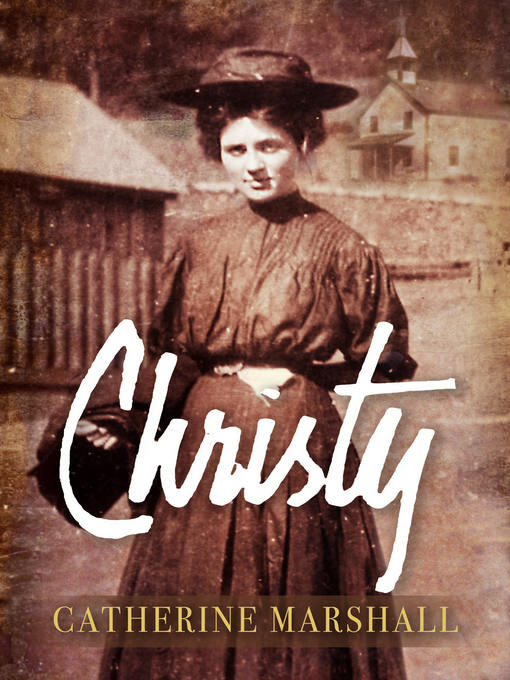
Christy by Catherine Marshall is a very dense book. It is full of life lessons weaved between poetic prose and hard realities of life in the Smoky Mountains in the late 19th and early 20th centuries. Following the story of fictional 19-year-old Christy Huddleston, the book is fiction but based, very loosely, on the real-life experience of Marshall’s mother, Leonora Whitaker Wood.
The CBS series, Christy, starring Kellie Martin, and a couple of made-for-TV movies were based on the book. I watched the show in the 1990s but had never read the book. I didn’t even know the TV-movies existed until I was doing research for this post.
In both the show and the book, Christy travels to a small mission in the mountains of Tennessee from her home in Ashville, North Carolina to teach in a school full of mountain children who have very little material items but a lot of heart and heartache.
The small area where these children and their families are from is called Cutter Gap. The fictional area isn’t really a town since it is only a collection of cabins scattered across the mountains and through the woods, but there is a fiction town called El Pano, located near it. The families in Cutter Gap are poor, uneducated, and fighting for their lives against disease and judgment.
Christy arrives at the mission after listening to the mission founder speak about it and begins her work with Miss Alice Henderson, a Quaker woman, and Pastor David Grantland, a minister who has been assigned to the school.
Once she arrives she meets other colorful members of the community — Dr. Neil McNeil, resident Ruby Mae, and resident Fairlight Spencer (who becomes her best friend), as well as other colorful (shall we say) characters. She also begins to learn more about the history of the area, the hardships they have faced since the 1700s, and the way some of the men feel they have to take a criminal route in life to scrape out a living.
There is a lot of beauty mixed in with some very ugly tales within the 500 pages of Christy. I marked up a lot of the book to remember parts of it later. Even though I found parts of the faith message of the book contradictory and a little confusing at times, there were many parts that were extremely thought-provoking and moving to me.
Most of what I underlined in the book were quotes by Miss Alice, who was my favorite character in the book besides Fairlight Spencer. In the beginning of the book, I found it hard to connect Christy who was very hard-headed and brash at times. She came to the mission with head knowledge of God but not heart knowledge of him.
I couldn’t stand David Grantland through most of the book and wasn’t sure what to make of Neil McNeil.
I wanted to shake Christy a couple of times throughout the book and tell her not to rush into dangerous situations. Toward the end of the book, though, when she truly struggled with the faith that she had only really found since working at the mission, I related to her immensely. So much of what happened to the people she’d come to love in Cutter Gap seemed so cruel to me. Even though the book was fiction, I found myself questioning the goodness of God, thinking about some similar cruel situations of those I’ve known over the years. It’s something I had to sit and wrestle with mental and spiritually in the moments, hours, and days after finishing the book. In many ways I am still struggling with these questions about God and the goodness I sometimes don’t see.
Some of the sections I underlined in the book included:
“Evil is real – and powerful. It has to be fought, not explained away, not fled. And God is against evil all the way. So each of us has to decide where WE stand, how we’re going to live OUR lives. We can try to persuade ourselves that evil doesn’t exist; live for ourselves and wink at evil. We can say that it isn’t so bad after all, maybe even try to call it fun by clothing it in silks and velvets. We can compromise with it, keep quiet about it and say it’s none of our business. Or we can work on God’s side, listen for His orders on strategy against the evil, no matter how horrible it is, and know that He can transform it.”
“What do you do when strength is called for and you have no strength? You evoke a power beyond your own and use stamina you did not know you had. You open your eyes in the morning grateful that you can see the sunlight of yet another day. You draw yourself to the edge of the bed and then put one foot in front of the other and keep going. You weep with those who gently close the eyes of the dead, and somehow, from the salt of your tears, comes endurance for them and for you. You pour out that resurgence to minister to the living.”
“I’d long since learned that no difference in viewpoint should ever be allowed to cause the least break in love. Indeed, it cannot, if it’s real love. …But relationships can be kept intact without compromising one’s own beliefs. And if we do not keep them intact, but give up and allow the chasm, we’re breaking the second greatest commandment.”
“The secret of her calm seemed to be that she was not trying to prove anything. She was—that was all. And her stance toward life seemed to say: God is—and that is enough.”
This was one of the few books I’ve read that I became completely immersed in when I read it. Everything around me disappeared – the language and descriptions were so vivid. I could see the mountains, picture the cabins and the people, and sometimes even smell, sadly, the smells.
It took me a little over a month to read through the book because it was so dense. I felt like I really got to know the characters that way and this was both a good and a bad thing.
It was a bad thing because, toward the end, some of the events hit me so hard and left me on my couch on a cold Sunday afternoon with a warm fire in our woodstove burning and me crying until my sides hurt.
I like to be immersed in books but at that moment I thought that maybe I wouldn’t like to be so immersed if it was going to be this painful to continue to read on.
I won’t give away too much but there was a death in the book that I could not make sense of in the least. Much of the book seemed to want the reader to see that there was hope still available, even in the midst of darkness, anger, and sadness, but when we had almost reached the end it was like that message was yanked out from under us with such a ferociousness that it made my head spin.
When I was reading the book, I was thinking, “Wow. There are so many deep messages about our relationship with God in this book” but then I was like, “But there were some really theological muddy waters in this book and I’m not sure how I feel about that.”
There was a lot of talk about superstitions and instead of dispelling them by saying God is in control, there were times the characters tried to explain it away by science or simply telling the mountain people that their beliefs were faulty. There is little to no mention of Jesus in this book. Yet this book is marketed as a great Christian book. That confuses me a little. Still, the story, overall, was very compelling, interesting, and realistic (maybe a bit too realistic).
I saw a review of this after I read it that tagged the book as being “heartfelt” and “family-friendly.”
The book was NOT family-friendly. There are discussions of rape, abuse, murder, molestation, and many other disturbing and triggering topics. There are not, however, extremely graphic descriptions of these subjects.
There are times this book seems to push that there is truth in superstition, even though, I’m sure that’s not what the author, a well-known Christian author, meant to do.
In the end, Christy was a painfully beautiful book that wrung me out emotionally. It challenged my thinking, built me up, tore me down again, and left me with a glimmer of hope that Christy and the people of Cutter Gap found some joy and happiness beyond the time frame addressed within the book’s pages.
I would be remiss if I did not mention that the ending of this book is very open-ended and, to me, somewhat abrupt. It does not answer all of the reader’s questions. Or it didn’t answer some of my questions at least. It left me with a bit of mystery and with a strong desire for a sequel.
According to more than one article online, notes for a sequel to the book were discovered in Catherine Marshall’s things after her death by her family. Those notes have never been revealed, however. Part of me would love to know what happened to Christy after the events at the end of the book (which were wrapped up a bit too quickly for me), but part of me agrees with the blogger of Taking Up Room who wrote, “Christy ending on a question mark has never failed to get my brain thinking, even after dozens of times of reading the book. In a way, it means the story never really ends. Adding more might just spoil whatever ending fans have come to in their own minds, and that’s no fun. I say keep the mystery.”
Many commenters have been telling me there are issues with commenting on WordPress. If you can’t comment, but want to, please feel free to hit the contact link at the top of the page.
If you like my content you can subscribe to my posts for free or support my writing right here on WordPress for $3 a month. Later in 2025 I will be offering exclusive posts for paid subscribers.
I haven’t had much time to sit and write up full book reviews lately so I thought I’d share five mini-book reviews today.
Death Comes to Marlow by Robert Thorogood
Description:
Judith (our favorite skinny-dipping, whiskey-sipping, crossword puzzle author), along with Becks the vicar’s wife, and Susie the dogwalker find themselves in a head-scratching, utterly clever country house, locked-room murder mystery.
Holiday festivities are now January doldrums when Judith gets a call―Sir Peter Bailey, a prominent Marlovian is inviting notable citizens to his house the day before his wedding to celebrate.
Judith decides to go―after all, it’s a few houses up the Thames and free champagne, for sure. During the party, a loud crash inside stops the festivities. The groom-to-be has been crushed to death in his study. The door was locked from the inside so the police say suicide, obviously.
My Review:
This was the second book in the Marlow Murder Club series. I did not enjoy it as much as the first book. This one was all over the place and very repetitive. I rolled my eyes way too often. I still love the characters but why the suspects were suspects was repeated and twisted around so many times it simply became obnoxious. We really needed another story to sort of break up the monotony of them running around in circles in this one. There was one side story related to the vicar’s wife Becks, but it came in way too late in the book and didn’t break up the way he kept saying, “We don’t know who killed him! Here is all our evidence….again.”
The Hound of the Baskervilles by Sir Arthur Conan Doyle
Description:
The Hound of the Baskervilles is the third of the four crime novels by British writer Arthur Conan Doyle featuring the detective Sherlock Holmes. Originally serialised in The Strand Magazine from August 1901 to April 1902, it is set in 1889 largely on Dartmoor in Devon in England’s West Country and tells the story of an attempted murder inspired by the legend of a fearsome, diabolical hound of supernatural origin. Holmes and Watson investigate the case. This was the first appearance of Holmes since his apparent death in “The Final Problem”, and the success of The Hound of the Baskervilles led to the character’s eventual revival.
One of the most famous stories ever written, in 2003, the book was listed as number 128 of 200 on the BBC’s The Big Read poll of the UK’s “best-loved novel”. In 1999, a poll of “Sherlockians” ranked it as the best of the four Holmes novels.
My review:
I really expected to like this a lot more than I did. Conan Doyle is a classic crime writer – the father of the detective/crime novel so it has to be great, right?
Sadly, this book really dragged for me and my son who read it with me for his British Literature class. Maybe it was because Sherlock wasn’t even in half of it. During that half it was Watson writing letters to Sherlock to tell him what had happened. There were way too many conversations about what might have happened and very little action for me. I also couldn’t stand the “lord of the manor”, Henry Baskerville. I would guess Conan Doyle was making him obnoxious because he was an American and the British like to make sure Americans know what they think about us. So maybe I wasn’t supposed to like him, which worked well because I didn’t.
I didn’t hate the book, but it was not one I would necessarily rush to read again anytime soon. I’d really like to read the short stories and the other three novels instead and then go back to this one later on to see if I like it any better.
Johnny Tremain by Esther Forbes
Description:
Fourteen-year-old Johnny Tremain, an apprentice silversmith with a bright future ahead of him, injures his hand in a tragic accident, forcing him to look for other work. In his new job as a horse-boy, riding for the patriotic newspaper, the Boston Observer, and as a messenger for the Sons of Liberty, he encounters John Hancock, Samuel Adams, and Dr. Joseph Warren. Soon Johnny is involved in the pivotal events shaping the American Revolution from the Boston Tea Party to the first shots fired at Lexington. Powerful illustrations by American artist Michael McCurdy, bring to life Esther Forbes’ quintessential novel of the American Revolution.
My review:
I read this one with Little Miss for English/History. The book is broken into sections with six chapters in each section, so we read a couple of the chapters each day for a few months.
I ended up really like this one even though the older writing style and the subject was a little difficult at times. There were some chapters where I skipped some of the more descriptive paragraphs to get to the point and move forward, but overall, this book was very well done, very educational, and had me crying more than once with the real life lessons within its pages.
Tooth and Claw by Craig Johnson
Description:
Tooth and Claw follows Walt and Henry up to Alaska as they look for work after they both returned from serving in Vietnam. While working for an oil company in the bitter cold of winter, they soon encounter a ferocious polar bear who seems hell-bent on their destruction. But it’s not too long until they realize the danger does not lurk outside in the frozen Alaskan tundra, but with their co-workers who are after priceless treasure and will stop at nothing to get it.
Fans of Longmire will thrill to this pulse-pounding and bone-chilling novel of extreme adventure that adds another indelible chapter to the great story of Walt Longmire.
My review:
I really enjoyed this novella. I’m a fan of the Walt Longmire Mystery books, with the exception of Hell is Empty, which I hated. I haven’t read one of the books since that one, which was early in 2024. I love Johnson’s writing, though, so I knew I couldn’t stay away for long. When I needed a short book to finish out the year, I remembered my husband had just won this one in a Goodreads giveaway. It is a story separate from the other books so I knew there wouldn’t be any spoilers.
I read it around Christmas, which is usually reserved for cozy books, not books where a man-eating, monster Polar Bear is terrorizing scientists in the arctic, but I could not put this book down. It was constant action, and I enjoyed it. I might even read another one of the full-length novels soon.
The Christmas Swap by Melody Carlson
Description:
All Emma Daley wants this holiday season is a white Christmas. But the young teacher and struggling musician sure can’t find that in sunny Arizona. Luckily, there’s someone living in a perfect mountain home in the Colorado Rockies looking to make a vacation trade this year.
West Prescott is an in-demand songwriter and talented musician who put his own singing career on hold to write songs for celebrity acts to perform. When his mother convinces him to do a vacation trade for Christmas, he never imagined one of the houseguests would be so sweet–or so strikingly pretty. Naturally, he decides to stick around, and, to get better acquainted, he poses as the house’s caretaker. But when Emma’s friend Gillian discovers his true identity and sets her sights on him, things get . . . messy.
My review:
I really liked Carlson’s book, A Quilt for Christmas, and thought this would be similarly heartwarming and well-written. It was not. This book was a very cheesy romance that would not end. I feel so bad saying this but it was such a short book I had no time to connect to the characters and in the end I really didn’t care if I did or didn’t. These ridiculous romances where people meet and three days later are in love and changing their lives around for each other drive me nuts. I had no idea that was what was going to happen in this book. It’s like the two books were written by two different people. Every author has hit or miss books, though, and every reader is different in their likes and dislikes so while this book was not for me it might be the perfect light read for someone else. I won’t give up on trying Carlson’s books, but I will be a bit more careful and read the descriptions better from now on.
Have you read any of these books? What did you think of them if you did?
(*note: I honestly thought I had already posted this review on my blog months ago, but I couldn’t find it so I am posting it for the first or second time. One or the other.)
The Mystery at Lilac Inn by Carolyn Keene is the fourth book in the Nancy Drew series, which debuted in the 1930s.
For this book, Nancy becomes wrapped up at a mystery at an inn recently purchased by a friend, but she is also caught off guard when her own house is ransacked and her credit plate stolen. She later learns someone is impersonating her and running up her credit or stealing from people.
When diamonds disappear from her friend’s inn she decides she needs to find out who stole the diamonds as well as who is impersonating her. Are the two cases connected? She hopes to find out.
As usual, there is some ridiculous developments and tactics used to solve the mystery (such as her being sent off with her father’s blessing to explore a lake with a man they barely know and then go after known criminals on her own without any back up), but it wouldn’t be a Nancy Drew book if there wasn’t. These books were written in a different time and for young kids so they were full of non-stop action, no matter how giggle inducing that non-stop action was.
This book was later rewritten to remove some of the more derogatory connotations toward certain races. It was released again in 1961 after those changes were made under Keene’s name, which is, of course, a pseudonym. The Nancy Drew books, like The Hardy Boys books were written by several different authors over the years.
Normally I don’t like the idea of old books being changed because someone is offended but in this case it was needed, even if the stereotypes weren’t as bad as some classic books.
I did not like this book as much as the first book in the series, The Secret of the Old Clock. The plot was okay but does not hold us as well as others in the series, in my opinion.
The Secret of the Wooden Lady is the 27th book in the original Nancy Drew series written by – uh, “Carolyn Keene.” Of course, most readers of Nancy Drew know there were a number of people who wrote Nancy Drew, including Mildred Benson and about 27 other authors.
This is the eighth book of the original series I have read and at first, I wasn’t sure I liked it as much as a couple others.
It seemed a little discombobulated and was a little slow in the middle of the book after starting off with a bang (not a literal bang this time).
Most of the book took place on an old clipper that an elderly sea captain wants to buy, but can’t because the original title can’t be found. In addition to the deed being lost, the captain has been experiencing some weird events involving thefts on the ship as well as seeing what he fears might be ghostly figures.
Nancy knows about what Captain Easterly is dealing with because he knows her father, Attorney Carson Drew, — described in the book as tall and handsome — and Captain Easterly has written him a letter.
Carson wants to help the old man find out what is going on and invites Nancy to go with him to Boston and look for the title and find out if someone is prowling around on the clipper at night.
Nancy is excited about having another mystery to solve and while she waits for the next day when she and her dad will leave, she gets a call from her friend Bess. While she and Bess are on the phone, Bess says she hears someone in the house. Her parents aren’t home and she’s nervous. Suddenly the line goes dead and Nancy, appropriately, freaks out and runs to her car to go see what’s happened to Bess.
She tried to call the police before she left, but the lines were busy. This was the 1930s so I suppose that is a plausible situation.
I was freaking out for Bess when I read this part. It was late at night and I was brushing my teeth and getting ready for bed and when I read the part about the phone going dead I was like, “Oh my gosh! What happened to Bess!”
My daughter was very confused until I explained to her it was a character in the book I was reading.
You will have to read the book to find out what happened to Bess, but it is a bit of a spoiler to say that Bess and her cousin, and Nancy’s other friend, George, are invited up to Boston by Carson Drew when he has to leave the city to find out more information about the title and doesn’t want to leave Nancy alone. That’s pretty nice of him since he usually he doesn’t seem too worried about his daughter investigating things alone.
It doesn’t take too long for the girls to learn that what happened to Bess and her family might be related to what is happening aboard the clipper – The Bonny Scot.
Before Nancy had left for Boston she went to a dance with Ned Nickerson, by the way. Ned is her “boyfriend” but he’s not necessarily called that. He is the young man who clearly cares for her but she’s always too busy solving crimes. Ned is sad she’s running off to Boston because he was hoping to take her out again before he has to go off to his summer camp job.
Luckily, it turns out that Ned’s camp isn’t too far from Boston, so we end up with Ned and two of his friends – apparent love interests of Bess and George that might have been mentioned in previous books I haven’t read yet – arriving to help out with the mystery as well.
Like I said above, the middle of this book was a little slow but then things picked back up again and the girls were thrown into more dangerous situations than the characters on a CW show, which is saying a lot.
As always, the book is simply written with more “telling” paragraphs that move the reader along at a fairly fast and furious pace, but these books were originally written for younger readers so that is understandable.
While I liked this one, The Case of the Whistling Bagpipes remains my favorite of the ones I’ve read so far.
You can read reviews of three of the other books I’ve read here:
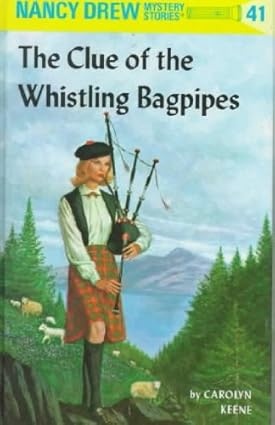
The Clue of the Whistling Bagpipes turned out to be one of my favorite Nancy Drew books that I have read so far. I really enjoyed the Scottish history woven into the story.
Description:
Warnings not to go to Scotland can’t stop Nancy Drew from setting out on a thrill-packed mystery adventure. Undaunted by the vicious threats, the young detective – with her father and her two close friends – goes to visit her great-grandmother at an imposing estate in the Scottish Highlands, and to solve the mystery of a missing family heirloom.
And there is another mystery to be solved: the fate of flocks of stolen sheep. Baffling clues challenge Nancy’s powers of deduction: a note written in the ancient Gaelic language, a deserted houseboat on Loch Lomond, a sinister red-bearded stranger in Edinburgh, eerie whistling noises in the Highlands. Startling discoveries in an old castle and in the ruins of a prehistoric fortress, lead Nancy closer to finding the solution to both mysteries.
My thoughts:
When Nancy travels to Scotland with her father, Drew, and her friends George and Bess, she’s already being pursued by someone who knows she is coming. Someone has already tried to run her off the road and she already knows someone has stolen an heirloom from her great-grandmother, Lady Douglas, that was meant to be given as a gift to her.
Once in Scotland, the attacks against her continue and it doesn’t help that Bess has sent her name into an international magazine, which announces that she is a famous detective. Now everyone in the small Scottish town they are going to visit knows who she is.
This news has someone on the edge because they are attempting to run her off roads like they did in River Heights, following her, and then pushing George down a hill to throw Nancy off their scent.
As usual, Carson Drew is off on other business and barely has a clue that Nancy is traveling the Scottish countryside alone with her friends while trying to track down sheep thieves and whomever has stolen her great-grandmother’s heirloom and her inheritance – a diamond encrusted brooch.
The diamond encrusted brooch was worn by Lady Douglas one night when she walked around the lake on her property and then disappeared when she went back the next day to take it off her shawl. Now she is worried about who could have stolen it and Nancy only makes her feel worse by suggesting it could be someone who works for her.
What was fun about this book was all the interesting, down-to-earth characters that Nancy and her friends meet during their journey. They aren’t only on a sleuthing mission, but are taken on a series of excursions to local landmarks where they learn about local and Scottish history. While they learn we, the readers, learn too.
I don’t know if it is because this is one of the later books or simply because of the subject matter but this book seemed more intricate, complex, and well-written than other installments of the series that I have read so far.
Have you read this one? What did you think about it?
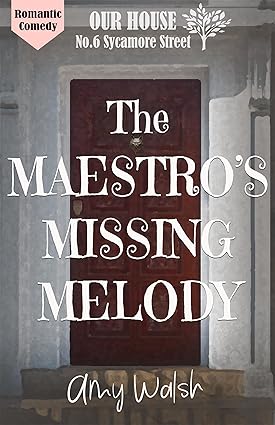
The first thing to note about The Maestro’s Missing Melody by Amy Walsh is that it can be read alone, even though it is part of a series.
The second thing to note is that this is a very well-written sweet romance that had me captivated from the beginning to the end. Also, I think I might be in love with The Maestro. Not really, of course, but I mean bookishly in love. The way The Maestro attempts to fight love when it is calling to him is very enthralling, even for readers, like me, who don’t always read romances.
The Maestro’s Missing Melody isn’t a over dramatic romance, but is instead a series of gentle steps toward healing for both main characters. The use of musical terms and musical metaphors are two of many aspects that make this book so rich and authentic.
McKay Moonlight has had her share of heartaches – the main one being abandoned by drug-addicted parents. Now she is in Scotland after being given a chance to study under the famous Scottish fiddler Huntley Milne, who she refers to as The Maestro because – to her – he is the fiddling maestro. She’s been listening to his fiddle music for years with her grandparents, who raised her.
Huntley isn’t sure what to make of McKay when she arrives, especially since during their first meeting she ruins a beautiful classical musical performance when the ringtone on her phone blares out a Willie Nelson song. Huntley has some heartache of his own to get over. First there is the loss of his wife many years before and the fact his Aunt BeeBee has suddenly been placed in a home, which means he is left to care for his tween niece and nephew that his aunt adopted years before.
This is an easy going book in some ways, yet there always seem to be something happening. There is a mystery that Huntley must solve when his aunt makes it clear that she wants Huntley to find a family book for her back at her mansion. The students that Huntley is mentoring are staying at the mansion as well and after the niece (Dory) attaches herself to McKay and asks her to come with them to visit Aunt BeeBee, McKay also becomes involved in helping to look for the book.
The mystery and the possibility of an “age-gap” romance (this means Huntley is a bit older than McKay) kept me turning the pages. Walsh’s writing did as well. She turns a simple meeting or interaction between characters into a delightful word treat.
For example:
“The Maestro bent toward me again and surrounded me with those huge arms. I savored the warmth of his chest, the smoothness of his newly shaved cheek sliding across mine, and a scent I’d never smelled on him before––possibly spiced citrus with a hint of pine. If the night had ended right then with my first-ever hug from Huntley Milne, it would have been the best birthday ever.”
Faith is a big part of this book, with both McKay and Huntley asking God to heal Aunt BeeBee, to guide them in their steps, to be a comfort to the children as they fear for their guardian while she is in the nursing home. Bible verses are also shared throughout or intertwined with aspects of the plot throughout.
The Maestro’s Missing Melody is a heartwarming, cozy read that I enjoyed each night before bed to help me decompress from long and stressful days. It’s a story that left me hoping the best for each character, praying (yes, for fictional characters) for them to have a happily ever after.